
If your cordless mouse stutters, your smart lock clicks half-heartedly, or your kids’ RC car crawls to a stop before the battery meter says “empty,” the culprit isn’t the device—it’s the voltage sag. Standard NiMH rechargeables top out at 1.2V, but your gadgets were designed to run on 1.5V alkaline cells. The result is a performance ceiling you never asked for, draining the fun and function out of your everyday electronics.
I’m Min — the co-founder and writer behind Gadgets Feed. My analysis for this buying guide comes from methodically comparing the energy density curves, discharge plateaus, and cycle-life ratings of over a dozen AA rechargeable chemistries to answer one question: which 1.5V cells actually deliver stable power until the very last drop?
Whether you are powering VR controllers, wireless microphones, or emergency kits, choosing the right chemistry and capacity matters more than you think. This guide evaluates the top contenders to help you find the best battery rechargeable aa 1.5 v for your specific use case and budget.
How To Choose The Best Battery Rechargeable AA 1.5 V
The landscape of AA rechargeables has split into two distinct camps: traditional 1.2V NiMH cells and the newer 1.5V lithium-ion cells with built-in voltage regulation. Your choice depends entirely on what you’re powering and how you prefer to charge.
Chemistry: Lithium-Ion vs. NiMH
Lithium-ion 1.5V cells maintain a flat discharge curve—they deliver a steady 1.5V until they are completely depleted. This makes them ideal for devices like VR controllers, smart door locks, and camera flashes that demand consistent voltage. The trade-off is a lower cycle life (typically 500–1500 cycles) and an internal charging circuit that requires a USB port. NiMH cells, like the legendary Eneloop, top out at 1.2V, which means some gadgets may report low battery early. However, they offer far higher cycle counts (up to 2100 cycles), negligible self-discharge over years, and can be charged with a dedicated multi-bay charger.
Capacity: mWh vs. mAh
Lithium 1.5V cells are usually rated in milliwatt-hours (mWh), while NiMH cells are rated in milliamp-hours (mAh). A 3600mWh lithium AA is roughly equivalent to a 2400mAh cell at 1.5V. Because NiMH operates at a lower voltage, a 2800mAh NiMH battery stores about 3360mWh of energy. Always check the watt-hour rating for an apples-to-apples comparison when choosing between chemistries.
Charging Convenience
If you travel often, lithium-ion AA batteries with built-in USB-C ports are a game-changer—you can charge them from a laptop, power bank, or wall adapter without a dedicated charger. NiMH cells require a specific NiMH-compatible charger, but they allow you to charge an entire 8- or 12-pack simultaneously in one hub. Think about your daily routine: do you prefer plugging in individual batteries, or dumping a whole batch into a charger overnight?
Quick Comparison
On smaller screens, swipe sideways to see the full table.
| Model | Category | Best For | Key Spec | Amazon |
|---|---|---|---|---|
| remGretivon 4100mWh | Lithium-ion | Highest capacity per cell | 4100mWh / 1.5V constant | Amazon |
| HW 3600mWh USB-C | Lithium-ion | Fast USB-C charging bundle | 3600mWh / 2-hr charge | Amazon |
| Panasonic Eneloop 2100 | NiMH | Ultimate cycle life & shelf life | 2100 cycles / 10yr retention | Amazon |
| Panasonic Eneloop Pro | NiMH | High-drain NiMH performance | 2600mAh / 500 cycles | Amazon |
| Tanatare 3000mWh Kit | Lithium-ion | Full bundle with smart charger | 3000mWh / IPX67 sealed | Amazon |
| EBL 2800mAh Combo | NiMH | AA + AAA value pack | 2800mAh AA / 1200 cycles | Amazon |
| WENJOOP 2800mAh 12-Pack | NiMH | Budget-friendly bulk pack | 2800mAh / 1200 cycles | Amazon |
In‑Depth Reviews
1. remGretivon 4100mWh 1.5V USB-C AA (4-Pack)
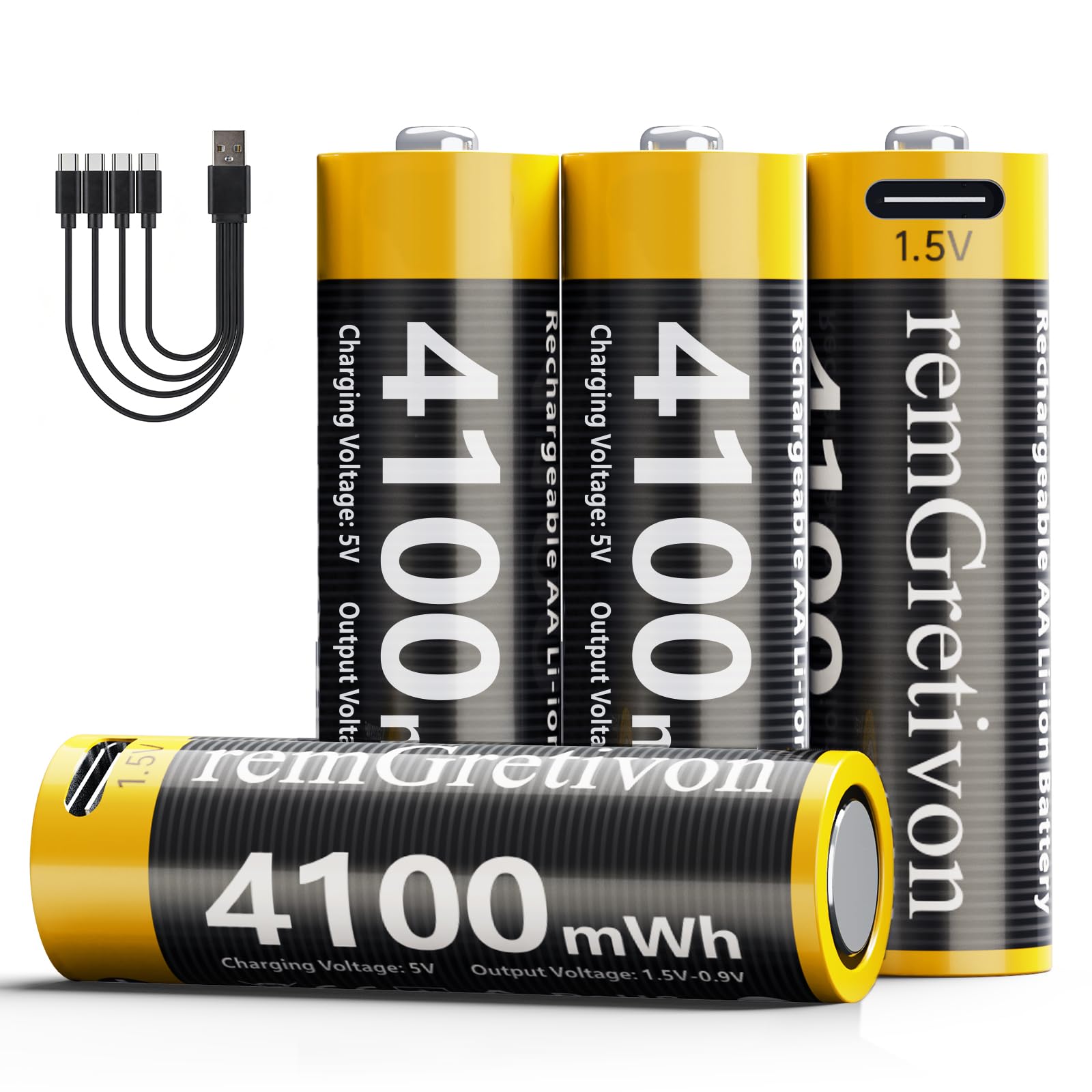
At 4100mWh, these lithium-ion cells hold the highest per-battery energy density in this roundup. That translates to noticeably longer runtime in high-drain gadgets like Xbox controllers and video doorbells compared to standard 3600mWh lithium offerings. The internal voltage regulator locks the output at a steady 1.5V from full charge to depletion, eliminating the gradual power fade that makes NiMH-powered devices feel sluggish midway through use.
The built-in USB-C port and included 4-in-1 cable make charging dead simple—no clunky external charger required. Each battery shows a blinking green LED while charging and a solid green light when full, taking about 2.5 hours for a complete top-up. With a rating of 1500 recharge cycles, these cells bridge the gap between lithium convenience and NiMH longevity better than most competitors at this price point.
Users consistently report these batteries outlast their previous rechargeables in both runtime and charge retention. The advanced IC chip inside handles overcharge, overcurrent, and short-circuit protection automatically, so you can safely leave them plugged in overnight without worry—though topping them off before they fully drain is the best habit for maximizing cycle life.
Why it’s great
- Highest capacity (4100mWh) in the group delivers longest runtime per charge
- USB-C charging with LED indicator eliminates the need for a dedicated charger
- Steady 1.5V output prevents device stuttering and low-battery warnings
Good to know
- 4-pack only; larger households may need multiple sets
- Lithium-ion cells average 1500 cycles vs. 2100 for premium NiMH
2. HW Rechargeable AA Lithium 3600mWh (4-Pack)
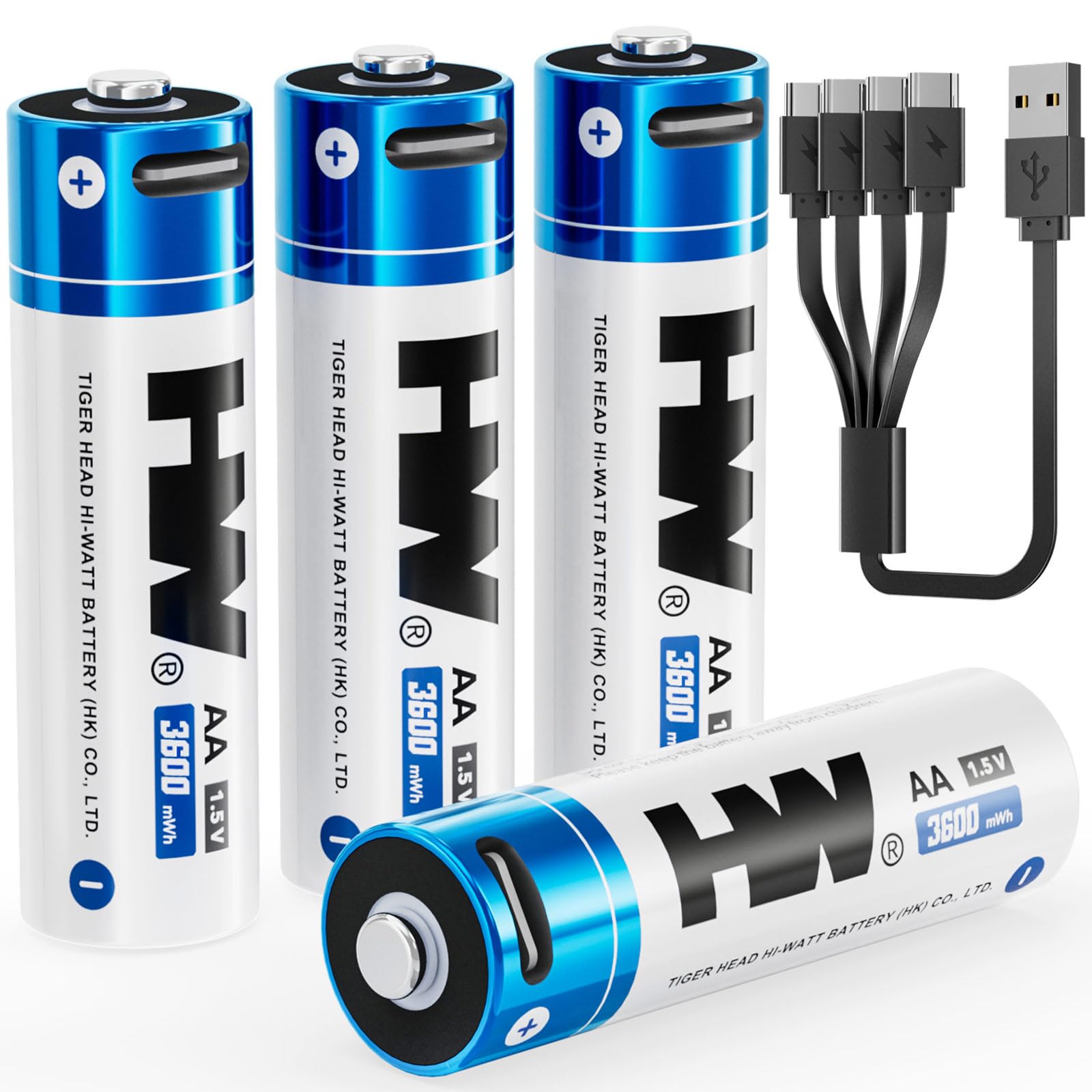
The HW lithium cells strike an impressive balance between cost and performance. With 3600mWh of energy storage, they provide 33% more runtime than typical 2700mWh NiMH cells while maintaining that crucial 1.5V plateau. The 4-in-1 USB-C cable enables simultaneous charging of all four batteries, and a full charge completes in just two hours—one of the fastest top-up speeds available at this tier.
Engineered with a gradual voltage decline rather than a sharp drop-off, these batteries deliver stable power to VR headsets, gaming controllers, and wireless microphones without sudden shutdowns. The built-in safety suite covers overcharge, over-discharge, over-voltage, over-current, short circuit, and overheating—six layers of protection that make them a safe choice for long-term installation in smoke alarms or smart door locks.
Customer feedback highlights the convenience factor heavily: users swapping from NiMH report immediate improvements in device performance, particularly in foil razors and gaming controllers that previously stuttered. The 1000-cycle rating means you’ll recoup your investment within the first few dozen recharges when compared to disposable alkaline cells. Just remember to charge these before first use, as they arrive with a partial charge.
Why it’s great
- Exceptional fast-charge speed: full 4-pack in 2 hours
- Gradual voltage decline prevents sudden device shutdown
- Six-layer safety protection suitable for unattended devices
Good to know
- Only 1000 cycles vs. 1500+ cycle competitors
- Requires USB-C source; no dedicated charger included
3. Panasonic Eneloop BK-3MCCA8BA 2100 Cycle AA (8-Pack)

The standard Eneloop AA is the gold standard for longevity, rated at 2100 recharge cycles and retaining 70% of its charge after an astonishing 10 years in storage. This NiMH cell delivers 2000mAh typical capacity at 1.2V—lower voltage than lithium competitors, but with a discharge curve so flat and predictable that it outperforms many 1.5V cells in low-drain scenarios like TV remotes, wall clocks, and wireless keyboards.
These batteries arrive pre-charged from the factory using solar power, so they work straight out of the box. The 8-pack format gives you enough cells to cover a household’s worth of devices immediately, and the consistency between cells is exceptional—reviewers testing internal resistance found all eight units within a tight 170 milliohm range, with actual capacity often exceeding the 2000mAh rating by 10–15%.
The trade-off for that incredible cycle life is lower peak power. In high-drain devices like photo flashes or RC cars, the 1.2V Eneloop may trigger low-battery warnings earlier than a 1.5V lithium cell. For general household use, however, these are the most economical cells you can buy over a decade. They work in extreme temperatures down to -4°F and have zero memory effect, so you can top them off at any time without degradation.
Why it’s great
- Unmatched 2100-cycle lifespan for decades of use
- Holds 70% charge for 10 years—perfect for emergency kits
- Japanese manufacturing with extremely consistent cell performance
Good to know
- 1.2V output may cause early low-battery alerts in some devices
- Requires a separate NiMH charger; no USB-C option
4. Panasonic Eneloop Pro BK-3HCCA4BA (4-Pack)

Eneloop Pro is the high-capacity sibling of the standard Eneloop, packing 2600mAh of NiMH power into the same AA form factor. That extra 600mAh over the standard model translates to roughly 20–30% longer runtime in demanding devices. In a controlled test against the standard Eneloop (2000mAh) and alkaline cells, the Pro ran a 4x AA flashlight for 3 hours 24 minutes—40% longer than alkaline and 25% longer than the standard Eneloop.
The trade-off is a reduced cycle count of 500 recharges (versus 2100 for standard Eneloop) and 85% charge retention after one year instead of 70% after ten. Think of the Pro as a specialty battery for semi-regular high-drain use—milk foamers, digital camera flashes, gaming mice, and high-output flashlights are its natural habitat. For those applications, the extra capacity per charge makes it well worth the upsell.
Made in Japan and pre-charged via solar power, these cells arrive ready to deploy. The robust 1.2V NiMH chemistry handles extreme temperatures down to -4°F without issue, and the DBCK steel shell resists pressure-related damage. Users who rotate through two sets of Eneloop Pros for daily-driver devices report they last years without noticeable capacity fade, easily paying for themselves within the first few dozen recharge cycles.
Why it’s great
- Highest NiMH capacity (2600mAh) for demanding devices
- Pre-charged and ready to use out of the box
- Robust construction with steel shell and extreme-temperature tolerance
Good to know
- Only 500 recharge cycles; not ideal for low-drain weekly devices
- 1.2V output may not satisfy voltage-sensitive gadgets
5. Tanatare 3000mWh Lithium-Ion AA (8-Pack with Charger)
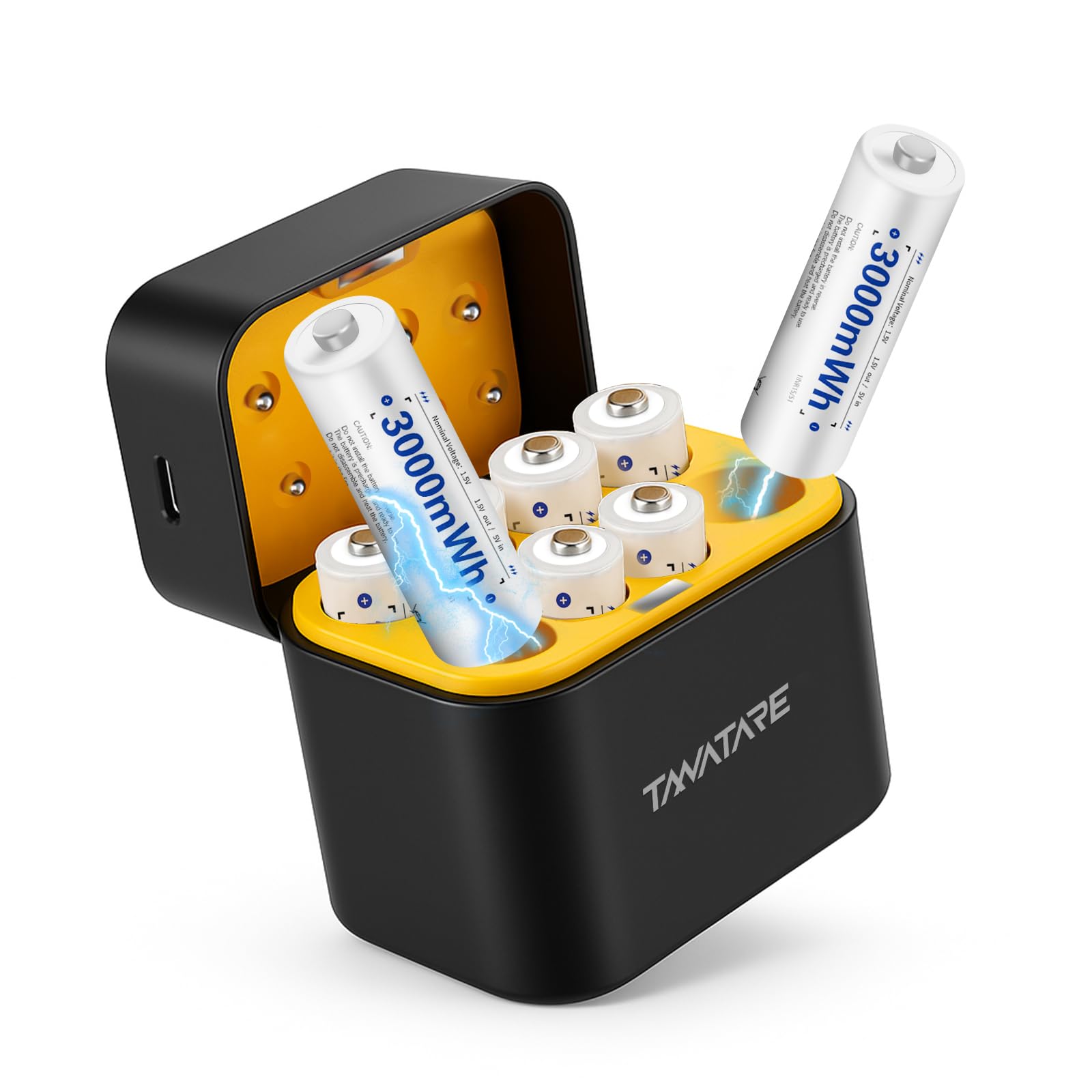
The Tanatare system is the rare lithium-ion kit that comes complete with a smart charger, making it the easiest entry point for anyone new to 1.5V rechargeables. The 8-cell charger features independent slots—charge 1, 4, or all 8 batteries simultaneously without pairing requirements. Each slot delivers 375mAh of charging current, refilling a depleted cell in about 2.5 hours.
The batteries themselves deliver 3000mWh of energy per cell with a steady 1.5V output. An IPX67 waterproof rating on the cells means they resist leaks and water ingress far better than standard lithium or NiMH batteries, making them suitable for outdoor gear, solar lights, and surveillance cameras exposed to the elements. The charger’s magnetic storage design also keeps the kit tidy during travel.
With a claimed 2000-cycle lifespan, these lithium cells rival premium NiMH in longevity while maintaining the voltage advantages of lithium chemistry. The low self-discharge rate means they’ll hold their charge for months in storage, and the smart IC chip prevents overcharging automatically. For households that want to go all-in on 1.5V rechargeables without buying a separate charger, this kit removes the friction entirely.
Why it’s great
- Complete kit with 8 batteries and smart independent-slot charger
- IPX67 waterproof rating for outdoor and security device use
- 2000-cycle rating rivals premium NiMH in longevity
Good to know
- Charger is designed specifically for Tanatare cells; not a universal NiMH charger
- Lower per-cell capacity (3000mWh) than top lithium competitors
6. EBL 2800mAh AA + 1100mAh AAA (20-Pack Combo)

EBL’s combo pack solves two problems at once: you get 10 AA cells at 2800mAh capacity and 10 AAA cells at 1100mAh, all stored in a wall-mountable organizer box. The NiMH chemistry delivers 1.2V nominal output with enhanced low self-discharge technology that retains 80% of capacity after three years of storage. For households drowning in mixed-size disposables, this is the cleanest transition to rechargeables.
These cells utilize EBL’s ProCyco recycling technology, which improves power delivery during the charge cycle and maximizes the usable capacity over the battery’s lifespan. The DBCK steel shell adds a layer of explosion protection in case of overpressure, and the NiMH eco-friendly cells are free from mercury, cadmium, and lead. With a 1200-cycle rating, they slot between budget NiMH and premium Eneloop in terms of longevity.
Some users note the AA cells have a slightly wider diameter than standard alkalines, which can make them a tight fit in certain battery compartments. Additionally, the 1.2V output means some voltage-sensitive devices may display low-battery warnings earlier than expected. For remotes, clock radios, calculators, and children’s toys, however, these consistently outperform disposable alkalines in both runtime and total cost of ownership.
Why it’s great
- Bulk 20-pack covers AA and AAA devices in one purchase
- Low self-discharge retains 80% capacity after 3 years
- Wall-mountable storage organizer keeps batteries tidy
Good to know
- Slightly wider diameter may cause tight fit in some devices
- 1.2V output can trigger premature low-battery warnings
7. WENJOOP 2800mAh NiMH AA (12-Pack)
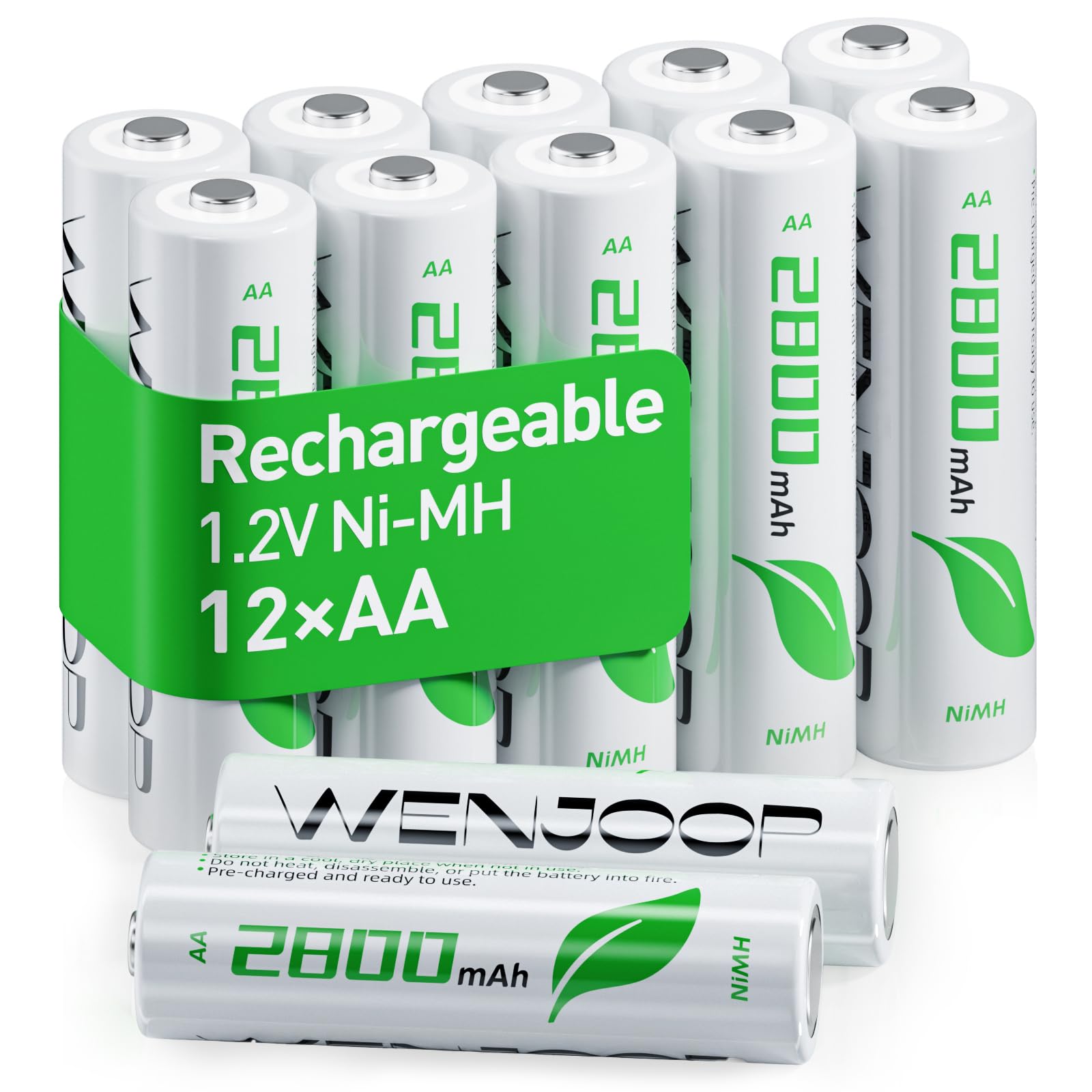
The WENJOOP 12-pack is the volume play for households with many low-to-mid-drain devices running simultaneously. Each NiMH cell contains 2800mAh of capacity and supports up to 1200 recharge cycles, with a leakage-resistant design that prevents the corrosive damage common with disposable alkalines. The per-unit cost makes this one of the most economical routes to converting an entire home to rechargeables.
The low self-discharge characteristic means these cells hold their charge during storage, making them suitable for backup supplies, emergency kits, and seasonal devices like flameless candles and solar lights. Users report that a full 8-hour solar light cycle runs through three summers on a single set without detectable performance degradation. The leak-resistant construction adds peace of mind for devices left unattended for long periods.
As with all NiMH cells, the 1.2V output is the trade-off—voltage-sensitive equipment may report low battery prematurely. The WENJOOP cells also arrived with only a partial charge, so a full cycle is recommended before first use. For TV remotes, wall clocks, wireless mice, and portable radios, however, these deliver reliable performance at a fraction of the cost of premium brands when measured on a per-cell basis.
Why it’s great
- Bulk 12-pack at the lowest per-cell cost in this guide
- 2800mAh capacity delivers competitive runtime for NiMH
- Leak-resistant construction protects expensive devices
Good to know
- 1.2V output may trigger low-battery alerts in some gadgets
- Arrives partially charged; requires full cycle before use
FAQ
Can I use 1.5V lithium rechargeables in devices designed for 1.2V NiMH?
Why do some smart locks and video doorbells work better with 1.5V lithium than NiMH?
Final Thoughts: The Verdict
For most users, the best battery rechargeable aa 1.5 v winner is the remGretivon 4100mWh USB-C pack because it packs the highest capacity per cell with convenient USB-C charging and a steady 1.5V output perfect for high-drain devices. If you want bulletproof longevity and low self-discharge for emergency kits and remote controls, grab the Panasonic Eneloop 2100-cycle 8-pack. And for a complete all-in-one setup with a smart charger and waterproof cells, nothing beats the Tanatare 3000mWh 8-pack kit.