
Finding a capable camera under the $200 threshold often means sacrificing lens reach for pixel count, or vice versa. Many entry-level models pile on megapixels while the zoom range barely beats a smartphone — leaving photographers stuck with grainy telephoto crops and limited creative flexibility.
I’m Min — the co-founder and writer behind Gadgets Feed. I’ve spent countless hours analyzing spec sheets, studying sensor performance across different price tiers, and cross-referencing real-world user feedback for this specific price bracket to identify which compromises are worth making.
After extensive research, I have identified the models that deliver the most reliable results for the money. This guide breaks down the best options currently available so you can pick a $200 digital camera that genuinely meets your needs without wasting cash on inflated marketing claims.
How To Choose The Best $200 Digital Camera
The sub-$200 digital camera segment is crowded with rebranded sensor modules and exaggerated feature lists. To avoid buyer’s remorse, focus on three core pillars that actually dictate real-world image quality and usability at this price point.
Optical Zoom — The Non-Negotiable Differentiator
A dedicated camera’s main advantage over a phone is glass — literally. Optical zoom uses physical lens elements to magnify without losing resolution. Digital zoom, by contrast, simply crops and enlarges pixels, producing soft, unusable images beyond 2x. Look for at least 5x optical zoom; 25x or 30x opens up wildlife, sports, and concert photography that no smartphone can touch.
Sensor Resolution — More Is Not Always Better
In this price range, cramming 48 or 88 megapixels onto a tiny 1/2.3-inch sensor results in noisy, artifact-ridden images in anything other than bright sunlight. A 16- or 20-megapixel sensor with larger individual pixels will produce cleaner, more detailed shots. Prioritize pixel quality over pixel quantity.
Autofocus and Stabilization — The Usability Gatekeepers
Slow autofocus causes missed moments and blurry shots, especially in low light. Phase-detection AF is faster than contrast-detection, but many budget cameras rely on the latter. Image stabilization (either optical or digital) reduces camera shake at full zoom — crucial for handheld telephoto shots. A camera that hunts for focus or produces shaky footage will frustrate you far more than one with slightly fewer megapixels.
Quick Comparison
On smaller screens, swipe sideways to see the full table.
| Model | Category | Best For | Key Spec | Amazon |
|---|---|---|---|---|
| Kodak PIXPRO AZ255-BK | Premium | Long-range optical zoom | 25x Optical Zoom | Amazon |
| Kodak PIXPRO FZ55 Bundle | Premium | Point-and-shoot simplicity | 5x Optical Zoom | Amazon |
| Tecglem 8K Camera | Mid-Range | Vlogging & WiFi sharing | 88MP Sensor | Amazon |
| Minolta 48MP Camera | Mid-Range | Rear selfie lens | 4K Video | Amazon |
| NBDDIGITAL True 5K | Mid-Range | Ultra-portable travel | 121g Weight | Amazon |
| XNSIAKXA 8K Camera | Budget | Feature-packed starter kit | 8K Video | Amazon |
In‑Depth Reviews
1. Kodak PIXPRO AZ255-BK 16MP Digital Camera

The Kodak PIXPRO AZ255-BK sits at the very top of the budget price ceiling because it brings genuine 25x optical zoom — a 24-600mm equivalent range — that no smartphone can replicate. The 16MP CMOS sensor is wisely paired with optical image stabilization (OIS), so those 600mm shots don’t turn into motion-blurred messes. It records 1080p Full HD video at 30fps, adequate for casual vlogs and family recordings.
What separates this camera from cheaper alternatives is the combination of a 24mm wide-angle lens for landscapes and the 25x telephoto reach for wildlife or sports. The 3-inch LCD is bright enough for outdoor framing, and the menu system is straightforward for beginners. It uses AA batteries — a niche convenience if you’re traveling and don’t want to hunt for a proprietary charger.
Real-world reviews consistently praise the sharpness of the optical zoom and the camera’s lightweight build (about 12 ounces). Some users note that low-light performance is limited by the small sensor, but that’s expected at this price. For anyone who needs actual reach beyond 5x, this is the strongest contender under the $200 mark.
Why it’s great
- True 25x optical zoom with OIS for steady telephoto shots
- 24mm wide-angle lens for expansive landscapes
- Runs on convenient AA batteries
Good to know
- 1080p video only — no 4K recording
- Small 1/2.3-inch sensor struggles in low light
- Relies on contrast-detection autofocus (slower than phase-detect)
2. Kodak PIXPRO FZ55 Digital Camera Bundle
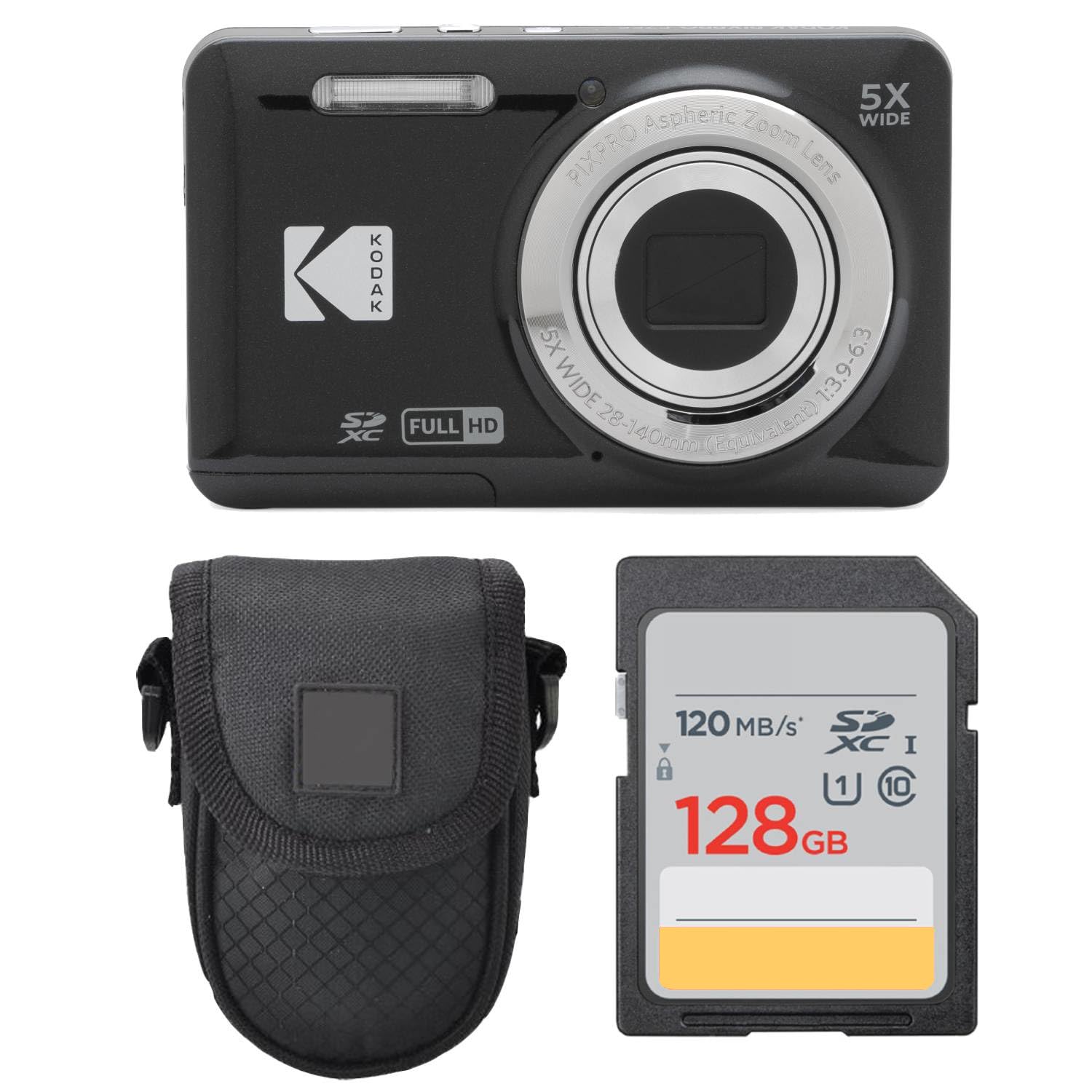
The Kodak PIXPRO FZ55 is a classic point-and-shoot with a 28mm wide-angle lens, 5x optical zoom, and a 16MP CMOS sensor. This bundle includes a protective case and a 128GB SDXC memory card, which is substantial for storing thousands of 16MP JPEGs or hours of 1080p video. The 2.7-inch LCD screen is modest but functional for composition and playback.
Digital image stabilization helps smooth out handheld shots, though it can’t match the effectiveness of optical stabilization found on the AZ255. It features built-in flash, panorama mode, and rechargeable lithium-ion battery — a more elegant solution than AA batteries for everyday carry. At 5x optical zoom, it covers the typical range for portraits, group shots, and moderate travel scenes.
User feedback highlights the camera’s compact size — easily slipping into a purse or jacket pocket — and the straightforward operation that requires zero photography knowledge. The “vintage look” some reviewers describe is due to the older sensor’s color science, which many find appealing for casual snapshots. It is not a low-light performer, but for daytime memories, it delivers consistent, shareable results.
Why it’s great
- Includes 128GB SD card and case right out of the box
- Ultra-compact and lightweight for pocketable carry
- Rechargeable battery — no AA hunting
Good to know
- Only 5x optical zoom — limited reach for distant subjects
- No image stabilization on sensor; digital-only
- 2.7-inch screen is smaller than competitors
3. Tecglem 8K Digital Camera
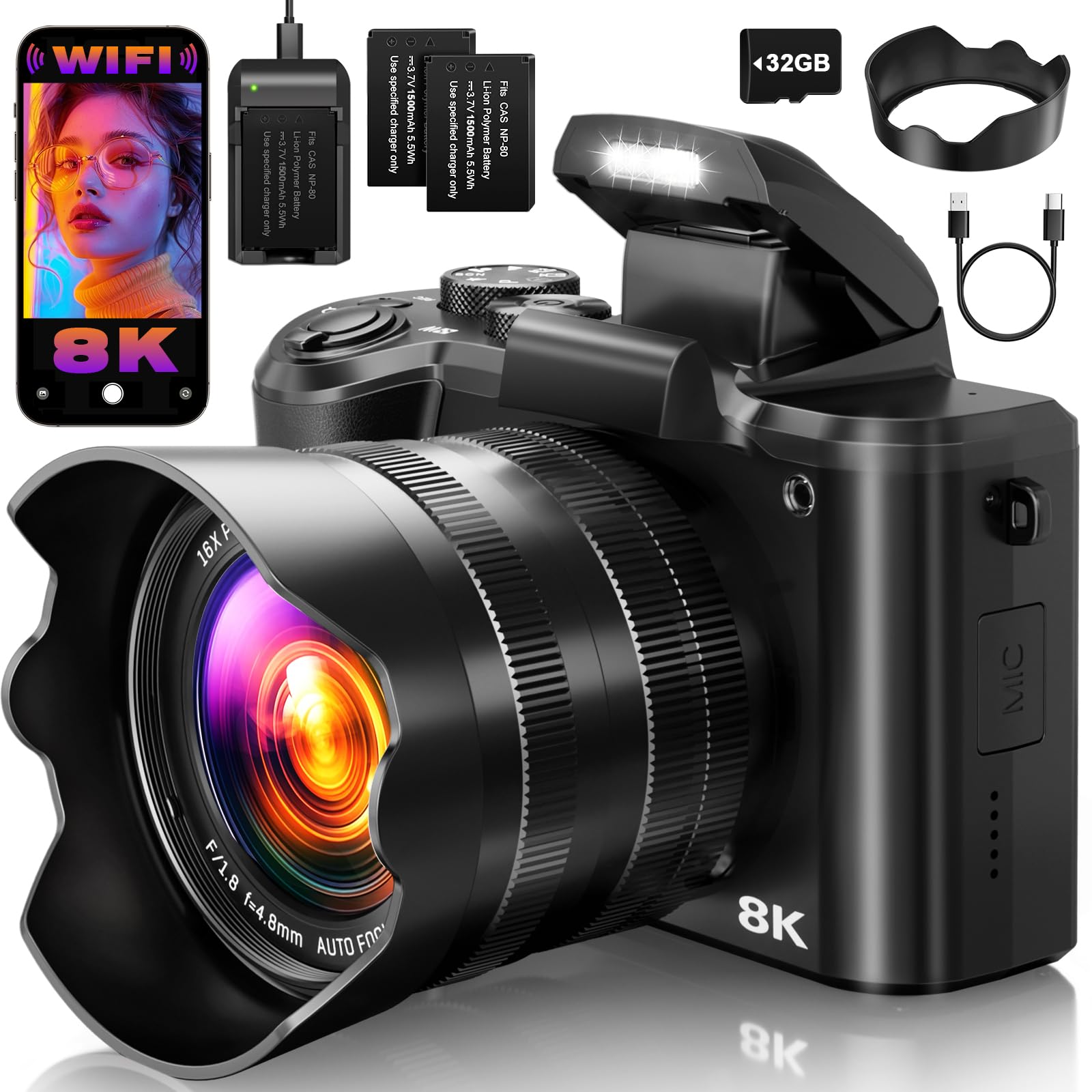
The Tecglem 8K camera packs an 88MP sensor, dual lenses (front and rear), a 3.2-inch IPS touchscreen, and built-in WiFi into a kit that also includes two batteries, a charging stand, lens hood, and 32GB SD card. The headline 8K video resolution is interpolated rather than native, but the resulting files are detailed enough for social media and YouTube. The touchscreen makes menu navigation and focus selection far more intuitive than button-only interfaces.
WiFi connectivity via the “iSmart DV2” app allows instant image transfer to a smartphone — a genuinely useful feature for sharing photos without a computer. The 16x digital zoom is mostly marketing fluff (digital zoom degrades quality), but the 6-axis stabilization does reduce shake in handheld video. The 360-degree mode dial provides quick access to scene modes, filters, and slow-motion recording.
Buyers consistently report excellent image quality for the price, with sharp details and vibrant color reproduction in good light. Battery life is adequate for a day of casual shooting, and the included charging stand simplifies power management. A small percentage of users reported file corruption issues, so formatting the included SD card in-camera before first use is recommended. It is a solid choice for vloggers and beginners who want WiFi and touch controls.
Why it’s great
- WiFi for instant smartphone photo transfer
- Large 3.2-inch touchscreen and dual-lens design
- Comes with two batteries, charging stand, and 32GB card
Good to know
- 8K and 88MP are interpolated, not native resolutions
- 16x digital zoom produces soft images
- Rare file corruption issues reported — format card first
4. Minolta 48MP Digital Camera

The Minolta MND23-BL revives the trusted brand name with a modern twist: a rear-facing selfie lens that lets you frame yourself without looking away from the camera. It shoots 48MP stills and 4K Ultra HD video, with phase-detection autofocus for faster locking than the contrast-detection systems on many competitors. The 2.8-inch LCD screen is smaller than the Tecglem but still functional for composing shots.
Creative flexibility is the main draw here — 9 scene modes, color filters, slow-motion, and time-lapse are accessible via the mode dial. The built-in flash (F2.2 aperture) helps in dim conditions, though the small sensor still produces noise above ISO 800. The included 32GB card, rechargeable battery, and carrying pouch mean you can start shooting immediately.
Reviews are mixed: many buyers love the build quality and ease of use, while some note significant shutter lag and poor battery life (around 140 shots per charge). The slow responsiveness makes it less ideal for action shots or running children. However, for posed portraits, travel landmarks, and creative vlogging with the rear lens, it offers a unique feature set at a competitive price point.
Why it’s great
- Rear selfie lens for easy vlogging and self-portraits
- Phase-detection AF for faster focus
- Includes 9 scene modes, filters, and slow motion
Good to know
- Significant shutter lag — not for fast action
- Battery lasts approximately 140 shots
- Image quality is inconsistent in low light
5. NBDDIGITAL True 5K 64MP Digital Camera
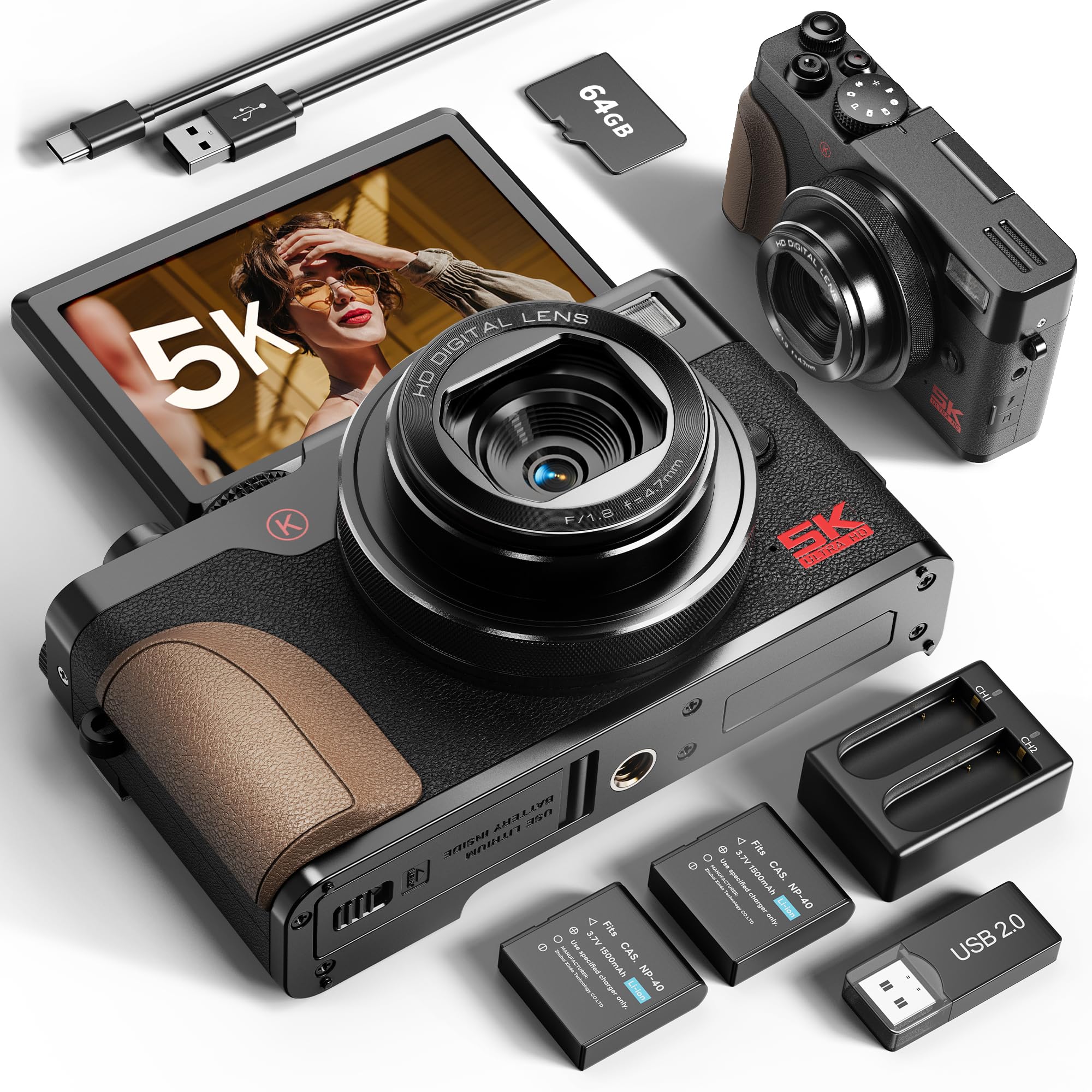
Weighing just 121 grams — barely heavier than a smartphone — the NBDDIGITAL True 5K camera is built for portability. It records 4K/30fps video and captures 64MP stills through a 16x digital zoom system. The body is made from a high-density composite material with a ceramic-like finish that feels durable and pleasant in the hand. A patented silent scroll wheel replaces traditional zoom buttons, eliminating the audible clicks that can ruin video audio.
The camera intelligently optimizes settings for 8 different shooting modes (Sports, Portrait, Night, etc.), adapting to lighting conditions automatically. The built-in high-capacity battery supports over 300 photos per charge, and fast USB-C charging gets you back to shooting quickly. A 32GB TF card is included. Notably, this camera does not have a front-facing lens; selfies are achieved by rotating the rear screen and using the superior main lens — a design philosophy that prioritizes image quality over convenience.
Owners praise the quiet scroll wheel and the solid build quality for the price. The 4K video is described as clear and vibrant, with anti-shake assistance keeping handheld footage stable. The lack of a front screen is a deliberate trade-off that some vloggers may find limiting. For travelers who want a lightweight camera that fits in a pocket and delivers clean 4K video, this is a compelling option.
Why it’s great
- Extremely lightweight at 121 grams — perfect for pocket carry
- Silent scroll wheel for noise-free operation during video
- Fast USB-C charging and 300+ shot battery life
Good to know
- No front-facing selfie screen
- 16x digital zoom — not optical, quality degrades
- No built-in flash for low-light shots
6. XNSIAKXA 8K Digital Camera
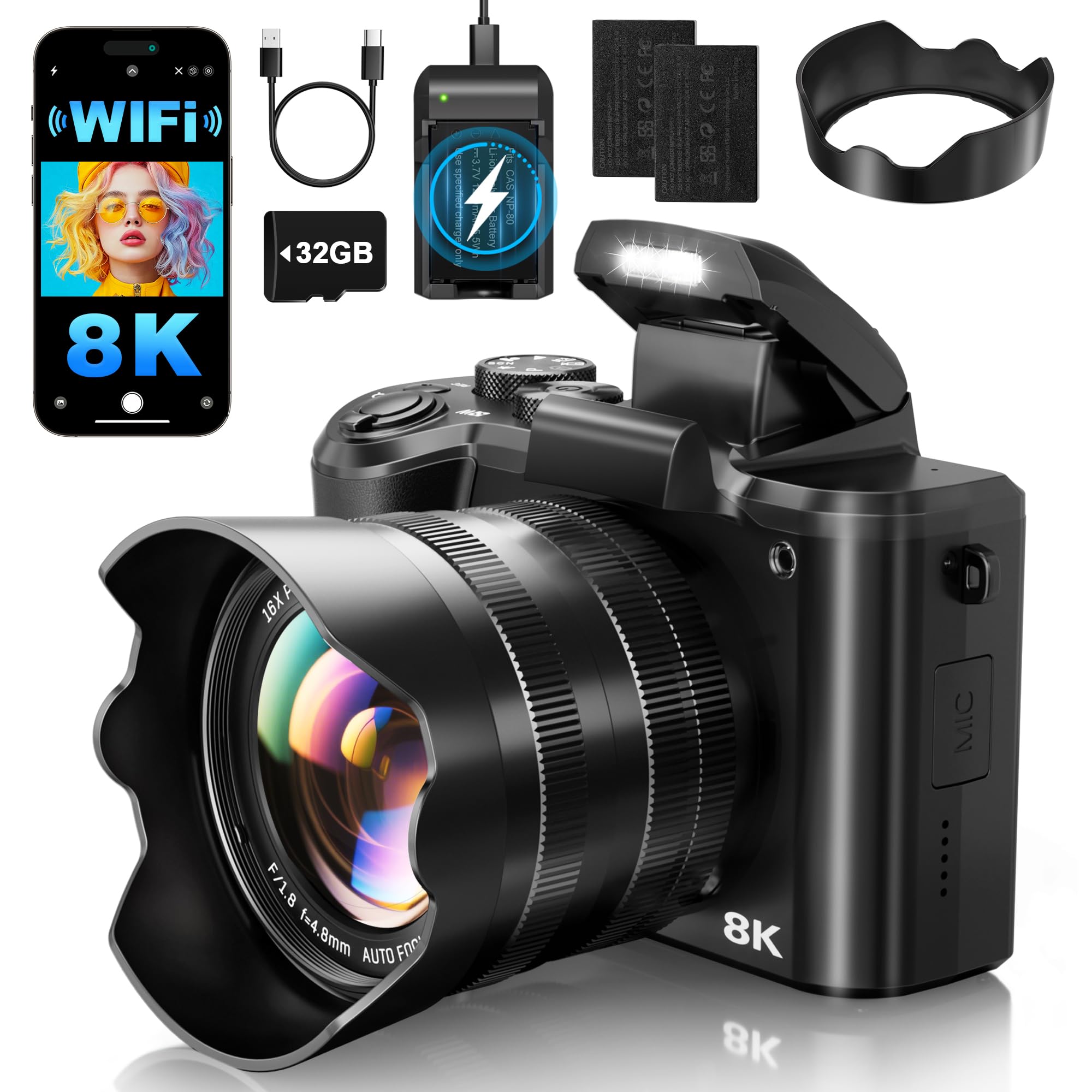
The XNSIAKXA 8K camera enters the market as a complete starter kit: two batteries, a charging stand, lens hood, 32GB SD card, HDMI cable, and a camera bag are all included. It advertises 8K video and 88MP stills with autofocus (phase, contrast, face, and eye detection). The 3.2-inch IPS touchscreen responds well to taps for framing and focus selection. Dual lenses (front and rear) enable straightforward vlogging.
WiFi connectivity through the iSmart DV2 app enables wireless image transfer, though some users report the app experience could be smoother. The 360-degree rotary dial provides quick mode switching between time-lapse, filters, portrait, slow motion, and more. The 16x digital zoom is the standard interpolation type; the 6-axis stabilization helps keep video steady during walking shots.
Customer reviews are overwhelmingly positive for the price, with many calling it a “great starter camera” for beginners and teens. The image quality in well-lit conditions is described as sharp and vibrant. Battery life, however, is a known weak point — one reviewer noted it lasts only about 45 minutes of continuous use. The camera comes with a 12-month hassle-free warranty, which adds peace of mind for first-time buyers.
Why it’s great
- Complete kit with bag, batteries, charging stand, and 32GB card
- IPS touchscreen and dual-lens design for vlogging
- WiFi transfer and 6-axis stabilization
Good to know
- Battery lasts only about 45 minutes of continuous use
- 8K and 88MP are interpolated, not native
- WiFi app connectivity could be more reliable
FAQ
Is a 48MP or 64MP camera better than a 16MP camera under $200?
Can I use a $200 digital camera for professional photography?
Why do many $200 cameras use AA batteries instead of lithium-ion?
Final Thoughts: The Verdict
For most users, the $200 digital camera winner is the Kodak PIXPRO AZ255-BK because its 25x optical zoom and optical image stabilization provide genuine utility that no smartphone can match. If you want a pocketable point-and-shoot with a huge memory card included, grab the Kodak PIXPRO FZ55 Bundle. And for vloggers and WiFi enthusiasts who want a touchscreen and dual lenses, nothing beats the Tecglem 8K Camera.