
Standard PLA prints left in direct sunlight warp, fade, and become brittle within weeks. ASA, the outdoor-grade cousin of ABS, was engineered to resist UV radiation, rain, and temperature swings while maintaining dimensional stability and impact strength over years of exposure.
I’m Min — the co-founder and writer behind Gadgets Feed. I’ve spent countless hours analyzing the mechanical properties, layer adhesion data, and real-world durability tests of dozens of outdoor-grade filaments to separate marketing claims from genuine engineering performance.
Whether you’re printing garden planters, automotive brackets, drone frames, or exterior signage, finding the right 3d filament for outdoor use comes down to understanding material chemistry and print parameters that most beginners overlook.
How To Choose The Best 3D Filament For Outdoor Use
Selecting filament for outdoor applications means prioritizing UV stability, temperature resistance, and moisture tolerance over ease of printing. PLA might be simple, but it degrades rapidly under sunlight and heat.
Material Chemistry — ASA is the Baseline
ASA (Acrylonitrile Styrene Acrylate) is the gold standard for outdoor 3D printing. Its acrylate rubber backbone provides inherent UV resistance that prevents yellowing and embrittlement. ABS lacks this backbone and will degrade. PETG offers better UV resistance than PLA but still fades and loses impact strength over time. ASA is the minimum starting point for any part expected to last longer than a single season outdoors.
Reinforcements — Glass Fiber vs. Carbon Fiber
Standard ASA is tough, but filled variants take outdoor durability further. Carbon fiber (CF) adds stiffness and reduces thermal expansion, which minimizes warping during printing but requires hardened steel nozzles. Glass fiber (GF) boosts impact resistance and heat deflection temperature without adding as much brittleness as CF. For parts subjected to mechanical loads, like drone frames or structural brackets, a 10–20% fiber reinforcement provides noticeable gains without completely sacrificing ease of printing.
Quick Comparison
On smaller screens, swipe sideways to see the full table.
| Model | Category | Best For | Key Spec | Amazon |
|---|---|---|---|---|
| SUNLU ASA | ASA | Best all-around outdoor prints | UV/Rain/Heat resistant, ±0.02mm tolerance | Amazon |
| Polymaker ASA | ASA | Reliable, weather-optimized prints | Heat resistant up to 100°C, USA made | Amazon |
| ANYCUBIC ASA | ASA | Budget-friendly outdoor parts | Heat deflection up to 90°C, ±0.02mm | Amazon |
| ERYONE Carbon Fiber ASA | ASA-CF | High stiffness, lightweight prints | 10% Carbon Fiber, needs hardened nozzle | Amazon |
| ELEGOO ASA | ASA | Large-volume outdoor projects | 2KG spool, HDT up to 99°C | Amazon |
| Creality ASA | ASA | High-speed outdoor functional parts | Optimized up to 350mm/s, 100°C stable | Amazon |
| Siraya Tech ASA-GF | ASA-GF | Maximum impact and heat resistance | 10% Glass Fiber, HDT 92-97°C | Amazon |
In‑Depth Reviews
1. SUNLU ASA Filament 1.75mm

SUNLU’s ASA formulation hits the sweet spot between cost, printability, and weather endurance. Users report excellent layer adhesion with minimal stringing at nozzle temperatures between 230–260°C and bed temperatures of 80–120°C. The ±0.02mm dimensional accuracy ensures consistent extrusion across long prints a critical factor for outdoor parts that must maintain precise fitment.
Customer feedback consistently highlights smooth feeding, no clogs, and a UV/rain/heat resistance that keeps functional parts structurally sound after months of exposure. The updated spool design with a weight and temperature scale fits AMS units, and the vacuum-sealed packaging prevents moisture absorption during storage.
While ASA requires an enclosed printer to minimize warping on larger parts, SUNLU’s formula is forgiving enough that users on enclosed Creality and Bambu Labs machines report success with minimal tuning. The 1kg spool provides strong value for the price.
Why it’s great
- Excellent layer adhesion with no clogs or bubbles out of the box.
- Consistent ±0.02mm diameter tolerance for reliable extrusion.
- Affordable price point without sacrificing outdoor durability.
Good to know
- Requires an enclosure for large or high-warpage parts.
- Some users reported vacuum seal inconsistency on a few rolls.
2. Polymaker ASA Filament 1.75mm Jet Black

Polymaker ASA is engineered with the same rigorous quality control the brand is known for across its entire filament lineup. This material can withstand sustained temperatures up to 100°C, making it suitable for automotive engine bay components and dark-colored parts that absorb solar heat. The recommended nozzle temperature of 250°C and bed temperature of 90°C produce clean overhangs and strong interlayer bonds.
Reviews on this filament praise its vibrant color retention and smooth feeding behavior. Users printing RC plane parts, car accessories, and outdoor enclosures note that the UV resistance prevents fading even in direct sunlight. The upgraded 3.0 packaging uses a fully recycled cardboard spool and box, a welcome shift toward sustainability without sacrificing product protection.
Warping remains a challenge on open-frame printers, especially for large flat surfaces. A brim and enclosure are strongly recommended, as is thorough drying before printing. The smoke and odor during printing require proper ventilation, but the final part quality and weather resistance justify the extra setup effort.
Why it’s great
- Proven UV and weather resistance with consistent color retention.
- Heat deflection up to 100°C for high-temperature outdoor applications.
- Eco-friendly cardboard spool and packaging reduce waste.
Good to know
- Strong smoke and odor during printing requires ventilation.
- Bed adhesion can be tricky without glue stick and a very clean surface.
3. ANYCUBIC ASA Filament 1.75mm Gray

ANYCUBIC positions this ASA as an entry-level option for users moving beyond PETG into true outdoor-grade materials. The filament’s heat deformation temperature of 90°C sits slightly below premium alternatives but is still more than adequate for most outdoor planters, garden tools, and non-structural automotive parts. The ±0.02mm diameter tolerance ensures compatibility with common FDM printers.
Users printing on Anycubic Kobra S1 and Bambu Lab X1C machines report flawless results after drying the filament for three hours at 80°C. The gray color provides a neutral base that accepts spray paint well for color-matched outdoor projects. The low shrinkage rate reduces cracking risk on parts with sharp corners.
This filament demands careful tuning out of the box. Users found best results at nozzle temperatures of 280°C and bed temperatures of 110°C with a 7mm brim. Without proper calibration, warping and adhesion failures are common. The competitive price point makes it a strong choice for users willing to invest time in profile optimization.
Why it’s great
- Low shrinkage and minimal cracking on intricate geometries.
- Dries well and responds predictably to temperature tuning.
- Excellent value for transitioning from PETG to ASA.
Good to know
- Requires drying before use for optimal print quality.
- Tuning nozzle and bed temperatures is mandatory for reliable results.
4. ERYONE Carbon Fiber ASA Filament 1.75mm
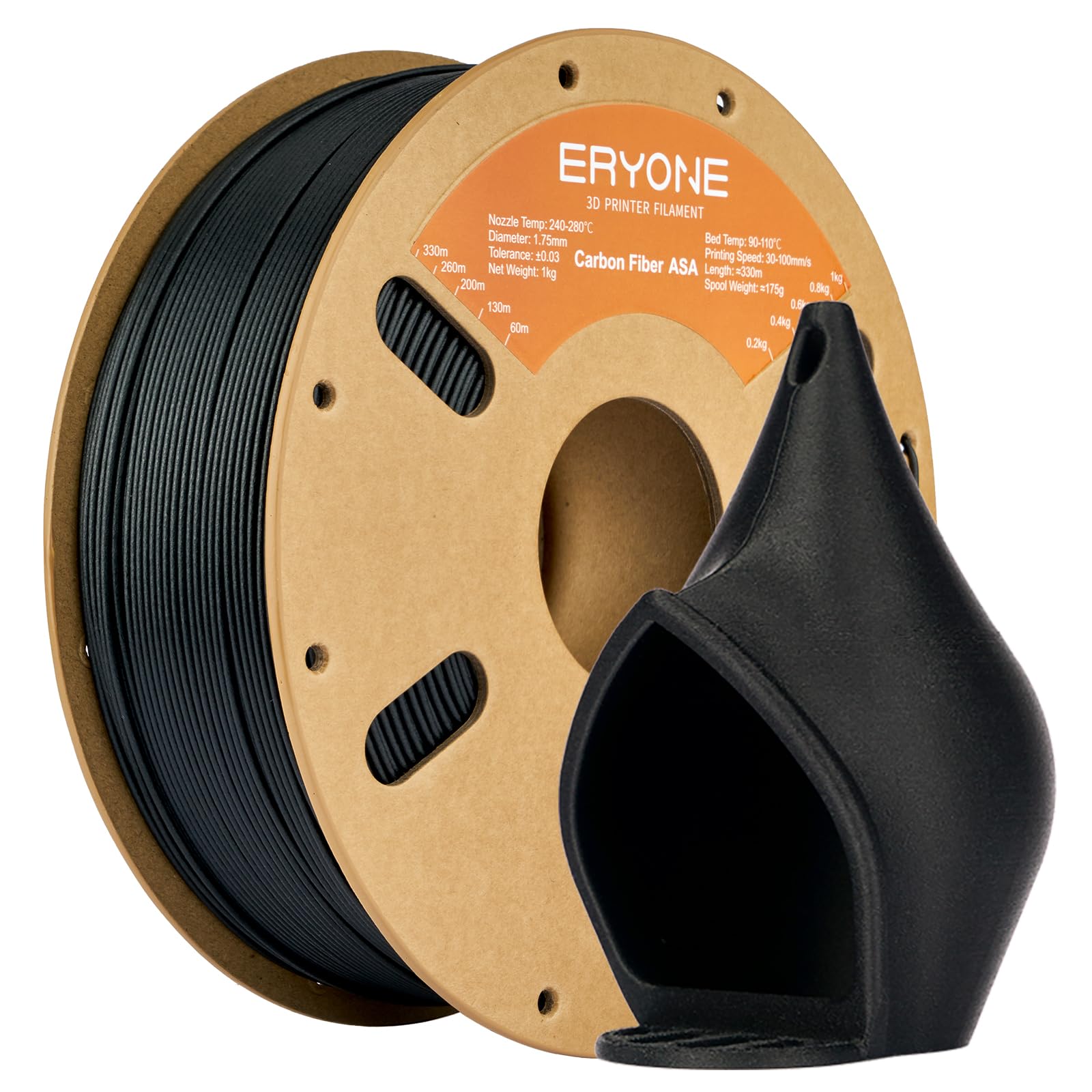
ERYONE’s ASA-CF filament blends ASA with 10% carbon fiber, producing parts that are simultaneously stiffer and lighter than standard ASA. The carbon fiber reinforcement reduces thermal expansion, which directly combats warping during printing. Users printing outdoor signage, marine accessories, and structural brackets report that the matte black texture hides layer lines effectively and gives a premium appearance.
The abrasive nature of carbon fiber requires a hardened steel nozzle to prevent nozzle wear. Enclosed printers are recommended to maintain a stable chamber temperature. Reviews highlight zero stringing, smooth surfaces, and excellent bed adhesion with minimal tuning on Bambu Lab P1S and Voron machines. The vacuum-sealed packaging with desiccant keeps the filament dry, though drying before printing still improves results.
One trade-off is reduced flexibility compared to unfilled ASA. The carbon fiber makes the material more brittle under sudden impacts. For applications where stiffness and heat resistance matter more than impact toughness, this filament delivers exceptional performance.
Why it’s great
- High stiffness with reduced thermal expansion for minimal warping.
- Matte black finish hides layer lines and looks professional.
- Excellent print quality with no stringing or oozing.
Good to know
- Hardened steel nozzle is mandatory due to carbon fiber abrasion.
- More brittle than unfilled ASA under impact loads.
5. ELEGOO ASA Filament 1.75mm Deep Black 2KG
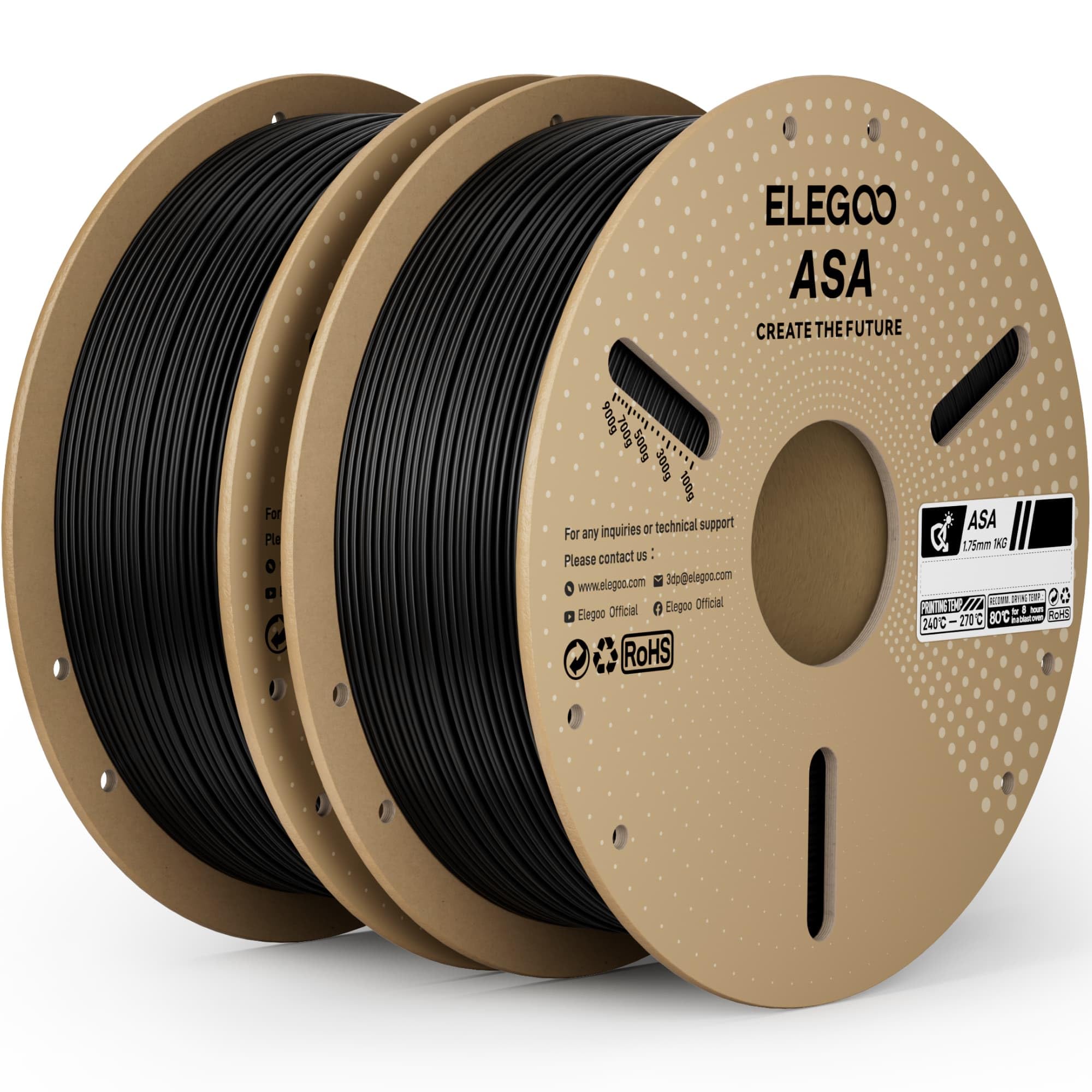
ELEGOO’s ASA comes in a 2KG spool, offering double the material of standard rolls without requiring a mid-print spool change. This is a practical advantage for large outdoor projects like full-size drone frames, automotive bumper brackets, or garden furniture components. The heat deflection temperature of 99°C matches premium ASA options.
User feedback on the Centauri Carbon and Creality K1C is overwhelmingly positive, with reports of easy dial-in and strong layer adhesion. The deep black color holds up well under sunlight, and the vacuum-sealed packaging with desiccant ensures the filament prints dry. The two-spool package provides redundancy for extended print sessions.
The primary downside is the strong styrene odor common to all ASA filaments. Adequate ventilation or an exhaust system is non-negotiable. Some users noted that the 2KG spool does not fit all AMS units, so compatibility with your specific setup should be verified before purchase.
Why it’s great
- 2KG spool provides exceptional material volume per purchase.
- Reliable print quality with minimal tuning on enclosed printers.
- Heat deflection up to 99°C for demanding outdoor applications.
Good to know
- Strong fumes require proper ventilation during printing.
- Large spool may not fit all AMS or enclosed printer setups.
6. Creality ASA 3D Printer Filament 1.75mm Black

Creality’s HP ASA formulation is optimized for high-speed printing up to 350mm/s without compromising dimensional accuracy. This is a distinct advantage for users running Creality K1, K1 Max, or other high-speed CoreXY machines where standard ASA might struggle with flow consistency. The ±0.03mm tolerance is slightly looser than some competitors but still adequate for functional outdoor parts.
Reviews from users printing motorcycle accessories and outdoor mechanical parts report easy printability and excellent weather resistance. The filament held up well on a Flashforge AD5X with a 0.6mm hardened nozzle, producing clean prints without clogs. The vacuum-sealed packaging and consistent diameter contribute to reliable print starts.
The main limitation is the manufacturer part number labeling, which still references Hyper PLA in some listings, potentially causing confusion during ordering. Additionally, high-speed printing with ASA requires a stable enclosure temperature to prevent warping, which adds setup complexity for open-frame printer users.
Why it’s great
- Optimized for high-speed printing without clogging or jamming.
- Excellent UV and weather resistance for long-term outdoor use.
- Works seamlessly with Creality high-speed printer ecosystem.
Good to know
- Part number confusion in listing could lead to wrong filament.
- Requires enclosure for warping-free high-speed prints.
7. Siraya Tech Fibreheart ASA-GF 1.75mm Black
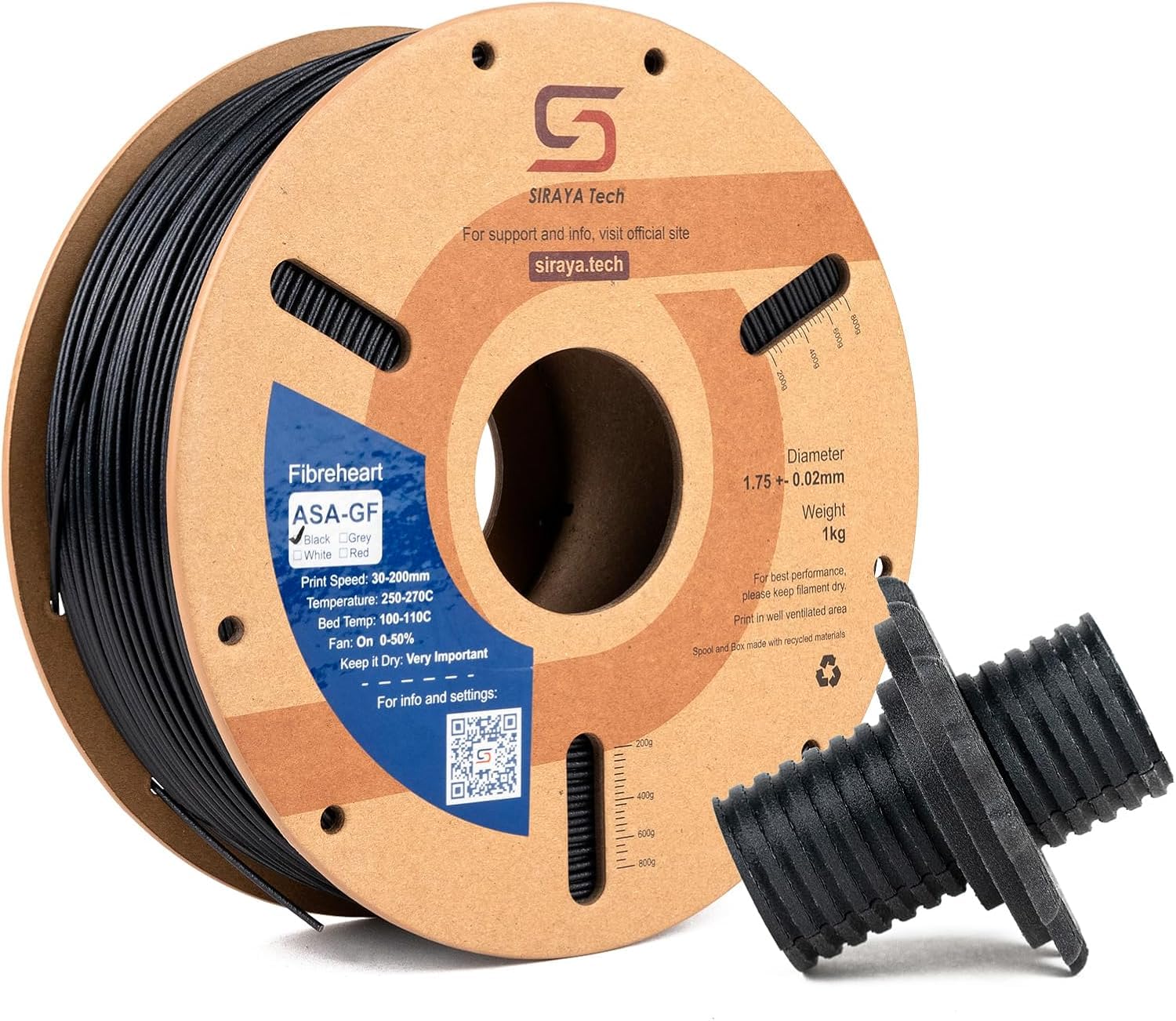
Siraya Tech’s Fibreheart ASA-GF reinforces standard ASA with 10% chopped glass fiber, raising the glass transition temperature to 106°C and the heat deflection temperature to 97°C. This makes it one of the most thermally stable outdoor filaments available. The glass fiber adds significant impact resistance and stiffness, ideal for heavy-duty components like telescope brackets, industrial wire looms, and automotive under-hood parts.
Users report that the material prints with minimal warping even on large 30cm parts, and supports detach cleanly without post-processing. The matte finish is consistent across black and white options. The included bed adhesive improves adhesion on glass and PEI surfaces. Several reviewers noted that the parts withstand extreme desert temperatures and occasional direct sun exposure without deformation.
However, some users experienced severe tangling in the spool after partial use, making the remainder unusable. The filament’s stiffness also makes it prone to cracking under vibration or impact loads despite the GF reinforcement. It excels in rigid, temperature-stable applications but is not the best choice for parts experiencing repeated mechanical shock.
Why it’s great
- Highest thermal stability with 106°C glass transition temperature.
- Minimal warping on large parts with excellent dimensional stability.
- Clean support removal and matte professional finish.
Good to know
- Spool tangling reported on some units after partial use.
- Brittle under vibration and impact loads despite glass fiber reinforcement.
FAQ
Can I print ASA outdoors on an open-frame printer?
How do ASA and PETG compare for outdoor UV exposure?
Do I need to dry ASA before printing it?
Final Thoughts: The Verdict
For most users, the best 3D Filament For Outdoor Use is the SUNLU ASA because it offers the best balance of print reliability, weather resistance, and cost across a wide range of applications. If you need the highest thermal stability and impact resistance for mechanically loaded parts, grab the Siraya Tech ASA-GF. And for large-volume outdoor projects where material cost per gram matters, nothing beats the ELEGOO ASA 2KG.