
Choosing the wrong hot air rework station for SMD soldering can lead to lifted pads, scorched boards, and a useless pile of plastic. That 700W heating element inside a budget chassis needs precise PID control — not just raw power — to safely remove QFP and BGA components without damaging neighboring parts. This guide cuts through the generic claims to find the units that actually maintain acceptable temperature stability below .
I’m Min — the co-founder and writer behind Gadgets Feed. I have spent countless hours analyzing the real specs, customer feedback, and thermal performance of these entry-level hot air stations, focusing on temperature accuracy (within ±5°C), airflow consistency, and long-term reliability for hobbyists and light repair work.
This guide ranks the best controller options and station configurations so you can confidently select a budget hot air rework station that won’t underperform when removing a troublesome QFP chip from a laptop motherboard.
How To Choose The Best Budget Hot Air Rework Station
A sub- hot air station is an investment in capability, but the market is full of clones that differ mainly in build quality and included accessories. To pick wisely, focus on the three spec categories that actually affect soldering outcomes: temperature control, airflow management, and the convenience of a 2-in-1 iron.
Temperature Stability and PID Control
Raw wattage is a trap. A 700W heater can overshoot wildly without a proper PID (Proportional-Integral-Derivative) algorithm. The best budget stations sample the thermocouple rapidly and adjust power to keep the nozzle at your set point — usually within ±2-5°C. Without this, you risk cooking sensitive BGA packages or applying insufficient heat to form proper solder joints.
Airflow Range and Nozzle Selection
Look for at least 8 distinct fan speed levels (roughly 20 to 120 L/min) and a station that includes a 10mm standard nozzle plus smaller 5mm and 8mm tips. A brushless fan in the handle means quieter operation and less vibration during delicate rework. The ability to swap nozzles quickly is non-negotiable for shifting between heat-shrink work and IC desoldering.
Single vs. 2-in-1 Configuration
A dedicated 858D-style hot air station is the cheapest route, but a 2-in-1 unit (hot air plus soldering iron) uses less bench space and lets you tack components down before reflowing them. The trade-off is that budget 2-in-1s sometimes split power between the two tools, so check that each channel has independent temperature control and its own switch.
Quick Comparison
On smaller screens, swipe sideways to see the full table.
| Model | Category | Best For | Key Spec | Amazon |
|---|---|---|---|---|
| Preciva 902D V | 2-in-1 | PCB rework with memory presets | PID temp control, 750W, 480°C max | Amazon |
| WEP 8786D-I SE | 2-in-1 | Balanced soldering + hot air | 2-in-1, PID, 896°F max, sleep mode | Amazon |
| MYPOUOS 8588D | 2-in-1 | Full kit with many accessories | 750W, 480°C, anti-static, ±2°C stability | Amazon |
| TXINLEI 8586 | 2-in-1 | Large tip selection | 12 soldering tips included, 480°C max | Amazon |
| CREWORKS 858D | Hot Air Only | Pure hot air rework on a budget | 700W, 842°F, 8 airflow levels, auto sleep | Amazon |
| NEWACALOX 858D | Hot Air Only | High temp (500°C) for lead-free work | 500°C max, 700W, auto cool-down | Amazon |
| TXINLEI 858D+ | Hot Air Only | Entry-level with full accessory kit | 700W, 450°C max, 7-in-1 kit included | Amazon |
In‑Depth Reviews
1. Preciva 902D V
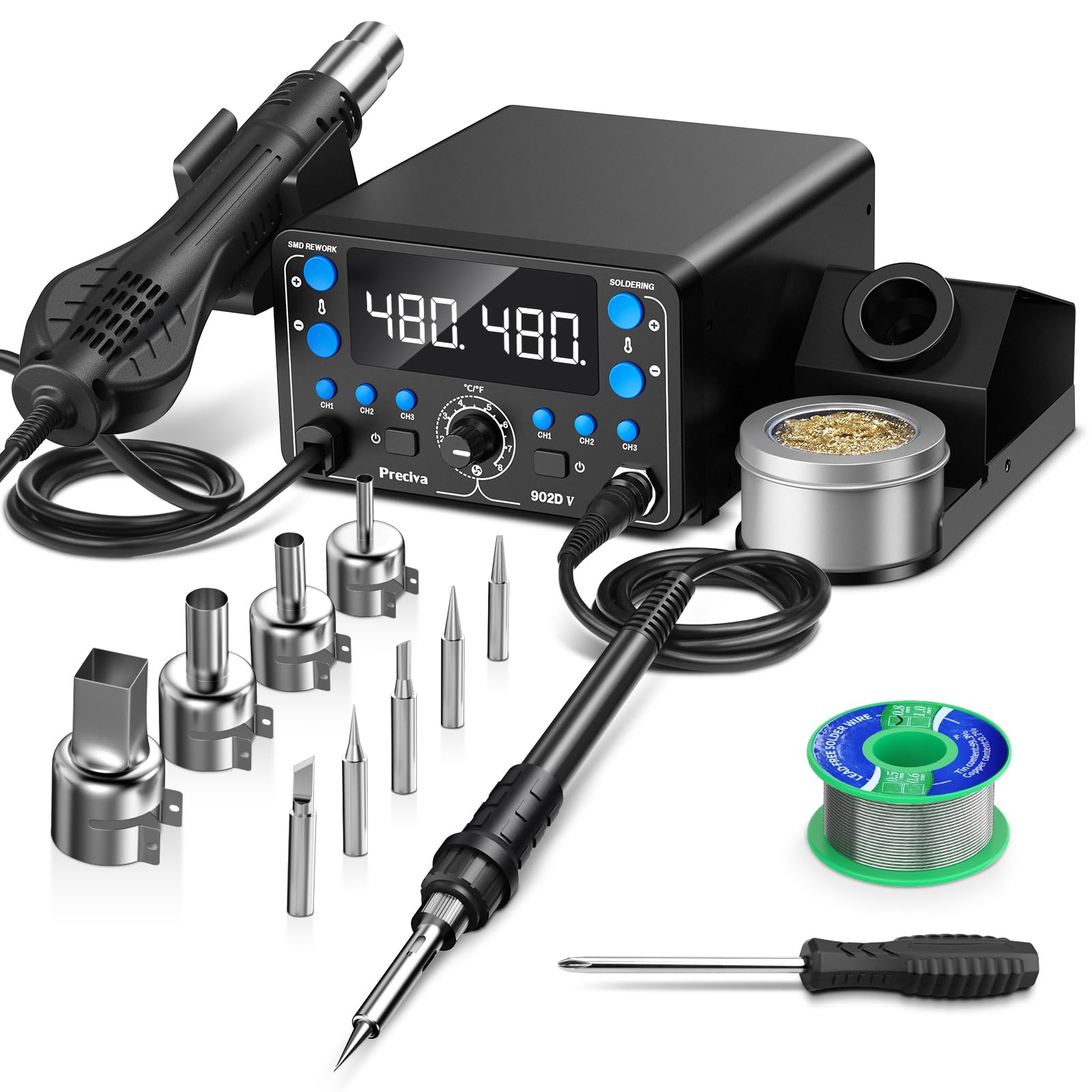
The Preciva 902D V is the most capable 2-in-1 station in this group, pairing a 750W heater with independent PID temperature control for both the soldering iron (392–896°F) and the hot air gun (212–896°F). The brushless blower delivers up to 120 L/min without the annoying whine of brushed alternatives, and the three memory presets let you store common profiles for different PCB rework tasks.
Dual power switches and separate channels mean you can leave the soldering iron on standby at 350°F while the hot air gun cools down, without draining the element. The included four nozzles (5mm, 8mm, 10mm, 12mm) cover SMD capacitor removal all the way to shrink tubing on wiring harnesses. The internal SMT double-face PCB construction improves signal stability and reduces the risk of drift during long reflow sessions.
Calibration is user-accessible via a small screwdriver trimmer inside the case, which addresses a common complaint about budget stations running hot. The iron itself may read slightly cooler than set, but the calibration feature allows you to zero it against a thermocouple. For the money, this is the most feature-complete package for someone who wants a single box for both soldering and SMD rework.
Why it’s great
- PID temperature control with 3 memory presets for repeatable profiles
- Brushless blower produces stable airflow with less noise at max fan speed
- Includes both iron sleep mode and hot air standby for heating element longevity
Good to know
- Some units may read 5-10°C cooler than displayed; calibration slot is accessible
- The manual lacks detailed calibration instructions in English
2. WEP 8786D-I SE
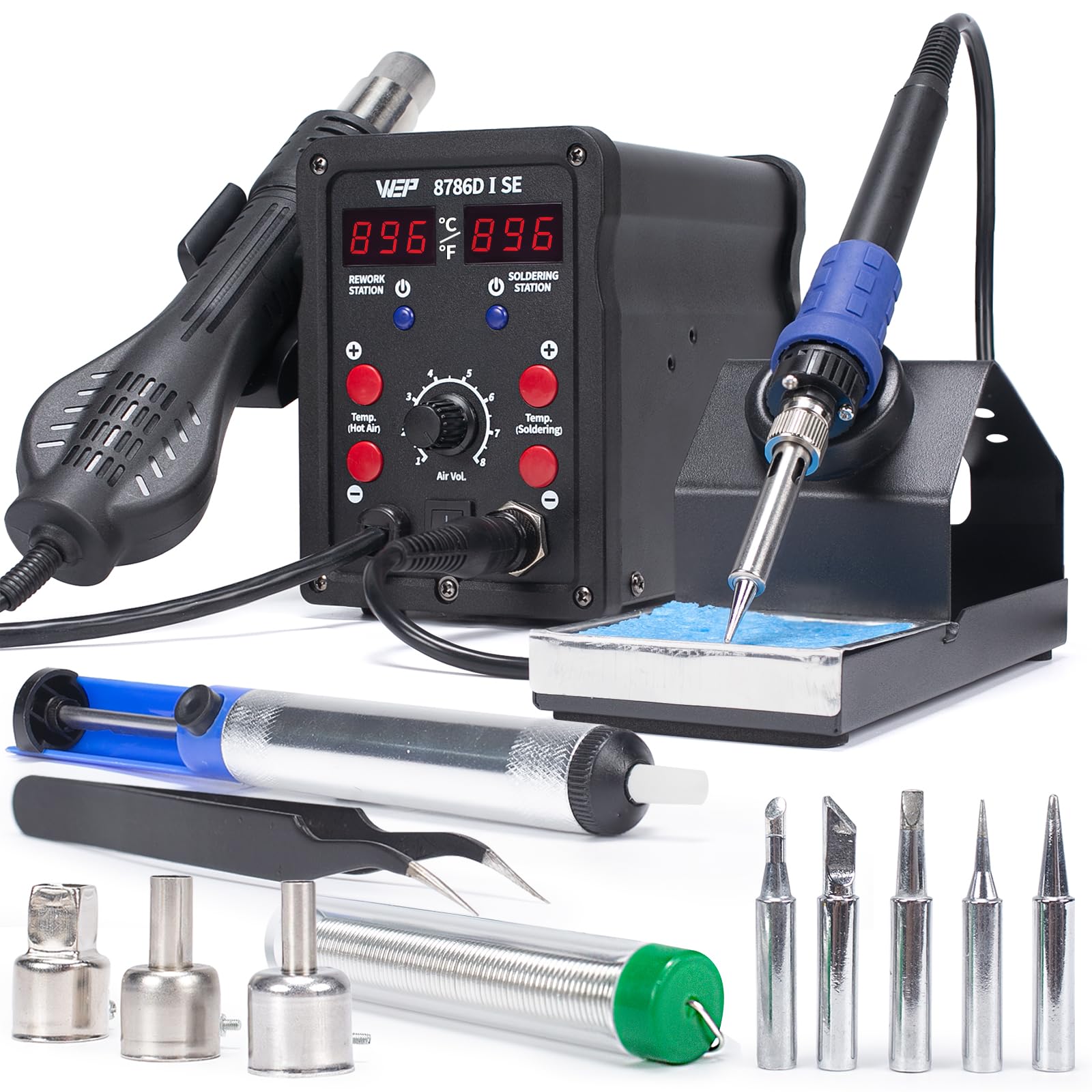
The WEP 8786D-I SE distinguishes itself with a solid build and a truly interactive PID stabilization loop that tracks and corrects the actual temperature at the nozzle. The hot air gun reaches 896°F and cycles down to a 212°F safety hold when placed in the cradle, preventing accidental burns and extending the life of the ceramic heating element. The soldering iron channel hits the same peak temperature and includes a 10-minute sleep timer.
Both channels have individual digital readouts in Fahrenheit, a welcome feature over the Celsius-only 858D clones. Included in the box are five soldering tips (I, B, K, 3.2D, 3C), three hot air nozzles, a desoldering pump, tweezers, and a length of lead-free solder wire. The ergonomic grip on the hot air wand provides a cooler handle surface even during extended use at medium airflow settings.
The 1-year USA technical support from WEP adds confidence absent from no-name imports, and the customer service team responds within 24 hours. The main trade-off is that the soldering iron can struggle with large ground planes or thick gauge wire — it’s tuned for SMD and small through-hole work. As a light-to-moderate rework station, however, this is a strong all-rounder.
Why it’s great
- Actual PID stabilization with digital display in both °F and °C
- Hot air gun safety standby holds at 212°F to protect the heater and user
- Includes solder wire, desoldering pump, and 5 tip styles for immediate use
Good to know
- Soldering iron may lack power for heavy thermal-mass joints like grounding wires
- Some units require an exchange to fix iron heat output on arrival
3. MYPOUOS 8588D

The MYPOUOS 8588D is the most comprehensive package in this lineup, shipping with ten soldering tips, four hot air nozzles, three anti-static tweezers, an IC puller, a desoldering pump, solder wire, flux, and a cleaning sponge all in one box. The dual blue LED displays show simultaneous temperature readings for the iron and hot air gun, with an advertised stability of ±2°C. Anti-static design throughout prevents ESD damage to sensitive MOSFETs and BGA substrates.
The 750W heater brings both channels up to temperature quickly — the iron reaches 350°C in under 30 seconds, and the hot air gun follows within 10 seconds of release from the holder. The handle induction system (Hall-effect sensor) triggers the hot air fan only when the wand is lifted, and the cool-down cycle runs the fan until the element drops below 100°C, a crucial safety feature often missing on cheaper 858D clones.
Long-term reliability is supported by user reports of units lasting over four years with moderate weekly use. The main weakness is the manual, which is poorly translated and won’t help with calibration or troubleshooting. For the buyer who wants the most accessories in one purchase and doesn’t mind deciphering the instructions, this is the best value 2-in-1.
Why it’s great
- Massive accessory count: 10 tips, 4 nozzles, tweezers, solder, and flux included
- Anti-static chassis protects sensitive ICs from electrostatic discharge
- Automatic cool-down fan continues running until element is safe to handle
Good to know
- The printed manual is nearly unusable due to poor English translation
- Bright blue display LEDs can be distracting in a dim workshop
4. TXINLEI 8586

This variety allows you to switch from a fine conical tip for 0201 resistor work to a wide chisel for ground plane soldering without buying extras. The hot air channel is rated to 480°C with a 700W heater, and the handle induction system automatically stops the heater when the wand is cradled.
Build quality is noticeably better than the cheapest 858D units: the sheet metal enclosure has a powder-coated finish, the wand connector is keyed, and the circuit board uses a proper grounded power inlet with a fuse holder. Users report that the iron stays hot at its lowest setting, thanks to a secondary power switch that prevents the standby circuit from starving the element. The hot air gun is fast enough to reflow QFP-100 packages within 30 seconds at medium airflow.
The weak point is the documentation — the manual is borderline incomprehensible, and the calibration procedure (if any) isn’t clearly documented. Some users also note that the included tips can oxidize faster than branded replacements under heavy use. For the hobbyist who values tip variety over a polished user experience, this is a compelling pick.
Why it’s great
- 12 soldering tips included, covering fine-pitch SMD all the way to high-mass joints
- Dual power switches allow the iron to stay hot on low setting without entering deep sleep
- Powder-coated metal case with grounded power inlet for safety
Good to know
- Manual is extremely poorly translated and lacks calibration guidance
- Tips may oxidize faster under heavy or daily professional use
5. CREWORKS 858D

If you only need hot air rework without a soldering iron, the CREWORKS 858D delivers the most reliable version of the classic 858D platform at an entry-level price point. The 700W heater hits 842°F in roughly 5 seconds, and the brushless fan provides 8 distinct airflow levels up to 4.2 CFM. The PID temperature control maintains the set point within a few degrees when you let the wand rest in the cradle.
The auto sleep function reduces the temperature to a safe idle when the wand is on the stand and instantly heats back up when lifted — this prevents accidental burns and cuts power consumption. The included 5mm, 8mm, and 10mm nozzles cover basic SMD removal, heat shrink, and plastic welding. The handle ergonomics are decent, though the metal bracket that holds the stand can be flimsy on some units.
Multiple users have verified temperature accuracy within ±5°C using infrared thermometers, which is acceptable for non-automated rework where you visually confirm solder reflow. The main downside is the lack of a soldering iron, so you’ll need a separate solder station for tacking components. For pure hot air tasks on a tight budget, this is the benchmark to beat.
Why it’s great
- Fast 5-second heat-up to 842°F with reliable PID temperature stability
- 8 airflow intensity levels (up to 4.2 CFM) handle both SMD and heat shrink work
- Auto sleep and standby functions improve safety and heating element lifespan
Good to know
- Hot air only — no soldering iron channel for through-hole components
- Handle stand bracket can feel lightweight and may flex on some units
6. NEWACALOX 858D

The NEWACALOX 858D differentiates itself by offering a maximum temperature of 500°C, 50°C higher than most 858D clones. This extra headroom is useful for lead-free rework (SAC305 typically reflows above 260°C) and for overcoming heat sinking from large PCB copper pours. The 700W heater and brushless fan combination delivers the same 3-5 second heat-up as the competition, with a digital LED display showing the current set point.
The automatic cool-down function is better implemented here — the fan continues running after the wand is cradled until the temperature drops below 100°C, then shuts off completely. This protects the ceramic heater from thermal shock and reduces the chance of accidental burns. NEWACALOX also provides responsive customer support; one reviewer received a free replacement after an initial fan control defect, and the second unit worked perfectly.
The main drawback is the well-known 858D inaccuracy: a set temperature of 275°C might measure only 230-235°C at the nozzle tip, particularly at high airflow settings. The case is not grounded on all units, and the Hall-effect sensor in the cradle can be finicky over time. For occasional rework where you can compensate with practice, the extra 50°C of range is a distinct advantage over other 858D models.
Why it’s great
- Max temperature of 500°C offers headroom for lead-free solder and large thermal masses
- Automatic cool-down cycle protects the heater and reduces risk of burns
- Good customer support with warranty replacements honored by the vendor
Good to know
- Display reads about 40-45°C higher than actual nozzle temperature in some units
- Case grounding and Hall sensor cradle alignment can be inconsistent
7. TXINLEI 858D+

The TXINLEI 858D+ is the simplest path into hot air rework, bundling the 858D station with an IC puller, two tweezers, a desoldering pump, and a 6-in-1 BGA tool all for a very low entry fee. The station itself is a standard 858D: 700W heater, 100-450°C temperature range, and handle induction auto-stop when cradled. The digital LCD display shows the set temperature clearly, and the analog dial for airflow is intuitive.
Out of the box, users have noted that the unit may run hot — one measurement showed 30°C above set point — but the thermocouple at the heating element can be recalibrated if you have a separate temperature probe. The included accessories compensate for the basic build. The tweezers are usable for SMD placement, and the desoldering pump works for through-hole cleanup after hot air has melted the solder.
Safety concerns include a reversed power cable on some batches that bypasses the fuse — check and correct this before first use. The internal soldering of the heating element wiring may also be sloppy, but it’s easy to clean up with a soldering iron. For someone who wants the absolute cheapest way to start SMD rework and doesn’t mind a few minutes of inspection, this kit is hard to ignore.
Why it’s great
- 7-in-1 kit includes most tools needed for basic SMD rework in one purchase
- Standard 858D platform is well-documented online with many repair guides
- Handle induction auto-stop adds safety and reduces element wear when not in use
Good to know
- Power cable may be wired backwards on some units, bypassing the fuse
- Displayed temperature can be inaccurate by up to 30°C without calibration
FAQ
Can a 700W hot air station reflow a BGA chip?
How accurate are the temperature displays on these budget stations?
What is the difference between a 2-in-1 station and a separate soldering iron?
How do you calibrate a budget hot air rework station?
Final Thoughts: The Verdict
For most users, the budget hot air rework station winner is the Preciva 902D V because it packs PID accuracy, three memory presets, a brushless blower, and dual channels into a single affordable package — making it the most capable station for hobbyists who need both soldering and hot air. If you want the absolute best 2-in-1 value with a superior safety standby, grab the WEP 8786D-I SE. And for pure hot air rework on the smallest budget, nothing beats the CREWORKS 858D.