
You cannot see carbon dioxide, smell it, or taste it, but when levels creep past 1000 ppm your focus blurs, your head aches, and your sleep quality plummets. A dedicated CO2 monitor puts a number on that invisible problem, telling you exactly when to crack a window or turn on a ventilation fan instead of guessing.
I’m Min — the co-founder and writer behind Gadgets Feed. I’ve spent countless hours cross-referencing NDIR sensor specs, real-world accuracy reviews, and feature sets across dozens of models to identify the monitors that actually deliver reliable data instead of just flashing colorful lights.
Whether you work from home, manage a greenhouse, or simply want better indoor air for your family, finding the best air quality co2 sensor means choosing between portable battery-powered units and always-on smart monitors that integrate with your existing home automation setup.
How To Choose The Best Air Quality CO2 Sensor
CO2 monitors range from simple desktop displays to fully integrated smart home devices. Your choice depends on whether you need portability, real-time alerts, historical data logging, or integration with existing smart fans and humidifiers. The most important factor is sensor accuracy — a monitor that drifts by 400 ppm after a week is worse than useless.
Sensor Technology: NDIR vs Photoacoustic
Non-dispersive infrared (NDIR) sensors are the gold standard for CO2 detection, using an infrared light source and detector to measure absorption at a specific wavelength. Photoacoustic NDIR sensors, like the SCD4x used in the GoveeLife, offer similar accuracy in a smaller package. Avoid monitors that do not specify their sensor type — cheap electrochemical sensors drift quickly and fail to respond to real concentration changes.
Power Source and Portability
Battery-powered monitors let you move the sensor between rooms, the car, or the office to identify problem areas. Look for units with at least 9 hours of continuous operation if you plan to move them daily. AC-powered monitors provide uninterrupted 24/7 tracking ideal for a nursery or home office but sacrifice placement flexibility. Some premium units offer both a rechargeable battery and a USB power option.
Alert Systems and Smart Features
A good CO2 monitor alerts you before symptoms set in. Triple alert systems — audible buzzer, on-screen color change, and smartphone notification — are the most effective. Smart home integration with Alexa or Google Assistant lets you query CO2 levels hands-free or trigger automatic ventilation via connected fans. Be aware that air purifiers cannot remove CO2, so smart linkages should target exhaust fans or HRV systems instead.
Quick Comparison
On smaller screens, swipe sideways to see the full table.
| Model | Category | Best For | Key Spec | Amazon |
|---|---|---|---|---|
| Autopilot APCEM2 | Premium | Data logging & grow rooms | NDIR, 7-day memory chart | Amazon |
| KDWKD AK23CA | Premium | Multi-gas detection | PM0.3–PM10 + TVOC + HCHO | Amazon |
| GoveeLife H5140 | Mid-Range | Smart home integration | SCD4x photoacoustic, 5s refresh | Amazon |
| SwitchBot Meter Pro CO2 | Mid-Range | Portable precision | ±50 ppm, 92mm large screen | Amazon |
| LifeBasis 11-in-1 | Mid-Range | Budget-friendly multi-sensor | 11 indexes, 2500mAh battery | Amazon |
| Kidde 30CUAR | Budget | Safety-alarm combination | Hardwired, AA backup, 85dB | Amazon |
| First Alert SMCO600NV-AC | Budget | Nest Protect compatibility | Wi-Fi alerts, voice warnings | Amazon |
In‑Depth Reviews
1. Autopilot Desktop CO2 Monitor & Data Logger

The Autopilot APCEM2 has been a mainstay for serious indoor growers and data-minded users for years, and its staying power is earned. It uses a low-drift NDIR sensor with two-channel measurement, logging CO2, relative humidity, and temperature onto a clear LED display. The onboard memory chart stores readings over an adjustable 24-hour or 7-day period, letting you spot patterns in room occupancy and ventilation effectiveness without needing a smartphone app or cloud subscription.
The unit is powered via USB and ships with two micro-USB cables and an AC adapter, so it runs continuously without battery anxiety. A hook-and-loop fastener on the back attaches to an optional external battery pack if you want temporary placement in different rooms. The audible alarm triggers at user-set low or high CO2 thresholds, though some users note the high-alarm function is LED-only in custom mode — a detail to keep in mind if you need a loud buzzer for elevated levels.
Multiple customer reports confirm the sensor still tracks accurately after five years of continuous use, a testament to the NDIR sensor stability. Outdoor readings hover around the expected 400–450 ppm baseline, and the unit catches CO2 spikes from gas stoves, crowded rooms, and enclosed greenhouses. Its no-frills approach — no Wi-Fi, no app, no colorful animations — appeals to buyers who just want reliable data they can act on.
Why it’s great
- Onboard 7-day trend memory with no app required
- Proven NDIR sensor accuracy lasting over 5 years
- Dual power: USB continuous or optional battery pack
Good to know
- High-CO2 alarm is LED-only in custom mode, no audio
- Display backlight is blue, not green as pictured
- No smart home integration or remote notifications
2. KDWKD Indoor Air Quality Monitor AK23CA
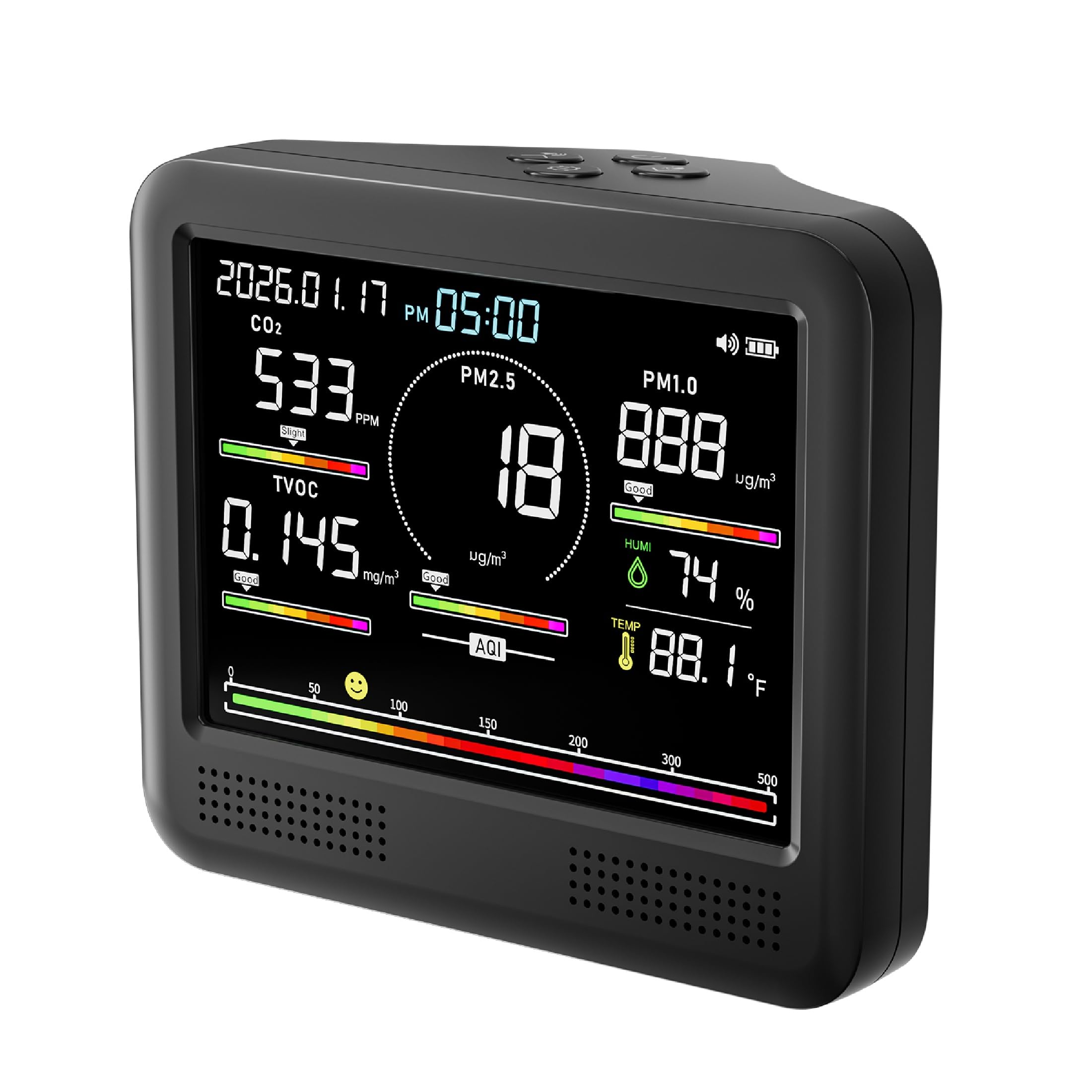
The KDWKD AK23CA goes beyond CO2 to track PM0.3, PM0.5, PM1.0, PM5.0, PM10, formaldehyde (HCHO), TVOC, temperature, and humidity — making it one of the most comprehensive portable air quality monitors in this price bracket. Its 7-level AQI display uses a color-coded warning system that shifts from green to red as conditions worsen, and an optional audible alert sounds when any parameter crosses into unhealthy territory. The large color screen shows all readings simultaneously so you can scan the overall air quality at a glance.
Portability is a strong suit here: the built-in rechargeable battery delivers up to 9 hours of operation, enough to carry the monitor room-to-room, into a hotel, or out to an RV without hunting for an outlet. The USB-C charging port is a welcome modern convenience. Reviewers confirm the CO2 and PM2.5 readings align closely with reference devices like PurpleAir monitors, and the VOC sensor spikes detectably around fresh paint or cleaning chemicals, validating its sensitivity.
Buyers should note that the monitor does not offer Wi-Fi or Bluetooth connectivity — all data is read directly from the screen, and there is no app-based logging or remote alerts. The unit ships with a charging adapter and USB-C cable, and the ABS enclosure feels robust enough for daily handling. For anyone renovating a home, moving into new construction, or dealing with wildfire smoke, this multi-sensor approach provides a fuller picture than a CO2-only monitor ever could.
Why it’s great
- Monitors CO2 plus PM, HCHO, TVOC, temp, and humidity
- 9-hour rechargeable battery for room-to-room portability
- 7-level AQI color display with optional audible alerts
Good to know
- No Wi-Fi or Bluetooth for app-based data logging
- Some units shipped with poor packaging, risk of damage
- Audible alarm can be triggered by alcohol-based products
3. GoveeLife Smart Air Quality Monitor H5140
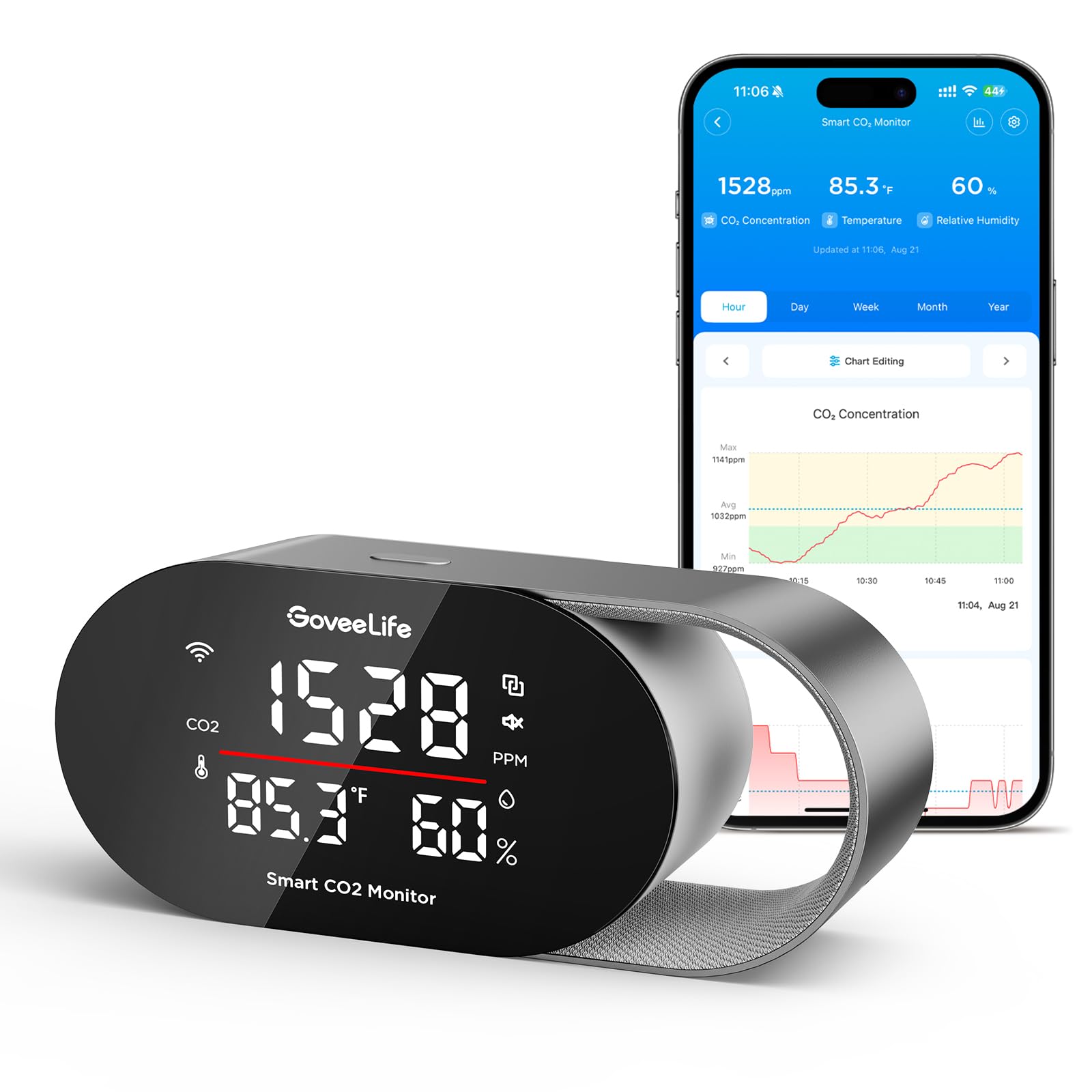
The GoveeLife H5140 uses the photoacoustic NDIR SCD4x sensor, delivering ±(40ppm + 5%) accuracy with a rapid 5-second refresh rate and built-in pressure compensation that maintains precision at any altitude. This AC-powered unit never needs battery swaps, providing uninterrupted 24/7 monitoring ideal for a nursery, home office, or bedroom. The 4.82-inch display shows CO2, temperature, humidity, and a clock, wrapped in a tri-color light bar that changes from green to yellow to red as CO2 climbs.
Smart home integration sets the H5140 apart. You can ask Alexa or Google Assistant for current CO2 readings, and the monitor can trigger smart plugs to activate humidifiers or tower fans when thresholds are exceeded. The companion app tracks up to two years of historical data, with interactive charts and CSV export for professional analysis. The triple alert system — built-in buzzer, app push notification, and email report — ensures you never miss a warning even when you are in another room.
The customizable LED display brightness adjusts on a day/night schedule to avoid disrupting sleep, a thoughtful touch for light-sensitive users. Reviewers consistently praise the actionable awareness it provides, noting that CO2 levels drop measurably after opening a window for just a few minutes. The only caveat is that Wi-Fi connectivity can occasionally drop if the monitor is placed far from the router, and air purifiers cannot be linked since they do not remove CO2 — the integration is specifically for fans and humidifiers.
Why it’s great
- Photoacoustic NDIR sensor with 5-second refresh rate
- Alexa/Google integration for voice queries and smart triggers
- Auto-dimming tri-color light bar on day/night schedule
Good to know
- AC-powered only — no battery backup for placement flexibility
- Wi-Fi may drop if monitor is far from router
- No particulate (PM) detection; CO2-focused only
4. SwitchBot Meter Pro CO2

The SwitchBot Meter Pro CO2 packs a Swiss-made NDIR sensor into a slim 92mm x 79mm x 25mm chassis that weighs just 154 grams, making it one of the most portable CO2 monitors available without sacrificing accuracy. It refreshes CO2 readings every second with a ±50 ppm accuracy window across a 400–9000 ppm range, and the 92mm large screen simultaneously displays CO2, temperature, humidity, time, date, and a comfort-level icon. The minimalist design blends into any room, and the adjustable stand or wall-mount holes give you flexible placement options.
Battery life is exceptional — the built-in cells last up to 12 months under normal use, with a low-battery warning before depletion. Three alert methods cover your bases: a sound audible alarm, on-screen visual warnings, and app notifications through the SwitchBot app (a Hub is required for app connectivity). Multiple verified reviewers cross-checked its readings against Aranet4 and Xiaomi detectors, finding it accurate within 50–100 ppm after initial calibration, with outdoor readings consistently hitting the 400–450 ppm baseline.
A minority of users reported readings that drifted by up to 400 ppm after a week, but SwitchBot customer service replaced defective units promptly, and the replacements performed within spec. The Bluetooth connection works reliably across floors for app data viewing, though graphs can be slow to load on the app side. For anyone who needs a truly portable, battery-efficient CO2 sensor with Swiss sensor pedigree and the option for smart home integration via the SwitchBot ecosystem, this is a compelling mid-range choice.
Why it’s great
- Swiss-made NDIR sensor with ±50 ppm accuracy
- Up to 12-month battery life on a single charge
- Ultra-compact and lightweight at 154g
Good to know
- App notifications require separate SwitchBot Hub purchase
- Some units needed replacement due to sensor drift
- Bluetooth app graphs can be slow to load
5. LifeBasis 11-in-1 Air Quality Monitor

The LifeBasis 11-in-1 monitor covers AQI, CO2, PM1.0, PM2.5, PM10, particles, formaldehyde (HCHO), TVOC, temperature, and humidity — all from a device that costs less than most CO2-only monitors. It combines NDIR infrared CO2 sensing with a laser particle sensor, semiconductor sensor, and photoelectric sensor in a single slim enclosure that measures just 0.95 x 2.92 x 6.3 inches. Each gas index gets its own color-coded icon (green, yellow, orange, red) on the LCD screen, and when any value exceeds normal, the device emits a ticking alert sound and the interface color shifts.
The built-in 2500mAh battery delivers 11–12 hours of continuous use, enough for a full day of moving between rooms or taking to the office. The Type-C charging port is standard and convenient. Multiple verified reviewers confirm the CO2 readings drop measurably after ventilation (from ~950 ppm to 450–500 ppm) and that PM2.5 measurements align well with reference-grade PurpleAir monitors. The manual CO2 calibration procedure — requiring 30 minutes outdoors — is straightforward and ensures baseline accuracy.
There is no Wi-Fi or Bluetooth connectivity, so all data is read from the screen, and there is no historical logging or remote alerts. A faint fan hum is audible at close range due to the laser particle sensor, though it is not disruptive in normal room use. For budget-conscious buyers who want a comprehensive snapshot of indoor air quality across multiple pollutants without committing to a smart ecosystem, the LifeBasis delivers excellent breadth at a very accessible price point.
Why it’s great
- 11 monitored indexes including CO2, PM, HCHO, TVOC
- 11–12 hour battery life with Type-C charging
- Color-coded visual alerts for each gas category
Good to know
- No Wi-Fi, Bluetooth, or app connectivity
- Faint fan hum from laser particle sensor
- Requires manual outdoor calibration for best accuracy
6. Kidde Hardwired Smoke & CO Detector 30CUAR

The Kidde 30CUAR is a hardwired 2-in-1 smoke and carbon monoxide detector that also includes CO2 awareness as part of its broader safety mission. It operates on 120V AC wiring with two included AA alkaline batteries providing backup during power outages, and its interconnect capability means when one alarm sounds, all compatible units in the home sound simultaneously. The enhanced sensing technology is designed to reduce nuisance alarms from cooking while meeting UL 217 9th Edition and UL 2034 4th Edition standards for smoke and CO detection respectively.
Three LED notifications keep you informed at a glance: green for normal operation, amber for an operating error, and red flashing with an 85-decibel alarm when smoke or carbon monoxide is detected. The Test & Hush button lets you silence false alarms easily and test the unit weekly. The self-testing feature continuously checks internal components, though Kidde recommends a manual push-button test once per week as well. The 10-year limited warranty provides long-term peace of mind.
Installation is straightforward for anyone comfortable with ceiling-mount wiring, though older homes may need a connector adapter to match existing mounts. Reviewers note the alarm is extremely loud and easily heard from adjacent rooms. This unit is best suited for homeowners who already need smoke/CO detection and want the added safety net of CO monitoring without adding a separate device — it is a safety complement, not a precision CO2 monitor for tracking ventilation or occupant density.
Why it’s great
- Combined smoke and CO detection in a single hardwired unit
- Interconnectable so all alarms sound simultaneously
- AA battery backup for continued protection during outages
Good to know
- No Wi-Fi, app, or smart home integration
- May require adapter for older wiring configurations
- Does not display CO2 concentration in ppm
7. First Alert SC5 Hardwire Smart Smoke & CO Alarm
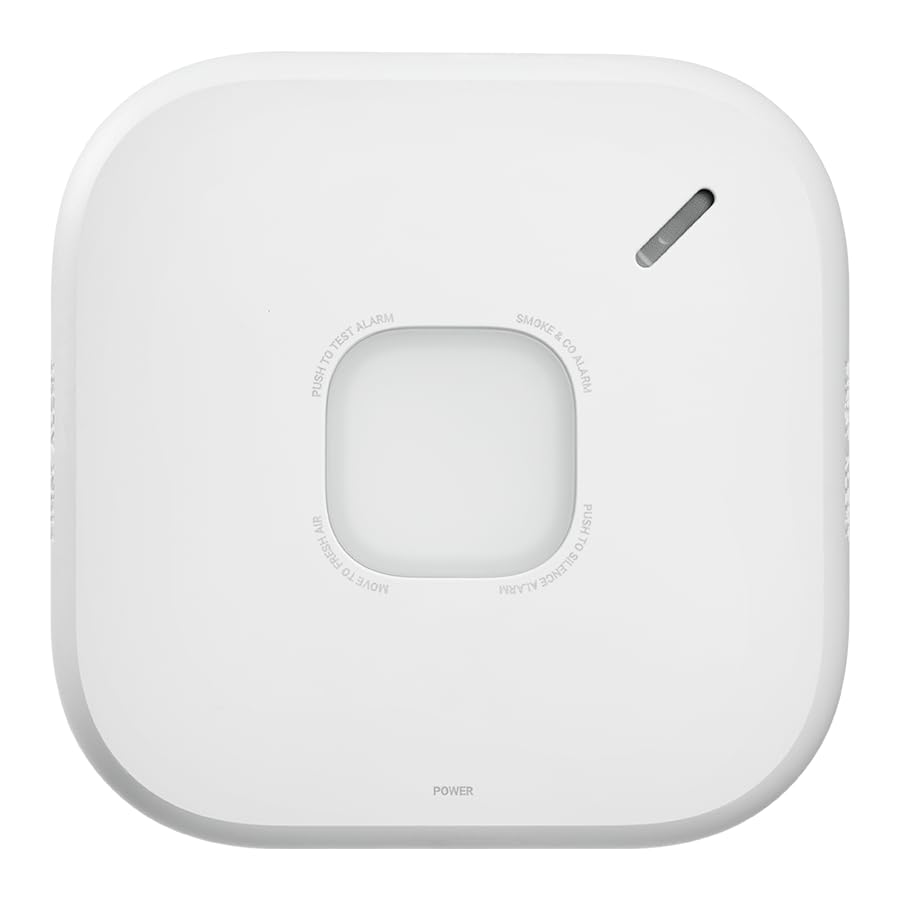
The First Alert SC5 brings smart connectivity to smoke and carbon monoxide detection, sending phone alerts through the First Alert app when smoke or CO is detected. It is designed to be compatible with Google’s Nest Protect ecosystem, allowing you to mix and match alarms across your home while maintaining interconnect capability — when one alarm detects danger, all compatible alarms sound. The Quick Connect Plug makes installation and replacement tool-free, with no need to rewire if replacing an existing hardwired unit.
Precision Detection Technology aims to reduce nuisance alarms from cooking or steam while still providing early warning of real threats. Voice alerts tell you the specific type and location of danger in the home, a significant upgrade over generic beeping. A 3V lithium battery pack provides backup during power outages, and the interconnect works across all compatible First Alert and Nest Protect alarms. The SC5 integrates with Google Home for voice control and notification routing through the Google Home app.
Customer experiences are sharply divided. Some users report flawless integration with existing Nest Protects and easy installation, while a significant number describe persistent false alarms — often in the middle of the night — that cannot be silenced through the app or the button, forcing physical disconnection from the ceiling. These reports suggest possible quality control issues with the sensor or firmware. If you already have Nest Protects and want smart CO monitoring, the SC5 has potential, but the false-alarm risk makes it a cautious recommendation for CC2 detection specifically.
Why it’s great
- Works with Google Nest Protect for unified smart safety
- Phone alerts via First Alert app for remote awareness
- Voice warnings identify danger type and location
Good to know
- Frequent reports of false alarms that cannot be silenced
- No nightlight feature compared to Nest Protect
- Some users found Google Home integration requires extra steps
FAQ
What is the difference between CO2 and carbon monoxide detectors?
Can an NDIR CO2 sensor lose accuracy over time?
Why does my air purifier not help with high CO2 levels?
How often should I check CO2 levels in my home office?
Final Thoughts: The Verdict
For most users, the best air quality co2 sensor winner is the Autopilot Desktop CO2 Monitor because its proven NDIR sensor, onboard 7-day trend logging, and reliable USB-powered operation make it the most trustworthy tool for understanding your indoor air patterns without any app or subscription dependency. If you want a fully integrated smart monitor that talks to Alexa, tracks two years of data, and auto-dims its display for nighttime, grab the GoveeLife Smart Air Quality Monitor. And for comprehensive multi-pollutant detection in a portable battery-powered package, nothing beats the KDWKD AK23CA.