
The hardest part of landscape photography isn’t waking up before dawn or hiking three miles in the dark — it’s choosing a camera that won’t fight you when the light is low, the wind is gusting, and you have exactly five minutes to capture golden hour. Beginners often grab whatever looks affordable, only to discover their sensor struggles with dynamic range, their kit lens lacks the reach for distant peaks, or their autofocus hunts endlessly in twilight. This guide targets the exact specs that matter for outdoor scenics: dynamic range, weather sealing, native ISO performance, and lens ecosystem.
I’m Min — the co-founder and writer behind Gadgets Feed. I’ve spent countless hours analyzing sensor specs, lens roadmaps, and real-world user reports to identify which entry-level bodies actually produce wall-worthy landscape prints without demanding a second mortgage.
Whether you are shooting sweeping vistas in Yellowstone or intimate forest streams in the Pacific Northwest, this guide ranks the best beginner camera for landscape photography by balancing image quality, ease of use, and long-term upgrade potential.
How To Choose The Best Beginner Camera For Landscape Photography
Selecting your first landscape camera means prioritizing outdoor-specific traits over general-purpose specs. A great deal on a sports-oriented body will frustrate you when its dynamic range clips shadows under a pine forest canopy. Here are the three filters every landscape beginner should apply before buying.
Sensor Size and Dynamic Range
Full-frame sensors (35.6×23.8mm) capture about 2.5× more light than APS-C (23.5×15.6mm) per pixel at the same f-stop, which directly translates to wider dynamic range — the ability to retain detail in bright skies and dark foregrounds simultaneously. Entry-level full-frame options like the Canon EOS RP or Sony a7 III deliver 13-15 stops of dynamic range, while even the best APS-C sensors hover around 11-13 stops. For landscapes, that extra range means less time blending exposures in post-processing. That said, APS-C bodies are significantly lighter and cheaper, and many produce prints up to 20×30 inches that look indistinguishable from full-frame to untrained eyes.
Weather Sealing and Build Durability
Landscape photographers shoot in drizzle on the coast, dust storms in the desert, and freezing fog at altitude. A camera with weather-sealed magnesium-alloy chassis (like the Panasonic G85 or OM System E-M10 Mark IV) protects internal electronics from moisture and particulates. Budget bodies such as the Nikon D3500 lack formal weather seals — fine for fair-weather use, but risky if you plan to shoot near waterfalls or in light rain. Check the manufacturer’s wording: “weather-sealed” means gaskets around buttons, dials, and memory card doors; “weather-resistant” is a lower standard.
Lens Ecosystem and Kit Lens Quality
A beginner’s first landscape lens will likely be the kit zoom. The Canon RF-S 18-45mm on the EOS R100 or the 12-60mm on the Panasonic G85 both offer wide-angle vantage points essential for scenic work, but their slow apertures (f/4.5-6.3 range) force higher ISOs in low light. The real advantage of mirrorless systems like Sony E-mount or Canon RF-S is the future access to affordable ultra-wide primes and zooms (e.g., Sony 11mm f/1.8 or Canon RF-S 10-18mm). A body with the deepest third-party lens support — Sony E and Micro Four Thirds — gives you the most upgrade paths without system lock-in.
Quick Comparison
On smaller screens, swipe sideways to see the full table.
| Model | Category | Best For | Key Spec | Amazon |
|---|---|---|---|---|
| Sony a7 III | Full-Frame Mirrorless | Best low-light dynamic range | 15-stop dynamic range | Amazon |
| Nikon Z 7II | High-Resolution Full-Frame | Ultra-high detail for large prints | 45.7MP BSI CMOS sensor | Amazon |
| Panasonic S5II | Video-Focused Full-Frame | Hybrid photo/video landscapes | Phase Hybrid AF, Active I.S. | Amazon |
| Canon EOS RP | Entry Full-Frame | Budget-friendly full-frame | 26.2MP full-frame sensor | Amazon |
| Fujifilm X-T30 III | APS-C Mirrorless | Film simulation colors out of camera | 26.1MP X-Trans BSI sensor | Amazon |
| Sony A6100 | APS-C Mirrorless | Fastest autofocus in class | 425 phase-detection AF points | Amazon |
| OM System E-M10 IV | Micro Four Thirds | Compact travel landscape setup | 5-Axis IBIS, 4.5 stops | Amazon |
| Panasonic G85 | Micro Four Thirds | Weather-sealed value | Dual I.S. 2 stabilization | Amazon |
| Canon EOS R100 | APS-C Mirrorless | Lightest mirrorless starter | 143-zone Dual Pixel AF | Amazon |
| Canon Rebel T7 (2000D) | DSLR | Classic DSLR experience | Optical viewfinder, 9 AF points | Amazon |
| Nikon D3500 | DSLR | Cheapest reliable entry point | 24.2MP, 5 fps, 11 AF points | Amazon |
In‑Depth Reviews
1. Sony a7 III Full-Frame Mirrorless with 28-70mm Lens

The Sony a7 III remains the gold standard for beginners entering full-frame landscape work because of its 15-stop dynamic range and 24.2MP back-illuminated sensor that resolves shadow detail deep into the woods without noise. Its 693 phase-detection AF points cover 93% of the frame, so composing near foreground boulders with distant peaks stays sharp even at f/11. The 28-70mm kit lens is competent but you will want to swap it for a wider zoom or a fast prime for astro-landscapes.
Battery life is exceptional at 710 shots per charge — enough for a full dawn-to-dusk outing without a spare. The in-body image stabilization helps steady handheld shots during twilight when tripod setup is impractical. The menu system is dense, but the touch focus and exposure compensation dial make exposure adjustments fast once you learn the layout.
At this price point, the a7 III offers the best sensor performance per dollar among full-frame options, and the E-mount ecosystem includes Sigma and Tamron ultra-wide lenses that cost half of Sony’s native glass. The 10 fps continuous shooting is overkill for landscapes but useful if you also shoot wildlife.
Why it’s great
- Industry-leading 15-stop dynamic range recovers highlights and shadows effortlessly
- Massive battery life supports all-day landscape sessions
- Deep third-party lens ecosystem saves money on ultra-wides
Good to know
- Menu system is cluttered and takes time to learn
- Kit lens is mediocre for true wide-angle landscape work
- Fully weather-sealed but older body design lacks modern features like a fully articulating screen
2. Nikon Z 7II Ultra-High Resolution Full-Frame Mirrorless

The Nikon Z 7II is the resolution king for landscape beginners who want to crop aggressively or print billboard-sized panoramas. Its 45.7MP BSI sensor captures enough detail that you can crop to a 16-megapixel composition from a single frame — useful when you cannot physically move closer to a distant waterfall or summit. The built-in intervalometer and in-camera timelapse with exposure smoothing are tailored for long-exposure cloud movement and day-to-night transitions.
The dual card slots (CFexpress/XQD and UHS-II SD) give you redundancy during multi-day backcountry trips, and the weather-sealed magnesium body handles drizzle and dust at coastal overlooks. The native Z-mount 24-50mm kit zoom is optically sharp but has a slow variable aperture; upgrading to the Z 14-30mm f/4 S unlocks the Z 7II’s true landscape potential.
Autofocus improvement over the original Z 7 means subject detection locks onto tree lines and mountain ridges faster, though it still trails Sony’s A7R series for speed. For landscapes where precision matters more than burst rate, the Z 7II’s 10 fps is ample. The 4K 60p video capability adds flexibility for capturing moving clouds or streams in high detail.
Why it’s great
- 45.7MP allows massive crops without losing resolution
- Built-in intervalometer with exposure smoothing for timelapses
- Dual card slots protect against card failure on remote trips
Good to know
- High resolution requires good glass to see the benefit
- Slow 24-50mm kit lens is not ideal for wide landscapes
- Native Z-mount lenses are fewer and pricier than E-mount alternatives
3. Panasonic LUMIX S5II Mirrorless with 20-60mm Lens
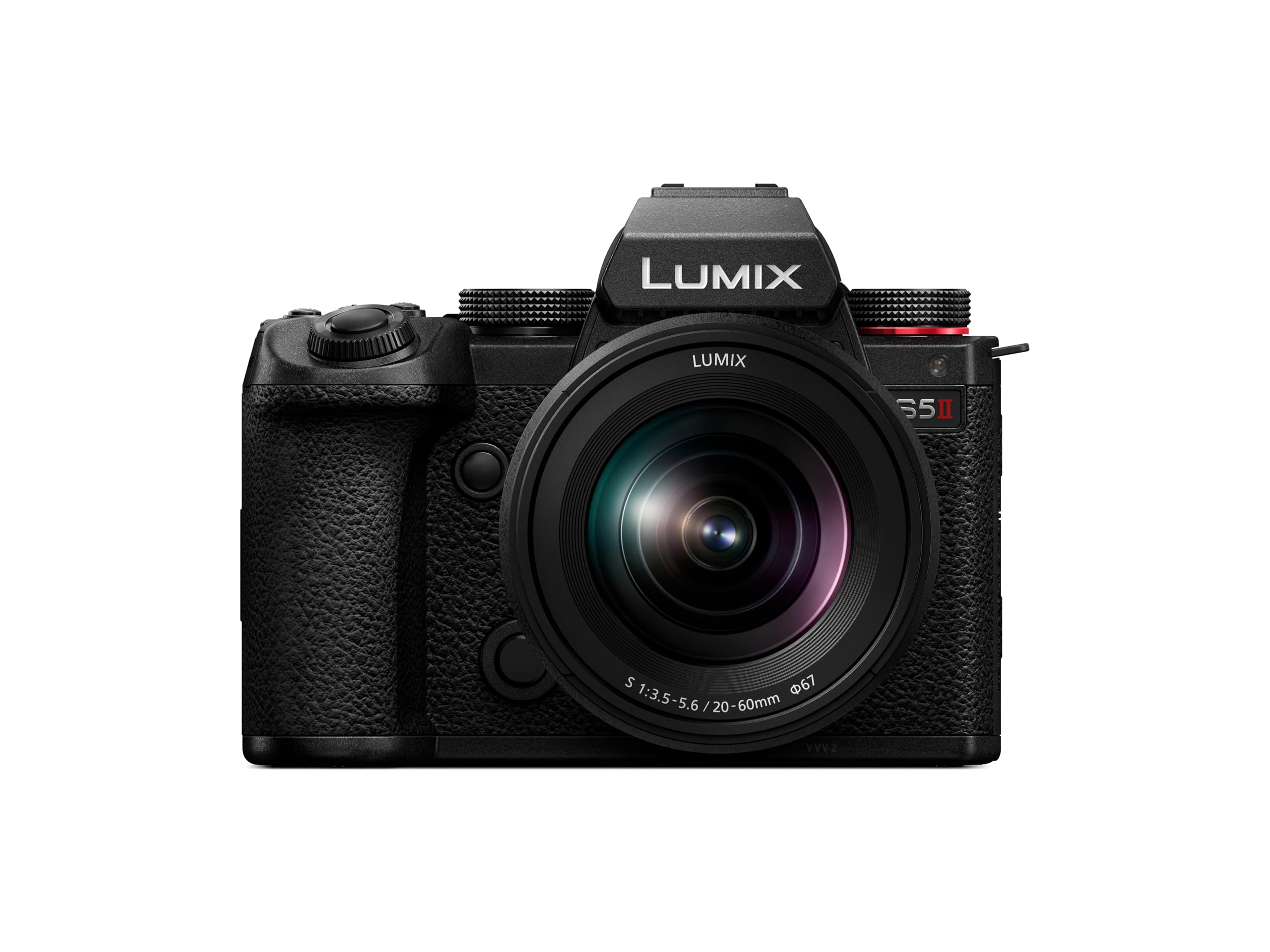
The Panasonic S5II solves the autofocus complaint that plagued previous Lumix cameras by introducing Phase Hybrid AF with subject detection that locks onto foreground trees and rock formations reliably. Its 24.2MP full-frame sensor delivers 14+ stops of dynamic range in V-Log mode, giving beginners the flexibility to grade sunset gradients without seeing banding. The 20-60mm kit lens provides a genuinely useful wide end for landscapes — wider than the typical 24-28mm start point of competitors.
Active Image Stabilization is a standout feature for handheld waterfall long exposures or shooting from a moving boat, providing gimbal-like steadiness. The internal fan enables unlimited 4K 10-bit recording, so long timelapses or interviews about your shooting location never overheat. Build quality is excellent with magnesium alloy and weather sealing, though the body is slightly boxy compared to the a7 III.
The L-mount alliance includes Sigma and Leica glass, giving you access to pro-grade ultra-wides like the Sigma 14-24mm f/2.8. The REAL TIME LUT function applies in-camera color grading, so you can preview a cinematic look directly in the electronic viewfinder without post-processing.
Why it’s great
- Active I.S. enables sharp handheld long exposures
- 20-60mm kit lens gives true wide-angle for landscapes
- Unlimited 4K 10-bit recording with no overheating
Good to know
- Battery life is short — plan to carry two spares
- L-mount lens selection is smaller than Sony E-mount
- High ISO above 51200 shows noticeable noise
4. Canon EOS RP Full-Frame with RF 24-105mm Lens

The Canon EOS RP is the most affordable gateway to full-frame landscape photography, packing a 26.2MP sensor into a body that weighs just 1.07 pounds including battery. The RF 24-105mm kit lens offers a versatile range from wide-angle to short telephoto — ideal for capturing everything from a sweeping valley to a compressed mountain ridge — with up to 5 stops of optical stabilization helping combat camera shake in low light. The Dual Pixel CMOS AF provides fast, accurate phase detection across the frame, and the flip-out touchscreen makes low-angle ground compositions much easier.
Image quality is excellent for the price, with full-frame depth of field rendering natural subject separation even with the kit lens stopped down. The 14-bit RAW files retain good shadow recovery for bringing up underexposed forest foregrounds. However, the 4K video mode crops 1.6× and limits recording to 30 minutes, so this body leans primarily as a stills machine.
The legacy Canon RF mount gives access to premium L-series glass and adapters for EF lenses, making the RP a solid starter body you can keep as your lens collection grows. The menu system is simpler than Sony’s, and the touch-and-drag AF in the viewfinder feels natural for landscape composition.
Why it’s great
- Lightest and cheapest entry into full-frame mirrorless
- RF 24-105mm OIS kit lens covers wide-to-tele range
- Simple menu and touch interface great for beginners
Good to know
- 4K video has a 1.6× crop and 30-minute limit
- Battery life is average — roughly 3 hours of active shooting
- Kit lens edges are soft at wide apertures; best at f/8
5. FUJIFILM X-T30 III Mirrorless Camera Body

The Fujifilm X-T30 III delivers APS-C image quality with a twist: 20 built-in Film Simulations that produce finished JPEGs with rich, filmic color profiles — Velvia for vibrant greens and blues in landscapes, Classic Chrome for muted earthy tones. This is the camera for beginners who want to skip heavy post-processing and get shareable photos straight out of camera. The 26.1MP X-Trans BSI 4 sensor captures excellent detail, and the 425-point hybrid phase/contrast AF system locks onto low-contrast landscape subjects reliably.
The compact magnesium body weighs only 13.7 ounces, making it a true lightweight companion for steep hikes. The electronic viewfinder is crisp (2.36M-dot OLED) and shows real-time exposure preview, so you see your Velvia sunset before you press the shutter. The Auto mode is genuinely good — hand it to a non-photographer friend and they will still get well-exposed results.
The X-T30 III body-only kit means you need to add a lens; the XC 15-45mm or XF 16-80mm are solid landscape starters, and the Fujifilm lens catalog is well-regarded for sharpness and character. The lack of in-body stabilization is a downside for handheld twilight shots, but the camera’s small size makes tripod packing easy.
Why it’s great
- Film Simulations create stunning JPEGs without editing
- Extremely light and compact for hiking
- Excellent hybrid autofocus with subject detection
Good to know
- No in-body image stabilization for handheld low light
- Body-only — lens purchase required
- X-Trans raw files need specific raw converters for best results
6. Sony ILCE6100KB Alpha 6100 with 16-50mm Lens

The Sony A6100 pairs a 24.2MP APS-C sensor with the fastest autofocus system in the sub-800 class: 425 phase-detection points covering 84% of the sensor with Real-time Eye and Object tracking. For landscape beginners, this means the camera can lock onto a distant bird, a foreground flower, or a moving stream surface and hold focus during 11 fps bursts. The Exmor sensor with front-end LSI delivers clean files up to ISO 3200, suitable for twilight shooting without heavy noise reduction.
The kit 16-50mm power zoom is compact and retractable for pocketability, but its f/3.5-5.6 aperture and image quality are average — landscape shooters will want to upgrade to the Sigma 16mm f/1.4 or Sony 10-18mm f/4 quickly. The 4K video oversamples from 6K with full pixel readout, giving detailed 4K footage of moving clouds or waterfalls. The 180-degree tilt screen works well for low-angle ground compositions but does not fully articulate for vertical portrait-format landscapes.
The A6100 is small enough to pack in a hip pouch on a climb, and the Sony E-mount ecosystem remains the richest for third-party lenses. The menu system is classic Sony complexity, but recent firmware updates have improved the touch interface slightly.
Why it’s great
- 425-point AF is the best in its class for locking focus
- 11 fps continuous shooting captures fast-changing light
- Massive third-party lens support for future upgrades
Good to know
- Kit 16-50mm lens is optically mediocre for landscapes
- Menu system is cluttered and unintuitive
- No weather sealing – risky in rain or dust
7. OM SYSTEM Olympus E-M10 Mark IV with 14-42mm EZ Lens

The OM System E-M10 Mark IV packs a 20MP Micro Four Thirds sensor into a body that fits in a large jacket pocket — the ultimate travel companion for landscape photographers who prioritize pack weight over ultimate resolution. The 5-Axis In-Body Image Stabilization compensates for 4.5 stops of camera shake, enabling clean 1-second handheld exposures of streams and waterfalls that would require a tripod on larger systems. The flip-down selfie screen is gimmicky for landscapes, but the high-resolution 2.36M-dot EVF is sharp and color-accurate for composing.
Image quality is excellent up to ISO 3200, and the 14-42mm EZ pancake kit lens collapses to a tiny profile for trail packing. The Micro Four Thirds 2× crop factor means the 14-42mm gives a 28-84mm full-frame equivalent field of view — wide enough for most scenic work, though you lose the extreme wide-angle of a 24mm equivalent. The scene modes and in-camera panorama stitching are genuinely helpful for beginners who do not want to stitch photos in software later.
The OM System lens catalog includes compact high-quality zooms like the 12-45mm f/4 PRO that pair perfectly for hiking. The app connectivity for GPS tagging photos is useful for mapping your shooting locations, though the Wi-Fi transfer speed is slow.
Why it’s great
- Very small and light for easy mountain packing
- 5-Axis IBIS enables handheld long exposures
- Built-in panorama and scene modes simplify landscape capture
Good to know
- Micro Four Thirds has less dynamic range than APS-C
- 2× crop factor makes wide-angle lenses less wide
- Slow burst rate compared to Sony/Canon APS-C
8. Panasonic LUMIX G85 4K with 12-60mm Power O.I.S. Lens

The Panasonic G85 is the budget king of stabilization and weather sealing in a single package. The 16MP sensor lacks an optical low-pass filter to boost fine detail resolution, and the 5-Axis Dual I.S. 2 combines in-body and lens stabilization to deliver sharp photos at shutter speeds 3-4 stops slower than normal — perfect for handheld forest-floor shots at 1/8 second. The magnesium-alloy body with splash-resistant seals allows you to shoot confidently in light rain or coastal spray, a feature almost unseen at this price tier.
The 12-60mm kit lens offers a 24-120mm full-frame equivalent, covering ultra-wide landscape vistas to a moderate telephoto compression for distant peaks. The 4K Photo mode lets you pull 8MP stills from 30 fps video — useful for capturing the exact split-second wave crashes or cloud formations. Post Focus allows you to refocus after capture, a unique teaching tool for understanding depth of field.
The electronic viewfinder is a high-quality OLED with 2.36M dots and 0.74× magnification, providing a bright preview even in midday sun. The 49-point contrast-detection AF is slower than modern phase-detect systems, but for static landscapes it never fails to lock.
Why it’s great
- Best-in-class stabilization for the price point
- Weather-sealed magnesium body handles wet conditions
- 12-60mm kit lens has useful wide-angle start
Good to know
- 16MP sensor is lower resolution than APS-C competitors
- Contrast-detect AF hunts in very low light
- Heavier than its plastic-bodied peers despite weather sealing
9. Canon EOS R100 with RF-S 18-45mm Lens

The Canon EOS R100 is the lightest and most affordable mirrorless body in the entire EOS R series, weighing just 12 ounces with the RF-S 18-45mm lens attached. The 24.1MP APS-C sensor paired with Canon’s DIGIC 8 processor produces pleasing color science straight out of camera, with natural greens and blues that suit outdoor scenes. The Dual Pixel CMOS AF covers 143 zones with human, animal, and vehicle detect, ensuring sharp focus on wildlife that wanders into your landscape frame.
The kit lens (18-45mm f/4.5-6.3) provides a 29-72mm full-frame equivalent, which is wide enough for most landscape work but lacks the dramatic distortion of true 16-18mm ultra-wide angles. The compact size makes it ideal for packing in a daypack alongside water and snacks. The 4K video captures at 24 fps with oversampling from 6K, delivering surprisingly detailed footage of flowing water or cloud movement.
The user interface is Canon’s typically beginner-friendly layout with a guided mode that explains settings in plain language. The absence of a hotshoe for adding a remote shutter release or external microphone for video is a limitation for more advanced work. No weather sealing means you need to keep it dry in wet conditions.
Why it’s great
- Smallest and lightest body for taking on long hikes
- Very intuitive beginner interface with guided modes
- 4K oversampled video looks great for waterfall clips
Good to know
- No hotshoe for external remote or flash
- Not weather-sealed — avoid rain and dust
- Slow f/4.5-6.3 kit lens limits low-light performance
10. Canon EOS 2000D (Rebel T7) with 18-55mm Lens + Accessories

The Canon Rebel T7 (EOS 2000D) represents the traditional DSLR approach to learning landscape photography — an optical viewfinder with no lag, a physically separated shutter and aperture system, and the classic Canon DSLR menu that teaches exposure triangle fundamentals. The 24.1MP APS-C sensor with DIGIC 4+ processor delivers solid 12-bit raw files with enough detail for 16×20 prints. The 18-55mm f/3.5-5.6 kit lens gives a 28.8-88mm full-frame equivalent, offering moderate wide-angle to short telephoto coverage.
The bundled accessory kit (case, memory card, tripod) provides immediate usability — you can start shooting landscapes the day it arrives. The built-in Wi-Fi with NFC allows quick photo transfer to a phone for social sharing from the trail. The 9-point autofocus system is basic by 2025 standards, but for static landscapes with a single focal point, it is perfectly adequate. The optical viewfinder provides a bright, direct optical path that never suffers from EVF lag or refresh rate issues.
Battery life is excellent at up to 500 shots per charge. The ISO range tops out at 6400 with noticeable noise above 1600, so twilight shooting benefits from a tripod. The lack of 4K video limits its use for video-focused landscape work.
Why it’s great
- Classic DSLR design teaches manual controls intuitively
- Excellent battery life for all-day field sessions
- Accessories kit includes everything to start immediately
Good to know
- 9 AF points is very limited compared to mirrorless rivals
- No 4K video recording
- DIGIC 4+ processor shows its age in processing speed
11. Nikon D3500 with 18-55mm VR Lens (Renewed)

The Nikon D3500 is the quintessential budget-friendly entry point for landscape beginners who want to learn exposure fundamentals without investing heavily. The 24.2MP DX-format sensor lacks an optical low-pass filter, which means it resolves slightly more detail than the Canon T7 on distant textures like cliff faces and tree bark. The Native ISO range of 100-25600 offers more headroom than the Rebel T7, though high-ISO noise still limits twilight shooting without a tripod. The 5 fps continuous shooting is sufficient for capturing cloud motion or wave sequences.
The kit 18-55mm f/3.5-5.6G VR lens includes Nikon’s Vibration Reduction optical stabilization, which helps steady handheld shots at shutter speeds 3 stops slower than normal. Guide Mode walks beginners through aperture, shutter speed, and ISO settings by simulating real-world scenarios like “blur the waterfall” or “freeze the stream.” The 11-point autofocus system is adequate for single-point landscape work but lacks the coverage of modern mirrorless systems.
This is a 2018 DSLR design with no 4K video, no touchscreen, and no Wi-Fi onboard (SnapBridge app can act as a bridge, though users report it crashes during long exposures). The D3500 is best viewed as a learning tool — you can shoot for years, master composition and exposure, then upgrade to a mirrorless system with full confidence.
Why it’s great
- No low-pass filter boosts fine detail resolution
- Guide Mode is excellent for teaching exposure concepts
- VR lens stabilization helps handheld shots in low light
Good to know
- No 4K video and no touchscreen
- Only 11 AF points — limited for dynamic scenes
- SnapBridge app issues with long exposure and bulb mode
FAQ
Do I need a full-frame sensor for landscape photography as a beginner?
How many megapixels do I need for printing landscape photos?
What is the most important lens characteristic for landscape photography?
Is image stabilization important for landscape photography?
Should I buy a mirrorless camera or a DSLR for learning landscape photography?
Final Thoughts: The Verdict
For most users, the beginner camera for landscape photography winner is the Sony a7 III because its 15-stop dynamic range and full-frame sensor give beginners the widest creative latitude to learn exposure without hardware limitations. If you want the best blend of portability and stabilization for hiking, grab the Panasonic G85. And for the absolute most affordable entry point that still takes great scenic photos, nothing beats the Nikon D3500.