
Watching your dog struggle to stand, drag their back legs, or lose the ability to walk is heartbreaking. An artificial limb — typically a rear-support wheelchair or prosthetic cart — can restore your dog’s freedom to run, explore, and live pain-free. But the wrong choice can cause chafing, instability, or even worsen your dog’s condition.
I’m Min — the co-founder and writer behind Gadgets Feed. I’ve spent hundreds of hours cross-referencing veterinary recommendations, frame materials (aluminum vs. steel), wheel types (foam vs. pneumatic), weight capacities, and adjustability ranges to find the safest and most durable options for your four-legged friend.
Whether your dog is recovering from IVDD surgery or managing degenerative myelopathy, this guide ranks the most reliable artificial limbs for dogs based on real customer experiences and technical specs.
How To Choose The Best Artificial Limbs For Dogs
A dog wheelchair is not a one-size-fits-all purchase. The wrong frame geometry can cause pressure sores or make your dog refuse to move. You need to match the cart’s adjustability, wheel type, and weight capacity to your dog’s specific condition and size.
Frame Material and Adjustability
Aircraft-grade aluminum frames keep the cart light (under 10 lbs for small models) while supporting dogs up to 180 lbs. Look for a patented adjustable design that lets you tweak height, length, and width as your dog’s health changes — essential for degenerative conditions where muscle mass shifts over time.
Wheel Type and Terrain Capability
Foam-core wheels with rubber treads are puncture-proof and roll quietly on pavement, grass, and gravel. Pneumatic tires offer more shock absorption on rough trails but risk flats. For dogs that spend most time indoors or on suburban sidewalks, dense foam wheels are the lower-maintenance choice.
Harness and Abdominal Support
Reinforced abdominal straps redistribute weight off the spine and hips — critical for dogs with IVDD or degenerative myelopathy. A soft, non-irritating harness prevents rubbing around the thighs and chest. Some models include a front harness for quick attachment, which simplifies the daily on/off routine.
Quick Comparison
On smaller screens, swipe sideways to see the full table.
| Model | Category | Best For | Key Spec | Amazon |
|---|---|---|---|---|
| Walkin’ Wheels (Large) |
Premium | Large breeds 70–180 lbs | 17 lb aluminum frame, 14–16 in leg height | Amazon |
| Walkin’ Wheels (Small, Blue) |
Mid-Range | Small dogs 15–25 lbs | 5 lb aluminum frame, 6–8 in leg height | Amazon |
| Walkin’ Wheels (Small, Seafoam) |
Mid-Range | Small dogs 15–25 lbs | 3 lb aluminum frame, 6–8 in leg height | Amazon |
| Virbraroo All-Terrain (Medium) |
Premium | Medium to large dogs | Aircraft aluminum, oversized wheels | Amazon |
| Virbraroo All-Terrain (Large/XL) |
Premium | Large dogs 55–88 lbs | 11.8 in wheels, 10.4 lb frame | Amazon |
| All-Terrain Dog Cart (Mid) |
Mid-Range | Medium dogs 35–48.5 lbs | 7.9 in all-terrain wheels | Amazon |
| Best Friend Mobility FML Elite |
Mid-Range | Large breeds 5–175 lbs | 13 lb aluminum frame, toolless width | Amazon |
| Walkin’ Wheels (Dachshund) |
Budget | Small breeds 2–30+ lbs | 10 lb aluminum frame, dense foam wheels | Amazon |
| Virbraroo All-Terrain (Medium, ver.2) |
Premium | Medium to large dogs | Aircraft aluminum, oversized wheels | Amazon |
In‑Depth Reviews
1. Walkin’ Wheels Dog Wheelchair (Large)

The Walkin’ Wheels large model is the gold standard for big breeds. Its 17-pound extruded aluminum frame supports dogs from 70 to 180 pounds while remaining light enough to lift into a car. The patented adjustable design lets you change height, length, and width without tools — crucial for dogs with degenerative myelopathy whose muscle tone shifts over time.
The dense foam wheels with rubber treads are puncture-proof and roll quietly on pavement, grass, and gravel. Owners report dogs adapting within minutes and walking a mile daily after just a month. The cart folds flat for storage, and all parts are washable — a practical detail when dealing with outdoor mud.
Customer feedback over five years shows the frame holds up through heavy use, including surviving a car accident. Some owners added reflective strips for nighttime visibility and foot braces to prevent knuckling, but the base design is solid enough that most dogs regain meaningful mobility within a week.
Why it’s great
- Adjustable width, height, and length without tools
- Folds flat for transport and storage
- Proven track record with dogs up to 180 lbs
Good to know
- Assembly can take a couple of hours initially
- Foam wheels wear faster than pneumatic on rough terrain
2. Virbraroo All-Terrain Dog Wheelchair (Medium)
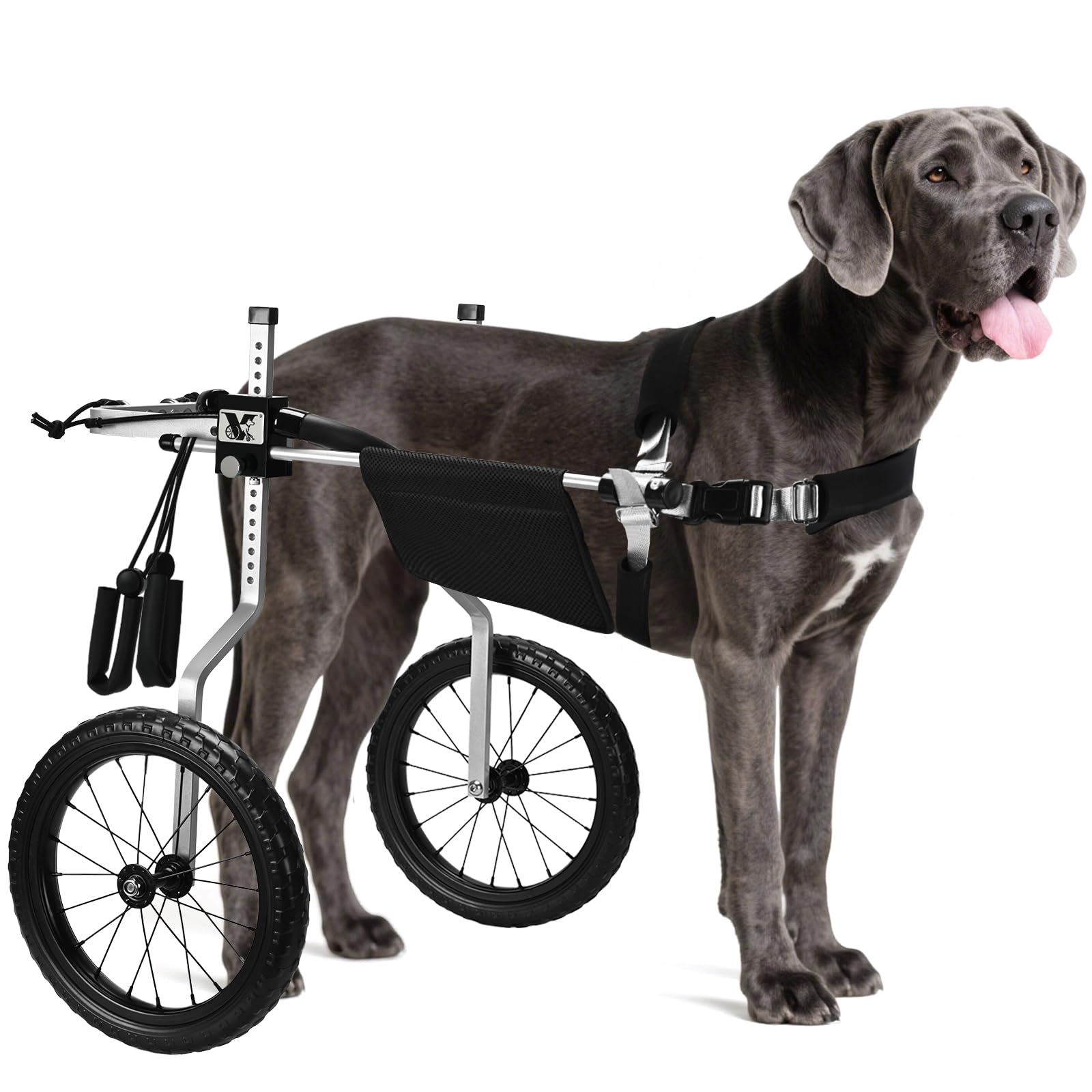
Developed with veterinary experts, the Virbraroo All-Terrain cart is built for dogs that love the outdoors. Its aircraft-grade aluminum frame is ultra-lightweight yet strong enough for medium to large breeds with hind-leg paralysis, arthritis, or IVDD. The oversized rugged wheels handle grass, gravel, trails, and sand far better than standard foam wheels.
The reinforced abdominal strap redistributes weight off the spine and hips — a key feature for dogs with degenerative myelopathy. Setup is tool-free for length, height, and width adjustments, though some owners found the initial sizing slightly tricky for very large dogs. Once dialed in, dogs adapt quickly and can manage uneven terrain without tipping.
A 12-month frame warranty covers the structure, but a few users noted the plastic wheel hubs felt less robust than the aluminum frame. For owners prioritizing all-terrain capability over puncture-proof simplicity, this cart offers the best mix of weight savings and trail performance in its class.
Why it’s great
- Oversized wheels excel on rough surfaces
- Tool-free adjustable frame
- Veterinarian-recommended design
Good to know
- Some users report plastic wheel components
- Requires tools for final tightening of hardware
3. Virbraroo XL Dog Wheelchair (55–88 lbs)
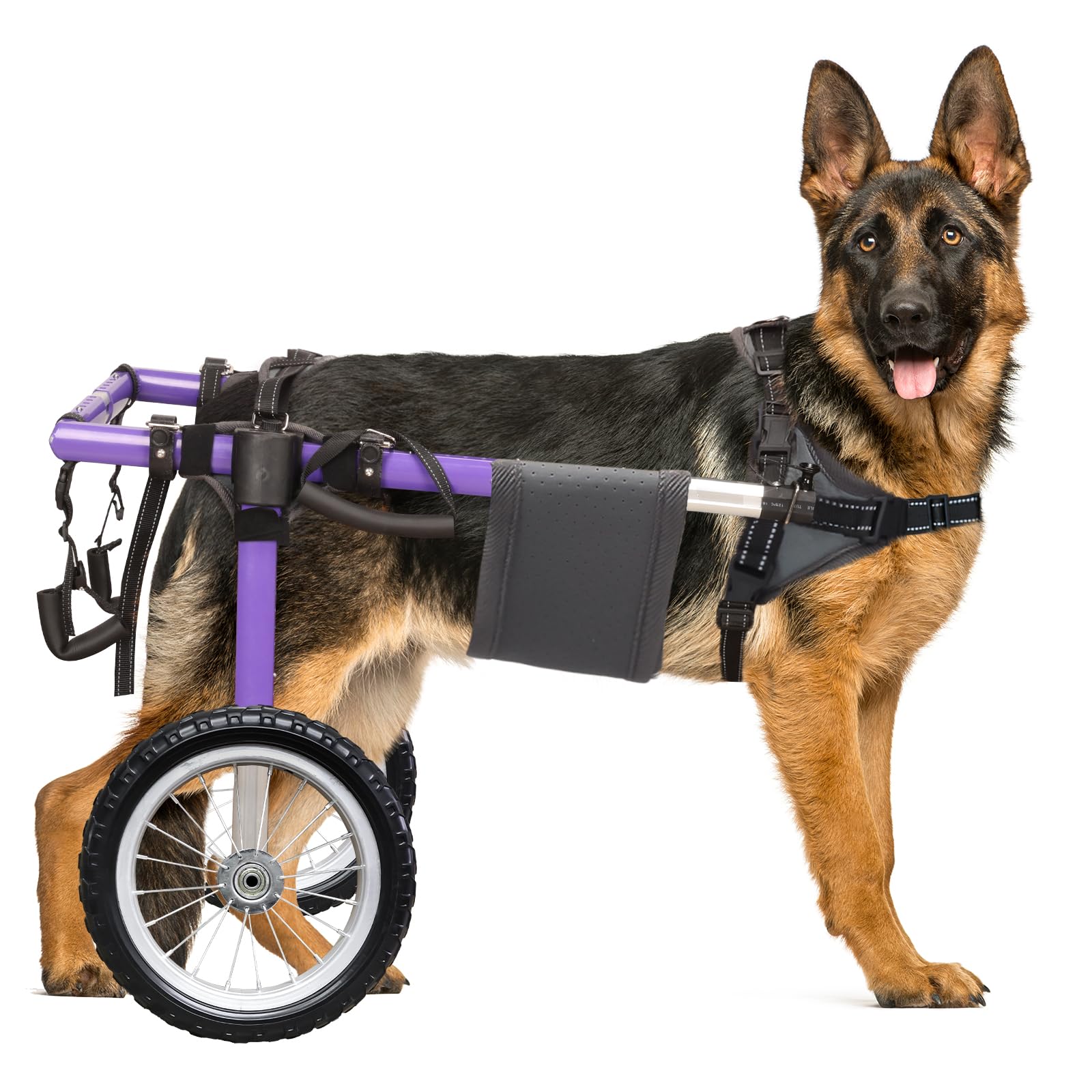
Built for large breeds between 55 and 88 pounds, the Virbraroo XL stands out for its 11.8-inch all-terrain wheels and upgraded rear handle that lets you lift a heavy back end without straining. The aircraft-grade aluminum frame keeps total weight around 10.4 pounds — impressive for a cart this size.
Soft foam tubes replace rigid leg harnesses, adapting to natural leg movements while reducing friction around the thighs. The front harness design allows attachment while the dog stands, eliminating the need to lift a heavy pet into the cart. For dogs with degenerative myelopathy or IVDD, the reinforced abdominal strap effectively redistributes spinal pressure.
Some owners experienced wheel retention issues after several uses, though the seller responded quickly with replacement parts. The included strap system has a learning curve — several users noted the instructions for the belts are less clear than the frame assembly guide. Once properly fitted, most dogs regain confident mobility within days.
Why it’s great
- Large wheels handle grass, gravel, and trails
- Upgraded rear handle for easy lifting
- Soft foam leg supports reduce chafing
Good to know
- Wheel retention bolts may need frequent checking
- Strap setup instructions are confusing
4. Walkin’ Wheels Small Dog Wheelchair (Blue, 15–25 lbs)
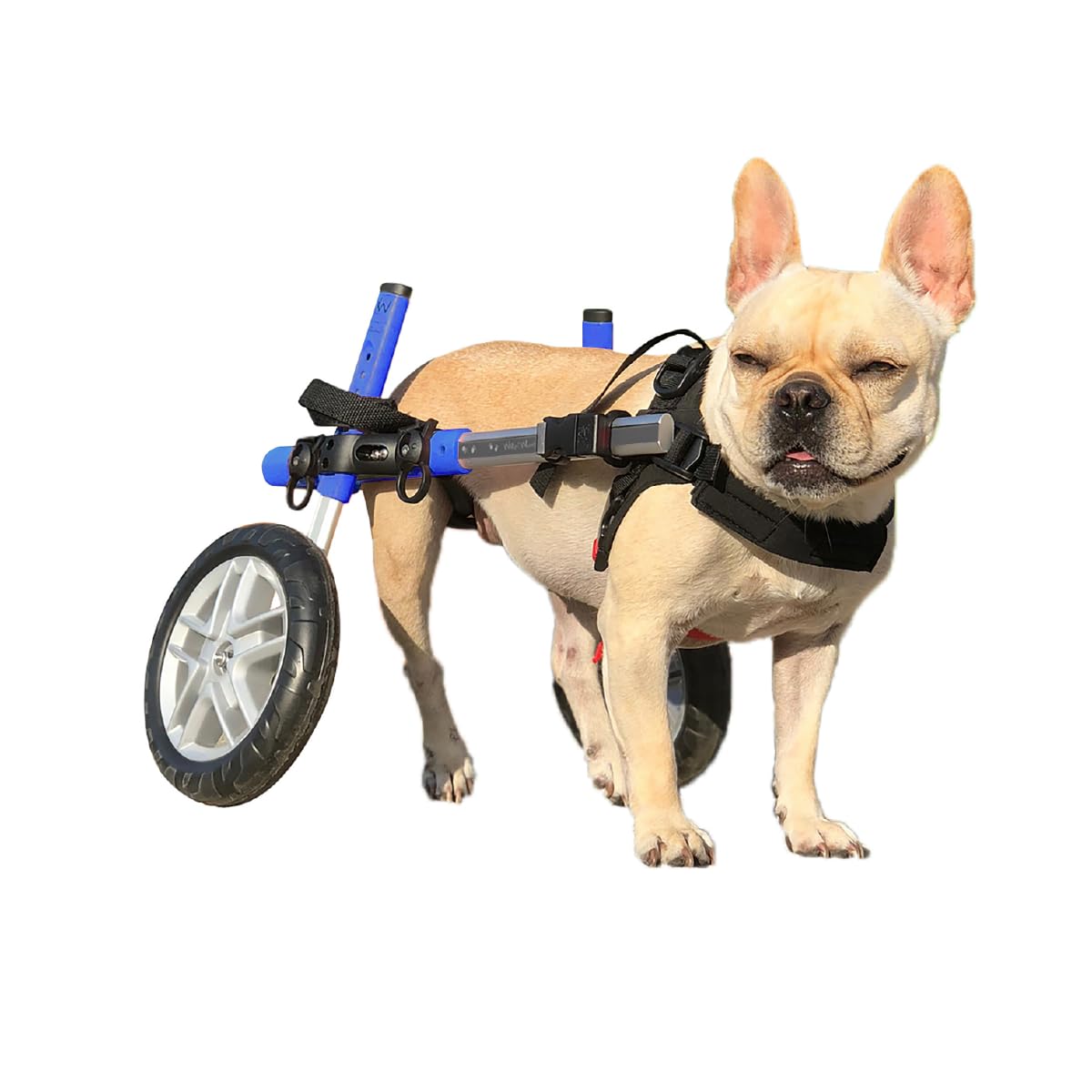
This Walkin’ Wheels variant is purpose-built for small breeds weighing 15 to 25 pounds with a leg height of 6 to 8 inches. The 5-pound extruded aluminum frame is light enough for a small dog to maneuver freely while still providing the patented adjustability that lets you tweak height, length, and width as your dog’s condition evolves.
The dense foam wheels with rubber treads are puncture-proof and roll smoothly on tile, carpet, and grass. Owners of senior pugs and dachshunds with IVDD report that after a one-week adjustment period, their dogs regained independence — walking, urinating, and even playing fetch while wearing the cart. The foldable struts make it easy to toss in the back seat for vet visits.
A minor annoyance: the leg-raising mechanism can snag during adjustment, and the instructions could be clearer for first-time users. But the overall build quality is high enough that many owners report using the same cart for five years across multiple dogs with different body shapes.
Why it’s great
- Lightweight at just 5 lbs
- Puncture-proof foam wheels
- Long-term durability across multiple dogs
Good to know
- Leg-raising mechanism can be tricky
- Assembly instructions are basic
5. Walkin’ Wheels Small Dog Wheelchair (Seafoam, 15–25 lbs)

At just 3 pounds, the Seafoam variant of Walkin’ Wheels is the lightest rear-support cart for small dogs in this lineup. It supports the same 15–25 lb weight range and 6–8 inch leg height as the blue model but sheds weight through a streamlined frame design that doesn’t sacrifice adjustability.
The chew-proof aluminum frame and dense foam wheels make it ideal for puppies or small breeds that still want to run and play. Owners of 14-year-old pugs with progressive hind-leg paralysis reported that after a week-long adjustment, their dogs regained the ability to exercise, urinate, and defecate normally — a major quality-of-life improvement.
The cart folds easily for storage, and the materials are fully washable. The only real trade-off is a slightly narrower adjustment range compared to the standard model, which may limit its usefulness if your dog gains or loses significant weight. For most small-dog owners, the weight savings outweigh this limitation.
Why it’s great
- Ultralight 3 lb frame
- Chew-proof aluminum construction
- Easy fold-and-go transport
Good to know
- Narrower adjustability than standard model
- Not suitable for dogs over 25 lbs
6. All-Terrain Dog Wheelchair (35–48.5 lbs, Medium)
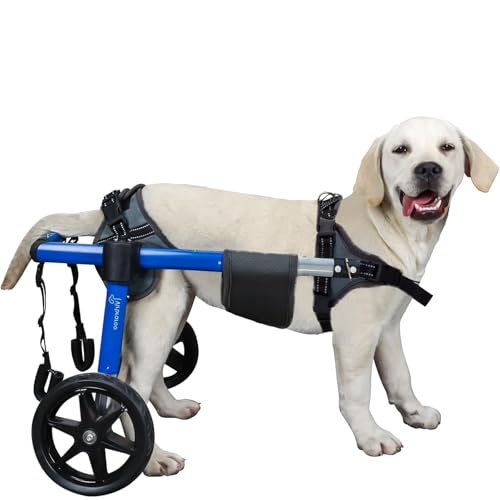
This mid-range cart targets medium dogs from 35 to 48.5 pounds with an aircraft-grade aluminum frame and 7.9-inch all-terrain wheels fitted with high-quality bearings for quiet rolling. It’s designed for dogs with arthritis, paralysis, or post-surgical recovery, offering a reinforced abdominal strap that offloads spinal pressure.
The harness system includes both a front attachment for quick setup and a soft, skin-friendly fabric that reduces rubbing during extended wear. Owners of German Shepherds with degenerative myelopathy reported that the cart enabled daily walks again, though some noted the wheels sit far out from the body, requiring careful navigation through doorways.
Quality control is inconsistent — while many users praise the sturdiness and easy assembly, a few experienced the main wheel falling off during the first walk, causing the dog to tip. The instructions are also sparse, particularly for first-time wheelchair users. If you get a properly assembled unit, the performance is solid for the price tier.
Why it’s great
- All-terrain wheels with sealed bearings
- Skin-friendly harness material
- Lightweight aluminum frame
Good to know
- Reported wheel retention issues
- Poor assembly instructions
7. Best Friend Mobility FML Elite (Large)

The Best Friend Mobility FML Elite covers an enormous size range — 5 to 175 pounds — making it a viable option if you have multiple dogs or a breed that doesn’t fit standard categories. The newly reinforced design uses steel buckles and high-strength polymer mounts, while toolless knobs allow quick width adjustments without set screws.
The foam tires reduce friction on hard floors, and the canted wheel design prevents wall scuffing — a thoughtful detail for indoor navigation. Owners of large mixed breeds (Akita/Pyrenees around 90 lbs) reported the cart flexing slightly under weight but still providing functional mobility. The sports sling helps keep the dog engaged rather than lazy inside the cart.
Assembly is the main hurdle: the crossbars can be difficult to align, and the included manual’s small photos are hard to follow. Some units arrived with missing pieces or weak plastic clips that disconnect randomly. For owners willing to work through the initial frustration, the cart offers good value for its massive size range.
Why it’s great
- Fits an extreme range of dog sizes
- Toolless width adjustment
- Foam tires and canted wheels
Good to know
- Assembly instructions are poor
- Some units have missing or weak parts
8. Walkin’ Wheels Dachshund Wheelchair (2–30+ lbs)

Designed specifically for dachshunds and other long-bodied small breeds, this Walkin’ Wheels cart supports dogs from 2 to over 30 pounds. The 10-pound aluminum frame is heavier than the standard small model, but the longer wheelbase provides better stability for dogs prone to IVDD — a common issue in wiener dogs.
The dense foam wheels with rubber treads handle grass and pavement easily, and the patented adjustable design lets you modify height, length, and width. Owners of 3-year-old dachshunds with IVDD-related hind-leg paralysis reported the cart gave their dogs freedom to run around outside. The assembly is straightforward, though the included pamphlet and video are necessary for first-timers.
The main limitation is the weight: at 10 pounds, the cart is heavy relative to a small dog’s body weight. Some owners noted their dogs needed time to adjust to the added load. A few elderly or extremely small dogs may refuse to move with the cart attached. For motivated dogs, however, this is a proven solution that veterinarians frequently recommend.
Why it’s great
- Long wheelbase for IVDD-prone breeds
- Veterinarian-approved design
- Adjustable in three dimensions
Good to know
- 10 lb frame is heavy for very small dogs
- Some dogs refuse to move initially
9. Virbraroo All-Terrain Dog Wheelchair (Medium, ver.2)
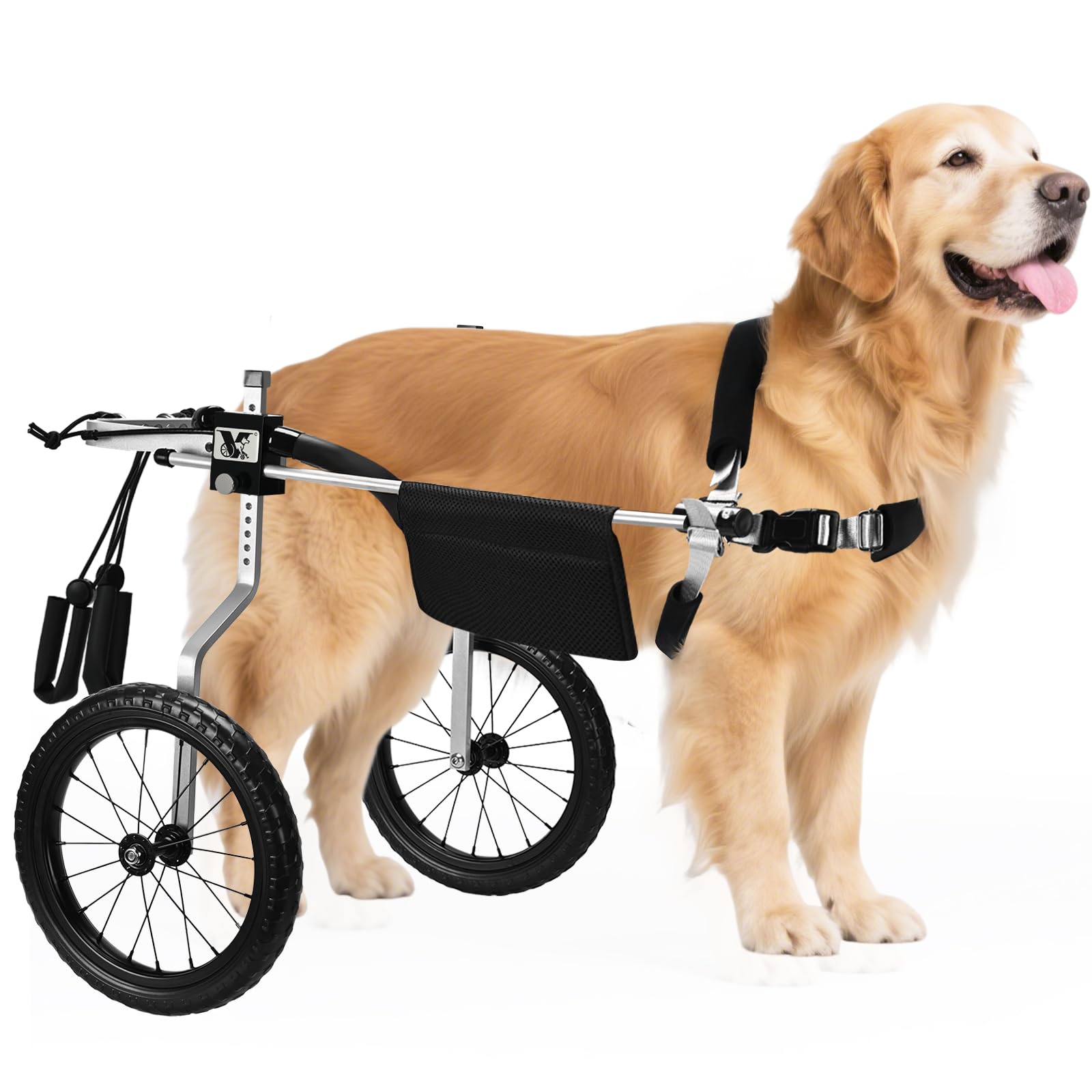
This second variant of the Virbraroo all-terrain cart shares the same aircraft-grade aluminum frame and oversized wheels as the first version but is listed as a separate ASIN on Amazon. It targets the same medium-to-large breed range and includes the same reinforced abdominal strap for spinal support.
Customer feedback mirrors the first variant: users praise the lightweight frame and quick dog adaptation, but criticize the plastic wheel components and the need for frequent hardware tightening. The ergonomic design handles grass, gravel, and uneven surfaces well, making it a good choice for active owners who don’t want to restrict their dog to pavement.
The biggest distinction appears to be stock availability and color options. If the first variant is out of stock, this alternate listing provides the same performance and warranty. The same caveats apply — expect to spend extra time with the strap instructions, and monitor wheel bolts during the first few weeks of use.
Why it’s great
- Same performance as primary Virbraroo model
- Good on varied terrain
- Lightweight aluminum frame
Good to know
- Plastic wheel components reported
- Strap instructions are lacking
FAQ
How do I measure my dog for a rear-support wheelchair?
My dog has weak front legs too. Can I still use a rear wheelchair?
How long does it take for a dog to adjust to a wheelchair?
Final Thoughts: The Verdict
For most users, the artificial limbs for dogs winner is the Walkin’ Wheels Dog Wheelchair (Large) because its patented adjustable design, durable aluminum frame, and puncture-proof wheels deliver proven long-term mobility for big breeds. If you want an all-terrain cart for medium dogs, grab the Virbraroo All-Terrain Dog Wheelchair (Medium). And for small dogs under 25 pounds, nothing beats the Walkin’ Wheels Small Dog Wheelchair (Seafoam) for its 3-pound frame and easy foldability.