
A corded landline phone is the most reliable communication tool in your home, operating without batteries or Wi-Fi during a power outage. But not all basic models deliver clear audio, readable caller ID, or buttons your fingers can actually find in the dark, so choosing the right one matters more than you think.
I’m Min — the co-founder and writer behind Gadgets Feed. I’ve spent hundreds of hours analyzing technical specs, comparing audio clarity levels, button sizes, and display readabilities across the corded phone market to find the models that truly work when you need them most.
After extensive research, I’ve narrowed the field to seven dependable models that balance simple operation with essential features, helping you find the best basic corded landline phone for your home, office, or senior family member.
How To Choose The Best Basic Corded Landline Phone
A corded landline phone should be the most dependable device in your home, but the wrong one can leave you squinting at a dim screen or missing calls because the ringer is too quiet. Focus on these three factors to avoid a frustrating purchase.
Audio Clarity and Volume Control
The primary job of a landline phone is to deliver clear, intelligible audio. Look for models with adjustable handset volume, ideally with multiple levels or an “Audio Assist” boost feature that amplifies incoming sound. A loud ringer, measured in decibels (dB), is equally critical — a 90dB ringer is adequate for a quiet room, but a 110dB ringer cuts through kitchen noise or can be heard from another floor. Models that offer a ringer-off option with a flashing visual indicator are invaluable for light sleepers or those who need quiet hours.
Button Size and Display Readability
Extra-large buttons with high-contrast numbering reduce dialing errors, especially in low light. The best designs feature backlit or light-up keys that activate with incoming calls. For the caller ID display, a backlit or tiltable LCD screen is a game-changer — dim non-lit displays are a common complaint even on premium models. If the phone will be used by seniors or anyone with vision challenges, prioritize a display that adjusts its angle and offers at least three brightness levels.
Power Source and Reliability
True line-powered phones draw all their operating power from the telephone line itself, meaning they work during a blackout without any batteries. Some models require AA batteries solely for the caller ID memory and display backlight — if the batteries die, the phone still makes and receives calls, but you lose visual caller info. For absolute reliability in emergencies, choose a model that does not require any external power or batteries for basic dialing and ringing.
Quick Comparison
On smaller screens, swipe sideways to see the full table.
| Model | Category | Best For | Key Spec | Amazon |
|---|---|---|---|---|
| AT&T CL4940 | Premium | Integrated answering system | 17-minute digital recording | Amazon |
| AT&T CL2940 | Premium | Audio Assist volume boost | Tilt display + big buttons | Amazon |
| Panasonic KX-TSC11B | Mid-Range | Brand reliability & compact size | 50-name caller ID memory | Amazon |
| Excelltel EX-LD-858HF | Mid-Range | Photo speed dial for dementia | 9 one-touch memory buttons | Amazon |
| Uvital B0G7YY5PF2 | Mid-Range | Loud 110dB ringer | LED visual call indicator | Amazon |
| Uvital VTC500 | Value | Do-not-disturb & calculator | 99-hour DND scheduling | Amazon |
| MCHEETA 160 | Value | Wall-mount space saving | Shatterproof ABS body | Amazon |
In‑Depth Reviews
1. AT&T CL4940

The AT&T CL4940 is the most complete corded landline phone on this list, packing a digital answering system with 17 minutes of recording time into a compact white desktop unit. Its backlit display and display-dial keypad make caller ID legible even in dim rooms, and the Clearspeak dial-in-base speakerphone delivers two-way conversations without cradling the handset. Message Guard memory ensures your saved messages survive a power failure, adding a layer of security most basic phones lack.
The audio quality stands out here — the speakerphone has a five-position volume control with zero distortion at maximum levels, and the handset receiver produces natural, warm tones that reduce listening fatigue during long calls. The tiltable display and extra-large buttons cater to seniors, and the wall-mountable design frees up desk space. Setup is straightforward: plug the RJ11 line cord into any standard PSTN jack, and the phone draws line power for all core functions.
One minor caveat is that the top-row control buttons are small and can be hard to read without glasses. The manual is dense and lacks clear explanations for advanced features like “Ask Rufus,” but the core answering and dialing functions are intuitive. For a basic corded phone that adds serious answering machine capability, the CL4940 is the undisputed champion.
Why it’s great
- Digital answering system with 17-minute recording capacity
- Backlit tilt display for easy caller ID reading
- Message Guard memory preserves recordings during outages
- Speakerphone with five-level distortion-free volume
Good to know
- Top-row control buttons are small and hard to read
- Manual lacks detailed explanations for some features
2. AT&T CL2940

AT&T designed the CL2940 with an “Audio Assist” feature that amplifies incoming sound beyond normal handset levels, making it a top contender for users with mild to moderate hearing loss. The extra-large buttons are spaced generously to prevent misdials, and the tiltable LCD display lets you angle the screen to reduce glare — a thoughtful detail you won’t find on most basic corded phones. It supports both desktop and wall-mount placement, and the extra-loud ringer has a high-low-off switch to suit any environment.
The hands-free speakerphone is clear enough for multitasking, though some users note the audio quality lacks the richness of the handset. Caller ID stores up to 50 names and numbers, but the display is not backlit, so reading it in low light requires ambient room lighting or the tilt feature aimed at a lamp. The phone requires 4 AA batteries for the caller ID and display memory, though basic dialing and speaking work on line power alone even if the batteries die.
Build quality is solid with a sturdy base that doesn’t slide on desks. The mute button and last-number redial are conveniently placed. The dial buttons are reportedly stiff to press, which may frustrate users with arthritis, and the speakerphone has a slightly hollow sound. Still, for its affordable price and senior-friendly design, the CL2940 is a reliable pick.
Why it’s great
- Audio Assist volume boost for hearing-impaired users
- Tiltable LCD display reduces glare
- Extra-large buttons with high-contrast numbers
- Sturdy build with wall-mount option
Good to know
- Caller ID display is not backlit
- Dial buttons require firm pressure to press
- Speakerphone audio quality is mediocre
3. Panasonic KX-TSC11B

The Panasonic KX-TSC11B is a no-frills single-line corded phone that prioritizes reliability over flashy features. Its compact footprint — just 3.8 x 9.1 x 8.4 inches — fits easily on a crowded desk or small nightstand. The one-touch dialer with memory buttons lets you assign up to three frequently called contacts for instant dialing, and the 50-number caller ID memory keeps a log of incoming calls even after you’ve missed them. The multi-function LCD display shows caller name and number, but it is not backlit and some users report it is difficult to read in dim light.
Audio quality is solid with a natural-sounding handset that works well for both voice and fax machine applications. The ringer volume has a low/high/off switch, and the phone includes a mute button and flash button for call waiting. Setup is plug-and-play: connect the RJ11 line cord to your wall jack and the phone draws power directly from the telephone line — no AC adapter or batteries needed for basic operation.
The main drawbacks are the faint display that requires good lighting to read comfortably and a handset that can fall off the hook if the phone is bumped. Some users also find the dial buttons less comfortable than competitors. But if you want a straightforward, space-saving corded phone backed by Panasonic’s engineering, this is a reliable choice.
Why it’s great
- Line-powered: works during power outages
- Compact size for small desks or nightstands
- One-touch dialer with three memory buttons
- 50-number caller ID memory
Good to know
- Display is not backlit and can be hard to read
- Handset can fall off the hook if bumped
- Dial buttons could be more ergonomic
4. Excelltel EX-LD-858HF

The Excelltel EX-LD-858HF is purpose-built for seniors with memory loss, dementia, or Alzheimer’s disease. Its standout feature is the nine one-touch speed dial buttons that accept physical photographs underneath a clear cover — so your loved one can dial by recognizing a face instead of recalling a number. An emergency SOS button adds peace of mind for caregivers. The phone is completely battery-free: plug the RJ11 line cord into any standard PSTN jack for instant use.
The ABS plastic body is lightweight at 600 grams, and the extra-large buttons have high-contrast white numbering on a dark background for easy reading. An LED light flashes in sync with incoming calls, providing a visual alert for users with hearing loss or in noisy environments. The hands-free speakerphone allows conversations without holding the receiver, though some users report a tinny echo on the speakerphone and an abnormally loud ringer that cannot be fine-tuned.
Setup requires reading the manual a few times to master the speed dial programming, but once configured, the phone is intuitive. The fake decorative photos in the buttons are tricky to remove and replace. Overall, for families seeking a reliable, picture-based communication lifeline for a loved one with cognitive decline, the Excelltel EX-LD-858HF is the most thoughtful option available.
Why it’s great
- Nine photo speed dial buttons for picture-based calling
- Emergency SOS button for urgent situations
- Flashes LED light with incoming calls
- No batteries required for operation
Good to know
- Speakerphone has tinny echo
- Ringer is abnormally loud with no fine adjustment
- Manual needed for initial speed dial setup
5. Uvital B0G7YY5PF2
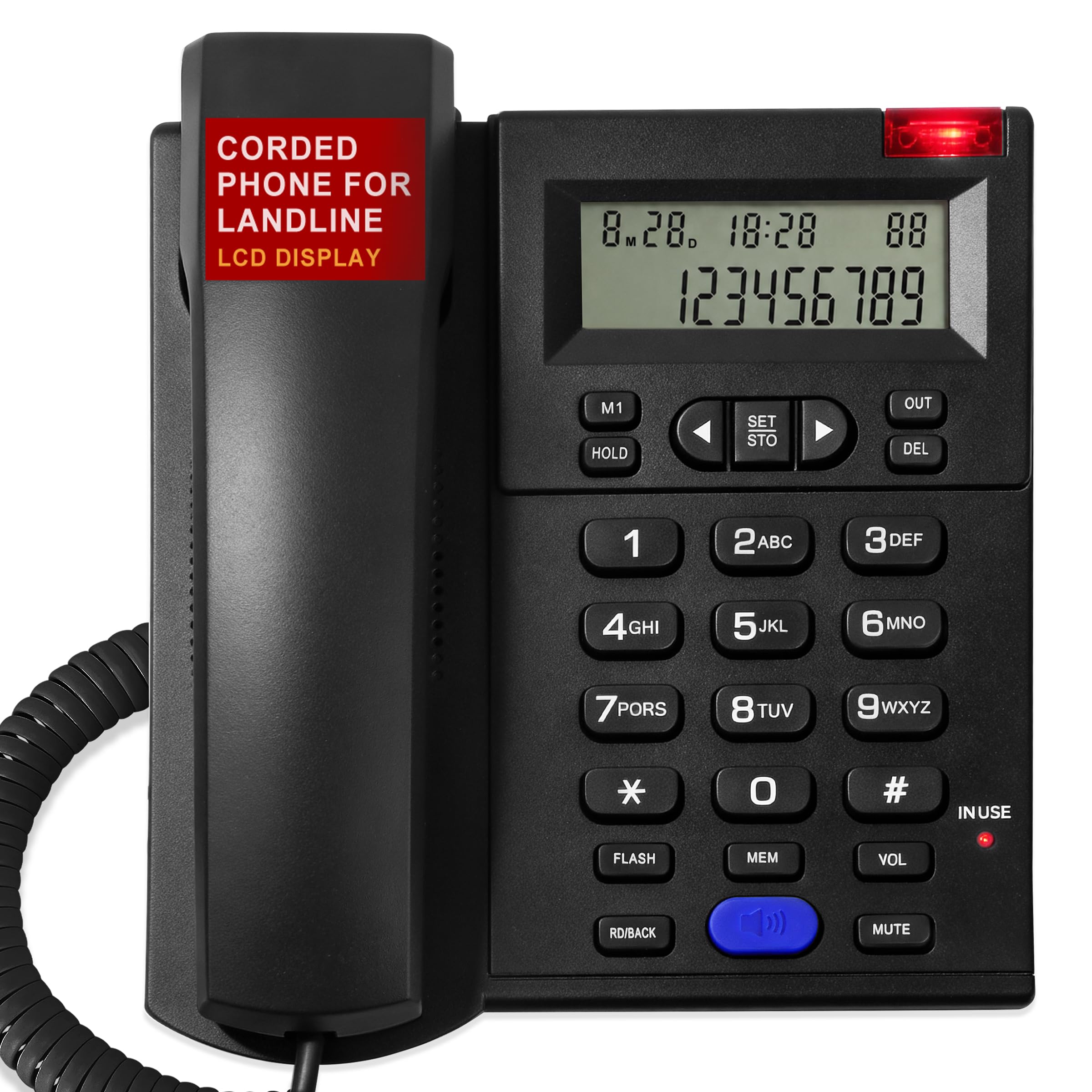
The Uvital B0G7YY5PF2 is the loudest phone on this list, with a ringer that reaches 110 decibels — enough to be heard across a multi-room home or over kitchen appliance noise. It features a red LED visual indicator that lights up on incoming calls, ensuring no call is missed even if the ringer is switched off. The LCD display shows caller ID and stores 61 incoming and 16 outgoing calls, though it only displays the number, not the caller’s name.
The hands-free speaker reaches 90dB, and both the handset and ringer have High/Low/Off volume settings. The phone supports one-touch and two-touch memory dialing for up to three speed-dial contacts, plus dedicated FLASH, MUTE, and REDIAL buttons. It draws all power from the telephone line, so no batteries or AC adapter are required — a critical feature for emergency preparedness. The ABS plastic build feels durable despite the lightweight design.
The main limitation is that the ringer only has two loudness levels (High and Low), and some users find even the Low setting too piercing. There is no answering machine or voicemail support. The caller ID display is not backlit and the screen is relatively small. For a bare-bones corded phone that prioritizes loud audio and visual call alerts, this Uvital model delivers exceptional value.
Why it’s great
- 110dB ringer — loudest in its price class
- Red LED visual call indicator for silent alerts
- Line-powered with no batteries required
- One-touch and two-touch memory dialing
Good to know
- Ringer only has High/Low/Off settings — no fine control
- Caller ID shows number only, not name
- Small, non-backlit display
6. Uvital VTC500
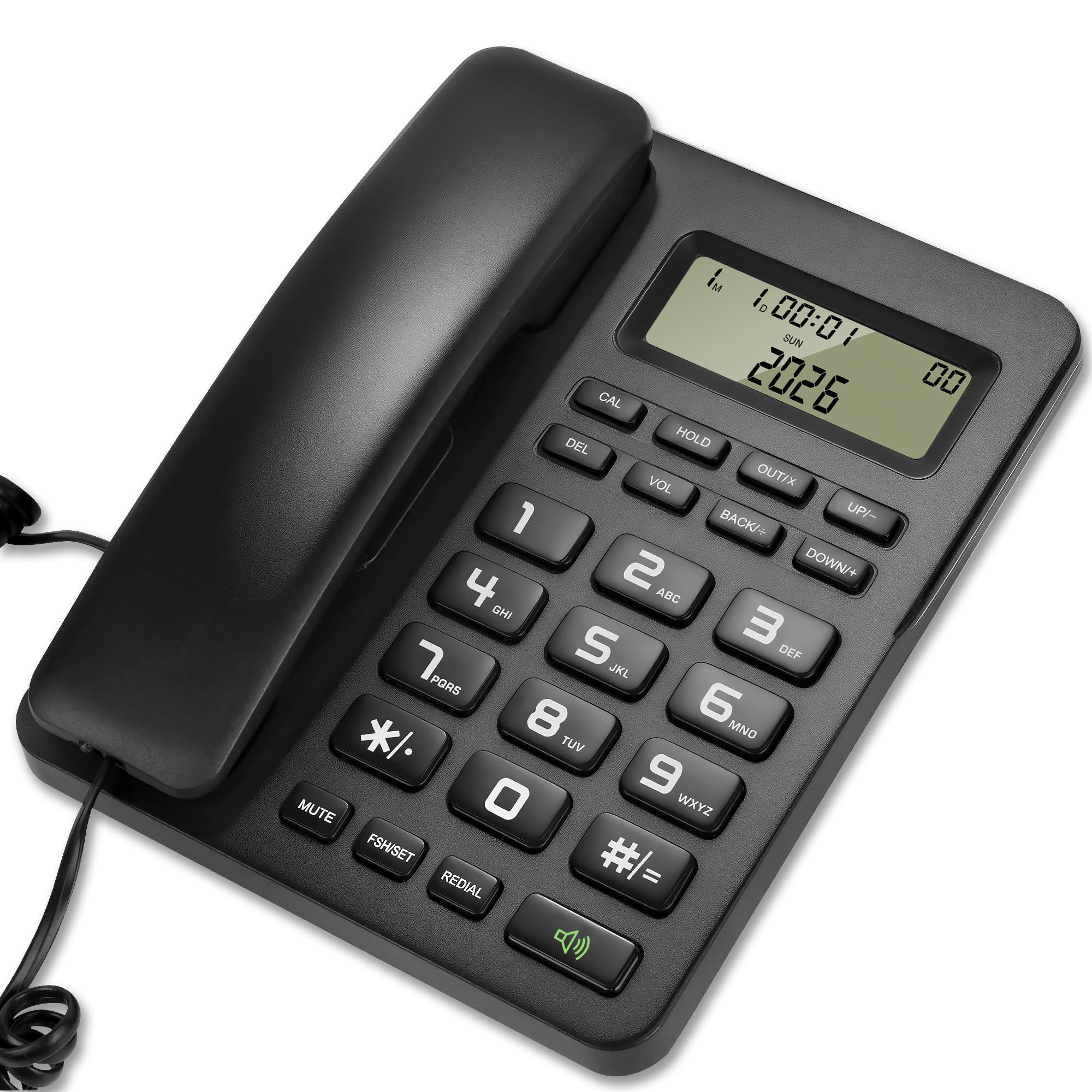
The Uvital VTC500 is an anomaly among basic corded phones: it includes a programmable “Do Not Disturb” mode that can silence calls for 1 to 99 hours, a four-stage mechanical keypad lock to prevent unauthorized dialing, and even a built-in calculator. This makes it uniquely suited for hotel rooms, reception desks, or shared offices where call control matters. The blue-lit LCD display shows up to 16 digits and stores 43 received calls and 12 dialed calls.
The phone supports 16 ringtones with four volume levels, hands-free speakerphone with two volume levels, and music-on-hold that automatically releases when you pick up the handset. The DND function is particularly handy — set it to block all incoming calls for a specific period while still allowing outgoing calls. The electronic anti-theft lock prevents the phone from being used if disconnected, adding security in public settings.
Audio quality is adequate but not outstanding — the speakerphone is functional but lacks richness. Some users were confused by the “corded electric” description, expecting it to plug into an AC outlet, but it actually draws power from the phone line. The handset volume is not adjustable, which may frustrate users with hearing difficulties. For the price, the feature density is unmatched, but audio purists may want to look elsewhere.
Why it’s great
- Programmable DND mode (1-99 hours)
- Four-stage mechanical keypad lock for security
- Built-in calculator for desk use
- Music-on-hold feature with auto-release
Good to know
- Handset volume is not adjustable
- Speakerphone audio quality is average
- Does not plug into an AC outlet despite description
7. MCHEETA 160
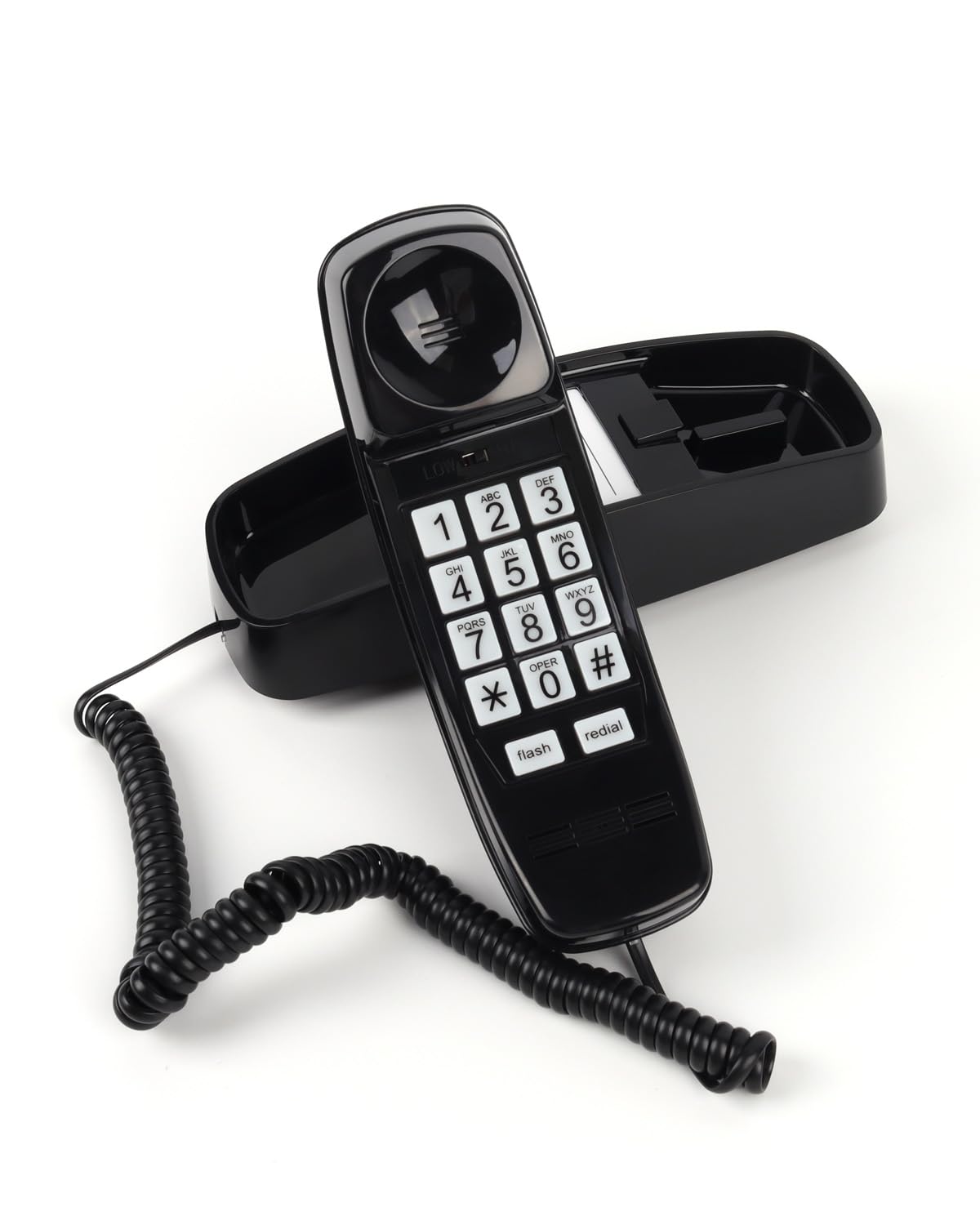
The MCHEETA 160 is a no-compromise budget corded phone built for wall mounting in kitchens, hallways, or dorm rooms. Its shatterproof ABS plastic body is designed to survive 5+ years of daily use, and the phone draws no batteries or AC power — it works purely on line power, making it fully functional during blackouts. The lighted keypad with oversized, high-contrast numbers ensures accurate dialing in complete darkness.
Audio performance is surprisingly good for the price point. The handset delivers natural voice reproduction, and the one-key flash button instantly ends calls. The phone has two buttons for adjusting call and ringer volume — from a soft whisper to a loud ring — giving you flexibility for different environments. It does not offer speed dial or a caller ID display, keeping the experience truly basic and intuitive.
Setup can be tricky because the wall-mount base has a cramped second jack compartment that some users struggle with. The ringtone is high-pitched and may annoy light sleepers. There is no visual call indicator and no speakerphone. For users who need an ultra-durable, zero-fuss wall phone for a secondary location, the MCHEETA 160 is an unbeatable value.
Why it’s great
- Shatterproof ABS plastic body rated for 5+ years
- Lighted keypad works in complete darkness
- Line-powered with no batteries or AC needed
- Space-saving wall-mount design
Good to know
- Wall-mount setup can be frustrating
- High-pitched ringtone may be annoying
- No caller ID display or speakerphone
FAQ
Will a basic corded landline phone work during a power outage?
How do picture speed dial buttons work for seniors with dementia?
Can I use a basic corded phone with a VoIP service?
Final Thoughts: The Verdict
For most users, the best basic corded landline phone winner is the AT&T CL4940 because it combines a reliable answering system, backlit display, and distortion-free speakerphone in a compact, wall-mountable package. If you need Audio Assist volume boosting for hearing-impaired family members, grab the AT&T CL2940. And for a dementia-friendly picture-based speed dial phone that prioritizes simplicity above all, nothing beats the Excelltel EX-LD-858HF.