
Building a home theater around a tight amplifier budget means every watt and every HDMI port must earn its place. The difference between a muddled action sequence and one that detonates with precise clarity lies in the receiver’s DAC quality, room correction logic, and channel separation — specs that separate a true cinema experience from a glorified soundbar upgrade.
I’m Min — the co-founder and writer behind Gadgets Feed. I’ve spent countless hours combing through measured power output curves, HDMI 2.1 chipset revisions, and real-world user calibration data to find the receivers that actually deliver on their promises without pushing you past your comfort zone.
If you want clean dialog, tight bass management, and enough HDMI bandwidth for a 4K gaming rig, this guide to the best av receiver under $500 will show you which models combine genuine amplifier headroom with modern connectivity you won’t outgrow next season.
How To Choose The Best AV Receiver Under $500
Every dollar in this tier must stretch across amplifier channels, video processing, and streaming smarts. Understanding which specs you can compromise on — and which ones are non-negotiable — will keep your system future-proof without blowing your budget.
Channel Count and Speaker Configuration
A 5.1-channel receiver powers five speakers plus one subwoofer, which is the sweet spot for most living rooms. A 7.2-channel unit adds two rear surround channels or supports Dolby Atmos height speakers. If you plan to add ceiling or upward-firing Atmos modules later, prioritize a 7.2 model. If space is tight, a solid 5.1 receiver with good room correction will still deliver immersive sound.
HDMI Version and Video Passthrough
HDMI 2.1 with 40 or 48 Gbps bandwidth enables 4K at 120 Hz and 8K at 60 Hz, critical for modern gaming consoles and future Blu-ray players. HDCP 2.3 copy protection ensures compatibility with 4K streaming services. Even if you only own a 1080p TV today, buying a receiver with HDMI 2.1 avoids the headache of upgrading your AVR when you eventually swap displays.
Room Correction and Auto Calibration
Room correction software like Yamaha’s YPAO, Denon’s Audyssey MultEQ, or Pioneer’s MCACC measures your speaker distances, levels, and crossover frequencies using the included microphone. A receiver with robust room calibration can make budget speakers sound far more cohesive than a higher-wattage unit without it. Never skip this feature in this price bracket.
Quick Comparison
On smaller screens, swipe sideways to see the full table.
| Model | Category | Best For | Key Spec | Amazon |
|---|---|---|---|---|
| Denon AVR-S670H | 5.2 Ch | Best Overall Value | 75W x 5, 8K/60Hz, HEOS | Amazon |
| Yamaha RX-V4A | 5.2 Ch | Streaming & Voice Control | Wi-Fi, AirPlay 2, MusicCast | Amazon |
| Denon AVR-X1700H | 7.2 Ch | Atmos Height Virtualization | 8K/60Hz, Audyssey MultEQ | Amazon |
| Onkyo TX-NR6100 | 7.2 Ch | THX Certified Power | 210W/Ch, HDMI 2.1, THX | Amazon |
| Onkyo TX-NR5100 | 7.2 Ch | Renewed Value for Atmos | HDMI 2.1, Klipsch Optimize | Amazon |
| Yamaha RX-V385 | 5.1 Ch | Budget-Friendly Clarity | YPAO, Bluetooth, 4K HDR | Amazon |
| Pioneer VSX-935 | 7.2 Ch | Gaming & Dual Zone | HDMI 2.1, Dolby Atmos Virtual | Amazon |
| Sony STRDH590 | 5.2 Ch | Simple 4K Setup | S Force PRO, eARC, Bluetooth | Amazon |
| Klipsch Reference Bundle | 5.1 Bundle | All-in-One Starter System | Denon S670H + 5 Klipsch Spkrs | Amazon |
In‑Depth Reviews
1. Denon AVR-S670H

The Denon AVR-S670H packs 75 watts per channel across five discrete channels, which is sufficient to drive most bookshelf and floor-standing speakers to reference levels in medium-sized rooms. Its 8K/60Hz and 4K/120Hz passthrough, combined with HDCP 2.3, make it a rare budget receiver that won’t bottleneck an Xbox Series X or PS5. The inclusion of HEOS multi-room streaming, Wi-Fi, and Bluetooth means you can skip a separate music streamer entirely.
Audyssey MultEQ room correction handles speaker distance, level, and crossover optimization through the included microphone, dramatically cleaning up muddy bass in less-than-ideal room layouts. The setup process is genuinely beginner-friendly — the on-screen guide walks you through HDMI ARC/eARC pairing, source naming, and speaker configuration without requiring a degree in audio engineering.
For those on the fence about future-proofing, the S670H also supports Dolby TrueHD, DTS HD Master Audio, and Dolby Pro Logic II upmixing. The main trade-off is the 5.2-channel ceiling — you cannot add height speakers for a full Atmos layout, but for a pure 5.1 or 5.2 setup, this is the most feature-complete receiver in this guide.
Why it’s great
- 8K/60Hz and 4K/120Hz HDMI with VRR and ALLM
- Audyssey MultEQ calibration delivers noticeable clarity
- HEOS multi-room streaming works with Tidal and Spotify
Good to know
- Limited to 5.2 channels — no Atmos height support
- HEOS wireless occasionally drops on congested 2.4 GHz networks
2. Yamaha RX-V4A

Yamaha’s RX-V4A is a 5.2-channel receiver built around the MusicCast ecosystem, giving you access to Spotify Connect, TIDAL, Deezer, Qobuz, Pandora, and Amazon Music HD without needing a separate streamer. The dual-band Wi-Fi (2.4 GHz and 5 GHz) and AirPlay 2 support allow for stable multi-room audio across Yamaha wireless speakers — a genuine convenience for whole-home listening.
On the video side, the RX-V4A features HDMI 2.1 with HDCP 2.3, supporting 4K60, 4K120AB, and 8K60B passthrough across four inputs. The included YPAO automatic room calibration optimizes timing, speaker levels, and crossover points. Reviewers consistently note the clean stereo separation and warm tonal balance when driving towers like Bowers & Wilkins CDM 7s, proving the 5.2 architecture doesn’t sacrifice sound quality.
Voice control via Alexa, Google Assistant, and Siri (through AirPlay 2) is fully integrated, and the on-screen HDMI menus make navigating the deep customization options far easier than the front-panel display alone. The remote’s tiny buttons are a minor ergonomic complaint, but the MusicCast app effectively replaces it for daily use.
Why it’s great
- Broad streaming service support via MusicCast
- HDMI 2.1 with 8K60B passthrough
- YPAO calibration is fast and effective
Good to know
- Remote buttons are small and hard to navigate
- Menu system can be confusing without a TV hooked up
3. Denon AVR-X1700H

The AVR-X1700H is a 7.2-channel receiver that brings Dolby Atmos Height Virtualization Technology to the table, meaning you get immersive overhead effects without installing ceiling speakers. This makes it arguably the best option in this guide for apartment dwellers or renters who cannot modify their ceilings but still want a three-dimensional soundstage. The 80 watts per channel (8 ohms, 20 Hz-20 kHz, 0.08% THD) drive five-channel Atmos configurations with headroom to spare.
Audyssey MultEQ (the same calibration found in Denon’s higher X-series line) fine-tunes equalization for up to six listening positions, correcting frequency response dips caused by furniture and room geometry. The receiver also includes three dedicated 8K HDMI inputs with HDCP 2.3, supporting 8K/60Hz and 4K/120Hz passthrough. For vinyl enthusiasts, the built-in phono input is a welcome addition rarely seen at this tier.
The setup guide is the most polished in this roundup — color-coded speaker terminals and an award-winning on-screen wizard make first-time installation nearly foolproof. Multi-room streaming via HEOS works with Spotify, Amazon Music HD, and Pandora, though some users report occasional latency when switching between wireless sources.
Why it’s great
- Dolby Atmos Height Virtualization for immersive sound without ceiling speakers
- Phono input for turntable connection
- Audyssey MultEQ calibrates up to six positions
Good to know
- Heatsink runs warm during extended high-volume sessions
- Requires certified 48 Gbps HDMI cables for stable 8K signal
4. Onkyo TX-NR6100
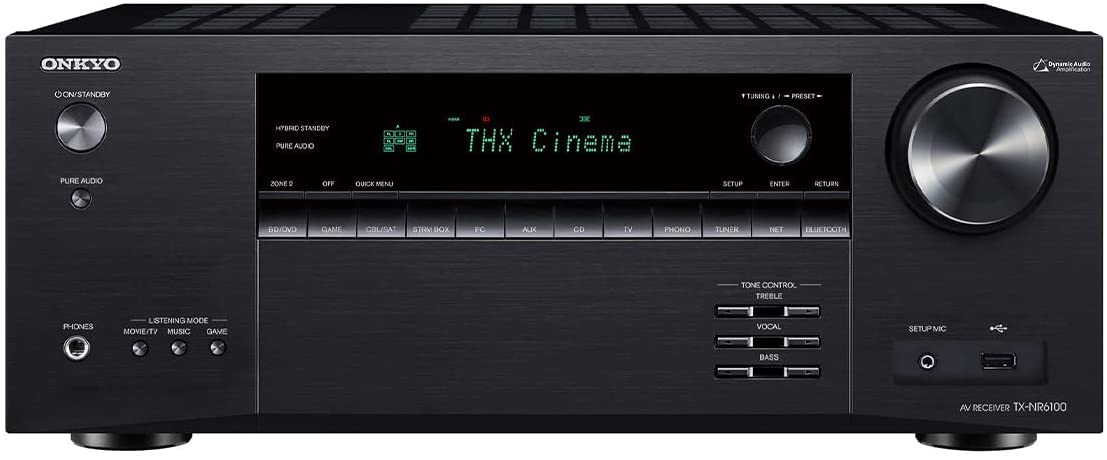
THX Select Certification is the headline here — it guarantees the receiver meets strict distortion and output standards for rooms up to 2,000 cubic feet. The Onkyo TX-NR6100 delivers 210 watts per channel into 6 ohms (1 kHz, 10% THD) and supports 5.2.2-channel Dolby Atmos and DTS:X playback. Three HDMI 2.1 inputs running at 40 Gbps enable 4K/120Hz gaming and 8K/60Hz passthrough.
Beyond raw power, the TX-NR6100 includes a discrete Zone 2 audio and video output, letting you send a separate source to another room while the main theater runs independently. The Onkyo Controller app provides granular control over input switching, sound modes, and EQ presets. The rear panel includes eight HDMI ports, which is generous for connecting multiple consoles, a Blu-ray player, and a streaming box simultaneously.
Reviewers consistently note the tight bass control and clear channel definition when paired with Klipsch Reference speakers. The bi-amping mode is available, but activating it sacrifices two surround channels, reducing the layout to 5.1. The non-backlit remote is a minor disappointment, but the overall value for a THX-certified 7.2-channel receiver is hard to beat.
Why it’s great
- THX Select certification ensures reliable high-output performance
- Eight HDMI inputs with HDMI 2.1 bandwidth
- Discrete Zone 2 audio and video output
Good to know
- Fan is audible during prolonged high-volume use
- Bi-amping drops to 5.1 channel operation
5. Onkyo TX-NR5100 (Renewed)

The renewed Onkyo TX-NR5100 offers 7.2-channel surround with Dolby Atmos and DTS:X support at a significantly reduced entry cost. The included Klipsch Optimize Mode tailors the receiver’s EQ curve specifically for Klipsch Reference and Reference Premiere speakers, which is a genuine advantage if you already own or plan to buy from that brand. HDMI 2.1 with 4K/120Hz and 8K/60Hz upscaling matches the video specs of newer models.
The auto-calibration microphone does a solid job of setting speaker distances, levels, and crossovers, and most users report a dramatic improvement over their previous 1080p-era receivers. The unit supports streaming services via built-in Wi-Fi, including Spotify, TIDAL, Deezer, and Pandora. The rear-panel connectivity is generous, with enough HDMI and optical inputs for a multi-component setup.
The renewed designation means this unit has been tested and refurbished, so the price-to-feature ratio is excellent. A small number of users have reported defective units, particularly with the subwoofer output, so buying from a seller with a reliable return policy is recommended. When it works, the sound quality and feature set rival receivers costing double.
Why it’s great
- Klipsch Optimize Mode for seamless brand integration
- 7.2-channel Atmos support at a budget-friendly renewed price
- HDMI 2.1 with 4K/120Hz passthrough
Good to know
- Renewed condition means potential for cosmetic wear or early defects
- Configuration menu is deep and can be overwhelming
6. Yamaha RX-V385

Yamaha’s RX-V385 is the entry-level anchor of this guide, but it punches far above its weight class in audio fidelity. The 5.1-channel amplifier delivers 100 watts per channel (1 kHz, 1% THD, 8 ohms) and includes YPAO auto-calibration — a feature often cut from budget-tier receivers. The direct mode bypasses tone controls for a purer signal path, and reviewers consistently praise the warm, clear dialog presentation.
Four HDMI inputs with HDCP 2.2 support 4K Ultra HD passthrough with HDR10, Dolby Vision, and Hybrid Log-Gamma (HLG). Bluetooth wireless connectivity is built in, making it easy to stream from a phone or tablet, though audiophiles will prefer the wired connection for FLAC and DSD64 playback. The binding posts accept banana plugs on all five channels, which simplifies speaker cable management.
This receiver lacks Wi-Fi, AirPlay 2, and multi-room streaming, so those features are absent. The on-screen setup manual is accessible only via HDMI, requiring a connected TV from the start. For someone building a pure 5.1 movie and music system who doesn’t need network features, the RX-V385 delivers the cleanest sound per dollar in this list.
Why it’s great
- YPAO calibration at this price point is exceptional
- Banana-plug compatible binding posts on all channels
- Direct mode for pure, unprocessed stereo playback
Good to know
- No Wi-Fi, AirPlay 2, or multi-room support
- Only four HDMI inputs — newer receivers offer more
7. Pioneer VSX-935
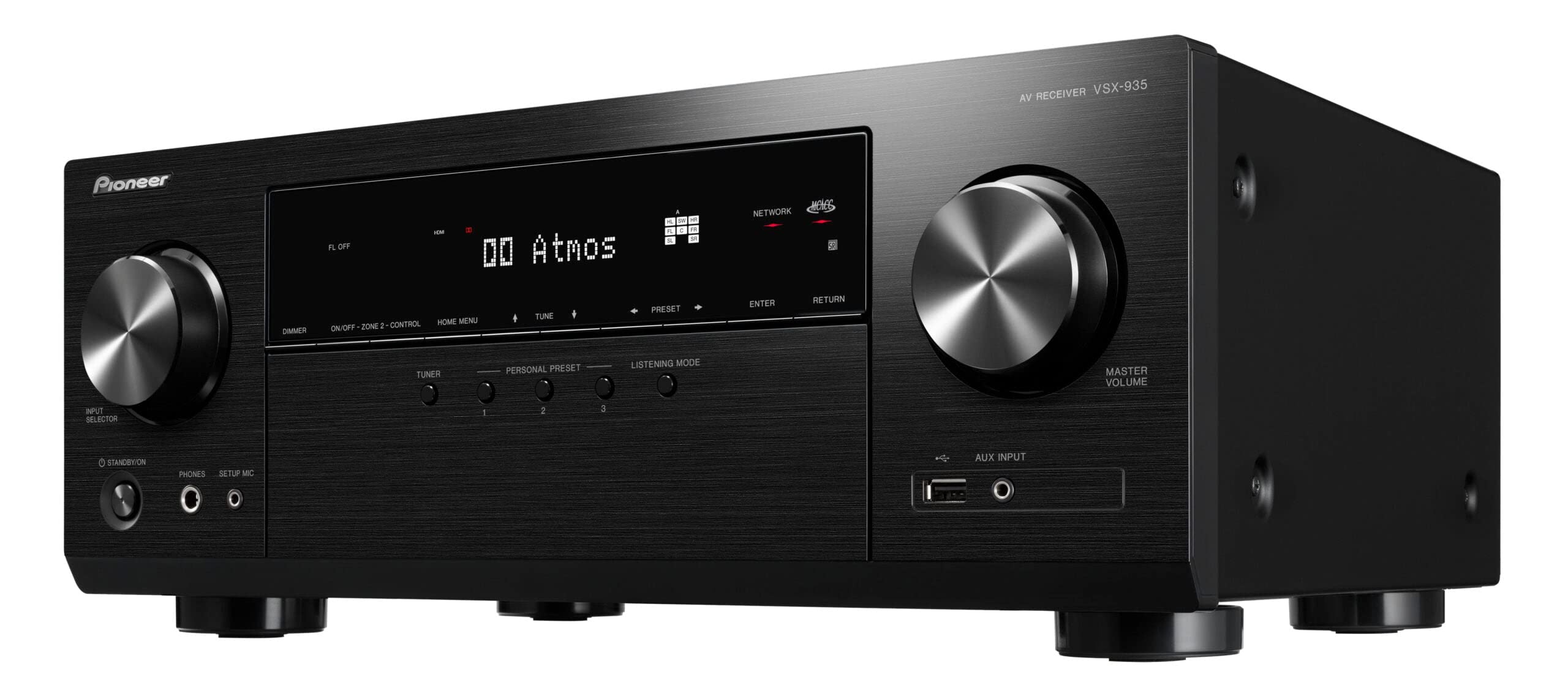
The Pioneer VSX-935 is a 7.2-channel receiver built with HDMI 2.1 support, making it a strong candidate for gamers who need VRR and ALLM for a seamless 4K/120Hz experience. Dolby Atmos Height Virtualization creates convincing overhead effects from standard 5.1 speaker layouts, which is ideal for rooms where in-ceiling installation isn’t feasible. The unit also supports DSD128 playback via USB for high-resolution audio enthusiasts.
Dual-zone output lets you send audio to a second room while the main zone plays independent content, and the RF remote works through walls and cabinets without line-of-sight issues. The included MCACC room calibration handles speaker distance, level, and EQ optimization. Users report that the firmware update process can be clunky, but once the receiver is configured, the audio quality is crisp and detailed, with excellent movie dialogue articulation.
The front-panel display is clear and dimmable, and the input naming customization helps keep a complex system organized. The primary drawbacks are the two-way Bluetooth implementation, which some find unreliable, and the menu navigation that feels outdated compared to Denon’s on-screen guide. If you’re willing to work through the initial setup, the VSX-935 delivers premium gaming and cinema performance.
Why it’s great
- HDMI 2.1 with full VRR and ALLM for gaming
- Dual-zone output for whole-home audio
- Dolby Atmos Height Virtualization without ceiling speakers
Good to know
- Bluetooth connectivity can be unreliable
- On-screen setup interface is clunky compared to competitors
8. Sony STRDH590
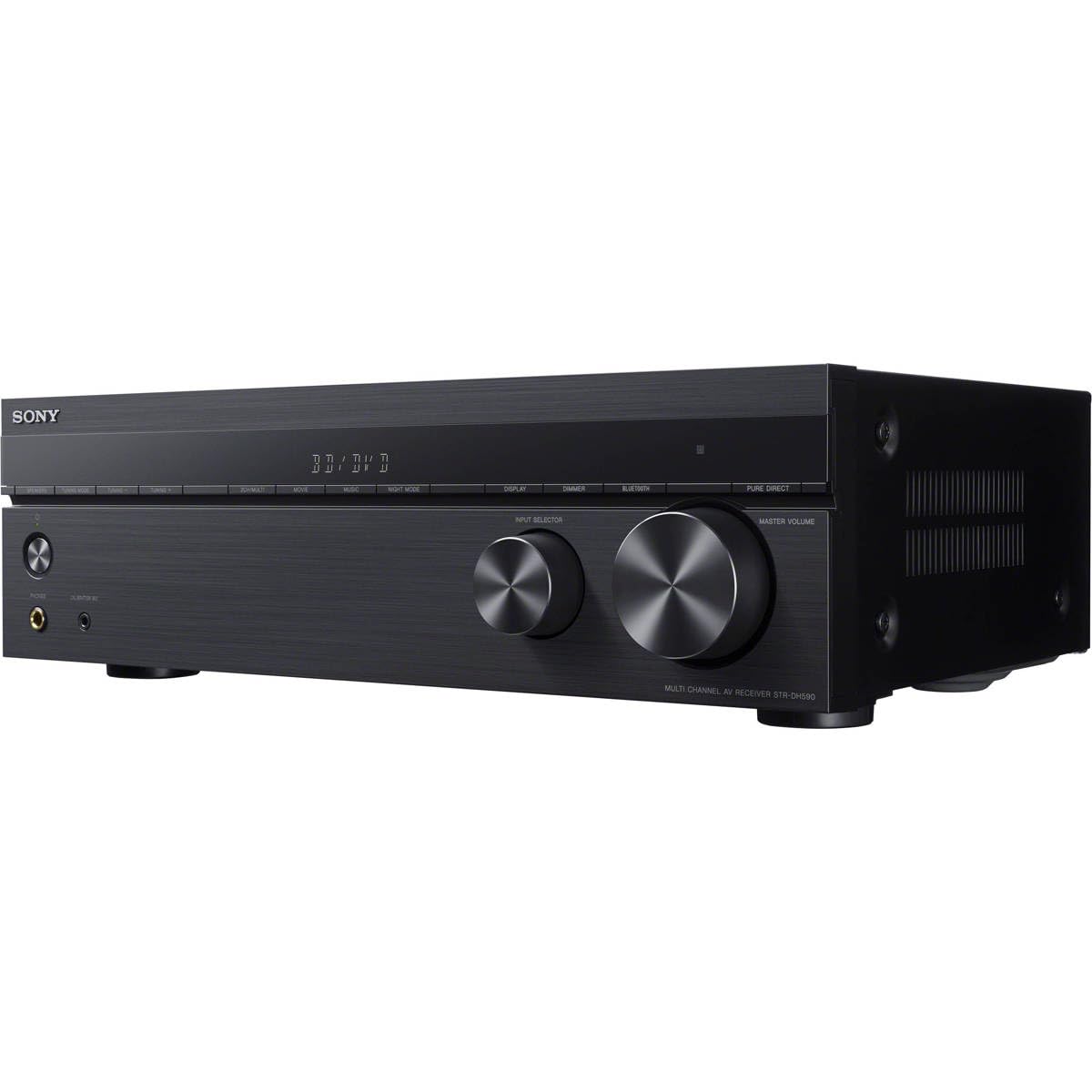
Sony’s STRDH590 is a 5.2-channel receiver that prioritizes simplicity and a compact footprint. Measuring just 5.25 inches tall, it fits into tight AV cabinets where bulkier receivers won’t. The S Force PRO virtual surround system delivers a convincing surround effect from just two speakers, which is handy for spaces where a full 5.1 array isn’t possible. Four HDMI inputs with HDCP 2.2 support 4K HDR passthrough with Dolby Vision.
The auto-calibration microphone walks through speaker setup and adjusts levels for your listening position. The eARC integration with modern Samsung and LG TVs works seamlessly, with the receiver automatically powering on and switching inputs when the TV starts. The front-panel display is adjustable, and the digital sound presets (Stadium, Concert, Jazz) actually produce distinct and usable acoustic profiles.
The STRDH590 lacks a phono input, Wi-Fi, and multi-room streaming, so it is best suited for users who want a no-fuss, wired home theater receiver. The main speaker terminals accept banana plugs, but the center and surround terminals use pin connectors. Reviewers note that the remote is straightforward and the learning curve is shallow compared to the more complex Yamaha and Denon models.
Why it’s great
- Compact chassis fits in small entertainment centers
- eARC works seamlessly with modern TVs
- S Force PRO virtual surround for 2-speaker setups
Good to know
- No Wi-Fi, AirPlay, or multi-room streaming
- Center and surround terminals use pin clips, not binding posts
9. Klipsch Reference 5.1 Bundle

The Klipsch Reference 5.1 Home Theater Bundle bundles the Denon AVR-S670H receiver with a full Klipsch speaker system comprising R-610F floorstanding towers, an R-52C center channel, R-41M bookshelf surrounds, and an R-12SW 12-inch powered subwoofer. This is a turnkey solution for anyone who wants a cohesive, brand-matched system without the headache of matching speakers to a receiver separately.
The Klipsch compression driver horn technology excels at clarifying dialog and high-frequency detail, which is particularly noticeable with compressed streaming audio from Netflix or Spotify. The 12-inch subwoofer, driven by a 400-watt BASH amplifier, delivers tight, room-shaking bass down to 29 Hz. The Denon S670H provides the 8K/60Hz HDMI backbone, HEOS streaming, and Audyssey room calibration covered in its individual review above.
The total system cost is higher than buying a receiver alone, but you are getting five speakers and a subwoofer that are already matched in timbre and efficiency. The floorstanding towers eliminate the need for stands, and the bundle includes all grilles, mounting hardware, and the remote. If you are starting from zero and want one box solution, this bundle removes all guesswork.
Why it’s great
- Complete 5.1 system with cohesive Klipsch timbre matching
- Denon S670H receiver with 8K passthrough and HEOS streaming
- 12-inch subwoofer delivers authoritative low-end extension
Good to know
- Larger footprint requires floor space for the towers
- Speaker break-in period needed for the woofers to loosen up
FAQ
Can I add height speakers later if I buy a 5.1 receiver now?
What is the difference between eARC and standard ARC?
Does a receiver’s wattage matter if I have efficient speakers?
Final Thoughts: The Verdict
For most users, the best av receiver under $500 winner is the Denon AVR-S670H because it blends 8K/60Hz video passthrough, Audyssey room calibration, and HEOS multi-room streaming in a package that requires no immediate compromises. If you want Dolby Atmos height virtualization without ceiling speakers, grab the Denon AVR-X1700H. And for a complete turnkey system with brand-matched speakers, nothing beats the Klipsch Reference 5.1 Bundle.