
You bought the 15-liter ultrasonic cleaner to stop scrubbing grease and carbon build-up off carburetors, chains, and tools, but the wrong unit leaves you waiting an hour for the water to heat while the noise drills into your skull. The difference between a frustrating chore and a reliable workshop tool comes down to transducer power, heating speed, and build quality — metrics that separate serious machines from cheap knock-offs.
I’m Min — the co-founder and writer behind Gadgets Feed. I’ve spent hundreds of hours dissecting technical spec sheets, cross-referencing real-world user experiences, and analyzing transducer configurations to find which 15-liter ultrasonic cleaners actually deliver the cavitation energy and durability their marketing claims promise.
This guide breaks down heater wattage, transducer count, tank material, and control interface so you can finally buy the 15 liter ultrasonic cleaner that matches your shop’s workload without paying for features you won’t use.
How To Choose The Best 15 Liter Ultrasonic Cleaner
Fifteen liters is the sweet spot for serious automotive, industrial, and lab cleaning because it fits cylinder heads, carburetor banks, and batch tool loads without consuming half your bench. But not every 15L machine delivers the same cavitation intensity. You need to match transducer power, heating capacity, tank thickness, and control flexibility to your specific contamination level.
Transducer Power and Count
Ultrasonic cleaning is only as good as the transducers glued to the tank bottom. A 15L tank typically needs at least 360W of ultrasonic power — entry-level units use small transducers that create dead zones where parts barely get cleaned. Premium units use six 60W transducers (360W total) spread evenly across the base to eliminate cold spots. More transducers also mean the load can be heavier before cavitation drops off.
Heater Wattage and Temperature Range
Heating power is the single biggest time-sink in ultrasonic cleaning. A 300W heater can take 50–60 minutes to bring 15 liters of cold water to 150°F. A 450W heater cuts that to about 30 minutes, and an 800W heater can reach temperature in under 15 minutes. If you run multiple cycles daily, heater wattage directly impacts your workflow. Most units cap temperature at 80°C (176°F), which is sufficient for dissolving grease and wax without damaging parts.
Control Interface and Modes
Your choice between analog knobs and digital panels depends on how you work. Knobs are reliable in greasy shop environments — no membranes to fail. Digital panels give you precise timer and temperature settings plus degas mode (which removes dissolved gas from the solution for better cavitation) and gentle mode (which halves power for delicate items). Dual-frequency machines (28/40kHz) let you switch between coarse cleaning of heavy parts and gentle cleaning of precision components.
Tank Material and Drain Design
Every 15L cleaner uses SUS304 stainless steel, but thickness matters. Thinner tanks (0.8mm) can warp under repeated heating cycles, while 1mm die-cast tanks stay flat and seal tightly against the transducers. A bottom-mounted drain valve with a shut-off is essential for 15L tanks — lifting that much water to pour it out is impractical. Look for a valve that accepts standard garden-hose fittings so you can drain directly into a bucket.
Quick Comparison
On smaller screens, swipe sideways to see the full table.
| Model | Category | Best For | Key Spec | Amazon |
|---|---|---|---|---|
| ACMESONIC A15L | Premium | Industrial Shop Use | 6 transducers, 450W heater | Amazon |
| DK SONIC DK-1500S | Premium | Triple Mode Versatility | 1–99 min timer, dual frequency | Amazon |
| EIWEI CD-E15 | Premium | Dual-Frequency Precision | 28/40kHz, 99 min timer | Amazon |
| Garvee 15L | Mid-Range | Heavy Industrial Cleaning | 800W heater, 600W ultrasonic | Amazon |
| CREWORKS 15L | Mid-Range | Multi-Mode Flexibility | Degas + gentle mode, 450W heat | Amazon |
| Granbo GW0615 | Mid-Range | Jewelry & Lab Glassware | Degas mode, 450W heating power | Amazon |
| GarveeLife 15L | Mid-Range | Quiet Workshop Operation | 3 transducers, soundproof lid | Amazon |
| VECKYJL 15L | Value | Budget Carburetor Cleaning | Anti-skid feet, built-in fuse | Amazon |
| VEVOR 15L | Value | First-Time Shop Buy | 40kHz, 0–110°C temperature range | Amazon |
In‑Depth Reviews
1. ACMESONIC A15L
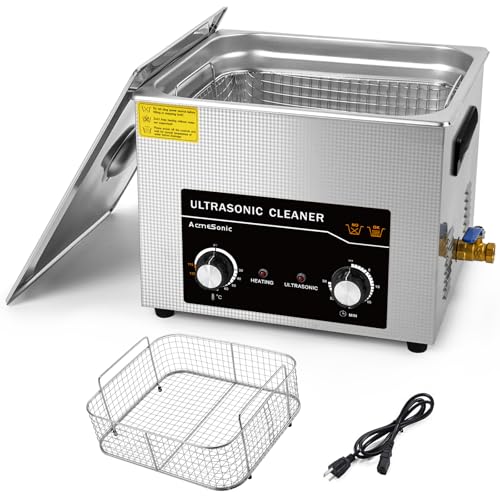
The ACMESONIC A15L is the only 15L unit in this guide using six discrete 60W transducers instead of the standard three sandwich-type transducers. That means 360W of ultrasonic power distributed evenly across the full tank base, eliminating dead zones where heavy carburetor bodies or tool stacks block cavitation. The 450W heater pulls the tank from tap temperature to usable heat in under half an hour, and the mechanical knob interface is deliberately simple — no touchscreens to fail when your hands are greasy.
Users running automotive shops report consistent cleaning of carburetor jets, brake caliper pistons, and injection pump components after two 15-minute cycles at 60°C. The 304 stainless tank with 1mm wall thickness resists the acidic degreasers needed for carbon removal, and the included basket keeps parts elevated off the tank floor where the densest cavitation occurs. The analog timer and temperature knob let you set parameters without cycling through menus — useful when you’re wearing work gloves.
The trade-off is acoustic output: owners describe the sound as a persistent buzzing around 75 dB, similar to a small air compressor. Placing the unit on a foam pad or rubber mat reduces structure-borne vibration noticeably. The 15L capacity fits up to four standard motorcycle carburetors simultaneously, making it a legitimate production tool for small engine rebuilders.
Why it’s great
- Six-transducer array eliminates cavitation dead zones
- Knob controls are reliable in dirty shop environments
- 450W heater reaches cleaning temperature quickly
Good to know
- No degas or gentle mode for delicate items
- Single 40kHz frequency limits coarse cleaning options
- Noticeable buzzing may require ear protection in quiet shops
2. DK SONIC DK-1500S
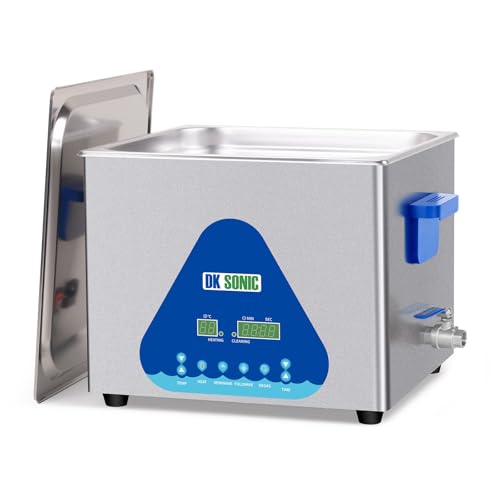
You get FullWave for deep cleaning of complex surfaces, SemiWave for breaking loose dirt on rough parts, and Degas to purge micro-bubbles from the solution before the main cycle starts. The 360W ultrasonic output runs through a die-cast SUS304 tank that measures 1mm thick — noticeably heavier than the stamped tanks found on most budget competitors.
The digital LED panel includes a power-off memory that recalls your last timer and temperature settings, eliminating the need to reprogram for repeat cycles. The 0–80°C heater works with the degas function to improve cavitation consistency, and owners report that using SemiWave at 40°C effectively strips chrome plating from wheel bolts when combined with aggressive detergents — a sign that cavitation energy is genuinely high. The timer extends to 99 minutes, letting you set long soak cycles for heavily carbonized parts without checking back.
The main criticism is that the up/down buttons are physically inverted on some units (press up to decrease value), though this only matters during initial setup. The noise level is comparable to other 360W units, and the cover does not meaningfully dampen the 40kHz whine. For shops that need to switch cleaning modes frequently — from greasy chains to circuit boards — the DK-1500S offers the widest parameter flexibility in the 15L class.
Why it’s great
- Three cleaning modes (FullWave, SemiWave, Degas) for different soils
- Die-cast 1mm SUS304 tank resists warping under heat
- Power-off memory saves presets for repeat cycles
Good to know
- Button layout is counter-intuitive on some units
- Single frequency unit (not dual-frequency)
- Lid does little to reduce ultrasonic noise
3. EIWEI CD-E15
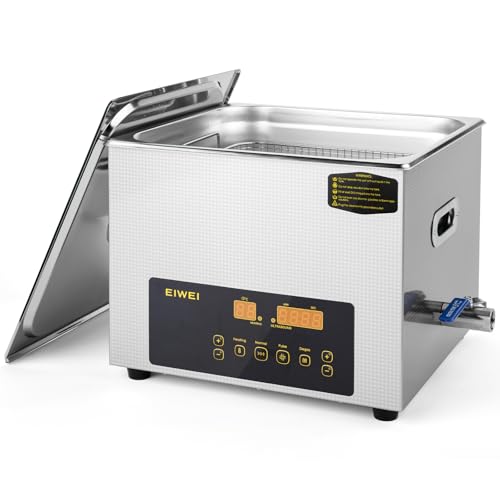
The EIWEI CD-E15 distinguishes itself with dual-frequency operation at 28kHz and 40kHz. Running at 28kHz generates larger cavitation bubbles that collapse with more force, making it better for removing thick carbon deposits from suppressor baffles and saw blades. Switching to 40kHz produces smaller, gentler bubbles that penetrate blind holes in circuit boards and delicate watch movements without eroding surfaces. This frequency flexibility alone justifies the premium for shops that clean both heavy industrial parts and precision components.
The tank is formed from a single stamping of 1mm SUS304 stainless steel, meaning no welded seams that can corrode and leak over time. The digital display shows remaining time and current temperature simultaneously, and the heater effectively maintains set temperature within ±2°C during extended cycles. Users report that cleaning 3D printer resin models at 40°C with the degas function active removes uncured resin from internal channels that manual washing cannot reach.
The downshift is that the CD-E15 uses a single 60W transducer rather than a multi-transducer array, which means cavitation intensity drops if you pack the basket too densely. Keep parts spaced apart and limit total load weight under 5 pounds for consistent results. The 20.7-pound unit sits on four rubber feet that transmit some vibration to the benchtop; placing it on a rubber mat helps isolate the noise from the work surface.
Why it’s great
- Dual-frequency (28/40kHz) for coarse and fine cleaning
- Seamless 1mm stamped SUS304 tank resists corrosion
- Heater maintains temperature within ±2°C during cycles
Good to know
- Single transducer limits load density
- No gentle mode for ultra-delicate items
- Vibration transmits to benchtop without isolation mat
4. Garvee 15L
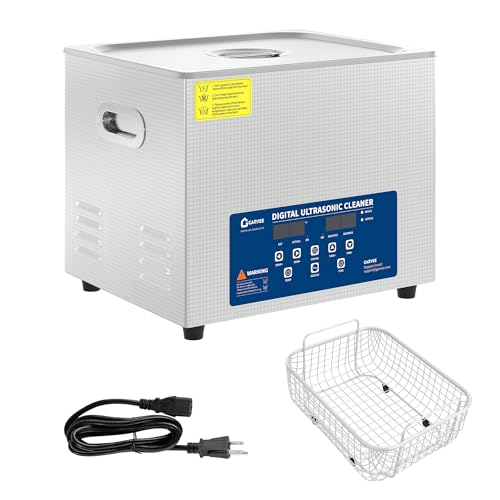
Garvee markets this 15L unit as commercial-grade, and the numbers back it up: 800W heating capacity plus 600W ultrasonic power from multiple sandwich-type piezoelectric transducers. That heater wattage is nearly double what most 15L cleaners offer, meaning the tank reaches 80°C (176°F) in roughly 12 minutes from a cold start — a meaningful time savings for shops running back-to-back cleaning cycles on engine blocks and transmission components.
The 40kHz operating frequency creates consistent cavitation across the 15-liter volume, and the reinforced stainless steel basket supports heavier loads without flexing. The digital controls display set temperature and remaining time clearly, though the manual is poorly translated and users note that the normal cleaning mode is activated by pressing the power button rather than a dedicated start — an intuitive step once you know it. The unit is FCC, CE, RoHS, and UL certified, giving industrial buyers confidence in electrical safety and interference compliance.
Noise is the Garvee’s main trade-off. At full ultrasonic output, the sound level is comparable to a shop vacuum in the next room, making extended use without hearing protection uncomfortable. The heater, while fast, cycles audibly during temperature maintenance. For high-throughput shops where cleaning speed matters more than silence, the Garvee 15L delivers the fastest heat-up in this class.
Why it’s great
- 800W heater reaches 80°C in ~12 minutes
- 600W ultrasonic power for heavy contamination loads
- Full UL/FCC/CE/RoHS certification for industrial compliance
Good to know
- Loud operation comparable to a shop vacuum
- Manual is confusing for first-time setup
- Wire basket gaps may drop small parts through
5. CREWORKS 15L
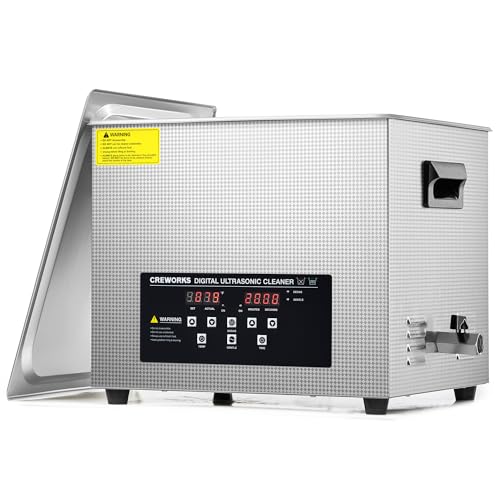
CREWORKS packs two modes into this 15L machine that are rare at its price tier: degas and gentle. Degas mode runs the transducer in a pulsed pattern to drive dissolved gas out of the cleaning solution before the main cycle, which significantly improves cavitation consistency on porous items like brake calipers and stone-tumbled rocks. Gentle mode halves ultrasonic power output, protecting circuit boards and acrylic items from surface erosion while still dislodging dust and flux residue.
The 360W ultrasonic output paired with a 450W heater strikes a practical balance for mixed-use shops. Heating from cold tap water to 60°C takes approximately 25 minutes, and the 304 stainless tank maintains temperature within ±3°C during the 30-minute timer cycle. Users report that adding foam tape to the lid reduces the ultrasonic whine by roughly 5 dB, bringing the noise down to a tolerable level for indoor workshop use without hearing protection.
The main limitation is the 30-minute timer ceiling — if you need to clean heavily carbonized parts that require 45-minute soak cycles, you’ll need to restart the timer manually. The control panel uses membrane buttons that may eventually wear out in frequent use. For users who switch between cleaning gold jewelry, aluminum circuit boards, and greasy auto parts in a single session, the CREWORKS offers the most mode flexibility in the mid-range bracket.
Why it’s great
- Dedicated degas and gentle modes for different soils
- Foam tape mod effectively reduces noise
- Food-grade 304 stainless tank and basket
Good to know
- Timer maxes at 30 minutes, no extended cycles
- Membrane buttons are not field-replaceable
- Heater is slow compared to 800W units
6. Granbo GW0615
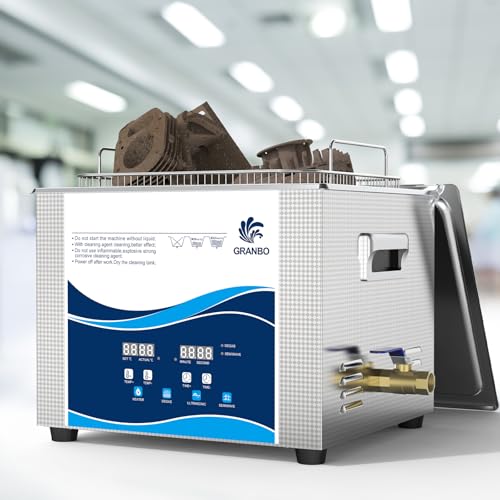
The Granbo GW0615 differentiates itself from other 15L cleaners by using adhesive combined with mechanical rivets to attach its transducers to the tank bottom — a dual-bonding process that prevents the vibration heads from loosening over time, which is a known failure point on cheaper units where transducers delaminate after months of thermal cycling. The 360W ultrasonic output at 40kHz produces consistent cavitation across the full 15-liter volume, and the degas mode helps improve cleaning performance on porous materials like denture acrylic and unsealed stone jewelry.
The digital control panel allows 0–30 minute timer adjustment and temperature settings up to 80°C with 450W heating power. The tank interior measures 11.8 × 13 × 5.9 inches, giving enough depth to submerge standard grooming shear blades and dental instrument cassettes vertically. Users cleaning Invisalign trays report that starting with hot tap water reduces total heat-up time to under 10 minutes. The unit runs noticeably loud — owners consistently describe it as louder than commercial dental office machines — but the cleaning results for jewelry, eyeglass frames, and watch bands are excellent.
The metric-only measurements on the control panel are a minor inconvenience for users accustomed to Fahrenheit, and the timer cannot be set beyond 30 minutes. For jewelers, dental labs, and optical shops that prioritize gentle but thorough cleaning of small precision items, the Granbo’s reinforced transducer mounting offers long-term durability that many competitors cannot match at this price.
Why it’s great
- Riveted transducer attachment prevents delamination over time
- Degas mode improves cavitation in porous items
- Deep tank fits vertical dental instrument cassettes
Good to know
- Metric-only control panel (no Fahrenheit option)
- Timer maxes at 30 minutes
- Audible noise level is higher than commercial dental units
7. GarveeLife 15L
The GarveeLife 15L is built with noise reduction as a design priority, featuring a soundproof lid and a stable base designed to minimize vibration transmission during extended cleaning cycles. While no ultrasonic cleaner is truly silent, this unit produces less structure-borne hum than most competitors, making it suitable for shared lab spaces or small workshops where excessive noise disturbs nearby work. The 360W ultrasonic output comes from three sandwich-type piezoelectric transducers, delivering consistent cavitation across the tank’s 330×300mm floor area.
The digital controls provide precise 0–30 minute timer adjustment and temperature settings up to 80°C (176°F) with a 450W heater. Users report effective cleaning of jewelry, eyeglass frames, and small mechanical components using a simple water-and-Dawn solution in a plastic bag to avoid contaminating the main tank. The heater takes approximately 50 minutes to reach 150°F from a cold start — slower than high-wattage competitors but acceptable for users who can start the preheat before beginning a cleaning session.
The tank and basket use 304 stainless steel, and the unit carries FCC, CE, RoHS, and UL certifications. The main trade-off is that the 15L capacity is better suited for batch processing of smaller items than for single large parts — the tank depth is insufficient for taller engine components like intake manifolds. For watchmakers, jewelers, and electronics technicians who want the capacity of a 15L machine without the acoustic punishment of typical industrial units, the GarveeLife is a strong fit.
Why it’s great
- Soundproof lid and stable base reduce noise output
- Full safety certification (FCC/CE/RoHS/UL)
- Consistent cavitation with three-transducer design
Good to know
- Heater is slow compared to 600W+ competitors
- Tank depth limits tall part cleaning
- No degas or gentle mode for specialized tasks
8. VECKYJL 15L

The VECKYJL 15L is the most cost-effective entry point into the 15-liter size class, and its value proposition is simple: it cleans carburetors, jewelry, and tools without the bells and whistles that drive up cost. The stainless steel cleaning basket reduces friction on delicate items, and four anti-skid rubber feet keep the unit stable on wet or oily workbench surfaces. The leak-proof design and built-in fuse protect against electrical surges — a safety feature often omitted from bottom-tier ultrasonic cleaners.
Users report consistent results on generator carburetors that had not been cleaned in years, with gelled gasoline dissolving after a single cycle. The adjustable heat and timer work via basic digital controls, and the 40kHz frequency is standard for general-purpose cleaning. The manual is minimal, but experienced ultrasonic users will find the interface intuitive — set temperature, set time, press start. The unit handles jewelry, dentures, and small engine parts competently within its power envelope.
The trade-offs are inherent to its price position: the transducer array uses lower-cost elements that produce slightly less aggressive cavitation than premium units, meaning heavily carbonized parts may need two or three cycles. The noise output is typical for the class — a buzzing that users find tolerable but not pleasant. For first-time buyers who want to establish whether a 15L ultrasonic cleaner fits their workflow without a large upfront investment, the VECKYJL provides a capable starting platform.
Why it’s great
- Most affordable 15L model with functional controls
- Built-in fuse and leak-proof design add safety
- Anti-skid feet prevent bench movement during cycles
Good to know
- Lower cavitation energy needs multiple passes for heavy carbon
- No degas or gentle mode
- Manual provides minimal guidance for new users
9. VEVOR 15L

VEVOR’s 15L ultrasonic cleaner stands out for its unusually wide temperature range — 0 to 110°C, compared to the 80°C ceiling of most competitors. This allows you to run cleaning cycles at near-boiling temperatures for heavy grease and wax removal on industrial parts, while also protecting heat-sensitive materials by operating at lower settings. The 40kHz frequency and 360W ultrasonic power are standard for the size class, and the corrosion-resistant 304 stainless steel tank and basket handle harsh detergents without degrading.
Users confirm that the unit takes roughly one hour to heat the full 15-liter tank above 80°C, which is comparable to other 300W-class heaters. The drain valve with shut-off is genuinely useful — it accepts standard fittings so you can route the used solution directly into a waste container. Owners of auto repair shops praise the cleaner’s performance on throttle bodies, carburetor castings, and heavily calcified shower heads, noting that stubborn calcium deposits dissolve completely after a single cycle in a vinegar-based solution.
The controls are basic analog knobs for time and temperature — no digital display, no degas mode, no gentle mode. The noise is described as a persistent frying-pan sizzle with an irritating pitch, though users find the trade-off acceptable given the price. For budget-conscious buyers who prioritize a wide temperature range and robust stainless construction over digital features, the VEVOR 15L delivers the essential ultrasonic cleaning function without premium extras.
Why it’s great
- Wider temperature range (0–110°C) than nearly all competitors
- 304 stainless tank and basket resist corrosion from harsh chemicals
- Drain valve with shut-off makes waste disposal easy
Good to know
- Analog knobs lack digital precision for repeatable settings
- No degas or gentle mode for specialized items
- One-hour heat-up time is slow for production use
FAQ
Can I leave a 15L ultrasonic cleaner running overnight?
What cleaning solution should I use in a 15L ultrasonic cleaner?
Why is my 15L ultrasonic cleaner making a loud buzzing or frying sound?
Can I use my 15L ultrasonic cleaner to clean circuit boards?
How do I maintain my 15L ultrasonic cleaner to prevent leaks or transducer failure?
Final Thoughts: The Verdict
For most users, the 15 liter ultrasonic cleaner winner is the ACMESONIC A15L because its six-transducer array delivers the most uniform cavitation across the tank base, and the mechanical knob interface holds up in dirty shop environments where digital panels fail. If you need dual-frequency capability to switch between heavy carbon removal and gentle circuit board cleaning, grab the EIWEI CD-E15. And for shops that run multiple daily cleaning cycles and need the fastest heat-up to production temperature, nothing beats the Garvee 15L with its 800W heater.