
The difference between winning and losing in competitive gaming often comes down to a split-second reaction. A standard headset lets you hear that enemy flanking from the left, but a true 3D haptic headset translates that audio cue into a physical vibration on the left side of your head, sending a signal directly to your reflexes before your brain even finishes processing the sound. This isn’t just about immersion—it’s about building a faster, more intuitive connection with your virtual environment.
I’m Min — the co-founder and writer behind Gadgets Feed. I’ve spent countless hours dissecting the technical specifications of haptic drivers, spatial audio codecs, and wireless latency figures to separate genuine performance from marketing hype in this specialized category.
After analyzing dozens of models, I’ve narrowed the field down to the nine standout contenders that define the current landscape of the best 3d haptic headset for gamers and enthusiasts who demand more from their audio gear.
How To Choose The Best 3D Haptic Headset
Navigating the market for a haptic headset requires a shift in focus from traditional audio specs. You are not just buying sound; you are buying a tactile feedback system. Understanding the core technologies will prevent you from overpaying for a headset that provides simple buzzes instead of precise, directional feedback.
Haptic Driver Architecture
Not all haptic feedback is created equal. The fundamental element is the driver architecture. Basic headsets use a single, large eccentric rotating mass (ERM) motor that vibrates the entire ear cup, offering a one-note rumble. Premium options like the Razer Kraken V4 Pro use multiple, smaller linear resonant actuators (LRAs) that can produce nuanced, directional vibrations. The best haptic headsets leverage software telemetry to translate specific in-game events—a to the left, a engine rev to the rear—into distinct haptic channels, creating a true 3D tactile soundstage.
Connectivity and Latency
Latency is the arch-nemesis of haptic immersion. If the physical rumble arrives even 50 milliseconds after the audio cue or visual event, the effect is jarring and breaks the illusion. For wireless models, a dedicated 2.4 GHz low-latency connection is non-negotiable. Look for headsets that advertise sub-20ms audio latency. Bluetooth 5.2 or 5.3 is fantastic for convenience and secondary audio, but should never be the primary gaming connection if haptic synchronicity is your goal. Wired connections (USB or 3.5mm) remain the gold standard for zero-latency haptic feedback.
Comfort and Fit for Extended Sessions
A haptic headset distributes weight and creates pressure. The extra hardware (motors, larger batteries) means these headsets can be heavier than standard gaming cans. The clamping force, ear cushion material, and headband design become critical for sessions lasting two hours or more. Premium memory foam with breathable athletic fabric, as seen on the Turtle Beach Stealth Pro, helps manage heat. A secure, balanced fit ensures the haptic motors are positioned correctly against your head for consistent feedback, rather than shifting around and dulling the effect.
Quick Comparison
On smaller screens, swipe sideways to see the full table.
| Model | Category | Best For | Key Spec | Amazon |
|---|---|---|---|---|
| SteelSeries Arctis Nova Pro Omni | Wireless Headset | Multi-Platform Versatility | 96kHz/24bit Hi-Res Audio | Amazon |
| Razer Kraken V4 Pro | Wireless Headset | Integrated HD Haptics | OLED Control Hub / Sensa Haptics | Amazon |
| JBL Quantum 910X | Wireless Headset | Head-Tracking on Xbox | 50mm Neodymium Drivers | Amazon |
| Turtle Beach Stealth Pro II | Wireless Headset | Hot-Swappable Batteries | 60mm Eclipse Dual Drivers | Amazon |
| Next Level Racing HF8 | Haptic Pad | Sim Racing Immersion | 8 Vibration Motors | Amazon |
| Meta Quest 3 (512GB) | VR Headset | Untethered VR Experiences | Snapdragon XR2 Gen 2 | Amazon |
| bHaptics TactSuit Pro | Haptic Vest | Full-Body VR Haptics | 32 Feedback Motors | Amazon |
| PlayStation VR2 | VR Headset | PSVR2 Immersion | OLED / 110° FOV | Amazon |
| Bose A30 Aviation | Aviation Headset | Professional Flight Use | Adjustable ANR / TSO Cert | Amazon |
In‑Depth Reviews
1. SteelSeries Arctis Nova Pro Omni
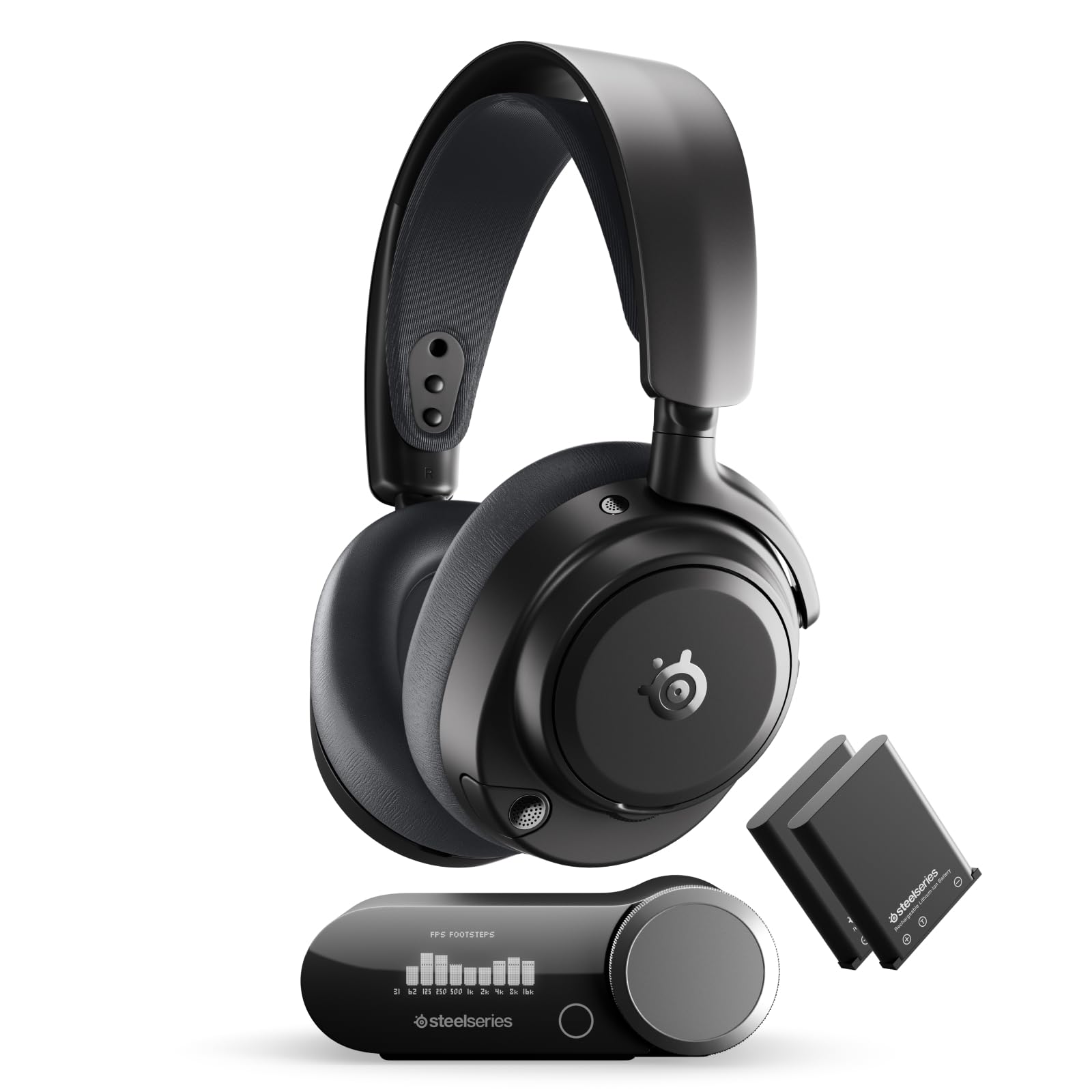
The SteelSeries Arctis Nova Pro Omni is a masterclass in versatility and high-fidelity audio. It is the only headset on this list with a true Hi-Res Wireless certification at 96kHz/24bit, which means you get studio-grade clarity without the tether. The OmniPlay system allows it to connect to five different devices simultaneously—PC, PlayStation, Xbox, and mobile—via 2.4GHz, Bluetooth 5.3, and line-in, making it the ultimate hub for a multi-platform gamer.
The integrated ANC is independently lab-tested to block 40% more noise than key competitors, and the ClearCast Pro microphone with AI Noise Rejection filters out up to 96% of background clutter, ensuring your comms are crystal clear. The dual-swappable battery system provides an incredible 60 hours of life, with a quick 15-minute charge getting you back in the fight. Its lightweight metal and fabric construction, combined with the suspension headband, ensures it remains comfortable even during marathon sessions.
While the Arctis Nova Pro Omni lacks a dedicated “haptic” vibration motor, its exceptional spatial audio rendering via the Sonar software creates a convincing phantom haptic effect. The precise, timbre-rich audio allows your brain to perceive the location and weight of objects in 3D space with startling accuracy. For those who want the bleeding edge of wireless audio tech and the most comprehensive platform support, this is the definitive package.
Why it’s great
- Hi-Res Certified 96kHz/24bit wireless audio provides unmatched detail.
- OmniPlay connectivity manages up to five devices and four audio sources simultaneously.
- Hot-swappable batteries provide 60 hours of playtime with zero downtime.
Good to know
- The multi-device setup can be overwhelming to configure initially.
- Leatherette ear cushions might trap heat during long, intense gaming sessions.
2. Razer Kraken V4 Pro

The Razer Kraken V4 Pro is the most direct answer to the question “What is a 3D Haptic Headset?” It features Razer’s next-generation Sensa HD Haptics, which uses advanced processing to translate low-frequency audio into layered, directional vibrations. This is not a gimmicky buzz; it creates distinct physical sensations for different in-game events—a punch feels different from an explosion, and both feel different from a vehicle engine.
The unique OLED Control Hub acts as a command center for your entire battlestation, allowing you to adjust haptic intensity, switch audio sources, and even check PC system metrics without alt-tabbing. The TriForce Bio-Cellulose 40mm drivers are designed for an ultra-wide soundstage, and with THX Spatial Audio, you get a highly accurate 7.1 surround sound profile. It offers four modes of connectivity (2.4GHz, Bluetooth, USB, 3.5mm), ensuring it works with everything from a PC to a Steam Deck.
Some users report that the out-of-box sound profile needs manual EQ adjustment to sound its best, and the battery life, while acceptable at around 20 hours with haptics on, is lower than many premium competitors. The Sensa Haptics can also be subtle; at maximum setting it’s impressive, but it requires the right game or audio content to really shine. For the gamer who wants the absolute deepest haptic integration available in a headset form factor, the V4 Pro is a compelling choice.
Why it’s great
- Razer Sensa HD Haptics offer nuanced, layered directional feedback unheard of in other headsets.
- The OLED Control Hub is a genuinely innovative product that centralizes audio and system control.
- TriForce Bio-Cellulose drivers provide excellent clarity and a wide soundstage for competitive audio.
Good to know
- Battery life is reduced to around 10-12 hours when using haptics at maximum intensity.
- The Sensa Haptics can feel weak in content not specifically optimized for it.
3. JBL Quantum 910X

The JBL Quantum 910X is an exceptional Xbox-centric headset that proves you don’t need a dedicated mechanical haptic motor to achieve a 3D audio effect. Its killer feature is integrated head-tracking technology, which works seamlessly via the USB-A dongle on Xbox, PlayStation, and Nintendo Switch. As you turn your head, the soundstage recalibrates in real-time, anchoring sounds to their fixed positions in the game world and creating a hyper-realistic sense of space.
This spatial accuracy is powered by JBL QuantumSPATIAL 360, which processes audio into a 360-degree sphere around you. The 50mm neodymium drivers deliver the punchy JBL QuantumSOUND Signature, which is tuned for competitive gaming—making footsteps and weapon reloads incredibly distinct. The low latency 2.4GHz wireless connection ensures zero lag, and the 37-hour battery life means you can go days between charges. Active Noise Cancellation is also on board to seal you off from the outside world.
While the head-tracking is impressive, it is a passive audio effect, not a physical vibration. The headset is comfortable for long sessions, though some users with larger heads find it slightly heavy after several hours. The custom EQ profiles are locked to the PC app, meaning adjustments on console require a separate device. For an Xbox gamer seeking the most advanced spatial audio on the platform, the 910X is a fantastic choice.
Why it’s great
- Integrated head-tracking on Xbox creates a unique and highly immersive 3D soundscape.
- Excellent battery life at 37 hours with zero-latency 2.4GHz wireless.
- Active Noise Cancellation is effective for blocking out ambient household noise.
Good to know
- The headset is slightly heavier than average, which can lead to fatigue over time.
- EQ customization is limited without a PC, making console tuning difficult.
4. Turtle Beach Stealth Pro II
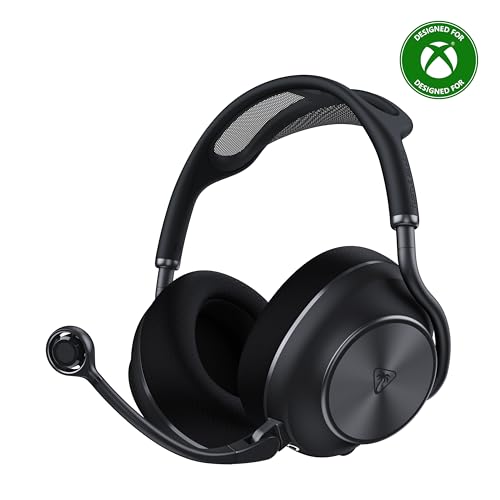
The Turtle Beach Stealth Pro II tackles the biggest pain point for serious gamers: downtime. Its hot-swappable dual battery system and sleek charging dock mean you can effectively have infinite battery life, charging one pack while using the other. The 80-hour total playtime is more than double that of many rivals.
Beyond the battery, the Stealth Pro II uses 60mm Eclipse Dual Drivers—the largest on this list—which deliver thunderous, room-filling bass without sacrificing vocal clarity. The Dolby Atmos Spatial Audio provides a wide, immersive 3D soundstage. The build quality is also a standout, with an anodized aluminum design and diamond-edged metal controls that feel premium and durable. The advanced ANC is superb for tuning out distractions, and the 9mm floating microphone with AI noise reduction ensures your voice is heard clearly.
The comfort level is generally high thanks to dual-layer memory foam, but the mesh cushion can be uncomfortable for users with larger heads over extended periods. Most EQ and feature adjustments are handled through a phone app, which is convenient but can be a secondary screen issue. For the value-conscious gamer who wants premium features like ANC and zero battery anxiety, the Stealth Pro II is an outstanding choice.
Why it’s great
- Hot-swappable batteries with a charging dock virtually eliminate downtime.
- 60mm drivers deliver the most powerful bass and loudest volume in this comparison.
- Robust aluminum build quality feels durable and looks sophisticated.
Good to know
- The mesh cushion material can create pressure points for some users with larger heads.
- Software configuration relies on a mobile app, which some users find less convenient than PC software.
5. Next Level Racing HF8 Haptic Pad

The Next Level Racing HF8 is a different beast entirely: it is a dedicated haptic feedback pad that you install onto your existing gaming chair, rather than a traditional headset. It deploys eight discrete vibration motors positioned across your shoulders, back, lower back, thighs, and legs. When paired with sim racing or flight sim titles, this creates an incredibly detailed and localized tactile picture of your vehicle’s behavior.
Using community software like SimHub or SimShaker for Aviators (the native NLR software is widely considered buggy), you can map specific vehicle physics to specific motors. You feel the rear wheels losing traction on the lower-back motors, while engine RPM vibration is felt up in the shoulder pads. This level of feedback is transformative for sim racing, allowing you to “feel” understeer and oversteer before you can even see it on the screen. It is silent, comfortable, and fits virtually any chair.
The major caveat is the software experience. The included Next Level Racing software is reported to be unreliable, failing to detect games on non-C drives and having server issues. The community-driven alternatives are excellent but require a learning curve to set up. The pad provides vibration, not the sharp “jolt” of a dedicated bass shaker. For the dedicated sim enthusiast willing to tinker for a superior tactile experience, the HF8 is a phenomenal tool.
Why it’s great
- Eight individually addressable motors provide a full-body, directional haptic experience.
- Fits universally on almost any gaming chair, office chair, or sim rig.
- When set up with SimHub, offers the most detailed sim racing haptic feedback available.
Good to know
- The native software is notoriously unreliable; third-party setup is almost mandatory.
- It only vibrates—it cannot produce the strong “kick” of a dedicated bass shaker transducer.
6. Meta Quest 3 512GB
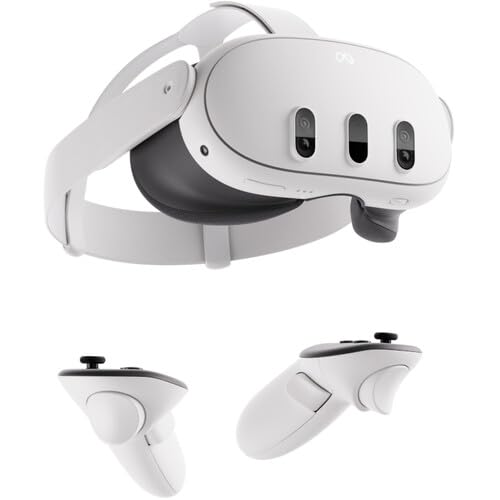
The Meta Quest 3 is the benchmark for modern standalone VR. While not a “haptic headset” in the traditional sense, its controllers feature TruTouch haptics, and its ecosystem supports countless haptic vests and accessories. The key draw is its stunning 4K+ Infinite Display with nearly 30% sharper resolution than its predecessor, powered by the Snapdragon XR2 Gen 2 processor. This gives you 2X the graphical processing power for smooth, fluid VR worlds.
The wireless, all-in-one design is its greatest strength. There are no cords, no base stations needed—just put it on and you are in. The full-color passthrough powered by dual RGB cameras is sharp enough to read your phone, making mixed reality (MR) experiences a core feature. With 512GB of storage, you can download a massive library of games, movies, and apps without worrying about space. The improved prescription lens spacer and ergonomic design make it more comfortable than the Quest 2.
The stock strap is a weak point and is nearly universally replaced by aftermarket options for better comfort and battery life. The battery itself only lasts about 2.2 hours, which is standard for standalone VR but short for extended sessions. The lenses can fog up during physical activity. For anyone wanting to dive into the highest quality standalone VR and MR, and who plans to augment it with haptic accessories, the Quest 3 is the device to build around.
Why it’s great
- Sharp, high-resolution 4K+ display with mixed reality passthrough is game-changing.
- Completely wireless and standalone, requiring no PC or console to operate.
- Massive 512GB storage for a huge library of VR games and experiences.
Good to know
- The stock head strap is uncomfortable for extended use and a common upgrade point.
- Battery life is limited to around 2 hours, often requiring an external battery pack.
7. bHaptics TactSuit Pro
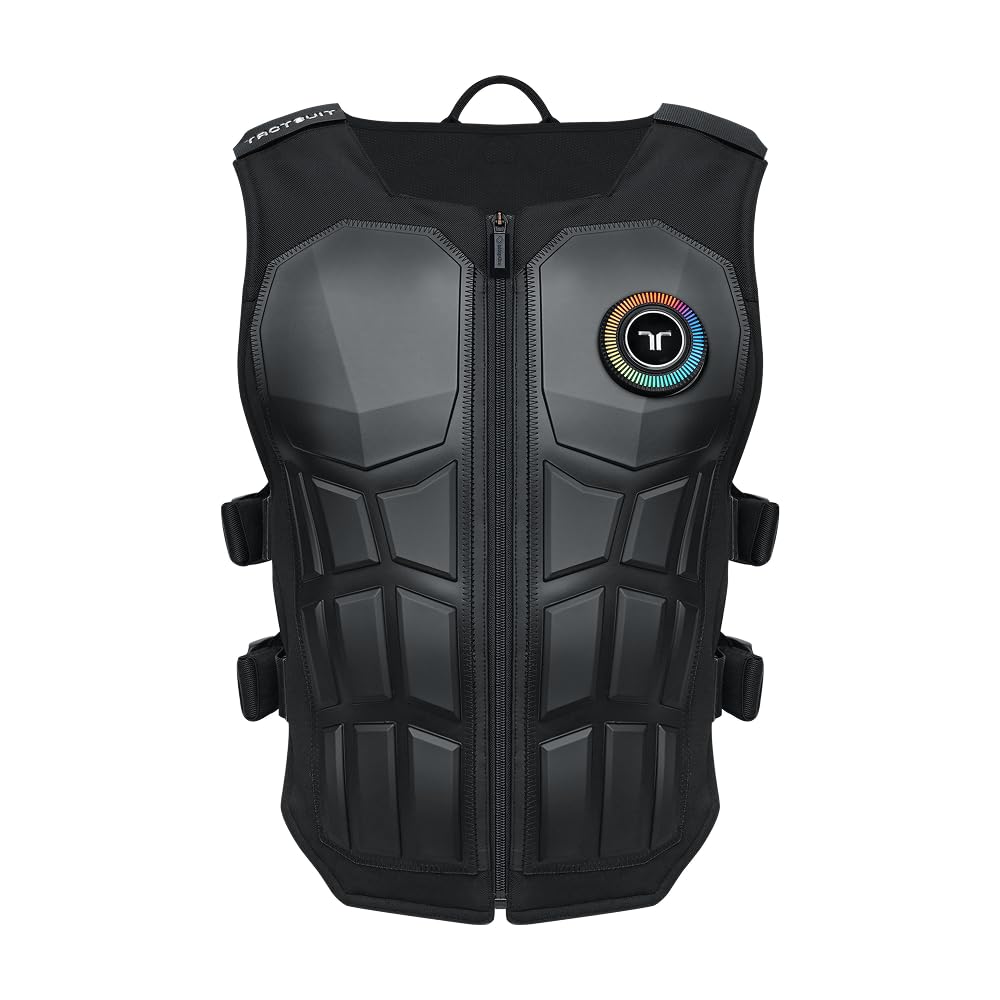
For the ultimate in 3D haptic immersion, you must move beyond the head and involve the torso. The bHaptics TactSuit Pro is a premium haptic vest equipped with 32 feedback motors distributed across your chest, back, sides, and stomach. This vest is the gold standard for VR enthusiasts who want to feel every bullet impact, directional punch, or gust of wind with stunning physical accuracy. It supports over 300 games across PC and VR platforms via native integrations.
The vest uses a combination of Bluetooth and a low-latency dongle to receive real-time telemetry data from your game. When a zombie bites your left shoulder in Arizona Sunshine, you feel a specific, localized vibration there. The Audio-to-Haptics feature can also analyze any audio source (even flat-screen games, movies, or music) and translate it into dynamic vibration patterns. The build quality is excellent, featuring a breathable mesh lining and adjustable straps for a secure, comfortable fit for long play sessions.
The primary drawback is the heavy reliance on software. While many titles have native support, others require manual setup through third-party tools that can be time-consuming and frustrating. The battery life is impressive at over 13 hours, but the unit is an additional piece of gear to put on and charge. Some users have reported hardware failures after limited use. For the serious VR gamer who wants to achieve a new level of presence, the TactSuit Pro is an incredible investment.
Why it’s great
- 32 independent motors provide incredibly detailed and localized full-body haptic feedback.
- Extensive library of over 300 supported games across multiple VR and PC platforms.
- Audio-to-Haptics feature allows it to work with any game, movie, or music source.
Good to know
- Setting up haptics for games without native support can be a complex, time-consuming process.
- The vest is an additional piece of hardware that adds to the setup and charging time before playing.
8. PlayStation VR2

The PlayStation VR2 is a dedicated console VR powerhouse that leverages the unique capabilities of the PS5. Its key differentiator is the combination of headset haptics and eye-tracking. The headset itself vibrates in sync with in-game events—a near-miss explosion rattles the visor, or a character’s heartbeat creates a subtle pulse. This head-haptic feedback, combined with the haptic triggers in the PSVR2 Sense controllers, creates a deeply integrated physical feedback loop.
The visuals are stunning thanks to an OLED display that offers true blacks and HDR, with a resolution of 2000 x 2040 per eye and a 110-degree field of view at up to 120Hz. Eye-tracking enables foveated rendering, which dramatically boosts performance by rendering the area you are looking at in sharp detail while blurring your peripheral vision. This tech, paired with the 3D Audio engine of the PS5, makes for an incredibly immersive and efficient VR system. The single USB-C connection makes setup trivial.
The biggest limitation is its wired connection to the PS5. While the wire is long and lightweight, it tethers you to the console and requires spatial awareness to avoid tangling. The setup with the Sense controllers and camera tracking requires a clear play area. The game library, while growing with exclusives like Horizon Call of the Mountain and Gran Turismo 7, is smaller than the PC VR library. For the dedicated PlayStation gamer, the PSVR2 offers a polished, high-fidelity VR experience.
Why it’s great
- Integrated headset haptics and adaptive triggers provide a unique, full-device haptic experience.
- OLED HDR display delivers exceptional contrast and vibrant colors for maximum immersion.
- Foveated rendering via eye-tracking optimizes performance for smooth, high-detail visuals.
Good to know
- The single USB-C cable, while simple, tethers you to the PS5 and limits movement.
- The game library is exclusive to the PS5 ecosystem and not as vast as the PC VR catalog.
9. Bose A30 Bluetooth Aviation Headset

The Bose A30 Aviation Headset is the outlier on this list, but it represents the pinnacle of haptic-adjacent audio in the most demanding environment possible: the cockpit. Designed for pilots, the A30’s 3D “haptic” feedback comes not from a motor, but from its industry-leading Active Noise Reduction (ANR) and Active Equalization. By stripping away the massive low-frequency drone of an aircraft engine, the A30 creates a spatial audio vacuum where every ATC callout and alert is crystal clear and precisely localized.
The unparalleled comfort is a key feature, with 20% lower clamping force than its predecessor, the legendary A20, and soft, plush ear seals. The three-selectable ANR modes allow pilots to tune the noise cancellation for different phases of flight. The precision-focused noise-cancelling microphone is engineered to reject engine noise from the transmitted audio, ensuring your voice is heard with perfect clarity on the radio. It is FAA TSO and EASA E/TSO-C139a certified for use in professional aviation.
This is a specialized tool for a high-stakes application. The price is a major barrier for casual use, and its functionality is purpose-built for aviation, not gaming. The Bluetooth 4.2 is dated compared to modern standards, though adequate for connecting to an electronic flight bag. For a pilot, however, the clarity, comfort, and ANR performance of the A30 make it an indispensable tool and a business expense that directly improves safety and reduces fatigue in the “3D” environment of the sky.
Why it’s great
- Industry-leading Active Noise Reduction is essential for the high-decibel cockpit environment.
- Extremely lightweight design with much lower clamping force, ideal for long flights.
- FAA TSO certified for professional use, with a durable build that can withstand harsh conditions.
Good to know
- Designed exclusively for aviation; its utility for gaming or general media consumption is limited.
- The price point is the highest on this list, justified by its professional certification and niche.
FAQ
Can a standard Dolby Atmos or DTS Headphone:X headset simulate 3D haptics?
Does a haptic headset work with all video games, or just specific ones?
Is a 3D haptic headset a good replacement for a dedicated bass shaker in a sim racing rig?
Final Thoughts: The Verdict
For most users, the best 3d haptic headset winner is the Razer Kraken V4 Pro because it is the only product that provides a integrated, and programmable Sensa HD Haptic system inside a full-featured wireless headset. If you want multi-platform flexibility and the highest fidelity wireless audio, grab the SteelSeries Arctis Nova Pro Omni. And for the ultimate full-body immersion in VR, nothing beats the bHaptics TactSuit Pro.