
Doubling up on 15-inch subwoofers isn’t about noise — it’s about spreading low-frequency pressure so evenly across your vehicle or room that every seat feels the kick drum in the same instant. Two drivers share the workload, cutting cone distortion in half while doubling the surface area that moves air. The catch? Wiring impedance, enclosure volume, and amplifier matching become more demanding with every additional driver.
I’m Min — the co-founder and writer behind Gadgets Feed. I’ve spent countless hours cross-referencing power handling specs, voice coil configurations, and enclosure requirements to build this guide around the real-world wiring scenarios that make or break a dual 15-inch setup.
Whether you are building a ground-pounding car audio wall or a home theater stack capable of shaking the couch, this guide to the best two 15-inch subwoofer setups will help you match drivers, amps, and boxes for clean, room-rattling bass without wasted power.
How To Choose The Right Two 15-Inch Subwoofer Setup
Running two 15-inch woofers multiplies every variable: impedance, enclosure volume, and amplifier current draw. A single 15 might forgive a slightly undersized box or a marginal amp, but a pair will expose every weakness in your build. Focus first on how the woofers will be wired together, then on whether they share a common chamber or each get their own enclosure.
Dual Voice Coil Configurations and Final Impedance
Most 15-inch subwoofers designed for pairing offer dual voice coils ranging from 2 ohms to 4 ohms per coil. Two dual-2-ohm subs can be wired to present a 0.5-ohm, 2-ohm, or 8-ohm load depending on series/parallel logic. A monoblock amplifier stable at 1 ohm will see the 2-ohm final load from dual-2-ohm coils wired in series-parallel — the most common and safe pairing for high-wattage builds. Dual-4-ohm coils wired in parallel yield a 1-ohm final load from two subs, which works well if your amp is 1-ohm stable and the electrical system can sustain the current draw.
Enclosure Volume for Two 15-Inch Woofers
Two 15-inch woofers need roughly double the box volume of a single unit, but shared-chamber designs can reduce total space slightly if both drivers face the same axis. For sealed enclosures, budget at least 3.5 to 4.5 cubic feet net for the pair. Ported enclosures typically require 5.0 to 7.0 cubic feet net with a tuning frequency around 30-35 Hz to avoid cancellation. Skimping on internal airspace raises the resonant frequency, making the bass peaky instead of deep.
Amplifier Power Per Driver
Matching amplifier RMS to the combined RMS of both subs is the single most common mistake. Two 15-inch woofers rated at 1000W RMS each need a 2000W RMS amplifier at the correct impedance. Underpowering the pair forces the amp into clipping when the gain is cranked — and clipped square waves burn voice coils faster than clean sine waves. Always select an amp that delivers 80-120% of the combined RMS rating of your two subs at the final impedance load you plan to run.
Quick Comparison
On smaller screens, swipe sideways to see the full table.
| Model | Category | Best For | Key Spec | Amazon |
|---|---|---|---|---|
| NVX VCW152v3 | Mid-Range | Deep low-end on a budget | 1500W RMS / Dual 2-ohm coils | Amazon |
| Rockford Fosgate P3D4-15 | Mid-Range | Balanced SQ and SPL | 600W RMS / Anodized aluminum cone | Amazon |
| Audiopipe TXX-BDC-V-15 | Mid-Range | High-power value with Kevlar cone | 1500W RMS / 5-magnet motor | Amazon |
| American Bass HD-15 | Mid-Range | Gut-punching daily driver | 2000W RMS / 3-inch voice coil | Amazon |
| Rockville Destroyer 15D2 | Mid-Range | Competition SPL builds | 2000W RMS / 35mm Xmax | Amazon |
| Gravity Warzone 15 (Pair) | Premium | Ready-to-run dual sub package | 3500W peak each / 4-ohm DVC | Amazon |
| SVS SB-1000 Pro | Premium | Home theater sealed sound | 325W RMS / 12-inch driver | Amazon |
| Sound Town METIS-15PWG (Pair) | Premium | Powered PA subwoofer stack | 500W RMS per sub / Class-D amp | Amazon |
| SVS PB-1000 Pro | Premium | Home theater ported depth | 325W RMS / 20Hz extension | Amazon |
In‑Depth Reviews
1. NVX VCW152v3

The NVX VCW152v3 delivers a massive 202-ounce triple-stacked ferrite magnet and a 3-inch 4-layer aluminum voice coil that handles 1500W RMS without thermal sag. The carbon-fiber-reinforced non-pressed paper cone keeps cone breakup at bay even when the pair is wired down to a 2-ohm load on a monoblock amp. Bolt-on dual progressive roll spiders with flat braided tinsel leads prevent lead slap during high-excursion passes.
Buyers report the VCW152v3 digs deep into the 30-45 Hz range with authority, making it ideal for sub-bass-heavy genres and low-tuned ported enclosures. Several reviewers note that running the sub slightly below its RMS rating in a sealed 2.0-cubic-foot box yields surprisingly tight response that doesn’t muddy the midbass. The die-cast aluminum basket and protective rubber boot on the magnet add a layer of build quality rarely seen at this price tier.
The biggest caution is amplifier matching: a 1500W RMS sub needs clean power at the rated impedance, and mismatched high-power amps without proper gain setting have caused blown units. For two VCW152v3s, a 3000W RMS monoblock at 1 ohm is the sweet spot. The sub also benefits from a proper break-in period of 10-15 hours before reaching full excursion capability.
Why it’s great
- Exceptional low-frequency extension down to 20 Hz
- Heavy-duty die-cast basket and bolt-on spider for reliability
- Underrated performance that competes with subs
Good to know
- Weak higher bass notes around 60-80 Hz compared to midbass
- Requires careful gain tuning to avoid overpowering the coil
2. Rockford Fosgate P3D4-15 Punch P3

The hybrid stamp-cast basket reduces unwanted resonance while keeping weight manageable for trunk builds. With 600W RMS and 1200W peak, this sub prioritizes linear excursion over raw power — meaning it stays clean at moderate listening levels where cheaper subs distort.
Long-term owners report that switching from a ported to a sealed enclosure (around 1.58 cubic feet) dramatically improves transient response and eliminates the boominess some users experience with the vented alignment. At 500W RMS in a sealed box, the P3D4-15 still rattles objects off tabletops, proving that efficiency matters more than peak wattage for real-world output. The 10-AWG nickel-plated push terminals accept heavy gauge wire without adapter rings.
The P3D4-15 is a dual 4-ohm voice coil sub, meaning two of them can be wired to a 1-ohm or 4-ohm final load. The sub lacks the extreme Xmax of competition SPL woofers, so it won’t hit the deepest 20-25 Hz notes as hard as subs with longer throw. Mounting depth of 7.58 inches fits most prefab enclosures, but the cutout diameter of 13.94 inches requires accurate baffle measuring.
Why it’s great
- Proven build quality with anodized aluminum cone for rigidity
- Excellent transient response in sealed enclosures
- Widely available prefab box compatibility
Good to know
- Limited ultra-low extension compared to high-Xmax woofers
- Dual 4-ohm coils require careful wiring for 1-ohm amp loads
3. Audiopipe TXX-BDC-V-15

The Audiopipe TXX-BDC-V-15 packs five magnets totaling 310 ounces, a 3.3-inch 4-layer aluminum voice coil with BASV ventilation, and a Kevlar-fiber composite non-pressed paper cone that resists deformation under high power. The 3000W peak / 1500W RMS rating places it firmly in the daily-driver SPL category, while the patent-pipe multi-connect terminals accept up to 8-gauge speaker wire without adapters for clean series/parallel wiring with a second unit.
Users consistently report that the TXX-BDC-V-15 hits far harder than its price point suggests, with tight, deep bass that outperforms comparable Pioneer and Kicker 10-inch and 12-inch models. The quad-weaved tinsel leads on both sides prevent the voice coil from unwinding during long low-frequency sweeps, a common failure point in cheaper high-power subs. The powdered black paint aluminum basket includes a dust-proof heatsink that keeps the motor cool during extended play.
The downside is mounting depth: at 9.5 inches, this sub requires a deep enclosure, limiting prefab box compatibility. Some buyers have noted that the sub needs a significant break-in period before the suspension loosens up — expect 15-20 hours of play before the sub reaches its full excursion. The sensitivity rating of 87 dB is average, so a clean 1500W RMS amplifier is essential to unlock the sub’s potential.
Why it’s great
- Five-magnet motor and Kevlar cone for high-power durability
- Patent multi-connect terminals for easy series/parallel wiring
- Exceptional price-to-performance ratio for dual builds
Good to know
- Deep 9.5-inch mounting depth limits box options
- Long break-in period required for optimal compliance
4. American Bass HD-15
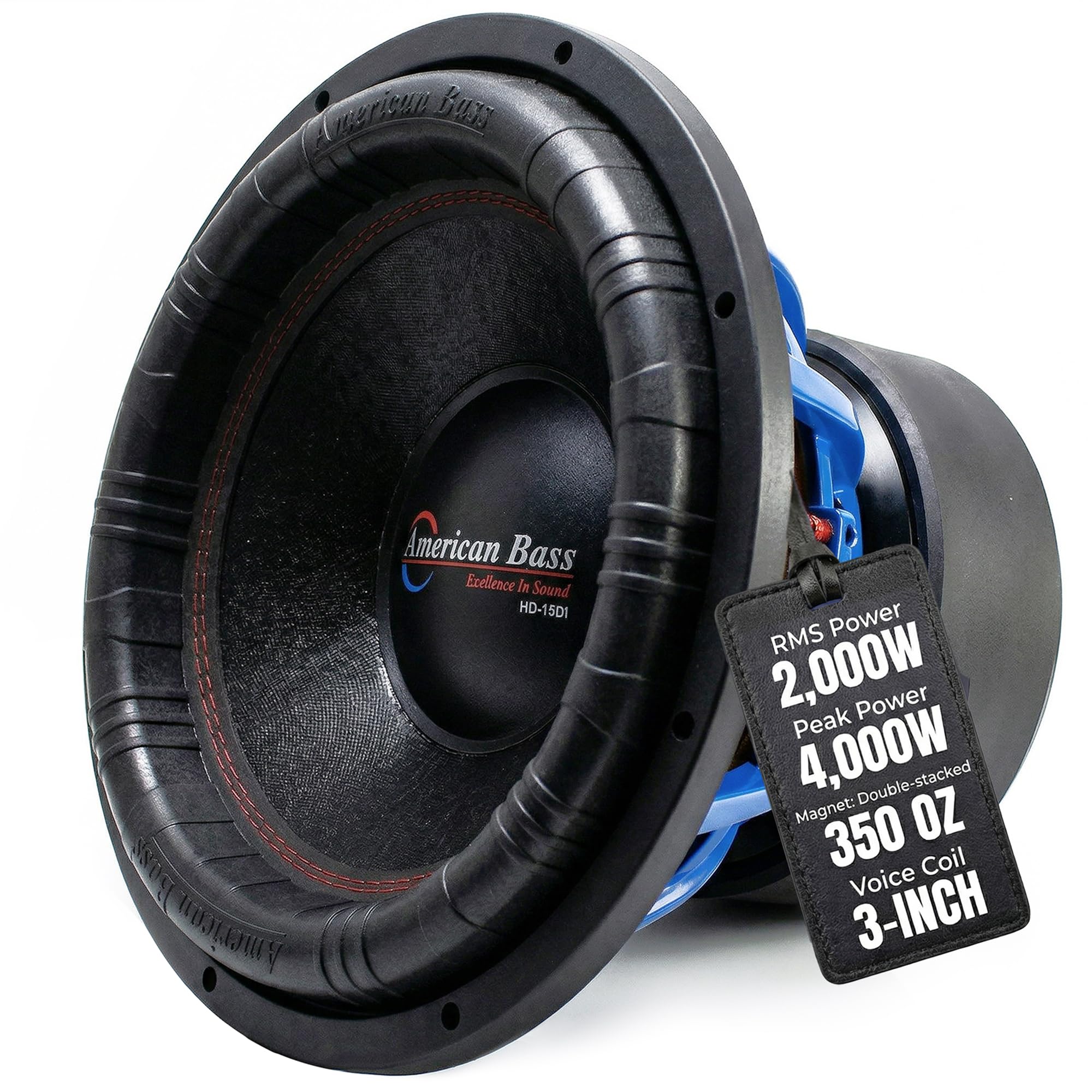
The American Bass HD-15 is built around a massive 350-ounce ferrite magnet and a 3-inch copper voice coil with Nomex reinforcement, handling 2000W RMS continuously. The Kevlar-fiber reinforced paper cone and 3-layer foam surround keep the cone under control at high excursion levels, while the stamped steel basket with blue powder coating adds visual flair without sacrificing structural integrity. This sub is designed for dedicated bassheads who want gut-punching output without stepping into full competition territory.
Real-world reports from owners running a single HD-15 on 2000W in an extended cab truck note that the sub sounds noticeably cleaner and more accurate than comparable Skar Audio models, producing defined kick drums rather than one-note boom. The dual 1-ohm voice coil configuration allows the HD-15 to be wired to a 0.5-ohm or 2-ohm final load, making it flexible for older high-current amplifiers. The rubber gasket and magnet boot protect the motor from debris in trunk and hatchback installations.
The HD-15 has a frequency response limited to 250 Hz, which is expected for a dedicated subwoofer, but its upper-bass rolloff means it pairs best with midbass drivers or a separate component system. The stamped steel basket, while durable, does not dissipate heat as effectively as cast aluminum baskets found in pricier competition subs. For long SPL competition runs, active cooling or a larger enclosure may be necessary to prevent thermal compression.
Why it’s great
- 350-ounce magnet provides enormous motor force for high SPL
- Nomex-reinforced voice coil resists deformation under heat
- Dual 1-ohm coils allow ultra-low impedance wiring options
Good to know
- Stamped steel basket less effective at heat dissipation than cast alternatives
- Upper frequency rolloff requires dedicated midbass drivers for full-range sound
5. Rockville Destroyer 15D2

The Rockville Destroyer 15D2 is engineered for SPL competition with a triple-stacked 300-ounce Y35 magnet, a one-piece chrome T-yoke, and a cast aluminum basket that resists flex under extreme motor forces. The USA-made 3-inch 4-layer black aluminum voice coil is rated to withstand 300-350 degrees Celsius, supported by high-temperature black glue that prevents coil separation during extended burp tests. With 35mm of Xmax, this sub can move massive air volume in either sealed or vented enclosures.
Competition builders have run two Destroyer 15D2s on 2000W RMS each in 4.0-cubic-foot vented enclosures tuned to 34 Hz, producing chest-compression bass that meters well in street classes. A reviewer who upgraded from Kicker L7 Q-class subs noted the Destroyer hit harder with the same amplifier power, thanks to the higher motor force and longer throw. The non-pressed paper cone with silver stitching and extra-thick foam surround handle high-excursion abuse without tearing.
At 9.76 inches of mounting depth and 14.76 inches of cutout diameter, this sub needs a large baffle and deep enclosure. The recommended vented box volume of 3.16-4.41 cubic feet means a pair will occupy significant trunk or cargo space. Some users have reported port chuffing from prefab enclosures not designed for this sub’s high-velocity airflow — a custom slot-port box tuned to the sub’s parameters is strongly recommended for full SPL performance.
Why it’s great
- 35mm Xmax and triple-stacked magnet for competition SPL
- USA-made high-temperature voice coil rated to 350°C
- Cast aluminum basket ensures structural rigidity at high power
Good to know
- Requires large custom box to avoid port chuffing
- Deep mounting depth limits vehicle fitment options
6. Gravity Warzone 15 (Pair)

The Gravity Warzone 15 arrives as a factory-matched pair of 4-ohm dual-voice-coil subwoofers, each rated at 3500W peak with a competition-grade pressed paper cone and high-roll foam surround. The advanced airflow cooling system vents hot air from the voice coil gap through the spider, reducing thermal compression during extended play. The 4-ohm DVC configuration allows the pair to be wired to a 1-ohm or 4-ohm final load, providing flexibility for different monoblock amplifier stabilities.
Buyers who pair the Warzone 15s with quality amplifiers in the 2000-3000W RMS range report impressive output for the price, with the subs producing deep bass that “hurts” when matched correctly. The pressed paper cone delivers a warm, musical character that some enthusiasts prefer over stiffer composite cones for daily listening. The pair package eliminates the hassle of matching impedance and power specs between two individually purchased subs.
The primary concern reported by multiple owners is durability at sustained high power levels. Several reviews mention blown voice coils when the subs were pushed near their rated peak for extended periods, suggesting these are best treated as high-SPL daily drivers rather than competition burp machines. The magnet structure, while strong, is not as large as the triple-stacked designs found in dedicated competition subs, so thermal management in tight enclosures becomes critical.
Why it’s great
- Factory-matched pair ensures consistent impedance and response
- Airflow cooling system helps manage voice coil temperatures
- Warm musical character from pressed paper cone
Good to know
- Reported reliability issues at sustained high power levels
- Smaller magnet structure compared to dedicated competition subs
7. SVS SB-1000 Pro
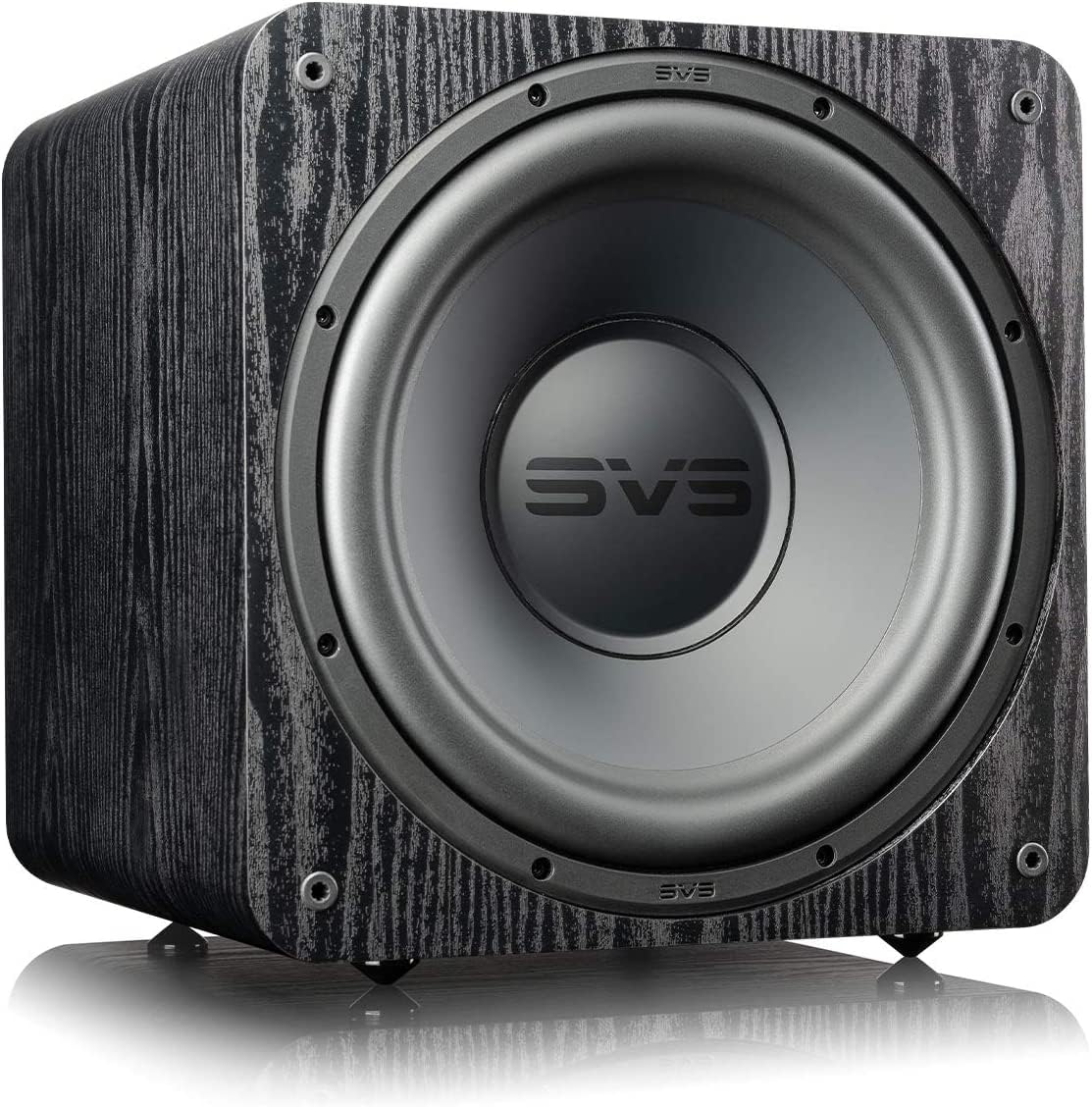
The SVS SB-1000 Pro is a sealed-cabinet subwoofer that pairs a high-excursion 12-inch driver with a 325W RMS Sledge STA-325D Class-D amplifier delivering over 820W peak. The dual ferrite magnet motor assembly and long-throw parabolic surround enable extreme excursion while maintaining low distortion through the crossover region. A 50MHz Analog Devices audio DSP handles in-room tuning with pinpoint accuracy, letting the subwoofer blend seamlessly with bookshelf or tower speakers.
Owners using dual SB-1000 Pros in media rooms report that the bass becomes non-directional, filling the space evenly without a localized thump. The SVS smartphone app provides control over volume, parametric EQ, crossover frequency, and custom presets from the listening position — a feature set typically reserved for subwoofers costing twice as much. The sealed cabinet’s compact dimensions make it easy to place near walls or furniture without exciting room modes as aggressively as ported designs.
While the SB-1000 Pro reaches 20 Hz with authority, its output in the 20-25 Hz range is limited compared to larger sealed subs or ported alternatives. For home theater enthusiasts wanting sub-audible rumble for explosion effects, the ported PB-1000 Pro is a better fit. The logarithmic volume taper on the app has been noted as somewhat awkward for fine adjustment, and the SB-1000 Pro may struggle to pressurize very large open-concept rooms without running out of displacement.
Why it’s great
- Compact sealed cabinet with 20 Hz extension
- Smartphone app with full DSP tuning capabilities
- Fast, articulate bass that blends with music systems
Good to know
- Limited ultra-low-end output compared to ported designs
- May struggle to pressurize very large rooms
8. Sound Town METIS-15PWG (Pair)

The Sound Town METIS-15PWG pair brings powered versatility to 15-inch subwoofers, with each unit housing a Class-D amplifier rated at 500W RMS / 1800W peak. The 4-inch voice coil on the 15-inch driver provides high thermal mass for sustained bass notes, and the 5/8-inch birch plywood front and rear panels resist panel resonance at high output levels. XLR and RCA combo inputs, plus 100 Hz high-pass XLR outputs, allow the subs to integrate directly with a PA mixer or a home theater processor.
Live sound users have found the METIS-15PWG pair hits harder than passive subs like the EV ELX200-18SP when fed from the same signal, with adjustable crossover frequency control on the rear panel. The recessed ergonomic handles and carpeted finish make these subs road-worthy for mobile DJs and small venue musicians. The 35mm pole mount socket supports satellite speakers for a full-range PA stack without separate stands.
The main drawbacks are weight and portability — each sub weighs roughly 90 pounds, making solo setup challenging. Users report the sub clips when pushed to full volume with heavy bass tracks, and the built-in cooling fan is audible during quiet passages. The subwoofer’s frequency response favors deep lows over mid-low punch, meaning it may feel less aggressive for kick drum reproduction compared to dedicated live sound subs with higher sensitivity in the 60-80 Hz range.
Why it’s great
- Powered Class-D amps eliminate need for external amplification
- Birch plywood cabinet resists resonance at high SPL
- XLR/RCA connectivity with high-pass output for PA integration
Good to know
- Heavy 90 lb per unit limits portability for solo setup
- Audible cooling fan during quiet playback
9. SVS PB-1000 Pro

The SVS PB-1000 Pro is the ported sibling of the SB-1000 Pro, using the same 325W RMS Sledge amplifier and 50MHz DSP but housed in an acoustically tuned dual-port cabinet that extends usable output down to 20 Hz with far greater output than its sealed counterpart. The high-excursion 12-inch driver with dual ferrite magnet motor assembly leverages the port tuning to deliver palpable, chest-compressing bass for movie explosions without audible distortion or chuffing at normal listening levels.
Home theater enthusiasts pairing two PB-1000 Pros in rooms as large as 15×17 feet report achieving flat ±3 dB response to 20 Hz using the Bluetooth app’s 3-band parametric EQ to tame room modes. The front-firing port design allows corner placement without exciting rear-wall reflections, and the app enables on-the-fly adjustments from the listening position. The PB-1000 Pro handles both movies and music with equal authority, producing tight, controlled bass that integrates seamlessly with bookshelf speakers like the KEF LS50.
In smaller rooms or condo/apartment settings, the ported output can be overbearing on bass-heavy music tracks, requiring gain reduction through the app. Some users note port noise at extreme volumes, though this typically occurs only with content below 20 Hz or in oversized enclosures. The PB-1000 Pro is physically larger than the SB-1000 Pro and may not fit in tight equipment racks or under desks, and its higher output may require careful gain staging to avoid overpowering the main speakers in compact spaces.
Why it’s great
- Deep 20 Hz extension with high output for home theater
- Front-firing ports allow flexible room placement
- Full DSP control via Bluetooth app for room EQ
Good to know
- Can overpower small rooms with bass-heavy music
- Port noise may occur at extreme output below 20 Hz
FAQ
Can I run two 15-inch subwoofers on a single monoblock amplifier?
What enclosure volume do I need for a pair of 15-inch subwoofers?
Should I use a sealed or ported box for two 15-inch subs?
Final Thoughts: The Verdict
For most users building a dual 15-inch setup, the two 15-inch subwoofer winner is the NVX VCW152v3 because it delivers 1500W RMS of deep, clean low-end with a build quality that punches well above its price tier. If you want reference-quality sound with proven reliability and anodized aluminum cone rigidity, grab the Rockford Fosgate P3D4-15. And for high-power SPL builds where every decibel matters, nothing beats the Rockville Destroyer 15D2 with its 35mm Xmax and triple-stacked magnet motor.