
A dead laptop, a dying phone, and a hungry CPAP machine are the fastest way to ruin a road trip or a workday from the driver’s seat. The right power inverter turns your vehicle’s 12-volt DC outlet into a reliable 110-volt AC lifeline, but choosing the wrong one—either too weak for your gear or too cheap to handle a continuous load—can leave you stranded or risk a dead battery. That is the exact problem a smart 12V car inverter solves.
I’m Min — the co-founder and writer behind Gadgets Feed. I spend countless hours analyzing conversion efficiency ratings, waveform types, and thermal management systems in portable power electronics so you don’t have to risk a bad purchase. This guide is the result of deep spec-level research into modified vs. pure sine wave designs, continuous vs. peak wattage claims, and real-world thermal behavior under load.
After comparing seven top-selling models on wattage capacity, waveform purity, USB-C fast-charging support, and integrated safety protections, this guide systematically breaks down what separates a dependable travel companion from an emergency-room fire hazard and lands on the definitive best 12v car inverter for most drivers, campers, and mobile professionals.
How To Choose The Best 12V Car Inverter
Before you buy, three decisions dictate whether your inverter powers your devices reliably or drains your battery and trips its internal fuse mid-use. Focus on continuous wattage, waveform type, and physical installation constraints.
Continuous Wattage vs. Peak Surge
The single most important spec is the continuous power rating in watts. This is the sustained output the inverter can deliver—running a 65W USB-C laptop charger is easy, but a 400W blender or a 700W refrigerator pulls that continuous power for minutes or hours. Peak surge (often 2x the continuous rating) only covers the momentary startup draw of motors or compressors and lasts milliseconds. If you ignore continuous wattage and only look at the surge number, you will trip the overload protection the first time your device switches on. A general rule: total the wattage of every device you plan to run simultaneously, then buy an inverter rated for at least 20% more continuous watts.
Modified Sine Wave vs. Pure Sine Wave
Modified sine wave inverters are cheaper and work fine for resistive loads like incandescent bulbs, heating pads, and basic power tool chargers. However, sensitive electronics—CPAP machines, variable-speed power tools, medical devices, and any device with a switching power supply—will hum, buzz, run hotter, or fail entirely on modified sine wave. Pure sine wave inverters replicate the clean AC waveform from your home wall outlet, so refrigerators, fans, laptops, and audio gear operate silently and efficiently. For occasional tailgate charging, modified sine wave is sufficient. For camping where you need a CPAP or a mini-fridge, pure sine wave is non-negotiable.
Input Connection & Heat Dissipation
Every 12V car inverter sold with a cigarette lighter plug is fundamentally limited to about 120W-180W continuous unless the engine is running. The lighter socket is fused at 10-15A, so anything above roughly 150W forces you to connect directly to the battery with ring terminals or alligator clamps. Models above 500W include heavy-gauge battery cables and require a hardwired connection. Equally important: thermal management. A cooling fan that only activates above 104°F-113°F keeps the unit silent at low loads, but if you push 800W continuously, a passive design overheats and shuts down. Look for inverters with thermally regulated fans and aluminum housings that passively shed heat.
Quick Comparison
On smaller screens, swipe sideways to see the full table.
| Model | Category | Best For | Key Spec | Amazon |
|---|---|---|---|---|
| VOLTWORKS 1500W Pure Sine Wave | Pure Sine Wave | RV / sensitive electronics | 1500W continuous pure sine wave | Amazon |
| BELTTT 2000W Pure Sine Wave | Pure Sine Wave | Heavy-duty off-grid setups | 2000W continuous, 4000W surge | Amazon |
| BESTEK 1000W | Modified Sine Wave | High-power camping / tailgating | 1000W continuous, dual PD 30W USB-C | Amazon |
| VEVOR 1500W Pure Sine Wave | Pure Sine Wave | Permanent RV / solar integration | 1500W continuous, 4 AC outlets | Amazon |
| Energizer 1500W Modified Sine Wave | Modified Sine Wave | Work truck / heavy DIY loads | 1500W continuous, LCD wattage display | Amazon |
| POTEK 500W Modified Sine Wave | Modified Sine Wave | Mid-range travel / tailgate power | 500W continuous, dual AC outlets | Amazon |
| Pro Chaser 400W Modified Sine Wave | Modified Sine Wave | Compact EDC / laptop & phone charging | 400W continuous, PD 65W USB-C port | Amazon |
In‑Depth Reviews
1. VOLTWORKS 1500W Pure Sine Wave Inverter
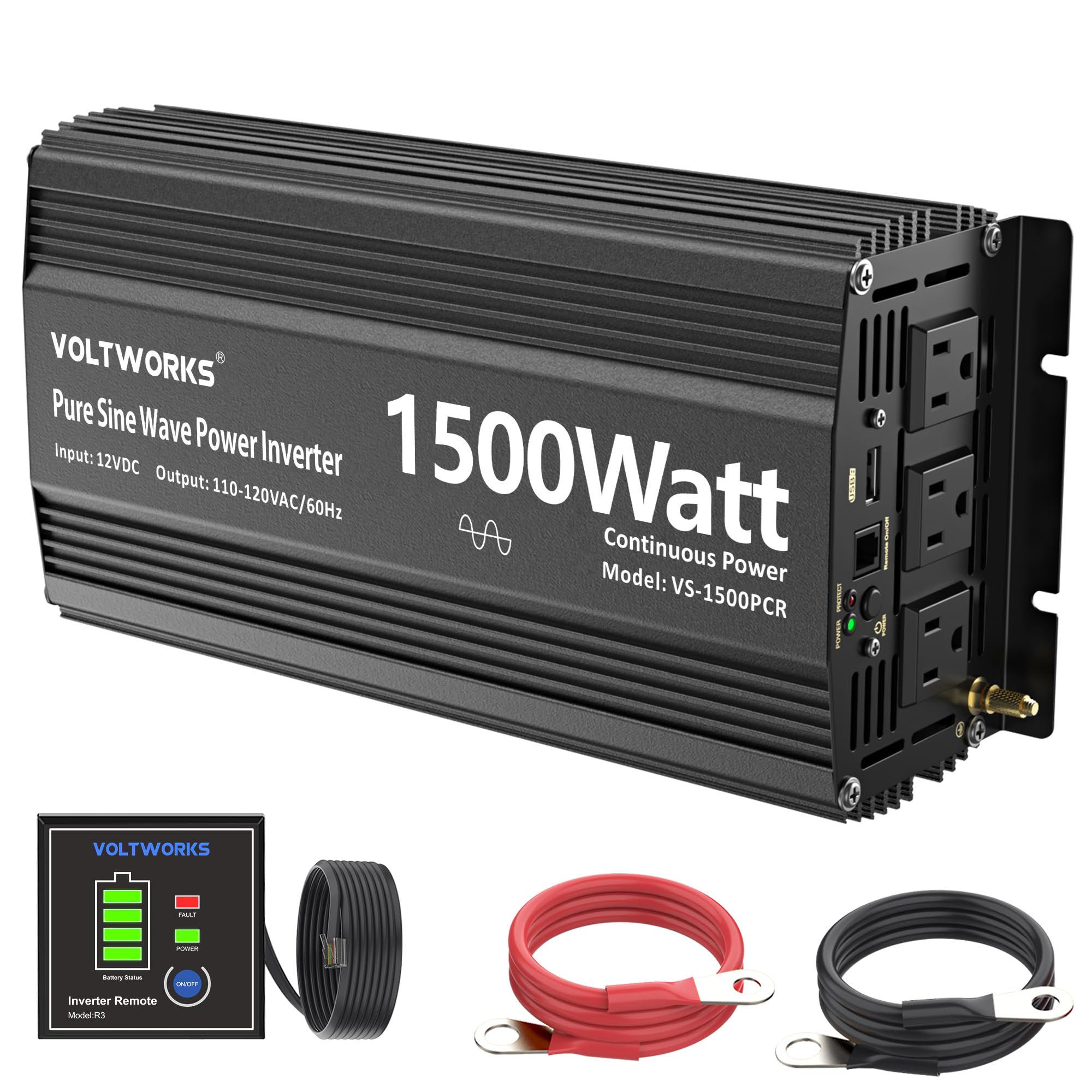
The VOLTWORKS VS-1500PCR delivers 1500 watts of continuous pure sine wave power from a 12V battery, making it the strongest clean-wave contender for RV and home backup use. Its three AC outlets and a 2.4A USB port give you flexibility for a microwave, CPAP machine, or refrigerator without the buzzing or overheating common in modified sine wave units. The aluminum housing sheds heat passively, and the cooling fan stays silent until the load exceeds 800 watts or the internal temperature hits 104°F, which keeps it whisper-quiet during light charging.
A standout feature is the included 15-foot remote controller with an LCD that displays input voltage, output wattage, and battery level. This is critical for permanent installs where you want to mount the inverter out of sight under a seat or in a cabinet and still monitor performance from the driver’s seat. The remote also lets you power-cycle the inverter without crawling into the cargo area. The package comes with 2-foot battery cables, a ground wire, and UL-listed fuses for a straightforward install.
Reviewers consistently praise its ability to run sensitive electronics without noise or load-shedding issues, although the remote’s battery gauge is less accurate with LiFePO4 lithium batteries—it tends to show a false “one bar” long before the BMS cuts power. If you pair it with a proper battery monitor, this minor metric complaint becomes irrelevant. For anyone needing clean, quiet, and reliable 120V AC from a 12V system—especially for medical devices or refrigerators—this is the benchmark.
Why it’s great
- True pure sine wave output eliminates hum and noise on sensitive electronics
- 15-foot remote control with LCD makes permanent installation practical
- Fan stays silent under 800W load, ideal for quiet camping
Good to know
- Remote battery gauge underreports reserve on LiFePO4 batteries
- Surge capacity not explicitly rated above 1500W
2. BELTTT 2000W Pure Sine Wave Inverter

At 2000 watts continuous and a massive 4000-watt peak surge, the BELTTT is the powerhouse of this comparison. It steps well beyond the “car lighter plug” category—this unit demands direct battery connection with its included 2AWG cables and is designed for serious off-grid solar, RV homesteads, and truck-bed workshops. Its conversion efficiency exceeds 93%, and the no-load draw is negligible, meaning it won’t silently drain your battery overnight when left switched on via the remote.
The dual AC outlets include one standard NEMA 5-15R and a dedicated 20A TT-30R outlet typically found in RV pedestals, plus a hardwire terminal for permanent installation. The high-brightness LCD displays both input and output voltage, load bar graph, and fault codes—a level of diagnostic feedback rare at this price tier. The remote controller comes with a generous 23-foot cable, making it ideal for trucks where the inverter sits in a toolbox or under the bed and the switch lives in the cab.
Customer experiences highlight rock-steady output voltage under load, but the included battery cables are undersized for a full 2000W run at distance. Several users replaced the 6 AWG pigtails with 2/0 AWG cable for installations farther than 3 feet from the battery. The plastic end caps feel slightly less durable than the all-metal VOLTWORKS housing, but the internal soldered lug connections reduce fire risk from loose bolted terminals. For users who need to run a microwave, coffee maker, or window AC unit from a battery bank, this inverter delivers the wattage headroom.
Why it’s great
- 4000-watt surge handles refrigerator and compressor startup easily
- Dedicated 20A RV outlet plus hardwire port for permanent installs
- Remote cable at 23 feet is the longest in this comparison
Good to know
- Included battery cables are undersized; plan to upgrade for 15-foot runs
- Plastic end caps feel less rugged than aluminum-body rivals
3. BESTEK 1000W Car Power Inverter

The BESTEK MRI10011 brings 1000 watts of continuous modified sine wave power plus a PD 30W USB-C port and a QC 18W USB-A port into a compact 9.1-inch footprint. This is the sweet spot for car campers who need to run a laptop, charge a camera battery, power a 400W blender, and still top off a smartphone simultaneously. The dual smart cooling fans automatically adjust speed based on temperature, keeping the unit quiet during light loads and only ramping up audibly under sustained high draw.
ETL certification under UL STD 458 is a meaningful safety credential at this price—many budget 1000W inverters skip third-party testing. The double-protection system uses both a smart chip and a physical fuse, so a short circuit or over-temperature event shuts the inverter down and lights a red warning LED. The package includes battery clamp cables for direct connection, which is mandatory when drawing more than 120W; using the lighter plug adapter at full load will blow the vehicle’s 15A fuse.
Real-world reviewers confirm it runs a 1/2-inch drill, a 400W blender, and even a small fridge without hiccups, though one unit failed at 300W on the first try—the replacement worked flawlessly for months. The fan is audible under heavy load but not distracting. For anyone who needs a reliable mid-power inverter with modern USB-C fast-charging and genuine safety certification, the BESTEK is the most convincing value proposition in this list.
Why it’s great
- PD 30W USB-C and QC 18W USB-A for fast device charging without AC plugs
- ETL certified with dual protection circuit and physical fuse
- Compact enough to stow in a glove box or center console
Good to know
- Fan can be loud under heavy loads above 700W
- Light-duty battery clamps included; upgrade cables for 1000W sustained use
4. VEVOR 1500W Pure Sine Wave Inverter
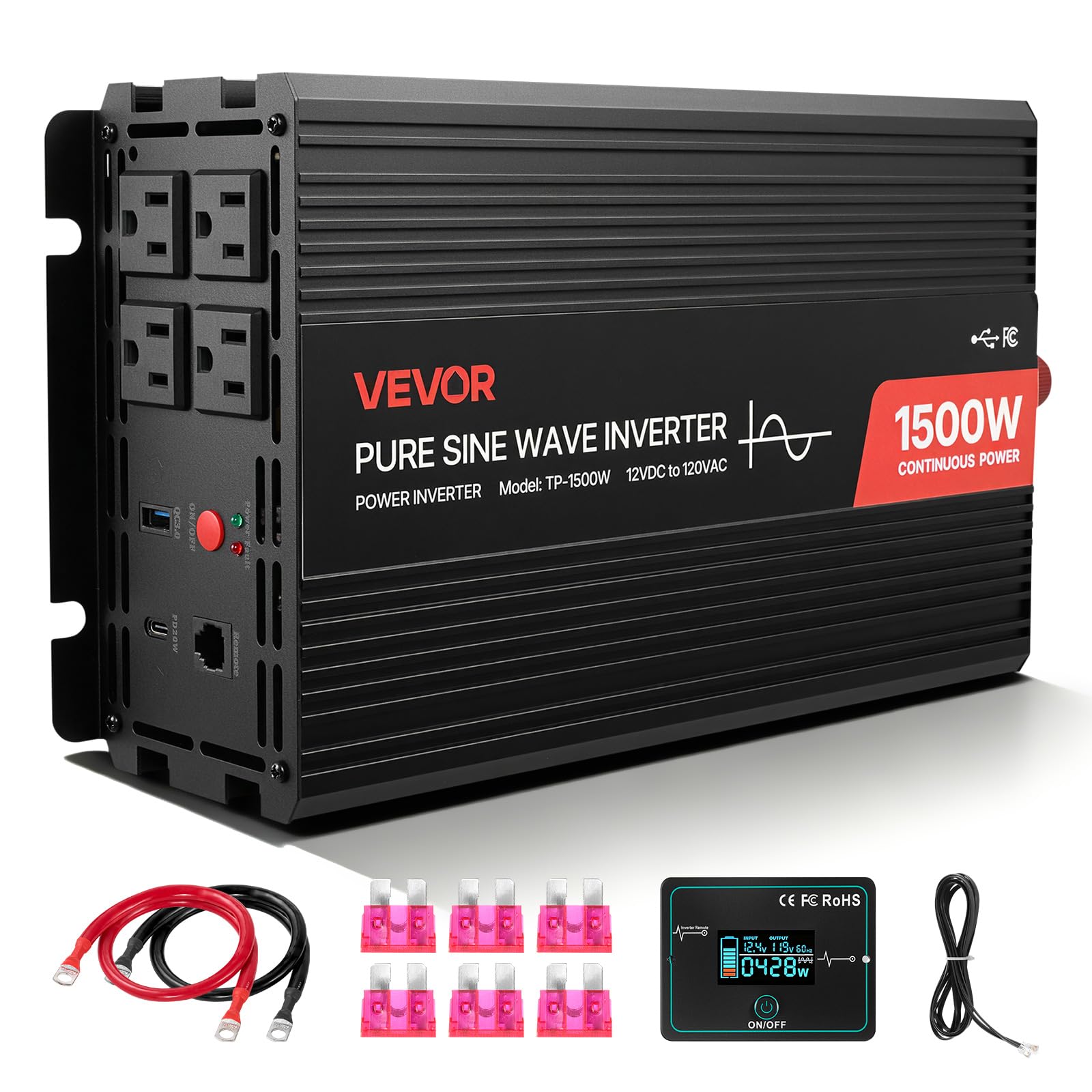
VEVOR’s 1500W pure sine wave inverter differentiates itself with four AC outlets—more than any other unit in this comparison—plus a USB-A and a USB-C port. This makes it the best choice for RVs or camp setups where multiple 120V devices need simultaneous power without daisy chaining power strips. The pure sine wave output is clean enough for a 13,500 BTU RV air conditioner, which several customers confirmed after hardwiring it through a transfer switch.
The remote controller cable is 9.8 feet, shorter than the VOLTWORKS and BELTTT options, but still sufficient for most under-seat to dash routing. A six-protection system (over-voltage, under-voltage, overload, over-temperature, short circuit, reverse polarity) is backed by six spare 40A fuses included in the box. The aluminum alloy housing is corrosion-resistant, and the intelligent fan activates at 113°F, preserving silence during low-load charging sessions.
One caveat: the LCD display shows DC input wattage including inverter losses, not the actual AC output wattage drawn by your device. At a 121W fan load, the display reads roughly 151W—a 20% overhead that reflects the inverter’s ~80% efficiency under that load. If you want precise AC power metering, pair it with an external watt meter. For users prioritizing raw outlet count, waveform purity, and compatibility with AGM/LiFePO4 battery chemistry presets, the VEVOR is a versatile premium workhorse.
Why it’s great
- Four AC outlets handle multiple devices without a power strip
- Six included 40A spare fuses for long-term maintenance
- Compatible with six battery chemistries including LiFePO4
Good to know
- Display shows DC input wattage, not AC output—adds ~20% overhead reading
- Remote cable at 9.8 feet is shorter than competitors
5. Energizer 1500W Modified Sine Wave Inverter

The Energizer ENK1500 delivers 1500 watts continuous (3000 watts peak) with a modified sine wave output, targeting users who need raw power for resistive loads like power tools, space heaters, and sump pumps without the premium cost of a pure sine wave unit. Its size is substantial at 13.8 x 7.7 x 3.5 inches, reflecting the heavy-gauge internal bus bars and dual 4AWG battery cables included in the box. The graphical LCD shows input voltage, output wattage, battery level, and fault codes for each protection mode (overload, over/under voltage, high temperature, short circuit).
ETL approval under UL STD 458 is a key trust marker at this power level, and the 2-year warranty extends to 3 years if you register the purchase online. The mounting brackets make it easy to bolt the inverter under a truck bed cap or on a shed wall, and the terminals accept large-gauge wire without modification. Users running it on a 100Ah lithium battery kept a sump pump running through a multi-hour outage, proving its reliability under sustained load.
The major limitation is the lighter socket cannot handle anything near 1500W—the included battery cables are mandatory for anything above 200W. Additionally, the modified sine wave output will cause fans and some power adapters to hum or run slightly warmer. For work-truck applications running incandescent lights, chargers, and induction tools, this is a robust, display-rich unit. If you plan to power a CPAP or a TV, step up to a pure sine wave model instead.
Why it’s great
- Full LCD display with per-mode fault code readouts
- Included 4AWG battery cables and mounting brackets for permanent install
- ETL certified under UL STD 458 with 3-year warranty
Good to know
- Modified sine wave causes hum in fans and some power supplies
- Stock alternators can’t supply full 1500W—requires high-output alternator or battery bank
6. POTEK 500W Modified Sine Wave Inverter

The POTEK 500W is a straight-ahead, no-frills modified sine wave inverter built for users who need moderate AC power for laptops, phone chargers, small TVs, and drill batteries during road trips or tailgates. Its continuous 500-watt rating (1000-watt surge) is enough to run a 1/2-inch drill or a 24-inch LED TV without straining the vehicle’s electrical system, even through the cigarette lighter plug if the engine is running. The unit includes two standard 15A NEMA AC outlets and a single 2.1A USB port—a basic but functional port selection.
At 6.7 x 4.1 x 2.2 inches and just over 2 pounds, the POTEK is compact enough to tuck into a glove box or seat-back pocket. The housing is matte black plastic with passive cooling supplemented by a temperature-activated fan. UL certification is listed, though the exact standard is not specified. Dual 30A internal fuses provide redundancy against short circuits and overloads, and the unit features a standard spring-loaded terminal block for direct battery connection with the included ring-terminal cables.
Customer feedback consistently highlights its quiet operation—the fan rarely spins up unless you sustain a load above 300W. The build quality feels solid for the price, and it has been used reliably to power a boom box, a camping blender, and even as a temporary power source for a shed. The only real drawback is the single USB port is limited to 2.1A (10.5W), so fast charging modern phones requires the AC outlet and a wall adapter. For a reliable, compact, mid-power inverter without unnecessary features, the POTEK is a proven standby.
Why it’s great
- Compact and lightweight at 2 pounds—easy to store anywhere
- Fan stays quiet under moderate loads; reliable cooling for its class
- UL-certified with dual 30A fuses and spring-loaded terminals
Good to know
- Single USB port limited to 2.1A—no fast charging
- Modified sine wave not suitable for sensitive medical or audio equipment
7. Pro Chaser 400W Modified Sine Wave Inverter
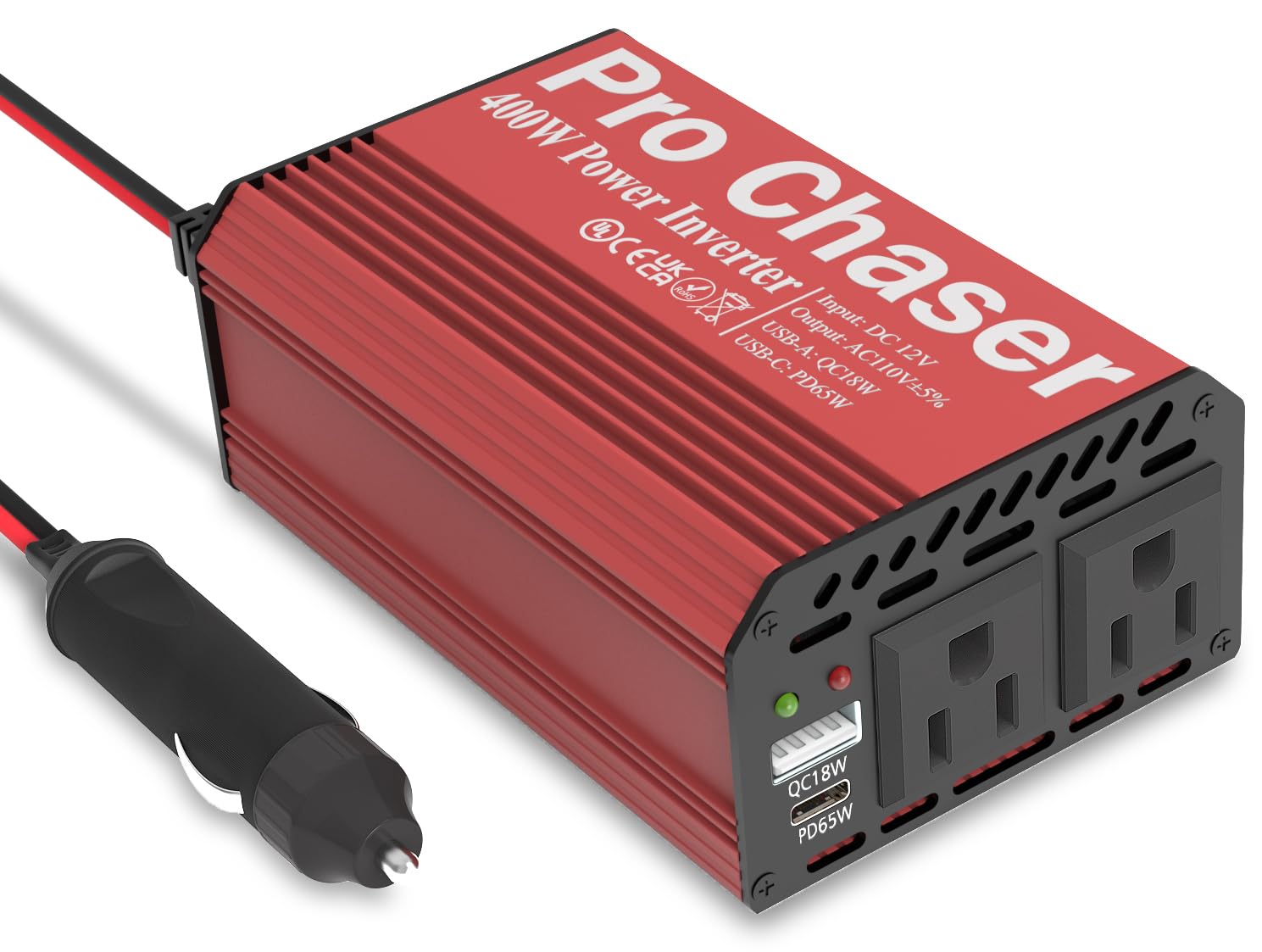
The Pro Chaser PCIV501-SRD packs 400 watts of continuous modified sine wave power (800W peak) into a form factor smaller than a smartphone, making it the most portable inverter in this guide. The headline feature is the PD 65W USB-C port—the highest wattage USB-C port in this comparison—allowing you to power or fast-charge a 15-inch MacBook Pro or a high-end Windows laptop directly without needing one of the two AC outlets. The USB-A QC 18W port handles rapid Android charging simultaneously.
The 30-inch cigarette lighter cord is convenient for reaching the back seat, but the unit is limited to roughly 120W continuous through the lighter socket due to the vehicle’s 15A fuse. To access the full 400W continuous rating, you must use the included alligator battery clamps for a direct battery connection. The built-in fuse covers short circuits, overload, low voltage, overvoltage, and overheating, and the cooling fan activates only at 113°F, so the unit stays silent during light laptop charging.
Real-world users confirm it ran a heating pad for six hours continuously with only mild case warmth, and the compact red housing fits easily in a door pocket. The 400W ceiling means it cannot run a refrigerator or a large power tool, but for its intended role—laptop, camera, drone, and phone charging on road trips—the Pro Chaser delivers exceptional portability and the fastest USB-C charging in this lineup. If your primary need is device charging rather than appliance power, this is the most space-efficient choice.
Why it’s great
- PD 65W USB-C charges laptops faster than any other inverter here
- Smartphone-sized footprint stores in any glove box or door pocket
- Nearly silent operation under typical charging loads
Good to know
- 400W ceiling limits use to laptops, phones, and heating pads only
- Lighter socket input caps usable power at ~120W; needs battery clamps for full output
FAQ
Can I power a refrigerator with a 12V car inverter?
Why does my inverter shut off when I plug in my laptop charger?
How long can a car battery run a 500W inverter?
Is there a difference between “car inverter” and “power inverter”?
Final Thoughts: The Verdict
For most users, the best 12v car inverter winner is the VOLTWORKS 1500W Pure Sine Wave Inverter because it combines clean power for sensitive electronics, a long-range remote display for permanent installation, and a UL-listed safety profile that makes it trustworthy for CPAPs, refrigerators, and home backup use. If you need maximum wattage and a dedicated RV outlet, grab the BELTTT 2000W Pure Sine Wave Inverter. And for a compact travel companion that charges a MacBook at full 65W speed, nothing beats the Pro Chaser 400W.