
Running a 100A subpanel to a detached garage, workshop, or large shed demands a specific conductor: 250 kcmil aluminum wire, or more commonly, the 2-2-2-4 aluminum SER service entrance cable. This cable handles the current load for major circuits while keeping the weight manageable compared to copper, but choosing the wrong length, ampacity rating, or jacket type can cause voltage drop or code violations that cost you time and material on the job.
I’m Min — the co-founder and writer behind Gadgets Feed. I’ve spent many hours researching the electrical supply market, analyzing conductor stranding configurations, insulation types, and UL listing compliance to separate the wire that delivers on its ampacity claims from the reels that come up short.
This guide breaks down the best options for 250 kcmil aluminum wire so you can pull the right cable for your next service entrance or feeder installation with full confidence in the build quality.
How To Choose The Best 250 kcmil Aluminum Wire
Selecting the right aluminum service cable is about matching the conductor size, stranding type, and jacket rating to your specific installation environment. A mismatch here means a tripped breaker or a failed inspection.
SER vs. URD vs. SEU: Which Jacket for Which Job
SER (Service Entrance Round) cable has a round, jacketed design with individual insulated conductors and a bare neutral, making it ideal for above-ground runs from the meter to the panel or inside a structure. URD (Underground Residential Distribution) cable is flatter and designed for direct burial, with a weather-resistant jacket that handles soil moisture. SEU (Service Entrance Under-ground) is a flat cable used in specific meter-to-panel applications. For most 100A subpanel feeds, SER is the standard choice for interior or conduit, while URD is best when trenching underground.
Stranding Count and Conductor Flexibility
The number of strands in each conductor directly affects how the cable bends around corners and fits into lugs. A 7-strand construction (common in SER cable) offers a good balance of flexibility and strength for pulling through conduit or stapling to studs. Compact or compressed stranding packs more metal into the same diameter, reducing overall cable weight but making the conductor stiffer. If you’re threading through multiple 90-degree bends, a higher strand count gives you noticeably easier handling.
Ampacity and Voltage Drop for Long Runs
Aluminum 2-2-2-4 SER cable is typically rated for 100A at 75°C termination temperature, which is the common limit for residential panels. On runs longer than 100 feet, voltage drop becomes a real concern — a 150-foot run at 100A can drop over 4%. You may need to upsize to 1/0 or 2/0 aluminum for distances above 150 feet, or plan for a higher ampacity cable if your load is continuous. Always check the NEC 310.15 table for the exact ampacity derating based on temperature and conduit fill.
Quick Comparison
On smaller screens, swipe sideways to see the full table.
| Model | Category | Best For | Key Spec | Amazon |
|---|---|---|---|---|
| Wirenco 2-2-2-4 SER (100FT) | SER Cable | 100A Subpanel Feeder | 100A / 600V / 7-Strand | Amazon |
| NASSAU 2-2-2-4 URD Dyke | URD Direct Burial | Underground Trench Runs | 155A Burial / 7-Strand | Amazon |
| NASSAU 4-4-4-6 SER | SER Cable | 60A Feeder Runs | 4-4-4 AWG / 600V | Amazon |
| Wirenco 2-2-2-4 SER (75FT) | SER Cable | Short 100A Feeder | 100A / 600V / 0.359 lb/ft | Amazon |
| Kimbluth 8/3 MC Cable | MC Armored | HVAC & EV Charger Runs | 8 AWG / 4-Cond / 600V | Amazon |
| Kimbluth 10/2 MC Cable (250FT) | MC Armored | Long Outdoor Runs | 10 AWG / 250FT / 600V | Amazon |
| Imperium Cable 12/2 NM-B | NM-B Romex | Indoor 20A Branch Circuits | 12 AWG / 250FT / Solid Cu | Amazon |
In‑Depth Reviews
1. Wirenco 2-2-2-4 SER Aluminum Service Entrance Cable (100FT Cut)

The Wirenco 2-2-2-4 SER cable in the 100-foot length hits the sweet spot for most 100A subpanel feeders. Each of the three phase conductors uses 7-strand construction, which makes pulling through conduit or bending around corners noticeably easier than compact-stranded alternatives. The bare aluminum neutral is sized at 4 AWG, matching the standard SER configuration for residential and light commercial service entrance panels.
Rated for 600 volts and 100 amps at 75°C termination, this cable meets NEC requirements for above-ground indoor use and can also be run in wet locations as long as it’s protected inside conduit. Buyers consistently report receiving the exact cut length with a foot or two extra, and the gray PVC jacket holds up well during pulling without tearing. At 0.359 pounds per foot, it’s manageable for one-person installs on runs up to 100 feet.
Multiple verified purchasers mention this being easier and cheaper than sourcing from local electrical wholesale houses. The shipping speed is a frequent positive note, with many receiving the coil days ahead of schedule. For a straightforward 100A feeder without direct burial requirements, this is the most balanced option in terms of price, quality, and length.
Why it’s great
- Rated for a full 100A at 600V — code-ready for subpanels
- 7-strand conductors pull through conduit without excessive force
- Delivered with verified cut length, often with bonus extra footage
Good to know
- Not rated for direct burial — must be run in conduit underground
- Stiffer than NM-B; requires a cable puller for tight 90° bends
2. NASSAU ELECTRICAL SUPPLY 100 FT Aluminum URD Dyke 2-2-2-4 Cable
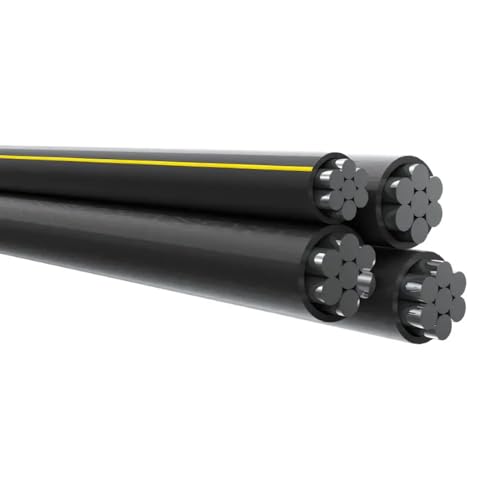
The NASSAU 2-2-2-4 URD Dyke cable is built specifically for underground direct burial, with a black XLPE jacket that resists moisture, soil chemicals, and physical abrasion. The ampacity jumps to 155 amps in direct burial applications, which gives you headroom above the standard 100A breaker — useful for feeder runs where future load growth is expected. Each of the three phase conductors is 7-strand aluminum with 60 mils of insulation, and the 4 AWG neutral completes the quadruplex assembly.
This cable weighs in at 367 pounds per 1000 feet, so the 100-foot spool is dense but still manageable with a helper. Users report that pulling the cable through conduit is easier than expected because of a light wax coating on the jacket, and termination preps quickly with standard aluminum-rated lugs. Multiple verified buyers specifically mention using it for 100A subpanels in detached garages, with one user confirming a 175-foot run delivered accurate length and phase markings.
The main trade-off is stiffness — aluminum at this gauge is heavy and doesn’t bend like copper NM. Planning your trench and conduit path carefully before pulling saves a lot of frustration. For anyone trenching a 100A feeder to an outbuilding, this cable eliminates the need for a separate conduit system underground, which offsets the higher per-foot cost compared to SER.
Why it’s great
- 155A direct burial ampacity exceeds NEC 100A requirements with margin
- Wax-coated jacket reduces pulling friction through long conduit runs
- Black XLPE jacket resists moisture and soil chemicals for years
Good to know
- Very stiff cable — bending radius is limited, plan large sweeps
- Primarily for below-grade use; not ideal for indoor panel connections
3. NASSAU ELECTRICAL SUPPLY 100′ 4-4-4-6 SER Aluminum Service Entrance Cable

The NASSAU 4-4-4-6 SER cable serves a specific purpose: feeding subpanels rated at 60A or lower. The three main conductors are 4 AWG aluminum with a 6 AWG ground, making it lighter and easier to pull than 2-2-2-4 cable. This configuration is common for smaller shop subpanels, RV pedestals, or 50A range circuits where the full 100A capacity isn’t needed.
Rated for 600V and built with multi-strand aluminum conductors, the gray SER jacket handles indoor and wet-location installations when protected in conduit. Verified buyers consistently praise the value proposition, with one calling it the third roll purchased from this brand. The shipping speed is a frequent highlight — several reviews mention delivery arriving days ahead of the projected window.
The limitation is obvious: you cannot run this cable at 100A. If you ever plan to upgrade the panel size or add high-draw equipment, buying 2-2-2-4 upfront avoids a full re-pull later. But for a fixed 60A feeder where you know the load won’t increase, this is the entry-level pick that saves money without cutting corners on UL compliance.
Why it’s great
- Lighter gauge makes pulling and bending significantly easier than 2-2-2-4
- Cost-effective for dedicated 50A-60A feeder runs
- Fast shipping and consistent quality across multiple purchases reported
Good to know
- Limited to 60A max at 75°C termination — not suitable for 100A subpanels
- 6 AWG ground is smaller than the 4 AWG neutral found on 2-2-2-4 cables
4. Wirenco 2-2-2-4 SER Aluminum Service Entrance Cable (75FT Cut)
The Wirenco 2-2-2-4 SER cable in 75 feet is the right choice when your subpanel run is under 75 feet and you want to avoid paying for unspooled leftovers. The cable construction is identical to the 100-foot version — 7-strand aluminum conductors, 600V rating, 100A capacity at 75°C — making it a direct drop-in for any standard 100A feeder that doesn’t exceed the 75-foot length.
Buyers consistently describe the product as “as expected” and confirm that the cable performs exactly like name-brand SER from big-box stores but at a lower price point. The gray jacket is the same UL-rated PVC found on the longer coils. At 0.359 pounds per foot, the total weight is around 27 pounds, which is light enough for one person to maneuver through an attic or crawl space.
The obvious caveat is length — if your run is 80 feet, you’ll need to upgrade to the 100-foot version. But for short feeders, 75 feet avoids the cost jump to the longer spool. This is the most budget-friendly way to wire a 100A subpanel when the distance is comfortably under the mark.
Why it’s great
- Full 100A ampacity at a lower entry cost for short runs
- Same UL-listed construction as the 100FT version
- Light enough for solo installation in attic or crawlspace
Good to know
- 75 feet is a hard limit — no extra slack for long routing paths
- Shipping can take several days; not ideal for urgent same-day installs
5. Kimbluth 8/3 Metal Clad (MC) Cable with Ground 100ft
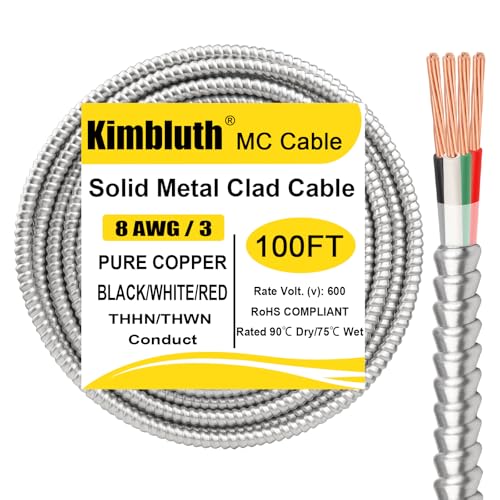
The Kimbluth 8/3 MC cable is a departure from the aluminum SER focus — this is a copper-conductor, aluminum-armored cable rated for 600V with a 90°C temperature rating. The 8 AWG stranded copper conductors (7 strands of 1.23mm each) deliver higher current capacity in a smaller diameter than equivalent aluminum, making this ideal for high-amp circuits in tight spaces like HVAC disconnects, EV chargers, and industrial machinery connections.
The interlocked aluminum armor provides mechanical protection without requiring conduit, which simplifies installs in unfinished basements or commercial spaces where MC cable is permitted by code. Buyers specifically mention using this for a 25-foot run to an outdoor HVAC disconnect and for a Level 2 EV charger installation. The 18.3mm diameter is manageable for termination in standard junction boxes, and the copper conductors terminate without the oxidation concerns that require anti-oxidant compound on aluminum.
The price is notably higher than aluminum cable, but the copper conductivity and the armor’s physical protection justify the premium for critical circuits. The main downside is that the armor can be tricky to cut cleanly — a standard armored cable cutter or careful hacksaw work is required. For dedicated high-load circuits where reliability is paramount, this MC cable is the armored specialist.
Why it’s great
- Copper conductors deliver better conductivity and no oxidation issues at lugs
- Aluminum armor eliminates the need for separate conduit in many applications
- 90°C rating provides thermal margin for continuous high loads like EV charging
Good to know
- Significantly more expensive per foot than aluminum SER of similar ampacity
- Armor cutting requires specialized tools or careful technique to avoid damaging conductors
6. Kimbluth 10/2 Metal Clad (MC) Cable with Ground 250ft
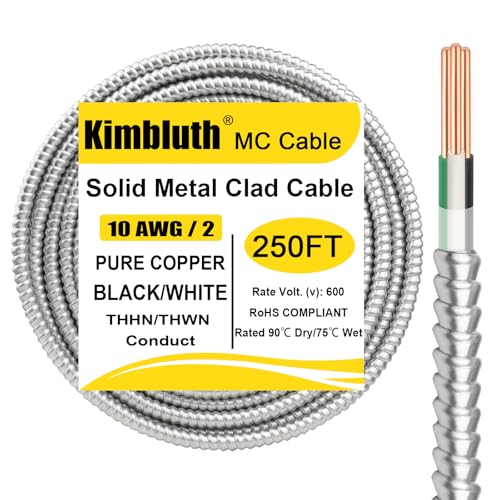
The 250-foot spool of Kimbluth 10/2 MC cable is the longest MC option on this list, designed for installations that require a continuous run from the panel to a remote outlet or equipment. The 10 AWG solid bare copper conductors and a solid copper ground wire provide 600V capacity with a 90°C rating, making it suitable for outdoor, underground, and embedded installations when protected by the aluminum armor.
The cable diameter is 13.6mm — noticeably slimmer than the 8/3 version — which makes pulling through long conduit runs or stapling along joists much less physically demanding. Verified buyers used it successfully for HVAC disconnects and EV charger installs, noting the aluminum armor was durable yet pliable enough to bend without kinking during routing. The weight of a full 250-foot spool is manageable for two-person handling.
The limitation is ampacity: 10 AWG copper is typically rated at 30A. This cable is best suited for 30A circuits like dryers, water heaters, or 30A EV chargers, not for 50A or 100A feeders. For those planning larger capacity, stepping up to the 8/3 version is necessary. But for a 30A long-run circuit where you want the mechanical protection of MC, this 250-foot spool avoids splicing mid-run.
Why it’s great
- Full 250-foot continuous spool eliminates mid-run splices for long circuits
- Copper conductors and solid ground provide reliable termination without oxidation
- Aluminum armor rated for outdoor, underground, and embedded use
Good to know
- 10 AWG limited to 30A — not suitable for 50A or 100A circuits
- At 250 feet, shipping weight is substantial and requires freight-style delivery
7. Imperium Cable 12/2 NM-B Electrical Wire – 250ft Coil
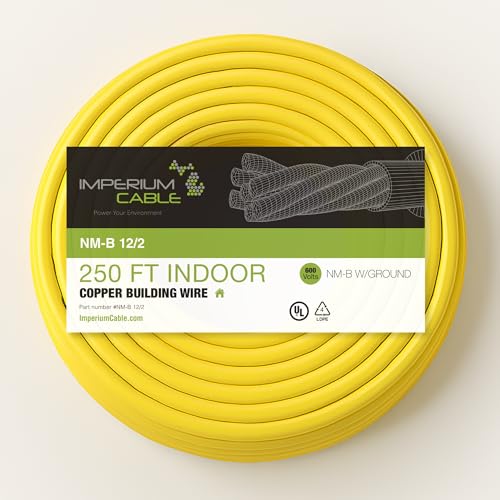
The Imperium Cable 12/2 NM-B with ground is a standard yellow-jacket Romex for 20A branch circuits — outlets, switches, lighting — not a heavy feeder cable. This 250-foot coil gives you enough wire for several rooms of receptacles in a single spool, making it a volume purchase for whole-house rewiring or large addition projects.
The solid copper conductors (12 AWG) with a bare copper ground are UL-listed and NEC-compliant for indoor residential use up to 600V. Buyers note the yellow sheath is easier to strip than some competing brands, with a nice balance of flexibility for pulling through studs and stiffness for staying neat in the panel. The insulation around the copper conductors is notably thick, reducing the risk of nicks when stripping the outer jacket.
This cable is not for subpanels or high-amp feeders — 12 AWG is strictly 20A. Using it for a feeder would violate code and create a fire hazard. It’s included here for the buyer who needs a long run of standard branch-circuit wire alongside their feeder cable purchase. For the budget-conscious homeowner wiring multiple rooms, this 250-foot coil offers the best per-foot value among NM-B options.
Why it’s great
- Thick insulation around copper reduces risk of damage during stripping
- 250 feet covers multiple rooms on one spool, reducing supply runs
- Yellow jacket is more flexible than Romex from some big-box brands
Good to know
- Limited to 20A circuits — cannot be used for subpanel feeders or 30A+ loads
- Solid copper is stiffer than stranded; less ideal for tight fixture boxes
FAQ
Can 2-2-2-4 aluminum SER cable handle a full 100A subpanel?
What is the difference between SER and URD aluminum cable?
Do I need anti-oxidant compound on aluminum wire terminations?
Final Thoughts: The Verdict
For most users, the 250 kcmil aluminum wire winner is the Wirenco 2-2-2-4 SER 100FT because it delivers the full 100A rating at a fair price with 7-strand flexibility that makes installation smoother than compact-stranded alternatives. If you need direct burial for a trench run, grab the NASSAU 2-2-2-4 URD Dyke for its 155A burial ampacity and weather-resistant jacket. And for a short 100A feeder under 75 feet where you want to save on material, nothing beats the Wirenco 2-2-2-4 SER 75FT cut.