
Our readers keep the lights on and my morning glass full of iced black tea. As an Amazon Associate, I earn from qualifying purchases.
Rust doesn’t have to mean the end of a tool, a car part, or a family heirloom. The right chemical formulation can dissolve corrosion down to bare metal without a single pass of sandpaper, saving hours of elbow grease and preserving the integrity of the underlying steel or iron.
I’m Min — the co-founder and writer behind Gadgets Feed. I’ve spent hundreds of hours combing through technical data sheets, customer field reports, and chemical safety profiles to isolate the formulations that actually perform when you need to strip oxidation fast.
Whether you’re restoring a vintage gas tank or cleaning up hand tools from a flood, the best acid for rust removal depends on balancing speed, safety, and surface compatibility for your specific project.
How To Choose The Best Acid For Rust Removal
Not all rust removers work the same way. Some dissolve iron oxide chemically, while others lift it through a process called chelation. Your choice should match the metal type, the rust severity, and your tolerance for handling concentrated chemicals.
Chelating vs. Acidic Formulations
Chelating agents like Evapo-Rust bind to iron ions and lift rust without attacking the base metal. These are safe on delicate parts and require no neutralization, but they work slower on heavy rust and lose effectiveness over time. Mineral acids such as phosphoric or oxalic acid react faster and can etch the surface, making them better for rough cast iron or concrete stains but riskier on thin sheet metal or polished chrome.
Concentration and Mixing Requirements
Ready-to-use liquids save time but cost more per gallon. Powders like oxalic acid require careful dilution and PPE but offer far more applications per dollar. Ultra-concentrated products like Rust911 give you the flexibility to mix weak batches for light flash rust or strong baths for deep corrosion — just measure the ratio precisely.
Reusability and Lifespan
A gallon of chelating solution can de-rust roughly 0.5 to 1 pound of iron oxide before turning black and losing potency. Some users report getting 6 to 12 months of intermittent use by filtering and storing the liquid in a sealed container. Acid baths, especially phosphoric, can be reused many times if you pour off the sediment, but they eventually saturate and require disposal.
Quick Comparison
On smaller screens, swipe sideways to see the full table.
| Model | Category | Best For | Key Spec | Amazon |
|---|---|---|---|---|
| Evapo-Rust ER012 (128 oz.) | Chelating | Auto parts & antiques | 1 Gallon ready-to-use | $33.93Amazon |
| Pure Oxalic Acid (5 lbs) | Acid Powder | Concrete & wood stains | Industrial grade powder | $33.99Amazon |
| Duda Energy Phosphoric Acid (85%) | Mineral Acid | Rust inhibition after removal | 85% concentration, 950ml | $31.25$34.60Amazon |
| Metal Rescue Rust Remover (1 Gal) | Chelating | Gas tanks & cooling systems | Non-toxic, biodegradable | $39.07Amazon |
| Rust911 Ultra-Concentrated (32 oz) | Chelating | High-volume restoration | Makes 4 gallons per bottle | $44.70Amazon |
| CRC Evapo-Rust (3.5 Gal) | Chelating | Heavy shop use | 3.5 Gallons with dip basket | $101.72Amazon |
| Evapo-Rust (5 Gal) | Chelating | Large parts & industrial use | 5 Gallons, ready-to-use | $123.17$129.90Amazon |
In‑Depth Reviews
1. Evapo-Rust ER012 Heavy Duty – 128 oz.

Evapo-Rust is the benchmark that every other chelating rust remover aspires to match. Its water-based, acid-free formula lifts iron oxide without etching the base metal, making it safe for chrome, rubber, stickers, and even paint. Users report submerging antique toy trains, bicycle chains, and cast-iron cookware with zero damage to non-rusted areas — just bare steel after a rinse.
The chemical reaction converts rust into a water-soluble iron chelate that can be rinsed away with plain water. A single gallon weighs 8.7 pounds and can be reused for roughly six months before turning black and losing potency. To extend its lifespan, filter out sediment between uses and store the liquid in a sealed container away from direct sun.
One critical user note: the bath must be degreased before submersion — gasoline or heavy oil contamination ruins the chelation reaction. For best results, soak overnight for moderate rust or up to 48 hours for thick crust. After removal, rinse with hot water to prevent flash rusting, and apply a corrosion inhibitor immediately.
Why it’s great
- Acid-free, non-toxic, and safe on skin with no fumes
- Reusable for months — filter and store properly
- Works on rubber, paint, and chrome without damage
Good to know
- Slower than mineral acids on heavy, multi-layer rust
- Requires thorough degreasing before soaking
- Leaves a gray/black conversion coating that needs rinsing
2. Pure Oxalic Acid – 5 Pounds (Industrial Grade)
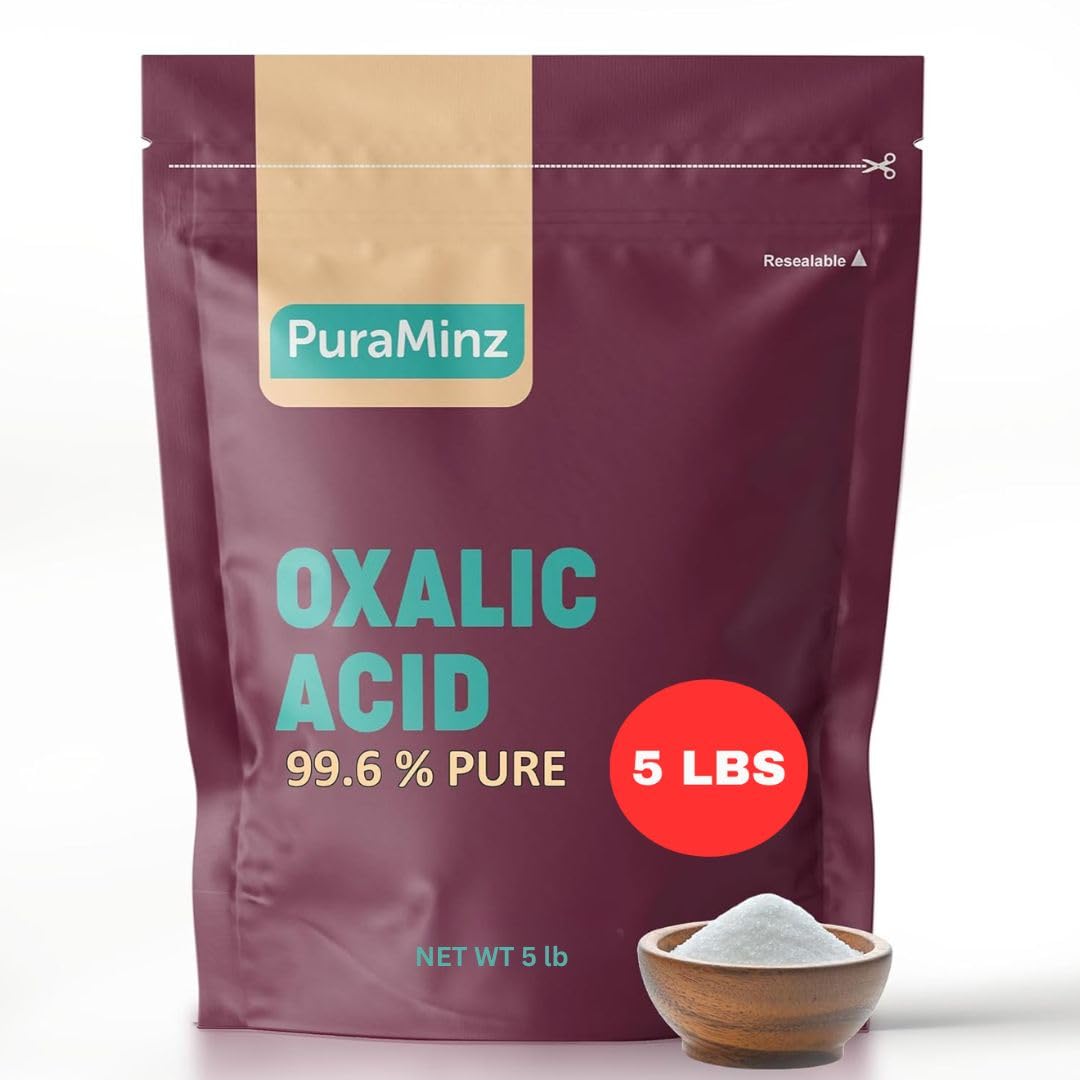
Oxalic acid is the go-to chemistry for hard water stains, red clay residue, and rust on concrete. This 5-pound bag of industrial-grade crystals offers massive yield per dollar — just mix with water to the desired strength. Users have successfully lifted deep rust stains from driveways after pretreating with Iron Out, and removed impossible Georgia red clay from concrete slabs with a pressure washer and a mask.
Unlike chelating liquids, oxalic acid is a true acid that dissolves iron oxide through direct chemical reaction. This makes it faster on flat surfaces, but also means you must wear rubber gloves, eye protection, and a respirator in enclosed spaces. It can bleach surrounding concrete if left too long, so test on a small area first and neutralize with baking soda after the stain lifts.
One safety warning from pool owners: oxalic acid is toxic if ingested and can bind to blood iron, causing kidney and liver damage. Never use it in a swimming pool — ascorbic acid is the safer alternative for water chemistry. For metal parts, dissolve 1 cup of powder per gallon of hot water and soak for 15 to 30 minutes, checking every five minutes to avoid over-etching.
Why it’s great
- Extremely cost-effective — one bag makes many gallons of solution
- Effective on concrete, wood, and metal surfaces
- Resealable packaging protects from moisture degradation
Good to know
- Requires full PPE — mask, gloves, and eye protection
- Can bleach surrounding concrete if not monitored
- Not safe for swimming pools — toxic if ingested
3. Duda Energy 85% Food Grade Phosphoric Acid (1 Qt)

Phosphoric acid is unique among rust removers because it does more than dissolve iron oxide — it also leaves behind a protective iron phosphate layer that inhibits future corrosion. This 85% food-grade concentrate from Duda Energy must be diluted to 25–50% with water before use, and a single quart lasts through many cycles because only a small amount is needed per gallon of working solution.
Users report exceptional results on cast-iron plant stands and steel parts: brush off loose scale, apply the diluted acid, let it sit for several hours, then rinse and dry. The coating that remains is slightly greasy to the touch if applied at full strength, so a 50-50 dilution is recommended for a dry finish. This product is also widely used by hydroponic growers as pH down, confirming its purity and consistency.
One important handling note: 85% phosphoric acid is thick and syrupy, but it can cause chemical burns on contact. Always wear acid-resistant gloves and eye protection. For old bottles with calcium-lime deposits, a weak 1:5 acid-to-water solution works well after a long soak. The reaction on rust is slower than oxalic but offers the dual benefit of removal plus passivation.
Why it’s great
- Creates a rust-inhibiting phosphate coating after removal
- Food-grade purity — consistent, no impurities
- Extremely economical — dilute as needed for many batches
Good to know
- Requires dilution — not ready-to-use from the bottle
- Stronger concentrations leave a greasy residue
- Can cause burns — full PPE required for handling
4. Metal Rescue Rust Remover – 1 Gallon

Metal Rescue is a non-acid, biodegradable chelating solution that offers a different chemical profile from Evapo-Rust. It is odorless, safe on skin, and approved for drain and sewer systems. Users have soaked everything from antique radio parts to moped gas tanks with impressive results — a 40-hour soak cleared 10 years of rust from a fuel tank, and the inline filter stayed clean for months after.
The product is thin like water, so it penetrates tight spaces and complex interiors without leaving residue. Each gallon can dissolve approximately 0.5 pounds of iron oxide before needing replacement. For cooling systems, a two-day soak followed by two flushes cleared 12 years of rust from a 1987 Camaro, leaving the coolant crystal clear. The main trade-off is cost per application — it is not cheap per gallon, and the chelating capacity decreases with each use.
One trick for fuel tanks: after the bath, check for residual flakes by running the solution through a filter. Some users rotate the tank every few hours to ensure full contact. The metal comes out with a clean, matte finish that is ready for paint or a clear coat. Just like Evapo-Rust, degreasing the part before submersion is critical to avoid contaminating the bath.
Why it’s great
- Odorless, non-toxic, and safe for skin contact
- Penetrates complex gas tank interiors without residue
- Biodegradable and safe for drain disposal
Good to know
- Expensive per gallon with limited reusability
- Loses potency after dissolving ~0.5 lbs of rust
- Requires full submersion — not effective as a spray
5. Rust911 Ultra-Concentrated Rust Remover (32 oz)

Rust911 takes the chelating approach and adds ultra-concentration to the equation. A single 32-ounce bottle makes 4 gallons of working solution when mixed at 8 ounces of concentrate per gallon of water. The unmixed concentrate stores for up to 5 years, making this the most space-efficient option on the list for shops that don’t need a permanent dip tank.
Users report that warming the solution with a halogen lamp accelerated rust removal on a 77-year-old gas tank, turning the bath black within hours. One restorer de-rusted a 1995 BMW 318i gas tank in a few hours with excellent results. The manufacturer claims each gallon of concentrate can de-rust up to 600 pounds of lightly to moderately rusted steel, which is an extraordinary value for high-volume restorations.
One limitation noted in feedback: Rust911 removes rust but does not strip paint or other coatings. You must remove paint before immersion, or the solution will leave a black film on the exposed metal that requires scrubbing with steel wool or brass brushes. For hidden areas like tank interiors, using steel BBs during agitation helps dislodge the black residue for a cleaner finish.
Why it’s great
- Ultra-concentrated — 32 oz makes 4 gallons of solution
- Unmixed concentrate stores up to 5 years
- Cost-effective for large-scale restoration projects
Good to know
- Does not remove paint — parts must be stripped first
- Leaves a black film that may need scrubbing
- Cold water is ineffective — solution needs warming
6. CRC Evapo-Rust Heavy Duty – 3.5 Gallon Pail

This is the same Evapo-Rust formula in a bulk format, bundled with a handy dip basket that makes retrieving small parts simple. The 3.5-gallon pail weighs 33.5 pounds and is the sweet spot for a home shop that regularly restores tools, engine brackets, or cast-iron cookware. No mixing, no preparation — just open the lid and submerge the part.
Users report that heavily rusted items come clean after a 24-hour soak, with the bonus that stuck threads and frozen mechanisms free up in the same bath. The pail is wide enough to accept brake calipers, carburetors, and small engine blocks. Just be aware that the solution can strip chrome off decorative parts, turning them a dark gray that requires polishing to restore shine. It also leaves pitting where rust had penetrated deep, which is normal for chelation — the metal is preserved, but the scars remain.
One practical tip: the pail works exceptionally well in an ultrasonic cleaner for accelerating the process on intricately shaped parts. The liquid can be reused several times if filtered between uses, but it will eventually saturate and need replacement. Post-rinse flash rusting is a real risk — have a towel and rust inhibitor ready immediately after pulling the part out.
Why it’s great
- Big 3.5-gallon bath with dip basket for small parts
- Ready-to-use — no mixing required
- Effective on heavily rusted parts and stuck mechanisms
Good to know
- Strips chrome and original finishes from parts
- Leaves pitting visible where rust penetrated deep
- Requires immediate anti-rust treatment after rinse
7. Evapo-Rust – 5 Gallons

At 5 gallons and 45 pounds, this is the volume play for anyone with a serious restoration habit. The same Evapo-Rust chelation chemistry, just enough liquid to submerge a motorcycle gas tank, a set of truck leaf springs, or a dozen hand tools simultaneously. Users report the same bucket lasting four to five years with proper care — just keep it covered to prevent evaporation and do not pour used fluid back into the original container.
The formula is incredibly forgiving: it works on heavy rust after 12 to 24 hours, and parts can sit for two to four days without damage to bare steel. The faint sulfur-like smell is mild and non-toxic. One user restored 30-year-old chain binders and chains that were completely seized — after a few hours in Evapo-Rust and a spray of CRC 6-56, the equipment worked like new.
The one design complaint: the 5-gallon bucket lacks a pour spout, making transfer to a secondary container messy. Some users recommend buying the 3.5-gallon version and swapping the lid for easier dispensing. For storage, pour the used solution through a coffee filter to remove sediment and keep it in a separate labeled container. This volume is ideal for shops that treat rust as a recurring task rather than a one-off project.
Why it’s great
- Massive 5-gallon capacity for large parts and batches
- Can last 4-5 years with proper storage and filtration
- Safe for long-term soaking — no damage to bare metal
Good to know
- Heavy — 45 pounds, awkward to move when full
- No pour spout on the bucket for easy dispensing
- Slow — heavy rust requires 24-hour soak minimum
FAQ
Can I use phosphoric acid on aluminum parts?
How do I dispose of used chelating rust remover?
Why does my part come out with a black coating after soaking?
Can I reuse rust remover solution multiple times?
Final Thoughts: The Verdict
For most users, the best acid for rust removal winner is the Evapo-Rust ER012 (128 oz.) because it balances non-toxic safety, reusability, and effectiveness across auto parts, tools, and antiques without damaging the base metal. If you need a concentrated powder for concrete stains and wood bleaching, grab the Pure Oxalic Acid. And for high-volume shops that want to maximize value per pound of rust removed, nothing beats the Rust911 Ultra-Concentrate.
Product prices and availability are accurate as of the date/time indicated and are subject to change. Any price and availability information displayed on Amazon at the time of purchase will apply to the purchase of this product. As an Amazon Associate I earn from qualifying purchases.
CERTAIN CONTENT THAT APPEARS ON THIS SITE COMES FROM AMAZON. THIS CONTENT IS PROVIDED "AS IS" AND IS SUBJECT TO CHANGE OR REMOVAL AT ANY TIME.
Amazon and the Amazon logo are trademarks of Amazon.com, Inc. or its affiliates.