
Our readers keep the lights on and my morning glass full of iced black tea. As an Amazon Associate, I earn from qualifying purchases.
Boiling water isn’t always an option, and trusting a stream or questionable tap source without protection is a gamble. The difference between a standard carbon pitcher and a real bacteria water filter is the difference between improving taste and actually removing the living organisms that can put you in bed for a week. If your water source carries the risk of bacteria, parasites, or protozoa, you need a filter that does more than just trap sediment—it needs a membrane pore size measured in fractions of a micron.
I’m Min — the co-founder and writer behind Gadgets Feed. I’ve spent hundreds of hours cross-referencing NSF certifications, pore-size specifications, and real-world flow rates to sort through the marketing claims and find the filters that can actually handle microbial threats.
Whether you’re packing for a backcountry expedition, building an emergency kit, or upgrading your kitchen tap, choosing the wrong one can leave you exposed. This guide breaks down the only specs that matter when selecting a bacteria water filter, so you can drink with confidence from any source.
How To Choose The Best Bacteria Water Filter
A bacteria water filter isn’t a luxury—it’s a barrier against organisms that cause real illness. Most mainstream pitchers can’t touch bacteria; they’re designed for chlorine and taste. The decision comes down to pore size, filtration method, and the environment you’re using it in.
Micron Rating: The Absolute Deciding Factor
Bacteria like E. coli and Salmonella range from 0.5 to 2 microns in size. To physically block them, the filter must have a pore size of 0.2 microns or smaller. Any filter with a larger rating—like the typical 1-micron carbon block—is not a bacteria filter. Look for “microfiltration” or “ultrafiltration” membranes rated at 0.2 microns or below. LifeStraw and the Practical Survival gravity system both hit this critical threshold.
Filtration Method: Straw vs. Gravity vs. Countertop
Personal straw filters are ideal for solo hikers: lightweight, immediate, but require you to suck from a direct source. Gravity systems handle groups—fill a bag, hang it, and let physics do the work for liters of clean water at a time. Countertop units are for home use where the incoming tap is suspect but you don’t want to drill under the sink. Each method has the same core job: block microbes, but the convenience and volume scale differently.
Flow Rate vs. Filter Life
A tight membrane inherently restricts flow. A filter that removes bacteria will never pour as fast as a simple carbon pitcher. Understand the trade-off: a flow rate of 0.5 to 1.5 gallons per minute is excellent for an ultrafiltration system. Filter life is measured in gallons—look for at least 1,000 gallons if you’re using it as a primary water source for an extended trip or off-grid setup.
Quick Comparison
On smaller screens, swipe sideways to see the full table.
| Model | Category | Best For | Key Spec | Amazon |
|---|---|---|---|---|
| LifeStraw Personal | Straw | Solo hiking & emergency prep | 0.2 micron, 1,000 gallon life | $49.05Amazon |
| Practical Survival Gravity | Gravity Bag | Group backpacking & base camps | 0.1 micron, 1,800 gallon life | $59.98Amazon |
| Clearly Filtered Pitcher | Pitcher | NSF-certified home fluoride removal | Targets 365+ contaminants | $100.00Amazon |
| Waterdrop TST-UF | Under Sink | Whole-family kitchen upgrade | 0.01 micron UF membrane | $141.99$189.99Limited time dealAmazon |
| OEMIRY Countertop | Countertop | Rental-friendly kitchen filtration | 1.6 GPM, 8,000 gallon life | $57.99Amazon |
| Yuclet 4-Pack Straw | Straw Bundle | Budget emergency multi-pack | 0.1 micron, 1,300 gal per straw | $38.99$44.99PrimeAmazon |
| ZeroWater 22-Cup Dispenser | Dispenser | Low TDS tap water purification | 0 TDS, TDS meter built in | $27.74$34.99Amazon |
In‑Depth Reviews
1. LifeStraw Personal Water Filter

The LifeStraw is the benchmark that every other portable bacteria filter is measured against. Its hollow-fiber membrane achieves a 0.2-micron pore size, which physically blocks 99.999999% of waterborne bacteria like E. coli and Salmonella, plus 99.999% of parasites such as Giardia and Cryptosporidium. Independent testing to EPA and NSF standards backs every claim, which is rare at this price tier.
Each unit filters up to 1,000 gallons of water, and because the membrane stays dry between uses, it has no expiration date. The straw weighs just over an ounce and measures under 9 inches, making it effortless to stash in a pack pocket or emergency go-bag. Flow rate is adequate for direct sipping, though you won’t be filling a Nalgene in under a minute.
Buyers consistently praise its simplicity and reliability in the field. The main limitation is that it does not improve taste, nor does it remove chemicals or heavy metals—its job is purely microbial protection. For a dedicated bacteria filter used in wilderness or disaster scenarios, nothing else hits this combination of proven efficacy and weight.
Why it’s great
- Proven 0.2-micron membrane meets EPA/NSF standards for bacteria removal
- Compact, ultralight design with indefinite shelf life when stored dry
Good to know
- No chemical filtration—won’t improve taste or remove heavy metals
- Best for personal use; not designed for large group volume
2. Practical Survival Gravity Water Filtration System

This gravity system solves the one problem every straw filter has: you can’t fill a camp kitchen with a straw. Practical Survival’s kit includes two 6-liter bags (dirty and clean), a filter, and a cleaning plunger. The filter membrane is rated at 0.1 micron, which is even tighter than the LifeStraw, removing 99.99% of bacteria and parasites as well as microplastics down to that same size.
Setup takes under a minute—fill the dirty bag, hang it, connect the hose, and walk away. In real-world use, six liters takes about ten minutes to filter completely. That makes it practical for a small group of hikers or a family base camp. The filter lifespan of 1,800 gallons is substantial, translating to years of weekend trips before a replacement is needed.
Customer reviews highlight fast flow and great taste, with some noting that the tubing twists during assembly. The included carry bag keeps everything organized. For anyone who needs to treat larger volumes without pumping or sucking, this is the best gravity option at a mid-range price point.
Why it’s great
- 0.1-micron membrane exceeds basic bacteria removal standards
- 1,800-gallon capacity suits long-term group use
Good to know
- Tubing can twist during attachment, requiring some adjustment
- Bags require a hanging point; not for flat terrain without a tree
3. Clearly Filtered Filtered Water Pitcher
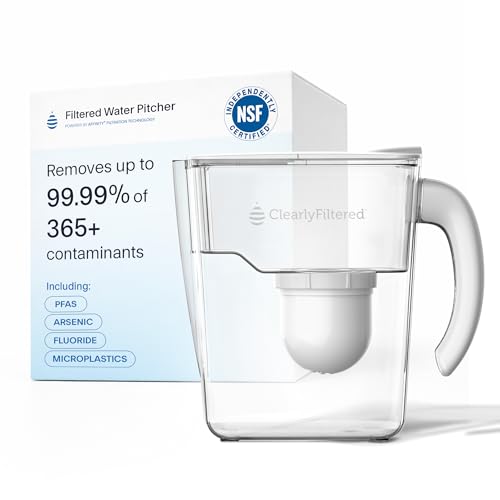
Clearly Filtered uses a proprietary Affinity Filtration Technology that targets 365+ contaminants, including fluoride, lead, PFAS, and microplastics. While the pitcher is not a dedicated bacteria water filter in the same sense as a straw or gravity membrane, it is one of the few pitchers on the market that has been independently tested and NSF certified for removing bacteria-sized threats like cysts and protozoa alongside chemical hazards.
The 80-ounce capacity fills about 10 cups per cycle, and each filter lasts 100 gallons—roughly four months of normal household use. Medical-grade Tritan plastic means the pitcher itself doesn’t leach BPA or endocrine disruptors into the filtered water. The design includes a spill-resistant dam and a comfortable handle that fits on standard fridge shelves.
Users report dramatically improved taste and peace of mind, especially those on well or municipal water with known issues. The downside is the upfront cost and the slower filtration rate compared to a carbon-only pitcher. But for a home solution that covers both chemical and microbial threats with third-party verification, this is a smart mid-range pick.
Why it’s great
- NSF certification for both chemical and microbial contaminant reduction
- Medical-grade construction and 100-gallon filter life
Good to know
- Slower flow than basic carbon pitchers
- Replacement filters cost more than standard pitcher filters
4. Waterdrop TST-UF Under Sink Water Filter System

Waterdrop’s TST-UF moves you into permanent home installation territory with an ultrafiltration membrane rated at 0.01 microns—ten times smaller than the 0.2-micron threshold for bacterial removal. This means it blocks bacteria, viruses, and cysts while preserving beneficial minerals. The three-stage process includes a PP sediment filter, a carbon block, and the UF membrane itself.
Installation is DIY-friendly with quick-connect fittings and no drilling required; it attaches directly to standard 3/8 or 1/2-inch cold water lines under the sink. The flow rate of 1.59 gallons per minute fills a glass in about two seconds, far faster than any pitcher or straw. The entire system is housed in lead-free 304 stainless steel canisters, a major upgrade from the plastic housings found on budget models.
Customer feedback is consistently positive on build quality and taste improvement, though some note that the push-connect fittings can be tricky if not perfectly seated. Filter lifespan varies between 6 and 24 months depending on the stage. For a premium home solution that genuinely removes microbial threats without sacrificing speed, this is the strongest option available.
Why it’s great
- 0.01-micron UF membrane removes bacteria and small viruses
- High 1.59 GPM flow and stainless steel build
Good to know
- Requires under-sink space and cold-water line connection
- No TDS reduction—retains minerals but won’t soften water
5. OEMIRY Countertop Water Filter

The OEMIRY countertop filter is designed for the renter or homeowner who wants clean water without drilling holes or plumbing under a sink. Its 304 stainless steel body connects directly to the faucet diverter, and with a twist of the switch, you toggle between filtered and unfiltered tap water. The multistage filtration targets chlorine, heavy metals, and bad odors while leaving beneficial minerals intact.
Flow rate is a disruptive 1.6 gallons per minute—that’s faster than most under-sink systems and far quicker than gravity or pitcher filters. The filter lifespan is rated at 8,000 gallons or 12 months, whichever comes first. Installation is literally a three-minute job: screw the diverter onto the faucet, attach the hose, and clamp the unit to the counter.
Users love the small footprint and the fact that it produces zero wastewater. Some note that the faucet adapter compatibility can be tricky—the system works only with standard threaded faucets, not pull-out or sensor models. For a countertop unit that delivers both speed and bacteria-rated filtration without permanent modification, this is a standout mid-range pick.
Why it’s great
- Fast 1.6 GPM flow with twist-on faucet connection
- Stainless steel build with 8,000-gallon capacity
Good to know
- Not compatible with pull-out, spray-style, or sensor faucets
- Does not reduce TDS—retains minerals but not for TDS-critical needs
6. Yuclet 4 Pack Water Filter Straw

Yuclet’s four-pack of filter straws brings the per-unit cost way down for emergency preparedness bulk buyers. Each straw features a 0.1-micron hollow-fiber membrane that removes 99.9999% of harmful substances, including bacteria and microplastics down to that size. SGS certification with a test report backs the claim, which is reassuring for a product at this budget-friendly price point.
Each straw filters 1,300 gallons, and because the membrane stays dry when not in use, there’s no expiration date. The 8.2-inch length and 3.5-ounce weight make it compatible with standard 28mm-threaded water bottles, turning any bottle into a filter. The maximum flow rate of 600 ml per minute is decent for personal sipping but slower than the LifeStraw for sustained drinking.
Buyers often stock these for bug-out bags and car kits. The main drawback is that the straw is single-purpose—it doesn’t thread onto bladders or gravity systems easily. For the price, though, having four individually sealed filters to distribute among family members or stashes is hard to beat for entry-level preparedness.
Why it’s great
- Four-pack delivers excellent value for emergency kits
- 0.1-micron membrane and SGS certification for bacterial removal
Good to know
- Slower flow rate than premium single-straw options
- Limited to personal use; not ideal for group water volume
7. ZeroWater 22-Cup 5-Stage Water Filter Dispenser

ZeroWater takes a different approach: instead of a membrane that physically screens bacteria, it uses a five-stage ion-exchange process that strips virtually all total dissolved solids, including metals, salts, minerals, and the dissolved organic material that can harbor bacteria. The built-in TDS meter gives you a real-time numeric readout of water purity—change the filter when it reads 006 or higher.
The 22-cup dispenser is the largest capacity pitcher-style unit on the market, equivalent to roughly 5.2 liters. It’s IAPMO certified to reduce lead, chromium, PFOA, and PFOS, and the BPA-free plastic construction is standard for the category. Users on hard water report dramatic reductions from 500 ppm TDS down to near zero, with a noticeably sweet, clean taste.
The trade-off is filter replacement cost and frequency, especially in areas with high TDS. Some users report replacing filters every 2-3 weeks, which drives the annual cost up considerably. The dispenser is best suited for households where the primary concern is dissolved solids and chemical contaminants rather than a specific bacterial threat in a wilderness water source. It’s a specialized tool for a specific tap-water problem.
Why it’s great
- Built-in TDS meter for instant water purity feedback
- High 22-cup capacity reduces refill frequency
Good to know
- Filter life varies widely with incoming water TDS levels
- Strips all minerals, including beneficial ones like calcium and magnesium
FAQ
Can a bacteria water filter remove viruses?
How do I know if a filter is certified for bacteria removal?
Does a bacteria water filter remove chemicals and heavy metals?
Final Thoughts: The Verdict
For most users, the bacteria water filter winner is the LifeStraw Personal Water Filter because it combines proven 0.2-micron filtration, EPA/NSF-backed certification, and lightweight portability at a reasonable price. If you need to filter water for a group, grab the Practical Survival Gravity System for its 0.1-micron membrane and 1,800-gallon capacity. And for a permanent home installation, nothing beats the Waterdrop TST-UF with its 0.01-micron ultrafiltration and instant flow.
Product prices and availability are accurate as of the date/time indicated and are subject to change. Any price and availability information displayed on Amazon at the time of purchase will apply to the purchase of this product. As an Amazon Associate I earn from qualifying purchases.
CERTAIN CONTENT THAT APPEARS ON THIS SITE COMES FROM AMAZON. THIS CONTENT IS PROVIDED "AS IS" AND IS SUBJECT TO CHANGE OR REMOVAL AT ANY TIME.
Amazon and the Amazon logo are trademarks of Amazon.com, Inc. or its affiliates.