
Our readers keep the lights on and my morning glass full of iced black tea. As an Amazon Associate, I earn from qualifying purchases.
A dead battery at a campsite isn’t just an inconvenience—it can mean no coffee in the morning, a cold tent at night, or a drained CPAP machine that ruins a trip. The quiet hum of a battery generator delivers power without the fumes and noise of a gas engine, letting you hear the forest while keeping your gear running. Whether you need to keep a fridge cold, charge camera batteries, or run lights for hours, the right station turns a good trip into a great one.
I’m Min — the co-founder and writer behind Gadgets Feed. I’ve spent countless hours dissecting the technical specifications of portable power stations, comparing LiFePO₄ chemistries, inverter ratings, and charge times to find the models that truly deliver for off-grid outdoor use. This guide focuses on the real-world performance metrics that matter when you’re miles from a wall outlet.
After analyzing dozens of units across capacity, weight, and solar compatibility, I’ve narrowed the field to the nine best options for your next adventure. Here is my curated list of the best battery generator for camping to keep your trip powered from dusk till dawn.
How To Choose The Best Battery Generator For Camping
Choosing a battery generator for camping isn’t as simple as grabbing the biggest number on the box. You need to balance capacity, weight, recharge speed, and port types to match your specific trip. The wrong unit leaves you with dead gear or a sore back from carrying a heavy brick through the woods.
Capacity (Wh) vs. Inverter Output (W)
Capacity, measured in watt-hours (Wh), tells you how long the generator can run your devices. A 1,000Wh unit can power a 50W fridge for about 20 hours. Inverter output, measured in watts (W), tells you what you can plug in simultaneously—a 1,500W inverter can handle a microwave (1,000W) plus lights (100W) without tripping. For camping, a unit with at least 600Wh and a 1,000W output covers most essentials.
Battery Chemistry: LiFePO₄ vs. NCM
Lithium Iron Phosphate (LiFePO₄) batteries last longer—often 3,000 to 4,000 charge cycles before degrading to 80% capacity—and are thermally more stable than standard lithium-ion (NCM) packs. For a camping generator left in a hot car or used seasonally, LiFePO₄ is the safer, more durable choice despite being slightly heavier per Wh.
Recharge Methods and Speed
AC wall charging speed matters when you have limited time between trips. Some units hit 80% in under an hour, while budget models take 7-8 hours for a full charge. Solar input is critical for off-grid stays—look for a high MPPT charge controller rating (200W or more) and a solar panel that matches the station’s voltage range. Pass-through charging (running devices while the station recharges) is a convenience worth checking.
Port Selection and Form Factor
Your camping kit might include a 12V fridge, USB-C laptop, and AC-powered lights. A good generator needs at least two AC outlets, a 12V car port, and fast USB-C (60W or higher). Weight is a real concern—a 25-pound unit is hand-transportable; a 50-pound unit needs wheels or a cart. Measure your trunk space and lifting ability before committing to a giant-capacity station.
Quick Comparison
On smaller screens, swipe sideways to see the full table.
| Model | Category | Best For | Key Spec | Amazon |
|---|---|---|---|---|
| BLUETTI Elite 100 V2 | Premium | All-around camping powerhouse | 1024Wh / 1800W output | Amazon |
| Jackery Explorer 1000 v2 | Mid-Range | Lightweight fast-charging camp setup | 1070Wh / 1500W output | Amazon |
| EF ECOFLOW Delta 3 Classic (with 110W Panel) | Premium | Complete solar-ready camping system | 1024Wh / 1800W output | Amazon |
| Anker SOLIX C1000 (with 200W Panel) | Premium | High-speed solar charging bundle | 1056Wh / 1800W output | Amazon |
| VTOMAN Jump1500X | Mid-Range | Car jump-start + camping backup | 828Wh / 1500W output | Amazon |
| DJI Power 2000 | Premium | Large group / RV extended trips | 2048Wh / 3000W output | Amazon |
| EF ECOFLOW DELTA 3 Max | Premium | High-power heavy-load camp base | 2048Wh / 3400W X-Boost | Amazon |
| LIBRIDS C600 | Budget | Budget-friendly CPAP & small device backup | 640Wh / 600W output | Amazon |
| EBL 1000W 999Wh | Budget | Entry-level value for weekend glamping | 999Wh / 1000W output | Amazon |
In‑Depth Reviews
1. BLUETTI Elite 100 V2
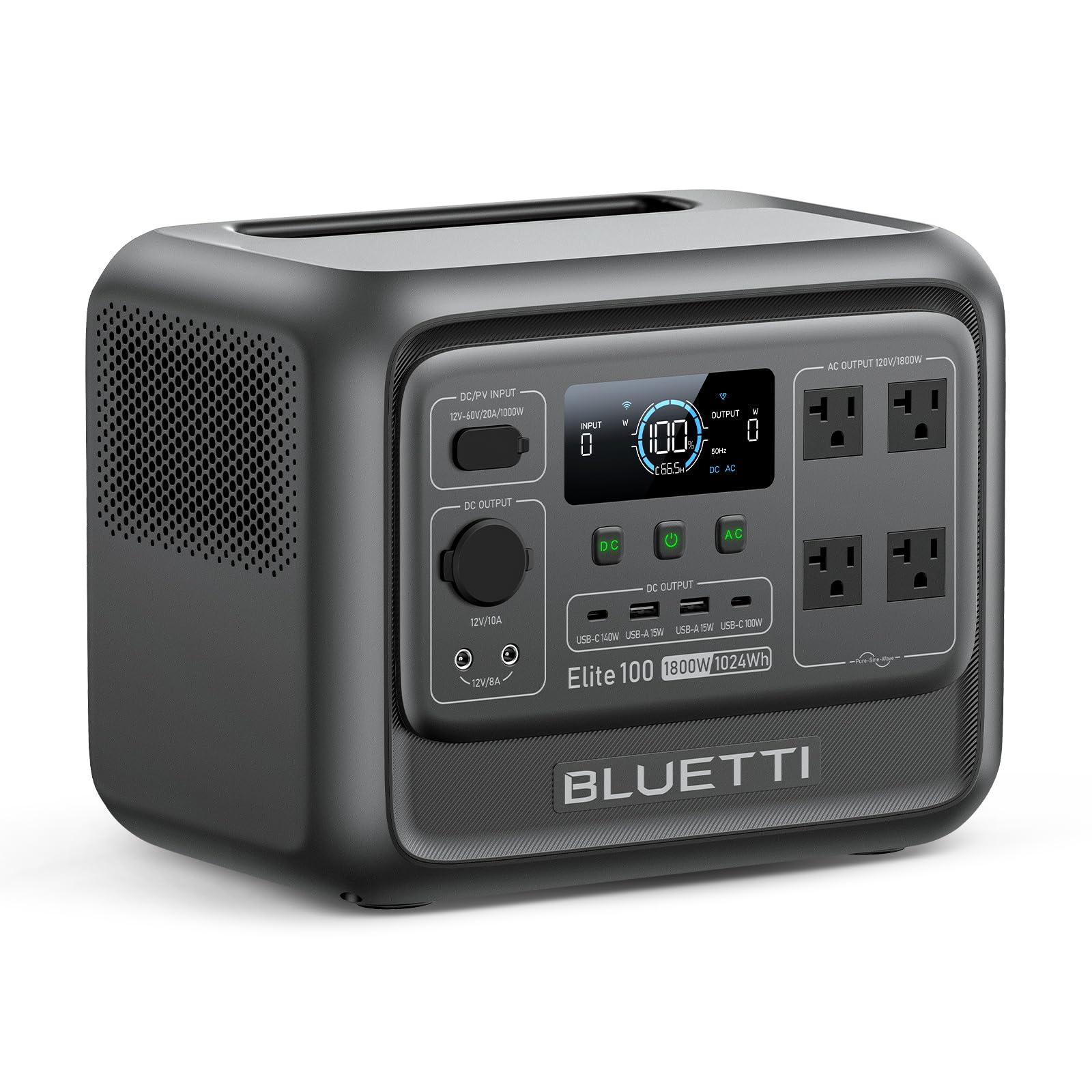
The BLUETTI Elite 100 V2 hits the sweet spot for camping with a 1,024Wh LiFePO₄ battery and a 1,800W inverter capable of a 3,600W surge. That means it can comfortably run a mini fridge, charge drone batteries, and power a laptop all weekend on one charge. The 70-minute full recharge via AC is one of the fastest in its class, and the 1,000W solar input lets you top off during the day with a single high-wattage panel.
At just 25 pounds with a hidden handle, this station is 35% smaller and 30% lighter than earlier BLUETTI models, making it genuinely camp-portable. The 10ms UPS backup keeps sensitive electronics safe during grid flickers at home, while the silent mode holds at 30dB—quiet enough for overnight use in a tent or RV without disturbing sleep. The smart app gives you remote control over settings and OTA firmware updates.
The 11 ports include four 1800W AC outlets, USB-C, and USB-A, covering every device in your camp kit. Some users note the lack of a built-in wireless charger or light compared to prior models, but the trade-off in weight and size is worth it for serious campers. The LiFePO₄ cells are rated for 4,000+ cycles, delivering a decade of reliable service.
Why it’s great
- Fast 70-minute AC recharge saves pre-trip wait time
- Light 25-pound build with hidden carry handle for easy transport
- 4000+ cycle LiFePO₄ battery offers long-term value
Good to know
- No integrated light or wireless charger built into the unit
- Fan noise increases noticeably above 500W load
2. EF ECOFLOW Delta 3 Classic (with 110W Solar Panel)
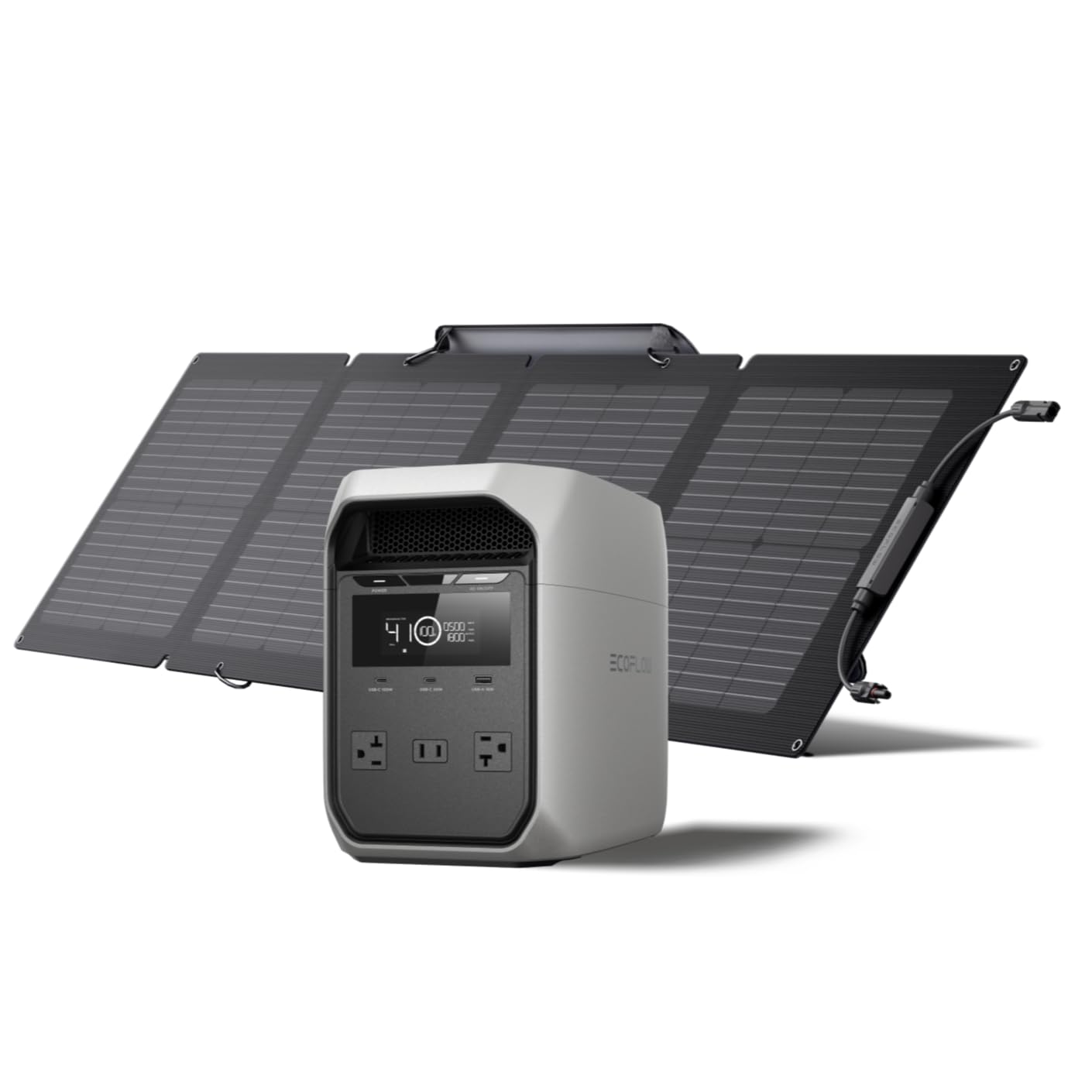
The EF ECOFLOW Delta 3 Classic bundles a 1,024Wh LiFePO₄ power station with a 110W solar panel, giving you an all-in-one solution for solar camping. The station delivers 1,800W of continuous AC power (3,600W surge) with X-Boost technology, so it can handle hungry camp appliances like a microwave or an electric skillet. The 45-minute 0-80% AC recharge via X-Stream is blisteringly fast, letting you top up during a lunch stop.
The included 110W solar panel features a 23% conversion efficiency and folds up compactly for storage. In moderate sun, it can fully recharge the station in about 11–12 hours, making it ideal for multi-day base camps where you can leave the panel out. The sub-10ms UPS transfer protects sensitive electronics like CPAP machines or laptops during grid fluctuations, and the unit itself is built with EV-grade CTC (cell-to-chassis) technology for durability.
Campers praise its ability to power a Starlink Mini, a projector for a full movie, and a window AC unit—all on a single charge. The form factor is compact at 15.7 by 11.1 by 7.9 inches, and the dual handles make it easy to lift in and out of a vehicle. Just note that the solar panel and station arrive in separate shipments, so plan accordingly.
Why it’s great
- Blazing 45-min 0-80% AC recharge for quick turnarounds
- Bundled 110W solar panel provides ready off-grid charging
- X-Boost tech handles heavy loads like microwaves and AC units
Good to know
- Solar panel and station ship separately
- Heavier than some similar-capacity units at around 28 lbs
3. Jackery Explorer 1000 v2

Jackery’s Explorer 1000 v2 upgrades the classic formula with a 1,070Wh LiFePO₄ battery and a 1,500W pure sine wave inverter (3,000W surge) in a 23.8-pound package. The foldable handle makes it easy to grab and go—an important feature when you’re moving between tent and truck. The 1-hour emergency charge mode (activated via the Jackery App) gets you from 0 to 100% in 60 minutes, while the default 1.7-hour mode optimizes battery health over its 10-year lifespan.
Real-world testing shows it running a refrigerator for 8 hours on only 53% battery, projecting about 14 hours of runtime on a single charge. The unit features three pure sine wave AC ports, two USB-C ports (one 100W PD), one USB-A port, and a 12V car port—enough to power a full camp kitchen and device station. The app control lets you toggle between emergency charging, quiet overnight mode (30dB), and energy efficiency mode.
The 4,000-cycle LFP battery means this station won’t need replacing for a decade of weekend trips. A common pro tip: pair this with a small gas generator for recharging during extended outages, giving you near-infinite runtime. The only catch is that solar charging is limited to Jackery’s own panels, which can be pricier than third-party options.
Why it’s great
- Ultra-light 23.8 lbs with integrated foldable carry handle
- 1-hour emergency AC charge via app for fast prep
- 4,000-cycle LFP battery offers 10+ year usable life
Good to know
- Solar charging only works with official Jackery panels
- No wireless charging pad on the unit
4. Anker SOLIX C1000 (with 200W Solar Panel)

The Anker SOLIX C1000 pairs a 1,056Wh LiFePO₄ power station with a 200W solar panel, making it one of the most powerful solar bundles in this range. The station itself delivers 1,800W continuous AC output with SurgePad technology pushing to 2,400W—enough to run 99% of home and camp appliances. The ultra-fast charging hits 80% in just 43 minutes via AC, and the included 200W solar panel features IP67 waterproofing and adjustable 30/40/50/80-degree angles for optimal sun tracking.
The 200W panel’s 23% conversion efficiency means you can add meaningful charge even on partly cloudy days. At 27.59 pounds, the C1000 is slightly heavier than the Jackery, but it offers 11 ports including six AC outlets—more than any other unit in this price bracket. This gives you freedom to run a coffee maker, charge a laptop, and power a fan simultaneously without hunting for an adapter. Anker’s app provides remote monitoring and UltraFast charging toggles.
Users report running a CPAP with humidity from 100% down to 48% overnight, and a 1/3-hp sump pump running intermittently only consumed 6% per hour. The 3,000-cycle LFP battery is rated for 10 years of daily use. Just be aware that the solar panel and station ship separately, and the panel’s initial mildew odor (reported by some) was resolved in later revisions by Anker support.
Why it’s great
- 43-minute 0-80% AC charge is fastest in this class
- 200W IP67 waterproof solar panel included for rugged camp charging
- Six AC outlets handle heavy simultaneous loads
Good to know
- Station itself is not weatherproof—keep dry
- Heavier build at 27.6 lbs; panel ships separately
5. VTOMAN Jump1500X

The VTOMAN Jump1500X is a 2-in-1 device that combines a portable power station with a car jump starter, solving two common camping headaches—dead camp gear and a dead vehicle battery. The base 828Wh LiFePO₄ battery can be expanded to 2,376Wh with an add-on battery (sold separately), giving you optional scalability for longer trips. The 1,500W inverter (3,000W surge) with V-Beyond technology maintains constant power even when loads exceed the rated output, providing an emergency reserve for space heaters or water pumps.
This unit shines with its regulated 12V DC outputs—two DC5521 ports and a car port, all delivering stable 12V/10A power ideal for car fridges and CPAP machines. The two PD 100W USB-C ports charge laptops at full speed, and the total 12-device simultaneous capacity means everyone in the group can plug in. The jump-start capability works with SUVs and full-size trucks, eliminating the need for a separate battery pack in your trunk.
The LIFEBMS battery management system provides 10 layers of protection for safe charging. Recharge time is about 4.5 hours via AC (200W input), and it supports solar charging with VTOMAN’s 110W or 200W panels. The main downsides are the weight—37.4 pounds—and a fan that’s noticeably louder than competitors, especially under high load. The display shows remaining runtime, which helps with trip planning.
Why it’s great
- Integrated car jump starter saves space in the trunk
- Expandable capacity from 828Wh to 2376Wh for longer trips
- Dual PD 100W USB-C ports for fast laptop charging
Good to know
- Heavy at 37.4 lbs; not ideal for backpacking
- Cooling fan runs louder than competitors under load
6. DJI Power 2000
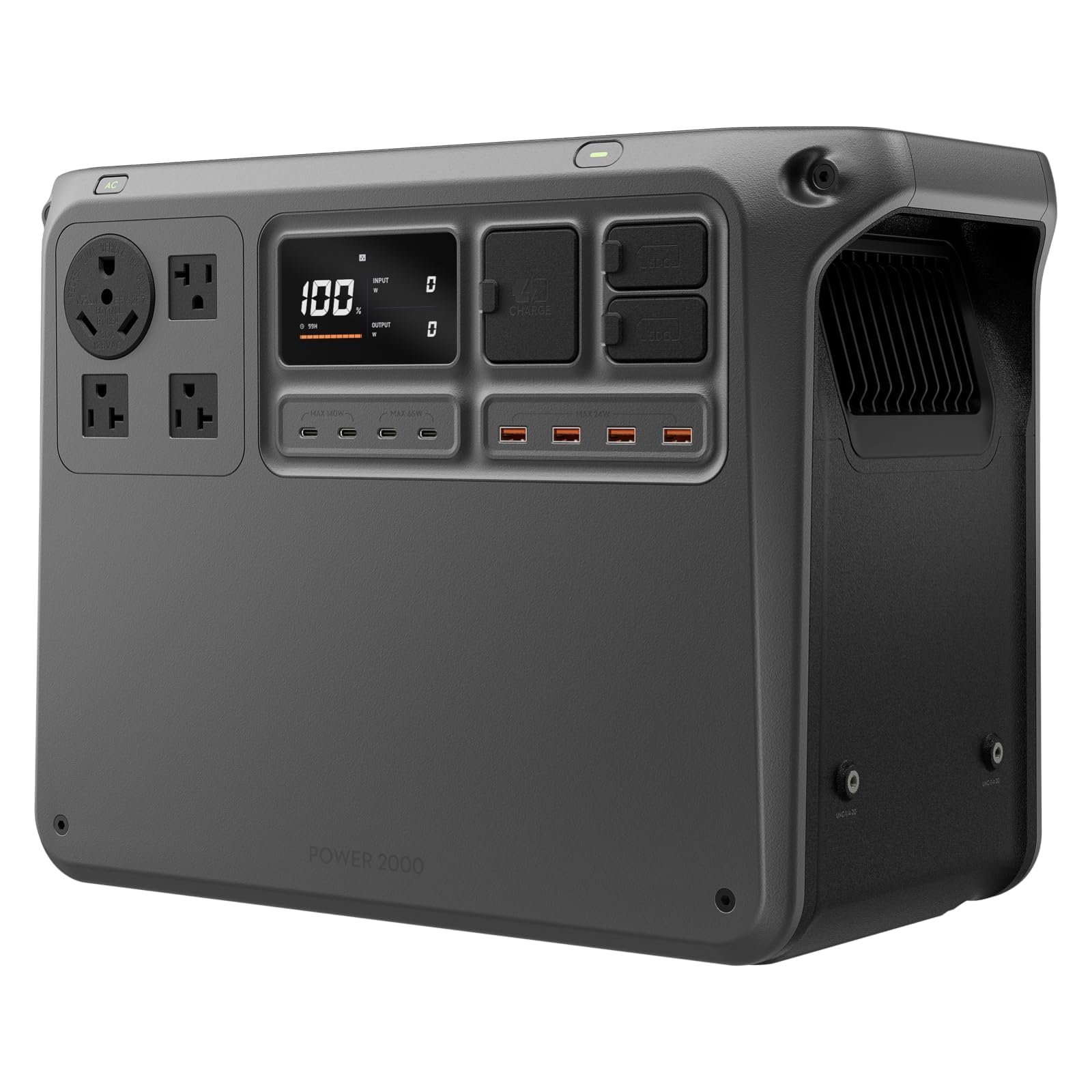
The DJI Power 2000 brings massive 2,048Wh capacity and a 3,000W inverter (4,000W peak) in a compact form factor that rivals much bulkier units. Designed for extreme outdoor scenarios, it can power a full RV setup for an estimated 40 hours or run essential home appliances for 4-6 days during outages. The 0-80% charge in 55 minutes via AC is exceptional for a 2kWh station, and the 1,800W solar input lets you recharge in peak sun in about 1-2 hours with the right panels.
The 15 ports include dual full SDC ports for high-power accessory connections, making it perfect for group camping where 4-5 people need to charge phones, lights, fans, and laptops simultaneously. The unit runs as low as 30dB in quiet mode—silent enough for RV bedrooms. DJI’s smart app provides remote monitoring and settings adjustment without needing a separate dongle. The sub-nano coating and flame-retardant housing add safety in damp outdoor conditions.
The battery is rated for over 3,000 cycles with a 5-year warranty. However, the reliance on the DJI app for some settings and the proprietary SDC connectors may frustrate users who prefer universal inputs. A small batch had region-locked 50Hz units shipped from Hong Kong, but DJI support resolved those cases. The weight of 47.9 pounds makes it a car-camp station rather than a hike-in option.
Why it’s great
- Massive 2,048Wh capacity for long multi-day camp trips
- 55-minute 0-80% AC charge is fastest for this size class
- Ultra-quiet 30dB operation for peaceful overnight use
Good to know
- Proprietary SDC connectors require adapters for solar
- Heavy 47.9 lbs, no built-in wheels for transport
7. EF ECOFLOW DELTA 3 Max
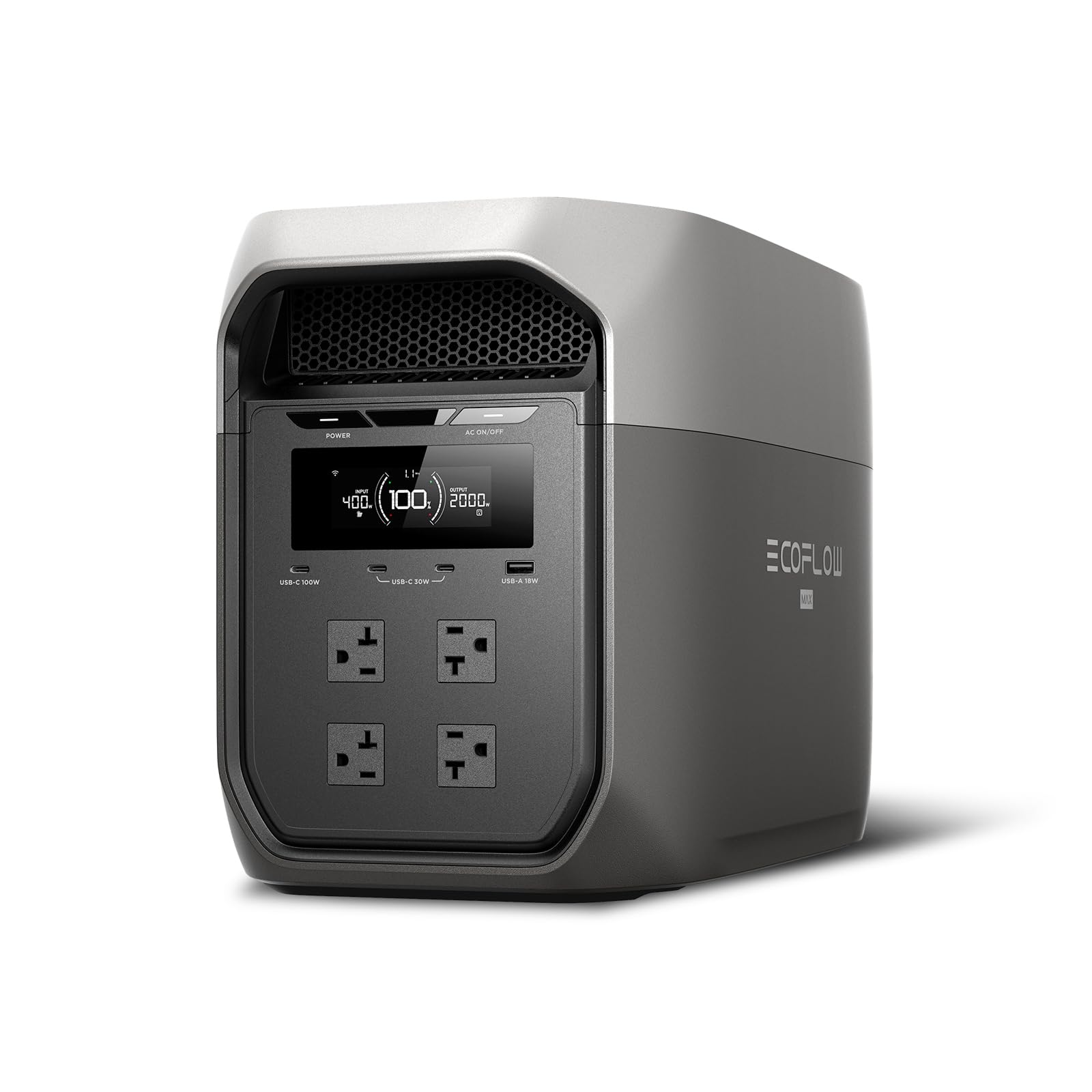
The EF ECOFLOW DELTA 3 Max is the heavy lifter of the series, packing a 2,048Wh LiFePO₄ battery with a 2,400W inverter that can X-Boost up to 3,400W for demanding appliances. This station handles electric kettles, toasters, and even power tools on a job site just as easily as it powers a full camp kitchen. The 0-80% AC recharge in 1.13 hours via X-Stream means you can refill nearly two kilowatt-hours during a lunch break, keeping the trip moving.
The unit features a sub-10ms UPS transfer that protects sensitive electronics during grid flickers, making it equally useful at home for computer backups. The LiFePO₄ battery is built to last 10 years of daily use, with a 5-year service warranty from EcoFlow. The app control allows real-time energy monitoring, charging/discharging scheduling, and a Storm Guard feature that automatically charges the station when severe weather is forecast.
Dual handles and a lighter-than-expected build for its capacity make it manageable for trunk-to-campsite moves. Real-world users report powering entire film sets (cameras, monitors, chargers) all day, running an RV with no issues, or keeping home essentials running through multi-day blackouts. The buttons can be hard to see in dim light, and the XT60i cable is needed for the fastest solar charging, so check your kit.
Why it’s great
- X-Boost 3,400W output handles the heaviest camp appliances
- Dual handles and durable build for easy transport
- Sub-10ms UPS protects sensitive electronics seamlessly
Good to know
- Buttons lack backlighting for low-light use
- Fast solar charging needs optional XT60i cable
8. LIBRIDS C600
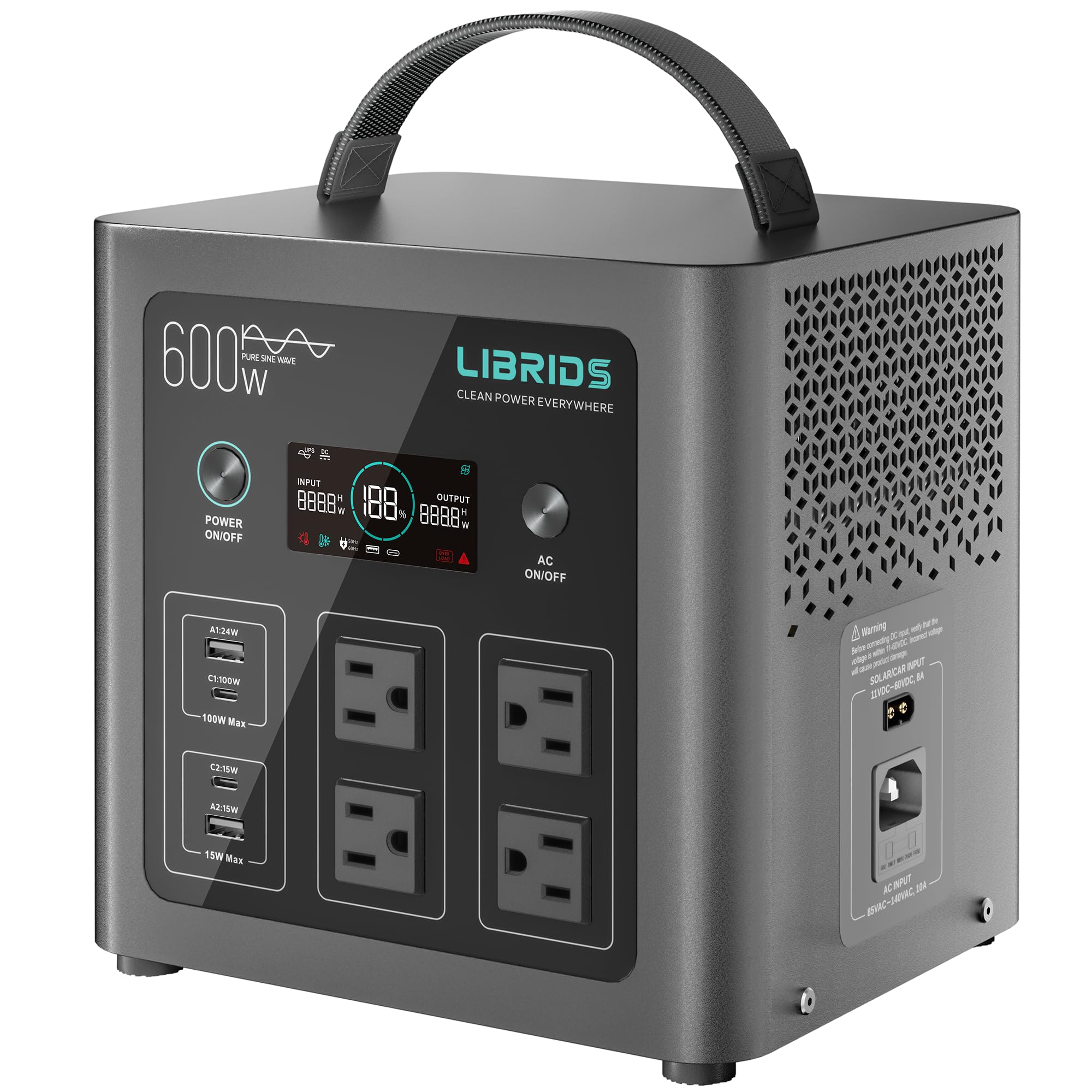
The LIBRIDS C600 is the entry-level powerhouse that doesn’t compromise on battery chemistry. With a 640Wh LiFePO₄ battery and a 600W inverter (1,200W surge), it’s purpose-built for lightweight camping where you need to keep a CPAP machine running all night, charge camera batteries, and power a laptop. The pure sine wave inverter delivers clean, stable power that’s safe for sensitive medical devices—a critical feature at this budget tier.
The 1.5-hour full AC recharge is impressively fast for a sub- range station, and the 8 output ports (4 AC plus USB) can handle a full campsite setup. The metal enclosure improves heat dissipation and adds durability compared to plastic-bodied competitors. The smart LCD screen shows real-time battery percentage and input/output power, giving you clear visibility into your energy use.
Users report running a Resmed Airsense 11 CPAP for 7 hours on only 24% battery drain, which translates to nearly 30 hours of CPAP runtime per full charge. The 10ms UPS backup keeps WiFi routers and essential electronics running during grid glitches at home. The 5-year warranty is a strong value commitment. Note that it’s labeled “Indoor Use Only” for UL compliance, but it’s safe for dry, well-ventilated campsites in clear weather.
Why it’s great
- Pure sine wave inverter is safe for CPAP and sensitive medical gear
- 1.5-hour full AC recharge for quick turnaround
- Metal enclosure and 5-year warranty at a budget price
Good to know
- 600W output won’t run high-power appliances like microwaves
- Intended for dry conditions; avoid rain and humidity
9. EBL 1000W 999Wh Portable Power Station
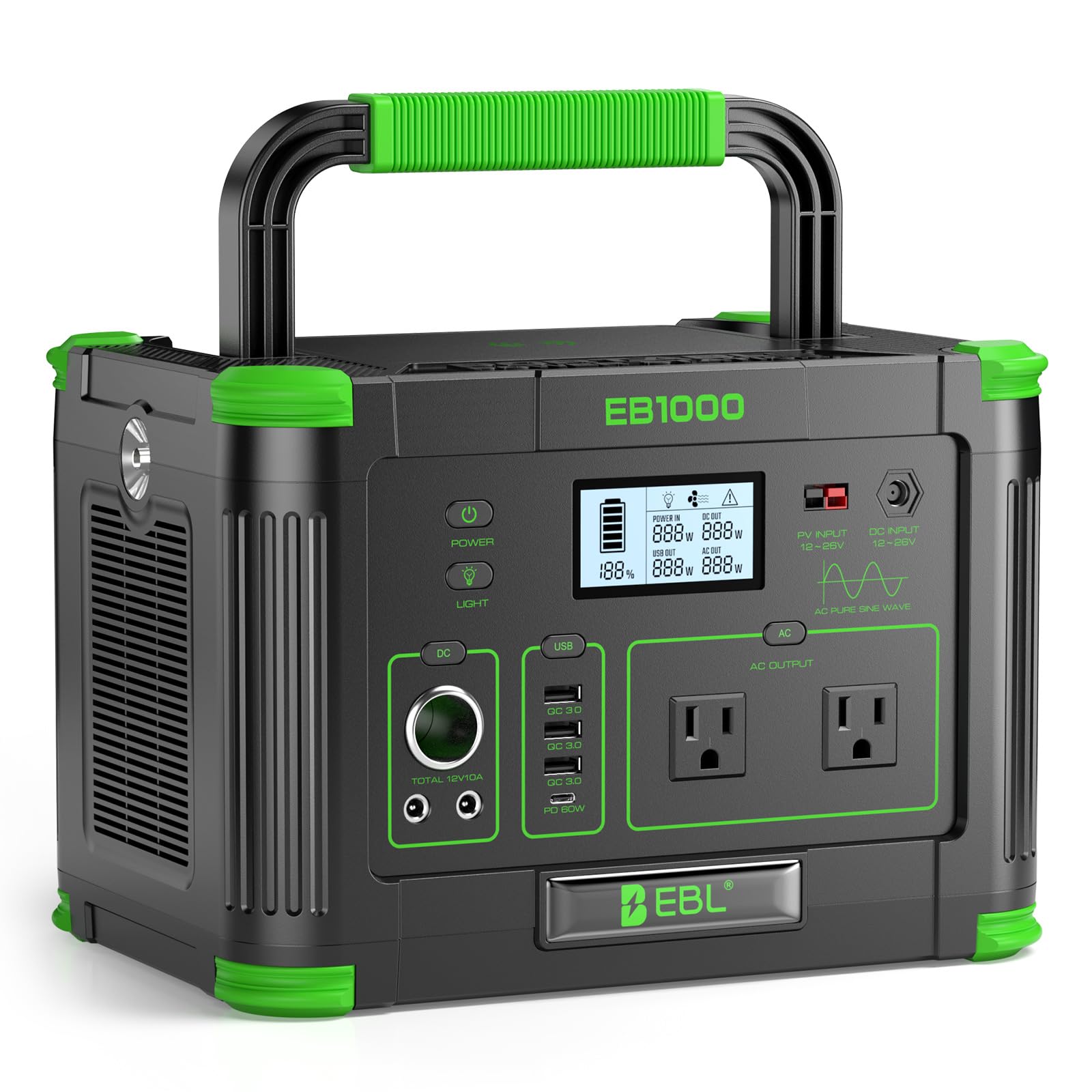
The EBL 1000W brings nearly 1,000Wh of capacity into a budget-friendly package, offering the best watt-hours-per-dollar ratio in this lineup. The 1,000W inverter can run floodlights for 212 hours or a TV for 56 hours, making it a solid choice for weekend car camping where you need reliable lighting and entertainment. The 10W wireless charging pad on top is a unique convenience for topping off phones without cables.
The port selection covers the essentials: one 120V AC outlet, two 12V DC ports, a 12V car outlet, one 60W PD USB-C, multiple USB-A QC3.0 ports, and the wireless pad. The LCD screen features a 20-second auto-sleep to conserve power, and an SOS LED light with normal and emergency modes adds safety. The folding handle and 17.86-pound weight make it one of the more portable mid-capacity options.
Real-world performance shows a large fan on high running for 4 hours with only 75% battery used. The BMS system prevents overcharging and overheating, and the cooling fan operates automatically. Some user reports note that the wireless charger may not work through thick phone cases, and the solar port can be finicky with third-party panels. The 7-8 hour AC recharge is slower than competitors, but acceptable for a unit at this price tier.
Why it’s great
- Nearly 1,000Wh capacity at a budget-friendly price point
- Built-in 10W wireless charging pad for cable-free phone top-ups
- Compact 17.86 lbs with folding handle for easy carry
Good to know
- 7-8 hour AC recharge is slower than premium competitors
- Single AC outlet limits simultaneous large-device use
FAQ
How do I size a battery generator for a weekend camping trip?
Can I run a CPAP machine all night on a battery generator?
How long does it take to recharge a camping generator with solar panels?
What’s the difference between a battery generator and a traditional gas generator for camping?
Final Thoughts: The Verdict
For most campers, the battery generator for camping winner is the BLUETTI Elite 100 V2 because it balances a quick 70-minute recharge, a lightweight 25-pound frame, and enough 1,024Wh capacity to run all your essential camp gear through the weekend. If you want the fastest AC charging and a solar panel included out of the box, grab the EF ECOFLOW Delta 3 Classic Bundle. And for those who need to jump-start a dead SUV battery while powering the campsite, nothing beats the VTOMAN Jump1500X.