
Our readers keep the lights on and my morning glass full of iced black tea. As an Amazon Associate, I earn from qualifying purchases.
That vague squish when you drop into a rock garden isn’t the fork bottoming out — it’s your sag setting telling you the shock pump you grabbed is bleeding pressure during disconnect. A proper bike shock pump must hold every PSI you pump in, or your suspension tuning becomes a guessing game that costs traction and control on the trail.
I’m Min — the co-founder and writer behind Gadgets Feed. I’ve sifted through hundreds of real-world user reports and spec sheets on high-pressure suspension pumps to identify which models actually maintain consistent pressure readings when you need them most.
Whether you fine-tune a Fox 36 or a RockShox Deluxe, this guide isolates the models that deliver repeatable accuracy, reliable Schrader seals, and practical bleeder controls so you can set your fork and shock with confidence — the definitive breakdown of the best bike shock pump today.
How To Choose The Best Bike Shock Pump
Unlike a floor pump, a shock pump must move tiny volumes of air at extreme pressures — typically 100 to 350 PSI — while retaining every pound when you disconnect. The wrong choice means losing 5-10 PSI every time you remove the head, ruining your carefully set sag.
Maximum Pressure Rating
Most air forks run between 80 and 120 PSI, while rear shocks can need 200 PSI or more depending on rider weight. A 300 PSI rating covers the majority of mountain bike suspensions. If you run a Fox DPX2 or a coil-over air can, consider a pump rated to 350 or 400 PSI to ensure the gauge stays accurate in the upper third of its range.
Bleeder Button and Fine Adjustment
Over-pressurizing is almost inevitable during setup. A precision bleeder button lets you release 1-2 PSI at a time without removing the pump head. This is the single feature that separates a trailside frustration from a fifteen-second sag adjustment. Without it, you’ll constantly unscrew, lose pressure, and start over.
Swivel Head and Hose Design
Full-suspension frames have tight clearances. A straight pump head can’t reach the rear shock valve on many bikes without bending the hose at a sharp angle. A swivel or pivoting head with a braided or flexible hose solves this — you can connect the pump at a natural angle and still read the gauge.
Gauge Quality and Readability
Analog gauges on budget-friendly pumps can be off by 5 PSI or more, especially near the bottom of their range. Look for ANSI B40.1 rated gauges or pumps with an industry-class dial that uses a full 360-degree sweep. A 1.5-inch or larger face with clear PSI and BAR markings reduces reading errors when you’re leaning over the bike.
Quick Comparison
On smaller screens, swipe sideways to see the full table.
| Model | Category | Best For | Key Spec | Amazon |
|---|---|---|---|---|
| RockShox High Pressure | Premium | Digital accuracy & repeatability | Digital gauge, CR2032 powered | Amazon |
| Fox Factory HP 350PSI | Premium | Fox-specific swivel head compatibility | 350 PSI max, 6063 aluminum barrel | Amazon |
| Beto SP-002AGN | Mid-Range | Precision 1.5″ industry gauge | 400 PSI, 6″ swivel hose, bleeder | Amazon |
| JACO ShockPro | Mid-Range | ANSI-accurate gauge in a compact build | 300 PSI, aircraft-grade aluminum | Amazon |
| Beto SP-005AG Dual Function | Mid-Range | Shock pump + tire pump in one | 300 PSI, Hi-V / Hi-P switching | Amazon |
| Optio Cycle High Pressure | Budget-Friendly | Dual-action pumping on a tight budget | 300 PSI, dual-action stroke | Amazon |
In‑Depth Reviews
1. RockShox High Pressure Fork and Shock Pump

The RockShox High Pressure pump stands apart with its digital gauge and the brand’s own 2-year warranty — a meaningful upgrade over the unbranded clones that flood the market. The digital readout displays pressure in real-time with repeatable precision that analog needle gauges simply cannot match, verified accurate against a Quarq ShockWiz by multiple users. Pumping effort remains consistent across the entire range, from 50 PSI up to the pump’s full high-pressure capacity, which makes fine-tuning rear shocks at 180+ PSI far less fatiguing than cheaper analog models.
The screw-on head creates a secure, leak-free connection to Schrader valves on both forks and rear shocks. Users report the CR2032 battery lasting well over six years in real-world use, and the lightweight build (roughly 120 grams) disappears into a trail pack without adding noticeable weight. The pump produces repeatable results every session, which is critical for dialing in consistent sag across different trail conditions.
Some units are functionally identical to Fox and Cane Creek pumps produced in the same Asian factory, but the RockShox branding guarantees a higher quality-control bar and the official 2-year manufacturer support. The only recurring mechanical complaint involves the removal screws stripping over time, though this typically takes years of regular use. For riders who want a digital display and proven repeatability, this pump justifies the premium price.
Why it’s great
- Accurate digital gauge with consistent effort at all pressures
- Verified repeatability against professional sag-measuring tools
- Official 2-year warranty from RockShox
Good to know
- Battery compartment screws can strip with heavy use over several years
- Higher upfront investment compared to analog alternatives
2. Fox Factory HP 350PSI Shock Pump

The Fox Factory HP pump is engineered specifically to work with the tight valve clearances found on Fox DPS and DPX2 rear shocks. Its stainless steel swivel head (the UP-SA design) rotates through a wide range of angles, letting you access the valve even when the shock sits inches from a frame linkage — a problem that straight-head pumps simply cannot solve. The barrel and handle are machined from 6063 aluminum, keeping the overall weight at a manageable 204 grams while providing enough leverage to reach the pump’s 350 PSI maximum.
The micro-adjust air bleeder releases pressure in 2-3 PSI increments, which is precise enough for setting sag without overshooting. Users report that the gauge reads accurately across the working range and that the foldable hose tucks neatly into a hydration pack. For Fox-specific applications, the swivel head eliminates the contortionist act required to connect a standard pump to the rear shock valve on many full-suspension frames.
Several long-term owners note that the pump works just as well on RockShox and other brand shocks despite being marketed toward Fox components. The one consistent observation is that the gauge is analog, so reading fine pressure changes requires a careful eye compared to a digital display. For riders who prioritize a seamless connection to Fox shocks and a proven, durable build, this is a focused tool that delivers exactly what it promises.
Why it’s great
- Durable stainless swivel head reaches tight shock valves without bending the hose
- Micro bleeder releases 2-3 PSI for controlled sag adjustment
- Lightweight 6063 aluminum construction rated to 350 PSI
Good to know
- Analog gauge requires careful reading for micro-adjustments
- Premium-tier pricing compared to multi-brand alternatives
3. Beto Precision High Pressure Shock Pump SP-002AGN

The Beto SP-002AGN packs a 1.5-inch industry-class gauge, a fine-tuning bleeder button, and a 6-inch swivel hose into a package that weighs just 180 grams — making it one of the lightest fully featured shock pumps at this price point. The maximum pressure rating of 400 PSI covers every air-sprung fork and shock on the market, including high-volume rear cans that sometimes exceed 300 PSI. The CNC-machined metal valve head grips the Schrader valve without cross-threading, and the patented pinch-free T-handle gives comfortable leverage even with sweaty or gloved hands.
Users consistently praise the bleeder button for enabling precise 1-2 PSI reductions without losing the pump connection — a feature that directly translates to faster, more accurate sag setting on the trail. The swivel hose reduces strain on the valve stem when the pump is attached at an awkward angle, which is critical for rear shocks buried inside the frame. The 400 PSI ceiling means the gauge stays accurate in its mid-range at typical fork pressures, rather than being pegged near its maximum.
A subset of users report that the pump can fail after roughly two years of frequent use, with the internal seal losing its ability to hold pressure. This durability concern appears in a minority of reviews but is worth noting for riders who pump multiple bikes every week. For most weekend trail riders, the Beto delivers reliable accuracy, a compact carry profile, and a bleeder that makes sag setup genuinely easy — all at a mid-range price that undercuts the premium-branded alternatives.
Why it’s great
- Large 1.5″ gauge with industry-class accuracy for clear PSI readings
- 400 PSI maximum covers all suspension types without gauge pegging
- Lightweight 180-gram build with pinch-free T-handle
Good to know
- Some users report internal seal failure after 2-3 years of heavy use
- Small handle size may feel cramped for riders with larger hands
4. JACO ShockPro MTB Shock Pump

The JACO ShockPro is built around an ANSI B40.1-calibrated gauge, which is the same accuracy standard used in industrial pressure tools — a meaningful step above the generic gauges found on entry-level pumps. The body is machined from aircraft-grade aluminum with ABS endcaps, giving it a durable, confidence-inspiring feel without excessive bulk. The 300 PSI rating covers most MTB forks and rear shocks, and users confirm the gauge reads within 1-2 PSI of their digital reference pumps across the entire range.
The integrated air bleeder button lets you micro-adjust pressure in small increments, and the compact 9.5-inch length fits neatly into a trail bag or even a hip pack. Multiple reviews from e-MTB and fat-tire owners note that the pump reached 120 PSI in just a few strokes on forks like the Fox 36 and RockShox Recon. The bleeder valve works reliably without sticking, and the screw-on Schrader head holds a tight seal with zero audible leaks during pumping.
The main trade-off is the gauge size — at roughly 1 inch in diameter, the face is smaller than the Beto or Fox pumps, which can make reading precise PSI values difficult in low light or when you’re crouched over the bike. Riders with less-than-perfect eyesight may prefer a larger dial. JACO backs the pump with a lifetime warranty, which offsets the minor gauge readability concern. For riders who want pro-grade gauge certification in a compact, rugged package, the ShockPro delivers exceptional value.
Why it’s great
- ANSI B40.1 calibrated gauge for verified accuracy compared to generic pumps
- Aircraft-grade aluminum body backed by a lifetime warranty
- Reliable bleeder button with consistent 1-2 PSI release
Good to know
- Small 1-inch gauge face can be hard to read in trail-side conditions
- 300 PSI max may not cover very high-pressure rear shocks above 280 PSI
5. Beto SP-005AG Dual Function Pump

The Beto SP-005AG is the only pump in this lineup that functions as both a high-pressure shock pump and a high-volume tire inflator, controlled by a simple button on the bottom of the handle. In Hi-P mode, one stroke equals roughly 1 PSI for shock tuning — typical for a dedicated shock pump. In Hi-V mode, the pump moves more air per stroke, letting you seat tubeless tires or fill a flat MTB tire without carrying a separate floor pump. This dual-function design saves space and weight for riders who want one tool for trailside emergencies.
The pump includes a mounting bracket that attaches under the bottle cage, keeping it accessible on long rides without needing a pack. The 360-degree swivel hose prevents sharp bends when connecting to rear shocks, and the included Schrader-to-Presta adapter adds compatibility with Presta-valve forks. The bleeder button works cleanly in shock mode, releasing pressure in controlled increments. At just 9.3 ounces and 9.65 inches long, it’s compact enough for a jersey pocket if you remove the bracket.
The trade-off for dual functionality is that neither mode performs at the level of a dedicated single-purpose pump. In Hi-P mode, the gauge reads roughly 2-3 PSI higher than a digital reference, and disconnecting the head loses about 0.5 PSI. In Hi-V mode, inflating a tire from flat to 20 PSI requires roughly 400 strokes — usable but tiring. The pump also requires a screw-on connection rather than a quick-release, which can cost pressure when removing from high-pressure shocks. For riders who prioritize having one tool for trail fixes over absolute gauge precision, the SP-005AG offers real utility.
Why it’s great
- Switchable Hi-V / Hi-P modes cover both tire inflation and shock tuning
- Includes under-bottle-cage mounting bracket for on-bike storage
- 360-degree swivel hose and Presta adapter included
Good to know
- Gauge reads 2-3 PSI higher than digital reference in shock mode
- Screw-on connection loses roughly 0.5 PSI on disconnect from high-pressure shocks
6. Optio Cycle High Pressure Shock Pump
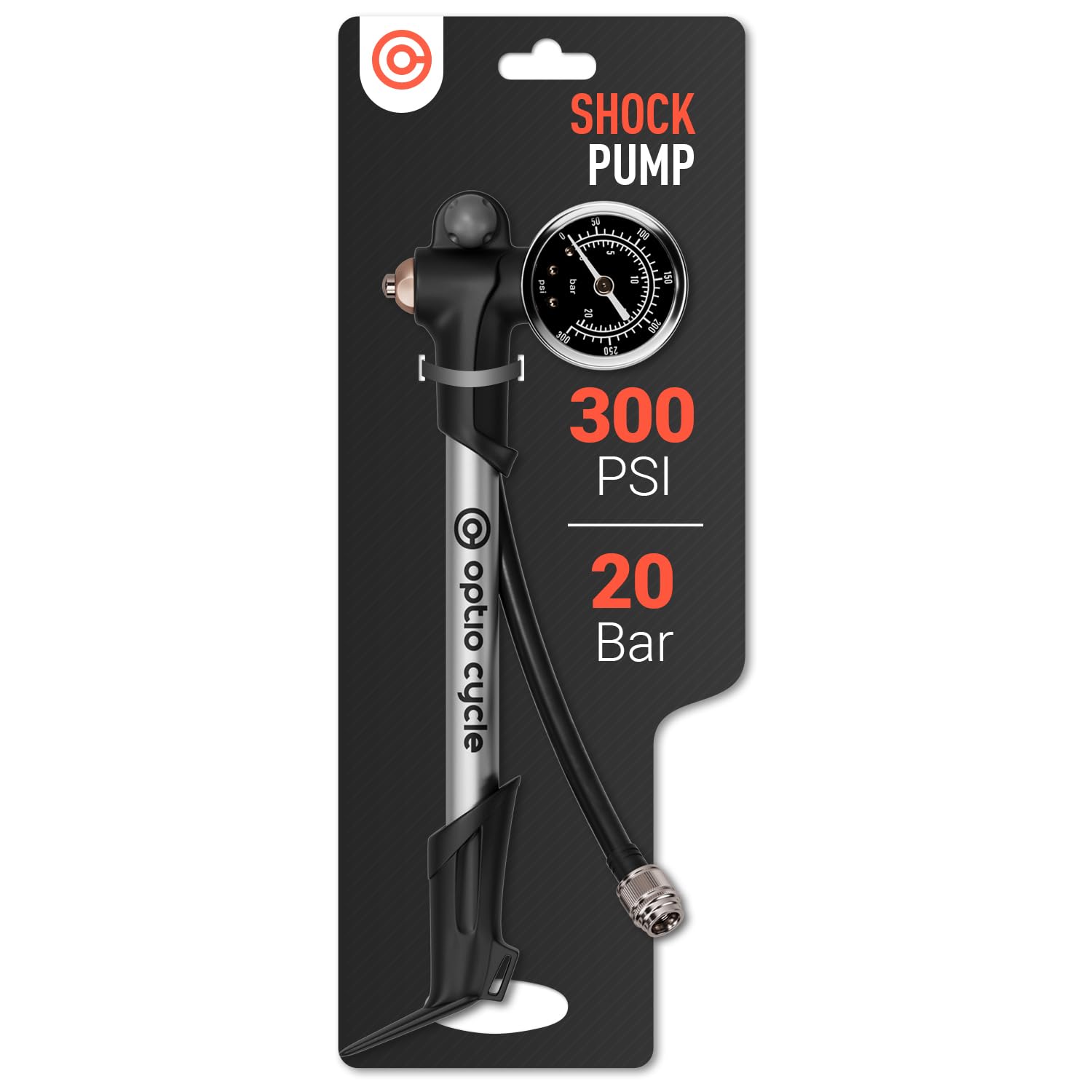
The Optio Cycle pump distinguishes itself in the budget-friendly tier with a dual-action design — it pumps air on both the forward and backward strokes, effectively cutting the effort to fill a fork or shock in half compared to single-action pumps at the same price. The gauge reads in both PSI and BAR up to 300 PSI / 20 Bar, and the stainless steel barrel withstands repeated high-pressure cycles without deforming. At just 6.3 ounces, it’s among the lightest options here, making it easy to stow in a saddlebag or wedge pack.
User reports confirm the Schrader valve head seals properly without cross-threading, and the compact 9.1-inch length fits into tight pack compartments. Several owners mention that the dual-action stroke noticeably reduces the time required to reach 150 PSI on trail-side adjustments. The aluminum and plastic composite body feels solid in hand, and the gauge, while small, provides clear markings that are readable in daylight without magnification.
Because this is a budget-oriented design, the gauge accuracy drifts more than premium-priced competitors — expect a discrepancy of 3-5 PSI compared to a digital reference, particularly at higher pressures. The plastic components in the handle and gauge housing feel less durable than the all-metal builds of the JACO or Fox pumps. For entry-level riders or those seeking a backup pump to keep in the car, the Optio Cycle delivers functional performance at a very accessible cost without sacrificing the dual-action advantage.
Why it’s great
- Dual-action stroke fills shocks on both push and pull for faster setup
- Ultra-lightweight at 6.3 ounces for easy pack storage
- Stainless steel barrel resists wear at 300 PSI
Good to know
- Gauge reads 3-5 PSI high compared to digital reference at high pressures
- Plastic components in the handle feel less durable than metal alternatives
FAQ
Can I use a regular tire pump for my bike suspension?
Why does my shock pump lose pressure when I disconnect it?
What is sag and how does the pump help set it?
Final Thoughts: The Verdict
For most users, the best bike shock pump winner is the RockShox High Pressure because its digital gauge delivers repeatable, verifiable accuracy that takes the guesswork out of sag adjustment, and the official 2-year warranty adds long-term peace of mind. If you want a precise 400 PSI analog gauge with a proven bleeder at a more accessible price, grab the Beto SP-002AGN. And for trail riders who need one tool that handles both shock tuning and emergency tire inflation, nothing beats the Beto SP-005AG Dual Function.