
Our readers keep the lights on and my morning glass full of iced black tea. As an Amazon Associate, I earn from qualifying purchases.
A bead roller is the difference between a floppy, amateur-looking panel and a stiff, professionally shaped piece of metal. But the market is flooded with machines that advertise a gauge rating they can’t actually hold without frame flex, turning what should be a crisp rib into a wavy mess.
I’m Min — the co-founder and writer behind Gadgets Feed. I’ve spent countless hours analyzing the frame rigidity, throat depth, and die compatibility of these machines to separate the genuine fabricators from the toys that shake apart under load.
This guide cuts through the marketing specs to find the best bead roller machine for your shop, whether you are restoring a classic car or fabricating custom HVAC ductwork.
How To Choose The Best Bead Roller Machine
Choosing a bead roller isn’t just about picking the cheapest option with a long throat. The machine’s frame must resist twisting under the force required to form a bead in steel. A flimsy frame flexes, causing the dies to misalign and the bead to lose definition. You must evaluate throat depth, gear ratio, die selection, and maximum material thickness simultaneously.
Frame Rigidity and Construction
The frame is the backbone of the machine. Look for thick, plate-steel construction — at least 1/2-inch thickness is a good baseline. A C-frame design is common, but the distance between the top and bottom plates must be minimized to reduce leverage and flex. Machines that rely on thin stamped steel will deflect under load, ruining your workpiece.
Throat Depth and Gear Ratio
Throat depth dictates how far from the edge of the panel you can roll a bead. An 18-inch throat allows you to work the center of a 36-inch panel, which is essential for floor pans and hoods. A higher gear ratio (like 4:1 or 5:1) multiplies your input force, making it easier to roll through 18-gauge steel without straining the handle or the frame.
Die Selection and Versatility
The dies determine the profile of your bead. A machine that includes 6 or more popular die sets (like 1/4″, 3/8″, and 1/2″ beads, plus step dies) offers immediate versatility. Check that the dies are made from hardened tool steel and that the shaft diameter is standard (often 22mm or 5/8″) so you can upgrade or replace them later.
Quick Comparison
On smaller screens, swipe sideways to see the full table.
| Model | Category | Best For | Key Spec | Amazon |
|---|---|---|---|---|
| KAKA INDUSTRIAL RM-18 | Mid-Range | Deep panel work | 18-Inch Throat, 53 lbs | Amazon |
| Eastwood Elite 8In | Mid-Range | Single-person operation | 4-Spoke Crank, 28.7 lbs | Amazon |
| Eastwood 19-Inch Throat | Mid-Range | Large panels | 19-Inch Throat, Gear-Driven | Amazon |
| Woodward Fab WFBR6 | Mid-Range | Thin gauge work | 6 Die Sets, 52 lbs | Amazon |
| Vibrant Performance 2990 | Premium | Exhaust tubing beads | Min 3/4″ OD Tube | Amazon |
| Graham Tool TUBEBM-HD | Premium | Small diameter tubing | 3/8″-5/8″ OD Tubing | Amazon |
| Sheet Metal Pedestal Roller | Premium | Rolling circles/rings | 3/8″ Thickness Capacity | Amazon |
In‑Depth Reviews
1. KAKA INDUSTRIAL RM-18
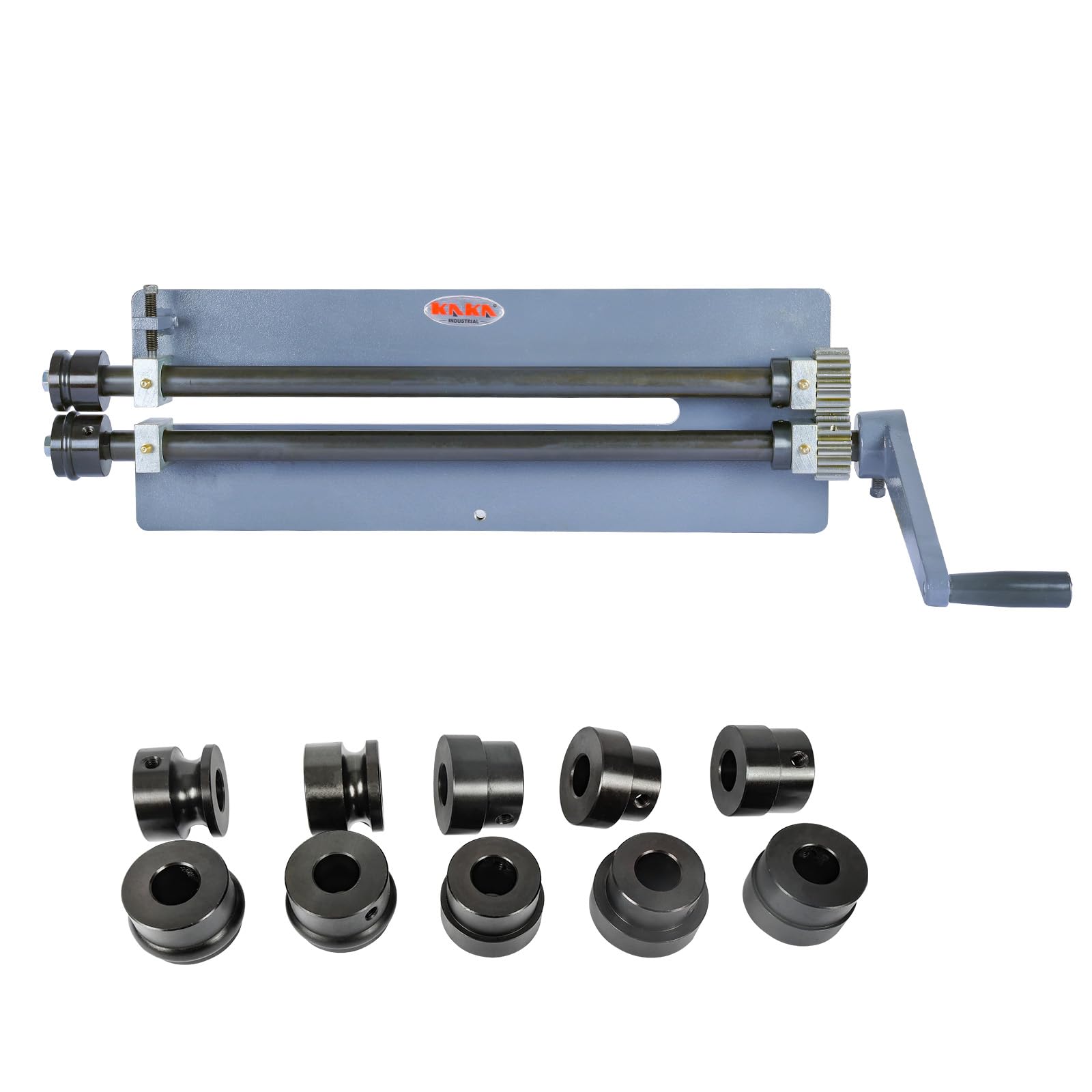
The KAKA INDUSTRIAL RM-18 hits the sweet spot between capability and cost, offering an 18-inch throat depth that lets you work deep into a 36-inch panel for tasks like roof panels and trunk floors. Its rigid plate-steel construction minimizes frame flex, a critical factor when forming beads in 18-gauge mild steel or 22-gauge stainless steel.
The inclusion of six forming rolls — 1/16″, 1/8″, and 1/4″ step dies plus 1/4″, 3/8″, and 1/2″ bead dies — covers the vast majority of common fabrication profiles right out of the box. Users report that after tightening all bolts and greasing the fittings, the machine produces crisp, repeatable beads with consistent depth thanks to the manual crank that drives both top and bottom rolls.
Some customers noted that the set lacks an adjustable edge stop, which requires clamping a guide for repeatable work on panel edges. The unit is also bench-mounted, so you will need a sturdy surface or a dedicated stand rated for its 53 pounds to prevent the machine from walking during operation.
Why it’s great
- Generous 18-inch throat depth for deep panel work.
- Six included die sets provide immediate versatility.
- Rigid plate-steel construction minimizes frame flex.
Good to know
- No adjustable edge stop included.
- Requires a dedicated bench or heavy stand.
2. Eastwood Elite 8In Heavy Duty

The Eastwood Elite 8In is a space-efficient solution for shops that need to produce strengthening ribs but don’t have floor space for a full-frame machine. Its 8-inch throat is perfectly suited for smaller panels, edge work, and forming intricate designs on door panels and fenders.
The 4-spoke crank handle design is a key ergonomic feature, making single-person operation genuinely feasible even on 16-gauge aluminum or 18-gauge mild steel. Users consistently report that the machine exceeds its rated capacity, with some successfully rolling 14-gauge steel without bogging down.
A common complaint in reviews is that the included die set sometimes ships with a 1/4″ bead die instead of the advertised 3/8″ set. While Eastwood’s customer support is responsive in correcting the issue, it is worth checking the package contents immediately upon arrival to avoid a delay in your project.
Why it’s great
- 4-spoke crank allows easy single-person operation.
- Handles 18-gauge mild steel with no frame flex.
- Compact footprint saves valuable bench space.
Good to know
- Some units ship with incorrect die sizes.
- Limited throat depth restricts large panel work.
3. Eastwood 19-Inch Throat Industrial

With the deepest throat in this lineup at 19 inches, this Eastwood machine is the go-to choice for fabricating full-sized floor pans, firewalls, and trunk floors where you need to reach the center of a 38-inch panel. The gear-driven mechanism delivers maximum forming power while requiring minimal handle force, which is a major benefit over direct-drive machines that are harder to turn.
The unit weighs 50 pounds and is built from alloy steel, providing a stable platform that resists twisting even when forming beads near the edge of a large sheet. The included offset dies allow you to create channels and flanges, expanding the machine’s versatility beyond simple beads.
Assembly is straightforward, but users note that the machine must be clamped securely — a 4-inch vise works, but bolting it to a heavy bench is recommended to prevent tipping when cranking against a large panel. Some customers also mentioned finding it cheaper elsewhere after purchase, so price shopping is advised.
Why it’s great
- 19-inch throat depth is best-in-class for large panels.
- Gear-driven mechanism multiplies input force.
- Includes offset dies for flanges and channels.
Good to know
- Requires a very secure mounting surface.
- Heavy unit at 50 pounds.
4. Woodward Fab WFBR6

The Woodward Fab WFBR6 offers the most die sets for the money, including six forming rolls that let you switch between profiles without an immediate additional purchase. The 1/2-inch thick steel frame provides plenty of rigidity for thin-gauge work, making it an excellent entry-level machine for hobbyists and DIY metal artists.
Customer experiences confirm the machine excels on 20 to 22-gauge steel, producing crisp, well-defined beads that give panels a professional appearance. However, the frame begins to flex noticeably when working with 18-gauge steel, and the included adjusting hardware and zerk fittings are noted as weak points that benefit from aftermarket upgrades.
The machine does not include a stand, and users strongly advise against using a vise for support — the frame’s geometry requires a solid mount to 2×2 square tubing or a dedicated bench to prevent the machine from torquing sideways during larger passes.
Why it’s great
- Six die sets included for immediate versatility.
- 1/2-inch thick steel frame for rigid thin-gauge work.
- Produces crisp beads on 20-22 gauge steel.
Good to know
- Frame flexes on 18-gauge and thicker material.
- Hardware quality is inconsistent.
5. Vibrant Performance 2990

The Vibrant Performance 2990 is a specialized manual bead roller designed specifically for creating retention beads on the ends of exhaust and intake tubing. It accepts a minimum tube diameter of 3/4″ OD, making it ideal for fabricating custom cold air intakes, intercooler piping, and exhaust sections where a bead prevents silicone couplers from blowing off.
Users report that achieving a perfect bead requires patience — multiple passes with progressive tightening produce the best results. The tool works effectively on both aluminum and steel tubing, though one unit shipped with a label voiding the warranty if used on steel, which contradicts the Amazon product description and is worth clarifying before purchase.
The 2990 is a bench-mount tool that requires significant arm effort, especially on thicker steel tubing. A few users noted that their arms were burning by the end of a long session, so consider using a drill adapter if you plan to run multiple pieces in a single setting.
Why it’s great
- Creates perfect retention beads on tube ends.
- Works with aluminum and steel tubing.
- Requires minimal setup.
Good to know
- Warranty restrictions on steel use are unclear.
- Requires significant arm effort.
6. Graham Tool TUBEBM-HD

The Graham Tool TUBEBM-HD is a precision beading tool for small-diameter tubing, handling 3/8″, 1/2″, and 5/8″ OD. It uses a vise-like clamping action that rotates around the tube, similar to a tubing cutter, creating a clean, consistent bead without deforming the rest of the pipe.
This tool is the only option in this lineup that can reliably bead steel tubing under 5/8″ OD, making it indispensable for custom heater hoses, transmission cooler lines, and classic British car restoration. Users have successfully beaded 5/8″ OD stainless steel with a 0.049″ wall thickness, finding the tool’s construction robust enough for professional use.
The trade-off is that it is a specialized tool with a narrow range of tube sizes. It also did not come with instructions, which some users found slightly confusing, though the operation is intuitive enough for most mechanics. Lubricating the bit is recommended for smoother operation and longer tool life.
Why it’s great
- Beats small-diameter tubing no other roller can.
- Professional-grade construction.
- Easy vise-like operation.
Good to know
- Limited to 3/8″-5/8″ OD tubing.
- No instructions included.
7. Sheet Metal Pedestal Band / Ring Roller

This pedestal-style band roller is designed for a different task than the other machines in this guide — it rolls circles and rings from flat bar stock, not beads on panels. It can roll 2-inch wide steel at 3/8-inch thickness and 1-inch wide steel at 1/2-inch thickness, making it a heavy-duty solution for fabricating metal table edges, decorative rings, and structural hoops.
The center knurled roller prevents workpiece slippage, and the heavy steel construction provides a stable platform for repetitive work. It produces circles as small as 8 inches in diameter, which is useful for custom metal furniture and resin table frames.
Assembly issues are a recurring theme in reviews. The main shaft is sometimes manufactured out of tolerance, requiring machining before the tool can be assembled. Additionally, the instructions appear to show an assembly sequence that many users found incorrect, with better results achieved by assembling the rollers in the reverse order.
Why it’s great
- Rolls circles from thick flat bar stock.
- Pedestal design provides excellent workpiece access.
- Knurled roller prevents material slippage.
Good to know
- Quality control issues with shaft tolerances.
- Instructions are misleading.
FAQ
Can a bead roller handle stainless steel?
What is the difference between a bead roller and a ring roller?
Final Thoughts: The Verdict
For most users, the best bead roller machine is the KAKA INDUSTRIAL RM-18 because it balances a deep 18-inch throat with a rigid steel frame and six versatile die sets at a value that’s hard to beat. If you only work on smaller panels and want single-person operation, grab the Eastwood Elite 8In. And for the widest possible panel reach in a mid-range frame, the Eastwood 19-Inch Throat Industrial is your best option.