
Our readers keep the lights on and my morning glass full of iced black tea. As an Amazon Associate, I earn from qualifying purchases.
The promise of a private, massive screen you carry in your pocket has finally arrived with AR augmented reality glasses. But the reality is more nuanced than the marketing — raw brightness and screen size aren’t everything. The real distinctions lie in optical engine design, spatial processing latency, and how well the glasses sit on your face without causing eye fatigue.
I’m Min — the co-founder and writer behind Gadgets Feed. Through many hours of cross-referencing technical datasheets, reading through thousands of user experiences, and comparing per-eye resolutions and field-of-view measurements, this guide isolates which glasses actually deliver on their specs in real-world conditions.
Whether you’re gaming on a Steam Deck, watching movies on a flight, or connecting to your iPhone for a private theater, finding the right pair means understanding which specific display technology and chipset power your ar augmented reality glasses.
How To Choose The Best AR Augmented Reality Glasses
Not all AR glasses are created equal. The raw specs like screen size and brightness matter, but the real-world experience depends heavily on optical design, chipset capability for spatial tracking, and ergonomic fit. Three factors separate a wearable display you’ll love from one you’ll return.
Field of View (FOV) and Virtual Screen Size
Every brand advertises a massive virtual screen size measured at a fixed distance — 147 inches, 201 inches, even 500 inches. But the actual perceived size depends directly on the Field of View. A 46-degree FOV gives you a screen roughly equivalent to a 27-inch monitor at arm’s length. Wider FOVs like 50 or 52 degrees push that perceived size wider, making movies feel more cinematic. Look for the actual FOV spec rather than the marketing inch number.
Spatial Tracking: 3DoF vs Fixed Screen
The cheapest glasses lock the screen to your head movement — turn your head, the screen turns with you. Native 3DoF (three degrees of freedom) anchors the virtual screen in physical space, so you can look around it naturally. The X1 chip in XREAL models achieves this with 3ms motion-to-photon latency, making it feel rock-solid. If you plan to work with multiple virtual monitors or game with your screen anchored in space, demand native 3DoF without needing an external puck or app.
Brightness, Color, and Eye Comfort
Peak in-eye brightness measured in nits determines how usable the glasses are in variable light. 600 nits is adequate indoors but struggles near a window; 1000 nits or more handles bright environments better. Color gamut matters — 98% DCI-P3 coverage makes movies pop. For eye safety, look for PWM dimming rates above 3000Hz and TÜV Rheinland certifications for flicker-free and low blue light. Micro-OLED is the standard for these glasses, and its contrast ratio (often 200,000:1) defines how rich blacks appear.
Quick Comparison
On smaller screens, swipe sideways to see the full table.
| Model | Category | Best For | Key Spec | Amazon |
|---|---|---|---|---|
| XREAL 1S | Premium | Best All-Around Immersion | 52° FOV, X1 Chip, 3ms M2P | Amazon |
| RayNeo Air 4 Pro | Premium | Best HDR Display | HDR10, Vision 4000 Chip | Amazon |
| XREAL One | Premium | Native 3DoF On All Inputs | 147″, 50° FOV, X1 Chip | Amazon |
| VITURE Luma | Premium | Gaming Ecosystem | 1200p, 1000 nits, Electrochromic | Amazon |
| TOZO VIZO Z1 Pro | Mid-Range | Lightweight Travel Companion | 63g, 47.5° FOV, 3840×1080 | Amazon |
| Rokid Max2 | Mid-Range | Direct Myopia Dial | 600° diopter, 50° FOV | Amazon |
| RayNeo Air 3s Pro | Mid-Range | Highest Brightness for Price | 1200 nits, 3840Hz PWM | Amazon |
| Rokid AR Joy Pack 2 | Mid-Range | Standalone Streaming Hub | 5000mAh Station, 160″ | Amazon |
| Lenovo Legion Glasses Gen 2 | Budget | Simple Plug-and-Play | 65g, 126″, FHD 120Hz | Amazon |
In‑Depth Reviews
1. XREAL 1S AR/XR Glasses
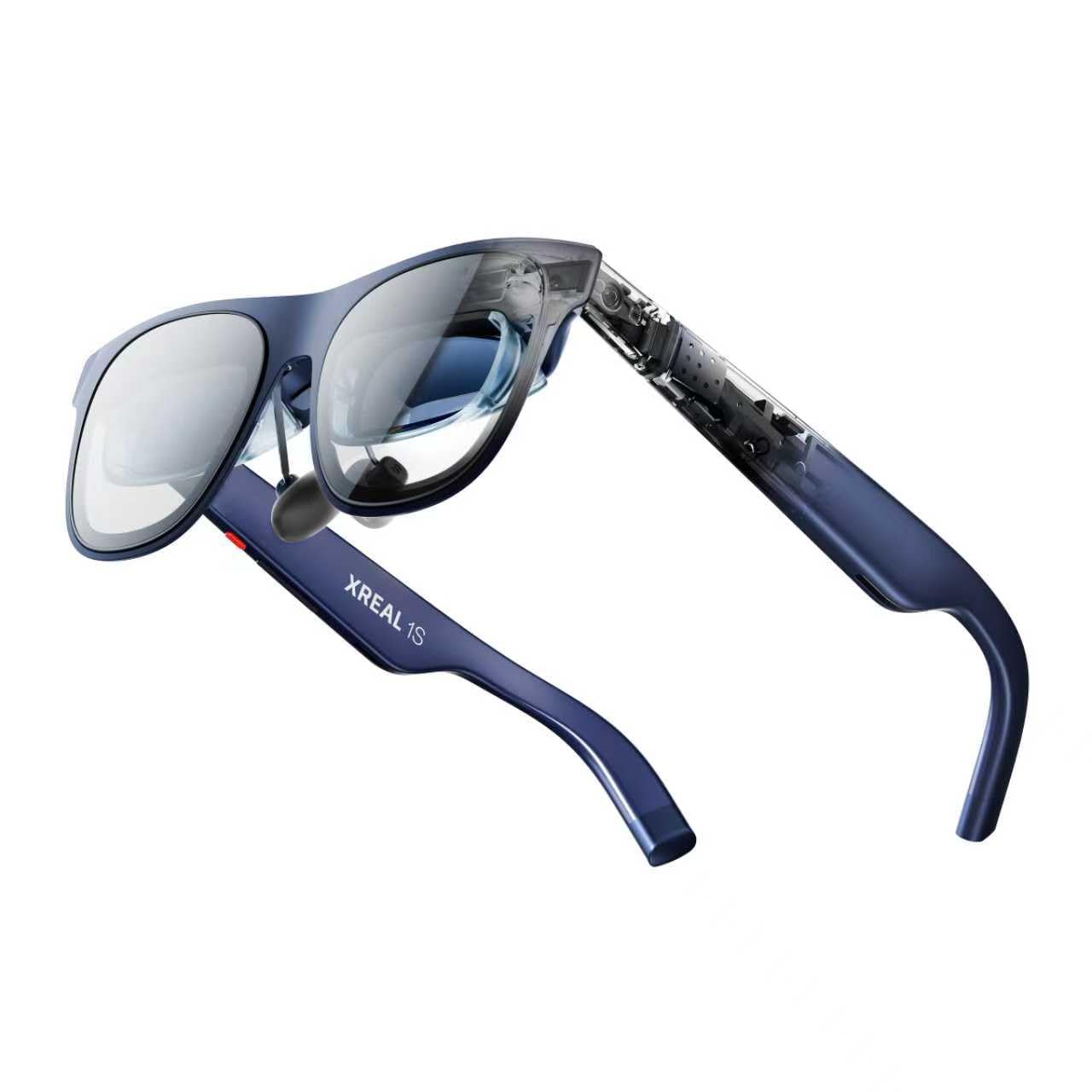
The XREAL 1S uses the self-developed X1 spatial computing chip to deliver native 3DoF tracking with an industry-leading 3ms motion-to-photon latency at 120Hz. This eliminates the feeling of screen drift or jitter that plagues glasses relying on phone-based processing. The 52-degree FOV gives the widest perceived virtual screen in this class, and the individual color tuning per unit ensures accurate whites and natural skin tones out of the box.
Sound by Bose is not just a marketing badge — the custom acoustic chamber and AR-grade drivers produce deeper bass and clearer vocals than any other open-ear glasses on this list. The REAL 3D mode converts any content into spatial depth with a single switch, though it runs at 30fps with 90-100ms latency. For standard 2D content, the 120Hz refresh rate keeps fast motion smooth and flicker-free. The TÜV Rheinland certification covers low blue light and flicker-free viewing, making long sessions easier on the eyes.
Below the surface, the XREAL 1S lacks built-in diopter adjustment — users who need vision correction must purchase and install prescription lens frames. The IPD range spans 59.5 to 70.5 mm, accommodating roughly 95% of users, but those outside that range will experience soft edges or reduced clarity. The glasses also require USB-C DP Alt Mode on the host device; HDMI users need a separate adapter.
Why it’s great
- Widest 52° FOV creates genuinely immersive virtual screen
- X1 chip provides rock-stable 3DoF without external hardware
- Bose audio tuning delivers best-in-class open-ear sound
Good to know
- No built-in myopia adjustment; requires separate prescription lenses
- REAL 3D mode limited to 30fps with noticeable latency
- Slight edge blur reported by some users with specific face shapes
2. RayNeo Air 4 Pro AR/XR Glasses
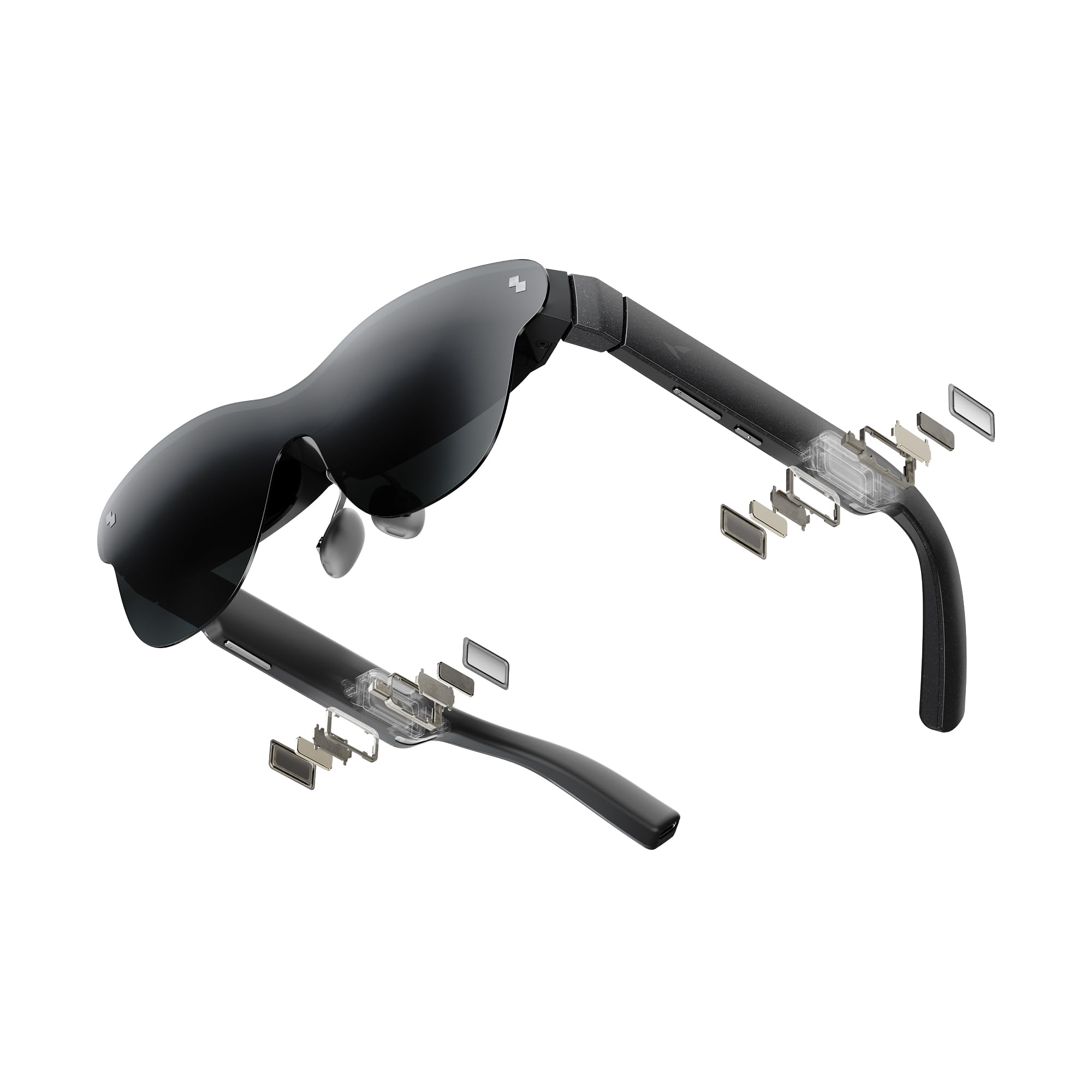
The RayNeo Air 4 Pro is the only wearable display glasses with native HDR10 certification, supporting over 10 billion colors with ultra-deep contrast. The Vision 4000 chip, co-developed with Pixelworks, provides AI-driven SDR-to-HDR upscaling in real time. This means standard Netflix streams and YouTube videos get expanded dynamic range — brighter highlights and richer blacks that non-HDR glasses simply cannot reproduce. The 46-degree FOV is narrower than the XREAL 1S, but the per-eye resolution and color accuracy make it the best choice for movie purists.
Audio is handled by four precision speakers from Bang & Olufsen, delivering 360-degree spatial sound. The optional Sound Tube accessory directs audio directly into the ear canal for private listening in noisy environments — a feature missing on most competitors. The frame weighs under 80 grams and features adjustable arms, though some users with larger head sizes report needing to press the glasses inward to see the full screen. There is no myopia dial; nearsighted users need custom prescription lens inserts.
The USB-C connection supports plug-and-play with iPhone 15 series, Android phones, MacBook, iPad, Steam Deck, and PlayStation consoles. No internal battery means lighter weight and instant power from the host device. The 3D movie support works natively with side-by-side content and includes AI-based 2D-to-3D conversion, though depth perception varies by content source.
Why it’s great
- Only AR glasses with HDR10 certification for true high-dynamic-range video
- Bang & Olufsen four-speaker spatial audio system
- Vision 4000 chip provides excellent motion clarity at 120Hz
Good to know
- 46° FOV feels narrower than premium competitors
- No built-in myopia adjustment
- Nose pads uncomfortable for some users over long sessions
3. XREAL One AR Glasses

The XREAL One uses the same X1 spatial chip found in the 1S, delivering the same 3ms motion-to-photon latency and native 3DoF anchoring without any external hardware. The display uses a 0.68-inch Sony Micro-OLED panel with a 50-degree FOV, projecting a virtual image up to 147 inches at 4 meters. Peak brightness hits 5000 nits at the source with 600 nits perceived in-eye — sufficient for indoor use but less competitive against the 1200-nit RayNeo Air 3s Pro in bright daylight.
The audio is tuned by Bose engineers in a dedicated sound chamber design. The open-ear configuration leaks less sound than most competitors — passengers sitting next to you on a plane will barely hear the audio at moderate volume. Software-side, firmware updates have added AI 3D mode and ultra-wide screen support. Users can switch between anchor mode (screen pinned in space) and follow mode (screen follows your head). The electrochromic dimming built into the lens changes transparency on demand, blocking out the environment for total focus.
A notable limitation: the glasses ship with a standard USB-C cable, but some users found that a Thunderbolt-compatible USB-C cable is required for stable connectivity with certain devices like the Steam Deck. The carrying case is smartly designed but lacks dedicated cable storage. Text readability for coding or spreadsheet work is good at medium distances, but the 50-degree FOV means the screen doesn’t fill your entire field of view like a VR headset would.
Why it’s great
- Rock-solid native 3DoF with ultra-low 3ms latency
- Continuing firmware updates adding new modes and features
- Electrochromic dimming adjusts transparency smoothly
Good to know
- Requires Thunderbolt-capable USB-C cable (not always included)
- No built-in myopia adjustment
- Case lacks cable storage compartment
4. VITURE Luma AR/XR Glasses
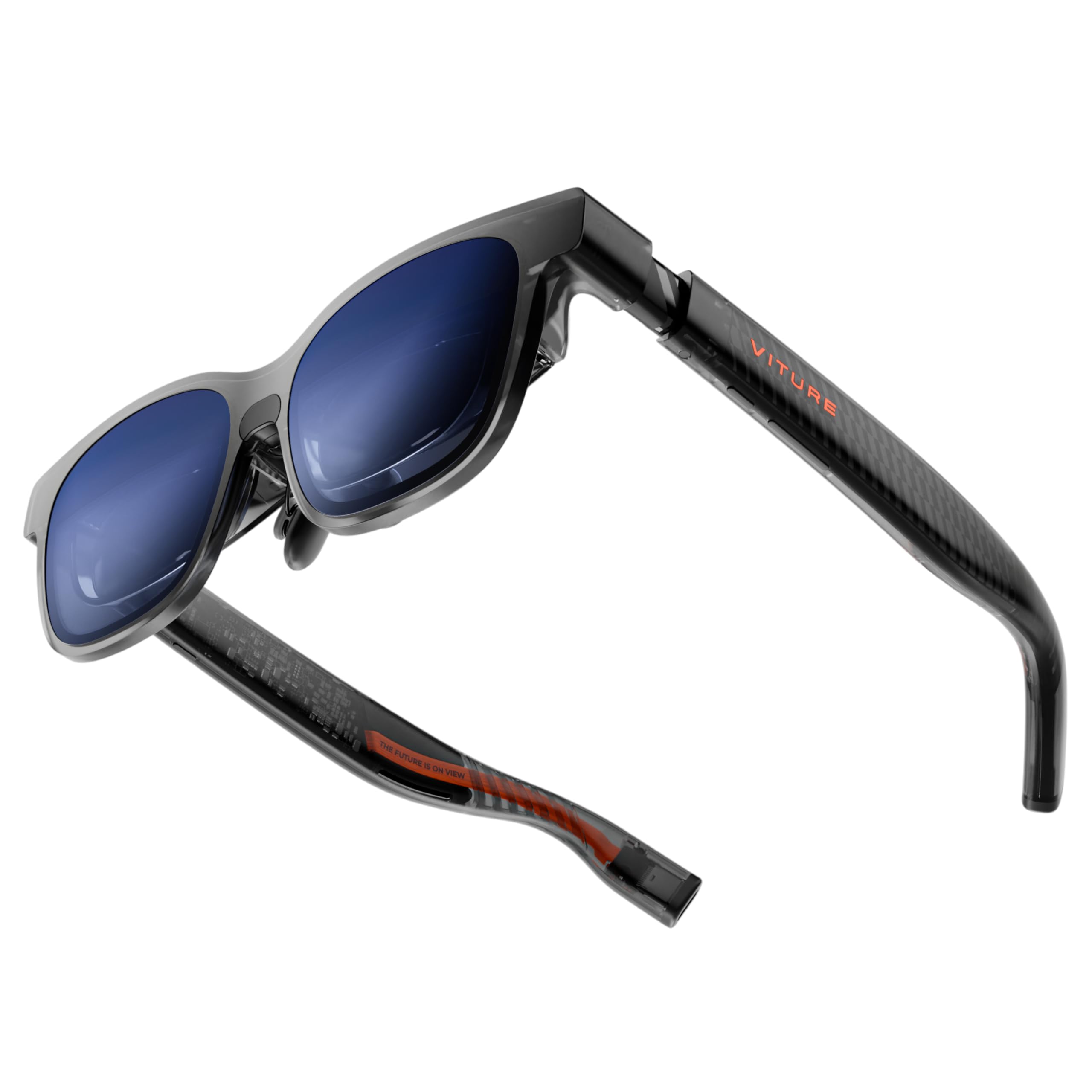
The VITURE Luma pushes the spatial display resolution to 1200p per eye, making it sharper than the standard 1080p found on most competitors. The 50-degree FOV and 1000 nits peak brightness place it in the premium tier, with enough luminance to remain visible in bright indoor environments. The built-in myopia adjustment covers up to -6.0 diopters directly on the glasses — no inserts needed up to that range, which is a significant convenience for nearsighted users.
Gamers will appreciate the electrochromic film that darkens the lenses at a touch, and the immersive 3D feature converts standard 2D content into spatial depth in real time. The VITURE ecosystem supports direct connection to the Switch 2, PS5, Steam Deck, and any USB-C DP device. For productivity, the SpaceWalker app enables multi-screen virtual desktops on macOS and Windows, though the app needs ongoing refinement for stability. The three magnetic nose pad options help with fit, but some users report the screen edges cut off depending on nose bridge shape.
Audio quality is good for an open-ear design, with clear mids and integrated spatial audio. The translucent design looks modern, and the 77-gram weight distribution makes it comfortable for two-hour gaming sessions. One notable downside: the right temple arm can get slightly warm during extended use, and the SpaceWalker app is required for multi-screen setups.
Why it’s great
- Sharp 1200p per-eye resolution for best text clarity
- Built-in myopia adjustment covers -6.0D without extra inserts
- Electrochromic dimming for instant environment blocking
Good to know
- Right temple arm can get warm during extended gaming
- SpaceWalker multi-screen app needs software refinement
- Nose pad fit can cause partial screen cutoff for some users
5. TOZO VIZO Z1 Pro AR Glasses
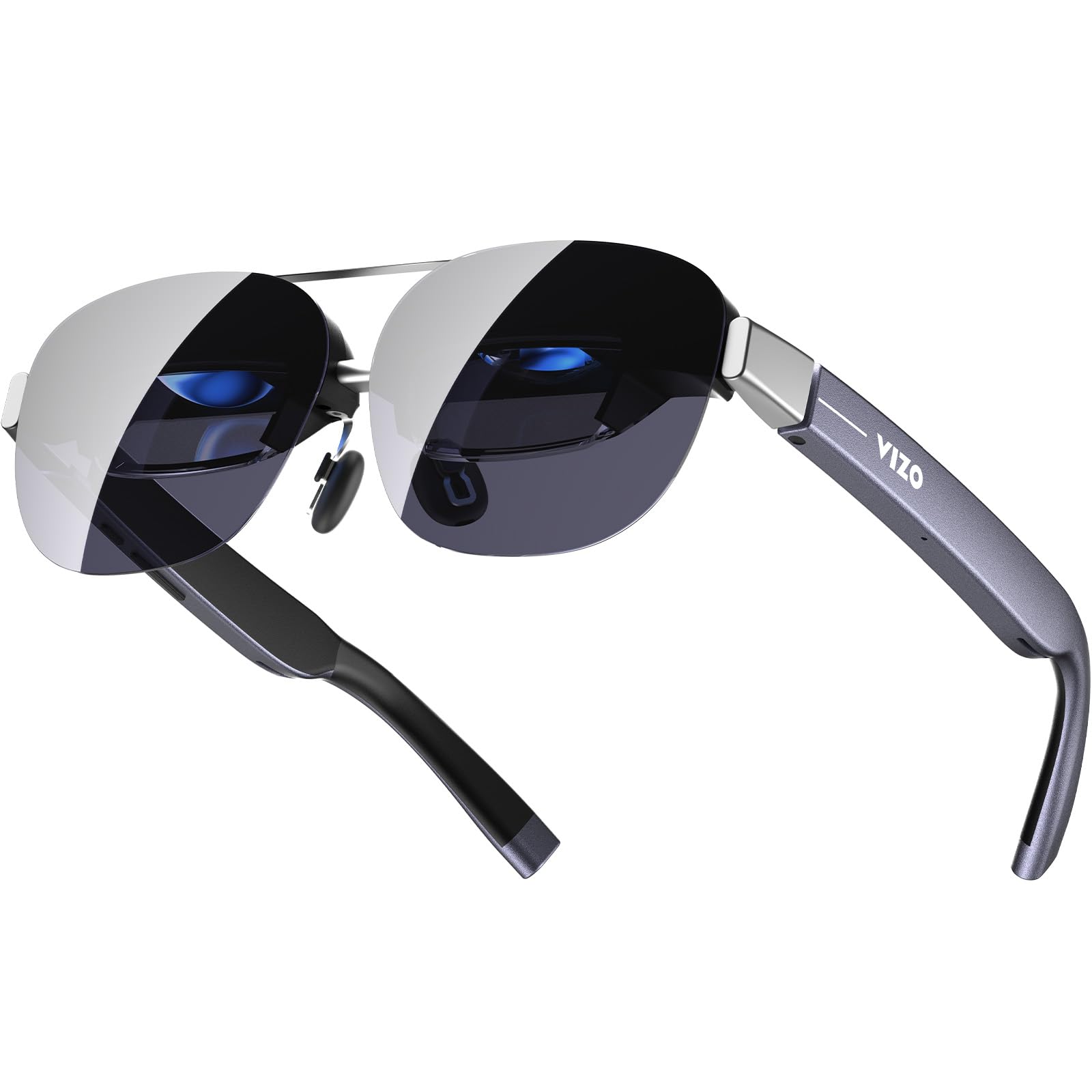
The TOZO VIZO Z1 Pro stands out for its ultra-lightweight design at just 63 grams — the lightest glasses in this roundup. It uses dual Micro-OLED displays delivering a combined 3840×1080 resolution, essentially full HD per eye. The 47.5-degree FOV is slightly wider than mid-range options, producing a 160-inch perceived screen. The color accuracy is excellent with 98% DCI-P3 coverage and a 200,000:1 contrast ratio that makes black levels impressive for the price tier.
The glasses fold like regular sunglasses using a sleek detachable frame that supports prescription lenses. The 120Hz refresh rate ensures fluid motion for gaming and fast-paced content, and the multi-level in-eye brightness control adapts to different lighting conditions. Dual stereo speakers and physical control buttons make this a self-contained media device — no separate dongle or control puck needed. The matte blue finish looks premium and the included carrying case is compact enough for a jacket pocket.
On the downside, the TOZO VIZO Z1 Pro lacks any spatial tracking — there is no 3DoF or depth-of-field adjustment. The screen is always head-locked, which is fine for watching movies but less comfortable for productivity. Some users report slight corner blur and audio bleed at higher volumes. At this price point, the lack of software ecosystem or app support also means you get exactly what the hardware provides with no upgrade path.
Why it’s great
- Ultra-light 63g frame is comfortable for hours of wear
- Dual Micro-OLED displays deliver 3840×1080 total resolution
- Folds into compact sunglasses form for easy portability
Good to know
- No 3DoF or spatial tracking available
- Slight corner blur on edges reported by some users
- Audio bleed at higher volumes noticeable in quiet rooms
6. Rokid Max2 AR Glasses
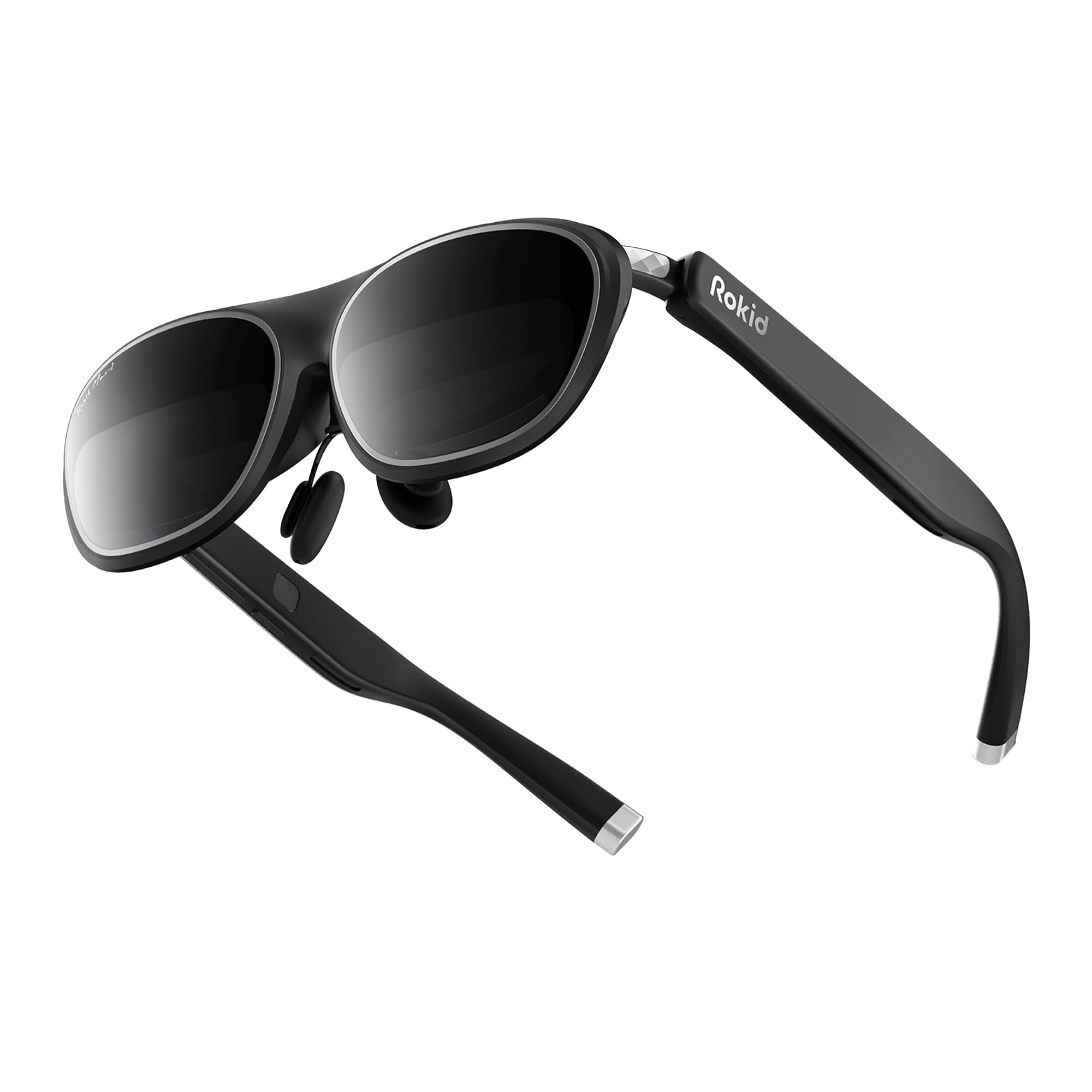
The Rokid Max2 solves one of the biggest pain points in AR glasses: vision correction. The on-glasses diopter adjustment dial goes up to 600 degrees, so nearsighted users don’t need to buy prescription inserts. Astigmatism and presbyopia are not supported on the dial, but for simple myopia, this is the most user-friendly system available. The 50-degree FOV projects a 215-inch virtual screen at 6 meters with a 120Hz refresh rate that keeps motion smooth.
Brightness sits at 600 nits — adequate for indoor use but less competitive in bright daylight compared to the 1000-1200 nit options. The Micro-OLED panel delivers decent contrast with the 200,000:1 ratio typical of this class, and the adjustable nose pads with airy cushioning prevent slipping. The frame is reinforced with plastic and aluminum, supporting faces up to 16 cm wide, and the 75-gram weight distribution is comfortable for most users.
Connectivity is strictly USB-C with no internal battery. The glasses support HDCP for secure streaming from apps like Netflix and work with iPhone 15 series, Android phones, Mac, Windows laptops, and iPads. The included blackout cover blocks peripheral light for more immersive viewing. Some users report that the adjustment dial is not precise enough for fine corrections, and the lack of spatial tracking means the screen always follows your head.
Why it’s great
- Built-in 600° myopia dial removes need for lens inserts
- 50° FOV and 215-inch virtual screen feel spacious
- Air-cushioned nose pads prevent slipping during wear
Good to know
- 600 nits brightness struggles in bright environments
- No spatial tracking; screen is always head-locked
- Diopter dial is not precise enough for minor corrections
7. RayNeo Air 3s Pro AR/XR Glasses
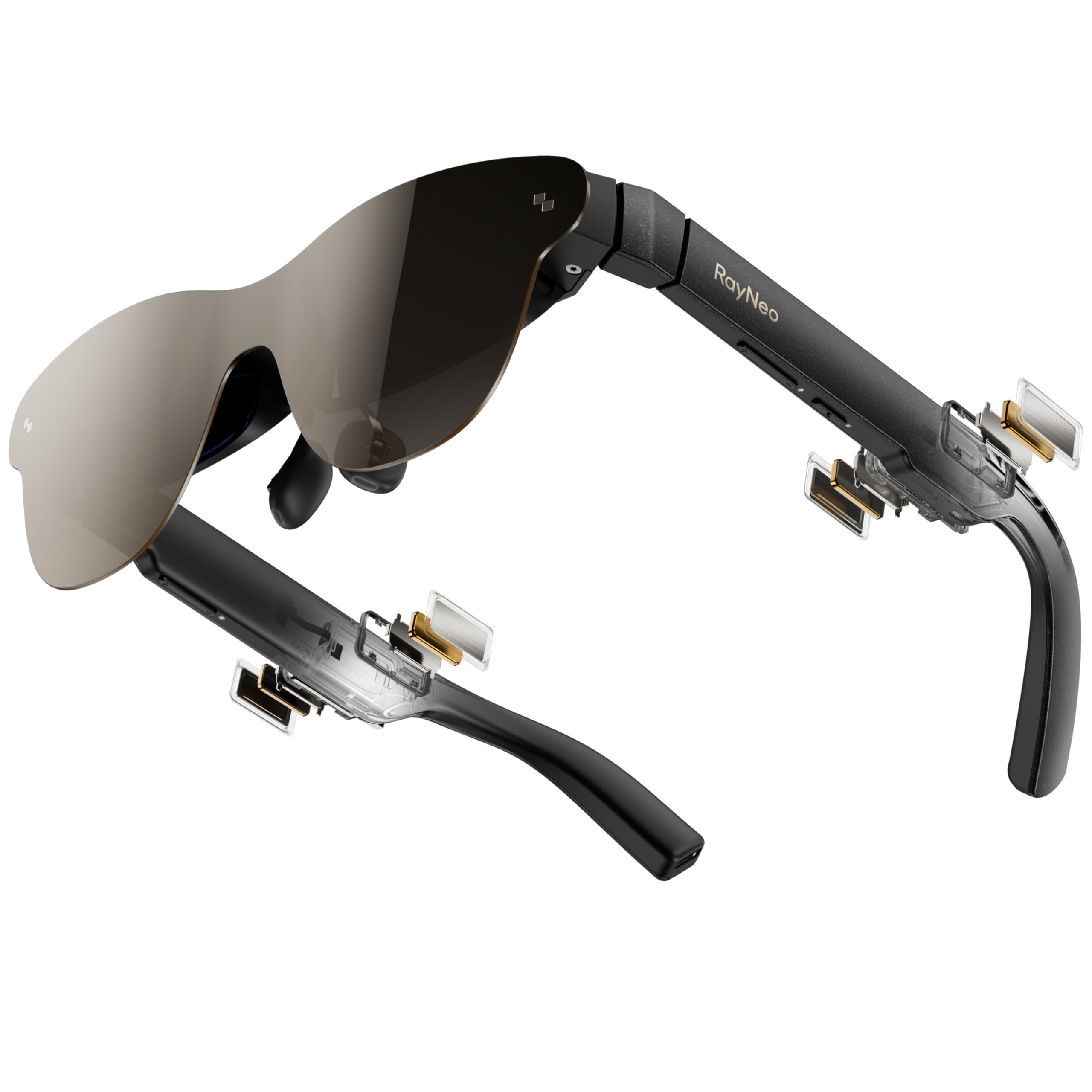
The RayNeo Air 3s Pro claims the title of brightest AR glasses on the market with 1200 nits to-eye brightness. This makes a noticeable difference in daylight or near windows — dim stars in movie scenes remain visible where lower-nit glasses would show pure black. The HueView 2.0 Micro-OLED tandem display delivers 200,000:1 contrast and 98% DCI-P3 color coverage, putting it on par with the RayNeo Air 4 Pro in color performance but lacking HDR10 certification.
Eye comfort is a standout feature here: the Air 3s Pro is the only glasses with TÜV SÜD Low Blue Light and Flicker-Free dual certification, combined with 3840Hz high-frequency PWM dimming that eliminates visible flicker for sensitive users. The 20-level brightness control lets you tune the display precisely to your environment. The 120Hz refresh rate matches the rest of the field, but the 46-degree FOV is narrower than premium options.
The spatial audio system supports whisper mode for private listening, though the open-ear design still leaks sound at higher volumes. The frame weighs 76 grams and users report the silicone nose pads can cause red marks after 2-3 hours of wear. For vision correction, a prescription lens sample is included to take to a local optician — not as convenient as the Rokid’s built-in dial. Some users report difficulty seeing the full screen due to fit issues, and the stiff power cable can pull the glasses downward during use.
Why it’s great
- 1200 nits peak brightness is best-in-class for daylight use
- TÜV SÜD dual certification for low blue light and flicker-free viewing
- 3840Hz PWM dimming eliminates visible screen flicker
Good to know
- 46° FOV feels tighter than premium competitors
- Nose pads can cause red marks after extended wear
- Stiff power cable can pull the glasses downward
8. Rokid AR Joy Pack 2
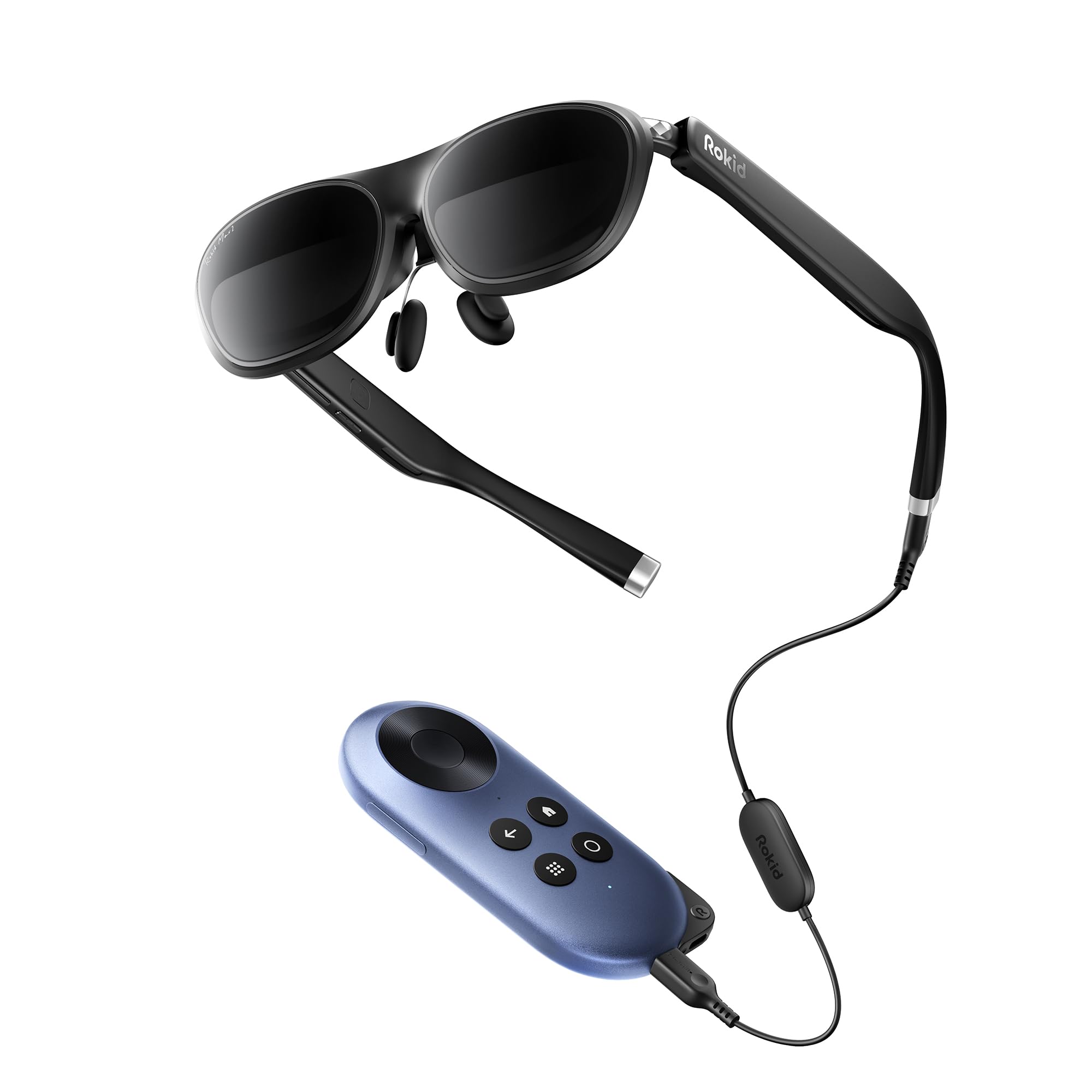
The Rokid AR Joy Pack 2 bundles the Rokid Max 2 glasses with a dedicated Station — a Google-certified Android TV box that makes the system fully standalone. The Station houses a 5000mAh battery offering up to 7 days of standby time, Chromecast support, and access to streaming apps (though Netflix is notably absent). The glasses themselves deliver the same 215-inch virtual screen with 50-degree FOV and 600 nits brightness as the standalone Max 2, but the Station adds wireless casting for a 360-inch virtual display from your phone or Steam Link.
The diopter adjustment dial works the same as the Max 2, supporting up to 600 degrees of myopia. The Station connects to the glasses via HDCP-compliant USB-C and supports plug-and-play setup. A thumb wheel controller and remote are included, making navigation through the Android TV interface straightforward. The 120Hz refresh rate applies to content that supports it, and the Micro-OLED display delivers the same contrast performance as the standalone model.
However, the Station has quirks: it does not support EAC3 audio format, so Apple TV users will encounter audio issues with some Plex content without workarounds. The glasses weight and fit are identical to the Max 2, which means comfort for larger heads can be hit-or-miss. The Station adds bulk compared to using the glasses solo, defeating some of the portability advantage.
Why it’s great
- Fully standalone with Android TV built into the Station
- 5000mAh battery allows wireless use without phone
- Wireless casting expands virtual display to 360 inches
Good to know
- Station does not support EAC3 audio format
- No Netflix support on the integrated Android TV
- Added bulk from the Station reduces portability
9. Lenovo Legion Glasses Gen 2

The Lenovo Legion Glasses Gen 2 strip the experience down to the essentials: a plug-and-play Micro-OLED wearable monitor with no AR overlays, no spatial tracking, and no software bloat. The 126-inch virtual screen runs at FHD 1920×1080 resolution per eye with a 120Hz refresh rate. The 65-gram weight makes these the lightest glasses after the TOZO, and the included prescription lens frame supports vision correction without requiring a complicated adjustment system.
The design is utilitarian — black plastic frame with adjustable nose pads and the Lenovo Legion branding. The high-fidelity speakers are adequate for casual use, and the USB-C connection works with any device supporting DP Alt Mode. Steam Deck users report that the larger virtual screen significantly improves text readability in games and desktop mode. The bundled carrying case, light shield, and cleaning cloth provide everything needed for travel.
Where the Legion Glasses Gen 2 fall short is comfort and optical alignment. The nose pads have limited adjustability, causing the glasses to slide upward on some faces, which cuts off the top and bottom of the display. The screen cannot be repositioned spatially, so fitting the image into your field of view requires precise positioning. Users with average to large head sizes report that the screen appears too small or truncated. The 126-inch virtual screen also feels less immersive than the 200-inch+ claims from competitors.
Why it’s great
- Lightest budget option at 65 grams
- True plug-and-play with no software setup
- Includes prescription lens frame for vision correction
Good to know
- Nose pad adjustability is limited; glasses may slide
- Screen can appear truncated for larger face shapes
- No spatial tracking or virtual screen repositioning
FAQ
Can AR glasses replace a monitor for regular computer work?
Do AR glasses work with prescription glasses underneath?
Why do some AR glasses have no spatial tracking?
Final Thoughts: The Verdict
For most users, the ar augmented reality glasses winner is the XREAL 1S because it combines the widest 52-degree FOV with native 3DoF spatial tracking powered by the X1 chip and best-in-class Bose audio, creating the most complete wearable display experience. If you want the best HDR movie display with superior color accuracy, grab the RayNeo Air 4 Pro. And for budget-conscious buyers who need built-in myopia adjustment without inserts, nothing beats the Rokid Max2.