
Modern dash cams have evolved far beyond a simple front-facing lens; today’s multi-channel systems provide complete 360-degree surveillance that monitors the road ahead, the cabin, and what’s happening behind your vehicle. Whether you are a rideshare driver documenting every trip or a daily commuter wanting irrefutable evidence for insurance claims, choosing the right setup means navigating a dense forest of resolutions, sensor types, night-vision capabilities, and parking-monitoring modes.
I’m Min — the co-founder and writer behind Gadgets Feed. After spending dozens of hours analyzing sensor specifications, real-world night-vision performance, and the differences between 4-channel and 3-channel architectures, I’ve assembled this guide to cut through the marketing noise and help you find the exact camera system that fits your vehicle and your driving habits.
Once you know the critical specs like sensor sensitivity (STARVIS 2 versus standard CMOS), lens aperture for low-light intake, and whether the system uses a supercapacitor or a lithium battery for extreme temperature safety, choosing the best car camera security setup becomes a straightforward decision rather than an overwhelming gamble.
How To Choose The Best Car Camera Security
Choosing the right dash cam system comes down to three core pillars: the number of channels you truly need, the low-light sensor quality that defines night footage, and the parking monitoring features that protect your vehicle when you are away. Understanding these elements prevents overspending on channels you will never use or ending up with blurry nighttime footage that fails as evidence.
Channel Count: How Many Cameras Do You Really Need?
A single front-facing camera covers roughly 170 degrees of the road, but it leaves your rear, cabin, and side blind spots completely unmonitored. Three-channel (front, rear, cabin) systems are the sweet spot for rideshare drivers and parents monitoring back-seat passengers. Four-channel (front, rear, cabin, and a second interior or side camera) systems offer true 360-degree coverage, but they also consume significantly more storage space and require a larger memory card to avoid overwriting critical footage too quickly.
Sensor Quality: Why STARVIS 2 Matters for Night Driving
The sensor is the heart of any dash cam. Standard CMOS sensors struggle when ambient light drops, producing grainy, unreadable footage at dusk. STARVIS 2 sensors from Sony offer about 4.6 times greater light sensitivity than their predecessors, meaning they can capture readable license plates in near-darkness without relying on harsh infrared illumination. If you drive frequently at night or park in poorly lit areas, a dash cam with STARVIS 2 technology is non-negotiable for reliable Car Camera Security.
Parking Mode: Buffered vs. Time-Lapse vs. Motion Detection
Parking monitoring has three primary implementations. Time-lapse mode compresses 24 hours of footage into roughly 30 seconds per hour, recording continuously at 1 frame per second to save storage while maintaining a log. Motion detection recording activates only when the camera sees movement within a set range, but it can miss fast events due to wake-up latency. Buffered parking mode — the most advanced — constantly records a rolling buffer (typically 10-30 seconds) and saves the footage from before the trigger event, ensuring you never miss the moment a car door dings your bumper. All parking modes require a hardwire kit to draw power from your car’s battery.
Quick Comparison
On smaller screens, swipe sideways to see the full table.
| Model | Category | Best For | Key Spec | Amazon |
|---|---|---|---|---|
| Vantrue N5S | 4CH Premium | Full 360° night coverage | 2.7K + 1440P + 1080P*2 STARVIS 2 | Amazon |
| BOTSLAB G980H | 4CH Value | 360° view with side coverage | 3K (front) + 1080P*2 + 150° rear | Amazon |
| 70mai T800E | 3CH Mid-Range | Rideshare & family monitoring | 4K + 1080P cabin + 1080P rear | Amazon |
| Pelsee S3 Touch | 2CH Premium | Color night vision | 4K HDR + STARVIS 2 + STARLIT | Amazon |
| TERUNSOUl 4K 3CH | 3CH All-Rounder | Triple-channel with GPS | 4K + 1080P cabin + 1080P rear | Amazon |
| Virrow X5 | 2CH Budget | Sharp 4K front + 2.5K rear | 4K + 2.5K dual recording | Amazon |
| Galphi M2 | 3CH Entry | Affordable triple-channel | 2.5K + 1080P cabin + 1080P rear | Amazon |
In‑Depth Reviews
1. Vantrue N5S 4 Channel 360 Degree 2.7K Dash Cam
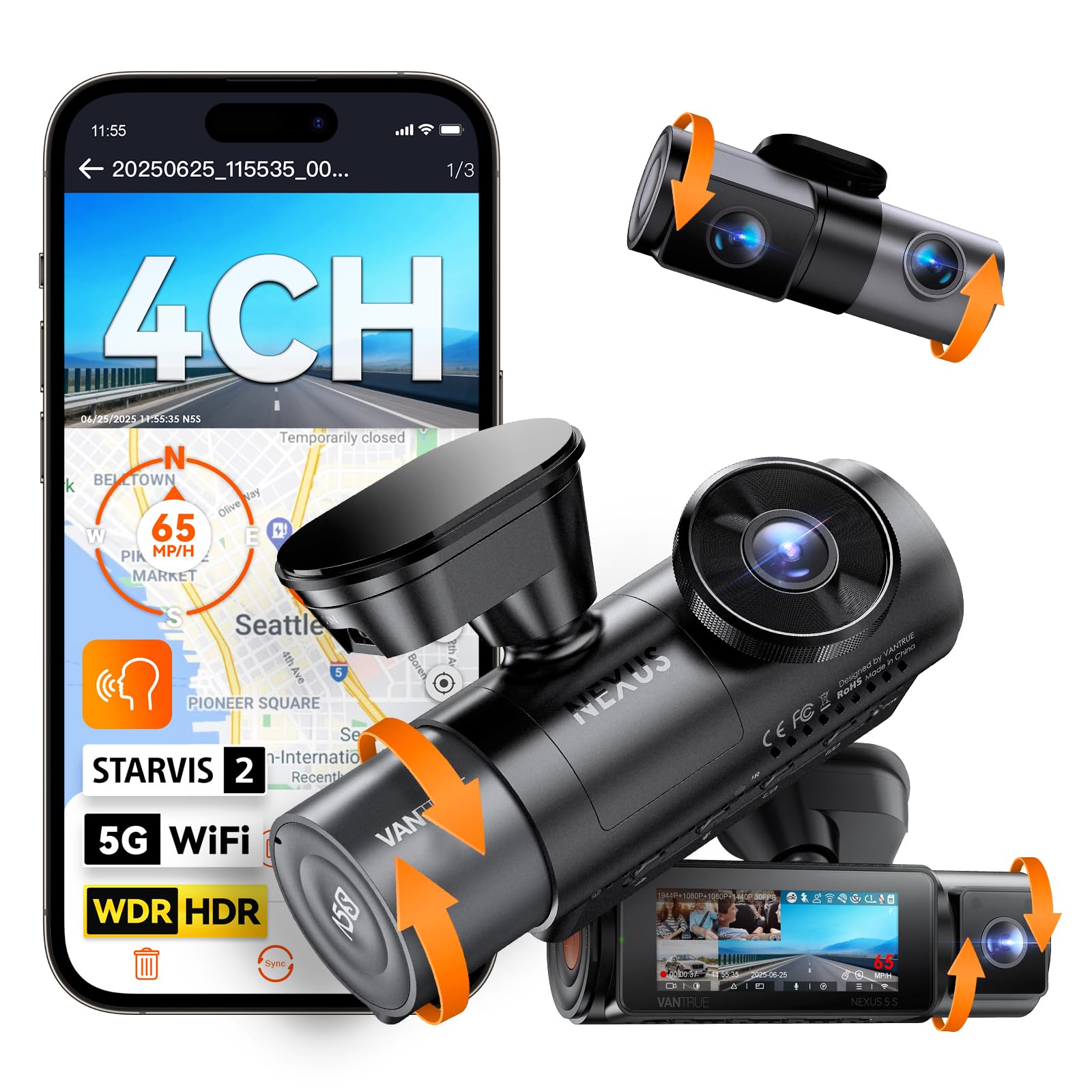
The Vantrue N5S is the most comprehensive Car Camera Security system in this roundup, delivering true 360-degree coverage through four cameras: a 2.7K front unit with STARVIS 2, a 2.5K (1440P) rear camera on the same premium IMX675 sensor, plus a front cabin and rear cabin camera (both 1080P with STARVIS 2 and infrared LEDs). This means the rear cabin camera can peer through the back window to monitor cargo or tailgating headlights while the main rear camera captures the road behind you — a level of redundancy that protects every possible angle.
The buffered parking mode is the standout feature here: the N5S constantly holds a 10-second rolling buffer in memory, so when motion or impact triggers recording, the footage from before the event is preserved. This eliminates the “wake-up delay” problem common in non-buffered systems, where the camera starts too late to catch the actual damage event. The supercapacitor power system handles -4°F to 140°F temperatures safely, which is critical for vehicles parked in direct sunlight or harsh winters, avoiding the swelling and fire risks inherent to lithium battery dash cams.
The 5GHz WiFi and dual-GPS module deliver fast 4x transfers and precise speed-and-location embedding on every video file. However, the 4-channel recording does chew through storage — Vantrue recommends their industrial-grade SD card (sold separately) for reliability, and the maximum 1TB support is a practical necessity for continuous 360-degree loop recording. The adhesive mount is secure but permanent; if you need a removable setup, the optional suction cup mount is a smart add-on.
Why it’s great
- Four STARVIS 2 sensors deliver class-leading low-light performance across every channel
- Buffered parking mode (10-second pre-recording) captures events before the trigger
- Supercapacitor rated for -4°F to 140°F ensures safe operation in extreme climates
Good to know
- 4-channel recording fills storage quickly; a large high-endurance SD card is essential
- Rear and cabin camera cables are not interchangeable with older Vantrue models
2. BOTSLAB 3K 4 Channel Dash Cam G980H
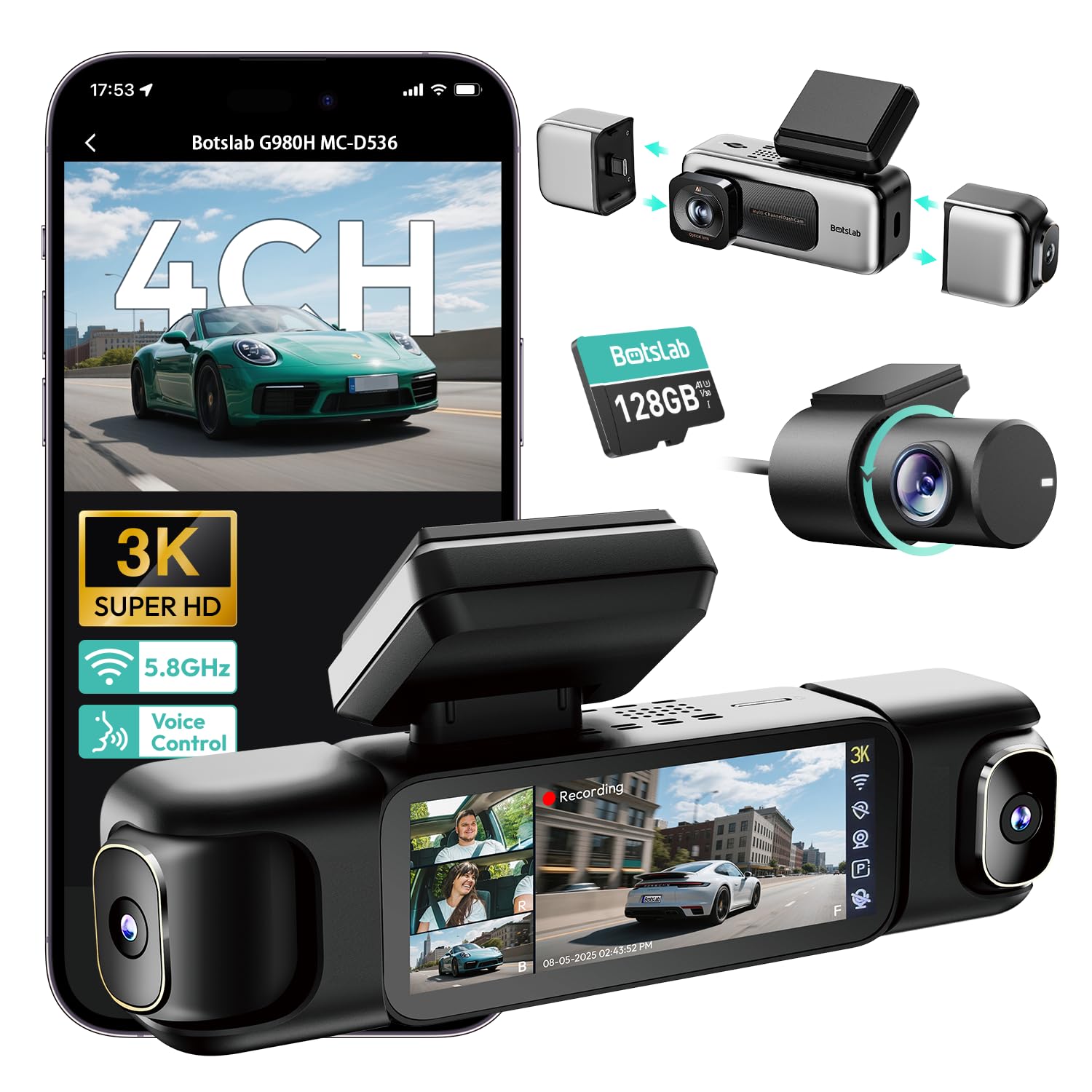
BOTSLAB’s G980H takes a unique approach to full coverage: instead of a standard four-camera layout, it uses a primary 3K front camera, a 150-degree rear camera, and two detachable magnetic side cameras that each cover 120 degrees. The side cameras can be removed and switched between 3-channel (4K + 1080P*2) or even dual-cam mode when you don’t need the full 560-degree view, making this an adaptable system for drivers who sometimes want minimal setup and other times want every angle recorded.
The 3.18-inch IPS touchscreen displays all four camera feeds simultaneously in a split-screen view, which is incredibly useful when reviewing incidents without needing to pull out your phone. Voice commands like “Start Recording” or “Take Photo” work reliably and keep your hands on the wheel. The 8-second pre-recording function activates when the G-sensor detects an impact, meaning the footage from the eight seconds leading up to the collision is saved — this is the same buffered parking logic found in more premium units.
Night quality is solid thanks to the F1.8 aperture six-layer lens and 940nm infrared LED, though it does not use Sony STARVIS sensors, so low-light plate readability is slightly below the Vantrue N5S. The free 128GB SD card is a welcome inclusion, and the supercapacitor ensures reliable performance from -20°C to 70°C. The main downside is the mandatory data-sharing requirement for the app — some users found this invasive enough to return the unit.
Why it’s great
- Magnetic detachable side cameras offer flexible channel configurations
- 8-second buffered pre-recording captures footage before impact
- Four-way split-screen playback on the 3.18-inch touchscreen
Good to know
- App requires personal data sharing, which may raise privacy concerns
- Side camera resolution is 1080P; overall detail is below STARVIS-based systems
3. 70mai 4K Dash Cam Front and Rear Inside T800E

The 70mai T800E earns its Best Overall badge by delivering premium 3-channel coverage (4K front, 1080P interior, 1080P rear) with a supercapacitor power system and WiFi 6 connectivity — all at a price that undercuts many dual-channel competitors. The interior camera features switchable infrared LEDs, so you can toggle IR on for pitch-black cabin recording (perfect for Uber or Lyft drivers who need to document passenger behavior at night) or off for natural-color daytime footage. The F1.55 aperture on the front lens collects ample light for HDR-enhanced recordings that handle tunnel transitions without blown-out highlights.
File transfer speed is where the T800E separates from the pack: WiFi 6 delivers up to 10 MB/s downloads through the 70mai app, roughly 5x faster than the 2.4GHz WiFi found in most budget dash cams. The built-in 5-mode GPS tracks location, speed, and route with embedded data directly burned into the video file — no external GPS module needed. The included 64GB SD card gets you started immediately, and the system supports up to 512GB for extended recording loops.
The adhesive mount and included pry tool make installation straightforward for beginners, but the parking mode does require the optional UP06 or UP03 hardwire kit (sold separately). The supercapacitor is rated for 14°F to 140°F, which covers most climates but falls slightly short of the -4°F lower limit on some flagship models. The voice commands respond quickly to “Start Recording” and “Lock the Video,” though the app connection occasionally requires manual reconnection after the car has been parked for extended periods.
Why it’s great
- WiFi 6 enables fast 10 MB/s video downloads over 5GHz band
- Switchable IR cabin camera provides clear interior footage in total darkness
- Supercapacitor design eliminates lithium battery swelling risks
Good to know
- No 4G connectivity option for remote live viewing
- App connection can be finicky after extended parking periods
4. Pelsee S3 Touch 4K Dash Cam Front and Rear
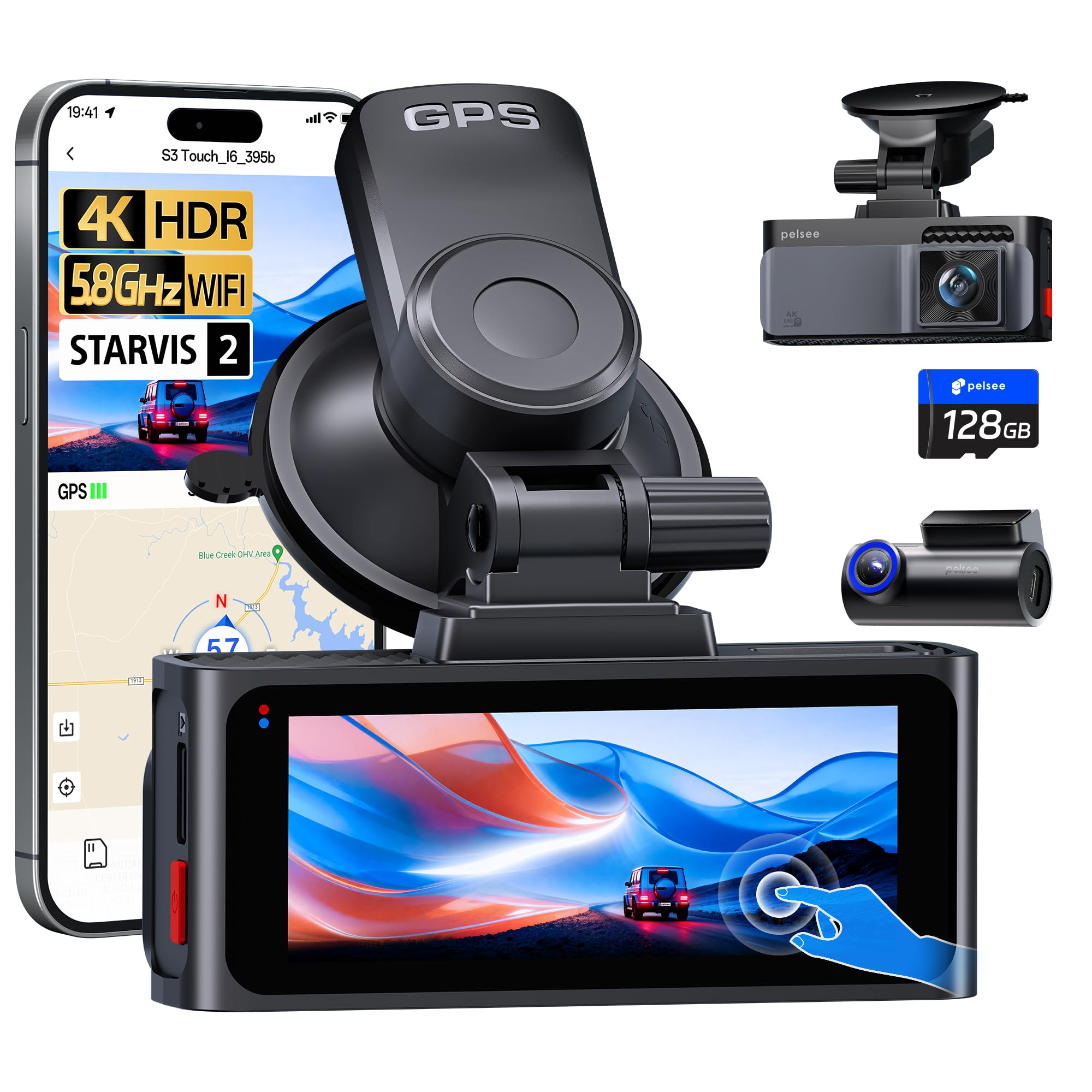
The Pelsee S3 Touch is engineered for drivers who want dazzling video quality during nighttime drives. Its STARVIS 2 sensor with STARLIT technology delivers full-color night vision without infrared — the camera captures ambient light from street lamps, headlights, and building windows to produce color video in near-darkness, where most dash cams switch to grainy black-and-white. The front 4K HDR recording adapts smoothly to rapid lighting changes, so entering a tunnel or passing under overpasses does not cause the exposure to blow out or go completely dark.
The 3.39-inch IPS touchscreen is bright and responsive, making menu navigation intuitive without requiring the app for basic functions. Hands-free voice control works with natural commands like “Lock the Video” or “Open Recording,” and the ADAS (Advanced Driver Assistance System) provides lane departure warnings and forward collision alerts — a rare convenience feature in this price tier. Wi-Fi 6 on the 5.8GHz band pushes downloads at speeds up to 30 MB/s, so extracting a 4K clip takes seconds rather than minutes.
The suction cup mount is robust enough to handle the vibrations from a HEMI V8 without dropping, according to real-world testing. The unit includes a 128GB SD card out of the box, supports expansion up to 256GB, and offers 24/7 time-lapse parking mode (hardwire kit required, ASIN B0F93QBZOT). One potential quirk: the real-time clock battery may deplete during shipping, showing the date as 2024 until the dash cam is charged for four hours. Otherwise, the STARIIT night footage speaks for itself.
Why it’s great
- STARLIT full-color night vision produces color footage in near-darkness
- ADAS provides lane departure and forward collision warnings
- WiFi 6 delivers 30 MB/s download speeds for 4K clips
Good to know
- RTC battery drain during shipping may reset clock; requires 4-hour initial charge
- Rear camera resolution is 1080P, not 4K like the front
5. TERUNSOUl 4K 3 Channel Dash Cam
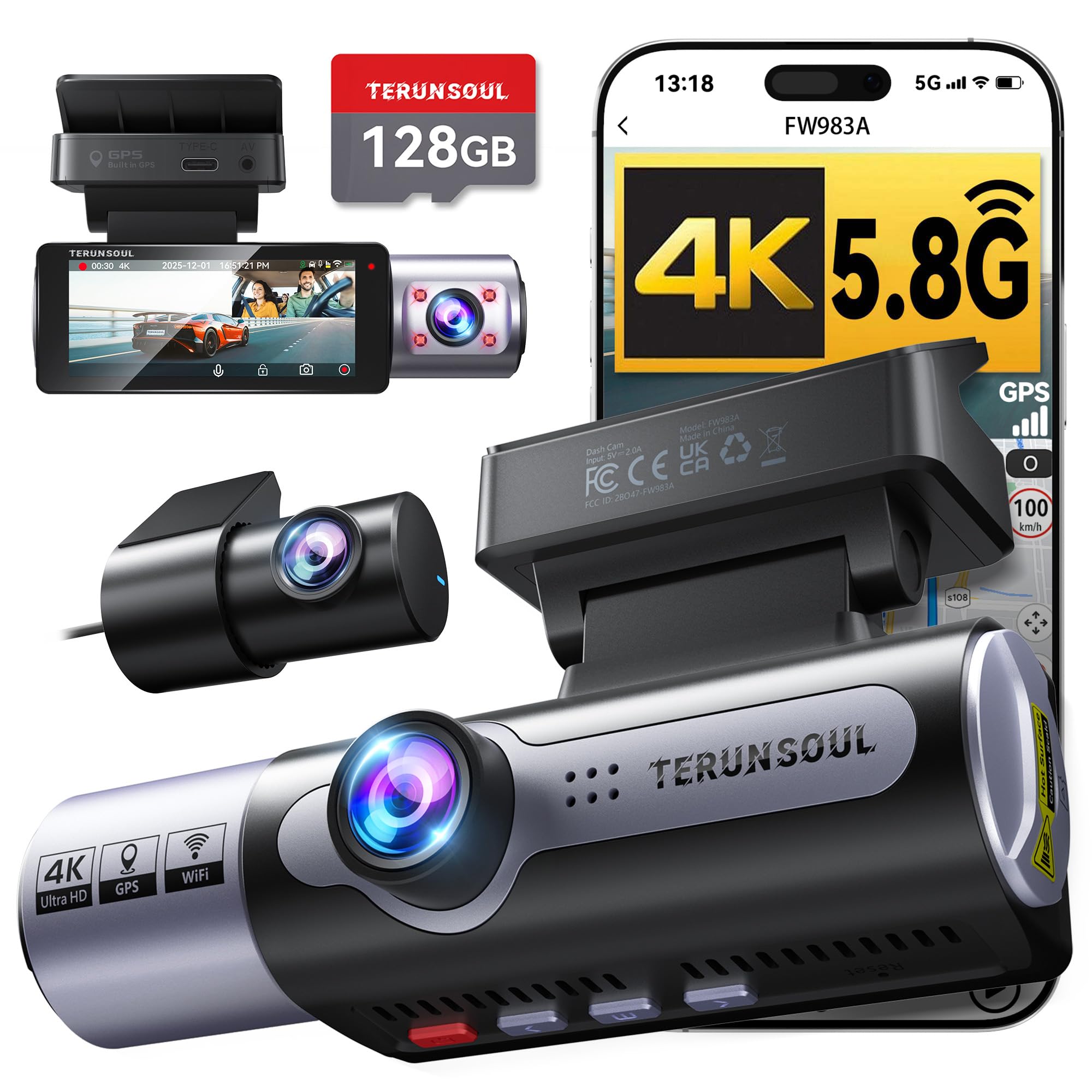
The TERUNSOUl 4K 3-channel dash cam packs an impressive feature set at a price point that undercuts most three-camera competitors. The front camera records 4K UHD (3840×2160) video through a starlight-grade five-layer lens with an F1.6 aperture, while the cabin and rear cameras each capture 1080P footage with a 165-degree wide angle. This configuration gives you near 360-degree awareness — front, rear, and cabin — without the extra cost of a dedicated side camera.
The included 128GB SD card is a meaningful bonus: many other dash cams at this price ship with a 64GB card or no card at all. The 18-month warranty and 24/7 customer support add confidence for long-term ownership. Built-in GPS records speed, route, location, and timestamp directly onto the video stream, which can be played back on the free GPS player for Windows and Mac — crucial detail for insurance claims. The 5.8GHz WiFi band enables app-based file previews and downloads at roughly 20 MB/s.
Night vision performance is good but not exceptional — the five-layer lens and F1.6 aperture capture plenty of light for urban driving, but the system lacks dedicated STARVIS 2 sensors, so rural or unlit parking lot footage shows more grain than the Pelsee S3 or Vantrue N5S. Parking mode requires a hardwire kit (ASIN B0G4LLMKG8), which is sold separately. The adhesive mount is secure, but the plastic trim around the lens feels slightly less premium than the metal-body units in the premium tier.
Why it’s great
- Includes a 128GB memory card ready out of the box
- Built-in GPS embeds speed, route, and location data on every video file
- 18-month warranty with responsive customer support
Good to know
- No STARVIS 2 sensors; nighttime plate readability is average for the class
- Parking mode hardwire kit sold separately
6. Virrow X5 4K+2.5K Dash Cam Front and Rear
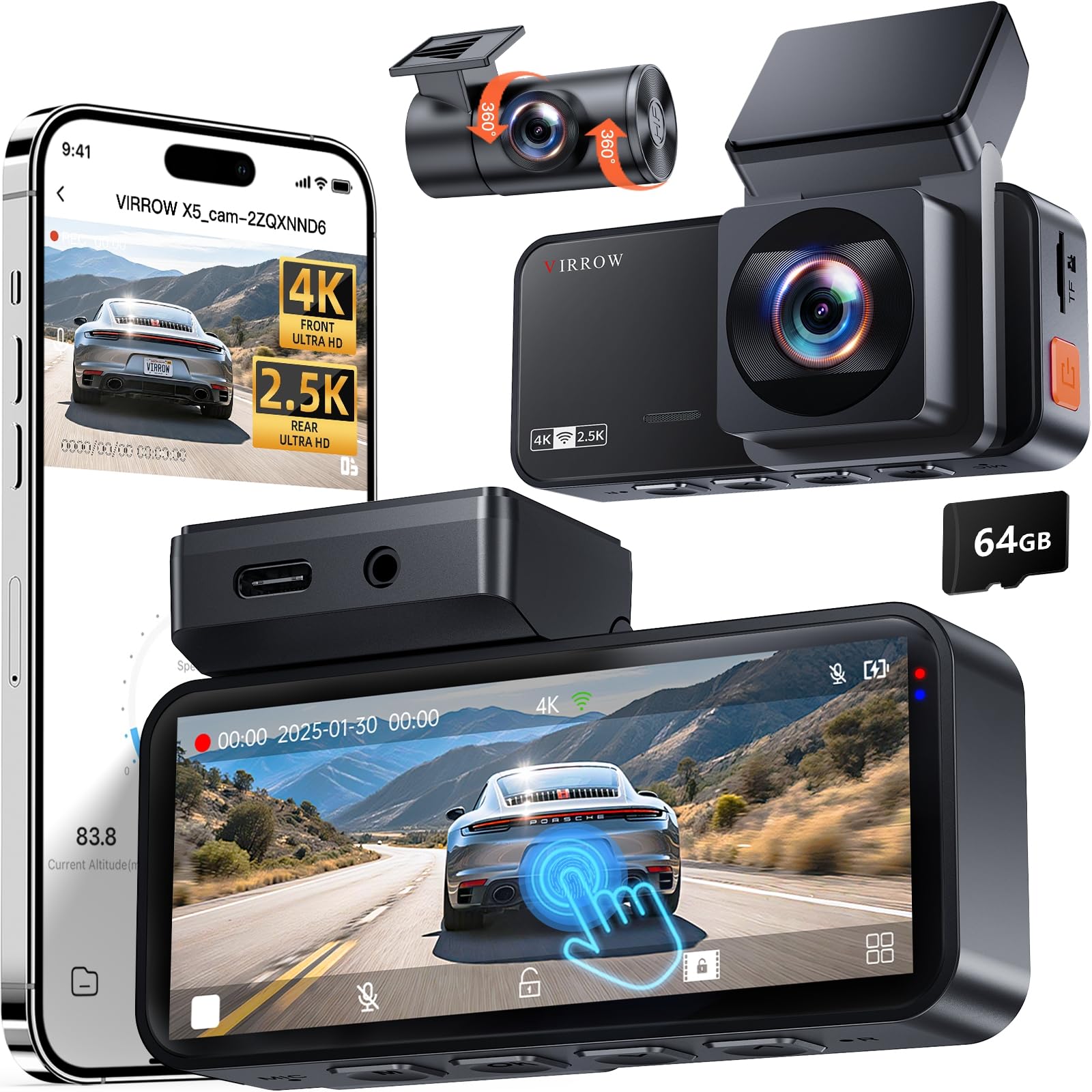
The Virrow X5 proves that you don’t need to spend premium-tier money to get exceptional front and rear resolution. The front camera captures native 4K video, while the rear camera delivers 2.5K (2560×1440) — that is 1.5x the pixel count of the typical 1080P rear camera found on most dual-channel dash cams. The 170-degree front lens and 165-degree rear lens minimize the blind spots along the sides of the vehicle, making it easier to capture side-swipe incidents.
The included 64GB memory card means the X5 is ready to record immediately after installation. The 3.39-inch touchscreen makes playback and settings adjustments straightforward without needing the app, though the WiFi connection does require manual reconnection each time you start the car (a common complaint among budget dual-band dash cams). The G-sensor collision detection automatically locks footage when an impact is detected, protecting it from being overwritten during loop recording.
Night vision relies on the SC2336 sensor and F1.8 aperture with WDR processing, which delivers clear footage on well-lit streets but struggles in completely dark parking scenarios. The adhesive mount is secure, but the included clips for the rear camera cable may be insufficient for longer vehicles, requiring extra clips purchased separately. For the price, the 4K front / 2.5K rear combo is unmatched — just be aware that the 24-hour parking mode requires a separate hardwire kit (ASIN B0F8HJPVZP).
Why it’s great
- Rear camera records in 2.5K, significantly sharper than standard 1080P rear cams
- Free 64GB SD card included for immediate use
- Touchscreen interface eliminates app dependency for basic operations
Good to know
- WiFi auto-reconnect fails; must manually reconnect to the camera each drive
- Rear camera cable clips are insufficient for larger vehicles
7. Galphi M2 3 Channel WiFi Dash Cam Front and Rear Inside
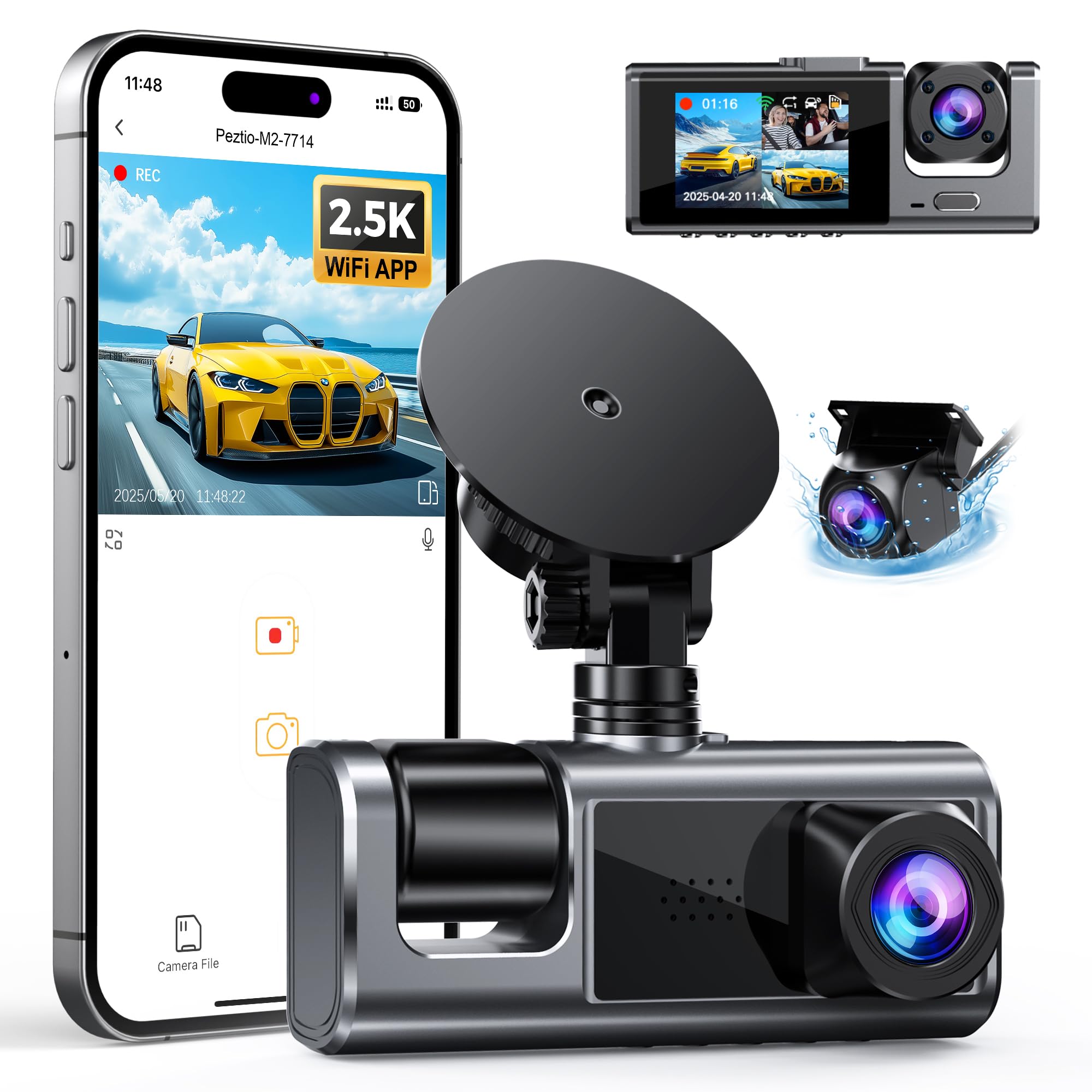
The Galphi M2 is the entry-level triple-channel dash cam that delivers surprising quality for its price point. The front camera records at 2.5K (2560×1440) using a Sony IMX sensor, while the interior and rear cameras both capture 1080P video. The interior camera features auto-IR (infrared) LEDs for cabin recording in total darkness, making it a viable budget option for rideshare drivers who need to document passenger behavior without spending premium money on the 70mai T800E.
The low-profile design is genuinely unobtrusive — the cameras tuck behind the rearview mirror area with minimal footprint, and voice notifications announce the dash cam’s status (started recording, parking mode active) without requiring you to look at the screen. The WiFi app allows live preview and video download, though the app lacks the polished interface of more established brands like 70mai or Vantrue. The SD card is not included (a note on the listing warns that rising memory chip costs forced this change), so factor in the cost of a Class 10 U3 card up to 512GB.
Heat tolerance is a notable concern: several users reported that the M2 shuts down when the interior cabin temperature reaches around 95°F, especially when parked in direct sunlight. This is likely due to the lithium polymer battery, which is less tolerant of extreme heat than the supercapacitor designs found in the 70mai T800E or BOTSLAB G980H. For drivers in cooler climates or those who will not park in direct sun for long periods, the Galphi M2 offers remarkable triple-channel value. For hot-weather regions, consider the supercapacitor alternatives.
Why it’s great
- Low-profile design with voice status notifications for hands-free operation
- Sony IMX sensor front camera produces crisp 2.5K daytime footage
- Auto-IR cabin camera enables dark interior recording for rideshare use
Good to know
- Lithium polymer battery may cause heat shutdowns in direct sun above 95°F
- SD card not included despite some listing references
FAQ
Do I really need a 4-channel dash cam or is 3 channels enough?
How important is buffered parking mode for Car Camera Security?
What SD card speed do I need for a 4K dash cam?
Final Thoughts: The Verdict
For most users, the best car camera security winner is the 70mai T800E because it balances premium 4K front coverage, an IR-switchable cabin camera for rideshare, WiFi 6 transfer speeds, and a supercapacitor for temperature safety — all at a price that undercuts many dual-channel competitors. If you need true 360-degree night coverage with buffered parking, grab the Vantrue N5S. And for a budget-friendly entry to triple-channel recording, nothing beats the Galphi M2.