
The Milky Way doesn’t wait for your autofocus to hunt. Tracking sharp pinpoints of light across a dark silicon sensor demands a lens that suppresses coma, keeps edge stars round, and pulls every photon from a moonless sky. This is the single most demanding optical task for any glass — and the difference between a keeper and a soft, smeary mess often comes down to a single f-stop or a multi-coated element.
I’m Min — the co-founder and writer behind Gadgets Feed. I’ve spent countless hours dissecting MTF charts, coma correction reports, and real-world star field samples to separate the truly exceptional from the merely overpriced in this unforgiving niche.
The right glass turns interstellar dust into art, and this guide ranks the only optics serious sky shooters should trust to deliver flawless best astrophotography lens results for deep-space and wide-field captures alike.
How To Choose The Best Astrophotography Lens
Star images magnify every optical flaw. Choosing a lens for the night sky means prioritizing coma correction, fast apertures to reduce exposure time, and smooth manual focus mechanics over general-purpose versatility. The wrong pick will leave you with bloated stars and softened corners even on the sharpest camera body.
Coma and Astigmatism Correction
Coma makes stars near the edges look like tiny comets instead of points. High-quality astro lenses use specialized glass elements — often extra-low dispersion and aspherical — to keep stars round across the entire frame. Without strong coma correction, you’ll spend hours in post-processing cleaning up the periphery of every image.
Fast Aperture vs. Focal Length
An f/1.4 lens gathers four times more light than an f/2.8, meaning shorter exposures and less star trailing. But a 135mm lens at f/2.0 produces tighter star clusters with more detail than a 14mm at the same speed. Wide-field shooters need speed; deep-space hunters need reach and resolution.
Manual Focus Reliability
Autofocus is useless in low contrast. A lens with a long-throw focus ring and hard infinity stop lets you lock in perfect focus without hunting. Many astro-specific lenses include a focus lock button or click-stop ring to prevent accidental drift during multi-minute exposure stacks.
Quick Comparison
On smaller screens, swipe sideways to see the full table.
| Model | Category | Best For | Key Spec | Amazon |
|---|---|---|---|---|
| Rokinon 135mm F2.0 | Prime | Deep-space & tight clusters | F2.0 / 9-blade diaphragm / ED element | Amazon |
| VILTROX AF 16mm F1.8 Z | Prime | Wide-field Milky Way on Nikon Z | F1.8 / 3 aspherical / 4 ED elements | Amazon |
| Samyang 135mm F1.8 | Prime | Compact deep-space telephoto | F1.8 / Linear STM / Weather-sealed | Amazon |
| Sigma 50mm F1.4 DG DN | Prime | Starscapes with context | F1.4 / HLA AF motor / Splash-resistant | Amazon |
| Sigma 18-35mm F1.8 Art | Zoom | APS-C versatility at f/1.8 | F1.8 constant / Ring USM / 18-35mm | Amazon |
| Sigma 24mm F1.4 Art DG DN | Prime | Classic wide-field astro | F1.4 / Super Multilayer Coating | Amazon |
| Sony FE 20mm F1.8 G | Prime | Ultra-wide with zero CA on stars | F1.8 / XD Linear motors / Nano AR | Amazon |
| Fujifilm XF 16mm F1.4 R WR | Prime | Fujifilm astro with WR | F1.4 / Nano-GI coating / 9 seal points | Amazon |
| Sony FE 24mm F1.4 GM | Prime | Premium wide-field low-light | F1.4 / 2 XA elements / XD motor | Amazon |
| Sigma 14-24mm F2.8 DG DN Art | Zoom | Ultra-wide flexibility at f/2.8 | F2.8 / HSM motor / Dust & splash-proof | Amazon |
| Nikon NIKKOR Z 14-24mm f/2.8 S | Zoom | Nikon Z ultra-wide flagship | f/2.8 / Nano Crystal / Weatherproof | Amazon |
In‑Depth Reviews
1. Rokinon 135mm F2.0 ED UMC Telephoto Lens
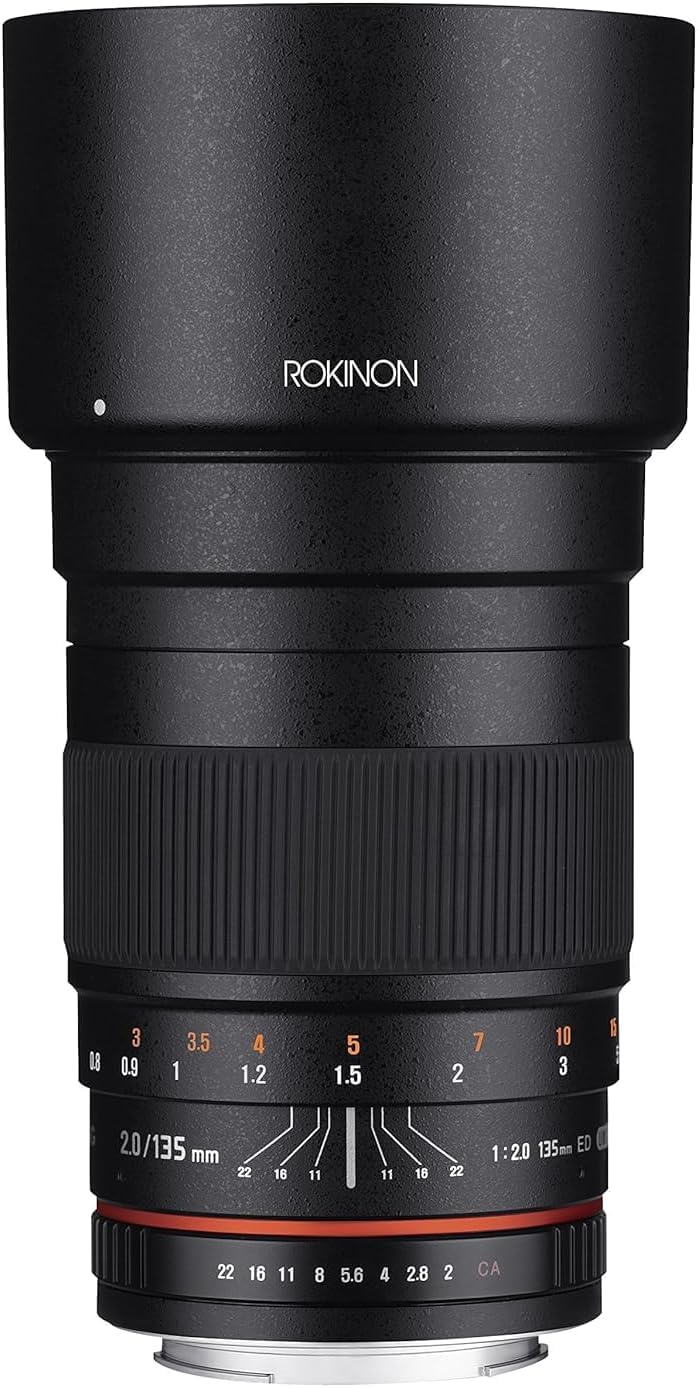
This lens has become a cult classic among deep-space imagers for a reason. The extra-low dispersion element delivers near-APO level chromatic aberration correction, keeping tight star clusters like the Pleiades pinpoint sharp even wide open at f/2.0. On a full-frame camera, the 135mm focal length resolves intricate nebula details without the weight of a telescope.
The manual focus ring includes an infinity bracket, which is essential for repeatable focus during multi-session stacking. Reviewers consistently note zero coma and astigmatism corner-to-corner when paired with dedicated astro cameras like the ASI1600MM-C. The 9-blade diaphragm creates tidy star diffraction patterns rather than messy sunstars.
Copy variation is the main headache — some units arrive decentered or with a stiff focus throw. Always test against a star field immediately after purchase. For the price, the optical performance easily outclasses canon L-series glass for this single demanding application.
Why it’s great
- Exceptional coma and CA correction across the entire frame
- Infinity focus bracket enables repeatable long-exposure stacking
- Ultra-sharp wide open at F2.0 without softening
Good to know
- Manual focus only — no autofocus capability
- Copy variation can cause decentered optics
- Lens hood feels loose on some units
2. Sony FE 20mm F1.8 G

The Sony 20mm F1.8 G strikes a rare balance between ultra-wide framing and speed. At just over half a kilogram, it is light enough to carry on hikes to dark sky locations, and the f/1.8 aperture captures the Milky Way’s core with significantly less exposure time than an f/2.8 zoom. The two XD linear motors provide fast, silent autofocus for daytime use, while the manual focus ring with linear response makes fine-tuning at night straightforward.
Optically, this lens shows virtually zero chromatic aberration even on bright stars — a direct result of the ED glass elements and Nano AR coating. Vignetting is minimal at f/1.8 and disappears by f/2.8. Astro shooters report star shapes staying round into the corners with only a hint of coma in the extreme periphery, easily corrected in post.
Some users find the aperture ring can be bumped accidentally, but the lockable switch to “A” mode prevents that. The lack of optical stabilization is irrelevant on a tripod, and the compact size means it doesn’t dominate your bag. For Sony full-frame shooters, this is the smartest entry point into dedicated wide-field astro glass.
Why it’s great
- Near-zero chromatic aberration on bright stars
- Lightweight and compact for travel to dark sites
- Fast, accurate autofocus with manual override
Good to know
- Aperture ring can be accidentally moved without lock
- No built-in image stabilization
- Minor coma in extreme corners wide open
3. Samyang 135mm F1.8 Full Frame Telephoto
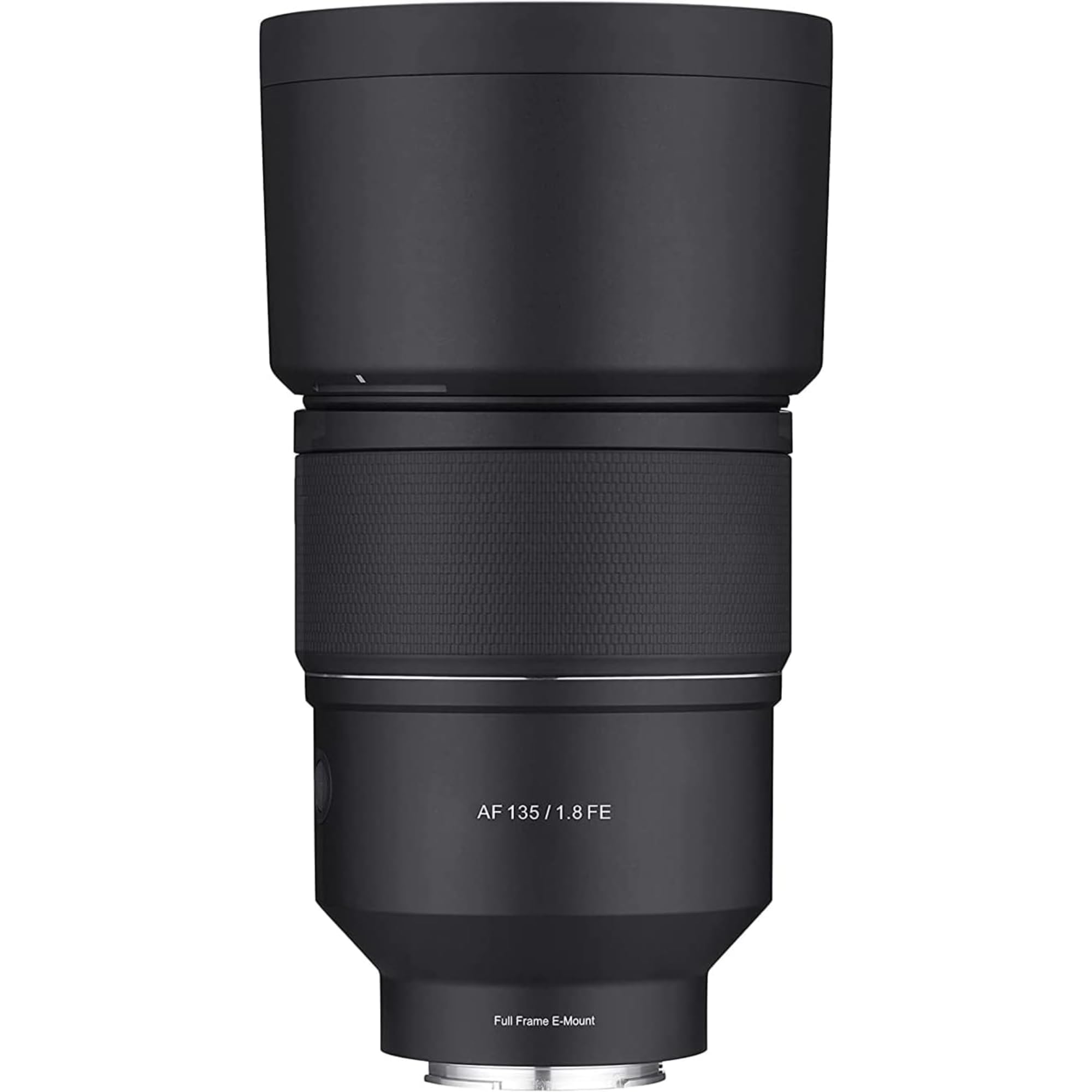
When you need to resolve the Orion Nebula with the same clarity as a telescope but without the mount, the Samyang 135mm F1.8 delivers. The linear STM motor keeps autofocus silent and smooth for video, but astrophotographers will appreciate the weather-sealed build that protects against condensation during damp night shoots. The f/1.8 aperture is a full stop faster than the classic Rokinon 135mm f/2.0, pulling in more photons from faint nebula structures.
Optical performance is stunning wide open — ultra-precision aspherical elements suppress coma and astigmatism, leaving stars crisp at the edges. The focus range limiter speeds up acquisition when switching between distant stars and closer foreground elements. Reviewers consistently rank it sharper than many Sony GM primes at a fraction of the cost.
The autofocus can occasionally hunt in very low contrast scenes, but the manual focus override is smooth and well-damped. At 772g it is heavier than some alternatives, but the combination of speed, sealing, and resolution makes it a top choice for serious deep-space enthusiasts on Sony E-mount.
Why it’s great
- F1.8 aperture gathers more light than classic F2.0 astro lenses
- Weather-sealed construction protects against night-time moisture
- Ultra-sharp wide open with minimal coma
Good to know
- Autofocus can struggle in very low-contrast scenes
- Heavier than some competing 135mm primes
- Sporadic focus search reported in extreme low light
4. Sony FE 24mm F1.4 GM

The Sony 24mm F1.4 GM represents the gold standard for wide-field astrophotography in the E-mount ecosystem. The two XA elements deliver extraordinary resolving power from center to edge, keeping the Milky Way core sharp across the entire frame even wide open. At f/1.4, exposure times can be halved compared to an f/2.0 lens, reducing star trailing and allowing more frames in a single stacking session.
The XD linear motor provides instant, silent autofocus for daytime use, while the focus hold buttons and focus range limiter make manual override fast and precise. Build quality is exceptional — the all-metal barrel feels solid in freezing temperatures, and the aperture ring clicks reassuringly. Reviewers call it the sharpest lens they own, and many have retired their 16-35mm zooms after acquiring this prime.
The price is premium, but the optical performance justifies the investment for serious astrophotographers. The 24mm focal length is wide enough for sweeping starscapes yet tight enough to show dust lanes in the galactic core. For Sony shooters who prioritize ultimate image quality, this remains the benchmark.
Why it’s great
- Incredible edge-to-edge sharpness with zero coma
- F1.4 aperture allows extremely short exposures
- Superb build quality with weather-sealing
Good to know
- Premium price point — significant investment
- 24mm may be too tight for some wide-field compositions
- No built-in stabilization (tripod-dependent)
5. Sigma 24mm F1.4 Art DG DN

The Sigma 24mm F1.4 Art DG DN brings full-frame f/1.4 performance to Sony E-mount at a price that undercuts the GM by a significant margin. The optical formula uses a Super Multilayer Coating to suppress flare and ghosting when bright moonlight enters the frame. Sharpness is exceptional at the center and very good in the mid-frame, though the extreme corners show slightly less pristine correction than the GM.
Astro-focused reviews emphasize that coma is well-controlled, making this lens a serious contender for Milky Way core shots. The HLA motor provides fast, confident autofocus in daylight, and the dust-and splash-resistant structure handles damp night conditions reliably. The aperture ring features a de-click function, useful for smooth exposure ramping during time-lapses.
Some users note noticeable barrel distortion that Lightroom profiles handle easily. The lens is larger and heavier than expected for a 24mm, but the optical quality per dollar is outstanding. For Sony shooters wanting f/1.4 speed without the GM price tag, this is the obvious choice.
Why it’s great
- Excellent coma correction for wide-field astro
- F1.4 aperture at a much lower cost than GM
- Splash-resistant structure for damp night shoots
Good to know
- Barrel distortion requires post-processing correction
- Corner sharpness not quite at GM level
- Larger and heavier than some alternatives
6. VILTROX AF 16mm F1.8 Z

The VILTROX 16mm F1.8 Z is a game-changer for Nikon Z-mount astrophotographers who need native autofocus and a fast ultra-wide. The three aspherical and four ED elements work together to suppress chromatic aberration and keep stars sharp across the frame. The built-in LCD screen displays aperture and focus distance, though several astro users report the LCD is hard to read in pitch darkness and prefer a programmed button to switch it off.
The STM stepping motor provides smooth, near-silent autofocus that supports eye and face tracking for daytime use. The click aperture ring with ON/OFF switch allows stepless changes for video while maintaining tactile control for stills. At 550g, it feels substantial on a Z8 but balances well without being front-heavy.
Some Nikon shooters note that the 16mm focal length is slightly narrower than a 14mm for the widest Milky Way sweeps, but the extra light-gathering from f/1.8 compared to f/2.8 zooms makes up for it. For Z-mount users wanting a dedicated astro prime, this is currently the best native option at a reasonable price.
Why it’s great
- Native Nikon Z mount with full autofocus
- Excellent coma and CA suppression for stars
- Click aperture ring with de-click for video
Good to know
- LCD screen not ideal for dark nighttime use
- 16mm slightly less wide than 14mm alternatives
- No image stabilization
7. Sigma 18-35mm F1.8 Art DC HSM

APS-C shooters rarely get a constant f/1.8 zoom, but the Sigma 18-35mm F1.8 Art delivers exactly that — effectively a prime-level aperture across a useful focal range. On a Nikon D7100 or D7200, this lens produces razor-sharp stars at the wide end with minimal chromatic aberration visible even at 100% crop. The constant f/1.8 aperture is like having three primes in one barrel, allowing flexible framing of the Milky Way without changing lenses in the dark.
The ring-type ultrasonic motor provides fast, near-silent autofocus, though most astro work will be manual. The focus ring is smooth and well-damped, with enough resistance for precise adjustments. Build quality is heavy but solid — the all-metal barrel feels reliable in cold conditions.
The main trade-off is the restricted zoom range (18-35mm) and the notable weight. Some copies may require AF fine-tune calibration for perfect daylight sharpness. For Nikon APS-C users seeking latitude in composition without sacrificing aperture, this zoom is unmatched.
Why it’s great
- Constant F1.8 aperture across entire zoom range
- Razor sharp with minimal CA on APS-C sensors
- Versatile framing without swapping lenses
Good to know
- Heavy for its size — requires a sturdy tripod
- Limited 18-35mm focal range
- Some copies need AF fine-tune calibration
8. Fujifilm XF 16mm F1.4 R WR
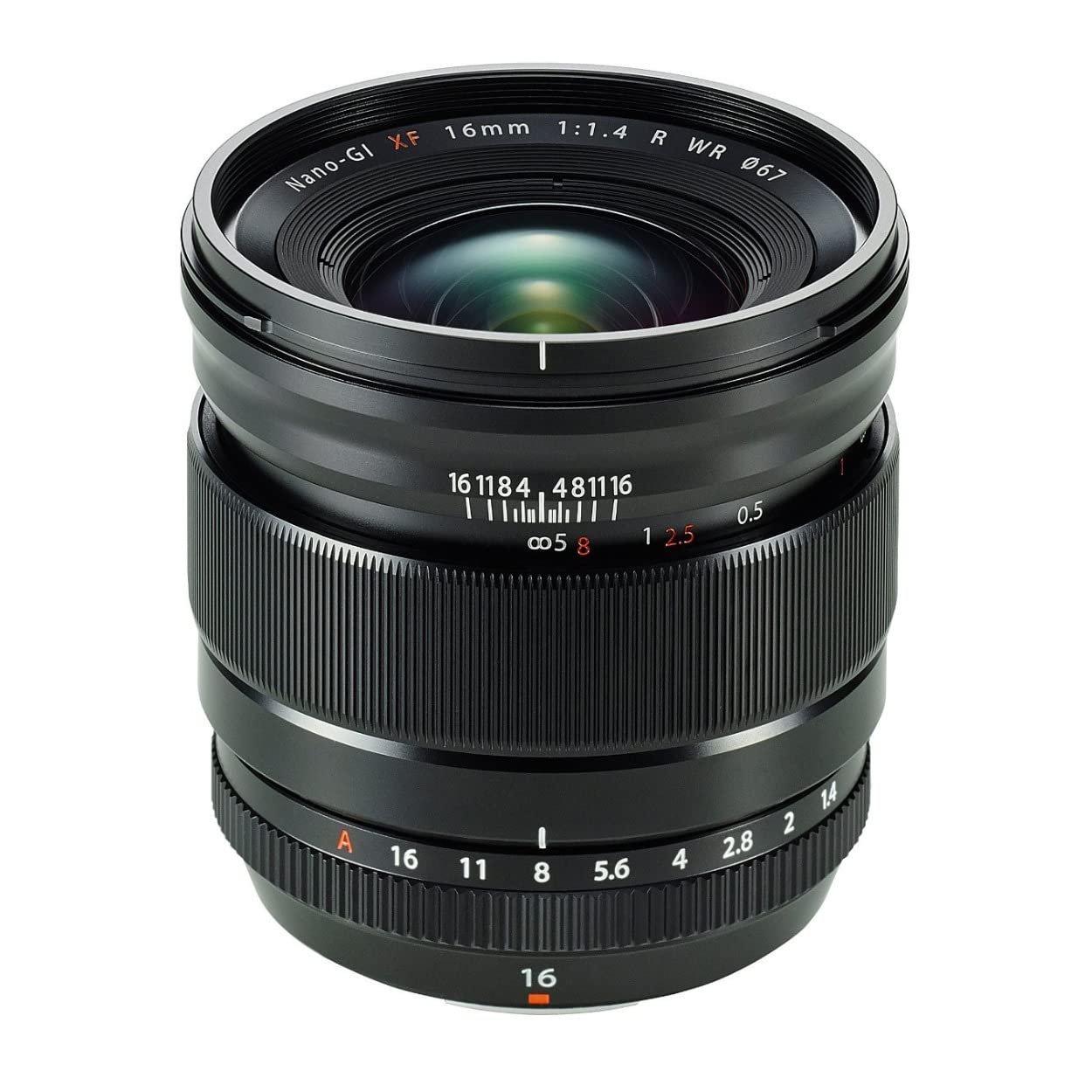
Fujifilm X-series shooters get a dedicated astro weapon in the XF 16mm F1.4 R WR. The 24mm full-frame equivalent is the classic Milky Way focal length, and the f/1.4 aperture pulls in enough light for clean 10-second exposures at ISO 3200. The Nano-GI coating effectively suppresses ghosting when bright stars or moonlight hit the front element, and the weather-resistant design with nine sealing points protects against dew during long overnight sessions.
Sharpness is excellent wide open at f/1.4 and becomes stunning by f/2.8. The clutch-style focus ring allows quick snap between autofocus and manual, and the hard stop past infinity helps consistent focus. The minimum focusing distance of under 6 inches also makes this useful for foreground astro compositions with rocks or trees.
Autofocus is slightly slower than the f/2 Fuji primes, but for astro work that is irrelevant. The 375g weight makes it a joy to carry on long hikes to dark sky locations. For Fuji users, this lens remains the gold standard for night sky imaging.
Why it’s great
- Excellent sharpness at F1.4 with creamy bokeh
- Weather-resistant with 9 sealing points
- Close focus for creative foreground compositions
Good to know
- Autofocus slower than XF F2 primes
- Slightly large and heavy for Fuji system
- Focus noise present but not intrusive
9. Sigma 50mm F1.4 DG DN Art

The 50mm focal length sits in a unique sweet spot between wide-field sweeps and deep-space detail, and Sigma’s new DG DN Art version brings exceptional optical quality for Sony E-mount. The HLA motor delivers fast, precise autofocus for daytime use, while the f/1.4 aperture allows short 6-second exposures at ISO 6400 that reveal the Milky Way core with context. The dust- and splash-resistant structure handles variable night conditions well.
Optically, this lens shows noticeable barrel distortion that Lightroom profiles correct cleanly. Chromatic aberration is well-controlled wide open and virtually gone by f/2.0. Star shapes remain round in the center with some astigmatism in the extreme corners, but not enough to ruin a stacked composition. The bokeh is smooth and natural for foreground elements.
The 50mm F1.4 DG DN is heavier and larger than some expected, but the optical performance punches near the Sony GM 50mm at a lower cost. For astrophotographers wanting a normal prime that also excels for portraits and landscapes, this is the best all-around choice.
Why it’s great
- Fast and accurate HLA autofocus motor
- Excellent low-light performance at F1.4
- Near-GM optical quality at a better price
Good to know
- Barrel distortion visible in raw files
- Heavier and larger than some competitors
- Minor astigmatism in extreme corners at wide apertures
10. Sigma 14-24mm F2.8 DG DN Art

The Sigma 14-24mm F2.8 DG DN Art is the ultimate ultra-wide zoom for Sony full-frame shooters who need flexibility in framing the night sky. At 14mm, the Milky Way arch can be captured in a single frame with dramatic distortion that adds energy. The f/2.8 aperture is a stop slower than fast primes, but the ability to zoom to 24mm for tighter compositions without changing lenses is invaluable during a dark night.
Sharpness is excellent at f/2.8 in the center, with good edge performance that becomes very sharp by f/5.6. The dust- and splash-proof construction is reassuring for dewy nights. The main limitation for astrophotography is the bulbous front element that prevents standard screw-on filters and makes rear filter use mandatory for light pollution reduction.
Some users note purple flaring in direct sunlight, but at night this is rarely a problem. For real estate shooters who also want astro capability, this lens does double duty admirably. The value proposition is strong — you get three ultra-wide primes in one barrel.
Why it’s great
- 14mm ultra-wide captures entire Milky Way arch
- Zoom versatility without lens changes in the dark
- Strong build quality with environmental sealing
Good to know
- Bulbous front element blocks screw-on filters
- F2.8 gathers less light than F1.4 primes
- Some purple flare reported in bright conditions
11. Nikon NIKKOR Z 14-24mm f/2.8 S

Nikon’s Z 14-24mm f/2.8 S sets a new benchmark for ultra-wide zoom performance on mirrorless cameras. The Nano Crystal Coating effectively eliminates internal reflections and flare, keeping star fields clean even with bright moonlight in the frame. The constant f/2.8 aperture provides solid low light performance, and the optical formula delivers corner-to-corner sharpness that rivals primes.
The lens accepts rear gel filters through a proprietary drop-in system, enabling light pollution filters without sacrificing image quality. The weatherproof build includes a filter ring hood and two caps that protect the delicate front element. At 650g, it is lighter than the F-mount predecessor and balances well on Z6, Z7, and Z8 bodies.
The price is the highest in this guide, but for Nikon Z users who demand the absolute best wide-angle optics for both day and night, this is the ultimate choice. The combination of 14mm ultra-wide coverage, f/2.8 speed, and flawless optical correction makes it a once-in-a-decade lens purchase.
Why it’s great
- Exceptional corner-to-corner sharpness across zoom range
- Nano Crystal Coating eliminates flare from bright stars
- Lightweight compared to previous F-mount version
Good to know
- Highest price in this guide
- Requires proprietary drop-in filter system
- Heavy for casual carry compared to prime alternatives
FAQ
What is the best aperture for astrophotography lenses?
Do I need a lens with manual aperture control for night sky photography?
Is image stabilization important for astrophotography lenses?
Final Thoughts: The Verdict
For most users, the best astrophotography lens winner is the Rokinon 135mm F2.0 because it delivers near-APO correction, sharp stars at f/2.0, and reliable infinity focus at a price that leaves budget for a tracker mount. If you want ultra-wide Milky Way sweeps with autofocus, grab the Sony FE 20mm F1.8 G. And for Nikon Z shooters needing the best native wide-angle zoom, nothing beats the Nikon NIKKOR Z 14-24mm f/2.8 S.