
Our readers keep the lights on and my morning glass full of iced black tea. As an Amazon Associate, I earn from qualifying purchases.
A transparent bottle or a polished-metal bracket — you position your 3D scanner, hit capture, and the tracking bar freezes. The software loses alignment because light bounces instead of diffusing. That frozen moment costs you minutes in rework, calibration, and frustration. A proper anti-reflective coating sprayed directly onto the surface eliminates this failure mode entirely, turning any object into a scannable matte target with micron-level detail preservation.
I’m Min — the co-founder and writer behind Gadgets Feed. I’ve analyzed technical user feedback, coating thickness data, and evaporation times across multiple formulations of sublimation-grade scanning aerosols to isolate the ones that actually improve scan quality without introducing residue nightmares.
Whether you scan automotive parts, heritage artifacts, or injection-molded prototypes, the right aerosol can mean the difference between a usable mesh and a corrupted point cloud. This guide ranks the best 3d scanning spray options for accuracy, cleanup effort, and surface compatibility based on real user experiences and measured spec data.
How To Choose The Best 3D Scanning Spray
Not all aerosols marketed for 3D scanning perform the same. Three variables define the gap between a successful scan and a cleanup nightmare: whether the coating requires physical removal, the average particle size it deposits, and its chemical safety on the substrate you are scanning.
Self-Evaporating vs. Semi-Permanent Coatings
A self-evaporating formula sublimates completely within three to four hours, leaving zero residue. This is ideal for heritage objects or finished parts where abrasion is unacceptable. Semi-permanent coatings leave a thin film that must be wiped or washed off — they last longer on the surface, giving you more scanning time, but demand thorough removal from crevices. Match the cleanup method to your object’s sensitivity.
Coating Thickness and Particle Size
Thicker coatings, around 15 to 25 microns, hide surface texture; ultra-thin layers at 4.5 to 8 microns preserve embossed lettering, tool marks, and grain. Look for sprays that advertise a measured micron thickness rather than vague “thin” claims. Verified particle size below 10 microns indicates the spray will not obscure fine features.
Chemical Composition and Substrate Safety
Titanium dioxide nanoparticles are still used in budget sprays, but they can embed into porous surfaces and cause long-term whitening. Modern formulations avoid TiO2, using water-soluble or fully sublimating carrier solvents that are skin-friendly and odorless. Always test on an inconspicuous area before applying to irreplaceable items — solvents in any aerosol can mar polished or painted finishes.
Quick Comparison
On smaller screens, swipe sideways to see the full table.
| Model | Category | Best For | Key Spec | Amazon |
|---|---|---|---|---|
| AESUB White ScanSpray 400ml | Mid-Range | Repeated scanning practice on large objects | TiO2-free permanent coating, 12.8 oz can | Amazon |
| Revopoint Semi-Permanent AB-P 500ml | Mid-Range | Reverse engineering polished tools | 4.5 µm ultra-thin coating | Amazon |
| HXOGYUB Professional 500ML | Mid-Range | Large batch scanning of multiple parts | 500ml covers up to 15 sq ft | Amazon |
| Revopoint Self-Evaporating Blue 400ml | Premium | Objects that cannot be touched or cleaned | Self-evaporates in 4 hours, 8-15 µm | Amazon |
| AESUB Blue 400ml | Premium | Maximum surface detail on small parts | Ultra-thin, pigment-free, self-evaporating | Amazon |
In‑Depth Reviews
1. Revopoint Semi-Permanent AB-P 500ml
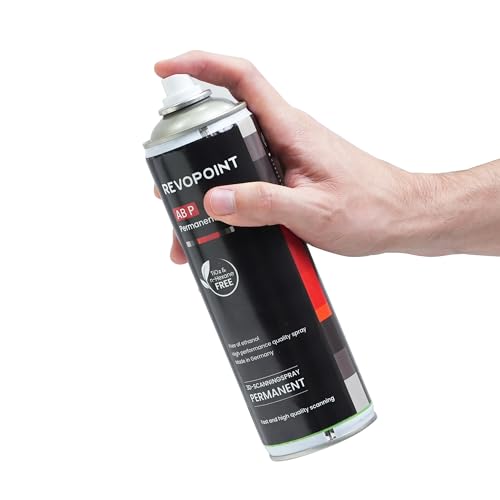
Revopoint’s AB-P formulation hits a 4.5-micron target thickness, which is among the thinnest semi-permanent coatings available. At that layer depth, the spray suppresses glare from polished steel and transparent acrylic without rounding off sharp edges or filling engraved text — a critical advantage for reverse engineering projects that demand dimensional fidelity. The 500ml canister covers roughly 15 square feet, making it a solid mid-range choice for users who scan multiple medium-sized parts per session.
Users report that the powder wipes off easily from non-porous surfaces like automotive paint and injection-molded plastic, though crevices may require a brush or compressed air. The solvent base carries a noticeable chemical odor, so outdoor or well-ventilated use is mandatory. Several engineers mention using it successfully with Revopoint Metro Y Pro and Einscan scanners, noting that the coating holds up during long capture sequences without flaking.
The semi-permanent nature gives you flexibility — you can scan, adjust lighting, rescan, and still wipe clean at the end. Compared to cheaper alternatives, the AB-P leaves less residue and does not contain titanium dioxide nanoparticles that can stubbornly bind to porous surfaces. It is a strong contender for anyone needing repeatable anti-reflection coverage without the premium price of self-evaporating sprays.
Why it’s great
- Ultra-thin 4.5-micron coating preserves surface detail
- Large 500ml can covers many scanning sessions
- Wipes off clean from painted, metal, and plastic surfaces
Good to know
- Contains solvents — requires test patch before full application
- Not self-evaporating; requires active cleanup from crevices
2. AESUB Blue 400ml

AESUB Blue stands apart because its entire coating sublimates within minutes to a few hours — no wiping, no washing, no residue. The spray deposits a pigment-free micro-layer that is significantly thinner than most semi-permanent alternatives, ensuring that even delicate surface features like knurling, embossing, and wear patterns survive the scan without being filled or obscured. For heritage documentation or scanning objects that cannot withstand abrasion, this is the defining advantage.
Multiple users note that the vanishing window is short: you have about 20 to 30 minutes before the coating fully disappears, which demands efficient scanning workflow. The aerosol particles are fine enough to create an even matte finish without pooling, even on complex geometries. One reviewer reported using it as a replacement for the messy baby-powder-and-alcohol method, citing drastically less airborne dust and faster overall setup.
The main trade-off is cost — per-milliliter, AESUB Blue is more expensive than semi-permanent sprays. Additionally, a small number of users reported residual white haze on porous models after several weeks, so a compatibility test is essential on unfinished wood or unsealed stone. For cleanroom environments or fragile objects, this spray justifies its premium position through complete elimination of post-scan cleanup.
Why it’s great
- Self-evaporates completely — zero physical cleanup needed
- Ultra-thin, pigment-free coating preserves micron-level detail
- Developed and approved by scanning experts for professional use
Good to know
- Short evaporation window requires fast scanning workflow
- May leave residue on porous surfaces without testing
3. AESUB White ScanSpray 400ml
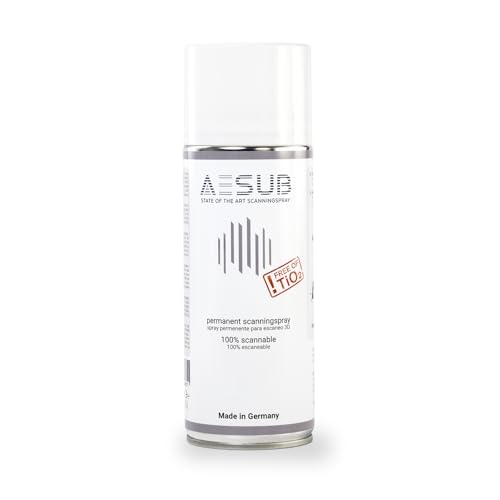
The AESUB White variant provides a permanent coating free of titanium dioxide nanoparticles — an important distinction for users concerned about chemical bonding with sensitive substrates. Unlike self-evaporating sprays, this layer stays on the object until physically removed, making it ideal for scanning sessions that stretch across multiple hours or require re-scanning after repositioning. The 400ml canister can coat an entire car bumper or two large engine components, giving you substantial coverage per can.
Scanning practitioners specifically praise this product for its ability to stabilize tracking on reflective or dark surfaces. Users who previously relied on baby powder or aerosol deodorants report that AESUB White delivers a more consistent matte finish with fewer hot spots. The coating applies as a thin, homogenous layer that does not bridge small gaps or obscure fine textures like brushed metal grain.
Cleanup involves wiping with a dry cloth or mild solvent, and the spray removes cleanly from hard, non-porous surfaces. The main disadvantage is that this spray must be actively cleaned off — unlike the blue AESUB variant, it does not disappear on its own. For users scanning the same object repeatedly, the permanent nature is actually a benefit, but for one-off captures of irreplaceable items, the cleanup requirement adds a layer of risk.
Why it’s great
- No titanium dioxide nanoparticles — safer for long-term application
- Covers large surfaces like entire car panels in one can
- Thin, homogenous coating prevents detail loss and tracking breaks
Good to know
- Requires active wiping for removal; not self-evaporating
- Some users compare performance to cheaper foot spray alternatives
4. Revopoint Self-Evaporating Blue 400ml

Revopoint’s Blue self-evaporating spray targets the same use case as AESUB Blue — zero-cleanup scanning — but with a slightly thicker coating range of 8 to 15 microns. The formula is specially designed for Revopoint’s own scanner lineup, particularly the Metro Y Pro, but works across all structured-light and laser scanners. The 400ml can lasts through several moderate-sized scanning projects and disappears entirely within four hours, leaving no residue behind.
Users highlight its effectiveness on shiny black surfaces and polished metal components that normally trigger tracking loss. The coating settles as a uniform matte layer without pooling in recesses or leaving streaks. Because the spray self-evaporates, you can scan a part and simply let it vanish — no need to disassemble, scrub, or risk scratching the original surface. This is a major time saver in production environments where multiple parts are scanned consecutively.
The primary downside is that the faster drying time reduces your window for repositioning or lighting adjustments. At room temperature, the coating may begin fading after 45 minutes, so scanning should begin immediately after application. Some users reported that the spray is toxic if inhaled — adequate ventilation is mandatory. For scanning jobs where object integrity is paramount and cleanup must be zero, this product delivers a reliable semi-premium option.
Why it’s great
- Self-evaporating — no manual cleanup at all
- Works on porous and non-porous surfaces including textiles and wood
- Specifically optimized for Revopoint scanner performance
Good to know
- Coating thickness of 8-15 µm is thicker than some competitors
- Fumes require outdoor or high-ventilation use
5. HXOGYUB Professional 500ML

HXOGYUB offers the largest canister in this roundup at 500ml, claiming coverage up to 15 square feet per bottle. The spray is marketed as odorless and skin-friendly, using a water-soluble carrier that makes cleanup relatively straightforward compared to solvent-based alternatives. For hobbyists or small workshops that scan a steady volume of parts, this entry-level pricing keeps the consumable cost low without forcing a switch to messy DIY solutions like foot spray or hairspray.
Customer feedback highlights that the spray applies evenly and creates an effective matte finish on glass, stainless steel, and transparent plastic. One user noted that a pressure washer was the most effective tool for removing the residue from porous or heavily creviced objects, while smooth surfaces cleaned easily with water and a cloth. The finish does not contain titanium dioxide, reducing the risk of permanent whitening on porous materials.
However, a vocal minority reported significant cleanup difficulties. In one case, the powder turned into a slurry when wet, smearing across the object and requiring hours of scrubbing. This suggests that the residue is less forgiving than mid-range sprays when left on for extended periods or when applied too thickly. For users who scan frequently and can afford slightly more per can, the AESUB White offers better consistency. For budget-conscious users who clean immediately, HXOGYUB covers the basics at a fraction of the cost.
Why it’s great
- Large 500ml can provides extensive coverage per dollar
- Odorless and water-soluble for easy cleanup on smooth surfaces
- Effectively coats transparent and reflective surfaces for reliable scanning
Good to know
- Residue can become stubborn slurry on porous or complex parts
- Performance consistency varies between batches, some users report mixed results
FAQ
Can I use foot spray or dry shampoo instead of dedicated 3D scanning spray?
Will 3D scanning spray damage my painted or polished object?
How long does a self-evaporating scanning spray last on the object?
Can I reuse a scanning spray can after the initial application?
Final Thoughts: The Verdict
For most users, the best 3d scanning spray winner is the Revopoint Semi-Permanent AB-P because its 4.5-micron coating preserves surface detail while providing a generous scanning window and straightforward cleanup. If you need zero-touch scanning for fragile objects, grab the AESUB Blue for its pigment-free, self-evaporating formula. And for high-volume scanning on a budget, nothing beats the value of the HXOGYUB Professional 500ML.