
Our readers keep the lights on and my morning glass full of iced black tea. As an Amazon Associate, I earn from qualifying purchases.
Selecting the wrong coaxial cable for your radio setup is the single fastest way to eat transmit power before it ever reaches the antenna. A mismatched impedance line—most commonly a 75-ohm cable meant for cable TV—introduces a standing wave ratio penalty that can drop your effective radiated power by 20 percent or more, turning a clean 50-watt signal into something your contact on the other end struggles to copy. The difference between a properly terminated 50-ohm path and a compromised one shows up immediately on your SWR meter and in the readability of every exchange.
I’m Min — the co-founder and writer behind Gadgets Feed. I’ve spent hundreds of hours dissecting the construction standards, shielding designs, and real-world insertion-loss figures of RF transmission line products so you can match the right coax to your frequency band and installation scenario without guesswork.
Whether you’re extending a base station feed line, building a mobile antenna jumper, or replacing a compromised patch cable inside a fixed installation, choosing the right 50 ohm coax comes down to understanding conductor gauge, shielding topology, and connector quality relative to the frequencies you actually use.
How To Choose The Best 50 Ohm Coax
A 50-ohm coaxial cable is not a generic commodity—the internal construction determines how much of your transmitter’s power reaches the antenna. The three variables that define performance are cable type (which governs conductor gauge and dielectric diameter), shielding method (foil plus braid versus single braid), and connector attachment quality (crimp versus clamp with adhesive heat shrink). Ignoring any of these three can turn a perfectly good radio installation into a lossy nightmare.
Map Cable Type to Your Frequency Range
RG58 is a thin, flexible cable that works acceptably on HF bands below 30 MHz, but its loss at 450 MHz is around 6 dB per 100 feet—meaning half your power disappears in the first 50 feet. RG8X improves the center conductor to 16 or 17 AWG and adds a second shield layer, cutting VHF/UHF loss roughly in half compared to RG58. LMR‑400 and its equivalents (KMR‑400) use a larger 0.405‑inch foam dielectric with a copper-clad aluminum center conductor, delivering roughly 60 percent less loss than RG58 at Wi‑Fi and 70‑centimeter frequencies. Choose RG8X for short VHF/UHF patch cables under 25 feet; choose LMR‑400 class cable for long base-station runs or any UHF installation where every decibel counts.
Check Connector Integrity Before Buying
A PL‑259 connector that is merely crimped onto the cable jacket without a soldered center pin often fails after repeated thermal cycling or physical stress. The best pre‑made cables use a clamp‑style connector that mechanically grips the braid and jacket, plus a soldered center conductor. Look for an adhesive‑lined heat shrink tube that extends at least two inches past the connector body—this seals moisture out and prevents the connector from pulling loose during installation. Cables marketed with “heat shrink tube length 1.1 inches” are cheaper to manufacture but leave part of the connector‑cable junction exposed to the elements.
Consider the Shielding Architecture
Single‑braid shielding is adequate for indoor jumper cables where RF noise is low. Double‑shielded cables (foil plus tinned copper braid) provide 100 percent coverage and are essential for outdoor runs near power lines, automotive ignition systems, or other transmitters. The foil layer blocks high‑frequency noise while the braid handles low‑frequency magnetic interference. A 100 percent foil shield with a minimum 85 percent braid coverage is the specification to look for in any cable that will be permanently installed between a radio and an external antenna.
Quick Comparison
On smaller screens, swipe sideways to see the full table.
| Model | Category | Best For | Key Spec | Amazon |
|---|---|---|---|---|
| MOOKEERF KMR400 25ft | KMR‑400 | Base station feed line | <0.85 dB loss at 450 MHz | Amazon |
| XRDS KMR400 50ft | KMR‑400 | Long outdoor runs | VSWR <1.35, 2.2″ heat shrink | Amazon |
| MPD Digital LMR400 3ft | LMR‑400 | Ultra‑low loss jumper | –40 dB SRL, soldered center pin | Amazon |
| XRDS KMR400 12ft | KMR‑400 | Meter extensions | Clamp connector, 20‑year jacket | Amazon |
| G‑PLUG RG8X 15ft | RG8X | VHF/UHF short runs | Gold‑plated pin, double shield | Amazon |
| exgoofit RG8X 50ft | RG8X | Mobile CB installations | 16 AWG 19‑strand conductor | Amazon |
| MOOKEERF RG58 10ft | RG58 | HF patch cables | 0.96 dB loss at 450 MHz | Amazon |
In‑Depth Reviews
1. MOOKEERF PL259 UHF Cable 25ft (KMR400)

The MOOKEERF KMR400 delivers LMR‑400‑equivalent performance at a mid‑range price point, making it the strongest value for base station owners who need a 25‑foot run without paying premium cable vendor prices. The loss at 450 MHz is spec’d at under 0.85 dB for the full 25 feet, meaning 80 watts of UHF power arrives at the antenna as roughly 66 watts—a 1.5 dB penalty that is invisible to most receivers. The copper‑clad aluminum center conductor and foil‑plus‑tinned‑copper‑braid double shield keep noise out and signal in.
Build quality stands out in the details. The clamp‑style PL‑259 connectors are far more secure than crimp‑type attachments, and the 2.2‑inch adhesive‑lined heat shrink tube seals the junction completely against moisture infiltration. Users report flat 1.0:1 SWR on 20‑meter and 40‑meter bands when used as a jumper between a transceiver and an antenna tuner. The outer PVC jacket is UV‑rated and remains flexible enough for routing through a window pass‑through panel.
At 25 feet this cable occupies a sweet spot—long enough to reach from a desk to a roof‑mounted antenna, yet short enough that the insertion loss of a KMR‑400 line is negligible on HF and very manageable on 2‑meter and 70‑centimeter bands. It is stiff, as any 0.405‑inch coax is, so do not plan on using it with a rotator or in any installation that requires repeated flexing.
Why it’s great
- Low loss of 0.85 dB at 450 MHz for a 25‑ft run
- Clamp‑style PL‑259 with 2.2‑inch adhesive heat shrink
- Double‑shielded foil and tinned copper braid
Good to know
- Stiff cable unsuitable for mobile or rotator use
- Requires SO‑239 adapter for some equipment
2. XRDS -RF KMR 400 UHF Coax Cable 50ft

The XRDS KMR400 50‑foot cable is built for the serious base station operator who needs to run coax from a second‑story shack down to a ground‑mounted vertical or a far corner of the yard. Swept with a network analyzer during manufacturing, each cable is certified to have a VSWR under 1.35:1 across the entire operating bandwidth—a guarantee you do not get from generic spool‑and‑connector jobs. The 0.26‑dB loss figure quoted for the 3‑foot version at 500 MHz scales linearly, so the 50‑foot run lands at roughly 4.3 dB of loss on 70 centimeters, which is still better than what an RG58 cable would deliver at 15 feet.
The connector attachment uses a heavy‑duty clamp design with a 2.2‑inch adhesive‑lined heat shrink. This is the same waterproofing method used by professional two‑way radio installers, and it ensures that even after years of rain, snow, and UV exposure the center conductor and braid remain corrosion‑free. The copper‑clad aluminum center conductor is standard for this cable class, and the RF Industries‑branded nickel‑plated brass connectors are a cut above the generic hardware found on cheaper imports.
Consider the 50‑foot length carefully. If your installation needs only 30 feet, the extra 20 feet of coiled cable adds roughly 1.7 dB of unnecessary loss at UHF. Measure your exact path before buying, and use this cable when the distance genuinely requires it or when you want the headroom for a future antenna relocation. The stiffness of the 0.405‑inch jacket makes pulling it through conduit easier than you might expect, but plan for a fixed, non‑moving installation.
Why it’s great
- Factory‑swept VSWR guaranteed under 1.35:1
- RF Industries waterproof clamp connectors
- Extreme durability with 20‑year UV‑rated jacket
Good to know
- 50‑ft length adds unnecessary loss for short runs
- Very stiff cable, not for flexible or mobile use
3. MPD Digital I LMR400 Times Microwave Coaxial Cable 3ft

This 3‑foot MPD Digital LMR‑400 jumper is the gold standard for a patch cable between a transceiver, antenna tuner, SWR meter, or dummy load. Genuine Times Microwave LMR‑400 with a 0.405‑inch foam polyethylene dielectric gives structural return loss of –40 dB, meaning virtually no power is reflected back toward the transmitter. The connectors are high‑quality crimp PL‑259 units with a soldered center pin, and the heat shrink bears a “Made in USA” touch that signals the attention to assembly detail.
The value proposition here is straightforward: you are paying a premium for a very short cable that uses true LMR‑400 rather than a generic import equivalent. For a 3‑foot run the difference in absolute loss between LMR‑400 and a decent RG8X is only about 0.03 dB, so the benefit is not in raw attenuation numbers. Instead, the advantage is in the rock‑solid VSWR and the confidence that the connector will not fail after repeated connect‑disconnect cycles in a crowded shack. Users report that it serves as an excellent test jumper for antenna analyzers and dummy loads because the cable itself introduces no measurable artifact into the measurement.
At 3 feet, flexibility is not a concern—the short length means you can position it easily despite the stiff LMR‑400 jacket. If you need a longer run for your main feed line, you are better off moving to a 25‑foot or 50‑foot KMR‑400 cable to save money, but for a critical patch cable where measurement integrity matters, this LMR‑400 jumper is the right choice.
Why it’s great
- Genuine Times Microwave LMR‑400, not a generic substitute
- Soldered center pin for reliable electrical contact
- –40 dB structural return loss guarantees clean measurements
Good to know
- Short 3‑ft length only suitable for patch cables
- Premium price per foot compared to KMR‑400
4. XRDS 12FT KMR 400 UHF Coax Cable

The 12‑foot XRDS KMR‑400 cable fills a specific gap: it is long enough to serve as a permanent feed line from a desk to a nearby window‑mounted antenna, yet short enough that the loss at 450 MHz is negligible. The copper‑clad aluminum conductor and 0.405‑inch diameter make it directly comparable to LMR‑400 in attenuation, but at roughly half the price of the name‑brand equivalent. The clamp‑style PL‑259 connectors are identical in construction to those found on the 50‑foot version, with a 2.2‑inch adhesive heat shrink that extends well past the connector body.
Real‑world testing by users shows that a 25‑foot run of this cable exhibits roughly 1 watt of loss at 80 watts output with no measurable change in VSWR compared to a known‑good reference cable. The 12‑foot version will perform even better because the loss scales linearly with length. For a short run on HF, the difference between this KMR‑400 and a premium LMR‑400 cable is essentially zero. Buyers who need a drop‑in replacement for an RG58 or RG8X feed line on 2 meters will notice a significant improvement in received signal strength.
As with all KMR‑400 class cables, the stiffness is the main trade‑off. The 12‑foot length is manageable, but routing it through tight corners requires some planning. The UV‑rated PVC jacket is rated for 20 years of outdoor exposure, so you can run it through a weatherproof passthrough without worrying about jacket cracking.
Why it’s great
- LMR‑400 class performance at a budget‑friendly price
- Clamp connector with 2.2‑inch adhesive heat shrink
- Negligible VSWR change in real‑world testing
Good to know
- Stiff cable, not suitable for moving installations
- Copper‑clad aluminum conductor, not pure copper
5. G‑PLUG 15FT RG8X Coaxial Cable

The G‑PLUG RG8X cable at 15 feet is the sweet spot for a VHF/UHF mobile installation or a short base‑station jumper where a 0.405‑inch cable would be overkill. The 16‑AWG pure copper center conductor and double shielding (foil plus braid) deliver significantly lower loss than a comparable RG58 cable—about 2.5 dB per 100 feet at 450 MHz compared to 6 dB per 100 feet for RG58. For a 15‑foot run the total loss at UHF is roughly 0.38 dB, which is invisible to any practical communication system.
The gold‑plated center pin and nickel‑plated brass connector body resist corrosion better than standard tin‑plated hardware. Users who have subjected this cable to a time‑domain reflectometer test after pulling it through a wall report that it passed with no impedance bumps, indicating consistent 50‑ohm characteristic impedance along the entire length. The PVC jacket is flexible enough for mobile installations where the cable must snake around vehicle trim panels without kinking.
One caveat: a reviewer measured 0.85 dB per 100 feet at 2 MHz and 9.60 dB per 100 feet at 450 MHz, which confirms that RG8X is still a lossy cable at UHF frequencies over longer distances. At 15 feet the loss is acceptable, but you should not extend this cable beyond 30 feet if you operate on 70 centimeters. For HF and 2‑meter use, the 15‑foot run is entirely adequate and represents a solid value.
Why it’s great
- Pure copper 16‑AWG center conductor
- Double shielded with foil and braid
- Gold‑plated pin resists corrosion
Good to know
- Too lossy for UHF runs over 30 feet
- Cable is thicker than RG58, less flexible in tight spaces
6. exgoofit RG8X Coaxial Cable 50ft

Fifty feet is a risky length for RG8X at UHF frequencies, but the exgoofit cable makes the best of it by using a 16‑AWG center conductor made of 19 strands of tinned pure copper rather than the 17‑AWG solid conductor found in cheaper RG8X. The stranded construction provides better flex life, and the tinning adds corrosion protection. At 450 MHz the loss across 50 feet is roughly 4.8 dB, meaning a 50‑watt signal arrives at the antenna as about 16.5 watts—still usable for FM voice but a penalty that becomes obvious on weak‑signal work.
The connectors are fully molded nickel‑plated brass PL‑259 with gold‑plated center pins. The molding process eliminates the weak point where a crimped connector meets the jacket, and it provides a clean water seal at the connector body. Users report SWR readings of 1.0:1 on nearly all bands from 80 meters through 6 meters when using this cable as a patch for a hex beam antenna. The double shielding ensures that external noise from power lines or household electronics does not leak into the receive path.
At this price point, the exgoofit cable is a legitimate choice for the HAM on a tight budget who needs a long run primarily for HF use. If you operate above 30 MHz, consider cutting the cable to the exact length you need rather than running the full 50 feet, as every extra foot adds measurable loss at VHF and UHF. The manufacturer offers a two‑year warranty and tests each cable before shipping, which is uncommon in the budget tier.
Why it’s great
- Stranded 16‑AWG tinned copper conductor for flex life
- Fully molded PL‑259 connectors with gold pins
- Two‑year warranty, each cable individually tested
Good to know
- ~4.8 dB loss at 450 MHz over 50 ft
- Not suitable for UHF weak‑signal work at this length
7. MOOKEERF PL-259 UHF CB Coax Cable 10FT (RG58)
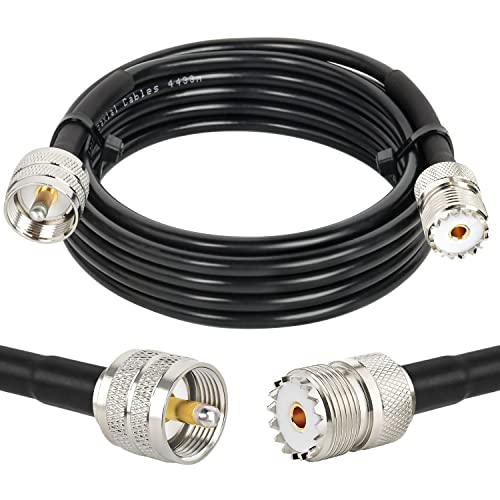
The MOOKEERF RG58 10‑foot cable is the right choice when you need a thin, flexible patch cord for an HF radio, a SWR meter, an antenna analyzer, or a dummy load—any application where the frequency stays below 30 MHz and connector bulk matters. RG58 has a 0.195‑inch diameter, making it roughly half the thickness of RG8X and one‑third the thickness of LMR‑400, so it fits into tight spaces behind a desk or inside a mobile center console. The 0.96‑dB loss figure at 450 MHz applies to the 10‑foot length; at 14 MHz the loss is under 0.2 dB.
The high‑density tinned copper braid provides 100 percent shielding coverage, and the adhesive‑lined heat shrink at each connector prevents moisture ingress during outdoor use. The SWR is spec’d at under 1.2:1 at 450 MHz, which is excellent for a cable of this size. Users running a mag‑mount antenna on a vehicle report that the 10‑foot length is sufficient to route the cable from the roof, through the door jamb, and to the radio without kinking or straining the connectors.
Do not reach for this cable if your primary band is 70 centimeters or 2 meters and your run exceeds 10 feet. At 25 feet, RG58 loses approximately 1.5 dB on 2 meters and over 3 dB on 70 centimeters—performance that will be audible as weaker received signals. For its intended role as a short HF jumper, however, the MOOKEERF RG58 is a well‑built, fully shielded, and very affordable option.
Why it’s great
- Thin 0.195‑inch diameter for tight routing
- SWR under 1.2:1 at 450 MHz
- Adhesive‑lined heat shrink on both connectors
Good to know
- Too lossy for VHF/UHF runs longer than 10 ft
- Center conductor is solid copper, less flexible than stranded
FAQ
Can I use a 75‑ohm TV coax cable with my ham radio?
What is the difference between LMR‑400 and KMR‑400?
How long can I run RG58 on 2 meters before the loss becomes a problem?
Final Thoughts: The Verdict
For most users, the 50 ohm coax winner is the MOOKEERF KMR400 25ft because it delivers true LMR‑400‑class performance at a mid‑range price with professional‑grade clamp connectors and full weather sealing. If you need an ultra‑low‑loss 3‑foot patch cable for critical measurements, grab the MPD Digital LMR400 3ft. And for a long outdoor feed line where every decibel counts, nothing beats the XRDS KMR400 50ft for its factory‑swept VSWR guarantee and 20‑year jacket durability.