
Our readers keep the lights on and my morning glass full of iced black tea. As an Amazon Associate, I earn from qualifying purchases.
An auto-darkening welding helmet is the single most critical safety tool for any welder, transforming how you see the weld puddle and drastically reducing eye strain. The difference between a cheap lens that flickers and a high-clarity unit with multiple sensors can mean better precision, fewer reworks, and far less fatigue at the end of a long day.
I’m Min — the co-founder and writer behind Gadgets Feed. I have spent countless hours analyzing optical clarity ratings, sensor counts, switching speeds, and shade ranges across the most popular auto-darkening helmets on the market to find exactly which models deliver real performance for their price tier.
Read on for a focused, spec-driven breakdown of the seven best options available today, covering everything from budget-friendly entry points to premium professional gear. I help you find the best auto-darkening welding helmet for the work you actually do.
How To Choose The Best Auto-Darkening Welding Helmet
The right auto-darkening welding helmet balances optical clarity, sensor reliability, shade range, and comfort. Beginners often buy on price alone, only to discover slow switching speeds or a tiny viewing window that makes TIG welding nearly impossible. Focus on these four areas first.
Optical Clarity and Viewing Area
Optical clarity ratings (1/1/1/1 is top-tier) measure light diffusion, angle dependence, and color distortion. A higher rating means you see the weld puddle in true color, which is crucial for TIG and low-amp work. The viewing area directly impacts your situational awareness — larger screens help you see base metal prep and weld progression without repositioning.
Arc Sensor Count and Switching Speed
Two sensors are the bare minimum; four sensors provide better detection in obstructed or tight spaces. Switching speed — measured in fractions of a second like 1/10,000 or 1/25,000 — determines how fast the lens darkens after the arc strikes. Faster speeds reduce eye fatigue and prevent arc flash when welding with high-frequency start or aluminum.
Shade Range and Power System
A helmet with shade range DIN 4 (light state) through DIN 13 (dark state) covers grinding, cutting, and all main welding processes. Look for solar-assisted power with a backup replaceable battery (CR2450 or CR2032) so your helmet never goes dark mid-job simply because the battery died in a low-light storage area.
Quick Comparison
On smaller screens, swipe sideways to see the full table.
| Model | Category | Best For | Key Spec | Amazon |
|---|---|---|---|---|
| Miller Digital Elite | Premium | Professional all-day use | ClearLight 4x, X-Mode, 4 sensors | Amazon |
| ESAB Sentinel A60 | Premium | Crisp true-color visibility | OpTCS lens, 4.65×2.80 in view | Amazon |
| Miller Classic Series | Mid-Range | Entry-level professional TIG/MIG | ClearLight, shade 8-13, 1/23,000s | Amazon |
| Jackson Safety Premium Graphic | Mid-Range | Best 1/1/1/1 clarity for the price | 1/1/1/1 rating, 4 sensors, 1.26 lb | Amazon |
| Hobart 770869 Creator | Mid-Range | Reliable workhorse for hobbyists | 7.1 sq in view, 3 sensors, grind mode | Amazon |
| ARCCAPTAIN XK-LY800H | Budget | Best value with large screen | 3.94×3.66 in view, 1/1/1/1, 4 sensors | Amazon |
| MIGVAN H-21 | Budget | Bundle value with storage bag | 1/1/1/1? No, 4 sensors, 1/10,000s | $75.99$89.98PrimeAmazon |
In‑Depth Reviews
1. Miller Digital Elite Series with ClearLight 4x

The Miller Digital Elite is built for the professional who demands uninterrupted arc detection in any environment. Its ClearLight 4x lens delivers the sharpest puddle visibility in the Miller lineup, and the four independent arc sensors ensure the lens darkens even when partially blocked. X-Mode electromagnetically senses the arc beyond the sensors, making this helmet especially reliable for outdoor welding where sunlight can confuse lesser units.
AutoSense automatically adjusts sensitivity to your workspace, and InfoTrack 2.0 records arc time and count — a useful feature for quoting jobs or tracking productivity. At roughly 2 pounds, it feels balanced on the head, and the ergonomic headgear reduces neck strain during all-day use. The one catch is that storing it in a completely dark environment for several days can drain the backup battery faster than expected, so keep it near a window or under ambient light.
For full-time welders or serious fab shop owners who need a helmet that adapts to every process — stick, TIG, MIG, gouging — the Digital Elite justifies its premium position through raw feature density. It also comes with a three-year warranty.
Why it’s great
- ClearLight 4x provides exceptional true-color clarity
- X-Mode prevents accidental flashing when sensors are blocked
- AutoSense and InfoTrack 2.0 add real workflow value
Good to know
- Battery can drain if stored in prolonged darkness
- Premium pricing places it out of most hobbyist budgets
2. ESAB Sentinel A60

ESAB’s Sentinel A60 uses OpTCS True Color Lens Technology to deliver what many users describe as the clearest view of the weld puddle available at this price tier. The shade range covers DIN 3/5 through 13 in 0.5-step increments, giving fine control for low-amp TIG work. Switching time is a fraction of a millisecond (0.08 ms), and four arc sensors cover the full screen area so the lens responds instantly even if your head is at an awkward angle.
The low-profile nylon shell is impact-resistant and weighs about 1 pound, making it one of the lighter premium hoods available. On-board memory stores up to nine user settings, a real time-saver for welders who alternate between processes. The head harness, while comfortable for table welding, does feel slightly under-engineered for the hood’s weight and may loosen over time in confined-space work. The included yellow cover lenses are also prone to scratching if handled roughly.
Overall, the Sentinel A60 is ideal for the TIG specialist or shop welder who prioritizes optical clarity above all else and wants programmable presets to avoid fiddling with knobs mid-job.
Why it’s great
- OpTCS lens offers superb true-color clarity
- Nine on-board memory presets for different processes
- Very lightweight at around 1 pound
Good to know
- Cover lenses scratch easily
- Head harness feels light-duty for the hood’s weight
3. Miller Classic Series with ClearLight

The Miller Classic Series bridges the gap between hobbyist affordability and pro-grade optics. It features ClearLight lens technology derived from Miller’s higher-end models, delivering high-definition clarity with minimal color shift. The dark-state shade range of 8 to 13 covers stick and MIG welding, while the cut shade (5-8) and grind shade (3) offer flexibility across shop tasks. Two arc sensors and a 1/23,000-second switching speed are sufficient for most work, though low-amp TIG below 5 amps may occasionally challenge the sensors.
Digital controls for shade, delay, and sensitivity are external and easy to adjust even with gloves on. The ratchet headgear provides a secure fit, and the 6-square-inch viewing area is adequate for stick and MIG but not as panoramic as some larger units. The lens remains light enough (around 1.2 pounds) for comfortable extended wear. Some users note the composite shell feels less premium than the fiberglass on Miller’s Digital Elite line, but it holds up well under regular use.
This helmet is the sweet spot for the part-time welder or apprenticeship trainee who wants Miller reliability and ClearLight optics without the Digital Elite price tag.
Why it’s great
- ClearLight HD optics at a mid-range price
- 1/23,000s switching speed for reliable protection
- Simple external digital controls
Good to know
- Shade range starts at 8 in dark state — limited for low-amp TIG
- Composite shell feels less robust than Elite models
4. Jackson Safety Premium Graphic ADF
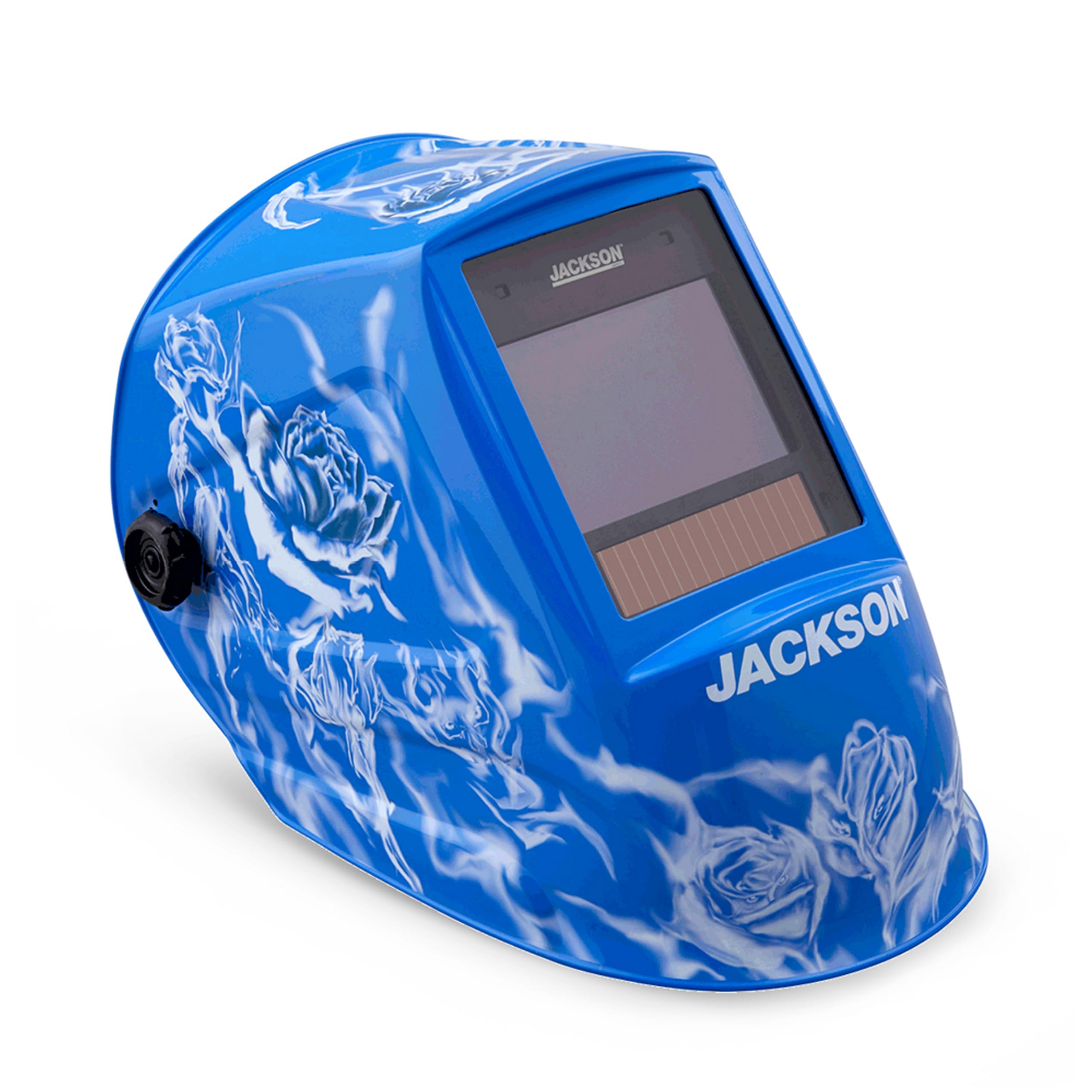
The 10.4-square-inch viewing area is among the largest in its class, giving you a wide window to see the base metal, the puddle, and the surrounding weld joint without moving your head. Four arc sensors eliminate blind spots, and a 1/20,000-second switching speed keeps your eyes safe from stray arcs during high-frequency starts.
At 1.26 pounds, it is one of the lightest helmets with a full-size viewing window. The patented 370 Speed Dial ratcheting headgear makes fit adjustments simple and holds position well. Internal controls keep the adjustment knobs protected from sparks and bumps. The shade range is variable from 3 to 10, which covers grind, cut, TIG, MIG, and stick, but stops at 10 rather than 13 — meaning it is not ideal for very high-amperage welding or carbon arc gouging.
For beginners in welding classes or fabricators who do mostly TIG and MIG under 250 amps, this helmet offers top-tier clarity and a massive view at a mid-range price point.
Why it’s great
- 1/1/1/1 optical clarity rivals helmets costing twice as much
- 10.4 sq in viewing area — class-leading for this price
- Very lightweight and comfortable for long sessions
Good to know
- Dark shade capped at 10 — not for high-amp stick or gouging
- Plastic headgear adjuster may wear over time
5. Hobart 770869 Creator Series Camo

The Hobart Creator Series helmet has been a consistent performer for hobbyists and light-industrial users for years. Its 7.1-square-inch wide-screen viewing area provides good peripheral visibility, and three independent arc sensors offer reliable detection for most stick and MIG applications. Grind mode prevents the lens from darkening during cleaning, a feature often missing on entry-level helmets. The shade range is not specified as widely as some, but the lens covers the standard welding and cutting needs for home-shop work.
The polyamide nylon shell is lighter than traditional fiberglass hoods, and the included protective lens kit adds value. Users who have owned this helmet for multiple years report consistent performance with no arc flash incidents — a testament to the sensor reliability and switching speed. The camo pattern is a stylistic choice, but the helmet is also available in other finishes. The headgear is functional but less adjustable than premium options, and the external control knobs could be more protected from accidental bumps.
For the weekend welder or farm-shop user who needs a dependable auto-darkening helmet without complex digital menus, the Hobart Creator Series is a proven, straightforward choice that holds up over time.
Why it’s great
- Proven long-term reliability from a trusted brand
- Wide 7.1 sq in screen for good visibility
- Grind mode adds versatility without extra cost
Good to know
- Headgear is less adjustable than premium competitors
- External controls could be more protected from bumps
6. ARCCAPTAIN XK-LY800H Skeleton
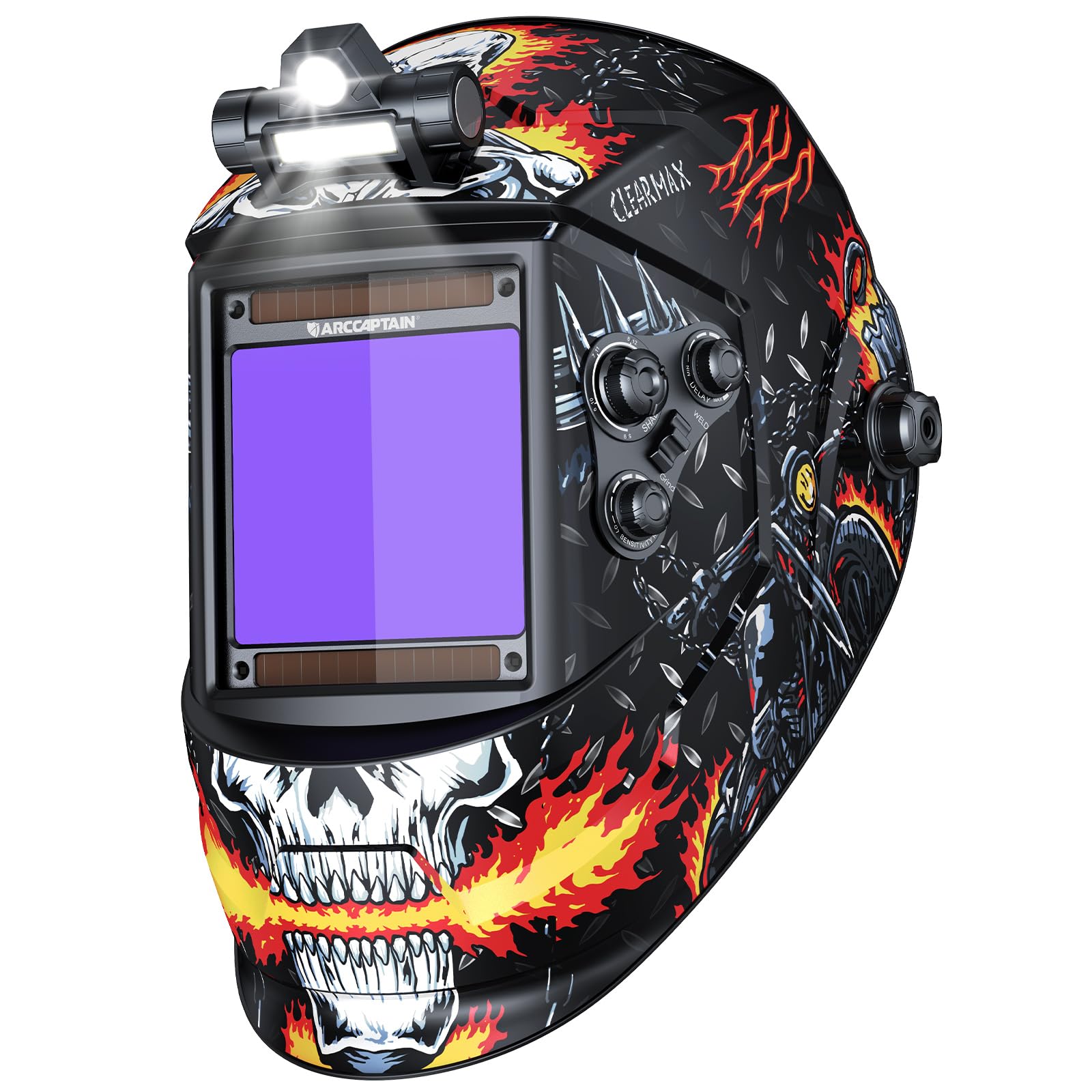
The ARCCAPTAIN XK-LY800H packs surprising specs into an entry-level price point. It features a 3.94 by 3.66-inch super-large viewing window with a 1/1/1/1 optical clarity rating — the same classification found on helmets at triple the price. Four premium arc sensors trigger the switch from light to dark in 1/25,000 second, outperforming many mid-range helmets on reaction speed. The shade range covers DIN 4 and 5/9 through 13, accommodating TIG, MIG, stick, cutting, and grinding.
This helmet also includes a USB-powered LED welding light that mounts on top, available in two brightness levels for low-light environments. The shell is polypropylene and weighs just 1 pound, reducing neck strain significantly. The headgear includes two top straps and a suspension that prevents the common “nose bash” when flipping down. Some trade-offs are inevitable at this price: the shell feels thinner than more expensive hoods, the headstrap is less robust, and a few users report minor quality control issues like a loose LED light or fragile battery tray.
If you are a beginner or need an affordable backup helmet with a brilliant viewing window and fast sensors, the ARCCAPTAIN delivers exceptional value — just be prepared for some plastic trim that feels budget-friendly.
Why it’s great
- 1/1/1/1 optical clarity and 4 sensors at an entry-level price
- 1/25,000s switching speed is faster than many mid-range units
- Included USB LED light helps in dark workshop conditions
Good to know
- Shell and headgear feel less durable than premium options
- Quality control on accessories (LED mount, battery tray) can vary
7. MIGVAN H-21 True Color Helmet
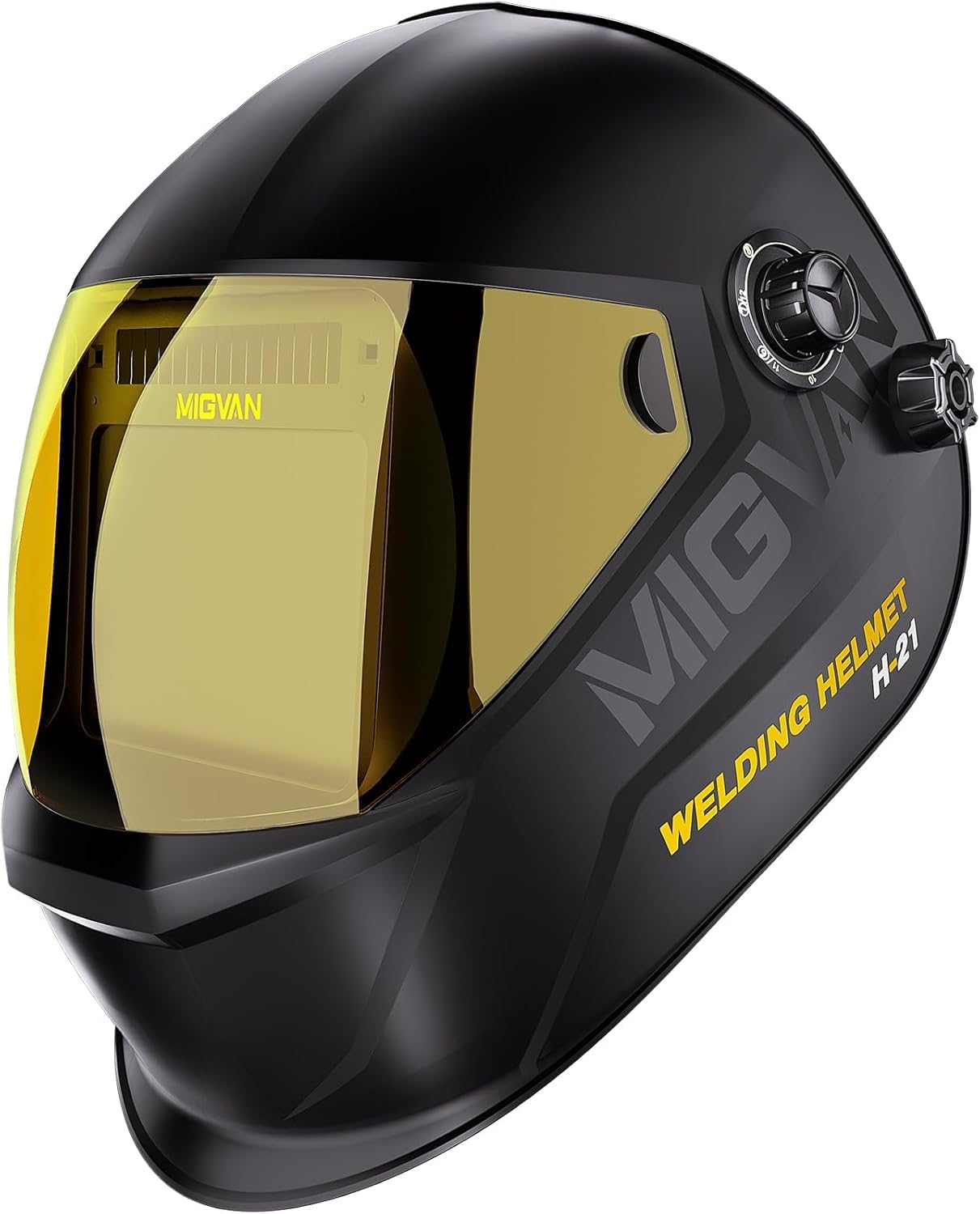
The MIGVAN H-21 enters the budget segment with a true-color gold lens, four ARC sensors, and a large viewing screen. Switching speed is rated at 1/10,000 second — fast enough for most hobbyist work, though not the instant snap of premium 1/25,000-second units. The shade range covers DIN 4 in light state and 5-9 through 9-13 in dark state, making it compatible with TIG, MIG, stick, and plasma cutting. The solar panel and replaceable lithium battery combination ensure you can weld even after storing the helmet in low light.
The package includes a heavy-duty storage bag, two extra inner lenses, and two outer protectors — genuine added value. The matte black shell meets ANSI and CE safety standards. Fitment is adjustable via a pivoting headgear with breathable padding. User feedback notes the helmet is comfortable but slightly small for some head sizes, allowing light to enter from the sides and bottom. The mirrored effect on the outside of the lens during welding is also mentioned as a minor aesthetic distraction.
For the home gamer or occasional repair welder who wants a complete kit — helmet, extra lenses, and bag — the MIGVAN H-21 is a solid entry point. It works well for casual stick and MIG but may not satisfy TIG purists who need perfect peripheral light sealing.
Why it’s great
- Complete bundle with storage bag and multiple replacement lenses
- True-color gold lens reduces color distortion
- Solar-powered with rechargeable battery backup
Good to know
- Shell is small; light may leak around edges for some users
- Switching speed is slower than premium options at 1/10,000s
FAQ
Can I use a shade 10 helmet for stick welding?
Why does my helmet flicker when I TIG weld at low amperage?
How do I adjust the sensitivity on my auto-darkening helmet?
What is the difference between 1/1/1/1 and 1/2/2/2 optical clarity?
Final Thoughts: The Verdict
For most users, the best auto-darkening welding helmet is the Miller Classic Series because it packages genuine ClearLight HD optics, reliable 1/23,000-second switching, and digital controls into a mid-range price that works for beginners and pros alike. If you want the absolute best viewing clarity with a massive screen and true 1/1/1/1 optics, grab the Jackson Safety Premium Graphic ADF. And for professional all-day use where sensor reliability in any position matters most, nothing beats the Miller Digital Elite Series.
Product prices and availability are accurate as of the date/time indicated and are subject to change. Any price and availability information displayed on Amazon at the time of purchase will apply to the purchase of this product. As an Amazon Associate I earn from qualifying purchases.
CERTAIN CONTENT THAT APPEARS ON THIS SITE COMES FROM AMAZON. THIS CONTENT IS PROVIDED "AS IS" AND IS SUBJECT TO CHANGE OR REMOVAL AT ANY TIME.
Amazon and the Amazon logo are trademarks of Amazon.com, Inc. or its affiliates.