
Our readers keep the lights on and my morning glass full of iced black tea. As an Amazon Associate, I earn from qualifying purchases.
Selecting an access control card reader is less about glamour and more about survival: you need a device that reliably decodes a 125kHz or 13.56MHz credential every single time, in rain, heat, or cold, without dropping a single bit of the Wiegand data stream. A cheap, flimsy reader will lock out your own team on a Monday morning, corrode at the terminal block within a season, or refuse to read silicone wristbands that your staff actually use. This guide breaks down the six most capable models you can buy right now, from a simple USB desktop reader to a full 4-door managed system.
I’m Min — the co-founder and writer behind Gadgets Feed. I’ve spent countless hours analyzing technical datasheets, cross-referencing customer field reports, and comparing read ranges, housing materials, and protocol compatibility to find the access control readers that actually hold up in real-world deployments.
Whether you are outfitting a single utility closet or managing a multi-door facility, this guide helps you find the best access control card reader for your specific environment and budget.
How To Choose The Best Access Control Card Reader
An access control card reader is a simple device at its core — it energizes a coil, listens for a modulated response from a credential, and outputs a Wiegand or data string. But the gulf between a reader that works for a decade and one that fails in six months comes down to three specific decisions: form factor, environmental sealing, and credential compatibility. Here is what you need to check before buying.
Form Factor: Desktop vs. Mullion vs. Full Keypad
A USB desktop reader like the HID OMNIKEY 5427ck is purpose-built for PC-based credential enrollment and identity verification, not door control. For actual door or gate access, you need a wired reader that outputs a Wiegand signal — either a compact mullion style (like the HID ProxPoint Plus) or a full keypad+reader combo (like the Sonew or AMOCAM units). Keypad combos add PIN-only and card+PIN modes, which are mandatory for two-factor authentication areas. Choose a mullion reader when you only need card-in, card-out and want the smallest possible footprint.
Environmental Rating: IP67 vs. IP68 vs. Unrated
If the reader lives outdoors, an IP67 or IP68 rating is non-negotiable. IP67 means the unit is dust-tight and can survive immersion in 1 meter of water for 30 minutes — enough for rain, snow, and hose-down cleaning. IP68 goes further, often with epoxy potting inside the housing, which also protects against condensation and temperature swings. Zinc alloy or metal housings (found on the Sonew and AMOCAM models) resist UV degradation and physical vandalism far better than plastic shells. An unrated reader belongs strictly at a clean, indoor reception desk.
Credential and Format Support: 125kHz vs. 13.56MHz and Wiegand Output
Most legacy proximity systems run on 125kHz (EM-ID, HID Prox, 1326 family cards). Modern smart card systems prefer 13.56 MHz (MIFARE, DESFire, ISO 14443). The reader you choose must match your existing credential stock — mixing frequencies means your cards simply will not work. For integration, Wiegand 26-bit is the default standard for access control panels, but some readers offer configurable output formats (40-bit, raw Wiegand, keyboard emulation). If you need to connect to a specific panel controller, verify Wiegand compatibility before purchase. USB readers like the FissaiD EH301 output the card UID as keystrokes, which is ideal for PC-based logging but not for door relay control.
User Capacity and Logging Depth
For a single door or small team, a reader supporting 2,000 to 3,000 users is more than sufficient. For a multi-door facility with hundreds of tenants or shift workers, you need a controller-based system like the MENGQI-CONTROL 4-door unit, which stores up to 20,000 users and 100,000 event logs. On-board memory matters because it determines whether you can audit who entered which door at what time without a cloud subscription. Standalone keypad readers store credentials locally, which is a security advantage (no internet dependency) but also means you must physically program each user at the keypad or via a master card.
Quick Comparison
On smaller screens, swipe sideways to see the full table.
| Model | Category | Best For | Key Spec | Amazon |
|---|---|---|---|---|
| MENGQI-CONTROL 4-Door System | Multi-Door Controller | Full facility access management | 20,000 users / 100,000 logs | $489.99Amazon |
| HID OMNIKEY 5427ck Gen 2 | USB Desktop Reader | PC credential enrollment & high-frequency reading | ISO 14443 A/B + 15693 | $114.99Amazon |
| HID ProxPoint Plus 6005BGB00 | Mini Mullion Reader | Discreet wired door access on metal surfaces | 125kHz, 85-bit format support | $129.99$141.99Amazon |
| Sonew IP67 Keypad | Wired Keypad + RFID | Outdoor weatherproof door control | IP67, zinc alloy, 3000 users | $39.59Amazon |
| AMOCAM K10ID Keypad | Wired Keypad + RFID | IP68 outdoor use with dry-contact gate openers | IP68, epoxy potted, 2000 users | $43.99Amazon |
| FissaiD EH301 USB Reader | USB Desktop Reader | Budget credential ID reading | 125kHz, 40 output formats | $42.97Amazon |
In‑Depth Reviews
1. MENGQI-CONTROL 4-Door Access System

This is not a standalone reader — it is a full access control infrastructure in a box. The MENGQI-CONTROL system manages four doors independently, supporting up to 20,000 users and logging 100,000 events with time-stamped, door-specific audit trails. It reads EM-ID cards at 125kHz with a response speed under 0.2 seconds, and the included 600lbs magnetic lock, exit buttons, and 110V power supply box mean you have everything for a complete install except the wire and the screws.
The TCP/IP networking allows you to manage all four doors from a single PC running the included software (Windows, SQL Server compatible). You can set minute-level schedules, define who enters which door at what time, and even trigger automatic open/close at preset hours. The smartphone app adds remote unlock capability, which is a genuine convenience for after-hours deliveries or forgotten credentials.
Setup is intermediate — you will need to run Cat5e to each door location and configure the software. The included video guide and wiring diagrams are clear, but the software learning curve is real. Once configured, this system is completely standalone with no cloud fees, no internet dependency for core operation, and the logging depth rivals commercial platforms costing four times as much. For any multi-door office, warehouse, condo, or gated community, this is the undisputed top pick.
Why it’s great
- Full 4-door controller with 600lb magnetic locks included
- 20,000 user memory and 100,000 event log capacity
- TCP/IP networked with remote app and no subscription fees
Good to know
- Software setup has a learning curve for beginners
- Requires running Cat5e cable to each door location
2. HID OMNIKEY 5427ck Gen 2

The HID OMNIKEY 5427ck Gen 2 is the gold standard for desktop credential reading and identity verification in corporate and government environments. It supports both low-frequency (125kHz HID Prox) and high-frequency (13.56 MHz) contactless smart cards, meeting ISO 14443 A/B and ISO 15693 standards. This dual-frequency capability makes it the only reader on this list that can handle a mixed-technology migration path — you can read legacy proximity cards alongside modern MIFARE DESFire credentials from the same device.
The reader operates in both CCID mode (standard smart card driver) and keyboard emulation mode, meaning it can drop card UID data directly into any text field as if it were typed. This flexibility is essential for PC-based attendance systems, visitor management kiosks, or custom software integrations. The built-in web-based management tool allows browser-based configuration of output formats, card number padding, and prefix/suffix settings without installing proprietary software. One reviewer verified over 6,000 reads with zero failures, calling it the most reliable reader they have used.
Be aware that this is a reader only — despite some confusion on HID’s website, the 5427ck Gen 2 cannot write or program credentials. You will need a separate reader/writer for card issuance. Setup is not always plug-and-play for custom configurations; you may need to download HID’s application for initial IP setup or firmware updates. For IT-managed deployments where credential compatibility and read reliability are paramount, this reader is worth the premium.
Why it’s great
- Dual-frequency (125kHz + 13.56 MHz) for mixed credential environments
- CCID + keyboard emulation mode for any PC software
- Proven reliability with thousands of reads and no failures
Good to know
- Reader only — cannot write or program credentials
- Advanced configuration requires downloading HID software
3. HID ProxPoint Plus 6005BGB00
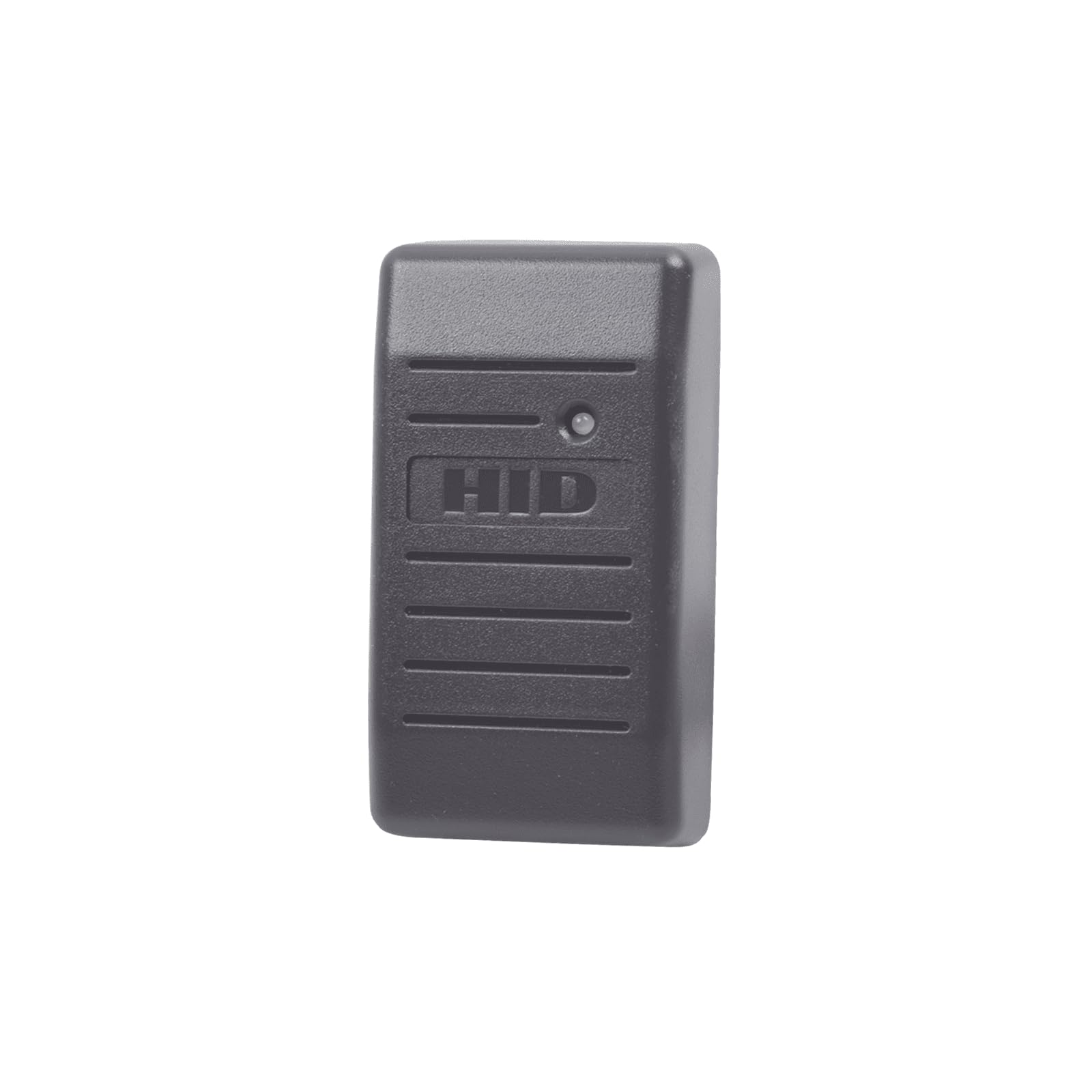
The HID ProxPoint Plus 6005BGB00 is arguably the most trusted single-door proximity reader on the market, and for good reason: it is one of the smallest mullion-style readers HID makes, yet it reads cards with formats up to 85 bits and works on metal surfaces without read range degradation. The charcoal gray shell blends into any door frame, and the standard 18-inch color-coded pigtail makes replacement of an older HID reader a five-minute job if you compare the wire mapping printed on the back.
This reader runs on 125kHz (HID Prox format) and outputs standard Wiegand data for compatibility with virtually any access control panel. The host-controlled or locally controlled beeper and LED notification system give you audible and visual feedback for granted or denied access. Customers report units exposed to California coastal weather for years with no issues, which speaks to the weather sealing even without a formal IP rating printed on the box. The small form factor (5.16 x 3.43 x 1.81 inches) allows discreet mounting on narrow door frames or mullions.
The main limitation is that this is a card-only reader — there is no keypad, so PIN-based or dual-factor entry is not supported. It also uses the proprietary HID Prox 125kHz protocol, so it will not read EM-ID or MIFARE credentials. If your facility already runs HID Prox cards, this is an effortless upgrade. For new installations or mixed-credential environments, you will need to match your card stock to this reader.
Why it’s great
- Ultra-compact mullion design for discreet mounting on metal
- Color-coded pigtail simplifies replacement of old HID readers
- Proven outdoor durability in coastal environments for years
Good to know
- Card-only (no keypad for PIN entry or dual-factor)
- Only works with HID Prox 125kHz credentials
4. Sonew IP67 RFID Keypad
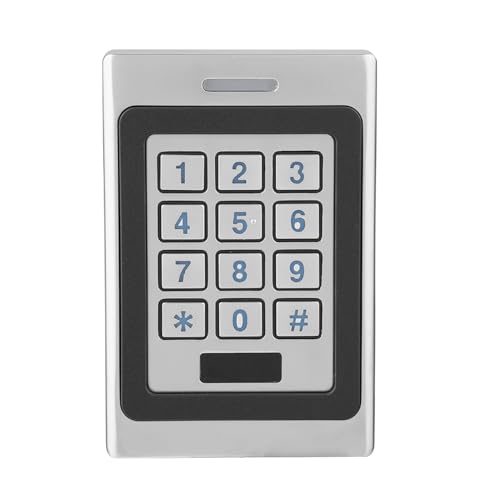
The Sonew IP67 RFID Keypad delivers three-factor access (card, PIN, or card+PIN) in a heavy-duty zinc alloy housing that is vandal-resistant and fully weatherproof. With support for up to 3,000 users, it outpaces many competitors at this level for user capacity, making it viable for a busy office or apartment building entrance. The illuminated keypad with backlit keys ensures reliable nighttime use, and the Wiegand input/output ensures compatibility with most access control panels on the market.
Build quality is the standout here: multiple customers have replaced cheaper plastic keypads that wore out after 3–4 years in cold climates, and the Sonew unit is described as “much higher quality” with a satisfying tactile button feel. The metal housing resists prying and UV degradation, and the IP67 seal keeps electronics dry even when mounted directly in the path of rain or sprinklers. Standalone operation means you can program users directly at the keypad without a computer or network connection, which is a major plus for quick installations.
The trade-off is that Wiegand programming instructions are poorly translated, and the default “tamper proof” feature uses a generic hex set screw that any hex key can remove. The number buttons do not press as smoothly as premium readers like HID, but for less than half the price, the difference is minor. For a rugged, weather-resistant keypad that handles card and PIN access without breaking the bank, the Sonew is the top value pick.
Why it’s great
- IP67-rated zinc alloy housing is truly weatherproof and vandal-resistant
- Supports up to 3,000 users with card, PIN, or card+PIN modes
- Standalone operation with no PC required for user programming
Good to know
- Wiegand programming instructions are poorly translated
- Keypad button feel is less refined than premium alternatives
5. AMOCAM K10ID Keypad
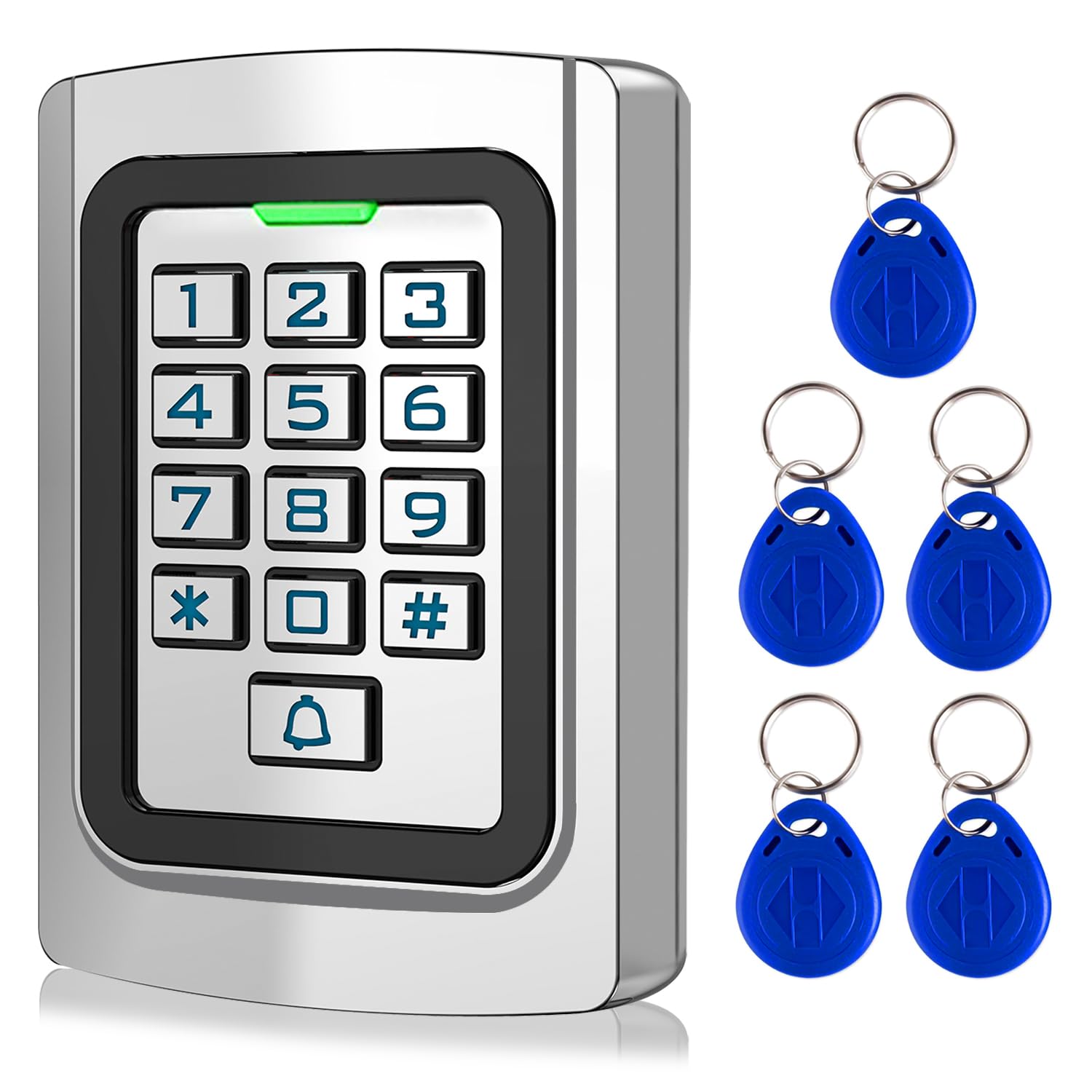
The AMOCAM K10ID is the only reader on this list with a true IP68 waterproof rating, achieved through internal epoxy potting that fills the electronics cavity. That means this unit can survive submersion, direct-pressure hose-downs, and the relentless humidity of indoor pools or outdoor coastal installations without internal corrosion. The zinc alloy housing and LED backlit metal buttons add to the rugged feel, and customers universally praise its “commercial-grade” build quality as overkill but welcome for a garage or gate.
Wired connectivity is straightforward for anyone comfortable with a multi-conductor cable: red/black wires handle 12V DC power input, blue/purple wires provide a dry-contact NO output for the garage door or gate opener. The keypad supports up to 2,000 users across three modes (code, card, or code+card), and the included five keyfobs at 125kHz EM/ID mean you can get started immediately. The Wiegand 26 output also lets you use it as an extra card reader with a compatible access panel.
The biggest frustration across every customer review is the instruction manual — it is vague, poorly translated, and the tiny M2 mounting screws are easy to drop. The multi-wire pigtail is only 4–5 inches long, requiring a junction box or careful wire-nut splicing. Once correctly wired, however, the unit works flawlessly every time, with a satisfying beep and green LED confirmation. For an outdoor keypad that will outlast the building it is mounted on, the AMOCAM K10ID is the choice.
Why it’s great
- IP68 with epoxy potting — the most weatherproof reader in this guide
- Solid zinc alloy housing with metal backlit buttons
- Works as standalone keypad or Wiegand 26 card reader
Good to know
- Instruction manual is vague and poorly translated
- Short 4-inch pigtail requires junction box or wire-nut splicing
6. FissaiD EH301 USB Reader

The FissaiD EH301 is the simplest and most affordable path to reading 125kHz proximity cards on a computer. It works with both 1326 family ISO Prox cards and 4100 ID cards, outputting the card UID as keyboard keystrokes — no drivers needed on Windows, Linux, Mac, or Android. The plug-and-play nature means any receptionist or security guard can use it immediately to log credential numbers into a spreadsheet or attendance system without any configuration.
Beyond basic read-and-type, the EH301 offers configurable output formats through a setup card system. You can choose from 40 different output formats for the ID card UID, including 10H or 13-digit decimal, and set prefix/suffix or ignore leading zeros. This makes it surprisingly flexible for integrating with legacy software that expects a specific card number format. The unit also reads silicone wristbands reliably when plugged directly into a computer port, though some users report intermittent reads when using a hub or dock.
Quality control is a concern at this price point: one reviewer received a unit with a faulty USB port that would only power on when the cable was held at a specific angle. The reader is also read-only — it cannot write or program cards, and it has no Wiegand output for door control. For desktop credential enrollment, badge printing stations, or low-cost integration testing, the EH301 is a fine tool. For any door or gate application, you need one of the wired readers above.
Why it’s great
- True plug-and-play USB with no driver installation needed
- Configurable 40-output format for legacy software integration
- Works on Windows, Linux, Mac, and Android
Good to know
- Some units have USB port reliability issues
- Read-only — cannot write or program credentials; no Wiegand output
FAQ
Can I use a USB card reader to control a door lock?
What does IP68 mean for an outdoor card reader?
How do I know if my existing cards will work with a new reader?
Can I install a wired card reader myself without an electrician?
Final Thoughts: The Verdict
For most users, the best access control card reader winner is the MENGQI-CONTROL 4-Door System because it combines a full controller, locks, and readers with deep user and log capacity at a fraction of commercial system cost. If you want a desktop reader for PC-based credential enrollment and mixed-frequency support, grab the HID OMNIKEY 5427ck Gen 2. And for a rugged, weatherproof outdoor keypad that will outlive every other component in the system, nothing beats the AMOCAM K10ID.
Product prices and availability are accurate as of the date/time indicated and are subject to change. Any price and availability information displayed on Amazon at the time of purchase will apply to the purchase of this product. As an Amazon Associate I earn from qualifying purchases.
CERTAIN CONTENT THAT APPEARS ON THIS SITE COMES FROM AMAZON. THIS CONTENT IS PROVIDED "AS IS" AND IS SUBJECT TO CHANGE OR REMOVAL AT ANY TIME.
Amazon and the Amazon logo are trademarks of Amazon.com, Inc. or its affiliates.