
Our readers keep the lights on and my morning glass full of iced black tea. As an Amazon Associate, I earn from qualifying purchases.
Shaky footage destroys the professional feel of a video faster than anything else. A 3 Axis Gimbal Camera isolates your camera from every bump, tilt, and pan while walking, running, or orbiting a subject — no amount of digital stabilization can match the buttery-smooth response of a real mechanical gimbal.
I’m Min — the co-founder and writer behind Gadgets Feed. I analyze payload capacities, motor torque specs, battery runtimes, and tracking algorithms to separate the gimbals that actually keep your shot level from the ones that fight you on every axis.
This guide cuts through the marketing noise to deliver a curated, spec-based ranking of the best 3 axis gimbal camera options for mirrorless rigs, pocket vloggers, and solo cinema operators.
How To Choose The Best 3 Axis Gimbal Camera
Your body weight and lens combo dictate whether a gimbal feels effortless or fights you at every tilt. Focus on payload headroom, axis lock type, battery chemistry, and tracking intelligence rather than brand hype. A gimbal that barely handles your camera is useless — aim for 20-30% payload overhead.
Payload Capacity and Motor Torque
Payload is the maximum weight the motors can stabilize. A mirrorless body with a 24-70mm f/2.8 zoom weighs roughly 2-3 lbs — budget gimbals with a 2 kg (4.4 lb) limit handle that fine, but add a hot-shoe mic and ND filter and you risk motor strain. High-torque gimbals like the DJI RS 4 Pro (4.5 kg) handle cinema cameras plus matte boxes without overheating.
Axis Lock System and Setup Speed
Second-generation auto axis locks release all three arms simultaneously with a single button press, dropping setup to under 10 seconds. Manual locks require knob-turning on each axis every time you pack or unpack — a significant friction point for solo shooters chasing fast scene changes. Pay the premium for auto locks if you shoot events or run-and-gun.
Tracking Intelligence — Sensor vs App
Built-in AI tracking sensors on the gimbal body (like FeiyuTech’s SCORP-C2 or DJI’s RS Tracking Module) keep the camera locked on a moving subject without draining your phone battery or requiring an app connection. App-based ActiveTrack 6.0 works well but introduces latency; the dedicated module responds faster for unpredictable subjects like pets or kids.
Quick Comparison
On smaller screens, swipe sideways to see the full table.
| Model | Category | Best For | Key Spec | Amazon |
|---|---|---|---|---|
| DJI RS 4 Mini Combo | Mirrorless Gimbal | Run-and-gun with lightweight cameras | Auto axis locks, 2 kg payload | Amazon |
| FeiyuTech SCORP-C2 | Mirrorless Gimbal | Heavy lens combos plus AI tracking | Built-in AI sensor, 3.5 kg payload | Amazon |
| ORDRO M5 | All-in-One Camcorder | Budget-friendly vlog kit | 5K video, built-in gimbal | Amazon |
| Feiyu Pocket 3 Kit | Pocket Camcorder | Wireless remote pocket vlogging | 130° FOV, 4K60, detachable handle | Amazon |
| Xtra Muse | Pocket Camcorder | High-bitrate 4K/120fps pocket rig | 1″ CMOS, 10-bit X-Log | $329.00$449.00Amazon |
| DJI Osmo Pocket 3 Creator Combo | Pocket Camcorder | Premium all-in-one vlog powerhouse | 1″ CMOS, 4K/120fps, ActiveTrack 6.0 | $512.00$629.00Amazon |
| DJI RSC 2 Pro Combo | Mirrorless Gimbal | Film rig with focus motor + transmission | Foldable, 3 kg payload, 14hr battery | Amazon |
| DJI RS 5 Combo | Professional Gimbal | Pro tracking with enhanced Z-axis stability | 2nd-gen auto locks, Z-axis indicator | Amazon |
| DJI RS 4 Pro | Cinema Gimbal | Heavy cinema cameras with LiDAR focus | 4.5 kg payload, 29hr battery | Amazon |
In‑Depth Reviews
1. DJI RS 4 Mini Combo

The DJI RS 4 Mini Combo packs auto axis locks — a feature previously reserved for the RS 4 Pro — into a compact body that handles mirrorless cameras up to 2 kg (4.4 lbs). Unfold and lock the arms in one second, no manual knob-turning. The included Intelligent Tracking Module adds subject framing without draining your phone, and the Teflon-enhanced axis plates make balancing a Sony A7IV with a 28-75mm zoom feel smooth from the first attempt.
Battery runtime hits 13 hours, enough for a full wedding day or a weekend vlog trip without recharging. The fast vertical switch pivots the camera plate in 10 seconds for Reels or TikTok content. Responsive Follow Mode lets you whip-pan the camera and have it return to steady lock instantly — useful for dynamic orbit shots around a subject.
One limiting factor: the 2 kg payload leaves little overhead if you add a heavy cine zoom or a full cage with accessories. The briefcase handle unlocks low-angle shots without hunching, but the Bluetooth camera connection can conflict with the wired USB control, so you must choose one method at a time. Overall, this is the most feature-dense lightweight gimbal for solo shooters who want professional speed.
Why it’s great
- Auto axis locks reduce setup to one second
- Briefcase handle simplifies low-angle and ground-level shots
Good to know
- 2 kg capacity limits heavy cinema-style lens rigs
- Bluetooth and wired control cannot be used simultaneously
2. FeiyuTech SCORP-C2 AI Tracking Gimbal
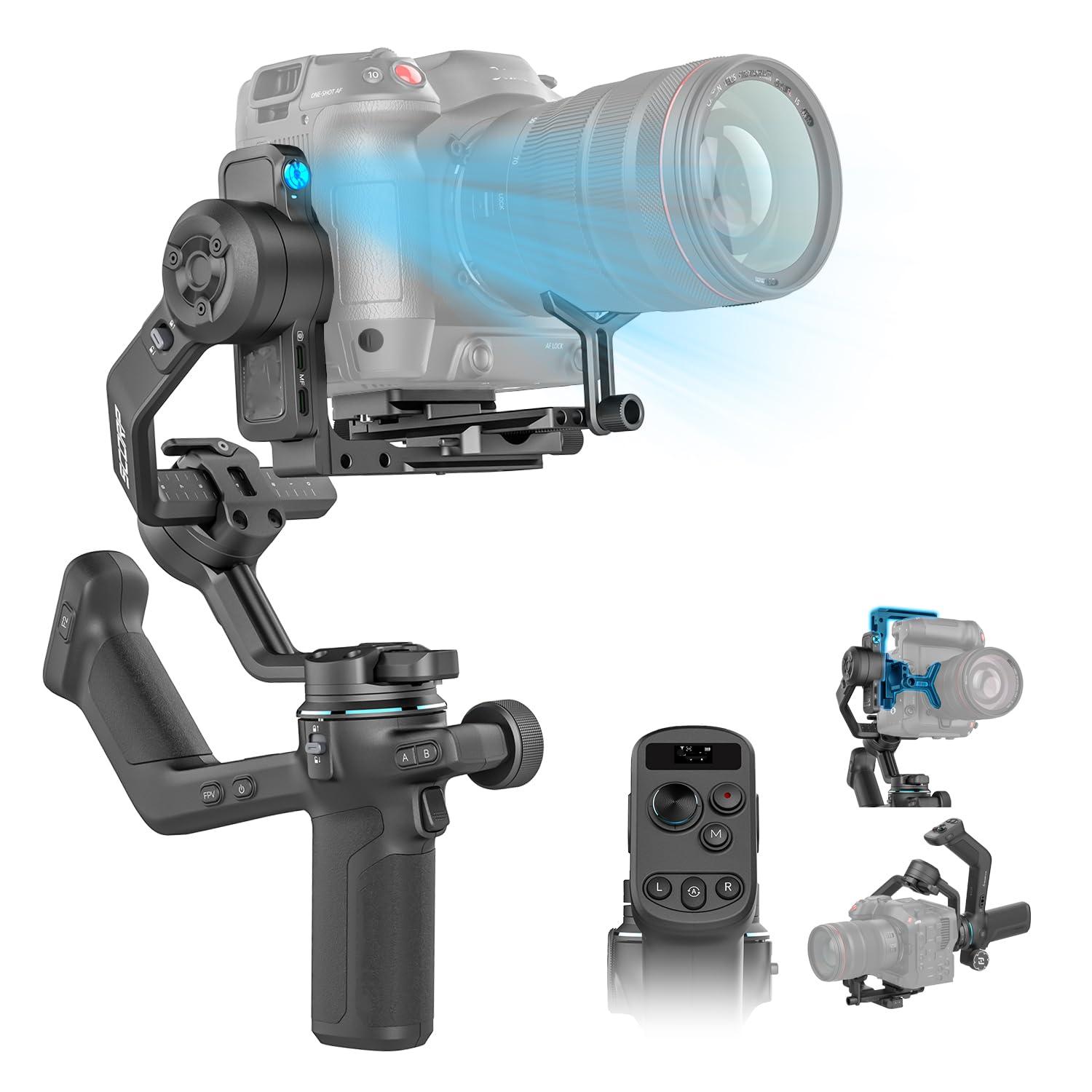
The FeiyuTech SCORP-C2 stands out for its onboard AI tracking sensor — no app required, no phone mount needed. The gimbal detects and locks onto a human face the second you power it up, and gesture control lets you start or stop tracking with a wave. This is a genuine solo-shooter advantage for interviews, walk-and-talks, and one-person content production where touching the phone is a disruption.
Payload capacity jumps to 3.5 kg (7.72 lbs), comfortably handling a Canon EOS R5 with a 24-105mm f/4 lens plus a top-mounted microphone. The integrated OLED display shows battery level, current mode, and motor status — no need to open an app to check if you are in Pan Follow or Lock mode. The updated quick-release plate has micro-adjust sliders that let you fine-tune the center of gravity after mounting.
The unit is not light at 2.91 lbs, and the sliders for balance adjustment are not as friction-free as DJI’s Teflon plates — expect to spend a few extra minutes dialing in the roll axis. The AI tracking only detects human faces, not animals or vehicles, so wildlife shooters will need app-based control instead. For heavy DSLR rigs that need reliable mechanical stabilization plus intelligent subject lock, this is a compelling mid-range option.
Why it’s great
- Built-in AI face tracking works without any app or phone
- High 3.5 kg payload fits full-frame bodies plus big zooms
Good to know
- Balance sliders are not as smooth as Teflon-coated competition
- AI tracking only recognizes human faces, not pets or vehicles
3. Xtra Muse Vlogging Camera

The Xtra Muse brings a 1-inch CMOS sensor and 4K resolution at 120fps to the pocket gimbal category — exactly the same sensor size as the DJI Osmo Pocket 3, but at a lower price point. The 3-axis mechanical gimbal delivers the same silky walking stability, and the 10-bit X-Log color profile preserves highlight and shadow detail during sunrise or sunset shooting. The 2-inch touchscreen rotates for horizontal or vertical switching.
Master Follow mode keeps you locked in the frame during solo shoots — mount it on a tripod, walk in front, and the gimbal rotates to keep you centered. Autofocus is fast and accurate in both bright and moderate low-light scenarios, and the built-in face and object tracking works reliably for vlogs or product demos. The bundled handle with a 1/4-inch thread lets you attach it to a monopod or selfie stick.
Battery life is around 161 minutes, which is competitive but falls short of the Osmo Pocket 3’s 166 minutes. The Xtra Muse lacks the D-Log M color space of the DJI, and its microphone port is limited — plugging in an external mic requires a USB-C adapter rather than a dedicated 3.5mm jack. For creators who want the 1-inch sensor and 120fps slow motion without the premium DJI tax, the Xtra Muse is a smart budget-friendly choice.
Why it’s great
- 1-inch CMOS sensor delivers excellent dynamic range for the price
- 10-bit X-Log color grading enables pro-level post-production
Good to know
- No dedicated 3.5mm mic jack — external audio needs USB-C adapter
- Battery runtime slightly below the industry-leading Osmo Pocket 3
4. DJI Osmo Pocket 3 Creator Combo

The DJI Osmo Pocket 3 Creator Combo is the pocket gimbal camera to beat. Its 1-inch CMOS sensor records 4K/120fps video that rivals many mirrorless cameras in terms of sharpness and low-light clarity. The 3-axis mechanical stabilization handles walking, jogging, and even light running without introducing microjitters — a level of smoothness that digital stabilization cannot replicate. ActiveTrack 6.0 locks onto a subject and keeps it centered even during erratic movement.
The 2-inch rotatable touchscreen is a standout ergonomic feature: it flips 90 degrees for vertical video, so you never shoot Reels or TikTok with black bars. The Creator Combo bundle includes the DJI Mic 2 transmitter, a battery handle that extends runtime to 166 minutes, a wide-angle lens adapter, a mini tripod, and a carrying bag. The mic connects directly via OsmoAudio — no cables, no adapters — and records broadcast-quality voice.
Digital zoom is limited to 2x without losing resolution, and the battery handle adds bulk to an otherwise pocket-sized device. The 9.4 MP effective still resolution is modest compared to dedicated cameras, so still photographers may want a separate body for high-resolution shots. For vloggers, travel content creators, and anyone who wants cinematic gimbal footage in a jacket pocket, the Osmo Pocket 3 is the gold standard.
Why it’s great
- Rotatable touchscreen enables instant switching between horizontal and vertical
- DJI Mic 2 transmitter included in Creator Combo delivers pro-grade audio
Good to know
- Digital zoom is limited to 2x — no optical zoom capability
- Still photo resolution capped at 9.4 MP, not for high-res photography
5. DJI RS 5 Combo
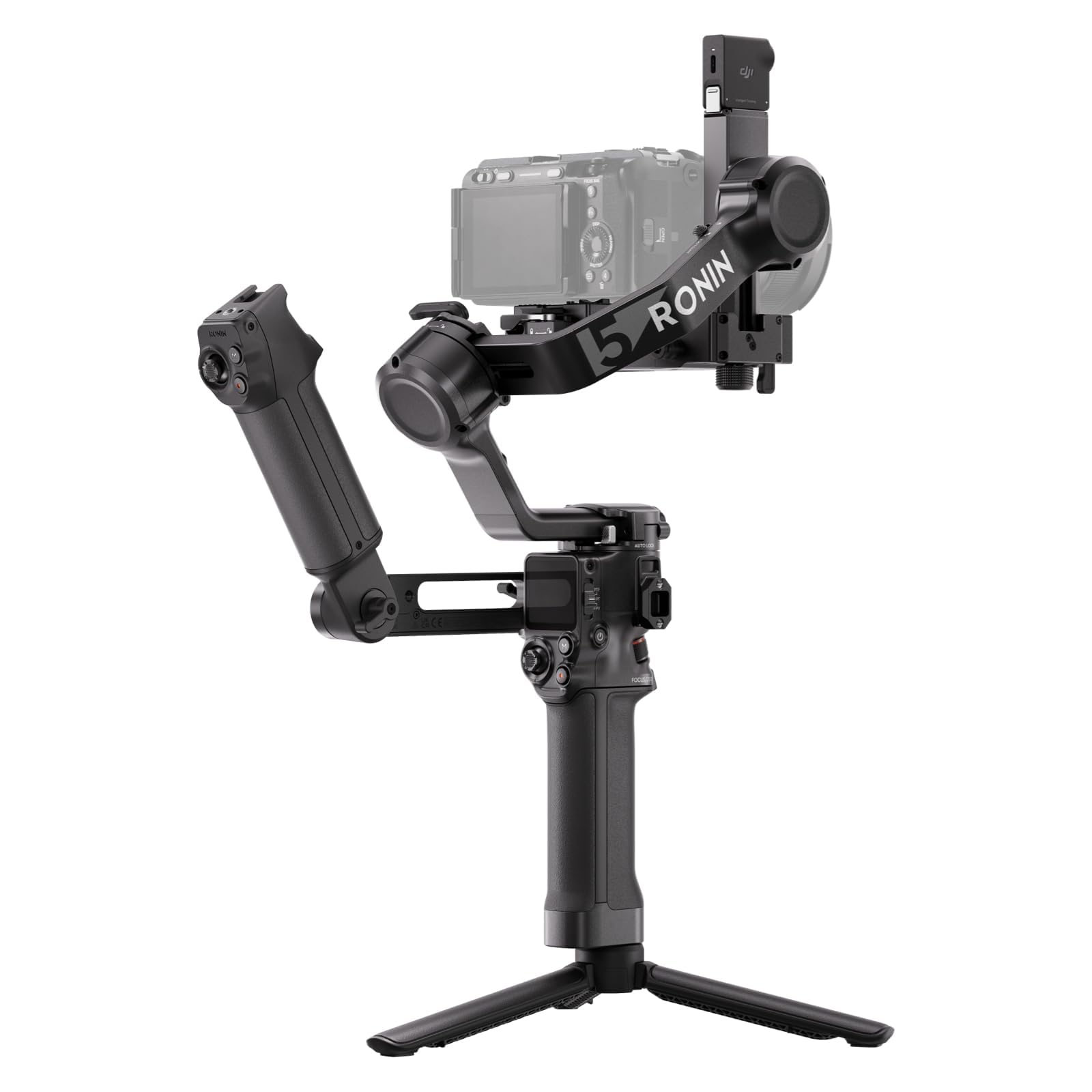
The DJI RS 5 Combo introduces a Z-Axis Indicator — a visual feedback system that tells you if your footsteps are causing vertical bounce. A small LED on the handle changes color when you sway, letting you adjust your gait in real time for the steadiest possible walking shots. This is a tool for professionals who cannot afford even a single shaky take during a wedding ceremony or a corporate interview.
The 2nd-Generation Automated Axis Locks work with the new Electronic Briefcase Handle, which includes a joystick and physical buttons for one-handed control of both pan and tilt. The Enhanced Intelligent Tracking Module tracks humans, vehicles, and pets — far more versatile than face-only trackers. Fine-tuning knobs on each axis and Teflon interlayers make heavy professional rigs feel effortless to balance.
Battery runtime reaches 14 hours, and a full charge takes just one hour via USB-C PD. The carrying case is robust and fits the gimbal with the briefcase handle attached. One early review noted that stabilization did not feel perfectly locked during walking after balancing — this may require a careful balance tune, especially with heavier lens combos. For cinematographers who need intelligent tracking plus a real-time stability coach, the RS 5 delivers a workflow edge.
Why it’s great
- Z-Axis Indicator provides real-time visual feedback on footstep stability
- Enhanced tracking module tracks people, vehicles, and animals
Good to know
- Walking stabilization may need a careful balance tune for some lens combos
- Price point sits between the RS 4 Mini and the RS 4 Pro
6. DJI RSC 2 Pro Combo

The DJI RSC 2 Pro Combo folds smaller than an A5 sheet of paper while still carrying a payload of 3 kg (6.6 lbs). This foldability makes it a favorite for travel cinematographers who pack a mirrorless body plus a 70-200mm lens into a single carry-on. The Titan Stabilization Algorithm and SuperSmooth mode compensate for micro-movements on long telephoto lenses — stabilizing a 100mm zoom without visible shake is impressive at this price bracket.
The Pro Combo bundle includes the RavenEye Image Transmission system, a Focus Motor with rod mount, a phone holder, and three types of HDMI cables. The 1-inch OLED screen on the handle gives you full control without needing a phone connected. The Manfrotto/Arca dual-layer mounting plate means you can swap between a tripod and the gimbal without removing the plate. Battery life is a solid 14 hours with fast charging support.
The DJI Ronin app is not available on Google Play — you must side-load it from DJI’s website, which raises security concerns for some users. The carrying case is too small for the gimbal when a camera is fully balanced, so you will need to loosen the arms or store the camera separately. The focus motor and image transmission add weight, pushing the total kit past 3 kg. For filmmakers who want a portable but powerful stabilization platform with remote focus control, the RSC 2 Pro Combo remains a strong contender.
Why it’s great
- Foldable design saves valuable backpack space during travel
- SuperSmooth mode stabilizes telephoto lenses up to 100mm
Good to know
- DJI Ronin app requires side-loading as it is removed from Google Play
- Carrying case is too cramped to store the gimbal with a fully balanced camera
7. DJI RS 4 Pro

The DJI RS 4 Pro is built for cinema cameras and heavy lens rigs. With a 4.5 kg (10 lb) payload and 20% more motor torque than the RS 3 Pro, it comfortably stabilizes a RED Komodo or a Sony FX6 with a cinema zoom. The carbon fiber axis arms keep the total gimbal weight to 1.84 kg while still handling professional payloads — a feat of materials engineering that matters when you carry it all day on a film set.
The Focus Pro LiDAR system projects 76,800 ranging points within 20 meters, giving solo operators accurate autofocus on subjects even in low light or backlit conditions. Native vertical shooting is second-generation: you release the horizontal plate, rotate it 90 degrees, and lock it in — no tools, no rebalancing. The BG70 battery grip extends runtime to 29 hours and can power the camera at up to 18W, reducing the need for a separate V-mount battery.
All this capability comes at a high price and a steep learning curve. The LiDAR module and image transmitter are sold separately, pushing the total investment even higher. The unit is bulky, and the auto axis locks, while fast, add mechanical complexity that may fail over time. For professional cinematographers who need the highest payload, LiDAR-assisted focus, and cinema-level stabilization, the RS 4 Pro is the definitive tool.
Why it’s great
- 4.5 kg payload handles full cinema cameras with heavy lenses
- LiDAR autofocus with 76,800 ranging points works in very low light
Good to know
- LiDAR module and image transmitter are not included in the base kit
- Bulk and weight are significant for run-and-gun shooting
8. Feiyu Pocket 3 Kit

The Feiyu Pocket 3 Kit stands out for its wireless remote handle — the camera and handle detach, allowing you to place the gimbal camera on a metal surface (via the magnetic mount base) while controlling it from up to 10 meters away. Real-time video monitoring on the handle’s screen means you can frame the shot without standing behind the camera. The 130° ultra-wide lens captures more background context than the typical 120° pocket camera.
The 3-axis mechanical gimbal provides smooth 4K60 footage during walking. The 1/2.3-inch CMOS sensor is smaller than the 1-inch sensors in the Xtra Muse or Osmo Pocket 3, so low-light performance is noticeably noisier. The magnetic mount sticks to stainless steel surfaces like refrigerator doors or car hoods, enabling creative fixed-angle shots that would require a tripod with other gimbals. AI face tracking works without an app.
Audio quality is the weakest link — the internal microphone picks up handling noise and wind rustle, and there is no 3.5mm jack for an external mic. The remote handle’s video feed has a noticeable one-second lag, making precise framing during fast action difficult. For vloggers who want an ultra-wide field of view and the flexibility of a wireless remote, the Pocket 3 fills a unique niche, but the sensor and audio limitations are real trade-offs.
Why it’s great
- Detachable wireless handle with real-time monitoring enables remote framing
- Magnetic base lets you mount the camera on any steel surface for creative angles
Good to know
- Small 1/2.3-inch sensor creates noticeable noise in low-light scenes
- Internal audio quality is poor and there is no external mic input
9. ORDRO M5 5K Gimbal Vlogging Camera

The ORDRO M5 delivers a complete vlogging package — integrated 3-axis gimbal stabilization, 5K video resolution, a 3.5-inch rotating touchscreen, and a carrying bag — at an entry-level price point. The wide-angle lens covers 120 degrees, and the built-in IR night vision lets you film in total darkness, a rare feature in this class. The 48 MP effective still resolution means you can capture usable photos from the same device.
Face tracking is functional but not as responsive as the DJI or FeiyuTech systems — it may drop lock if you move too quickly or turn your head sharply. The 3-hour battery life is adequate for a day of casual shooting, but power users will want to bring a USB power bank. The camera supports micro SD cards up to 512GB, giving plenty of storage for extended recording sessions.
Build quality and customer service are the biggest concerns. One reviewer reported a gimbal glitch after heavy trail use, and the manufacturer was unhelpful with video file support. The internal microphone picks up handling noise, and there is no slow-motion mode despite marketing claims. For beginners who want an all-in-one gimbal camera kit with 5K resolution and night vision, the M5 offers a low barrier to entry, but experienced shooters should invest in more robust options.
Why it’s great
- 5K resolution and 48 MP stills in a single integrated gimbal camera
- IR night vision enables filming in complete darkness
Good to know
- Customer support responsiveness has been reported as inconsistent
- Face tracking can lose lock during fast or erratic movement
FAQ
What is the difference between 3-axis mechanical stabilization and digital stabilization?
How do I know if a gimbal’s payload is enough for my camera?
Final Thoughts: The Verdict
For most users, the best 3 axis gimbal camera winner is the DJI RS 4 Mini Combo because it delivers auto axis locks, intelligent tracking, and a 2 kg payload in a lightweight body that handles 90% of mirrorless setups. If you want a pocket-sized all-in-one solution with a 1-inch sensor, grab the DJI Osmo Pocket 3 Creator Combo. And for heavy cinema rigs that need LiDAR autofocus and a 4.5 kg payload capacity, nothing beats the DJI RS 4 Pro.
Product prices and availability are accurate as of the date/time indicated and are subject to change. Any price and availability information displayed on Amazon at the time of purchase will apply to the purchase of this product. As an Amazon Associate I earn from qualifying purchases.
CERTAIN CONTENT THAT APPEARS ON THIS SITE COMES FROM AMAZON. THIS CONTENT IS PROVIDED "AS IS" AND IS SUBJECT TO CHANGE OR REMOVAL AT ANY TIME.
Amazon and the Amazon logo are trademarks of Amazon.com, Inc. or its affiliates.