
Our readers keep the lights on and my morning glass full of iced black tea. As an Amazon Associate, I earn from qualifying purchases.
A home recording setup lives or dies by the audio interface. A weak preamp forces you to crank gain into the noise floor. A cheap converter dulls your microphone’s transient detail. The market between entry-level noise boxes and pro rackmount gear is crowded, but a well-chosen unit delivers clean 192 kHz conversion, phantom power, and latency low enough to track vocals without delay.
I’m Min — the co-founder and writer behind Gadgets Feed. I’ve spent hundreds of hours reading spec sheets, analyzing customer feedback, and comparing preamp gain, converter dynamic range, and driver stability across the leading models under the threshold to build this guide.
Whether you are recording vocals, podcasting, or tracking instruments, finding the right audio interface under 500 comes down to matching your input count and preamp quality to your actual workflow.
How To Choose The Best Audio Interface Under 500
Every interface in this range delivers 24-bit depth and at least 96 kHz sampling. The differences that actually affect your recordings are preamp gain headroom, converter dynamic range, driver stability, and the specific I/O configuration that matches your gear.
Input Count and Combo Jacks
Two-input interfaces cover a single microphone and a DI instrument. Four or more inputs let you record stereo mics, multiple vocalists, or a drum machine simultaneously without repatching. Combo jacks accept both XLR and quarter-inch connections, saving space, but dedicated Hi-Z inputs often provide better impedance matching for electric guitar and bass.
Preamps and Phantom Power
A preamp with 60 dB or more of clean gain can drive a dynamic microphone like an SM7B without an external cloudlifter. Look for separate phantom power switches per channel if you frequently swap between dynamic and condenser microphones. The noise floor plotted in reviews against the EIN (Equivalent Input Noise) spec tells you how quiet the preamp really is.
Converter Quality and Latency
AD/DA converters with 120 dB dynamic range or higher preserve the transient attack of a snare drum or vocal plosive. Latency under 10 ms round-trip at 32-sample buffer is ideal for real-time monitoring. Interfaces that offer zero-latency direct monitoring bypass the computer entirely, which is critical for recording vocals or guitar while hearing the track playback.
Quick Comparison
On smaller screens, swipe sideways to see the full table.
| Model | Category | Best For | Key Spec | Amazon |
|---|---|---|---|---|
| Motu M4 | Premium | Multi-input home studio | 4 inputs, 192 kHz, LCD meters | Amazon |
| SSL 2 MKII | Premium | Vocals and podcasting | 32‑bit/192 kHz, Legacy 4K | Amazon |
| Focusrite Scarlett 18i16 | Premium | Large multitrack setups | 18 inputs, 69 dB preamp gain | Amazon |
| Roland Rubix22 | Mid-Range | Durable touring and studio | 2 inputs, metal chassis, ground lift | Amazon |
| Universal Audio Volt 2 | Mid-Range | Vintage tone and mobile use | 2 inputs, 192 kHz, Vintage mode | Amazon |
| Shure MVX2U Gen 2 | Mid-Range | Mobile XLR recording | 1 XLR input, 192 kHz, DSP | Amazon |
| PreSonus AudioBox USB 96 | Budget | Complete beginner kit | 2 inputs, 96 kHz, Studio One Artist | Amazon |
| M-Audio AIR 192|4 Vocal Studio Pro | Budget | All-in-one package | 2 inputs, 192 kHz, 2.59 ms latency | Amazon |
In‑Depth Reviews
1. Motu M4 4×4 USB-C Audio Interface

The Motu M4 delivers four inputs and four outputs at 192 kHz through a USB-C bus-powered connection, a rare spec at this level. Its mic preamps measure at a -129 dB EIN noise floor, which is roughly 6 dB quieter than the typical budget interface, so a condenser mic captures room tone without hiss. The front panel LCD meters show level on all four channels simultaneously, a feature usually reserved for rack-mount gear.
Low-latency ASIO drivers on Windows and Core Audio on Mac let you run a 32-sample buffer without dropouts, making it suitable for running virtual instruments live while overdubbing. The built-in loopback channel streams your computer’s audio back into the DAW, handy for podcast recording or streaming game audio. The independent headphone and monitor volume controls let you set separate cue mixes without the software mixer.
The headphone amp is bus-powered and slightly weaker than the SSL 2 MKII’s — high-impedance headphones like the Beyerdynamic DT 880 (250 Ω) need more volume than this can deliver. The volume knobs have a dead zone in the first 25 percent of rotation, requiring precise tweaking at low monitoring levels. If you need more than four analog inputs, stepping up to the Motu 8A is the next logical jump.
Why it’s great
- Ultra-clean preamps with -129 dB EIN noise floor
- Four simultaneous inputs for multi-mic recording
- Onboard LCD level meters for each channel
- USB-C bus powered with low-latency drivers
Good to know
- Headphone amp struggles with 250 Ω headphones
- Volume knobs have a noticeable dead zone at low settings
- No built-in DSP effects or reverb
2. Solid State Logic SSL 2 MKII 2×2 USB Audio Interface

The SSL 2 MKII brings the brand’s console heritage to a desktop format with 32-bit/192 kHz AD/DA converters that deliver roughly 121 dB of dynamic range on the inputs. The Legacy 4K button emulates the SSL 4000 series console’s harmonic distortion and high-frequency shelf, adding presence to vocals and acoustic guitar without requiring external plugins. The stainless steel chassis is heavier than the Motu M4, weighing a bit over 2.5 pounds, which adds desk stability but makes it less portable.
Voice-over artists report the high-pass filter at 75 Hz immediately cuts booth rumble and plosive thumps that otherwise require post-production editing. The two headphone outputs each have independent volume controls, letting a vocalist and an engineer monitor different cue mixes from a single unit.
USB bus power handles phantom power on both channels simultaneously, but the unit draws near the limit of a standard USB-C port — connecting through a unpowered hub can cause instability. The noise floor is impressively low, but it picks up ambient background in a untreated room. If you are recording primarily with dynamic microphones and want the SSL coloration, the MKII is a huge step up from the original SSL 2.
Why it’s great
- 32-bit/192 kHz converters with 121 dB dynamic range
- Legacy 4K analog enhancement adds console-like tone
- Built-in high-pass filter cuts room rumble
- Two independent headphone outputs with separate mixes
Good to know
- Heavier and larger than most 2×2 interfaces
- USB bus power can be borderline with high phantom loads
- No loopback channel in the hardware
3. Focusrite Scarlett 18i16 4th Gen USB Audio Interface
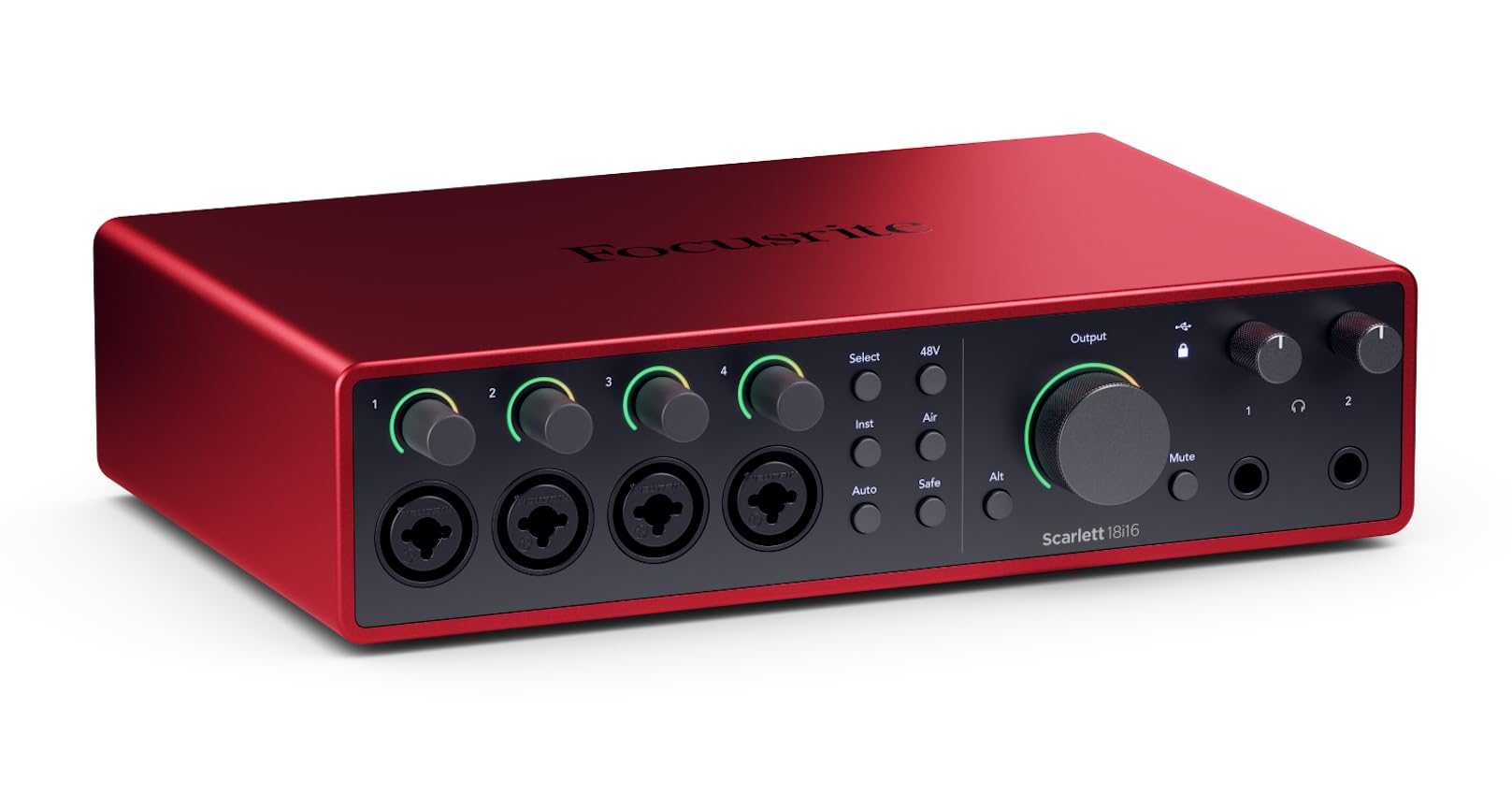
The Scarlett 18i16 4th Gen is the highest-I/O model in this roundup, offering 18 inputs via four mic preamps, ADAT expansion, S/PDIF, and MIDI ports. The mic preamps now deliver 69 dB of gain — up from 56 dB on the 3rd Gen — which is sufficient to drive an SM7B to recording level without an inline booster. The converters are borrowed from Focusrite’s RedNet line, offering 122 dB of dynamic range on the outputs so your monitor mix stays clean even at high levels.
Auto Gain sets input level by playing a short sample and adjusting the preamp automatically, which saves time when switching between different microphones or instruments. The Clip Safe feature monitors the AD converter and backs off gain in real time if peaks approach clipping, a safety net for transient-heavy sources like percussion. The physical controls now use continuous encoders instead of the stepped gain knobs on previous models, so you need to glance at the ring of LEDs to confirm the exact setting.
This interface requires an external power supply — it is not bus-powered — which adds one more cable to manage but guarantees stable power for all four preamps at 48V. Setting up the extra inputs on Windows requires the Focusrite Control desktop app, which some users find unintuitive. If you are tracking a full band or expanding an existing studio with ADAT gear, the 18i16 is the ceiling of what you can get without moving to rack-mount.
Why it’s great
- 69 dB of preamp gain for demanding dynamic mics
- 18 inputs via ADAT and S/PDIF expansion
- Auto Gain and Clip Safe for fast, safe setup
- 122 dB dynamic range converters from RedNet line
Good to know
- Requires external power supply, not bus-powered
- Control software needed to route the rear inputs
- Continuous knobs lack detent for gain position memory
4. Roland Rubix22 2-In/2-Out USB Audio Interface

The Roland Rubix22 is built around a full metal extrusion with rubber side panels, making it noticeably more durable than plastic-shelled interfaces. It includes dedicated MIDI In and Out ports via 5-pin DIN jacks — a feature often missing on 2×2 units at this level — so you can sync a hardware synthesizer or drum machine without buying a separate USB-MIDI adapter. The ground lift switch on the back panel is rare for a bus-powered interface and stops the 60-cycle hum that appears when plugging into a venue’s electrical system.
The mic preamps are extensively shielded and deliver a -128 dB EIN, competitive with the Motu M4. Latency at 64 samples on Windows ASIO stays around 8 ms round-trip, which is comfortable for monitoring vocals while tracking. Combo jacks accept XLR and quarter-inch, and the Hi-Z input handles high-impedance sources like a piezo pickup on an acoustic guitar without loading the signal.
The headphone jack is a known weak point: the connector is surface-mounted and can be damaged by a sideways bump on the desk. Users who had the USB port fail reported solid support from Roland, but the replacement process took a week. The lack of an input/DAW mix knob means you have to use the control panel software to blend dry and processed signals, which is less convenient than a hardware knob.
Why it’s great
- Ground lift switch eliminates venue electrical hum
- Full 5-pin MIDI I/O for hardware synths
- Metal chassis with no plastic panels
- Low-noise preamps with -128 dB EIN
Good to know
- Headphone jack is fragile and surface-mounted
- No hardware blend knob for input/DAW mix
- USB port reported as failure point in long-term use
5. Universal Audio Volt 2 USB Audio Interface

The Universal Audio Volt 2 packs a discrete preamp circuit that mimics the UA 610 tube console when you engage the Vintage mode switch. The difference is audible: the high end gets a subtle saturation that rounds off harsh digital transients, especially on condenser microphones and DI electric guitar. The converters run at 24-bit/192 kHz and the dynamic range measures around 112 dB, which is a few dB behind the SSL 2 MKII but still clean enough for professional podcast work.
The LUNA DAW is included and integrates tightly with the Volt hardware, offering near-zero-latency tracking and a tape-style summing engine. The unit is USB-C bus-powered and supports iPad and iPhone (with the Apple Lightning Camera Adapter), making it the most portable option here for mobile recording in untreated spaces. The build uses a mix of metal chassis and plastic end caps that keeps the weight down to about 1.4 pounds — easy to toss in a backpack for location work.
There is no MIDI I/O and only two inputs, so recording a stereo drum mic pair plus a DI guitar simultaneously is impossible without external patching. The Vintage mode is always active at 100 percent — there is no blend control to dial it back to subtle. Guitarists using high-output active pickups may find the instrument input overloads faster than the competition, forcing them to pad the signal at the source.
Why it’s great
- Vintage switch adds analog tube-style warmth to any source
- Portable USB-C bus power works with iPad/iPhone
- Includes full LUNA DAW with integrated features
- Solid build at under 1.5 pounds for mobile recording
Good to know
- No MIDI I/O ports
- Vintage mode is fixed, not a blendable effect
- Instrument input clips more easily with active pickups
6. Shure MVX2U Gen 2 XLR-to-USB-C Digital Audio Interface
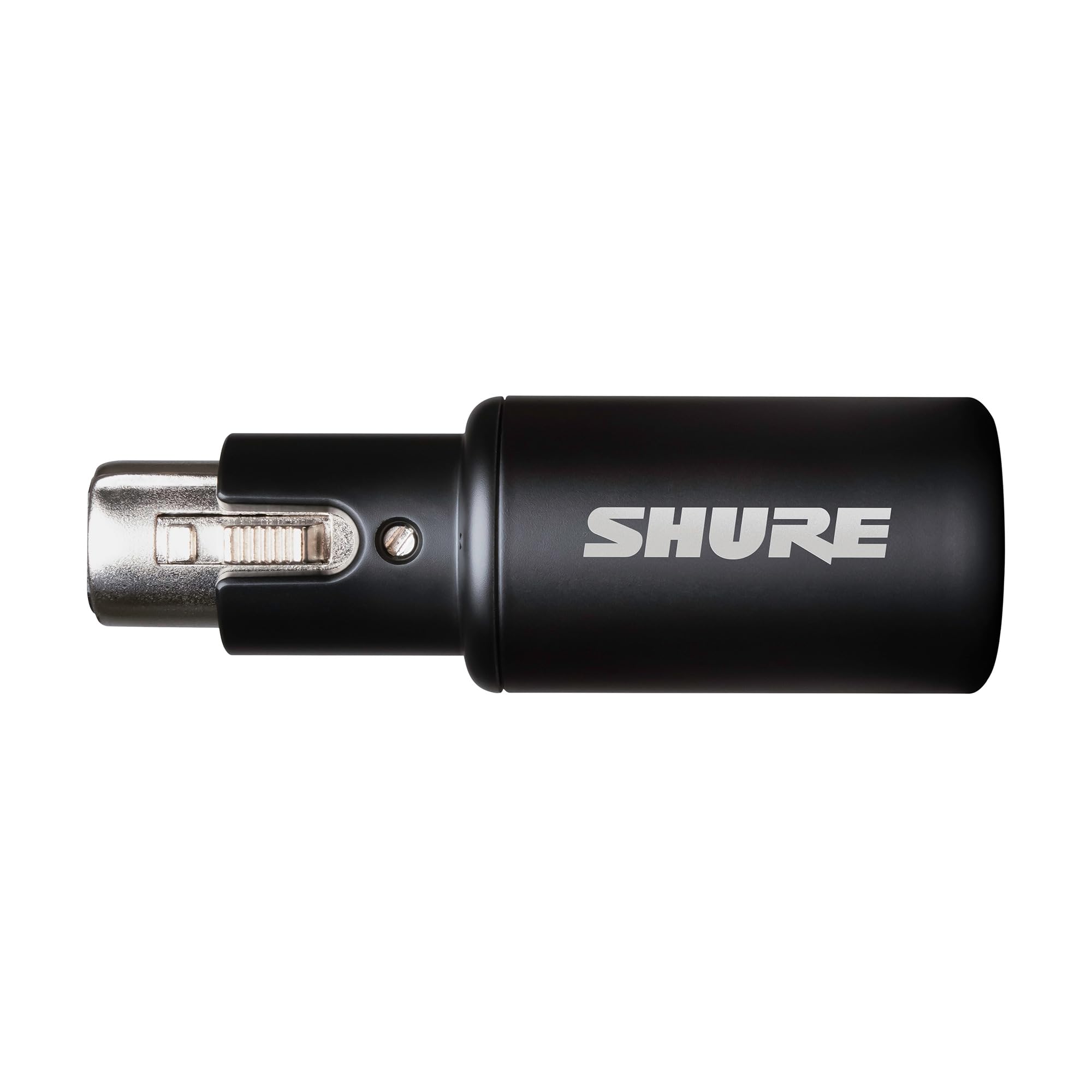
The Shure MVX2U Gen 2 is a single-channel XLR-to-USB-C adapter that gives you Shure’s studio-grade DSP processing in a form factor smaller than a deck of cards. The onboard Auto Level mode adjusts gain in real time to prevent clipping, while the Real-Time Denoiser filters out computer fan hum or air conditioning rumble without flattening the vocal signal. The 60 dB of gain is enough to drive an SM7B to level without a cloudlifter, and the 48V phantom power works with condenser microphones.
The MOTIV app for desktop and mobile gives you a three-band EQ, compression, and limiter that process the signal before it reaches your DAW, so you can record with compression printed to the track. The tone control — Dark, Natural, or Bright — is useful for tailoring the microphone sound without EQ plugins. It works as a bus-powered device on any USB-C phone, tablet, or computer, making it the ultimate solution for a minimalist travel rig.
It is strictly a single-channel interface, so recording stereo sources or a duo requires two units. The USB-C connector uses a thin cable that some users found too fragile for repeated coiling in a gig bag. The app-based control is powerful, but you must open the app to change settings — there are no physical knobs beyond the mute button. For a mobile journalist or podcast host who needs one pristine channel, this is the most focused tool here.
Why it’s great
- Onboard DSP with Auto Level and Denoiser
- 60 dB of clean gain powers demanding dynamic mics
- Ultra-compact form factor for mobile recording
- Compatible with iOS, Android, Windows, and Mac via USB-C
Good to know
- Single channel only — no stereo or multi-mic recording
- Thin USB-C cable is a potential durability concern
- All settings require the app; no physical controls
7. PreSonus AudioBox USB 96 25th Anniversary Studio Recording Package

The PreSonus AudioBox USB 96 package bundles the interface with an M7 large-diaphragm condenser microphone, HD7 monitoring headphones, a desktop stand, cables, and Studio One Artist. The interface itself has two combo inputs with Class A preamps that deliver 48V phantom power and a mix control that blends direct input with computer playback for zero-latency monitoring. The maximum sample rate is 48 kHz at 24-bit — limited compared to the 192 kHz units above, but sufficient for podcasting and demos.
The M7 microphone has a warm low-end response that flatters softer vocalists and works well on acoustic guitar, though it lacks the detail of higher-end LDCs. The HD7 headphones are comfortable for long sessions and have a balanced frequency response without too much bass boost. Studio One Artist includes over 6 GB of loops, samples, and virtual instruments, and the drag-and-drop workflow makes it easy for someone opening a DAW for the first time.
The interface only handles up to 48 kHz sample rate, which means it cannot capture the extended frequency range that some high-res plugins require. The included cables are short and the USB cable type is specific — using a longer or cheaper replacement can cause the interface to disconnect. Serious producers will outgrow this kit within a year and want an upgrade to 192 kHz converters and more input channels, but for the price the value is unmatched.
Why it’s great
- Complete studio package with mic, headphones, and DAW
- Class A preamps with zero-latency mix control
- Studio One Artist is beginner-friendly but feature-rich
- Excellent value for someone starting from zero gear
Good to know
- Limited to 48 kHz sample rate
- Included cables are short and USB-specific
- Outgrows quickly for serious production workflows
8. M-Audio AIR 192|4 Vocal Studio Pro

The M-Audio AIR 192|4 Vocal Studio Pro combines a 2-in/2-out interface with a Nova condenser microphone, shock mount, XLR cable, and HDH40 headphones in one box. The interface has a class-leading round-trip latency of 2.59 milliseconds at the lowest buffer settings, which is competitive with the Focusrite Scarlett line and ensures that monitoring feels instant. The preamps are labeled as “crystal” with low-noise AD converters, and the unit supports 24-bit/192 kHz recording.
The Nova microphone includes a cardioid capsule with a shock mount and windscreen, and it delivers a usable sound for vocal demos and streaming. The HDH40 headphones have a closed-back design with decent isolation for tracking. The included software bundle covers MPC Beats, Ableton Live Lite, Touch Loops effects, and Xpand!2 virtual instrument, giving new producers enough tools to start mixing immediately. The USB-C and USB-A cables are both included for modern and legacy computer ports.
Customer reports indicate intermittent USB failure on some units where the interface passes phantom power but loses computer detection — M-Audio support replaced the faulty units under warranty. The Nova microphone has a somewhat thin midrange and lacks the warmth of the PreSonus M7. The shock mount uses plastic clips that can snap if over-tightened. For the price of the bundle, the interface is the star component, and the extra gear is a genuine starter kit rather than landfill filler.
Why it’s great
- Ultra-low 2.59 ms round-trip latency for real-time tracking
- Includes Nova condenser mic, phones, cables, and software
- 192 kHz / 24-bit converter quality
- USB-C and USB-A cables included for broad compatibility
Good to know
- Some units experience USB failure after months of use
- Nova microphone midrange is thinner than competing mics
- Shock mount clips are plastic and prone to snapping
FAQ
Do I need an interface with MIDI I/O if I only use software instruments?
Should I prioritize more inputs or better preamp quality under ?
What does loopback do and who needs it?
Can I power an interface with a USB hub or power bank?
Final Thoughts: The Verdict
For most users, the audio interface under 500 winner is the Motu M4 because it packs four clean preamps, LCD meters, low-latency drivers, and loopback at a price that undercuts comparable 4-input rivals. If you want the classic console sound with a high-pass filter and exceptional converters, grab the Solid State Logic SSL 2 MKII. And for maximum input count and recording flexibility in a semi-pro home studio, nothing beats the Focusrite Scarlett 18i16 4th Gen.