
That check-engine light glare is finally getting dealt with, but the rusted O2 sensor thread has other plans. Few DIY frustrations match the grind of a cheap socket spreading open on a seized 22mm nut, stripping the hex, and leaving you stranded under the car. The right removal tool delivers the torque and grip to crack that bond without collateral damage.
I’m Min — the co-founder and writer behind Gadgets Feed. I’ve spent countless hours comparing steel grades, drive end designs, and beam geometry across dozens of sensor-specific sockets to build a guide that flags the tools that actually hold up to real-world breakout torque.
This guide cuts through the hype to identify the best o2 sensor removal tool for your specific access challenges and budget, so you stop wrestling with the job and start winning.
How To Choose The Best O2 Sensor Removal Tool
Picking the wrong socket can turn a 30-minute sensor swap into a multi-hour extraction nightmare. Focus on these three criteria to get the tool that fits your car’s specific access constraints and your tolerance for rust-induced torque.
Steel Quality & Drive End Compatibility
The socket must be forged from chromium-vanadium or chromium-molybdenum steel and must offer both 3/8-inch and 1/2-inch drive options. A 1/2-inch drive with a breaker bar delivers the necessary leverage for sensors that have been heat-cycled for a decade; a thin 3/8-inch socket alone will likely deform at the detent.
Access Geometry: Flex-Head vs. Offset vs. Slot
Upstream sensors sit tight against the exhaust manifold, often with wiring harnesses routed directly above them. A flex-head wrench lets you snake the tool in from an angle, while an offset crowfoot design provides a straight-on bite. The side-cut wire slot must be wide enough to pass the sensor connector without forcing it.
Included Thread Chasers vs. Separate Purchase
Removing a corroded sensor frequently damages the bung threads. A kit that includes M18 x 1.5mm and M12 x 1.25mm thread chasers lets you clean the threads immediately before installing the new sensor, preventing cross-threading and costly re-tapping later.
Quick Comparison
On smaller screens, swipe sideways to see the full table.
| Model | Category | Best For | Key Spec | Amazon |
|---|---|---|---|---|
| Lisle 12390 | Premium | Seized, rusted sensors | Forged, heat-treated alloy steel, 6-point design | Amazon |
| MateAuto 16PC | Premium | European / multi-vehicle bays | 16-piece, includes 29mm sockets & swivel adapter | Amazon |
| WORKPRO 7PCS | Mid-Range | Versatile DIY with oil/temp sensors | Alloy steel, includes 27mm thermal & oil pressure sockets | Amazon |
| MateAuto 7PCS | Mid-Range | Quick-release ratchet users | CR-V / CR-MO steel, 72-tooth quick-release ratchet included | Amazon |
| ABN Flex Head | Entry-Level | Downstream / tight floorboard access | Cold-forged steel, flex head, curved handle | Amazon |
| bylikeho 6PC | Entry-Level | Budget-conscious first-time DIY | High-strength steel, 3 socket types + thread chasers | Amazon |
| HTOMT 5PCS | Budget | Light-duty / occasional use | Chrome vanadium steel, 3 socket types + thread chasers | Amazon |
In‑Depth Reviews
1. Lisle 12390 Dual Drive Oxygen Sensor Wrench

The Lisle 12390 is the gold standard for breaking loose sensors that have fused into the exhaust bung. Its forged, heat-treated alloy steel body and true 6-point broach eliminate the rounding failure that plagues generic 12-point sockets. The 1/2-inch drive end lets you pair it directly with a breaker bar, delivering the shear force needed to crack rusted threads without deforming the tool.
At just under nine ounces, this is a dedicated single-purpose wrench — not a kit — and that focus is its strength. It offers no wire slot, so you must disconnect the sensor connector before applying the socket. The dual-drive tang accepts both 3/8-inch and 1/2-inch ratchets, giving you flexibility based on available clearance. Reviewers consistently note that it succeeds where multi-piece kits failed on heavily corroded fasteners.
Costlier than most entry sockets, the Lisle pays for itself on the first sensor it saves you from having to drill out. If you regularly work on older vehicles in the salt belt, this is the tool that belongs in your go-to box. Its six-point teeth grip the flat of the hex, not the corners, which is the mechanical difference between removal and slip.
Why it’s great
- Forged steel withstands high torque without flexing
- Dual 3/8″ and 1/2″ drive compatibility
- Six-point design prevents rounding on seized sensors
Good to know
- No wire slot requires sensor disconnection first
- Single-socket tool, not a full kit
2. MateAuto 16PC Oxygen Sensor Socket Set
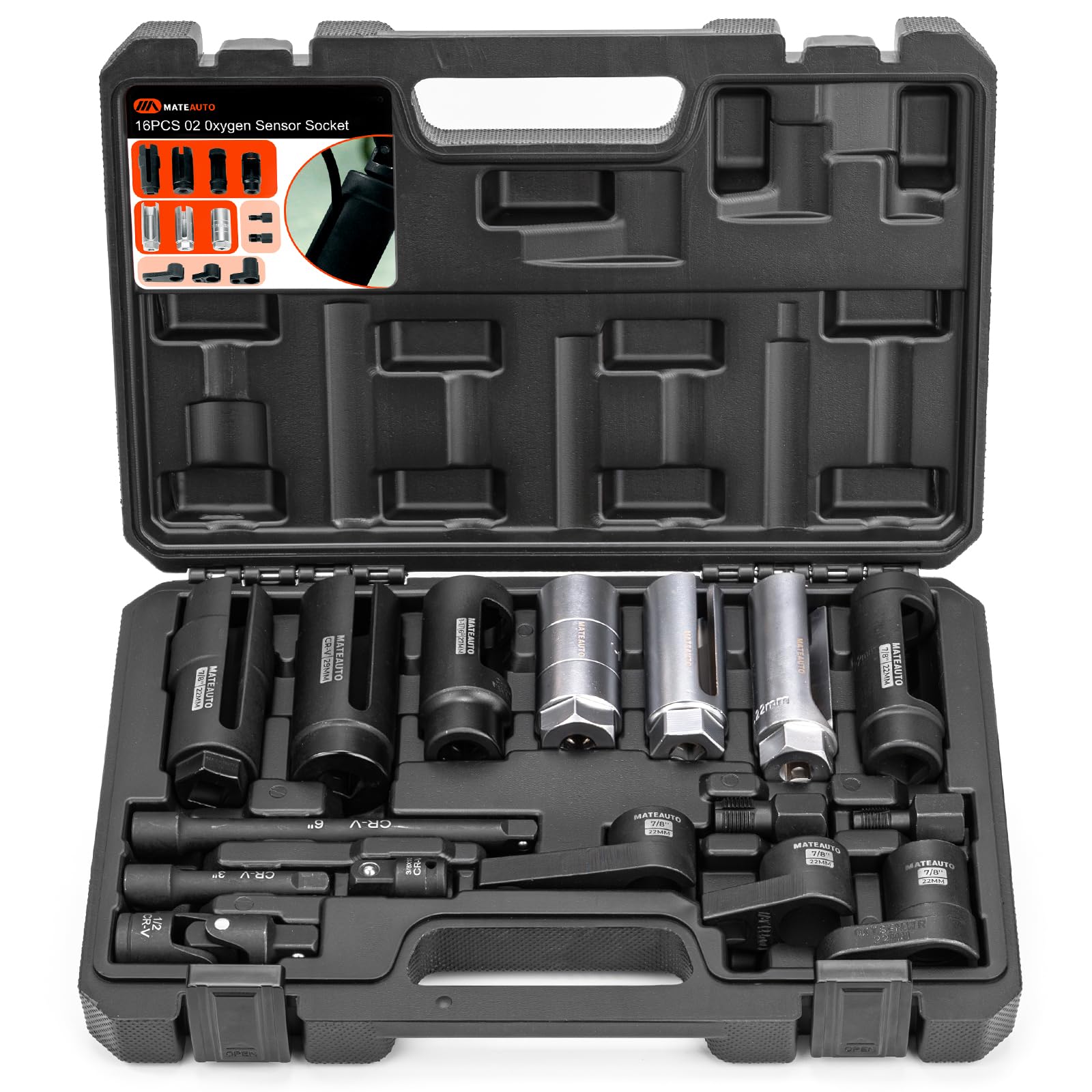
This 16-piece set from MateAuto covers the widest size range of any kit on this list, including 22mm, 27mm, and 29mm sockets plus 7/8-inch, 1-inch, and 1-1/16-inch variants. The inclusion of a 1/2-inch swivel adapter and 3-inch and 6-inch extensions makes it the only kit that can reach deeply recessed or awkwardly angled sensors without sacrificing torque transfer.
The sockets are heat-treated chromium-molybdenum and chromium-vanadium steel, with both 6-point and 12-point broach options included. Laser-etched size markings let you grab the correct socket without squinting. The M12 x 1.25mm and M18 x 1.5mm thread chasers are standard, and the heavy-duty plastic case keeps everything organized.
European car owners will appreciate the 29mm coverage — larger than the universal 22mm standard — which fits some Mercedes, VW, and BMW sensors directly. At 8.27 pounds, this is a heavy kit best kept in a garage cart rather than a roadside pouch. For the DIYer working across multiple platforms, this set eliminates the need for second purchases.
Why it’s great
- Largest size range including 29mm for European cars
- Includes swivel adapter and extensions for tight access
- Heat-treated CR-MO and CR-V steel prevents spread
Good to know
- Heavy kit not ideal for mobile tool rolls
- No ratchet included despite the price point
3. WORKPRO 7PCS O2 Oxygen Sensor Socket Set

The WORKPRO 7PCS set hits the sweet spot between coverage and cost. It includes both offset and long 7/8-inch 22mm O2 sockets plus two specialized sockets for thermal (27mm) and oil pressure (1-1/16-inch) sensors, making it a multi-role solution for anyone tackling more than just oxygen sensors. The phosphorus and heat-treated surface fights corrosion effectively.
Each socket features a wide wire gate that cleanly passes the sensor connector, and the slotted square hole design on the offset socket adds noticeable anti-slip retention compared to smooth interior bores. The M12 x 1.25mm and M18 x 1.5mm thread chasers are included, allowing immediate bung cleanup after removal. The 3/8-inch and 1/2-inch drive ends match standard ratchets.
Reviewers highlight the kit’s ability to handle multiple makes — from Honda Pilot to older Chevrolet trucks — without any socket deformation. The absence of a 29mm socket means it won’t cover all European applications, but for domestic and Asian vehicles this is the most bang for the buck. The blow-molded case keeps the pieces organized without taking up excessive drawer space.
Why it’s great
- Includes thermal and oil pressure sockets for broader utility
- Wide wire gate and anti-slip slot design
- Thread chasers included for immediate cleanup
Good to know
- No 29mm socket for European sensor sizes
- Case is functional but not impact-resistant
4. MateAuto 7PCS Oxygen Sensor Socket Set
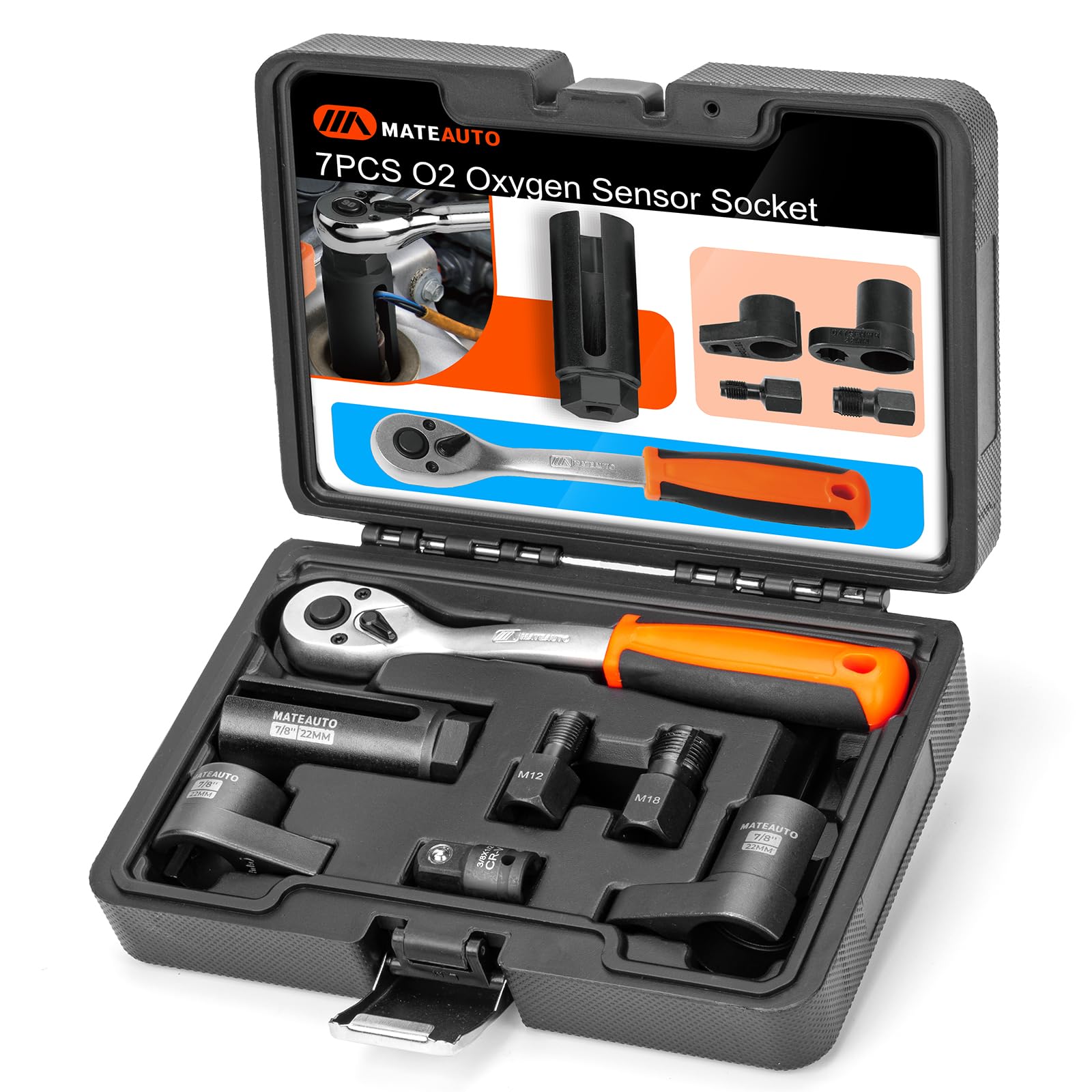
This 7-piece set is the only kit on this list that includes a 72-tooth quick-release ratchet, saving you the hassle of digging out your own handle. The socket selection covers the three essential O2 profiles: 3/8-inch drive offset, 1/2-inch drive offset, and a 3/8-inch drive long socket for downstream sensors with deeper bung positions. All sockets are forged from CR-V and CR-MO steel with a phosphated finish.
The anti-slip groove on each socket and the offset structure on the two drive sizes enhance grip and stability when applying leverage. The M12 and M18 thread chasers clean the bung threads efficiently. The included 3/8-inch to 1/2-inch adapter lets you use the ratchet on the larger 1/2-inch drive offset socket without needing a separate tool.
Reviewers on Toyota Sienna and Honda Pilot applications report the set handled multiple sensor swaps without deformation. The quick-release mechanism on the ratchet is convenient for fast socket changes, though the ratchet itself is a mid-weight unit — fine for sensor work but not a heavy breaker bar replacement. This set fills the gap for someone entering mid-range investment without owning a dedicated ratchet.
Why it’s great
- 72-tooth ratchet included saves separate tool purchase
- CR-V and CR-MO steel resists deformation under load
- Includes adapter for cross-drive compatibility
Good to know
- Included ratchet lacks breaker bar leverage for extreme rust
- Only three socket profiles limit multi-sensor coverage
5. ABN 7/8in 22mm Flexible Head Oxygen Sensor Wrench

The ABN flex-head wrench is purpose-built for downstream sensors positioned upward toward the floorboard — a common frustration on unibody vehicles where a straight socket simply cannot align. The 22mm hex end is cold-forged steel, and the flex head pivots to let you approach the sensor from an angle while still applying rotational force.
Its curved handle provides additional clearance around exhaust pipes and heat shields, and the wire gap in the socket head passes the sensor cable. Unlike socket-based kits that rely on a ratchet, this wrench works as a standalone tool — no additional handle needed. The slim profile fits spaces where a ratchet and socket stack would be too tall.
Anecdotal feedback from owners of 1993 BMW 740iL and 1999 Buick Century models confirm the wrench accesses tight spots that defeat socket-style removers. The primary trade-off is leverage — the handle length is shorter than a breaker bar, so heavily rusted sensors may require a cheater pipe or penetrating oil pre-soak. For non-seized downstream swaps, this is the fastest tool in the box.
Why it’s great
- Flex head reaches upward and inward sensor positions
- Cold-forged steel resists deformation
- No additional ratchet or handle needed
Good to know
- Short handle limits leverage on seized sensors
- Single-use tool without thread chaser or other socket types
6. bylikeho O2 Sensor Socket Set

The bylikeho set proves entry-level pricing doesn’t have to mean entry-level capability. This six-piece kit includes a 3/8-inch drive ultra-deep socket (3-1/8 inches long), a fine-pry socket wrench (1-1/4 inches), a 1/2-inch drive offset crowfoot (1-15/16 inches), and both M18 and M12 thread chasers. The steel is black oxide coated for basic corrosion resistance.
The side-cut design on the sockets allows the sensor wiring to pass without damage, and the offset structure on the crowfoot provides additional clearance in manifold-adjacent positions. The compact plastic case fits into a small tool drawer or glovebox, making it a viable emergency roadside companion. At 1.82 pounds, this is the lightest full kit on the list.
Real-world feedback from Honda Pilot and Chevrolet Avalanche owners confirms the set handled four-sensor jobs without failure. The thread chasers are fully functional for cleaning bung threads, removing the need for a separate tap-and-die purchase. Where this kit falls short is on heavily rusted sensors with high breakaway torque — the steel can survive, but the 3/8-inch drive is not optimal for breaker bar use.
Why it’s great
- Ultra-deep socket reaches recessed sensor positions
- Thread chasers included for post-removal cleanup
- Compact and portable storage case
Good to know
- 3/8-inch drive only on some sockets limits leverage
- Black oxide finish less corrosion-resistant than phosphating
7. HTOMT 5PCS Oxygen Sensor Socket Set
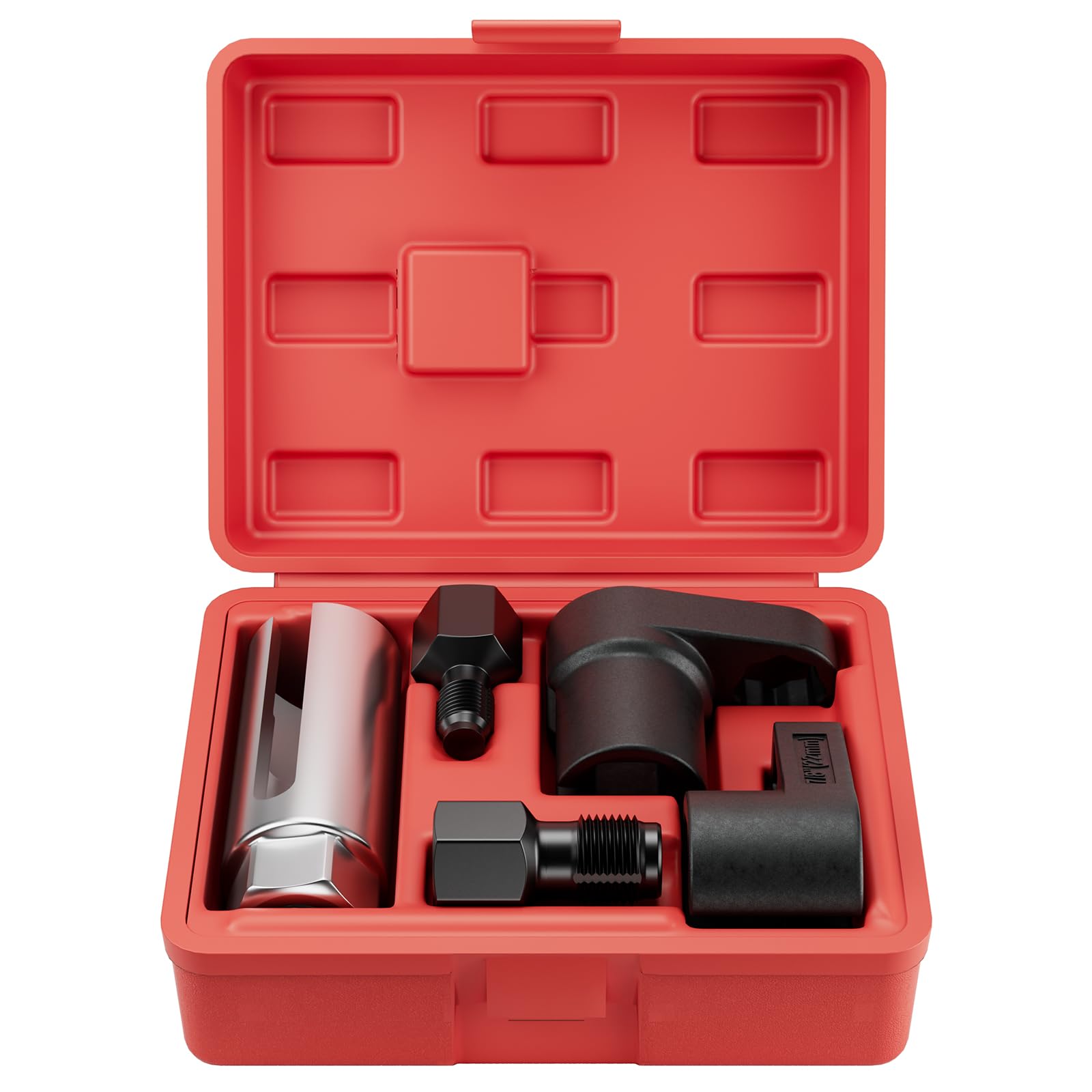
The HTOMT 5-piece set is the no-frills entry point for DIYers performing a one-time sensor replacement on a relatively clean vehicle. The kit provides three socket profiles — an extra-deep broach, a low-profile crowfoot, and an offset crowfoot — plus M18 and M12 thread chasers. The chrome vanadium steel is protected with a phosphating and electroplating layer for rust resistance.
All sockets use the universal 7/8-inch 22mm hex opening and accept both 3/8-inch and 1/2-inch drive ends. The side-cut design on the deep socket passes sensor wiring without pinching. The high-impact ABS case offers drop protection and organized storage, though it occupies slightly more space than fabric rolls.
User reports confirm the set works for standard sensor swaps on late-model vehicles without corrosion issues. The thread chasers are functional for cleaning, though the tool steel is noticeably lighter than premium alloy sets. The primary limitation is the lower hardness of the chrome vanadium steel — repeated high-torque applications in rust-bound environments may eventually deform the socket corners. For occasional use on well-maintained vehicles, this is a perfectly capable starter kit.
Why it’s great
- Three socket styles cover common sensor positions
- Thread chasers included for bung thread cleaning
- Phosphated and electroplated for corrosion protection
Good to know
- Cr-V steel may deform under repeated high torque
- No 27mm or 29mm sockets for non-standard sensors
FAQ
Can I use a standard 22mm socket to remove an O2 sensor?
Do I need thread chasers for every O2 sensor replacement?
What is the correct drive size for a breaker bar on O2 sensors?
Final Thoughts: The Verdict
For most users, the best o2 sensor removal tool winner is the Lisle 12390 because its forged, heat-treated 6-point design delivers the torque capacity required to break rusted sensors without rounding the hex. If you want a comprehensive multi-vehicle kit with broad size coverage, grab the MateAuto 16PC set. And for a single-purpose flex-head solution that reaches tight floorboard positions, nothing beats the ABN Flex Head Wrench.