
A 4K TV with HDR is only as good as its ability to handle the contrast between a starfield and a shadow. Without real luminance headroom and per-pixel backlight control, HDR is just a checkbox — the difference between a washed-out image and one that makes you flinch at an explosion is measured in nits and local dimming zones. This guide cuts through the marketing to focus on the panel technology and HDR format support that actually transform your viewing.
I’m Min — the co-founder and writer behind Gadgets Feed. I’ve spent hundreds of hours cross-referencing peak brightness measurements, local dimming zone counts, and HDR format compatibility across the current market to build a guide that matches real-world performance to the spec sheet.
Whether you game in Dolby Vision or binge native HDR10+ content, understanding which Mini-LED or QD-OLED panel delivers genuine HDR punch ensures you buy the best 4k tv with hdr for your room and budget.
How To Choose The Best 4K TV With HDR
HDR performance is defined by three core pillars: peak luminance (measured in nits), the number of local dimming zones controlling the backlight, and the HDR formats the display can decode. A TV that supports Dolby Vision but only hits 400 nits peak brightness will crush shadow detail in dark scenes. Conversely, a 1000-nit panel without Dolby Vision IQ’s ambient-light sensing won’t adapt to changing room brightness. You must match the panel’s physical capability to the HDR ecosystem you consume most — whether that’s Dolby Vision on streaming services or HDR10+ on Amazon Prime Video.
Peak Brightness and Local Dimming Zones
For true HDR impact, aim for a sustained brightness of at least 800 nits on a 10% window. Mini-LED panels with 200+ local dimming zones can produce the kind of contrast that makes specular highlights — like sunlight glinting off a car hood — pop without blooming into surrounding dark areas. Budget-tier edge-lit panels often lack both the brightness and the zone count to avoid a gray halo around bright objects.
HDR Format Support: Dolby Vision, HDR10+, HLG
Dolby Vision is the most widely used dynamic HDR format across Netflix, Disney+, and Blu-ray releases. HDR10+ is prevalent on Amazon Prime Video and some 4K discs. HLG is the broadcast standard for live HDR sports. A TV that supports both Dolby Vision and HDR10+ gives you the widest content compatibility. Filmmaker Mode is also important — it preserves the director’s intended color and frame rate by disabling motion smoothing and sharpening.
Refresh Rate and Gaming HDR
If gaming with HDR is your priority, a native 120Hz or 144Hz panel with HDMI 2.1 ports ensures you can run 4K at high frame rates while keeping VRR enabled. Dolby Vision Gaming mode on compatible titles can deliver dynamic metadata at 120Hz, but you’ll need a TV that specifically advertises Dolby Vision Gaming support — not all Dolby Vision TVs do. Input lag should fall below 15ms in game mode to keep HDR gaming responsive.
Quick Comparison
On smaller screens, swipe sideways to see the full table.
| Model | Category | Best For | Key Spec | Amazon |
|---|---|---|---|---|
| iFFALCON 55U85 | Mini-LED | High-fps Gaming | 144Hz native VRR, 1000 nits | Amazon |
| Amazon Ember 50″ | QLED Fire TV | Alexa Integration | Omnisense auto wake, Wi-Fi 6 | Amazon |
| LG QNED85A 55″ | Mini-LED | AI Picture Processing | 144Hz VRR, Alpha 8 Gen2 | Amazon |
| Toshiba Z670R 55″ | Mini-LED QLED | Japanese Tuning | 144Hz, REGZA Engine ZRi Gen3 | Amazon |
| Hisense 55U7SG | Mini-LED ULED | Bright Room HDR | 165Hz native, 3000 nits peak | Amazon |
| TCL QM7K 65″ | QD-Mini LED | Halo-Free Contrast | 2500 dimming zones, 144Hz | Amazon |
| Samsung S90F 55″ | QD-OLED | True Black HDR | 144Hz, NQ4 AI Gen3, HDR+ | Amazon |
| Samsung QN90D 75″ | Neo QLED Mini-LED | Object Tracking Sound+ | 144Hz, Neo Quantum HDR+ | Amazon |
| TCL QM8 85″ | Mini-LED QLED | Massive Screen Size | 2300 zones, 240Hz Game Accelerator | Amazon |
| Sony BRAVIA 7 85″ | Mini-LED | PS5 Integration | XR Clear Image, Dolby Vision | Amazon |
In‑Depth Reviews
1. iFFALCON 55″ MiniLED Smart TV
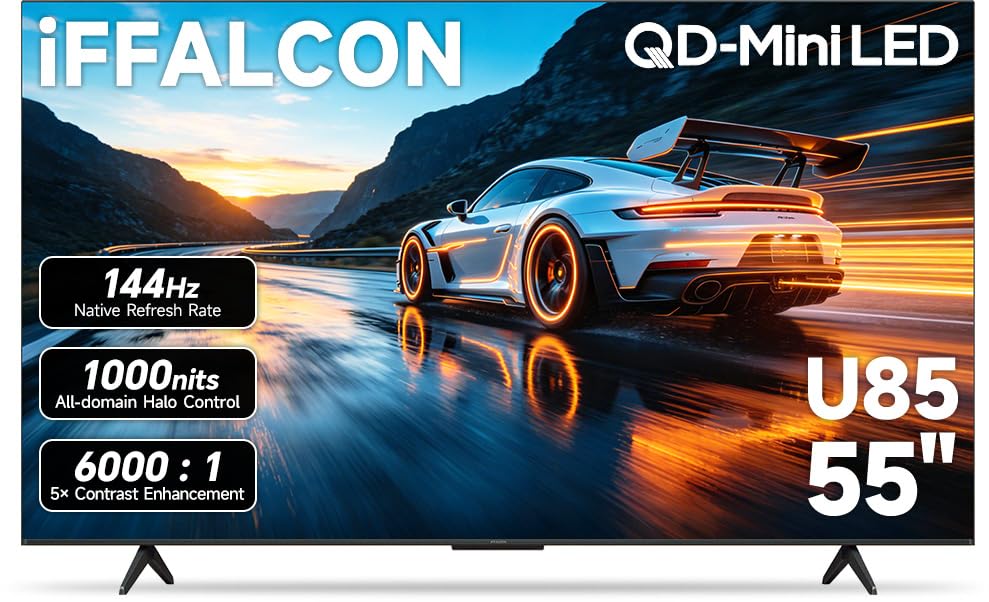
The iFFALCON 55U85 is a Mini-LED panel with a native 144Hz refresh rate and VRR range that scales up to 288Hz, making it one of the fastest HDR gaming displays in its price tier. Its 6000:1 contrast ratio combined with local dimming and 1000-nit peak brightness delivers Dolby Vision and HDR10+ content with enough luminance to separate specular highlights from shadow detail — Cylon raiders in Battlestar Galactica look appropriately menacing in dark space scenes.
Four HDMI 2.1 ports — two running 4K@144Hz for PC and consoles, two at 4K@60Hz for peripherals — eliminate port-swapping entirely. Auto Low Latency Mode (ALLM) kicks in instantly without digging through menus. The built-in 50W 2.1-channel system (15W tweeters plus a 20W woofer) with Dolby Atmos passthrough and DTS Virtual:X provides room-filling audio that actually has bass presence.
Beyond gaming, the inclusion of Google TV hotel mode, IR blaster, and IP control makes this unit functional for commercial installations like Airbnb properties or hotel rooms where menu locking and remote management are required. The far-field voice control via Google Assistant and Alexa gives hands-free search without reaching for the remote. For the price, the feature density here is remarkable.
Why it’s great
- 144Hz VRR panel with FreeSync Premium Pro
- Four HDMI 2.1 ports with 4K@144Hz capability
- Built-in 50W audio with Dolby Atmos
Good to know
- Thicker chassis than ultra-slim premium models
- Flickering reported on a small number of units
2. Amazon Ember 50″ QLED Series
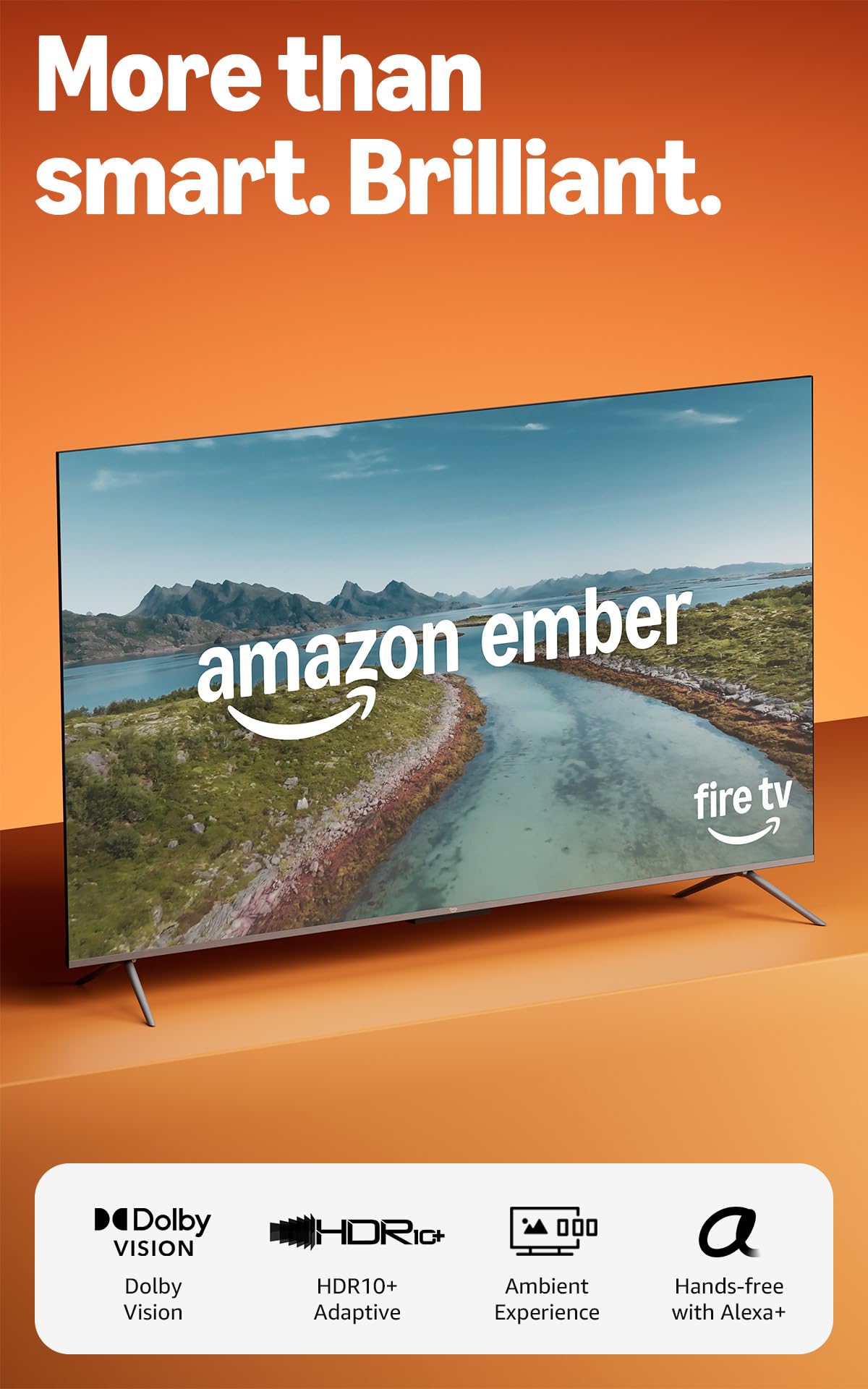
The Amazon Ember 50″ QLED Series integrates the 2026 Fire TV OS with a quad-core processor and Wi-Fi 6 support for snappy app loading and smooth streaming. The QLED panel with Dolby Vision and HDR10+ Adaptive delivers vibrant colors and good brightness for a mid-range unit, though peak luminance is significantly lower than Mini-LED competitors — about 400-500 nits, limiting HDR impact in bright rooms.
The custom Omnisense technology uses built-in sensors to wake the display when you enter the room — a feature that turns the TV into a digital art frame when idle. Hands-free Alexa with the microphones electronically disconnected via a physical switch provides privacy control. The new Fire TV interface reduces scrolling by pinning favorite apps and offering personalized recommendations from Alexa+.
Streaming game support through Amazon Luna and Xbox Game Pass without a console is a practical bonus. Input lag is adequate for casual gaming, but serious HDR gamers will want the higher refresh rates of the iFFALCON or Toshiba. Some users report audio desync on Prime Video and occasional menu stuttering, which Fire TV firmware updates typically address.
Why it’s great
- Omnisense auto wake and art mode
- Wi-Fi 6 for fast streaming
- Physical mic disconnect switch
Good to know
- Modest ~500-nit peak brightness limits HDR
- Occasional audio delay on certain apps
3. LG 55″ QNED85A Mini LED

The LG QNED85A uses Mini-LED backlighting with Precision Dimming — an array of individually controlled zones that improve black levels and color saturation compared to standard edge-lit QNED. The Alpha 8 AI Processor Gen2 analyzes content in real-time, applying scene-adaptive tone mapping and AI Super Upscaling 4K to improve lower-resolution HDR streams without introducing artifacts.
Dynamic QNED Color promises 100% Color Volume in the DCI-P3 space, meaning colors maintain saturation even at peak brightness. The native 120Hz panel supports VRR up to 144Hz and includes AMD FreeSync Premium. The Game Optimizer dashboard centralizes all gaming settings — VRR toggle, black stabilizer, crosshair overlay — in one location, which is useful for switching between HDR and SDR game modes quickly.
webOS 24 includes LG Channels with 350+ free channels and the Re:New Program for future software updates. The adjustable stand width — up to 42.3 inches for the 65-inch model — accommodates different AV furniture. Users who prefer a number pad for quick access to apps may find the Magic Remote limiting, as it relies on pointer navigation.
Why it’s great
- Alpha 8 Gen2 AI picture and upscaling
- 144Hz VRR with FreeSync Premium
- 100% DCI-P3 Color Volume
Good to know
- Magic Remote lacks number pad
- Sound may revert to internal speakers
4. Toshiba 55″ Z670R Mini-LED

The Toshiba Z670R combines Mini-LED backlighting with QLED quantum dot color, driven by the REGZA Engine ZRi Gen3 — an AI processor developed by Toshiba’s engineering team in Japan. The processor performs scene-by-scene optimization of clarity, contrast, and audio, resulting in natural skin tones and stable black levels that avoid the oversharpened look some competitors produce.
Native 144Hz panel with AMD FreeSync Premium, VRR 144Hz, and ALLM makes this suitable for high-frame-rate HDR gaming. The Total HDR Solution Pro supports Dolby Vision IQ, HDR10+, HDR10+ Adaptive, and HLG, covering all major dynamic HDR ecosystems. The AI Light Sensor Pro adjusts brightness and color balance to ambient room conditions, reducing eye strain during extended sessions.
REGZA Power Audio Pro with a dedicated bass woofer delivers deeper low-end than typical TV speakers — about 20W of subwoofer power — reducing the immediate need for a soundbar. The Fire TV interface with Alexa built-in provides voice search and app management. The minimalist design with clean lines reflects the Japanese aesthetic heritage Toshiba promotes.
Why it’s great
- REGZA Engine ZRi Gen3 for natural picture
- Dolby Vision IQ and HDR10+ Adaptive
- Bass woofer for richer built-in audio
Good to know
- Limited availability outside Amazon
- Some users report menu lag on initial boot
5. Hisense 55″ U7 Mini-LED ULED
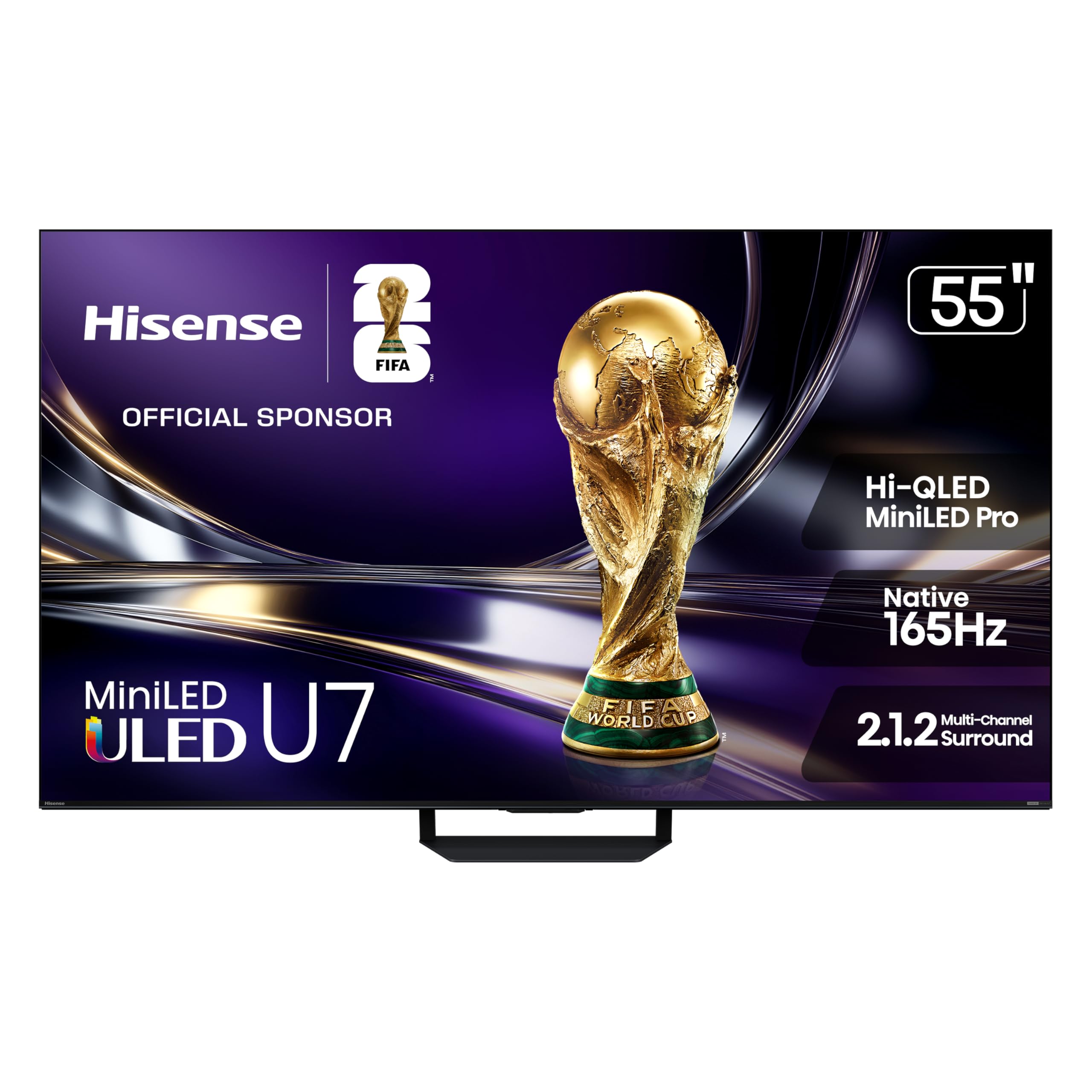
The Hisense 55U7SG is a Mini-LED ULED panel with a native 165Hz refresh rate and VRR that scales to 330Hz — the highest refresh rate in this comparison. The Hi-QLED MiniLED Pro backlight system claims up to 3000 local dimming zones and 3000 nits peak brightness, figures that rival premium flagships. The Hi-View AI Engine Pro constantly adjusts color, contrast, and detail based on scene analysis.
The anti-reflection and glare-free screen treatment uses a dual-layer coating that minimizes reflections from windows and overhead lights, making this one of the few HDR TVs that performs well in sunlit rooms without washing out shadow detail. Dolby Vision IQ, HDR10+, and IMAX Enhanced are all supported, ensuring compatibility with the widest range of HDR content.
Google TV integration with Bluetooth 5.4 provides low-latency wireless connectivity for peripherals. The 2.1.2-channel audio system with Dolby Atmos produces better built-in sound than many competitors, though a dedicated soundbar still enhances the experience for critical listening. The raw brightness of this panel makes it particularly effective for HDR gaming in spaces where you can’t control ambient light.
Why it’s great
- 165Hz native with 330Hz VRR
- 3000 nits peak for bright-room HDR
- Dual-layer anti-glare screen coating
Good to know
- Interface can feel cluttered
- Soundbar recommended for audiophiles
6. TCL 65″ QM7K Mini LED QLED
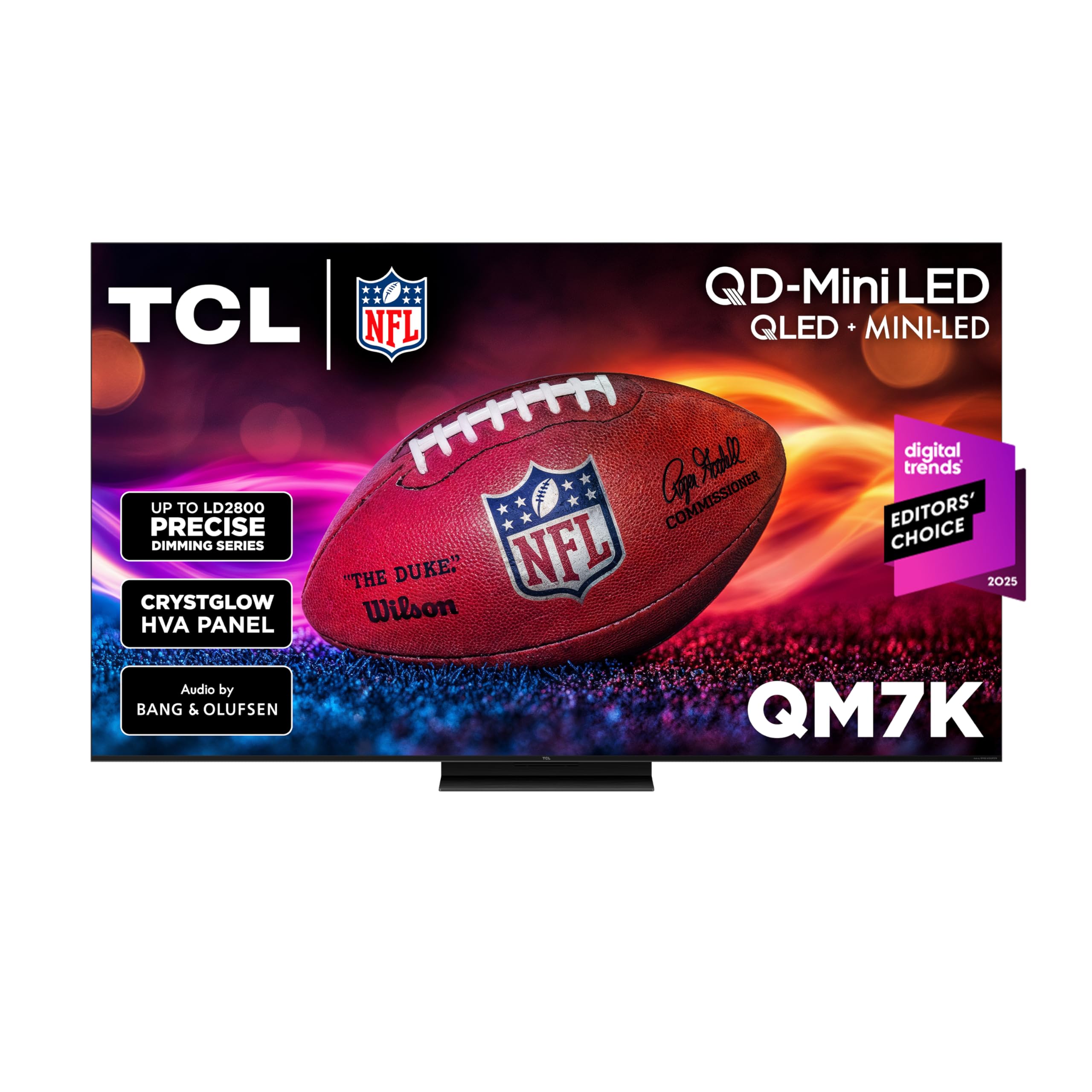
The TCL QM7K uses QD-Mini LED technology with the TCL Halo Control System, which combines a Super High Energy LED Microchip, Micro-OD Reduced Optical Distance, and a Bi-direction 23-bit Backlight Controller to minimize haloing around bright objects. Up to LD2500 precise dimming zones provide pure black levels that approach OLED territory while maintaining the high brightness Mini-LED is known for.
The CrystGlow HVA panel blocks reflections and maintains image detail even in sunlit rooms. The native 144Hz panel supports VRR up to 288Hz and includes AMD FreeSync Premium Pro. Onkyo audio with Dolby Atmos and Bang & Olufsen sound tuning delivers a noticeably wider soundstage than most integrated TV speakers — the B&O partnership brings DSP tuning that improves dialogue clarity.
Google TV runs responsively on the platform, though some users report the included remote feels cheaper than the TV itself. Port placement — HDMI on the right, power on the left — is well thought out for cable management. For the price, the combination of zone count, Hi-QLED color, and Halo Control makes this a strong mid-range to premium option for HDR movie enthusiasts.
Why it’s great
- 2500 dimming zones for near-black levels
- B&O tuned audio with Dolby Atmos
- CrystGlow HVA panel for reflection control
Good to know
- Remote feels cheap for the price
- No 3.5mm audio jack
7. Samsung 55″ S90F Smart TV

The Samsung S90F is a QD-OLED panel — the only emissive display technology in this list — meaning each pixel emits its own light, achieving absolute black levels without any backlight bleed. The NQ4 AI Gen3 processor uses 128 neural networks for real-time 4K upscaling and HDR tone mapping, transforming SDR content into HDR-like quality by boosting brightness and expanding color volume dynamically.
Motion Xcelerator 144Hz provides smooth motion in fast-paced HDR games and sports. The AI Motion Enhancer specifically tracks fast-moving balls in sports, reducing blur and flickering. The Q-Symphony feature syncs the TV speakers with a compatible Samsung soundbar for a unified sound stage — useful for HDR movies where dialogue and effects need separation.
The ultra-thin bezel and Graphite Black finish give it a premium aesthetic, but the anti-reflective coating is fragile — cleaning with standard glasses cleaner can permanently damage it. The Samsung Tizen OS offers all major streaming apps, but Samsung’s practice of requiring an account for full functionality and the ads on the home screen are downsides. The solar-powered remote is a thoughtful sustainability touch.
Why it’s great
- QD-OLED per-pixel lighting for true black
- 128 neural network AI upscaling
- Q-Symphony with Samsung soundbars
Good to know
- Anti-reflective coating is delicate
- Samsung account required for full features
8. Samsung 75″ Neo QLED QN90D

The Samsung QN90D is a Neo QLED Mini-LED panel with Quantum Matrix technology — Micro LEDs precisely controlled to reduce blooming and improve contrast. Neo Quantum HDR+ maps dynamic metadata across the entire frame to maintain peak brightness and shadow detail simultaneously. The NQ4 AI Gen2 Processor runs 20 neural networks to drive the Smart TV Hub and Dolby Atmos sound.
Object Tracking Sound+ is this TV’s standout feature: built-in speakers create the illusion of sound moving across the screen to match on-screen action — cars speeding from left to right produce audio that tracks with them. Real Depth Enhancer Pro analyzes the focal point of each frame and applies contrast adjustments to create a more dimensional image. The combination of these features makes the QN90D particularly strong for high-budget HDR movies and narrative games.
Motion Xcelerator 144Hz ensures smooth motion, and the Ultra Viewing Angle layer keeps color accuracy consistent when viewed from the side — a common weakness of VA panels. The HDR Brightness Optimizer adjusts tone mapping in real time based on room lighting. The 75-inch size and heavy weight (75 lbs) require a sturdy stand or wall mount with proper support.
Why it’s great
- Object Tracking Sound+ for directional audio
- Neo Quantum HDR+ high dynamic range
- Ultra Viewing Angle for side seating
Good to know
- Samsung account and ads on home screen
- Heavy — requires strong wall mount
9. TCL 85″ QM8 Mini LED QLED

The TCL QM8 offers 85 inches of Mini-LED real estate with up to 2,300 local dimming zones that dynamically adapt to on-screen content, producing ultra-deep blacks without blooming. The HighBright Pro LED Backlight and QLED quantum dot technology deliver over a billion colors with a wide color gamut that meets DCI-P3 standards for HDR content.
HDR Ultra support includes Dolby Vision IQ, HDR10, HDR10+, and HLG — providing compatibility across all major HDR platforms. The Motion Rate 480 with MEMC frame insertion combines multiple motion enhancement technologies for blur-free sports and action scenes. The Game Accelerator 240 boosts the native 120Hz panel up to 240Hz VRR with AMD FreeSync for competitive gaming.
Google TV provides a clean interface with Chromecast built-in and voice control via the included remote. The sheer size of this panel means it needs professional setup — at 85 inches, it is heavy and requires a two-person lift. Some units have reported backlight defects, so checking the package upon arrival and testing within the return window is recommended.
Why it’s great
- 2300 local dimming zones for high contrast
- 240Hz Game Accelerator with FreeSync
- Massive 85-inch screen for immersive HDR
Good to know
- VA panel has narrow viewing angles
- Quality control issues reported on some units
10. Sony 85″ BRAVIA 7 Mini LED QLED

The Sony BRAVIA 7 uses thousands of Mini LEDs precisely controlled by the XR Backlight Master Drive to deliver high brightness and contrast without the blooming that plagues lesser Mini-LED implementations. The XR Triluminos Pro processor accesses billions of accurate real-world colors through QLED technology, producing skin tones and natural landscapes with a realism that Sony’s image processing is known for.
Exclusive PlayStation 5 features include Auto HDR Tone Mapping — which lets the PS5 recognize the TV and automatically optimize HDR settings — and Auto Genre Picture Mode, which switches to Game mode when a game is detected and back to Standard mode for streaming. The Game Menu puts all gaming picture settings and assist features in a single overlay, including a crosshair and screen size adjustment for competitive play.
The Acoustic Multi-Audio system uses speakers positioned behind the screen to create sound that matches picture, improving dialogue clarity. Studio calibrated picture modes for Netflix, Prime Video, and Sony Pictures CORE deliver reference-grade colors without manual tweaking. Dolby Vision, IMAX Enhanced, and DTS:X support cover the full HDR gamut. The Sony Pictures CORE app includes 5 credits for 4K UHD movie purchases and a 12-month subscription to a library of classics.
Why it’s great
- Auto HDR Tone Mapping with PS5
- XR Triluminos Pro for accurate colors
- Studio calibrated modes for major streaming apps
Good to know
- Noticeable blooming in high-contrast scenes
- Narrow viewing angle compared to OLED
FAQ
Does Dolby Vision require special HDMI cables?
What is the difference between HDR10 and HDR10+?
Can I use an HDR TV as a computer monitor?
Final Thoughts: The Verdict
For most users, the best 4k tv with hdr winner is the iFFALCON 55U85 because it delivers a native 144Hz Mini-LED panel with four HDMI 2.1 ports, Dolby Vision and HDR10+ support, and room-filling 50W audio — all at a price that undercuts competitors on feature density. If you want true OLED black levels and can control room lighting, grab the Samsung S90F QD-OLED. And for a bright room where raw luminance conquers ambient light, nothing beats the Hisense 55U7SG with its 165Hz panel and anti-glare coating.