
The shelf-staring panic is real. At 11 months, your baby is a mobility machine — crawling, pulling up, cruising — and their brain is processing cause-and-effect faster than you can say “no.” The toys they played with last month are suddenly boring, and anything within arm’s reach becomes a target. This is the moment the right toy shifts from simple entertainment to a critical tool for fine motor control, sensory integration, and the first sparks of problem-solving logic.
I’m Min — the co-founder and writer behind Gadgets Feed. I’ve spent hundreds of hours researching and cross-referencing developmental milestones, material safety standards, and real parent feedback to isolate only the toys that genuinely challenge and engage an 11-month-old without overstimulating or falling apart.
Whether you want to encourage crawling, strengthen the pincer grip, or teach object permanence, this guide to the best 11 month old toys will help you cut through the noise and find safe, durable, and developmentally appropriate picks.
How To Choose The Best 11 Month Old Toys
An 11-month-old is in a developmental sweet spot: they crave interaction but lack the patience for complex rules. The best toys for this age hit three specific notes: they demand a deliberate physical action, they offer a clear and immediate result, and they survive being chewed, dropped, and thrown.
Prioritize the Pincer Grasp and Fine Motor Work
At 11 months, the thumb and forefinger are learning to work together. Toys that require pinching, pulling, or twisting — like tissue box pull toys or pop-up buttons — directly strengthen the muscles needed for self-feeding and, later, writing. Avoid anything that only lights up passively; your baby needs to do the work.
Look for Cause-and-Effect Mechanics
This is the age when babies realize their actions create reactions. A spinning drum that moves when they bat it, a shape sorter that rewards the correct orientation, or a crawling toy that moves away when touched — these teach the foundational logic of “if I do X, Y happens.” The feedback needs to be instant and consistent.
Material Safety and Cleanability
Every toy you choose will end up in your baby’s mouth. Food-grade silicone is ideal because it resists bacteria, has no harmful chemicals, and washes easily. Avoid painted wooden toys that may chip, and check that any fabric elements are reinforced with tight stitching to prevent fraying or loose threads.
Quick Comparison
On smaller screens, swipe sideways to see the full table.
| Model | Category | Best For | Key Spec | Amazon |
|---|---|---|---|---|
| Adena Montessori Play Kit | Montessori | Spinning Drum & Sensory | 7.5 x 5.98 x 4.53 inches | Amazon |
| Thremhoo Inflatable Roller | Crawling | Encouraging Mobility | 16 x 8.5 x 8.5 inches | Amazon |
| Hahaland Silicone Tissue Box | Sensory | Fine Motor & Pulling | 4.72 x 4.72 x 4.72 inches | Amazon |
| Keysense Crawling Turtle | Electronic | Music & Light Play | 10 x 4 x 8 inches | Amazon |
| Duchong Pop Up Toy | Interactive | Cause & Effect Learning | 1 x 0.99 x 1 inches | Amazon |
| Majabike 7-in-1 Set | Activity Set | Variety & Teething | 11.02 x 5.91 x 7.09 inches | Amazon |
| Qirptey 4-in-1 Set | Montessori | Stacking & Sorting | 1 x 1 x 1 inches | Amazon |
In‑Depth Reviews
1. Adena Montessori Baby Toys Play Kit

This Montessori kit delivers exactly what an 11-month-old needs: open-ended, self-directed play. The spinning rainbow drum is the star — its weighted wooden base keeps it stable during tummy time, and when your baby bats or kicks it, the panels rotate with a soft, soothing wooden rattle sound. The motion directly rewards effort, reinforcing cause-and-effect without any batteries or screens.
The medium knob puzzle and rainbow fabric ball round out the set perfectly. The knobs are thick enough for a developing pincer grasp, and the fabric ball is lightweight for easy throwing and chasing. Everything is made from natural wood and organic cotton, free from paint or coatings that could chip. The drum does require supervision on hard floors — it can tip if pushed aggressively — but on a mat or carpet it stays planted.
Parents report that this kit holds attention longer than flashier electronic alternatives. One review noted their baby stayed engaged for a full half-hour, which at this age is a small miracle. The minimalist design means it won’t overstimulate, and the pieces grow with your child — the puzzle challenges a one-year-old later, while the drum remains a favorite into toddlerhood.
Why it’s great
- Battery-free, screen-free Montessori design.
- Thick wooden knobs strengthen pincer grip.
- Drum creates instant cause-and-effect feedback.
Good to know
- Drum may tip on hard, smooth floors.
- Requires some adult setup for puzzle play.
2. Thremhoo Inflatable Rolling Toy
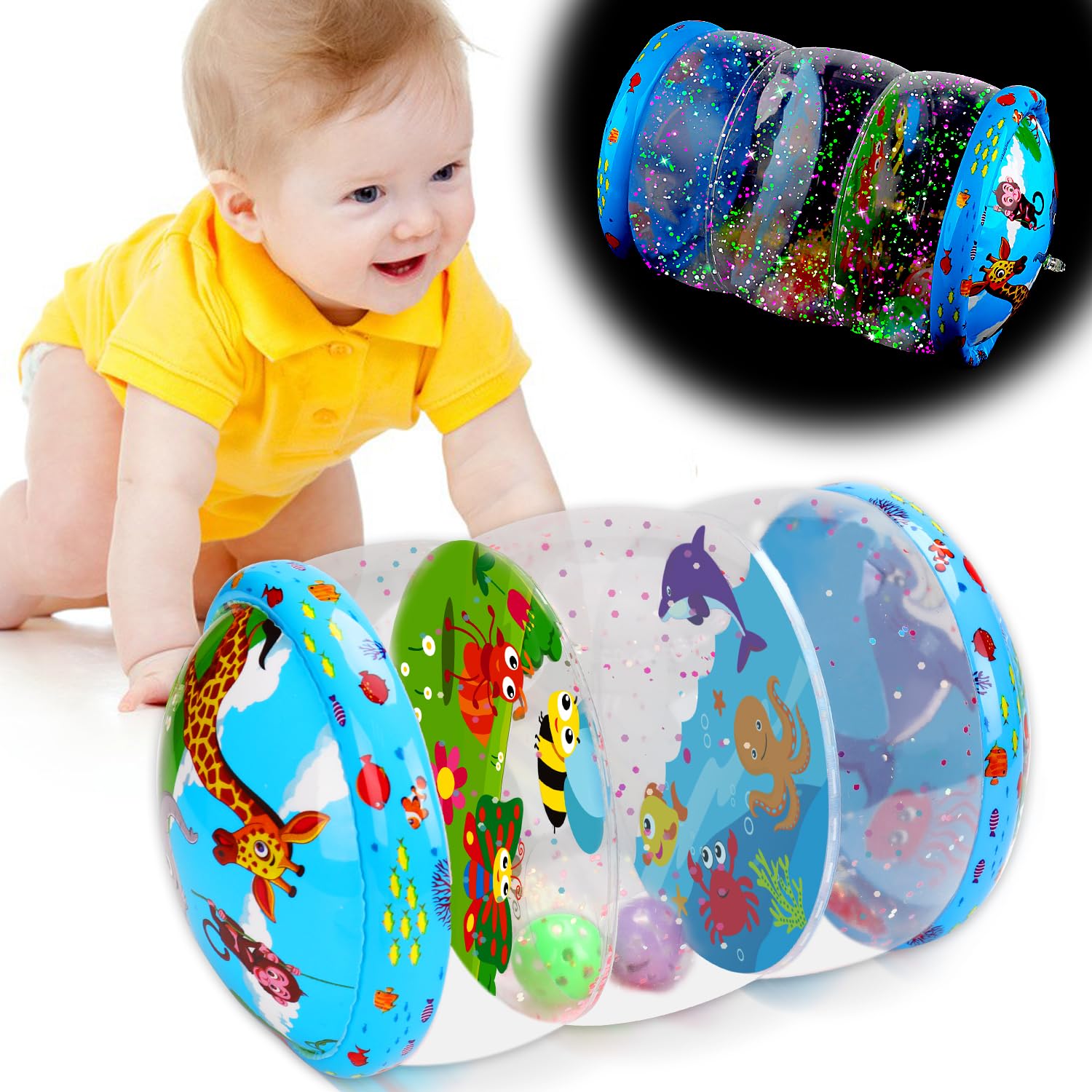
If your 11-month-old is still reluctant to crawl or needs extra motivation, this inflatable roller is a near-perfect solution. The jumbo size — 16 inches long and 8.5 inches in diameter — rolls slowly when pushed, giving a baby just enough time to chase it before it stops. Inside, two rattling balls and hundreds of glittering sequins create a sensory reward that encourages forward movement.
The material is a thick, puncture-resistant plastic that holds air well. It inflates easily with a standard hand pump, and deflates flat for storage or travel. The “glow in the dark” sequin effect is subtle — it requires direct light exposure to charge — but even in normal daylight the shimmering motion is enough to captivate. A few reviewers noted the light-up effect is less dramatic than advertised, but the core crawling incentive remains strong.
At just 0.18 kilograms, it’s lightweight enough for a baby to knock over and reset themselves, promoting independent play. The surface wipes clean easily, and there are no small parts or batteries. This is a low-risk, high-reward tool for building gross motor confidence at a stage when every inch of forward movement matters.
Why it’s great
- Large, slow-rolling design encourages chasing.
- Easy to inflate, deflate, and travel with.
- Rattling balls and sequins provide sensory feedback.
Good to know
- Glow effect is subtle, not a bright night light.
- Less engaging once baby masters walking.
3. Hahaland Silicone Tissue Box Toy
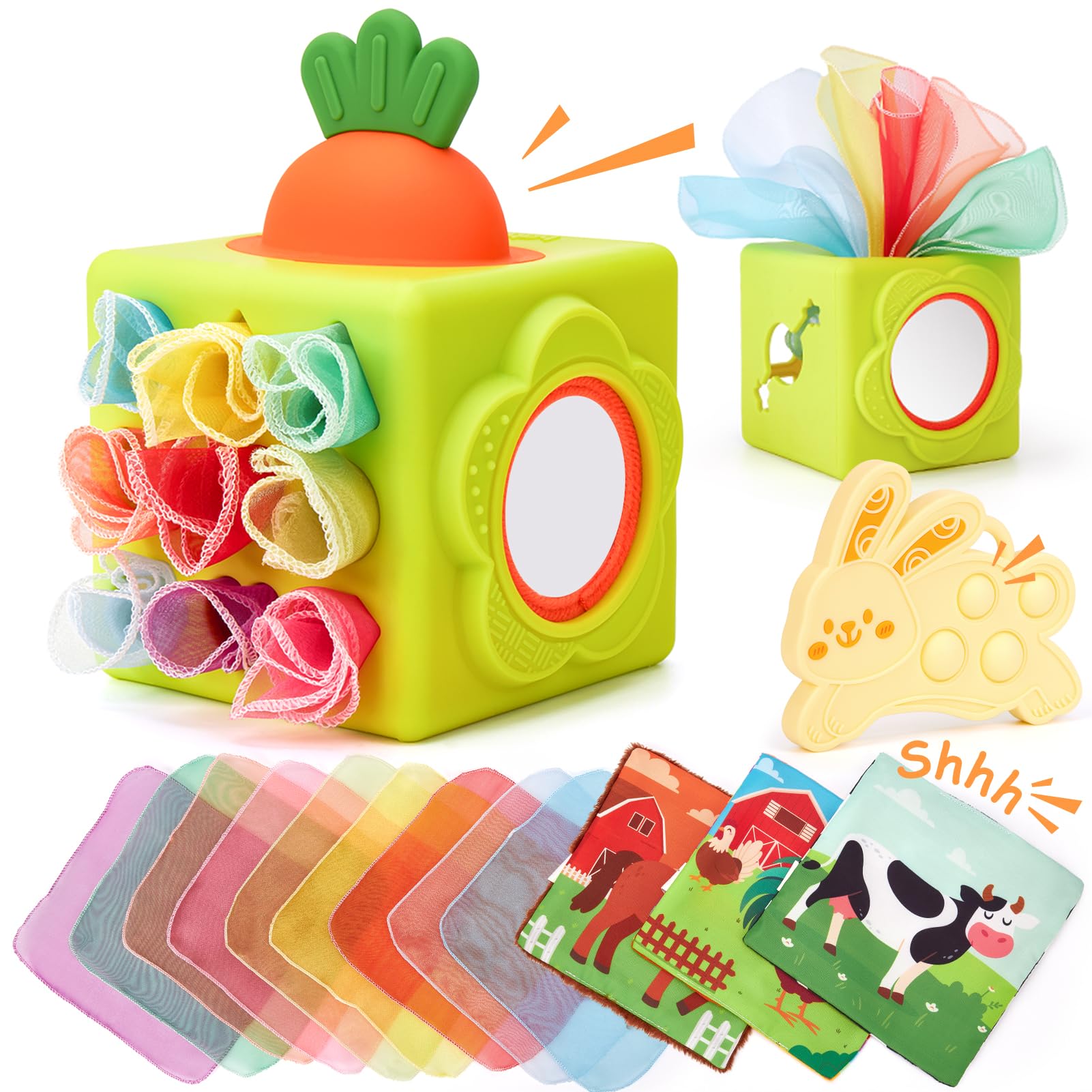
This silicone tissue box solves the classic problem of a baby emptying your real tissue box. The main body is molded from a single piece of premium, food-grade silicone — it’s soft enough to be safe for teething but firm enough to hold its shape during repeated pulls. Each of the six sides offers a different activity: a tissue pull slot, a push-and-pop carrot, a large loading opening, shaped holes, a textured sheep panel, and a baby-safe mirror.
The kit includes nine colorful scarves, three crinkle tissues, and a separate silicone bunny teether with pressable bubbles. The scarves have reinforced stitching that resists fraying, a crucial detail at this age when everything goes in the mouth. The crinkle tissues provide auditory feedback that babies find endlessly fascinating. The teether doubles as a fidget popper, keeping little hands busy during diaper changes or car rides.
Parents consistently praise this toy for its ability to redirect attention from household items. The 4.72-inch cube size is perfect for small hands to grasp and rotate. Everything is dishwasher-safe on the top rack. Some reviewers wished the silicone was slightly heavier to prevent sliding on flat surfaces, but overall this is a meticulously designed, screen-free tool for fine motor and sensory development.
Why it’s great
- Food-grade silicone is safe for mouthing and teething.
- Reinforced scarves resist fraying and pulling apart.
- Six distinct activities on one cube prevent boredom.
Good to know
- Box may slide on smooth surfaces during use.
- Some scarves shed lint in initial washes.
4. Keysense Crawling Turtle Musical Toy

When you need an electronic toy that genuinely teaches, this musical turtle delivers. Press the button on its shell and it crawls forward slowly — slow enough that a baby can actually catch it without frustration — while playing music and flashing soft, eye-protection lights. The turtle’s movement is the primary hook, but the shell houses a staggering amount of content: letters A-Z, numbers 0-9, 6 animal sounds, 5 instrument sounds, 8 lullabies, and a pretend telephone with ringtones and greetings.
The turtle measures 10 x 4 x 8 inches, a size that’s easy for a crawling baby to reach and push. The hand drum on the back plays drum sounds when hit, and the rotating beads on the side add a tactile element. Two adjustable volume levels are a life-saver for parents — the low setting is genuinely quiet enough for playtime without headache. The lights are diffused rather than harsh, reducing the risk of overstimulation.
One concern: the manufacturer lists the minimum age at 18 months, but real-world feedback from pediatric therapists and parents confirms it works well for 11-month-olds who are already crawling. The toy requires 3 AA batteries (not included). It’s sturdy enough to survive drops from a high chair, and the turtle’s movement is consistent enough to keep a baby chasing for multiple play sessions. A grandparent reviewer noted their grandchild still played with it at 18 months, proving its longevity.
Why it’s great
- Slow, catchable movement encourages crawling.
- Two volume levels protect little ears.
- 10-in-1 functions grow with your child.
Good to know
- Requires 3 AA batteries (not included).
- Official age rating starts at 18 months.
5. Duchong Pop Up Animals Toy

Pop-up toys are a developmental staple for a reason, and this Duchong version refines the formula with three distinct play modes. In Animal Sound mode, each animal names itself and makes its sound when it pops up — reinforcing vocabulary before your baby can even talk. In Game mode, a light indicates which button to press, turning cause-and-effect into a simple chase game. Quiet mode disables the music but keeps the popping action, perfect for car rides or wind-down time.
The buttons require four different actions: a lever, a switch, a dial, and a push button. This variety is critical — each action works a different set of finger and wrist muscles, building the dexterity needed for self-feeding and later writing. The animals are molded from BPA-free ABS plastic with smooth, burr-free edges. The unit is compact, but the 1-inch dimensions in the specs appear to be a listing error — the actual box is roughly the size of a small shoebox.
Parents report that 9-month-olds can figure out the push button relatively quickly, while the switch and dial take a few more weeks of trial, giving the toy a natural progression curve. One reviewer noted their 10-month-old needed time to learn to open the lids, which is exactly the kind of sustained challenge that builds frustration tolerance. The only catch is that it requires 2 AA batteries, and some families wished for a lower volume setting even in Quiet mode.
Why it’s great
- Four different button mechanisms build varied fine motor skills.
- Three play modes adapt to different moods and settings.
- BPA-free ABS is durable and easy to wipe clean.
Good to know
- Batteries not included.
- Volume may still be loud for sensitive babies.
6. Majabike 7-in-1 Montessori Teething Set

This set is essentially a starter kit for the second half of the first year. It includes 6 soft blocks, 6 stacking rings, 6 matching eggs, 7 stacking cups, 3 rotating suction cup toys, a pull-string speed-changing ball, and a sensory exploration box with 6 additional blocks — all packed into a large-capacity storage bin that teaches organization from the start. The sheer variety means you’re unlikely to need another toy purchase for at least three months.
The materials are a mix of food-grade silicone and BPA-free plastic, all CPC and ASTM certified. The stacking cups have different textures, colors, and numbers, and they nest inside each other compactly. The matching eggs require the baby to open the halves and match the internal shapes, a skill that typically clicks around 12-14 months but can be explored earlier. The pull-string ball changes speed based on how hard it’s yanked, introducing a primitive physics lesson.
One critical caveat: a single verified review reported a choking hazard recall on the string toy type included in this set. The rest of the components are widely praised for quality and durability. Parents love that it provides enough variety to rotate activities without clutter. The 14.4-ounce total weight and 11 x 5.9 x 7.1-inch box make it easy to grab and go. If you can verify the current safety status of the pull-string ball, this set is an exceptional value for a growing baby.
Why it’s great
- Enormous variety covers fine motor, sorting, and sensory play.
- Food-grade silicone and BPA-free materials throughout.
- Storage bin teaches cleanup habits early.
Good to know
- One report of choking hazard recall on string ball.
- Some blocks may not interlock as intended.
7. Qirptey 4-in-1 Montessori Toy Set
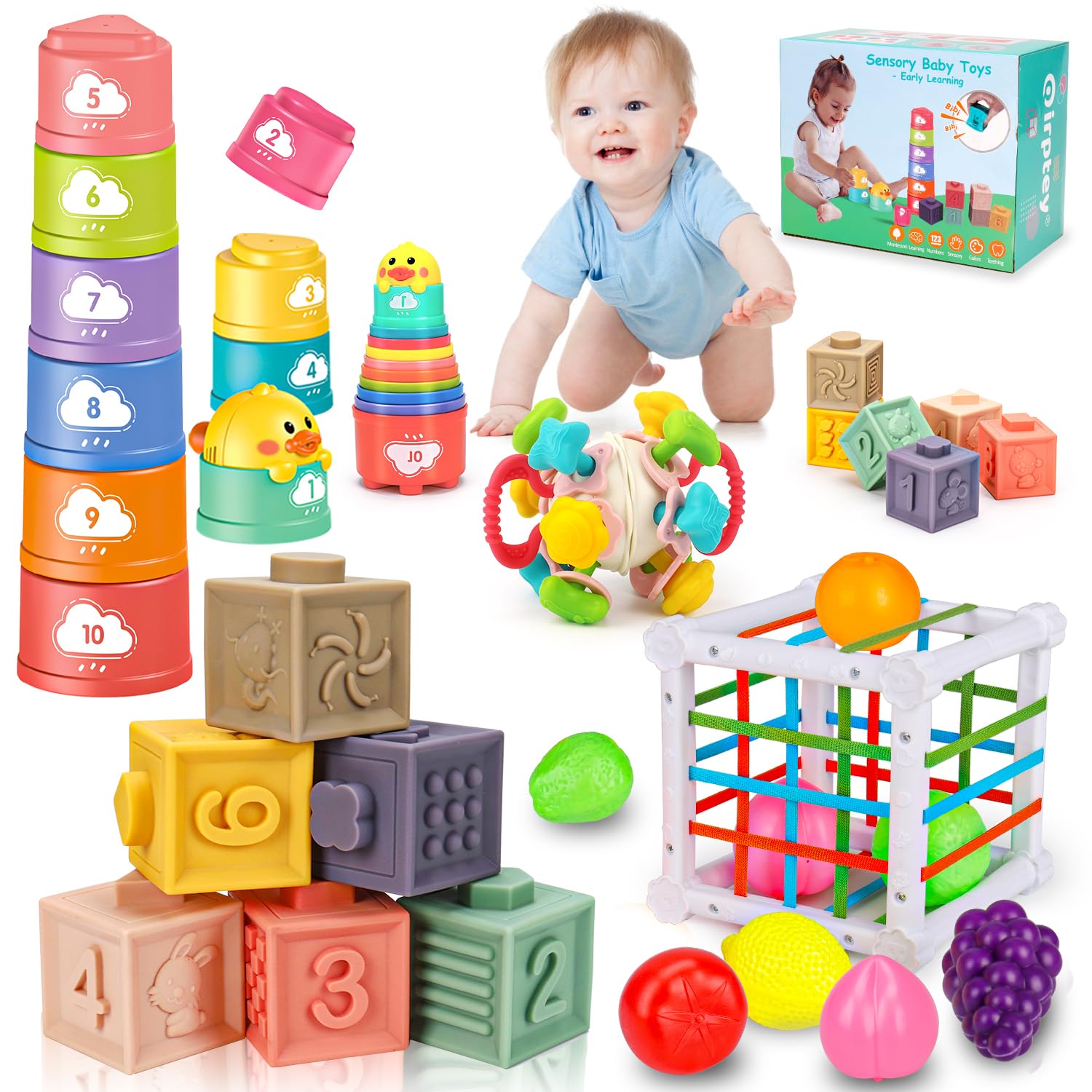
This 4-in-1 set brings together the four core skill-building activities for this age: stacking blocks, stacking cups, a shape sorter, and a sensory exploration bin. The blocks are made from soft, food-grade silicone — safe for teething and flexible enough to squeeze — while the cups are molded from high-quality ABS with raised numbers and textures on each. The shape sorter is the standout: six fruit-shaped pieces (guava, orange, peach, tomato, lemon, grape) in bright, non-toxic colors that encourage sorting by both shape and color.
The sensory bin has a unique design with elastic bands that blocks can be pushed through, adding a fine-motor challenge beyond simple stacking. The cups stack in multiple configurations, and the numbered rims introduce early counting concepts without pressure. Everything fits inside the storage bin, which doubles as the sorter base. The set is notably compact — the individual pieces are designed specifically for small hands, making this an excellent travel companion for restaurant visits or plane rides.
Material quality is consistently praised, though one review noted the bin’s walls feel slightly fragile and may crack under aggressive use. The fruit shapes are hollow and light, so they don’t hurt when thrown. At 11 months, your baby may not master sorting immediately — the value here is in the exploratory phase of picking up, examining, and attempting to fit shapes. The set’s longevity is strong; parents report it stays engaging past the second birthday.
Why it’s great
- Food-grade silicone blocks double as teethers.
- Fruit-shaped sorter pieces are intuitive and colorful.
- Compact design with built-in storage for travel.
Good to know
- Bin walls may crack if dropped on hard floors.
- Some pieces are smaller than expected.
FAQ
How do I know if a toy is safe for an 11-month-old?
What is the difference between Montessori and traditional toys for this age?
Final Thoughts: The Verdict
For most users, the best 11 month old toys winner is the Adena Montessori Play Kit because its battery-free, multi-stage design grows with your child from 6 to 18 months and builds genuine fine motor skills through repetitive, self-directed action. If you want to specifically encourage crawling, grab the Thremhoo Inflatable Rolling Toy. And for the best all-around sensory variety in one box, nothing beats the Hahaland Silicone Tissue Box Toy.