
Golf cart owners and fleet managers know the frustration: one weak 8-volt cell in a string of six drags the entire pack down, leaving you stranded mid-round. A proper load tester applies a 100-amp draw that mimics a starter motor, exposing batteries that show a resting voltage but collapse under real demand. Without this test, you’re replacing batteries by guesswork.
I’m Min — the co-founder and writer behind Gadgets Feed. I’ve spent hundreds of hours analyzing battery diagnostic equipment, cross-referencing manufacturer specs with real-world user data to separate tools that actually detect bad 8V cells from those that just measure surface voltage.
If you maintain a fleet of 8-volt batteries for golf carts, industrial equipment, or off-grid systems, you need a tester that applies a genuine carbon-pile load to reveal internal resistance. This guide highlights the best 8 volt battery tester options for accurate load testing and reliable diagnostics.
How To Choose The Best 8 Volt Battery Tester
Not every voltmeter can tell you if a battery is actually healthy. A multimeter reading 8.2V at rest means nothing if the voltage drops to 5V the moment you draw 50 amps. Here’s what separates a useful 8V tester from a decorative one.
Load Current: 100 Amps Is the Baseline
An 8-volt golf cart battery delivers hundreds of cold cranking amps under real service. A tester must apply a load that removes surface charge and stresses the internal plates. Look for a unit that pulls at least 100 amps during the test cycle. Units that only measure resting voltage or apply a tiny current will miss weakened cells every time.
Voltage Range Selector: Explicit 8V Support
Some testers claim to handle 8V but only have a 6V and 12V switch, leaving you to guess what the reading actually means. The best 8V-specific testers include 8V as a discrete setting, often alongside 6V, 12V, 16V, and 24V. This ensures the internal resistor and meter scaling are calibrated for the 8V nominal range.
Display Type: Analog vs. Digital
Analog gauges give you a quick glance at where the needle lands during the 10-second load window, but some users report difficulty interpreting exact voltage. Digital LCDs offer precise readouts to 0.1V and sometimes include backlights for dim garages. Your choice depends on whether you prefer fast pattern recognition or exact numbers.
Quick Comparison
On smaller screens, swipe sideways to see the full table.
| Model | Category | Best For | Key Spec | Amazon |
|---|---|---|---|---|
| QPKING BT760 | Premium | Fleet diagnostics with printed reports | 8V–32V, built-in thermal printer | Amazon |
| CRLITSIY AG004 | Mid-Range | Golf cart battery health checks | 6V–24V, large LCD with backlight | Amazon |
| AUTTGINN AT008 | Mid-Range | Multi-vehicle use with bright display | 6V–24V, 3-step LED display | Amazon |
| KAIHENG CSY-3 | Value | Simple load testing on a budget | 6V–24V, 100A / 50A load | Amazon |
| AUTTGINN AT008POINTER | Value | Analog needle readout for quick checks | 6V–16V, analog pointer display | Amazon |
In‑Depth Reviews
1. QPKING BT760 Automotive Battery System Tester

This is not a carbon-pile load box — it’s a conductance-based analyzer that works across 8V to 32V systems. The BT760 runs a battery, load, cranking, and charging test in about three seconds and prints a detailed receipt via its integrated thermal printer. For fleet managers tracking 8V golf cart batteries across multiple carts, that printed record is invaluable for warranty claims and rotation scheduling.
The color screen displays results in clear pass/fail language rather than a raw voltage number you have to interpret yourself. It tests 100 to 3000 CCA and supports AGM, gel, flooded, and deep-cycle chemistries. The 3-year warranty on non-human damage adds a level of support you won’t find on budget load testers.
The tradeoff is cost — this unit sits at the premium end. It also only works on 12V and 24V nominal systems natively, but its 8V–32V claimed operating range covers 8V battery strings used in series. One caveat: the printer paper is a consumable you’ll need to reorder.
Why it’s great
- Prints diagnostic reports for record-keeping
- 3-second test with 99.5% accuracy rating
- 32V max input covers all 8V series strings
Good to know
- Premium price compared to basic load testers
- Printer paper rolls are a recurring purchase
2. CRLITSIY 6V 8V 12V 16V 24V Battery Load Tester
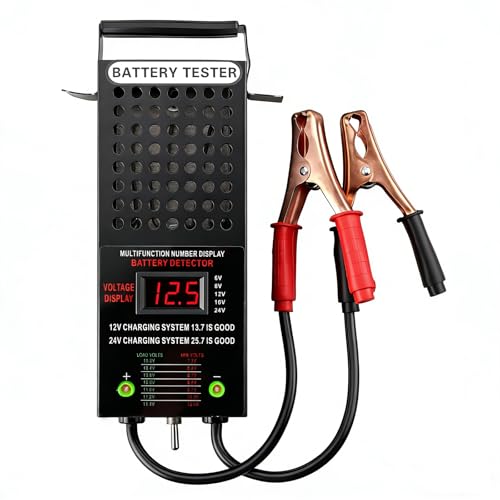
The CRLITSIY AG004 is a digital carbon-pile load tester with an explicit 8V setting in its voltage selector — not just 6V and 12V with 8V as an afterthought. It applies a 100A load to 8V batteries and shows the result on a large LCD with backlight, making it usable in dim garage or cart-barn environments. Users have confirmed it accurately identifies weak 8V golf cart cells.
Safety features include over-voltage, over-current, short-circuit, and reverse-connection protection. The unit covers flooded, gel, and maintenance-free lead-acid types. The cable length is sufficient to reach batteries installed in deep cart battery trays without stretching.
Some users noted that the claimed 0.01V precision doesn’t hold — actual accuracy is around 0.1V, which is adequate for load testing but not for precise equalization checks. Also, the unit may produce visible smoke during the first use as the resistor burns off manufacturing residue; this is normal but alarming if you aren’t warned.
Why it’s great
- Explicit 8V voltage setting on the dial
- Large backlit LCD for low-light reading
- Multiple safety protections included
Good to know
- Voltage accuracy is 0.1V, not the advertised 0.01V
- Initial use may produce brief smoke from resistor
3. AUTTGINN 6/8/12/16/24V Battery Load Tester AT008

The AUTTGINN AT008 uses a 3-step LED indicator system that many users find easier to read at a glance than a digital number. Green, yellow, and red LEDs correspond to good, weak, and replace conditions — handy when you’re testing six batteries in a row and don’t want to write down precise voltages. It supports 8V as a selectable range alongside 6V, 12V, 16V, and 24V.
The clamps are copper-plated steel with strain relief and heavy-duty insulation, built to survive repeated connection to corroded battery posts. One reviewer successfully found a bad 10.2V battery in a set of four that dropped to zero under load, while the three good batteries held at 10.8V under the same 100A draw — exactly the diagnostic ability you need.
Some users reported initial failure with the unit, only to find it worked after reviewing other customers’ tips. The instructions are minimal and the 10-second load limit is repeated in several locations. If you need a simple go/no-go indicator rather than logging precise millivolt data, this tester delivers.
Why it’s great
- Color-coded LEDs eliminate guesswork
- Heavy-duty clamps with strain relief
- Explicit 8V selector in the voltage range
Good to know
- May need a learning curve for proper operation
- Instructions lack detail for interpreting results
4. KAIHENG Battery Load Tester CSY-3

The KAIHENG CSY-3 is a no-frills carbon-pile load tester that delivers 100A of load for 12V batteries and 50A for 6V batteries. It’s one of the few budget units that a verified golf cart owner confirmed “worked perfectly” for testing 8V batteries. The copper clamps have rubber grips and the unit includes an insulated carry handle for safe transport.
The design is simple: clip on, press the load switch for up to 10 seconds, and read the voltmeter. No LCD, no LED array, no software — just a moving needle. That simplicity is either a strength or a weakness depending on your preference. The perforated metal housing allows heat to dissipate during repeated tests on a multi-battery pack.
The major complaint is the lack of a reference chart. The unit shows you a voltage number but doesn’t tell you what “good” looks like for an 8V battery under 50A load. Seasoned users know that 7.2V under load is generally healthy for a fully charged 8V lead-acid cell, but beginners will need to research that elsewhere.
Why it’s great
- Lowest price point for a true load tester
- Verified to work on 8V golf cart batteries
- Simple analog operation with no electronics to fail
Good to know
- No reference chart for interpreting voltage under load
- 50A load on 8V may be lower than ideal for some batteries
5. AUTTGINN Battery Load Tester AT008POINTER
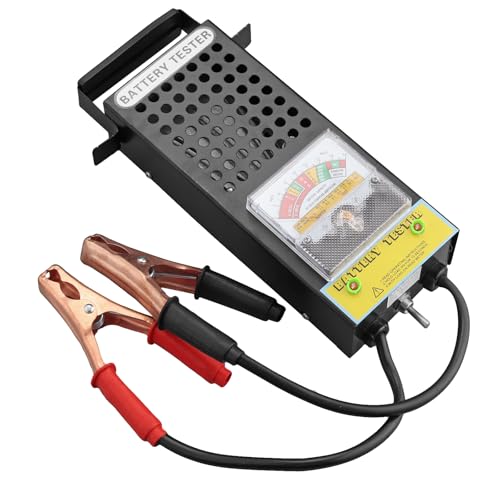
The AT008POINTER from AUTTGINN is an analog needle version of the brand’s digital tester, covering 6V, 8V, 12V, and 16V batteries. It applies a 100A load and displays the result on a traditional gauge with ±0.2V accuracy. The insulated carry handle and copper-plated clamps mirror the construction quality of the digital model.
For users who prefer the mechanical feel of a moving needle — watching it sag under load and recover — this provides immediate visual feedback. The rubber-grip clamps and 9.45-inch cable length are identical to the brand’s digital unit, so you aren’t sacrificing build quality for the analog form factor.
However, multiple customer reviews specifically dispute the 8V testing accuracy. Two verified purchasers reported that the unit misread good 8V batteries as bad and concluded the tester is actually only calibrated for 6V and 12V loads. If precise 8V diagnostics are your primary need, the digital CRLITSIY or the KAIHENG analog unit appear more reliable based on user feedback.
Why it’s great
- Classic analog needle for immediate visual feedback
- 100A load capacity for 8V batteries
- Insulated carry handle and robust clamps
Good to know
- Multiple users report inaccurate 8V testing
- Seems optimized for 6V and 12V despite 8V labeling
FAQ
Can I use a standard 12V car battery tester on an 8V golf cart battery?
What voltage should an 8V battery show under a 100A load test?
Final Thoughts: The Verdict
For most users, the best 8 volt battery tester winner is the CRLITSIY AG004 because it combines an explicit 8V selector, a large backlit LCD, and proven accuracy for golf cart battery diagnostics at a mid-range price. If you need printed reports for fleet management, grab the QPKING BT760. And for simple go/no-go testing on a budget, nothing beats the KAIHENG CSY-3.