
Nothing kills a carefully printed architectural set or a finished watercolor faster than improper storage. Rolled tubes leave permanent curl memory, stacking heavy binders on top bends covers, and the wrong box material slowly turns white paper yellow. The solution is a dedicated 11×17 storage system that keeps flat sheets flat, protects edges from dings, and stores them in a way that stays organized even as your collection grows.
I’m Min — the co-founder and writer behind Gadgets Feed. I’ve spent hundreds of hours analyzing the material science, fastening mechanisms, and dimensional tolerances of every major tabloid-size storage solution on the market so you don’t have to guess which option actually protects your oversized prints.
This guide compares seven distinct approaches — from archival clamshell boxes to zippered portfolios to pressboard binders — so you can find the best 11×17 paper storage that matches how you actually use and access your large-format documents.
How To Choose The Best 11×17 Paper Storage
Not all 11×17 storage solutions serve the same purpose. A hard-shell portfolio that lets you toss maps into a truck bed has different requirements than an archival box meant to preserve a watercolor painting for a decade. Matching the format to your use case is the single most important decision.
Material: Archival Grade vs. Everyday Carry
If your goal is long-term preservation — storing high-quality prints, original art, or legal documents — look for acid-free and lignin-free construction. Boxboard meeting these specifications prevents the yellowing and embrittlement that cheaper paper-based materials cause over time. For daily transport and temporary storage, polypropylene and pressboard are more durable and moisture-resistant, though they may lack the long-term chemical stability of archival board.
Closure System: Zipper, Clasp, or Prong Fastener
Zippers offer the most complete dust seal, making them ideal for travel. Plastic clasps are convenient for quick access, but reviews show they can break after repeated use — metal or reinforced plastic is preferable. For binders, the metal prong fastener with a compressor delivers the most secure hold for large page stacks, though it makes page rearrangement difficult. Ring binders allow easy page swapping but can sag under heavy tabloid sheets if the rings aren’t heavy-duty.
Capacity and Expansion
A portfolio that expands to 1.5 inches holds roughly 100–150 standard sheets of 20 lb paper. For thicker sets — architectural blueprints, multiple projects, or stacks of graphed proposals — look for 3-inch capacity binders rated for 750 sheets. The internal dimensions should be slightly larger than 11×17 to prevent edge curling, but not so loose that sheets slide around and get dog-eared inside the case.
Quick Comparison
On smaller screens, swipe sideways to see the full table.
| Model | Category | Best For | Key Spec | Amazon |
|---|---|---|---|---|
| UniKeep Presentation Binder | Clamshell Binder | Professional presentations & frequent page swapping | 10 archival sleeves included; 6 metal rings | Amazon |
| Blue Summit Pressboard | Report Cover | High-capacity blueprint sets in the field | 3-inch capacity; holds 750 sheets | Amazon |
| Perfromore Pressboard Binder | Report Cover | Bulk classroom or office document sets | 10-pack; metal prong compressor | Amazon |
| Golden State Art Drop-Front Box | Archival Box | Long-term preservation of valuable artwork | Acid-free 60pt board; 3.75″ deep | Amazon |
| Golden State Art Clamshell Box | Archival Box | Stackable photo and document storage | Metal edges; 1.75″ depth | Amazon |
| Ruby Paulina Portfolio Case | Portfolio | Field transport & client meetings | Water-resistant poly; expands to 1.5″ | Amazon |
| Acocony Zippered Portfolio | Portfolio | Student or artist travel kit | Zipper closure; PP waterproof shell | Amazon |
In‑Depth Reviews
1. UniKeep 11×17 Presentation Binder

This is the most versatile solution for anyone who needs to both present and store 11×17 documents. The hard polypropylene clamshell seals out dust and moisture with two snap closures, and the six metal rings distribute the weight of tabloid pages evenly, preventing the page sag that plagues three-ring alternatives. The flat exterior also stacks vertically without warping the contents, a detail that matters if you’re shelving multiple projects.
It ships with ten crystal-clear archival-safe EnvyPak sleeves that hold pages back-to-back, saving you the trouble of buying them separately. Architects and comic art collectors on Amazon noted the hard shell feels reassuringly protective, and the professional look works well for client-facing presentations. The included sleeves are polypropylene, so they’re chemically stable and won’t leach acids into your prints over time.
That said, the hinge durability is the common complaint among heavy users — after roughly ten open/close cycles, some reviewers reported cracking along the plastic seam. The rings also lack an easy-open mechanism, so swapping pages requires a bit of prying. If you plan to constantly rearrange contents, a binder with standard O-rings may frustrate you less, but for a set-and-present workflow, this is the most capable all-in-one choice.
Why it’s great
- Complete with 10 archival sleeves right out of the box
- Hard shell protects against crushing, dust, and moisture
- 6-ring design prevents large pages from sagging
Good to know
- Hinge can crack after repeated opening cycles
- Rings are fixed and not easy to open for rearranging pages
2. Blue Summit Pressboard Report Covers

For anyone managing thick sets of construction prints, engineering schematics, or multi-section proposals, these 25pt pressboard covers are the most capacity-dense option in this lineup. The reinforced spine expands to a full 3 inches, and the metal center-to-center prong fastener with a compression bar holds pages snugly so the cover stays flat even when fully loaded. Tyvek reinforcement along the spine edge prevents tearing during repeated use, which is critical for a field binder that gets tossed onto truck seats.
Reviews from construction foremen specifically praise how these covers survive daily site use — the pressboard resists moisture and the fasteners hold up to frequent page additions. The navy blue color also gives a surprisingly professional look for such an industrial product; you wouldn’t be embarrassed handing this to a client. At 10 units per pack, it’s also the best per-unit value for anyone storing more than one active project set at a time.
The trade-off is that the prong fastener system is permanent — once you compress the prongs, removing or rearranging pages is a two-person job involving pliers and a screwdriver. The covers also lack any dust seal, so they’re best for shelf storage rather than transport. For a permanent binding solution on a multi-month project, this is hard to beat; for a frequently updated portfolio, look at the ring-based UniKeep instead.
Why it’s great
- Massive 3-inch capacity holds up to 750 sheets
- Reinforced spine with Tyvek resists tearing
- Professional navy blue finish suitable for client presentations
Good to know
- Prong fasteners are difficult to undo once compressed
- No dust or moisture protection for the edges
3. Performore Pressboard Binder Folder (10-Pack)

The red pressboard here is stiffer than typical catalog-quality covers — the 25pt stock resists bends and smudges, making these folders a smart choice for classroom sets of handouts, proposal drafts that will be marked up, or temporary storage of engineering drawings that don’t need archival permanence. The metal prong fastener with a compressor keeps about 20–50 sheets of 20 lb paper snug without creating a bulky profile, and the 1/3-cut tab on the top edge allows basic filing on open shelves.
Multiple Amazon reviews specifically mention 11×17 engineering drawings fitting correctly, and the bright red color is useful for color-coding different projects or departments when you have multiple sets. The 10-pack price point makes this the most economical option per folder, especially if you’re outfitting a studio or a classroom workstation. The pressboard also holds up better than manila for occasional transport in a bag.
The folders also don’t expand as much as the Blue Summit option, so for sets exceeding 50 sheets, you’ll want the higher-capacity alternative. For bulk organization of smaller document sets, this is the most practical pick.
Why it’s great
- Attractive red color useful for project color-coding
- Sturdy 25pt pressboard resists bending in transit
- Lowest per-unit cost in this comparison
Good to know
- Prong fasteners deform after a few open/close cycles
- Limited to about 50 sheets before bulging
4. Golden State Art Drop-Front Archival Box

If your 11×17 sheets are irreplaceable — signed prints, original watercolors, genealogical documents, or archival photographs — this drop-front box is the most preservation-focused option on the list. The 60-point boxboard is explicitly acid-free and lignin-free, meeting museum-grade standards for chemical stability. The removable lid with a drop-front panel lets you access contents without dragging sheets across the lid edge, which prevents the scuffing and edge fraying that clamshell boxes can cause over time.
At 3.75 inches deep, it can hold several inches of material — think a stack of 40–50 individual matted prints or a thick binder of documents — and the beige, unbranded exterior looks professional on a shelf without screaming “cardboard box.” Reviews posted by quilters storing wall quilts and artists preserving pastel paintings confirm the box does its job without complaint. The metal corner reinforcements add meaningful crush resistance when stacked.
The downsides: this is boxboard, not polypro, so it has no moisture resistance — a basement flood or outdoor exposure would destroy it. The price per unit is also higher than the clamshell version from the same brand. And unlike the clamshell Golden State Art box, this model cannot be stacked with the lid on because the drop-front design adds height. If your priority is pure preservation in a stable indoor environment, this is the safest choice.
Why it’s great
- Acid-free and lignin-free for true archival protection
- Drop-front design prevents edge scuffing during access
- Deep 3.75″ interior fits thick stacks of matted art
Good to know
- Boxboard is not water-resistant
- Harder to stack than standard clamshell boxes
5. Golden State Art Clamshell Archival Box
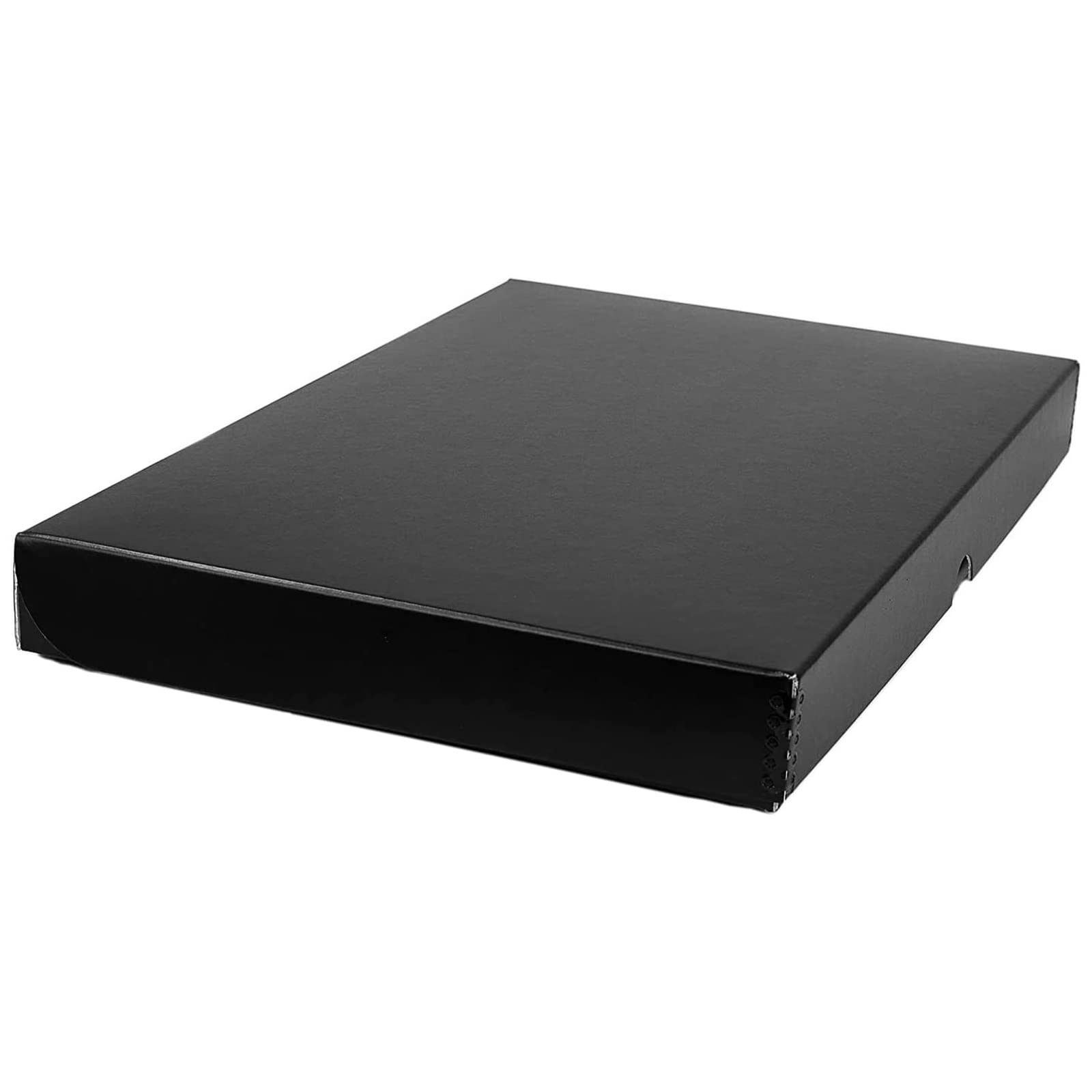
This is the more stackable sibling of the drop-front box above. Identical archival-quality 60-point acid-free board and metal corner protectors, but the clamshell lid with a thumb-cut makes it faster to open and naturally suited for vertical stacking. The interior dimensions — roughly 11x17x1.75 inches — are optimized for flat photo sets, newspaper clippings, greeting cards, or a single thick stack of art prints without the extra headroom of the drop-front version.
Customer reviews consistently highlight the sturdiness — the metal edge reinforcement genuinely prevents the crushing you get with plain corrugated boxes, and the box holds its shape even when stacked three or four high. The black color also blends into office decor better than the beige of the drop-front version. Quilters, photographers, and stamp collectors all reported using this for long-term storage with excellent results.
The limitation is depth. At 1.75 inches, this box can’t hold as much material as the 3.75-inch drop-front, so you’ll need multiple boxes for a large collection. The clamshell lid also requires you to lift the sheets out vertically, which over time can cause edge wear if you’re accessing the same print frequently. For a set-it-and-forget-it archival solution on a shelf, this is the more practical and affordable choice.
Why it’s great
- Excellent stacking stability due to metal corner reinforcements
- Acid-free, lignin-free board protects against yellowing
- Compact 1.75-inch depth ideal for flat photo sets
Good to know
- Shallow depth limits collection size per box
- Clamshell lid can cause edge wear on frequently accessed sheets
6. Ruby Paulina Portfolio Case

This portfolio case is the least expensive dedicated 11×17 carrier in the list, and it accomplishes its main job well: keeping tabloid-sized sheets flat and wrinkle-free during transport. The polypropylene shell is water-resistant and lightweight at 1.3 pounds, with a handle that makes it easy to grab for a client meeting or a classroom presentation. The 1.5-inch expansion capacity holds a substantial stack of maps, drawings, or documents — enough for a full semester of art projects or a week’s worth of construction prints.
Reviewers specifically praised it for carrying 11×17 maps and architectural prints without folding, and the sturdy plastic shell with solid clasps earned consistent 5-star feedback for durability in light field use. One artist using it for a graphic design portfolio liked the anti-glare sleeves (sold separately, not included) and the comfortable handle. For the entry-level tier, the build quality exceeds what the price point would normally suggest.
The main drawbacks are that it feels stiffer and cheaper than pricier portfolios — one 3-star reviewer described it as “functional but may break if roughly handled,” and a 5-star user reported losing a plastic rivet on the buckle after some use. There are no interior pockets for small accessories like the Acocony option offers. This is a cost-effective solution for occasional transport, not daily abuse; treat it gently and it will serve you for years.
Why it’s great
- Lightweight and portable at only 1.3 pounds
- Water-resistant poly shell protects in light rain or spills
- Budget-friendly entry point for 11×17 storage
Good to know
- Plastic rivets on clasp can break with rough handling
- No interior organization pockets
7. Acocony Zippered Art Portfolio

If your 11×17 documents need to survive a commute, a field trip, or a school bag, the full-length zipper on this portfolio makes it the most sealed option in the roundup. The outer shell is rugged polypropylene reinforced with Oxford cloth edging, which prevents the tearing that plagues softer canvas or vinyl portfolios when they scrape against desks and backpack zippers. Inside, there’s an X-shaped elastic buckle to hold a drawing board in place plus multiple pockets for pens, erasers, and small reference sheets — genuinely useful for the traveling artist or architect.
Amazon reviews are overwhelmingly positive: professors, gamers carrying tabloid maps, and art students all praised the accurate sizing and smooth zipper quality. The capacity expands to 1.5 inches, which is enough for a semester’s worth of class projects, and the built-in handle makes it easy to grab from a shelf. At this price point, getting a fully zippered option with interior organization is hard to beat.
The trade-off is that the polypropylene shell, while waterproof, has a slightly plasticky feel that lacks the rigid, premium heft of the UniKeep case. The zipper track, while smooth now, has not been tested for multi-year durability in the feedback yet. It also does not include any clear sleeves, so you’ll need to buy sheet protectors separately if you want to keep individual prints separated. For daily carry where dust and rain are real threats, this is the most practical choice.
Why it’s great
- Full zipper provides complete dust and moisture seal
- Oxford cloth edges prevent tearing at stress points
- Internal pockets organize pens, boards, and accessories
Good to know
- Shell feels less rigid than premium poly cases
- No clear sleeves included for separating prints
FAQ
Can I store unfolded 11×17 paper in a standard filing cabinet?
What is the difference between a portfolio and an archival storage box?
How many sheets of 20 lb paper fit in a 1.5-inch portfolio?
Final Thoughts: The Verdict
For most users, the 11×17 paper storage winner is the UniKeep Presentation Binder because it combines hard-shell protection, archival-safe sleeves, and a ring binding system in one ready-to-use package. If you need massive capacity for permanent blueprint sets, grab the Blue Summit Pressboard Report Covers. And for absolute archival preservation of irreplaceable artwork, nothing beats the Golden State Art Drop-Front Box.