
The difference between a painting that pops and one that feels flat often starts with a single layer: the primer. A quality acrylic primer for painting locks down your surface, boosts color vibrancy, and prevents the canvas from drinking every drop of your expensive paint, making it the invisible backbone of any durable artwork.
I’m Min — the co-founder and writer behind Gadgets Feed. For this guide, I’ve dissected the technical specs of six market contenders, comparing opacity, viscosity, drying time, and surface adhesion across dozens of reviews to identify which acrylic primers actually deliver on their promises.
Whether you are prepping a raw canvas for your next commission or sealing a wooden panel for a mixed-media project, you need a primer that bonds without cracking and dries to the perfect tooth. This deep-dive analysis will help you find the absolute best acrylic primer for painting that matches your specific surface and budget.
How To Choose The Best Acrylic Primer For Painting
Selecting the right primer for acrylic painting is about matching the formula to your workflow and substrate. The wrong viscosity can obscure fine detail on a highly-textured canvas, while a primer with insufficient “tooth” will cause paint to bead or peel over time.
Viscosity and Coverage Thickness
A primer’s viscosity dictates everything from application method to final surface texture. Low-viscosity formulas, often called “student grade” or “thin,” penetrate porous canvas deeply but may require two coats for full opacity. Heavy-body or “artist grade” gesso sits on top of the surface, providing a stiff, absorbent ground ideal for heavy-body acrylics and palette knife work. For miniature painting or detailed illustration, a thinner, self-leveling primer preserves crisp edges; for large abstract canvases, a thicker, toothy primer gives the paint something to grip.
White vs. Clear Primer
Standard white gesso provides the bright, reflective base that makes subsequent layers of paint appear more vibrant. A clear primer, by contrast, preserves the natural color or texture of the substrate beneath—essential if you want the wood grain or raw linen to show through a wash. Clear formulas also work well as an isolation coat between the surface and the paint layer when working with transparent pigments.
Container Size and Value Per Surface
Primer pricing is heavily skewed by the volume per container, but raw ounces are not the full story. A 16-ounce bottle of premium gesso might cover roughly 80 to 100 square feet; a gallon container can easily exceed 600 square feet of coverage. For classroom settings, bulk mural work, or artists who prime dozens of canvases a month, the larger volume options provide a dramatically lower cost per square foot. For casual hobbyists or painters working on small panels, a 16-ounce bottle usually provides months of work without the risk of the primer drying out inside the container.
Quick Comparison
On smaller screens, swipe sideways to see the full table.
| Model | Category | Best For | Key Spec | Amazon |
|---|---|---|---|---|
| Hyatt’s Artist Gesso | Premium Bulk | Mass priming & studios | 128 fl oz (1 Gallon) | Amazon |
| U.S. Art Supply Clear Gesso | Premium Specialty | Preserving surface grain | Clear / 16 fl oz | Amazon |
| The Army Painter Matt White | Specialty Spray | Miniature & model priming | Aerosol / 400 ml | Amazon |
| Nicpro White Gesso | Mid-Range All-Rounder | Versatile surface prep | 513 ml / Heavy body | Amazon |
| Falling in Art White Gesso | Budget-Friendly | Quick-dry & airbrush | 500 ml / Gel formula | Amazon |
| Handy Art Acrylic Gesso | Value Pick | Budget student priming | 16 fl oz / Low viscosity | Amazon |
In‑Depth Reviews
1. Hyatt’s Artist Gesso Primer

Hyatt’s Artist Gesso comes in a full one-gallon container, offering a staggering 128 fluid ounces that caters specifically to heavy-volume studios, classroom environments, and artists who frequently prep large-format canvases. The formula is engineered for smooth brushing with a fine, consistent “tooth,” ensuring that each coat provides an opaque, matte ground without requiring sanding between layers.
Users consistently praise its covering power: it handles porous surfaces like raw canvas and rigid panels with a single coat when applied correctly, and it dries to a flexible, waterproof finish that will not crack with the natural expansion and contraction of a stretched canvas. The versatility extends beyond acrylics—the fine-tooth surface also accepts oil, watercolor, tempera, and even pencil or ink without beading.
The wise bulk buyer should note the 24-hour full cure time, which is standard for a thicker-body gesso. Because of the generous volume, it is critical to store this container sealed and in a cool environment to prevent the liquid from thickening or developing a skin on top.
Why it’s great
- Massive 128 fl oz volume dramatically lowers cost per square foot of coverage.
- One-coat opacity on most surfaces saves significant time and labor.
- Compatible with acrylic, oil, tempera, and drawing media.
Good to know
- Requires up to 24 hours for a full waterproof cure between coats.
- The bulk can size is heavy to handle and pour without a secondary smaller container.
2. U.S. Art Supply Clear Gesso Primer

U.S. Art Supply’s Clear Gesso Primer occupies the narrow slot for artists who need the surface-preparation properties of a primer without obscuring the substrate. When a raw wood panel or textured paper must remain visible through washes or transparent layers, this transparent formula preserves the exact visual character of the material while providing the necessary “tooth” for paint adhesion.
This formulation has a notably wetter, smoother consistency compared to standard white gesso, making it exceptionally easy to spread in thin, streak-free coats. It dries to a flexible matte finish that is an effective isolation coat, preventing subsequent paint layers from being sucked into overly absorbent paper or board. Artists using airbrushes will particularly value the way this clear ground prevents paint bleed from masking.
Because the primer is clear, you lose the reflective boost that white gesso offers for color brightness—if you want that luminous base, stick with an opaque white. Also, some users have noted that a single coat on highly absorbent surfaces may not fully seal the grain, requiring a second thin layer for complete barrier performance.
Why it’s great
- Transparent finish preserves wood grain, linen texture, and colored papers.
- Wet consistency spreads easily without brush strokes in a single pass.
- Acts as an excellent barrier coat for airbrush work and masking fluids.
Good to know
- Does not boost color vibrancy as white gesso does.
- Highly porous surfaces may require two coats for a complete seal.
3. The Army Painter Matt White Primer

The Army Painter Matt White Color Primer departs from brush-on gesso entirely, delivering a super-fine aerosol spray specifically formulated for miniature wargaming figures and small-scale models. The acrylic-based spray combines primer and a highly pigmented white base coat into one step, drastically cutting the time between cleaning a figure and applying layer paints.
The pressurized application deposits an even, ultra-thin coat that does not obscure delicate sculpted detail—a critical requirement for 28mm and 32mm scale miniatures. Users who follow the manufacturer’s directions—shaking vigorously for one minute and spraying from 6-8 inches away—report exceptionally smooth results with no orange-peel texture. The matte finish provides a slightly satin sheen in practice, which helps wash paints and contrast paints flow into recesses without pooling.
The can’s lifespan is the primary limitation: 400 ml covers roughly one to two dozen standard infantry figures, depending on application method. The aerosol also requires proper ventilation and upside-down nozzle cleaning after each session to prevent clogging. This is not a tool for stretching canvas; it is a finely tuned instrument for the miniature painter’s bench.
Why it’s great
- Aerosol application preserves every microscopic detail on miniatures.
- Combines primer and white base coat into a single pass.
- Matte finish with slight satin sheen ideal for wash and contrast paint flow.
Good to know
- Limited can volume covers approximately one to two dozen small figures.
- Requires meticulous cleanup of nozzle to prevent clogging between uses.
4. Nicpro White Gesso Primer
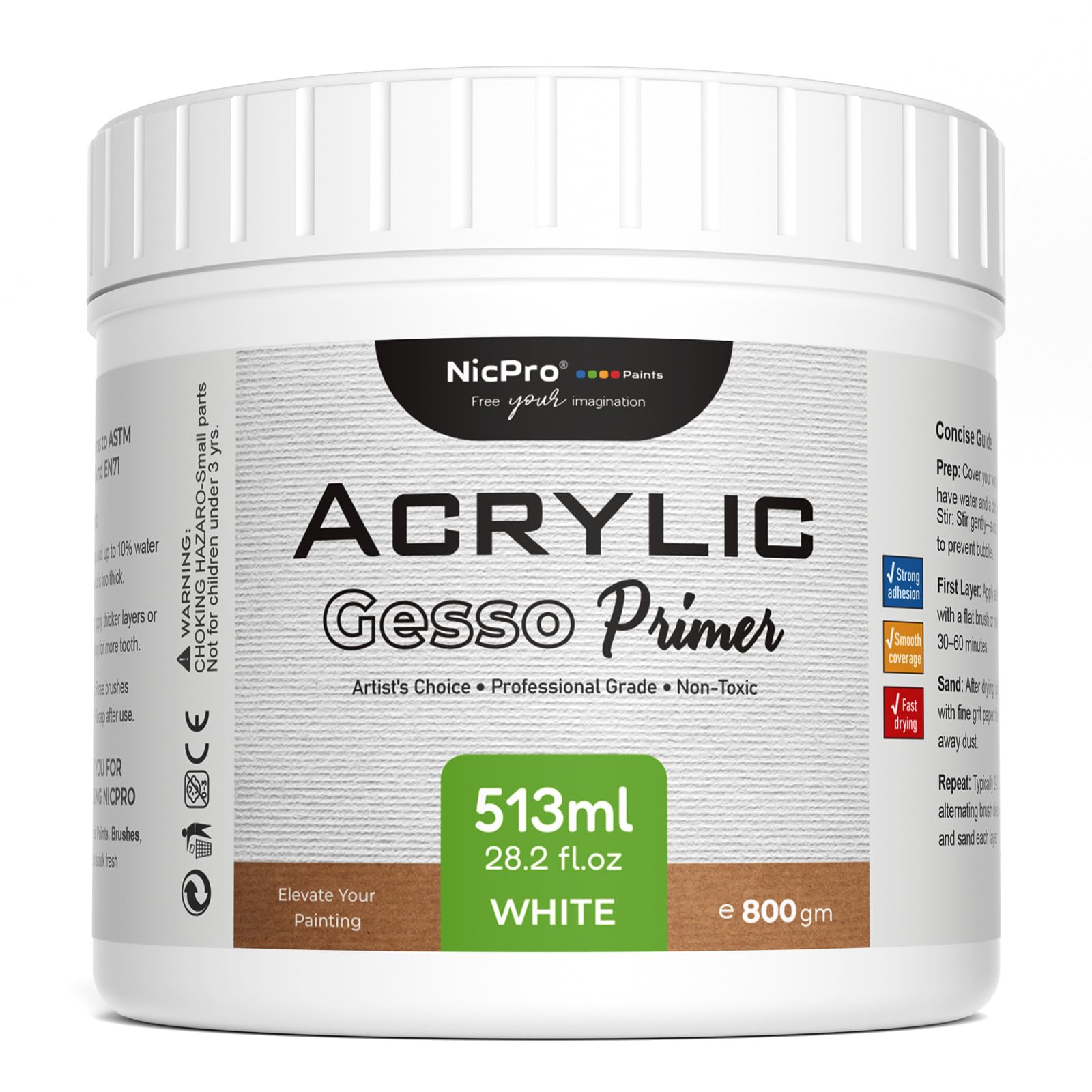
Nicpro’s White Gesso Primer delivers artist-grade opacity and a heavy, creamy body that competes directly with premium brands while staying within a mid-range price bracket. The 513 ml tub is a generously sized pot that offers excellent value for an artist working at least weekly on standard canvases and wood panels. The formula hides stray base colors and surface stains in a single coat, reducing the need for multiple passes.
The gel-like consistency is notably thick straight out of the tub, which gives the artist control over the final texture. You can apply it undiluted for a pronounced, absorbent ground that grips heavy-body acrylics and slows drying, or thin it with water to create a smoother, more penetrative layer for detailed work. Customer feedback frequently highlights its low odor and rapid drying time, making it suitable for small, indoor studio spaces without overwhelming fumes.
Because of its dense body, the gesso may leave visible brush strokes if not applied with a wide, soft brush or a damp sponge. For airbrush applications, you will need to thin it to a near-milk consistency with water. It also lacks an official waterproof rating, so for outdoor or humid display conditions, a compatible varnish seal is recommended over the cured paint.
Why it’s great
- One-coat opacity hides surface stains and stray colors effectively.
- Thick, creamy body allows for custom thinning and texture control.
- Very low odor and fast drying suitable for small studio spaces.
Good to know
- Thick gel may show brush strokes if applied without a wide soft brush.
- Requires substantial thinning for airbrush or fluid-paint techniques.
5. Falling in Art White Gesso Primer
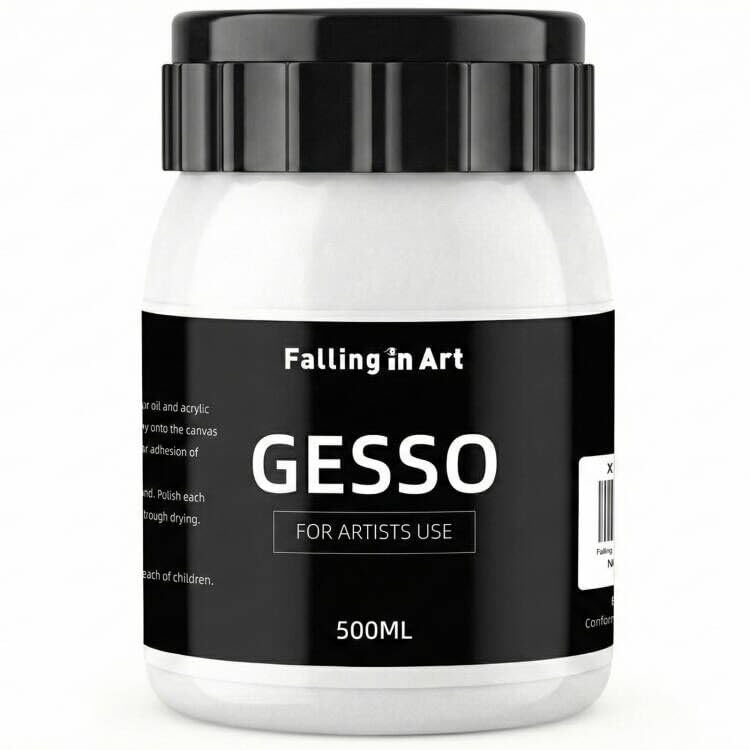
Falling in Art’s White Gesso Primer is positioned as a premium-quality gel that behaves more like an artist-grade medium than a basic student primer. Its most striking trait is its exceptionally fast drying speed: a thin coat on a pre-sized canvas can be touch-dry within minutes, allowing artists to layer paint almost immediately. This makes it a favorite among paint-by-number enthusiasts, adult coloring book users, and artists who work in quick, successive layers.
The consistency hits a sweet spot between heavy body and creamy gel, spreading smoothly without the watery runniness that plagues cheap student gesso. Users consistently describe it as non-toxic and lightweight, with one notable reviewer confirming that it created a perfectly smooth surface for airbrush work, preventing any masking-tape bleed-through. The finish dries to a clean, bright white that restores luminosity to an aged canvas.
One pattern that emerged from long-term testing is that the gesso can feel slightly slippery to the brush after it cures, which some painters may experience as reduced “drag” compared to traditional chalky gesso. If you rely on a high-friction surface for controlled blending, test a small patch before committing to a full canvas. Additionally, the 500 ml bottle is a modest size, so heavy users will work through it relatively quickly.
Why it’s great
- Extremely fast touch-drying enables rapid layering workflows.
- Smooth gel consistency ideal for airbrush and masking work.
- Bright white finish restores luminosity to aged or dull surfaces.
Good to know
- Cured surface can feel slightly slick, reducing brush drag for blending.
- 500 ml volume is moderate; heavy users may want a larger size.
6. Handy Art Acrylic Gesso
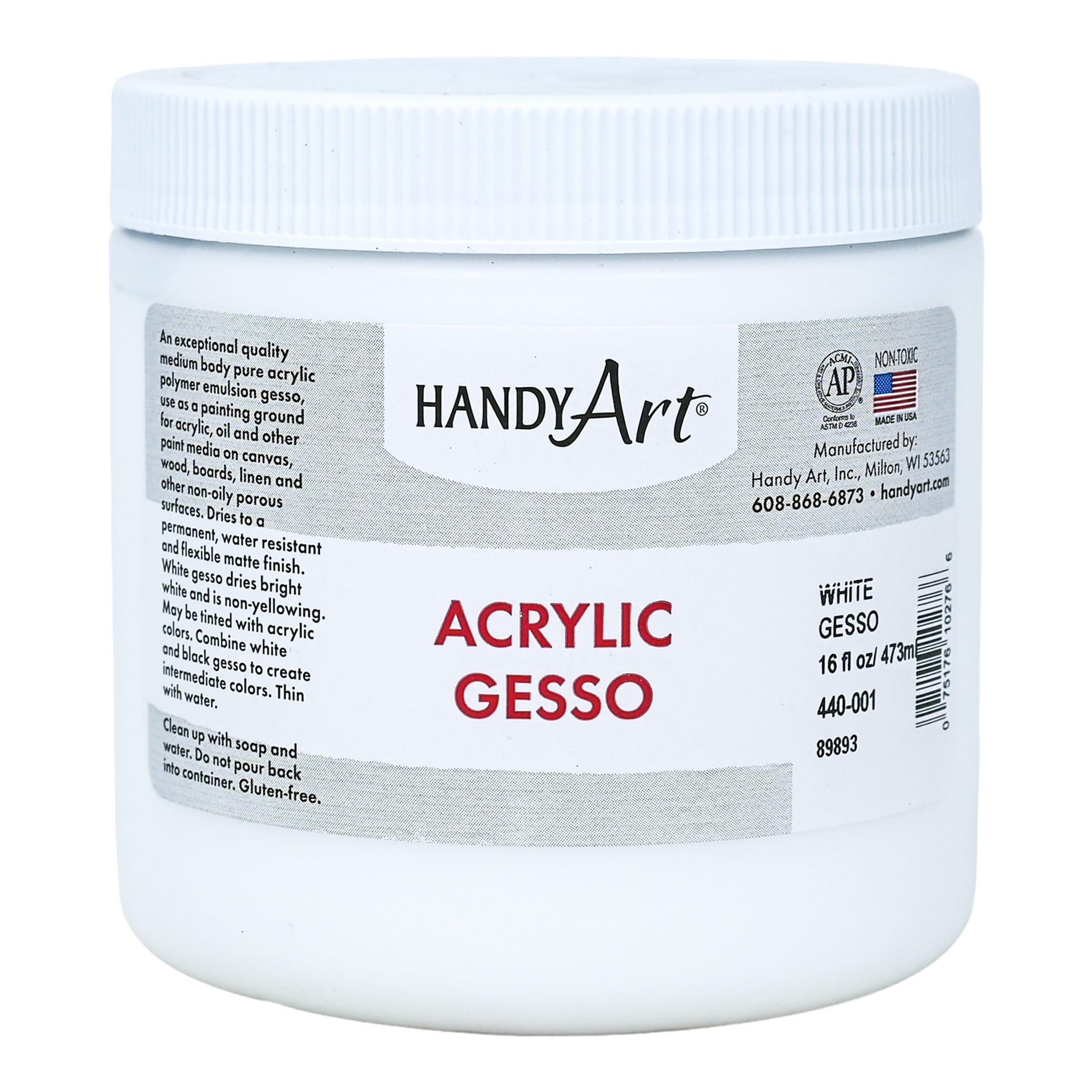
Handy Art’s Acrylic Gesso is an AP-certified, non-toxic student-grade gesso that is purpose-built for the budget-conscious classroom, the hobbyist, or the artist who needs to prime a large volume of practice surfaces without spending a premium. The 16-ounce bottle dispenses a low-viscosity liquid that soaks into porous canvas quickly, acting as a flexible seal that prevents raw fabric from sucking up paint.
The formula is notably thin and smooth, making it effortless to spread across canvas, wood panels, MDF, and even smooth surfaces like glass with a brush or sponge. The finish dries to a matte, waterproof coating that resists cracking or peeling as the canvas stretches. It is also made in the USA under strict quality controls, which is a noteworthy assurance for institutional buyers who must avoid latex, dairy, soy, or gluten allergens.
The primary trade-off with this price tier is coverage density. The low viscosity means that one coat often leaves slight discoloration visible on raw canvas; achieving a solid, opaque white base generally requires two coats. This doubles the drying time and effort, which is why many coaches and classroom users still recommend it for practice work rather than for final exhibition-grade pieces. The wide-mouth bottle is easy to dip a brush into, but users should transfer product to a working palette to prevent contaminating the main container.
Why it’s great
- Very affordable, AP non-toxic, and free of common allergens.
- Thin, easy-spreading consistency perfect for classroom and bulk priming.
- Made in the USA with consistent quality control standards.
Good to know
- One-coat coverage is translucent on raw canvas; requires two coats for opacity.
- Student-grade formula lacks the heavy body and tooth of artist-grade gesso.
FAQ
Can I use acrylic primer on wood without sanding first?
How many coats of gesso should I apply to a stretched canvas?
Can clear gesso be used over a finished acrylic painting?
Final Thoughts: The Verdict
For most users, the best acrylic primer for painting winner is the Hyatt’s Artist Gesso because its 128-ounce bulk volume and reliable one-coat coverage produce an unbeatable cost per primed canvas for studios and classrooms. If you want a specialty transparent primer that preserves wood grain or linen, grab the U.S. Art Supply Clear Gesso. And for the aerosol speed and detail-preserving finish needed by miniature painters, nothing beats the The Army Painter Matt White Primer.