
Every glance down at your instrument cluster steals a fraction of a second from your reaction time. An auto HUD display projects critical driving data — speed, RPM, coolant temperature, and navigation prompts — directly into your line of sight, keeping your eyes on the road and your hands on the wheel. The right unit eliminates the head-down dance, reduces cognitive load, and turns your daily commute or road trip into a more informed, safer drive.
I’m Min — the co-founder and writer behind Gadgets Feed. I’ve spent hundreds of hours dissecting GPS lock times, OBD2 protocol compatibility, display refresh rates, and brightness sensor accuracy across this category to separate the units that genuinely improve driving from the ones that just add dashboard clutter.
Whether you drive a modern sedan, a classic truck, or a weekend project car, the best auto hud display delivers the telemetry you actually need without forcing you to refocus your vision away from the road ahead.
How To Choose The Best Auto HUD Display
Not every HUD is a straight upgrade. The wrong choice can leave you with a dim screen that washes out midday or a GPS-only unit that lags at highway speeds. Focus on these four criteria to zero in on the right match for your vehicle and driving habits.
OBD2 vs. GPS — Dual System is the Standard
A unit with both OBD2 and GPS onboard gives you a fallback if your vehicle’s OBD2 protocol is partially closed or if you drive a pre-2008 model. OBD2 pulls live ECU data (RPM, coolant temp, fuel trims) for instant accuracy, while GPS handles speed, compass heading, and altitude. Single-mode units limit your data set and compatibility window.
Display Readability Under Sunlight
A TFT or IPS color screen with automatic brightness adjustment is critical. Many budget HUDs use simple LED segments that wash out on bright days. Look for a unit that offers at least 8 brightness levels and a light sensor that transitions smoothly between day and night modes without blinding you in dark tunnels.
Alarm System for Critical Parameters
The best safety feature of a premium HUD is its ability to alert you before trouble escalates. Over-speed, high water temperature, low voltage, and RPM alarms let you set thresholds. If your coolant creeps past 105°C on a steep grade, the HUD should buzz — not wait for the check engine light that may already be too late.
Quick Comparison
On smaller screens, swipe sideways to see the full table.
| Model | Category | Best For | Key Spec | Amazon |
|---|---|---|---|---|
| KONNWEI KW206 | OBD2 Scanner | DTC Reading & Alarms | 3.5in color LCD, sleep mode, 2003+ | Amazon |
| CAMECHO F16 | Dual System | IPS Display Clarity | 3.5in IPS, auto-brightness, 2008+ | Amazon |
| wiiyii C5 | Reflective Panel | Universal Fit (Hybrid/Diesel) | HD reflective lens, OBD+GPS | Amazon |
| LORPHEIR L5010 | Dual System | Extreme Temp Range | -40°C to 80°C, 20+ parameters | Amazon |
| KAOLALI WP-2 | Color TFT | 9 Interface Options | 3.5in TFT, 180° bracket | Amazon |
| MH P6 | Dual System | Compact Dash Fit | 4.16 oz, 10 interfaces | Amazon |
| wiiyii G6 | GPS Only | No-OBD2 Vehicles | GPS speed & altitude, USB power | Amazon |
In‑Depth Reviews
1. KONNWEI KW206

The KONNWEI KW206 pulls double duty as a full-color HUD and a professional-grade OBD2 scanner. Its 3.5-inch digital LCD displays hundreds of real-time engine parameters — speed, RPM, coolant temperature, fuel consumption, intake air temp — and reads engine fault codes with DTC descriptions so you can diagnose a check engine light without a separate scan tool. It supports all 2003 and newer OBDII-certified gas and diesel vehicles, including light trucks and SUVs.
Four independent alarm thresholds for RPM, vehicle speed, engine coolant temperature, and voltage give you proactive warnings before minor issues become major repairs. The unit automatically enters sleep mode when the engine is off and wakes on ignition detection, so you can leave it plugged in permanently without draining the battery. The metal housing gives it a solid feel that lighter plastic units lack.
Real-world feedback from a 2011 Crown Vic Interceptor owner confirms accurate speedometer and tachometer readings, while a 2008 Prius driver relies on the customizable display for coolant temp and MPG data that Toyota omitted from the factory dash. A few users note the included double-sided tape is weak, easily solved with a third-grade automotive mounting pad.
Why it’s great
- Reads and clears DTCs — eliminates need for a separate scan tool
- Sleep mode prevents battery drain when parked
- Metal construction feels more premium than plastic competitors
Good to know
- Sticky pad on stand is weak — replace with stronger adhesive
- Some early units may not clear codes after long-term use
2. CAMECHO F16
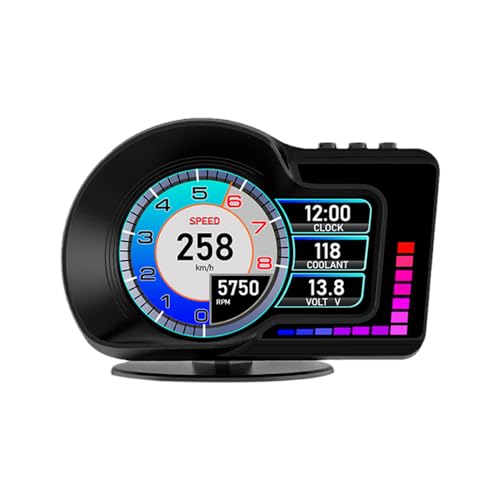
The CAMECHO F16 uses a 3.5-inch IPS panel that maintains vivid color and contrast even in direct midday sun — a clear step up from the washed-out LCDs found on entry-level HUDs. The OBD2-plus-GPS dual system means you get instant ECU telemetry when your car supports it and fallback GPS speed, altitude, and compass data when it doesn’t. Automatic brightness adjustment uses an ambient light sensor to dim the display smoothly as the sun sets.
Data coverage includes water temperature, oil temperature, voltage, fuel consumption, RPM, turbo pressure, driving direction, and latitude/longitude coordinates. Overspeed, high water temperature, low battery, and fatigue driving alarms keep you informed without overwhelming the screen. The included bracket rotates 360 degrees, letting you dial in the perfect angle on the dashboard or windshield.
A reviewer with a 2025 model-year vehicle confirmed full OBDII compatibility out of the box, reading voltage and oil parameters, while another reported clear daytime readability and accurate water temp readings. Time zone setup requires a few manual steps, and the OBD2 cable is specific to 2008-and-newer vehicles — older cars must rely on GPS mode only.
Why it’s great
- IPS panel stays readable under direct sunlight without glare
- OBD2+GPS dual system works with nearly any car
- Automatic brightness sensor eliminates manual dimming
Good to know
- OBD2 mode limited to 2008+ vehicles
- Time zone setting requires manual configuration
3. wiiyii C5

The wiiyii C5 takes a different optical approach with a high-definition reflective panel that projects data at a virtual distance rather than showing a direct LCD screen. This design produces no ghosting, no windshield film required, and a wide viewing angle that keeps the readout crisp as you shift your head position. It covers trucks, hybrids, and diesel vehicles thanks to the OBD2-plus-GPS switch — one button toggles between ECU data and satellite telemetry.
In OBD2 mode, the C5 reads vehicle speed, RPM, fuel consumption, water temperature, voltage, clock, single-trip mileage, direction, altitude, satellite count, and even 0–100 km/h acceleration time. It can also clear engine fault codes. GPS mode handles speed, voltage, time, distance, direction, and altitude. The overspeed alarm, fatigue driving reminder, water temperature alarm, and voltage alarm cover the essential safety triggers.
Users report excellent satellite lock (up to 12 satellites) even in areas with weak signal, and the ability to recalibrate displayed speed by a few km/h to match GPS reference. One long-term reviewer has used the C5 since 2022 without a single speeding ticket, crediting the precise GPS speed readout. The reflective film on the lens can degrade over time, and the instruction manual is poorly translated, but the core performance holds up well for the price bracket.
Why it’s great
- Reflective panel eliminates windshield film and ghosting
- Works with gas, diesel, and hybrid vehicles
- Recalibratable speed readout matches GPS reference
Good to know
- Reflective lens film may degrade over months of sun exposure
- Manual translation is rough — expect some trial-and-error setup
4. LORPHEIR L5010
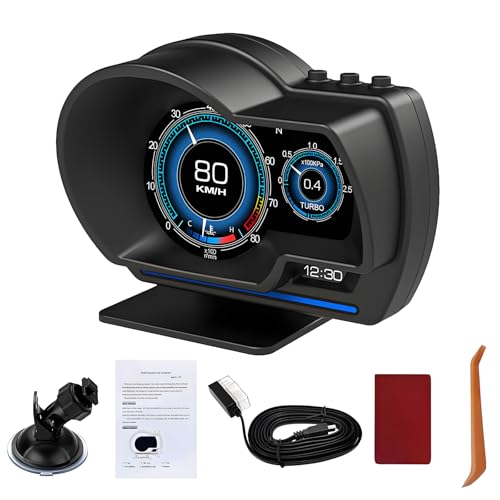
The LORPHEIR L5010 is engineered for harsh environments with an operating range of -40°C to +80°C and humidity tolerance from 10% to 95%. The dual-core processor handles over 20 real-time driving parameters simultaneously including speed, RPM, water temperature, voltage, fuel consumption, altitude, driving distance, turbo pressure, intake pressure, oil temperature, and navigation coordinates. The 1% accuracy variance on speed keeps the readout trustworthy at highway speeds.
The 360-degree rotating suction cup bracket mounts on the windshield or dashboard, and the unit includes a base plate for permanent adhesive installation. Both OBD2 mode (post-2008 vehicles) and GPS mode (100% compatibility) are available with customizable display layouts. Overspeed alerts, fatigue driving warnings, and voltage protection between 11V and 18V round out the safety package.
A 2013 Chevy Cruze owner confirmed accurate temperature gauge readings with a settable alarm for overheating, alongside live monitors and speedometer. A 2009 Mini Cooper driver uses the L5010 explicitly because the car lacks a factory temperature gauge — the HUD fills that blind spot. However, a 2002 Tundra user experienced ABS light flashing when plugged in, indicating protocol conflicts on older or niche platforms.
Why it’s great
- Rated for -40°C to +80°C — survives extreme cabin heat and cold
- Dual-core processor handles 20+ simultaneous data streams
- 360° rotating mount for optimal sight-line placement
Good to know
- May cause ABS light flash on some older trucks
- Speed can be off by up to 10 MPH on certain vehicles
5. KAOLALI WP-2
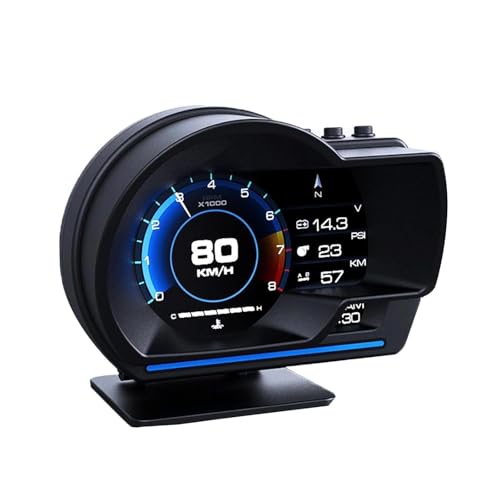
The KAOLALI WP-2 uses a 3.5-inch TFT color display that presents nine distinct interface layouts you can cycle through on the fly. Each layout prioritizes different data sets — one focuses on speed and RPM, another on fuel economy and trip statistics, a third on turbo pressure and water temperature. This modularity lets you match the screen to your driving context without wading through a menu every time.
OBD2-plus-GPS dual system operation keeps the data pipeline stable. Functions include speed, clock, water temperature, mileage, RPM, battery voltage, fuel consumption, driving time, turbo pressure, and alarms for water temperature, RPM, voltage, and speed. It also runs brake and accelerator tests. The bracket rotates 180 degrees in all axes, giving you fine-grained control over the viewing angle even on curved dashboards.
Owners generally report a good fit and reliable operation for the price, though compatibility is explicitly limited to vehicles with OBD2 protocol — mostly models after 2012. A 2004 Intrepid failed to read the tachometer and fuel gauge. One buyer noted the USB cable was missing from the package, so confirm contents on arrival.
Why it’s great
- 9 switchable display layouts for different driving scenarios
- 180-degree adjustable bracket for precise angle tuning
- TFT panel stays bright enough for daytime use
Good to know
- OBD2 mode only works reliably with post-2012 models
- Some units ship missing the USB cable — inspect package
6. MH P6

At just 4.16 ounces, the MH P6 is the lightest HUD on this list — a meaningful advantage when mounting on a curved dashboard where heavy units can sag or vibrate loose. Despite the low weight, it packs OBD2 and GPS dual-system connectivity, ten customizable display interfaces, and brightness adjustable across eight levels. The interface includes speed, tachometer, fuel consumption, water temperature, drive time, altitude, turbo pressure, compass, clock, and voltage.
The P6 also functions as a basic OBD2 fault code scanner — it can read DTCs, display fault descriptions, and clear the check engine light. The acceleration and brake test features give DIY tuners a crude but usable performance benchmark. Alarms for speed (5–200 km/h), engine temperature (50–200°C), voltage (10–15V), and RPM (1000–8000) all have independent on/off toggles.
One owner installed it on a 2019 Daihatsu Hijet and confirmed MPH, RPM, battery voltage, and engine temp readings without blocking the windshield. Another noted that the timer shut-off and odometer setting didn’t work — the display stayed on unless physically unplugged. A few units arrived DOA, so testing immediately after delivery is strongly advised.
Why it’s great
- Ultra-light 4.16-ounce build stays secure on angled dashes
- Includes basic DTC scan and clear functions
- 10 interface layouts with 8-level brightness control
Good to know
- Timer shut-off and odometer setting may not function
- Quality control inconsistent — test immediately on arrival
7. wiiyii G6
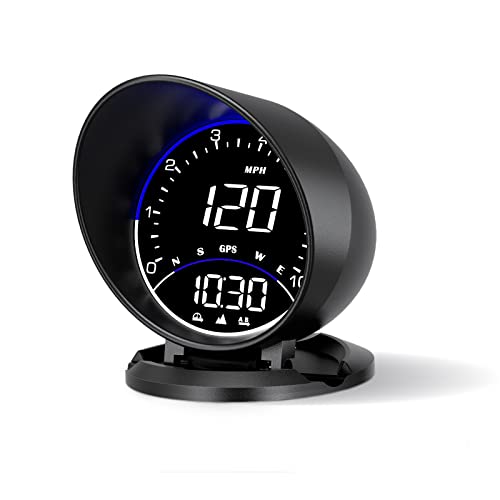
The wiiyii G6 is a pure GPS-speedometer HUD — no OBD2 connection required. It draws power from any standard USB port and locks onto satellite signals to display vehicle speed, altitude, driving distance, satellite-based time, and compass direction. The lack of OBD2 means zero compatibility headaches, making it the only truly universal option for pre-2008 vehicles, golf carts, and classic cars that lack a modern data port.
A photoresistor on the back of the unit automatically adjusts screen brightness based on ambient light, keeping the readout legible from sunrise to late-night drives. The toggle switch on top cycles through display modes and adjusts settings. The included base uses double-sided adhesive for dash mounting, and the whole package weighs 185 grams with a compact 3.54-inch width that fits even crowded dashboards.
Multiple buyers use the G6 on golf carts and report that GPS speed tracking stays accurate over a year of use. A 30-year-old truck owner relies on it as a reliable speedometer replacement, noting consistent operation even under overcast skies. There is no RPM, no coolant temp, and no fuel data — the G6 is a speed and position display only, which is exactly what some drivers need.
Why it’s great
- 100% universal — USB power, no OBD2 port needed
- Auto-brightness sensor for day/night readability
- Proven reliability on golf carts and classic trucks
Good to know
- GPS-only — no RPM, temp, or engine data
- Speed readout has a slight lag compared to wired OBD2
FAQ
Will an OBD2 HUD work on a 1999 vehicle?
Can an auto HUD drain my car battery when parked?
Why does my HUD show a different speed than my dashboard?
Final Thoughts: The Verdict
For most users, the best auto hud display winner is the KONNWEI KW206 because its OBD2 scanning capabilities, sleep-mode intelligence, and metal build quality offer the deepest feature set without demanding a premium budget. If the sharpest display readability under direct sun is your priority, grab the CAMECHO F16. And for a no-fuss GPS-only solution that works in any vehicle from a golf cart to a 1970s pickup, nothing beats the wiiyii G6.