
Waiting for a game level to load is a reminder that your storage is the bottleneck. A 1TB PCIe Gen 4 NVMe drive changes that equation entirely, slashing load times from minutes to seconds and keeping your library of AAA titles instantly accessible. The right drive doesn’t just store your games—it makes them playable without stutter or texture pop-in.
I’m Min — the co-founder and writer behind Gadgets Feed. I’ve spent countless hours analyzing sequential read/write speeds, controller architecture, NAND types, and thermal solutions across dozens of models to separate the genuine performers from the marketing claims.
Whether you are upgrading a desktop, a laptop, or a handheld console, understanding the subtle differences in PCIe generations and controller technology is critical. This guide breaks down the best 1tb gaming ssd options available today so you can match the right drive to your specific system and budget.
How To Choose The Best 1TB Gaming SSD
Not every 1TB NVMe drive is built for gaming. The interface, controller, and NAND type dictate whether your drive delivers consistent frametimes or chokes during texture streaming.
Interface and Protocol: PCIe Gen 4 is the Baseline
A PCIe Gen 4 x4 interface with NVMe 1.4 or 2.0 support provides the bandwidth needed for DirectStorage API calls. Gen 3 drives top out around 3,500 MB/s, while Gen 4 drives routinely exceed 7,000 MB/s read. For modern game engines that stream assets directly from the SSD, the faster lane prevents hitching and reduces level load times from half a minute to under ten seconds.
NAND Type and Endurance
3D TLC NAND offers the best balance of speed and endurance for gaming workloads. QLC drives are cheaper but suffer from slower write speeds after the SLC cache fills and lower total bytes written (TBW) ratings. Look for a TBW rating of at least 600 TBW for a 1TB drive to ensure the SSD survives years of game updates and reinstallations.
Thermal Management
High-speed PCIe Gen 4 controllers generate noticeable heat. Sustained transfers above 6,000 MB/s can push temperatures past 80°C, triggering thermal throttling that drops read speeds by half. A graphene heatsink, copper foil label, or an aluminum heat spreader helps maintain peak performance. Desktop users should utilize their motherboard’s built-in M.2 heatsink; laptop and PS5 users need a drive that stays cool under its own cooling solution.
Quick Comparison
On smaller screens, swipe sideways to see the full table.
| Model | Category | Best For | Key Spec | Amazon |
|---|---|---|---|---|
| Patriot Viper VP4300 Lite | Premium | Max Throughput | 7,400 MB/s Read | Amazon |
| BIWIN Black Opal NV7400 | Premium | Sustained Writes | 7,450 MB/s Read | Amazon |
| Crucial P310 | Mid-Range | All-Around Value | 7,100 MB/s Read | Amazon |
| Kingston NV3 | Mid-Range | Low Power Draw | 6,000 MB/s Read | Amazon |
| Fanxiang S880E | Premium | Advanced Cooling | 7,000 MB/s Read | Amazon |
| Ediloca EN705 | Mid-Range | PS5 Expansion | 5,000 MB/s Read | Amazon |
| WD_Black SN770M | Premium | Handheld Consoles | 5,150 MB/s Read | Amazon |
In‑Depth Reviews
1. Patriot Memory Viper VP4300 Lite 1TB

The Viper VP4300 Lite pushes the PCIe Gen 4 ceiling with sequential reads reaching 7,400 MB/s and writes hitting 6,400 MB/s. That raw throughput translates directly into faster asset streaming for DirectStorage titles and sub-ten-second level loads in games like Starfield and Cyberpunk 2077. The Lite designation means no bundled heatsink, but the drive runs efficiently enough for motherboards with integrated thermal pads.
Built with a PCIe Gen 4 x4 controller that complies with NVMe 2.1, this drive offers forward-compatible command set improvements. Real-world reports from PS5 owners confirm it auto-detects immediately and delivers sustained read speeds around 6,800 MB/s after formatting. The thin graphene heat spreader handles thermal dissipation adequately in the console’s tight bay.
Patriot backs the VP4300 Lite with a five-year warranty, and user feedback after months of heavy Steam patching and OS booting shows zero degradation or crashes. The 1TB variant provides ample space for a core game library without the premium attached to DRAM-cached enterprise drives.
Why it’s great
- Class-leading 7,400 MB/s sequential read speed
- Works flawlessly in PS5 without an additional heatsink
- Five-year warranty for long-term peace of mind
Good to know
- No physical heatsink included in the box
- May not show peak speeds on older Gen 3 motherboards
2. Crucial P310 1TB SSD
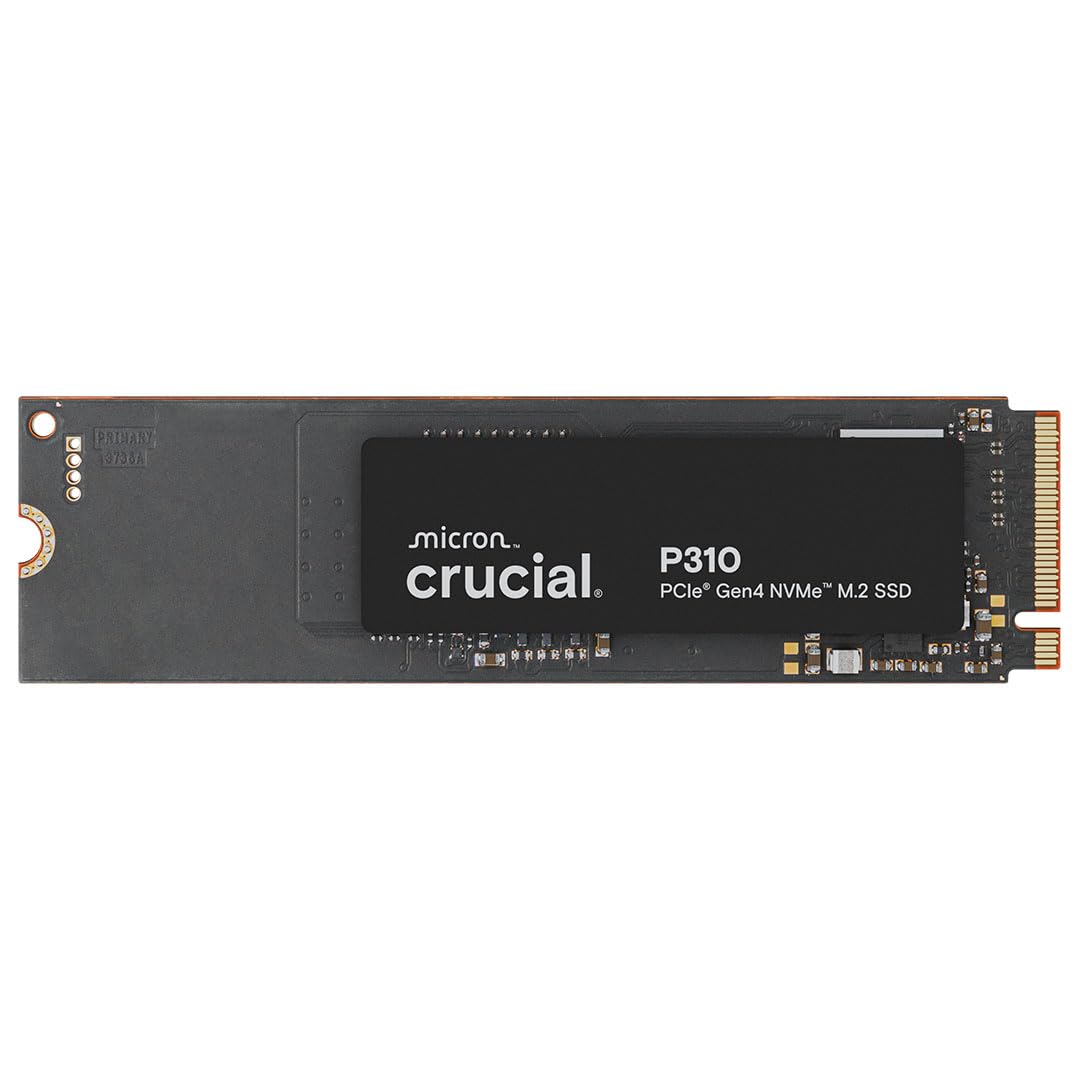
The Crucial P310 leverages Micron’s 8th-generation NAND (G8) to deliver up to 7,100 MB/s reads and 6,000 MB/s writes. Crucial has a well-earned reputation for reliable firmware, and this drive includes Acronis data recovery software in the box—a rare addition that saves buyers from purchasing a separate cloning utility.
Compatibility extends beyond standard PCs and laptops to include handheld gaming devices like the ROG Ally X, Lenovo Legion Go, and AYANEO Kun. The 1TB capacity balances cost against performance, offering twice the throughput of Gen 3 drives without crossing into premium pricing territory. Backward compatibility with PCIe Gen 3 systems means it can serve as an upgrade path for older builds.
Customer reports highlight the ease of cloning existing drives and the immediate boot-time improvement in systems ranging from HP ProBooks to custom SFF gaming PCs. The included thermal management keeps the controller stable even during sustained 2.5 Gb network transfers and game streaming via Sunshine/Moonlight.
Why it’s great
- Includes free Acronis data recovery and migration software
- Broad compatibility with handheld gaming consoles
- G8 NAND provides excellent power efficiency for laptops
Good to know
- No dedicated DRAM cache; uses HMB instead
- Peak speeds require a PCIe 4.0 slot
3. BIWIN Black Opal NV7400 1TB

The NV7400 targets the top end of Gen 4 bandwidth with sequential reads rated at 7,450 MB/s and writes at 6,500 MB/s, backed by random IOPS reaching 1,000K. BIWIN pairs the Phison E27 controller with a PMIC (power management integrated circuit) to improve energy distribution and extend drive lifespan compared to simpler voltage regulation designs.
A 0.5 mm graphene-aluminum hybrid heatsink keeps temperatures in check during extended transfers, and the drive includes HMB (Host Memory Buffer) technology for efficient small-file handling. The bundled Biwin Intelligence software provides firmware updates, performance benchmarking, and data migration tools directly from the desktop.
Users running the NV7400 as an OS drive report consistent temperatures around 42°C under load, with no throttling. The drive performs stable extraction and file operations in systems equipped with high-end GPUs like the Radeon 9070 XT. The premium price point reflects the combination of top-tier controller, thermal solution, and software ecosystem.
Why it’s great
- Near-maximum PCIe 4.0 bandwidth at 7,450 MB/s
- Includes graphene-aluminum heatsink for sustained performance
- Free Biwin Intelligence management software suite
Good to know
- Premium pricing compared to entry-level Gen 4 drives
- Heatsink may interfere with some thin laptop chassis
4. Kingston NV3 1TB NVMe SSD
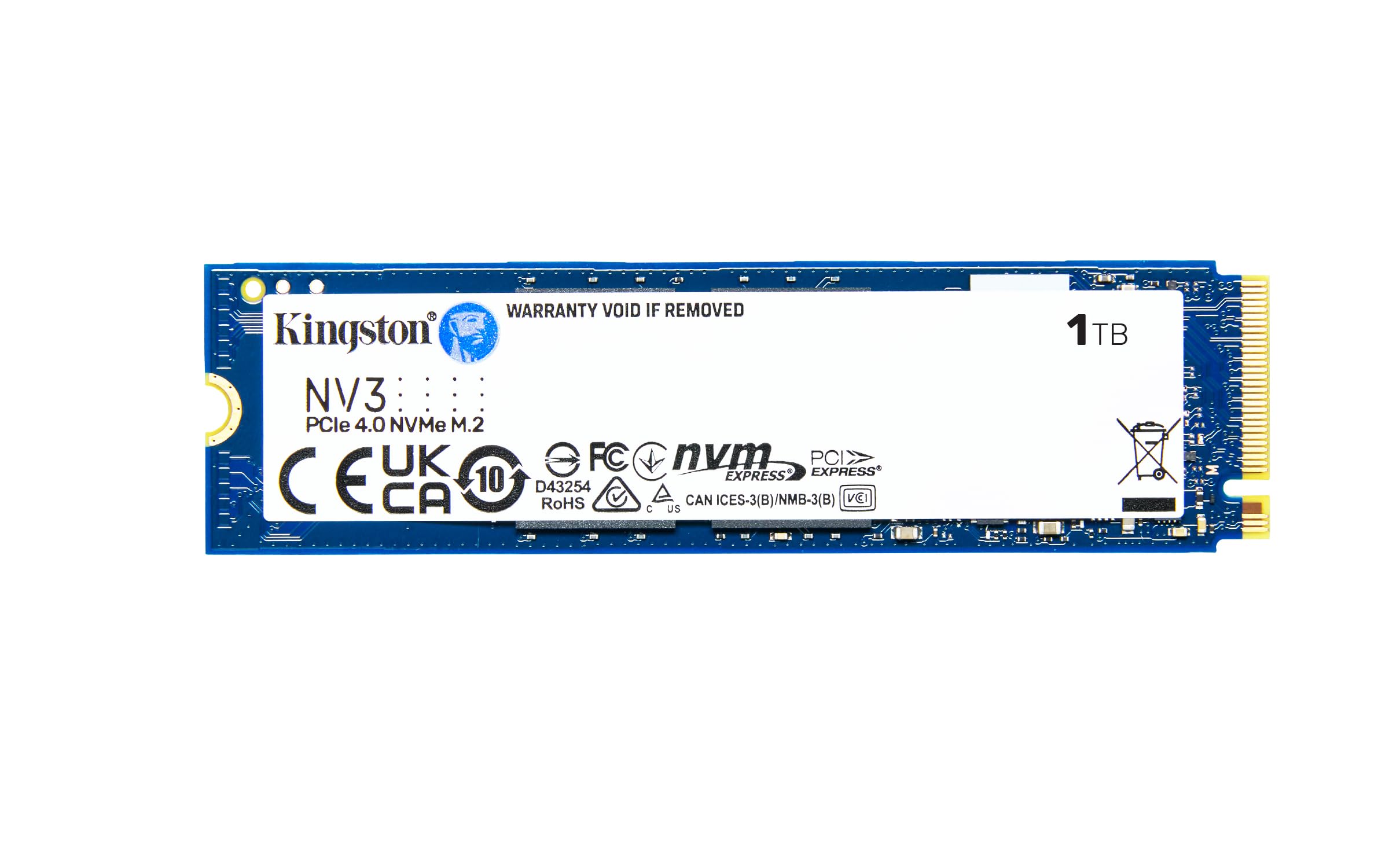
Kingston’s NV3 focuses on efficiency and reliability rather than chasing the highest sequential numbers. It delivers up to 6,000 MB/s reads on PCIe Gen 4 platforms, which is more than sufficient for DirectStorage and modern game loading. The lower power draw makes it an excellent choice for laptops and SFF builds where thermal headroom is limited.
The drive uses a 4-lane Gen 4 controller and is built with shock-resistant components. Capacities go up to 4TB for those who need a single-drive library. Kingston’s reputation for compatible firmware means the NV3 works in external USB4 enclosures and Mac Studio expansion hubs without the compatibility quirks sometimes seen with lesser-known controllers.
Owners report the drive runs cool and stable even in older ThinkPad docks running at PCIe Gen 3 speeds. The blue PCB is a visual departure from the standard black, but it has no impact on performance. For gamers who want a no-nonsense boot or secondary drive with solid speed and proven brand support, the NV3 delivers consistent results.
Why it’s great
- Low power consumption ideal for laptops and portable setups
- Shock resistant construction adds physical durability
- Strong brand support and firmware compatibility
Good to know
- 6,000 MB/s ceiling is lower than flagship Gen 4 competitors
- No bundled heatsink or software utilities
5. Fanxiang S880E 1TB NVMe SSD

The S880E hits sequential reads of 7,000 MB/s and writes of 3,000 MB/s, placing it firmly in high-performance Gen 4 territory for read-heavy gaming workloads. Fanxiang’s differentiating feature is the sticker itself: a multi-layer graphite-coated copper foil with an aluminum backing that acts as a passive heatsink, keeping the NAND and controller temperatures down even during graphically intense sessions.
Compatibility extends to PS5 storage expansion and any desktop or laptop with an M.2 2280 slot. The drive supports NVMe 2.0 and is specifically marketed for DirectStorage acceleration, which aligns with the needs of modern game engines. Fanxiang includes a five-year warranty and lifetime technical support, backed by over two decades of manufacturing history.
Users have deployed the S880E in NAS units (Ugreen models) and report file copy speeds over rsync that are five times faster than aging SATA SSDs. The drive recognizes immediately in all tested systems, and the integrated thermal sticker removes the need for an aftermarket heatsink in most chassis.
Why it’s great
- Innovative graphite-copper thermal sticker for heat management
- NVMe 2.0 support for next-gen API compatibility
- Five-year warranty with lifetime technical support
Good to know
- Write speed of 3,000 MB/s is half the read speed
- Not compatible with macOS
6. Ediloca EN705 1TB SSD

The Ediloca EN705 delivers sequential reads up to 5,000 MB/s and writes up to 3,800 MB/s on a PCIe Gen 4 x4 interface. That bandwidth clears Sony’s PS5 minimum requirement easily, making it a cost-effective internal expansion option for console owners. Dynamic SLC caching accelerates burst writes for game installations and updates.
Ediloca includes an installation screwdriver and mounting screw in the box, removing a common friction point for first-time builders. The drive has passed 1,500+ hours of validation with a 320 TBW endurance rating and supports TRIM, S.M.A.R.T., and LDPC error correction for long-term data integrity. The five-year warranty adds further confidence.
PS5 owners report the drive is recognized immediately after a simple YouTube-guided installation. The EN705 also works as a secondary drive in standard desktop PCs, where its thermal characteristics remain manageable without an extra heatsink. One caveat: a review notes the drive cannot be used as a Windows OS boot device, limiting its role to game storage.
Why it’s great
- Officially validated for PS5 storage expansion
- Includes installation screwdriver and mounting screw
- Dynamic SLC cache for faster burst write performance
Good to know
- Cannot be used as a bootable Windows OS drive
- Write speeds trail high-end Gen 4 competitors
7. WD_Black SN770M 1TB M.2 2230 SSD
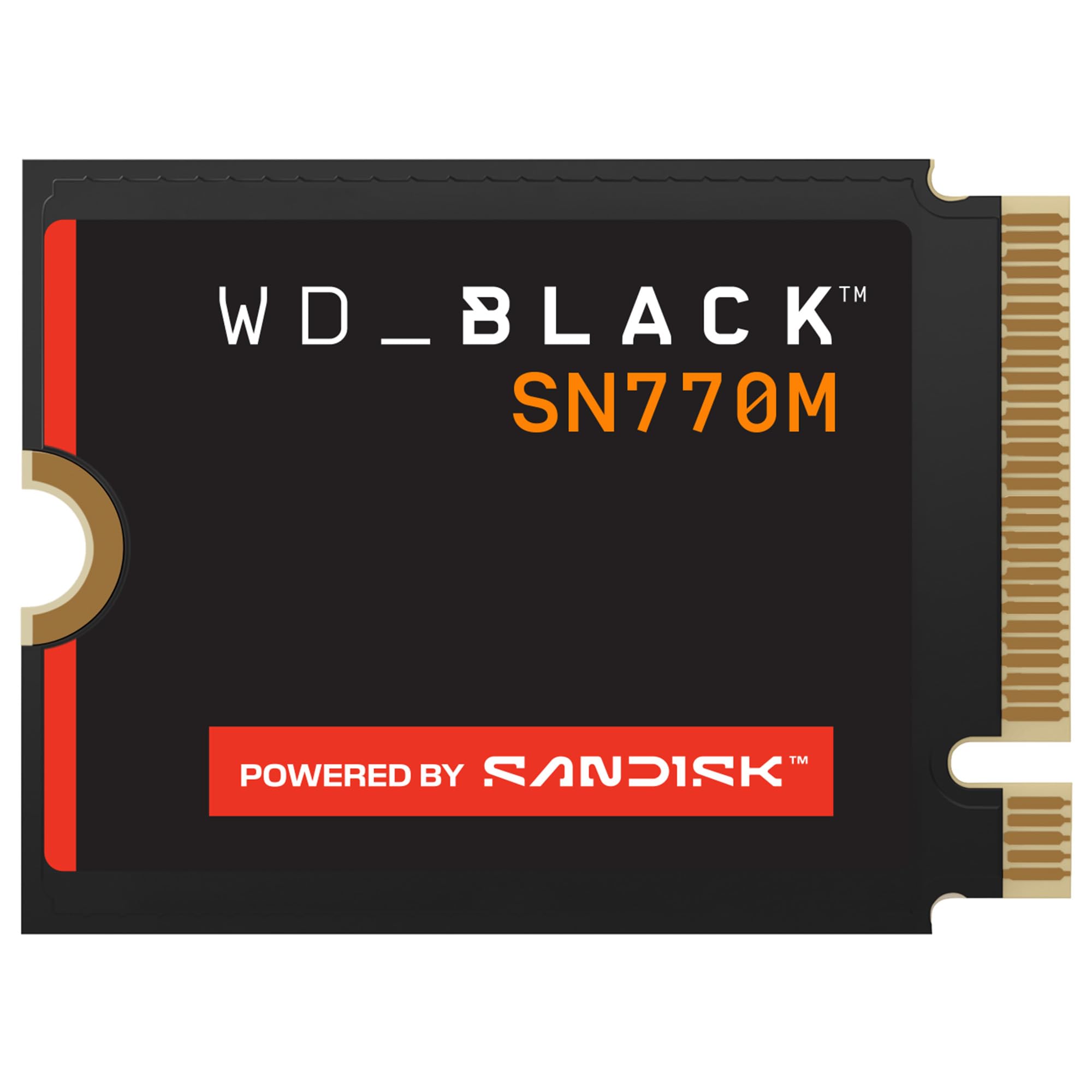
The SN770M is purpose-built for the M.2 2230 slot found in handheld gaming PCs like the ASUS ROG Ally and Valve Steam Deck. Despite the compact form factor, it delivers up to 5,150 MB/s sequential reads and 4,900 MB/s writes—enough bandwidth to eliminate load screen delays in any handheld library. The drive uses SanDisk TLC 3D NAND and includes nCache 4.0 technology for burst write acceleration.
WD_BLACK’s Game Mode 2.0 works in conjunction with Microsoft’s DirectStorage API to optimize asset decompression and reduce CPU overhead. The 1TB variant allows handheld users to install a dozen or more modern AAA titles without juggling external microSD cards. The drive also fits compatible laptops like the Microsoft Surface and Dell XPS series.
Customer reviews emphasize the drop-in simplicity: an ROG Ally user reported a five-minute swap that transformed game load times from slow microSD performance to near-instant. Thermal management keeps the drive cool inside the tightly packed handheld chassis, and the SLC cache ensures large game installations finish quickly without throttling.
Why it’s great
- Exact 2230 fit for Steam Deck, ROG Ally, and Legion Go
- 5,150 MB/s read speed in a compact footprint
- DirectStorage support for reduced CPU load during gaming
Good to know
- 2230 form factor limits upgrade options for full-size desktop slots
- Premium price per GB compared to standard 2280 drives
FAQ
Is a PCIe Gen 4 SSD necessary for gaming or is Gen 3 enough?
Can I use any 1TB NVMe SSD with the PlayStation 5?
What does the TBW rating mean on a gaming SSD?
Final Thoughts: The Verdict
For most users, the best 1tb gaming ssd winner is the Patriot Viper VP4300 Lite because it delivers class-leading 7,400 MB/s read speeds at a reasonable price and works flawlessly in both desktop and PS5 environments without an extra heatsink. If you want maximum sustained write performance and premium thermal management, grab the BIWIN Black Opal NV7400. And for handheld gaming console upgrades, nothing beats the WD_Black SN770M with its drop-in 2230 compatibility and DirectStorage optimization.