
Ceramic is porous, brittle, and subject to thermal expansion — three properties that make it one of the trickiest surfaces to bond reliably. Standard white glues peel off, thin cyanoacrylates wick into the grain and leave a brittle joint, and epoxy can fail if the surface isn’t perfectly prepped. The right adhesive doesn’t just stick; it creates a molecular-level grip that survives washing, heat, and mechanical stress without yellowing or cracking.
I’m Min — the co-founder and writer behind Gadgets Feed. I’ve spent hundreds of hours analyzing adhesive chemistry, viscosity ratings, tensile strength data, and real-world failure modes to separate the products that truly bond to ceramic from those that just smear on and claim to work.
Whether you are gluing a cracked mug handle, reattaching a porcelain figurine, repairing a tile edge, or bonding ceramic to metal or wood, this guide cuts through the marketing to find the real adhesive for ceramic solutions that actually hold up over time.
How To Choose The Best Adhesive For Ceramic
Ceramic fractures into two categories: glazed (vitrified, non-porous surface) and unglazed (terra cotta, bisque, stoneware — porous and thirsty). The wrong adhesive type on the wrong ceramic surface guarantees a weak bond that fails under the first thermal cycle or drop. Selecting the correct chemistry, viscosity, and working time makes the difference between a repair you forget about and one you redo every month.
Viscosity: Thin vs. Thick vs. Gel Formulas
Viscosity is measured in centipoise (CPS) and directly controls how the adhesive behaves on application. Thin cyanoacrylates (around 10–100 CPS) wick into hairline cracks on glazed ceramic but run off vertical surfaces almost instantly. Medium-viscosity formulas (200–800 CPS) offer a balance of capillary action and minimal runoff. Thick gels (above 1000 CPS) and epoxy putties stay precisely where applied, making them ideal for vertical repairs, gap filling, and porous unglazed ceramic where thin liquids would soak in and leave a starved joint. For most household ceramic repairs, a gel consistency or epoxy putty provides the best control.
Tensile Strength and Flexibility
Tensile strength (measured in PSI) indicates how much pulling force the cured adhesive can withstand, but raw strength without flexibility leads to failure on ceramic. Ceramic and the adhesive expand at different rates when heated (from washing, microwaving, or sunlight), so the bond line must absorb that expansion without fracturing. Standard cyanoacrylates are extremely rigid and can shatter under thermal stress — epoxy and toughened cyanoacrylates include flex agents that prevent brittle cracking. Look for formulations explicitly marked as “flexible” or “toughened” if the ceramic part will experience temperature changes or vibration.
Working Time and Full Cure Duration
Set time (the seconds or minutes before the adhesive holds parts together without slipping) and cure time (the hours or full day before the bond reaches maximum strength) are completely different metrics. Fast-setting cyanoacrylates (15–60 seconds) are ideal for clean, tight-fitting breaks where you can hold the pieces steady. Epoxies with 5–30 minutes of working time let you reposition pieces, fill gaps, and sculpt the adhesive before it hardens. No adhesive for ceramic reaches full bond strength in under 12–24 hours — rushing the cure is the most common reason repairs fail under load.
Temperature and Water Resistance
Ceramic items frequently encounter heat (coffee mugs, oven-safe dishes) and water (dishwashing, outdoor planters). Standard cyanoacrylates degrade above 120°F and become brittle at high temperatures, while specialized formulas like sodium silicate with a 2000°F rating handle kiln environments. Epoxy typically withstands continuous heat up to around 200–250°F. For dishwasher-safe repairs, the adhesive must be both waterproof and heat-resistant — not all “waterproof” glues survive the combination of hot water, steam, and detergent cycles. Check the product’s temperature rating specifically, not just whether it says waterproof.
Quick Comparison
On smaller screens, swipe sideways to see the full table.
| Model | Category | Best For | Key Spec | Amazon |
|---|---|---|---|---|
| CYAFIXED Gap Fill Super Glue | Thick CA Glue | Gap-filling repairs on vertical ceramic surfaces | 1500 CPS viscosity; 3580 PSI | Amazon |
| LEENEXUS Super Glue for Ceramic | Gel CA Adhesive | Clear, low-odor ceramic repairs | Gel formula; anti-clog tip | Amazon |
| BEACON 527 Multi-Use Glue | Multi-Surface Adhesive | General crafts and lightweight repairs | 24-hour full cure; waterproof | Amazon |
| Endhokn Epoxy Putty | 2-Part Epoxy Putty | Sculpting and filling large ceramic gaps | 30-min working time | Amazon |
| Lynn Manufacturing Sodium Silicate | High-Temp Adhesive | Kiln-safe ceramic and refractory repairs | 2000°F rating; 40% solution | Amazon |
| Weldbond Multi-Surface Glue | PVA-Based Adhesive | Mosaic tile work and non-structural repairs | 20-min set; non-toxic | Amazon |
| STARBOND 5 Minute Epoxy | Flexible Epoxy | High-stress, flexible ceramic bonds | 2600 PSI shear; 5-min set | Amazon |
In‑Depth Reviews
1. CYAFIXED Gap Fill Super Glue
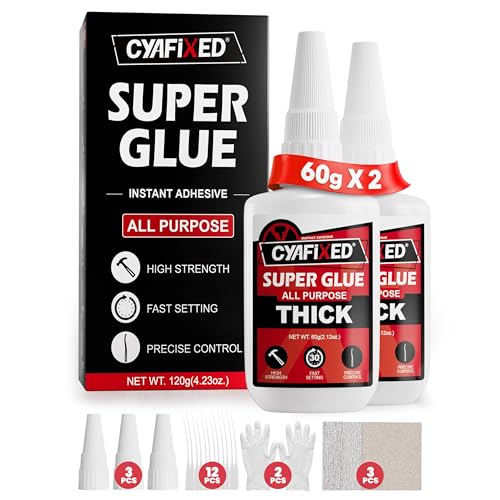
This honey-thick cyanoacrylate sits at 1500 CPS, which is the sweet spot for ceramic repairs that involve gaps, uneven breaks, or vertical surfaces. Unlike thin CA glues that run down a mug handle and pool at the base, this formula stays put for 30 to 60 seconds before setting, giving you a real repositioning window — critical when aligning a multi-fragment ceramic repair. The included 20-piece accessory kit (anti-clog caps, precision microtips, sanding papers, gloves) adds genuine utility for first-time and frequent users alike.
The 3580 PSI tensile rating is significantly higher than typical consumer CA glues (which hover around 1500–2000 PSI), and real-world reviews confirm the bond withstands the force needed to hold a filled bucket of water or repair a glass table leg. The thick consistency also makes it well-suited for porous unglazed ceramic, where thin adhesives would soak in and leave a starved joint. The anti-clog caps and microtips extend bottle life through months of intermittent use — a common pain point with standard CA glue bottles that weld themselves shut after one session.
Application downside: the microtips do clog if not wiped immediately after each use, and the glue bonds skin aggressively (keep acetone nearby). For ceramic repairs involving gap filling — chipped edges, broken handles with missing fragments, or uneven mating surfaces — this is the most versatile thick CA option currently available.
Why it’s great
- Honey-like 1500 CPS viscosity stays on vertical ceramic surfaces
- 3580 PSI tensile strength holds high-stress repairs
- 30–60 second working window for precise alignment
- Generous 4-ounce bottle with anti-clog caps and microtips
Good to know
- Bonds skin instantly; keep acetone available
- Microtips may clog if not wiped immediately after each use
2. LEENEXUS Super Glue for Ceramic
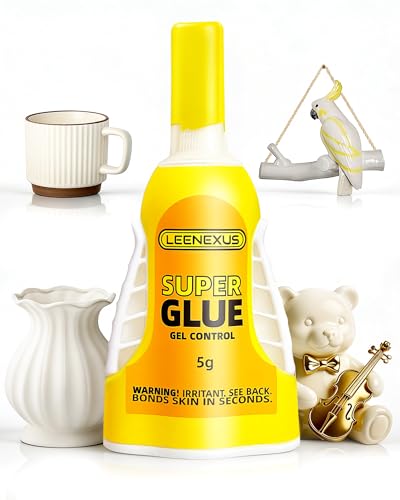
This is a purpose-built ceramic gel CA adhesive that tackles the three biggest complaints about standard super glues: blooming (white fog that ruins the look of clear repairs), odor, and clogging. The dual-threaded cap and built-in cleaning needle are not gimmicks — they actively prevent the nozzle from locking up, which is the number-one reason CA bottles get thrown away before they’re empty. The gel stays where applied, making it ideal for reattaching mug handles, fixing porcelain figurines, or bonding ceramic tile trim on vertical walls.
The dual-molecular cross-linking technology claim translates to real-world adhesion that holds on polished glazed ceramic surfaces where many glues fail. Reviews report successful repairs on sentimental heirlooms that look nearly invisible after curing. The 30–60 second set time and 24-hour full cure are standard for CA gel, but the low-odor formula means you can use this indoors without overwhelming the room with fumes. Heat resistance up to 212°F means the bond survives hot tap water and tea temperatures, though repeated dishwasher cycles remain an open question for any CA-based adhesive.
The 5-gram bottle is compact — sufficient for several small repairs but not ideal for large-area bonding or multiple projects. A small number of reported empty or partially filled bottles suggests quality control inconsistencies that the manufacturer’s warranty should cover. For one-off ceramic repairs where appearance matters most, this is the cleanest-finish option.
Why it’s great
- Gel formula and cleaning needle prevent nozzle clogging
- Low bloom and low odor for indoor use without fumes
- Dries crystal clear, nearly invisible on porcelain repair
- Heat resistant to 212°F for hot water contact
Good to know
- Small 5-gram bottle best for 2–3 small repairs
- Quality control can vary; check seal on arrival
3. BEACON 527 Multi-Use Glue
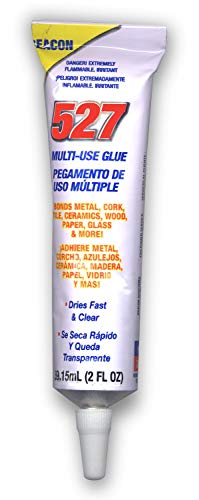
The BEACON 527 is a clear-drying, flexible liquid adhesive that fills a different niche than cyanoacrylate gels: it is formulated for crafts and lightweight repairs where quick grab and shock resistance matter more than instant set. The adhesive dries in about an hour and cures fully in 24 hours, with a UVA-resistant and waterproof finish that holds up to outdoor conditions. For ceramic items like garden pottery, decorative tiles, or ceramic jewelry components, this glue provides a clear bond that won’t yellow over time.
The flexibility of the 527 formula is its standout feature compared to rigid CA glues. When applied to thin ceramic pieces that experience slight flex or thermal expansion (like a ceramic dish moved from fridge to microwave), the shock-resistant bond line absorbs movement without fracturing. The formula is paintable and can be cleaned up with toluene while wet, making it practical for projects where aesthetics matter. The 2-ounce twin pack provides substantial volume for multiple craft sessions.
However, this is not a structural adhesive — it will not hold under the shear load of a broken mug handle reattachment or a ceramic statue leg. The bond strength is significantly lower than cyanoacrylate or epoxy, and the toluene cleanup requirement is a real household limitation. For non-structural ceramic craft and light repair work, it is a reliable, easy-to-apply option.
Why it’s great
- Flexible bond absorbs thermal expansion without cracking
- Dries clear and resists UV yellowing
- UVA and weatherproof for outdoor ceramic use
- Generous 2-pack provides good value per ounce
Good to know
- Not strong enough for structural or load-bearing repairs
- Cleanup requires toluene, not water or alcohol
4. Endhokn Epoxy Putty

This 2-part epoxy putty is the correct choice when the ceramic piece has missing chunks, deep cracks, or uneven surfaces that no liquid glue can fill. The putty is kneaded by hand to activate the epoxy and hardener, giving you about 30 minutes of molding and sculpting time before it begins to set. It cures to a hard, paintable, drillable surface that bonds to both glazed and unglazed ceramic, making it ideal for architectural repairs like cracked tiles, broken pottery with missing shards, or sculptural restoration where the adhesive itself becomes part of the visible form.
Real-world applications include filling a 2-inch hole for AC pipes, repairing ceramic salt and pepper shakers by reinforcing the legs, and fixing small statues where the putty was sculpted to match the original shape. The cured epoxy is waterproof and temperature-resistant from -58°F to 266°F, so it survives outdoor use, hot water contact, and freezing conditions. The included gloves and scraper make the mixing and application process significantly cleaner than working with raw epoxy putty from unlabeled sticks.
The primary limitation is aesthetic: the white putty color will be visible on dark or colored ceramics unless painted over. The putty also has a tacky feel during initial application that can be smoothed with petroleum jelly, but this leaves a greasy residue that requires sanding before painting. For gap filling and structural reconstruction where liquid adhesive cannot physically bridge the gap, this is the most capable option.
Why it’s great
- Can be sculpted to fill missing ceramic shards and gaps
- 30-minute working time allows careful shaping
- Drillable, paintable, and sandable after full cure
- Waterproof with broad temperature tolerance
Good to know
- White color requires painting on dark ceramics
- Tacky surface benefits from smoothing agent during application
5. Lynn Manufacturing Sodium Silicate

This is not a glue in the conventional sense — it is a 40% sodium silicate solution (water glass or liquid glass) that cures to a hard, clear, glass-like solid capable of withstanding 2000°F. For any ceramic application involving fire, kilns, stoves, or high-temperature environments, this is the only adhesive on this list that will not burn off, yellow, or disintegrate. Real-world applications include repairing ceramic flame guards, bonding firebrick to metal in wood stoves, and restoring ceramic components in heaters that experience cyclic 1000–3000°F blue flame exposure.
Application differs fundamentally from CA glue or epoxy: the liquid is brushed onto clean ceramic edges, clamped, and allowed to set for 30 minutes to a hard clear state, then left to fully cure for 24 hours. The cured bond is extremely hard and can be diamond-filed, sanded, or polished. Because it cures via water evaporation and carbon dioxide absorption rather than polymerization, a sealed coating is required to prevent future moisture reabsorption at room temperature. The 4-ounce bottle goes a long way — a small brush applies a thin layer that covers a significant repair area.
The critical constraint is that this adhesive is caustic alkaline (high pH) before curing, so skin contact must be avoided. It also conducts electricity when wet, which matters for electrical ceramic repairs. This is not a general-purpose ceramic adhesive — it is a specialized tool for high-temperature bonding where every other adhesive fails. If your ceramic repair faces a kiln, furnace, or stove, buy this; otherwise choose a CA or epoxy.
Why it’s great
- Withstands 2000°F continuous — kiln-safe
- Cures to hard clear glass that can be polished
- 4 oz bottle covers many repairs
- Real-world proven on firebrick and stove repairs
Good to know
- Caustic alkaline; wear gloves and eye protection
- Conducts electricity when uncured
- Not suitable for general household ceramic repairs
6. Weldbond Multi-Surface Glue
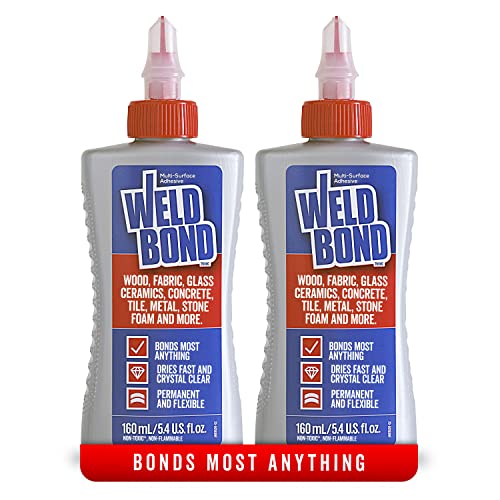
Weldbond is a PVA-based adhesive engineered specifically for porous surfaces and mosaic work, where non-toxicity, low odor, and water cleanup are non-negotiable. Unlike cyanoacrylates or epoxies, this glue applies white and dries clear — a useful visual cue during application — and sets in 20 minutes while allowing up to an hour of repositioning. This working window is essential when placing ceramic tile pieces in a mosaic pattern where each piece must be adjusted before the adhesive grabs.
The formula is weatherproof and temperature-resistant, making it suitable for both indoor and outdoor ceramic projects like garden stepping stones, backsplash tiles, and decorative ceramic sculpture. It is sandable and paintable after curing, so the bond line can be seamlessly integrated into the final surface. The 160ml (5.4 oz) twin pack provides substantial volume for large projects at a reasonable per-ounce cost compared to specialty ceramic adhesives.
The trade-off is bond strength: this is not a repair adhesive for broken structural ceramic pieces. The PVA chemistry cannot match the tensile holding force of cyanoacrylate or epoxy on non-porous glazed ceramic surfaces. It also requires clamping or weight to maintain contact during the 20-minute set period. For mosaic mounting, craft assembly, and non-structural ceramic bonding, this is the safest, most user-friendly option — but it should not be your first choice for fixing a broken mug handle or reattaching a ceramic figurine arm.
Why it’s great
- Non-toxic, odorless, safe for indoor crafts and kids’ projects
- 20-minute set with up to 1 hour repositioning time
- Weatherproof and UV resistant for outdoor ceramic use
- Applies white, dries clear for easy application tracking
Good to know
- Bond strength insufficient for structural ceramic repair
- Requires clamping or weight during set period
7. STARBOND 5 Minute Epoxy Pro Kit

This 2-part epoxy delivers the highest measurable bond strength on this list (2600 PSI shear) with a critical engineering advantage: the formula is toughened and flexible, meaning it absorbs vibration and thermal stress without the brittle cracking that plagues rigid epoxies and standard CA glues. For ceramic repairs on items that experience mechanical load, temperature swings, or physical handling — such as a ceramic mug handle that gets torqued during dishwashing, or a ceramic tile on a frequently used counter — this is the most failure-resistant option.
The 1:1 mix ratio simplifies preparation, and the Pro Kit includes mixing trays, spatulas, and screw-cap bottles that prevent the tubes from bonding shut (a common failure mechanism with syringe-style epoxy dual-dispensers). The 5-minute working time is tight but realistic: you have enough time to mix, apply, and align the parts, but not to dawdle. Real-world applications include tombstone restoration, basement crack sealing, and general household repairs where the repair must hold under sustained load. The epoxy cures clear, so it blends well with light-colored ceramic surfaces.
The 8-ounce twin-pack provides substantial volume for multiple repairs. The primary operational requirement is careful surface preparation: ceramic must be clean, dry, and slightly abraded for the epoxy to achieve maximum adhesion on glazed surfaces. Unlike CA glue that can bond through minor contamination, epoxy demands clean mating surfaces. For load-bearing ceramic repairs where failure is not an option, this is the strongest and most mechanically sound solution.
Why it’s great
- 2600 PSI shear strength with flexible toughened formula
- Absorbs vibration and thermal stress without cracking
- Pro kit includes trays, spatulas, and screw-cap bottles
- 8 oz twin-pack provides large volume for multiple repairs
Good to know
- 5-minute working time demands careful prep before mixing
- Glazed ceramic must be abraded for maximum adhesion
FAQ
Can I use regular super glue on ceramic dishes that go in the dishwasher?
How do I prepare a ceramic surface for the strongest possible bond?
What is the difference between gel CA glue and epoxy putty for ceramic repair?
Why did my ceramic glue repair fail after a few days?
Can epoxy or CA glue be used on ceramic that contacts food?
Final Thoughts: The Verdict
For most users, the adhesive for ceramic winner is the CYAFIXED Gap Fill Super Glue because its 1500 CPS thick viscosity, 3580 PSI tensile strength, and generous accessory kit make it the most versatile option for ceramic repairs involving gaps, vertical surfaces, and moderate structural load. If you need a crystal-clear, low-odor gel that leaves no visible bloom on porcelain and figurines, grab the LEENEXUS Super Glue for Ceramic. And for high-stress, load-bearing ceramic repairs where flexibility and maximum shear strength are required, nothing beats the STARBOND 5 Minute Epoxy Pro Kit.