
A flickering light, the hum of the fridge cutting out, and that sinking feeling as you realize you’re without power for an unknown stretch. A backup battery system is the difference between a manageable inconvenience and a spoiled refrigerator, a dead sump pump, or a drained medical device. These aren’t just oversized phone chargers; they are whole-home or critical-load power stations that sit silently until the grid goes down.
I’m Min — the co-founder and writer behind Gadgets Feed. I’ve spent hundreds of hours cross-referencing inverter specifications, battery chemistries, charge cycle ratings, and real-world capacity tests across the current market landscape to separate the truly robust systems from the marketing noise.
This guide is built from that deep research to help you find the perfect backup battery system for your home, RV, or campsite without wasting money on undersized or overpriced hardware.
How To Choose The Best Backup Battery System
Not all power stations are created equal. Picking the right one requires you to match your specific load requirements with the system’s capacity and inverter capabilities. Here are the core decision points to lock in before you buy.
Capacity vs. Appliance Load
Capacity (measured in watt-hours, Wh) tells you the total energy stored, but the inverter’s continuous wattage rating determines what you can actually run. A 2000Wh system with a 1200W inverter will struggle with a microwave, while a 2000Wh system with a 2400W inverter handles it easily. Estimate the total wattage of everything you plan to plug in simultaneously and add 20% headroom for start-up surges.
Battery Chemistry and Cycle Life
Lithium Iron Phosphate (LiFePO4) batteries dominate the premium segment for good reason. They offer 3,000 to over 6,000 charge cycles before degrading to 80% capacity, which translates to a decade or more of daily use. This chemistry is also inherently more stable and safer than older NMC or lead-acid options, with a lower risk of thermal runaway.
Recharge Speed and Solar Compatibility
The ability to recharge your station quickly is critical, especially during multi-day outages. Look for units with 1200W+ AC input capabilities that can refill from 0-80% in under two hours. Solar input acceptance is equally vital for off-grid independence; a high MPPT controller rating (600W to 1200W) determines how fast you can top up from panels during daylight.
Quick Comparison
On smaller screens, swipe sideways to see the full table.
| Model | Category | Best For | Key Spec | Amazon |
|---|---|---|---|---|
| EF ECOFLOW DELTA 3 Max | Premium | High-demand home backup | 3400W X-Boost Output | Amazon |
| BLUETTI Elite 200 V2 | Premium | Long daily use & 3900W lift | 6000+ Cycle Life | Amazon |
| Jackery HomePower 3000 | Premium | Whole-home essentials & large RV | 3072Wh Capacity | Amazon |
| Anker SOLIX C2000 Gen 2 | Premium | Ultra-compact & fast recharge | 58 Min Full Charge | Amazon |
| BLUETTI AC200L | Mid-Range | Expandable home system | 8192Wh Max Expansion | Amazon |
| DJI Power 2000 | Mid-Range | Professional gear & drone ops | 0-80% in 55 Mins | Amazon |
| VTOMAN FlashSpeed 2400 | Mid-Range | Budget-friendly 12V jump-start | 2400W Continuous Output | Amazon |
| Jackery Explorer 2000 v2 | Mid-Range | Lightweight carry & camping | 39.5 lbs / 2042Wh | Amazon |
| AFERIY 2048Wh P210 | Budget-Friendly | Value home UPS & silent use | 16 dB Normal Load Noise | Amazon |
In‑Depth Reviews
1. EF ECOFLOW DELTA 3 Max
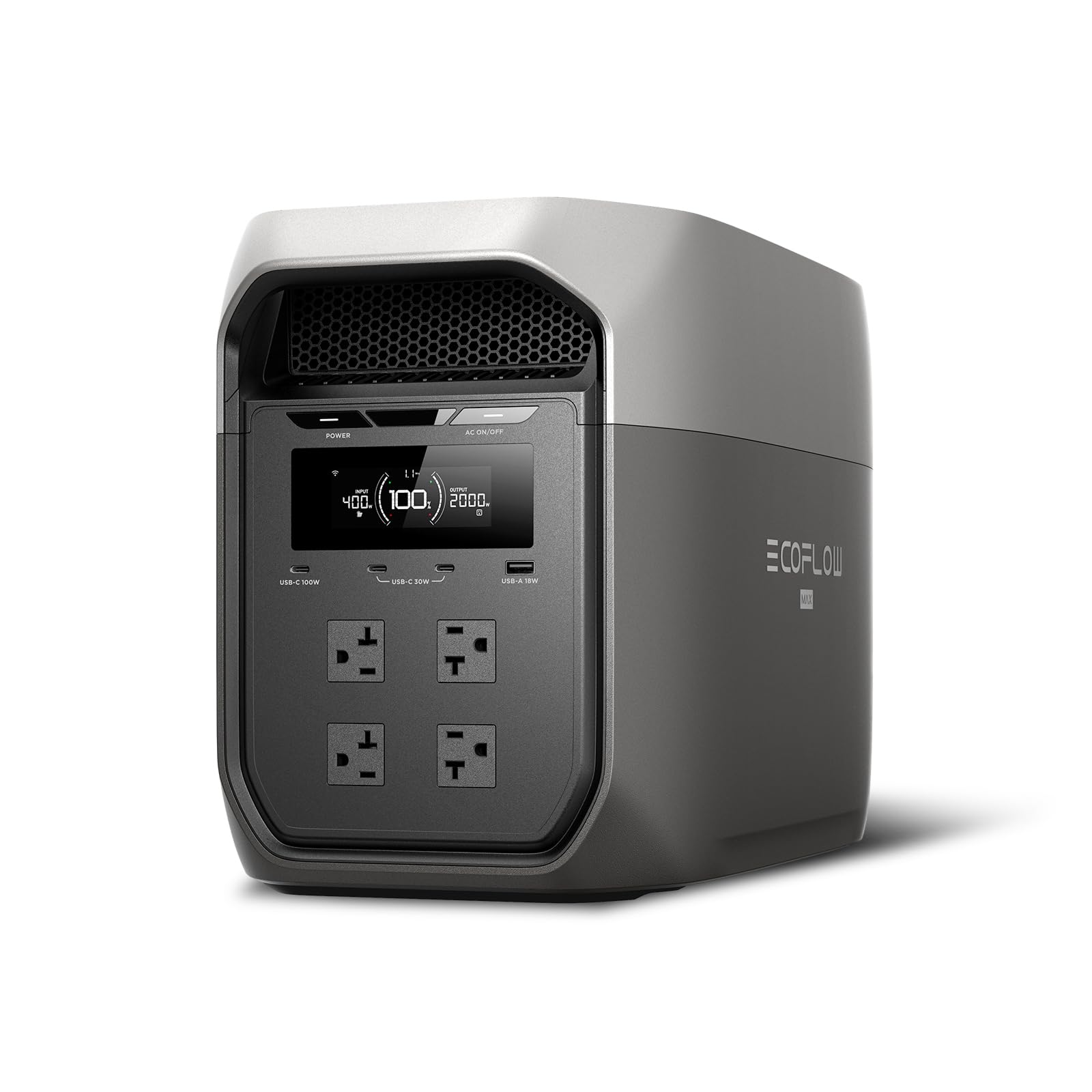
The EcoFlow DELTA 3 Max hits a rare sweet spot between raw power and fast refueling. Its 2048Wh LiFePO4 battery packs a 3400W X-Boost inverter that can handle 99% of household appliances, including large fridges and microwaves, while the X-Stream technology refills 0-80% in just 1.13 hours. This makes it a formidable choice for both hurricane-season home backup and RV campsite hosting.
The ultra-quiet operation is a standout—it remains unobtrusive even under load, which is a huge plus for overnight use in an RV or a bedroom-during-a-blackout scenario. The 10ms UPS transfer time is certified fast enough to keep a desktop PC or CPAP machine running without a hiccup, and the companion app gives you granular remote control over charging schedules and energy monitoring.
Durability is also a key feature here. EcoFlow rates this for a 10-year lifespan with daily use, and the solid aluminum and plastic construction feels robust. The dual handles make it easier to lug around than its bulky size suggests, though at 61.5 lbs it’s not a one-handed carry. For a versatile system that charges faster than most competitors and runs almost everything, this is the gold standard.
Why it’s great
- Unmatched 3400W X-Boost for high-demand loads
- Ultra-fast 0-80% recharge in 68 minutes
- Robust 5-year warranty
Good to know
- Heavier than some comparable 2kWh units
- Solar panels sold separately
2. BLUETTI Elite 200 V2

The BLUETTI Elite 200 V2 redefines longevity. Using a CNAS-certified automotive-grade LiFePO4 battery, it offers a remarkable 6,000 charge cycles to 80% capacity, translating to a theoretical 17-year lifespan. That makes it the best long-term investment on this list, especially for users who plan to cycle the battery daily for off-grid living or year-round energy savings.
Its power delivery is equally impressive. The 2600W continuous output and 3900W Power Lifting mode allow it to start stubborn appliances like large refrigerators and air conditioners without tripping. The standby power consumption is an industry-low 10W, meaning you lose less energy to idling compared to similarly sized units that burn 30W or more just sitting there.
The user interface is clean, with a clear display and the option to switch between Turbo, Standard, and Silent charging modes via the app. At 53.35 lbs it’s heavy, but the dual handles and compact footprint (less than 14 inches in height) make it manageable for occasional transport. The lack of a dedicated 30A RV port is its one notable omission for full-time RVers.
Why it’s great
- Industry-leading 6000+ cycle lifespan
- 3900W Power Lifting for high-surge appliances
- Very low 10W standby power consumption
Good to know
- No dedicated 30A RV port
- Heavy at over 53 lbs
3. Jackery HomePower 3000
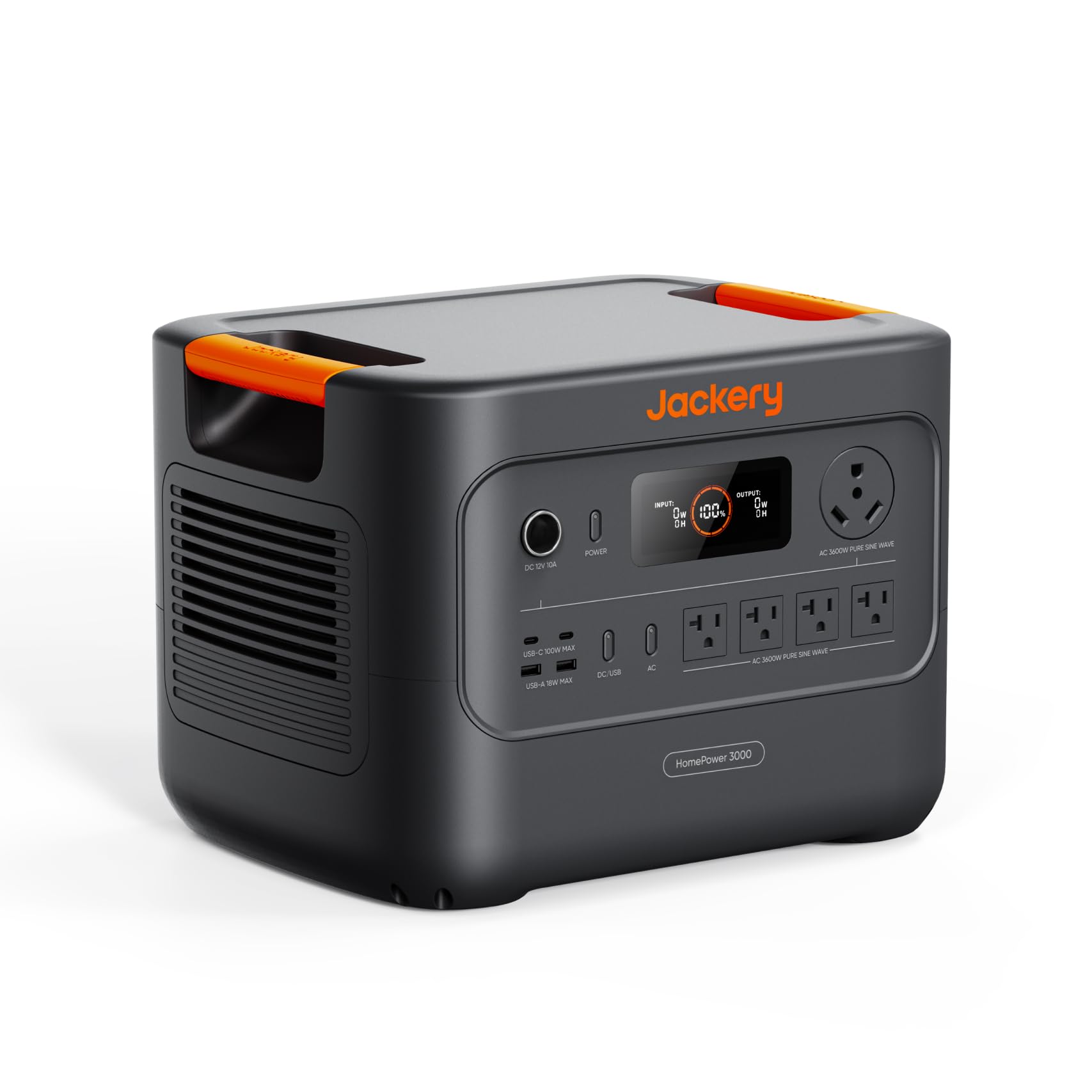
Jackery’s HomePower 3000 is a brute force machine. It’s the only unit here with a built-in TT-30 RV port for direct camper plug-in without a dongle.
The use of CTB (Cell-to-Body) technology makes this 47% smaller and 43% lighter than equivalent capacity units—at 59.5 lbs, it’s surprisingly portable for a 3kWh station. The 20ms UPS switchover is UL-certified and fast enough for most electronics, though it’s a hair slower than the sub-10ms competitors. The dual 100W USB-C PD ports are a boon for fast-charging drones and laptops simultaneously.
One major caveat concerns the warranty: Jackery’s policy reportedly requires a direct purchase from their store rather than Amazon to activate the full warranty. The fan can also be loud at around 60 dB when under noticeable load, making it less ideal for a quiet office UPS. Nonetheless, for sheer capacity and the ability to plumb directly into an RV’s 30A system, this is a powerful contender.
Why it’s great
- Massive 3072Wh capacity with 7200W surge
- Built-in TT-30 RV port
- Very compact for a 3kWh station
Good to know
- Warranty requires direct purchase from Jackery
- Fan noise can be high under load
4. Anker SOLIX C2000 Gen 2

The Anker SOLIX C2000 Gen 2 is the speed demon of the 2kWh class. It achieves a full 100% charge from a wall outlet in just 58 minutes, which is a full 15-20 minutes faster than most rivals. This rapid refueling is complemented by an 800W alternator charging capability, allowing you to top off from your vehicle’s battery in about 3 hours—8 times faster than a standard 12V socket.
Its 2048Wh LiFePO4 battery feeds a 2400W rated inverter capable of a 4000W peak, which is enough to start most window and RV air conditioners. The standby power consumption is a lean 9W, stretching runtime between charges. The size and weight are also premium—at just 41.7 lbs and 18.1 x 9.8 x 10.1 inches, it’s 25% lighter and 29% smaller than similarly specced units.
The expandability up to 4kWh with an add-on battery gives it future-proofing for longer outages. The built-in app provides clear energy monitoring and control. Some users note the lack of a printed manual, but the digital quick start guide is sufficient. For anyone who hates waiting for their power station to recharge, this is the clear winner.
Why it’s great
- Full recharge in only 58 minutes
- Ultra-light and compact design
- 800W alternator charging for vehicle top-ups
Good to know
- Expansion battery sold separately
- No physical manual included in box
5. BLUETTI AC200L

The BLUETTI AC200L is a modular powerhouse that grows with your needs. The base unit delivers 2048Wh and a 2400W inverter, but it can be expanded with up to four additional B-series batteries, reaching a whopping 8192Wh total capacity. This makes it a genuinely viable whole-home backup platform for multi-day outages without needing a gas generator.
It features a 30A RV port for direct fifth-wheel or travel trailer connection, a dedicated 48V/8A DC port, and a 100W USB-C PD port. The 2400W AC input refills the base unit from 0-80% in just 45 minutes, which is incredibly competitive. The 3600W Power Lifting mode provides the surge needed for heavy-starting loads like well pumps and shop vacs.
The unit is built for semi-permanent installation, weighing over 61 lbs, but the rugged construction and high-quality display make it feel like a premium investment. The app supports both Wi-Fi and Bluetooth for reliable monitoring. The only real downside is that buying multiple expansion batteries adds cost quickly, but for those planning a serious home backup setup, this is the most scalable platform here.
Why it’s great
- Expandable up to 8192Wh total capacity
- 45-minute 0-80% fast recharge
- Built-in 30A RV port
Good to know
- Base unit is heavy at 61.4 lbs
- Expansion batteries are expensive
6. DJI Power 2000
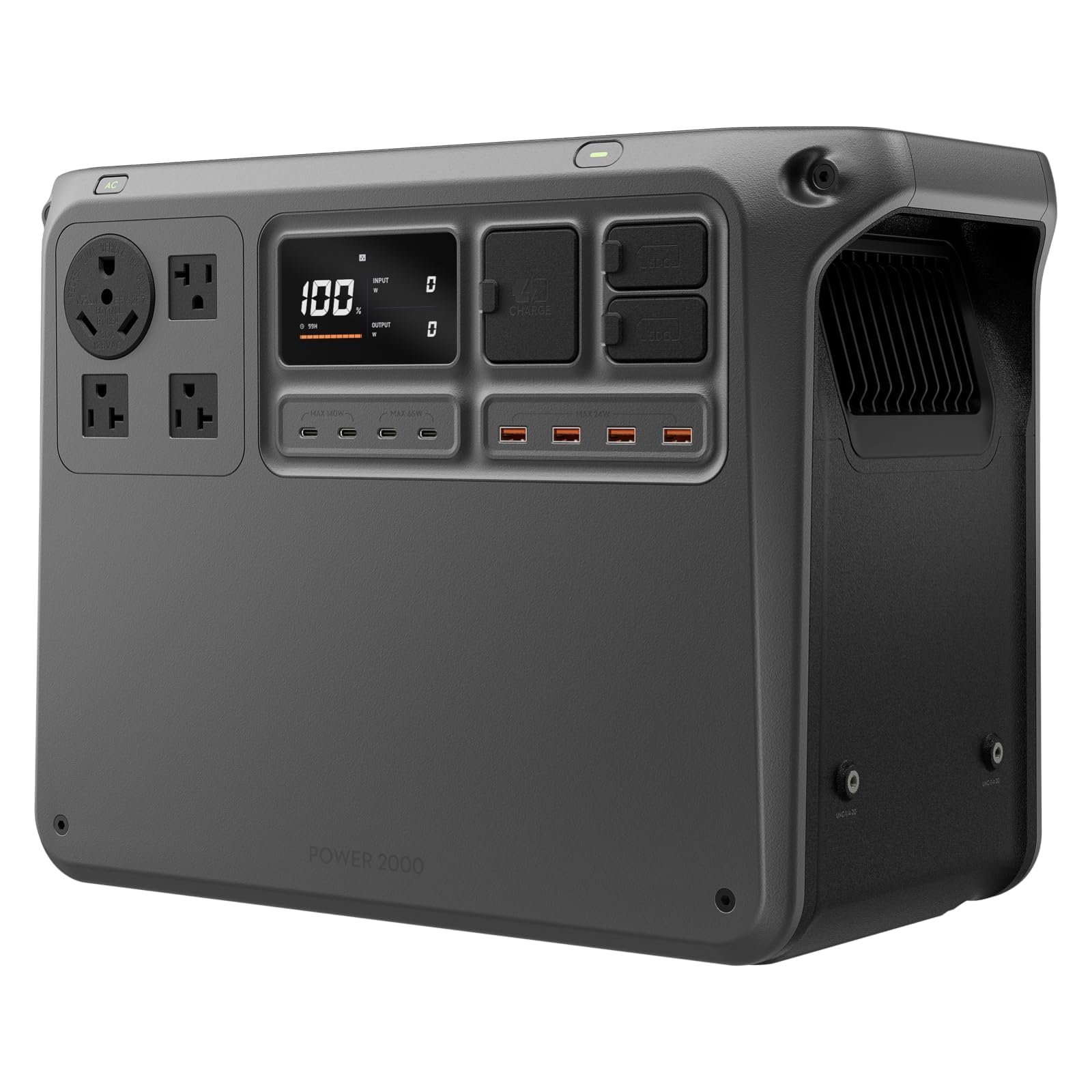
DJI brings its drone-grade engineering prowess to the backup battery market with the Power 2000. This 2048Wh LiFePO4 unit outputs a stable 3000W continuous (4000W peak), making it one of the strongest inverters in its size class. The headline feature is the 0-80% charge in just 55 minutes using a standard wall outlet, which is exceptionally fast for a 3kW-rated unit.
The build quality is unmistakably DJI—a flame-retardant housing with sub-nano coating for moisture resistance and a smart BMS with 26 temperature sensors. The 10ms UPS switch is twice as fast as DJI’s own Power 1000, providing near-instant seamless backup. It’s also whisper-quiet at under 30 dB, crucial for overnight use in a camper van or bedroom.
The battery can be expanded up to 22.5kWh with separate expansion packs, providing several days of backup for critical loads. The main drawbacks are the proprietary connectors for solar and expansion inputs, and the lack of built-in wheels given its 47.8 lb weight. The DJI Home app is required for advanced charging modes, which may feel limiting to some users, but the core hardware reliability is top-tier.
Why it’s great
- 3000W continuous output for heavy appliances
- 55-minute 0-80% recharge
- Excellent build quality and safety features
Good to know
- Proprietary connectors for expansion
- App required for advanced settings
7. VTOMAN FlashSpeed 2400
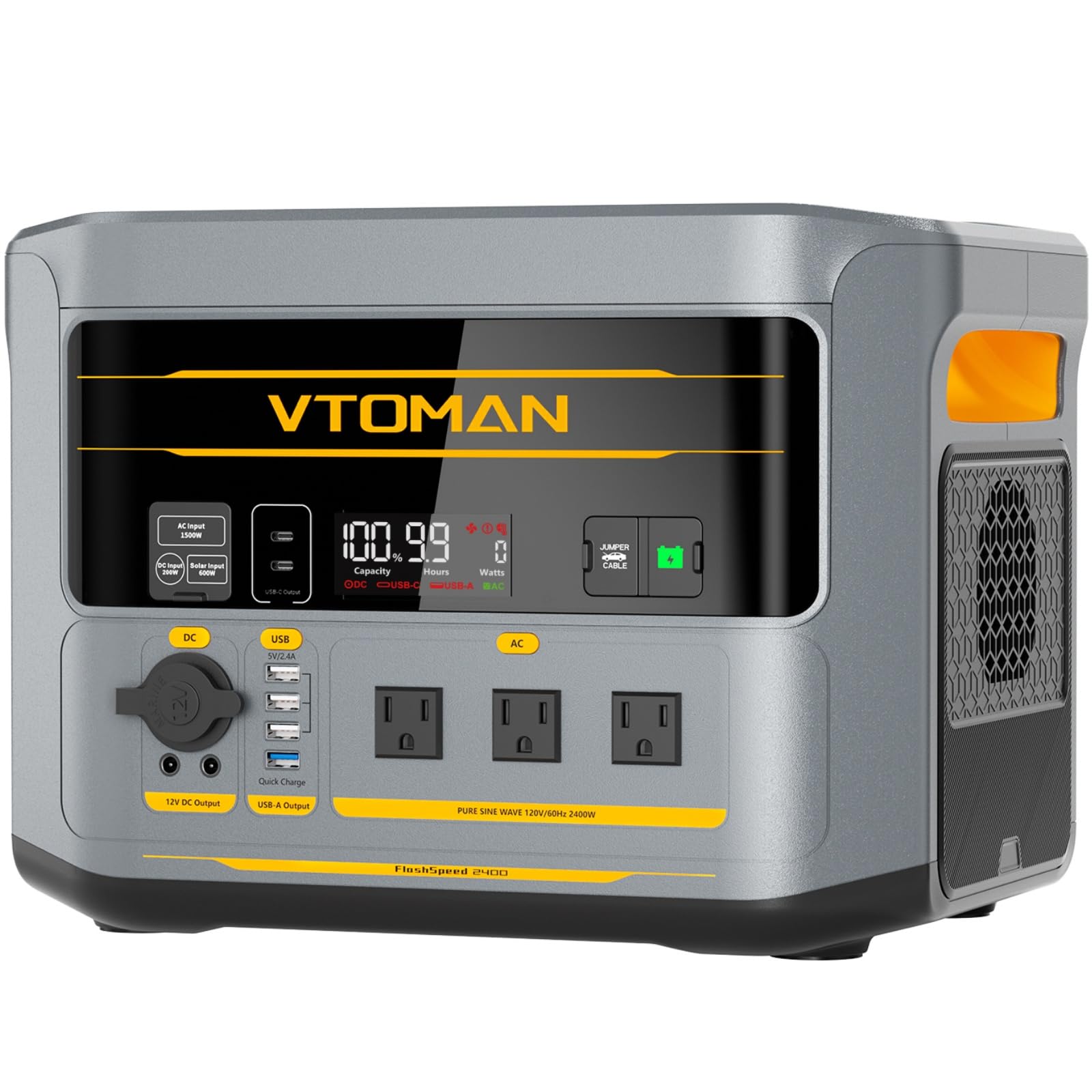
The VTOMAN FlashSpeed 2400 packs a 1408Wh LiFePO4 battery with a 2400W inverter (3200W peak) into a compact package. Its standout trick is the ability to fully charge in about one hour using a 1500W AC input, which is remarkably fast for a unit with less capacity than the 2kWh class winners. It also includes a built-in 12V jump-start capability for dead car batteries—a unique feature here.
With 12 output ports (3 AC, 4 USB-A, 2 USB-C, 3 DC) and a 10ms UPS backup, it’s well-equipped for powering a home router, modem, a small refrigerator, and medical devices during an outage. The 600W solar input with MPPT allows for solid off-grid top-ups. The built-in 5-mode LED light with SOS is a thoughtful addition for emergency situations.
Reviews indicate it runs a CPAP or a TV and laptop without breaking a sweat, though users note it’s better suited for low-to-moderate power loads rather than sustained high-draw usage. The customer support seems responsive, with options for partial refunds for early issues. For a budget-friendly system that charges faster than most and can jump-start your car, this is a very strong value play.
Why it’s great
- Full recharge in roughly 1 hour
- Integrated 12V car jump-start capability
- Bright 5-mode LED emergency light
Good to know
- Less capacity than standard 2kWh units
- Max 600W solar input is lower than competitors
8. Jackery Explorer 2000 v2

The Jackery Explorer 2000 v2 is the lightest 2kWh power station on the market, tipping the scales at just 39.5 lbs thanks to its CTB (Cell-to-Body) technology borrowed from EV architecture. This makes it 41% lighter and 34% smaller than typical 2kWh LiFePO4 units, which is a massive advantage for anyone who needs to move it between rooms, vehicles, or campsites regularly.
Its 2042Wh capacity feeds a 2200W inverter, and it features a 20ms UPS switchover, which is UL1778 certified. The AC Fast Charging brings it from 0-80% in just 66 minutes, and the Silent Charging mode operates at under 30 dB for uninterrupted sleep. The app provides easy monitoring and control, including an Emergency Super Charging mode for a full charge in 102 minutes.
Users consistently praise its portability and build quality. It runs a full-sized refrigerator for over 21 hours, which is excellent for a unit this light. The main compromise is the lower 2200W inverter output compared to the 2400W+ competitors, meaning it won’t handle the biggest power tools or microwave simultaneously. For campers and light home backup, however, its portability makes it the top pick.
Why it’s great
- Incredibly light at 39.5 lbs for 2kWh
- CTB technology for compact size
- Silent charging mode under 30 dB
Good to know
- Only 2200W inverter limit some appliances
- Solar port flex reported by some users
9. AFERIY 2048Wh P210

The AFERIY P210 offers a staggering 2048Wh of LiFePO4 capacity and a 2400W inverter for a budget-friendly price, coupled with an industry-leading 7-year extended warranty. Its most distinctive feature is the near-silent operation—it runs at under 30 dB at full load and a whisper-quiet 16 dB under normal load, making it the least intrusive unit for overnight use in a bedroom or RV.
The <10ms server-level UPS switchover provides pristine power for sensitive electronics, and the 16 output ports (including 4 USB-C with a 100W PD option) ensure you can charge your entire household’s devices simultaneously. The 0-100% charge in about 2 hours via AC is competitive, and the app allows for intelligent energy management and automation settings. The pure sine wave AC output is identical to wall power, protecting your devices from damage.
At 48.5 lbs, it’s heavier than the Jackery v2 but lighter than many 2kWh competitors. Some users have reported display glitches and the absence of a scheduled charging feature, though customer service appears responsive. For buyers who prioritize absolute silence and a longer warranty over raw brand recognition, the AFERIY P210 delivers fantastic value.
Why it’s great
- Nearly silent operation at 16 dB normal load
- 7-year warranty is best in class
- 2048Wh capacity with <10ms UPS
Good to know
- Some reports of display screen issues
- No scheduled charging feature
FAQ
Can I run a standard refrigerator on a 2048Wh backup battery system?
What is the difference between UPS and EPS modes in a power station?
How many solar panels do I need to recharge a 2048Wh battery in a day?
Can I leave my backup battery system plugged in all the time?
Final Thoughts: The Verdict
For most users, the backup battery system winner is the EF ECOFLOW DELTA 3 Max because it combines a powerful 3400W X-Boost inverter with ultra-fast refueling and a proven track record. If you want the longest lifespan and most cycles, grab the BLUETTI Elite 200 V2. And for portable camping and home backup, nothing beats the lightweight Jackery Explorer 2000 v2.