
A broken metal bracket, a cracked plastic radiator tank, or a wooden table leg that snapped at the joint — these are repairs where a simple super glue or basic white craft glue fails immediately under load. The chemistry required to bridge two dissimilar materials and deliver a bond that outlasts the original part is specific, and it starts with a two-part reactive system that cross-links at the molecular level rather than just evaporating a solvent.
I’m Min — the co-founder and writer behind Gadgets Feed. I’ve spent hundreds of hours cross-referencing tensile strength ratings, working times, temperature tolerances, and substrate compatibility data to separate the formulations that actually hold from those that merely promise.
Whether you are repairing an engine component, bonding a concrete paver, or assembling a fishing rod guide, finding the right best 2 part adhesive means matching the cure speed and mechanical properties to the specific stress your project will endure.
How To Choose The Best 2 Part Adhesive
Selecting the right two-part adhesive is not about grabbing the first epoxy syringe off the shelf. You need to consider the substrate material, the mechanical load the bond will carry, the ambient temperature during application, and how much time you have to position parts before the chemical reaction becomes irreversible. Every formulation trades off working time against ultimate strength or flexibility.
Working Time vs. Full Cure Time
Working time refers to the window after mixing during which you can still adjust the parts. A 5-minute epoxy sets fast but demands quick, accurate positioning. A 15-minute variant like the Mid-Cure formula gives you room to clamp and align complex assemblies. Full cure time — often 8 to 24 hours — is when the adhesive reaches its maximum mechanical and thermal performance. Never stress-test a bond before the manufacturer’s specified full cure period.
Substrate Compatibility and Surface Preparation
Not all adhesives stick equally to every material. Polyethylene and polypropylene are notoriously low-surface-energy plastics that require a specialized urethane or a surface primer. Porous materials like wood and concrete absorb epoxy and create a mechanical lock, while smooth metal needs a slightly roughened surface for the adhesive to grip. Always clean the bond area with isopropyl alcohol and abrade glossy surfaces before applying any two-part system.
Temperature and Chemical Resistance
If your repair lives near an engine block, exhaust system, or hot water pipe, the adhesive must retain strength above 250°F. Standard epoxies soften around 200°F, while formulations like J-B Weld Original hold up to 550°F. For underwater or chemical-exposure scenarios, look specifically for waterproof and petroleum-resistant ratings in the technical data.
Quick Comparison
On smaller screens, swipe sideways to see the full table.
| Model | Category | Best For | Key Spec | Amazon |
|---|---|---|---|---|
| J-B Weld 8281 Professional | Cold Weld Epoxy | High-temp metal repairs | 5020 PSI / 550°F tolerance | Amazon |
| PC Products PC-Masonry 70079 | Masonry Epoxy | Concrete and stone repair | Non-sag paste / wet-surface apply | Amazon |
| Starbond 5 Minute Pro Kit | Flexible Epoxy | Vibration-prone joints | 2600 lb shear / clear finish | Amazon |
| Bob Smith Industries BSI-203H | Medium-Set Epoxy | Precision hobby assembly | 15-min working time / light amber | Amazon |
| 3M Super-Fast Repair 04747 | Urethane Adhesive | Low-energy plastics | 30-sec set / semi-rigid urethane | Amazon |
| PEGATANKE Black Epoxy | Cold Weld Paste | High-pressure submerged repairs | 550 lb hold / 120 PSI / black | Amazon |
| GDDP 5 Minute Epoxy 8.45oz | Fast-Cure Epoxy | Quick transparent fixes | 5-min set / heat resistant 300°F | Amazon |
In‑Depth Reviews
1. J-B Weld 8281 Professional Size Steel Reinforced Epoxy – 10 oz

J-B Weld Original is the benchmark against which all other cold-weld two-part epoxies are measured. The steel-reinforced paste delivers a tensile strength of 5020 PSI, which means a properly cured bond on a quarter-inch steel plate will hold more than two tons of force before the material itself yields. The 4-to-6-hour set time and 15-to-24-hour full cure window give you enough time to clamp complex assemblies, and the cured dark-grey surface can be drilled, tapped, sanded, and painted exactly like the parent metal.
The 550°F temperature ceiling makes this the go-to formulation for automotive exhaust brackets, engine block cracks, and barbecue grill repairs where lesser epoxies soften and creep. The chemical resistance against petroleum, acids, and common solvents means a gas tank patch will not dissolve the first time it contacts fuel. Surface versatility spans metal, wood, plastic, PVC, concrete, ceramic, and fiberglass — essentially every rigid substrate found in a workshop or garage.
One real-world limitation is the relatively thick paste consistency, which makes precise application on vertical overhead surfaces manageable but not delicate. Users also report that the large 10-ounce tubes contain a notable air void at the top, reducing the effective volume by roughly a third. Factor that into your estimate if you are sizing the purchase for a multi-repair session.
Why it’s great
- Industry-leading 5020 PSI tensile strength withstands extreme mechanical loads
- Resists continuous temperatures up to 550°F, ideal for engine bay and exhaust repairs
- Fully machinable after cure — drill, tap, sand, and paint as needed
Good to know
- Thick paste makes fine-detail or capillary-action bonding difficult
- Tubes ship with approximately one-third air volume, reducing net product
2. PC Products PC-Masonry Epoxy Adhesive Paste, 8 oz, Gray 70079
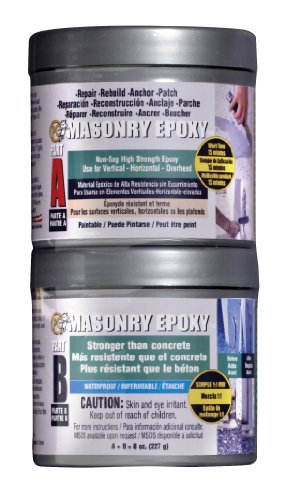
PC-Masonry is purpose-built for concrete, brick, stone, and mortar repairs where standard epoxies lack the thixotropic body needed to stay put on a vertical wall or an overhead ceiling. The dough-like paste does not sag or drip, even when applied in thick layers to fill spalled concrete edges or cracked masonry joints. You can trowel it into a missing chunk of a flagstone paver, shape it with a gloved finger wetted with rubbing alcohol, and leave it to cure without slumping.
The moisture-resistant formulation bonds to damp surfaces, which is critical for basement wall cracks, outdoor retaining walls, and pool coping repairs that cannot be fully dried before application. The working time is roughly five minutes, and the material hardens enough for light sanding within a few hours, though full mechanical strength develops over one to two days. Once cured, the gray paste accepts paint, stain, and even light machining.
The two small cans hold only 8 ounces total, so large-scale projects like a full walkway resurfacing will require multiple kits. This is a targeted repair product, not a bulk-fill material. Users also note that the unmixed paste skin can form inside the can if not resealed immediately after dispensing each portion, so transfer the needed amount to a mixing board and reseal the container quickly.
Why it’s great
- Non-sag thixotropic paste stays on vertical and overhead surfaces without dripping
- Bonds to wet or dry concrete and masonry, even underwater during cure
- Can be sanded, painted, and stained after full cure for a seamless finish
Good to know
- Limited 8-ounce volume is insufficient for large-area resurfacing jobs
- Unused paste in the can may skin over if container is not sealed promptly
3. Starbond 5 Minute Epoxy Pro Kit – 8 oz, Flexible Toughened

Starbond’s 5-minute formula is engineered for applications where the bonded assembly will experience vibration, thermal cycling, or minor flexing without catastrophic fracture. The toughened chemistry — rather than a brittle, rigid cure — delivers a 2600-pound shear strength rating while retaining a slight elastomeric give. This makes it the right choice for repairing a cracked plastic bumper, reattaching a metal bracket on a power tool that rattles during use, or securing a ceramic tile on a floor that sees foot traffic.
The kit includes screw-cap bottles (no syringe clogging), reusable mixing trays, and application spatulas. The 1:1 mix ratio by volume is straightforward, and the clear finish means the repair line is nearly invisible on glass, transparent plastics, and light-colored wood. Full cure in 24 hours, but handling strength arrives in roughly five minutes — enough time to align the parts before the reaction locks them in place.
Curing in warm conditions accelerates the set time noticeably; if your workshop is above 80°F, mix small batches and apply immediately to avoid waste. The flexible nature of the cured resin means it sands less cleanly than a rigid epoxy, so if you plan to machine or tap the bond, consider a stiffer alternative like J-B Weld.
Why it’s great
- Toughened formula absorbs vibration and thermal expansion without brittle cracking
- Complete pro kit with screw-cap bottles, trays, and tools for controlled mixing
- Cures clear, leaving a nearly invisible bond line on glass and light surfaces
Good to know
- Higher ambient temperature significantly shortens the working window below five minutes
- Flexible cure is less suitable for machining, tapping, or filing operations
4. Bob Smith Industries BSI-203H Mid-Cure Epoxy – 4.5 oz, Light Amber
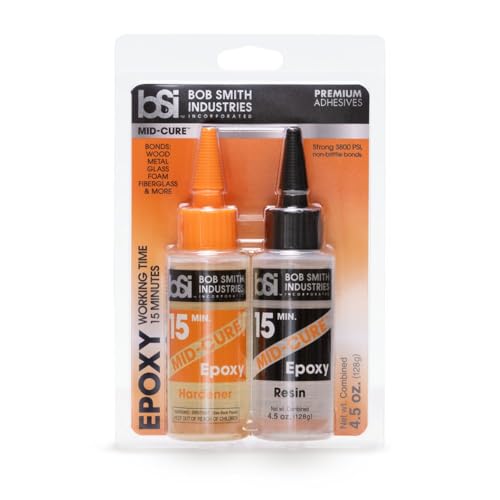
Bob Smith Industries Mid-Cure epoxy is the adhesive equivalent of a scalpel — it prioritizes controlled positioning and working latitude over sheer speed. The 15-minute working time and 30-to-45-minute cure window give you the ability to assemble complex multi-part projects like RC airplane wing spars, fishing rod guides, or intricate wood inlays without rushing. The slight thickness in the uncured state bridges small gaps on uneven surfaces where watery thin cyanoacrylate would simply wick away and leave a weak joint.
The cured light-amber color is more visible than a water-clear epoxy, which matters for aesthetic repairs on transparent or white substrates. However, the rigidity of the fully cured bond is outstanding for structural loads on wood, metal, fiberglass, and most crafting plastics. Users report that the separate bottles with individual caps last indefinitely — unlike syringe packages where the mixed material inside the nozzle hardens and wastes the remaining product.
The 4.5-ounce combined volume is modest, and the amber tint may not suit every cosmetic repair. For applications requiring optical clarity, consider the GDDP 5-minute clear epoxy instead. The Mid-Cure formula also has a slightly lower temperature ceiling than the steel-reinforced options, so keep it away from direct engine heat.
Why it’s great
- Extended 15-minute working time for precise alignment on complex assemblies
- Separate bottles with caps never clog or cure inside the container
- Slightly thick consistency fills uneven gaps where thin adhesives fail
Good to know
- Cured amber color is visible on transparent or white substrates
- Lower heat tolerance compared to steel-reinforced cold-weld epoxies
5. 3M Super-Fast Repair Adhesive, 04747 – 1.6 fl oz Cartridge

3M’s 04747 is a two-component urethane adhesive, not a traditional epoxy. The urethane chemistry is what enables it to bond low-surface-energy plastics — polyethylene, polypropylene, ABS, and PVC — that repel standard epoxies. The set time is an aggressive 30 seconds, and handling strength arrives in roughly one minute, which means you must have all parts cleaned, roughened, and clamped before you even depress the plunger on the dispensing gun. The semi-rigid cured state absorbs impact without shattering, making it ideal for automotive bumper repairs and outdoor equipment.
The cartridge system requires a separate 3M manual or pneumatic dispensing gun and a steady supply of static mixing nozzles, since the urethane cures inside the nozzle within minutes of stopping flow. The 1.6-fluid-ounce volume is small but concentrated — a single cartridge can bond a bumper corner or seal a leaking PVC pipe joint with material to spare. The adhesion on polyethylene is genuinely unmatched in the two-part adhesive space; no other product on this list achieves a structural bond to untreated HDPE.
The temperature operating range is narrower than the best epoxies, topping out around 250°F. The cost per ounce is the highest in this comparison, and the need for a dispensing gun adds to the upfront investment. This is not a general-purpose adhesive — it is a specialized tool for the specific pain point of plastic-to-plastic bonding where nothing else holds.
Why it’s great
- Bonds polyethylene and polypropylene where standard epoxies fail completely
- Semi-rigid urethane absorbs impact and resists cracking under vibration
- Extremely fast 30-second set enables same-day handling and use
Good to know
- Requires a separate 3M dispensing gun and mixing nozzles, increasing setup cost
- Cartridge urethane cures inside the nozzle within minutes if flow stops
6. PEGATANKE Black 2 Part Epoxy Resin & Cold Weld Adhesive – 1.48 oz

PEGATANKE is a black cold-weld paste that punches well above its price tier when it comes to holding power in wet or high-pressure environments. The 1.48-ounce kit supports a dead-weight hold of 550 pounds and resists 120 PSI of hydraulic pressure, which translates to reliable underwater repairs on boat hull intakes, pool pump fittings, and coolant system housings. The black color blends invisibly into rubber hoses, dark plastics, and automotive underbody components, eliminating the need for paint touch-up on visible repairs.
The application process follows a simple six-step routine: clean, mix equal parts, stir for three minutes, apply, join, and wait 30 minutes in direct sunlight or 90 to 120 minutes in shade for initial set. Full cure spans about eight hours. The thick paste consistency means it excels as a gap filler on cracked cast-iron pipes, broken mirror housings, and split fuel tanks, but the same body makes it difficult to spread thinly over large surface areas.
Compatibility with acrylic surfaces is explicitly poor — PEGATANKE will not form a useful bond on acrylic sheets or acrylic-based composites. The small volume also limits the scope of repairs to spot fixes rather than wide-area laminations. For a single cracked radiator or a leaking water tank, the cost-to-performance ratio is exceptional.
Why it’s great
- 550-pound dead-weight capacity and 120 PSI pressure rating for demanding repairs
- Fully cures underwater and resists petroleum, coolant, and saltwater exposure
- Black paste hides repair lines on dark automotive and marine components
Good to know
- Does not bond to acrylic surfaces effectively
- Thick paste is challenging to spread thinly over broad areas
7. GDDP 5 Minute Epoxy Glue – 8.45 fl oz, Clear
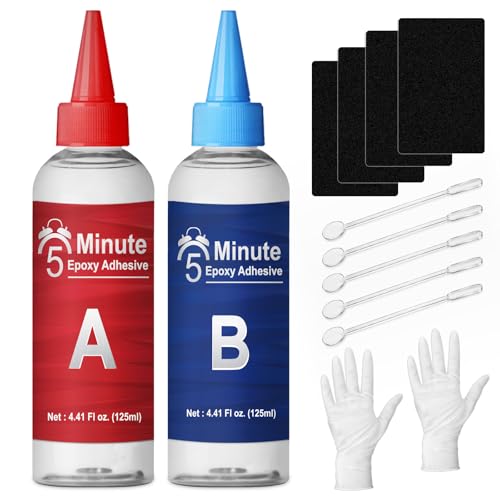
GDDP’s 8.45-ounce kit delivers the fastest working cycle among the entry-level options: approximately five minutes of open time, handling strength in one hour, and full cure in 24 hours. The clear liquid formulation wets out well on glass, polished metal, and glossy ceramic surfaces, creating a bond line that is barely visible on transparent repairs. The kit includes wooden stir sticks, gloves, and four mixing trays, so you have everything needed for a clean mix session without hunting for tools.
The 300°F heat resistance is a notable advantage for a fast-cure clear epoxy — most transparent 5-minute formulations soften around 200°F. This extends usability to toaster-oven trim repairs, coffee machine mounting brackets, and light engine-bay components that do not see direct exhaust heat. Users in lapidary and gem-cutting report that the GDDP formula cures with fewer trapped bubbles than premium-brand alternatives and maintains a harder surface finish for holding stones in setting fixtures.
The low-odor chemistry is a practical benefit for indoor work in small apartments or poorly ventilated workshops. However, the cure speed accelerates in warm or humid environments — if your workspace is above 80°F, the five-minute window shrinks to roughly three minutes. Plan your clamping and alignment steps before mixing the resin and hardener.
Why it’s great
- Transparent cure with low bubble formation ideal for glass and jewelry work
- Withstands 300°F continuous heat, surpassing typical clear fast-cure epoxies
- Complete mixing kit with trays, sticks, and gloves included in the box
Good to know
- Working time shortens significantly in high-temperature or humid conditions
- Liquid viscosity is less effective for filling large gaps without sagging
FAQ
Can I use a 2-part epoxy on polyethylene or polypropylene plastic?
How do I remove excess epoxy before it fully cures?
What causes an epoxy bond to fail after it has cured?
Final Thoughts: The Verdict
For most users, the best 2 part adhesive winner is the J-B Weld 8281 Professional because its 5020 PSI tensile strength and 550°F temperature tolerance handle the widest range of demanding metal, wood, and plastic repairs. If you need a bond that absorbs vibration and remains clear, grab the Starbond 5 Minute Epoxy Pro Kit. And for bonding low-energy plastics that nothing else sticks to, nothing beats the 3M Super-Fast Repair Adhesive 04747.