
Hovering, torque rolling, knife-edge loops, and flat spins at waist height — 3D RC planes are a breed apart, engineered not just to fly, but to defy physics. These aerobatic machines demand a power system, airframe material, and flight controller that can handle violent transitions from full-throttle uplines to dead-stick harrier descents without a hint of torque roll you didn’t command.
I’m Min — the co-founder and writer behind Gadgets Feed. I’ve spent hundreds of hours researching 3D-specific power-to-weight ratios, AS3X gyro tuning, EPP vs. EPO foam durability, and the critical connector compatibility issues that ground more aspiring 3D pilots than any crash ever could.
This guide cuts through the parameter confusion to help you find the very best 3d rc planes that match your skill level and flying ambitions without risking your wallet on a mis-spec’d build.
How To Choose The Best 3D RC Planes
Selecting a 3D-capable plane is fundamentally different from choosing a warbird or trainer. The deciding factors are airframe material for crash survival, power system for grunt out of a hover, and the flight controller’s ability to let you switch from beginner stabilization to full manual 3D mode without a re-flash.
Airframe Material: EPP vs. EPO
Expanded Polypropylene (EPP) is the gold standard for 3D trainers because it bends rather than breaks on hard harrier landings. Expanded Polyolefin (EPO) looks better and holds detail but tends to crack on repeated tip-overs. The best 3D planes use EPP reinforced with carbon rods or spars.
Power System: Motor KV and Prop Pitch
A high-KV brushless motor spinning a large-diameter, low-pitch prop is the 3D sweet spot — it produces instant torque for hovering without ripping the prop off at high RPM. Look for a motor that delivers at least 1.5:1 thrust-to-weight ratio with the recommended battery cell count (2S, 3S, or 4S).
Flight Controller Stabilization
AS3X, SAFE Select, and Byme-A gyros dampen wind gusts and prevent tip stalls in slow high-alpha flight, which is critical for 3D. The key spec is whether the controller offers a fully manual/Acro mode that unlocks full control surface deflection — without it, you cannot perform true 3D aerobatics.
Quick Comparison
On smaller screens, swipe sideways to see the full table.
| Model | Category | Best For | Key Spec | Amazon |
|---|---|---|---|---|
| E-flite Extra 330 SC 1.3M BNF | Premium | Competition 3D | 1.3m wingspan, 4S compatible, 85A Smart ESC | Amazon |
| E-flite 4-Site 3D FF 800mm BNF | Premium | Flat foam 3D learning | 800mm wingspan, 3S 850-1000mAh, AR630+ receiver | Amazon |
| Fms F3A Olympus 1400mm PNP | Premium | Large-scale pattern + 3D | 1400mm wingspan, 4250-KV550 motor, 6S compatible | Amazon |
| Radiolink A560 RTF | Mid-Range | Entry-level 3D park flyer | 580mm wingspan, PP foam, 2.5 mi range telemetry | Amazon |
| volantexrc TrainStar 500mm Brushless RTF | Mid-Range | Beginner aerobatics with modes | 500mm wingspan, brushless, 6-axis gyro with 3 modes | Amazon |
| E-flite UMX Ultrix BNF Basic | Mid-Range | Micro 3D in tight spaces | Dual brushless, 1S 500mAh, differential thrust | Amazon |
| FLYCOLOR QIDI-560 M7 RTF | Budget | Off-road stunt flying | 560mm wingspan, EPP, one-key hover, level-5 wind resistance | Amazon |
| Viloga Upgrade 3D EPP Sakura 420mm Kit | Budget | Build-it-yourself micro 3D | 420mm wingspan, EPP + carbon rods, DIY kit (no TX/RX) | Amazon |
In‑Depth Reviews
1. E-flite Extra 330 SC 3D 1.3M BNF Basic w/SAFE

The E-flite Extra 330 SC is a scale replica of the real championship airframe, but the real story is under the hood: a Spektrum Avian 85-amp Smart Lite ESC that spits real-time RPM, voltage, and current data back to a compatible transmitter. That kind of telemetry is critical when you’re pushing a 3D plane hard — you need to know exactly how much battery voltage remains before you pull another torque roll.
Airframe construction is EPO, which holds up better than flat foam for the moderate dings you’ll get in a 1.3m class plane, and the motor mount is reinforced to handle the stresses of aggressive 4S power. The AR631 receiver with AS3X and SAFE Select gives you a calibrated stabilization mode for learning harder 3D moves, plus a fully manual mode that unlocks the control surfaces for unlimited aerobatics.
Experienced 3D pilots will appreciate that it’s light and floaty enough for high-alpha harriers but has enough mass to punch through wind. Assembly is minimal — nearly ready-to-fly out of the box — making it the premium choice for anyone who already owns a Spektrum transmitter and wants a serious competition-level 3D plane.
Why it’s great
- 85A Smart ESC with real-time telemetry for precise battery management
- SAFE Select allows novice-to-expert progression on same airframe
- Reinforced motor mount handles 4S power without modification
Good to know
- Floaty feel may feel twitchy to pilots used to heavier 3D planes
- Requires separate Spektrum transmitter and 3S/4S battery
- Wind sensitivity above 10-15 mph due to lighter wing loading
2. E-flite 4-Site 3D FF Flat Foamy 800mm BNF
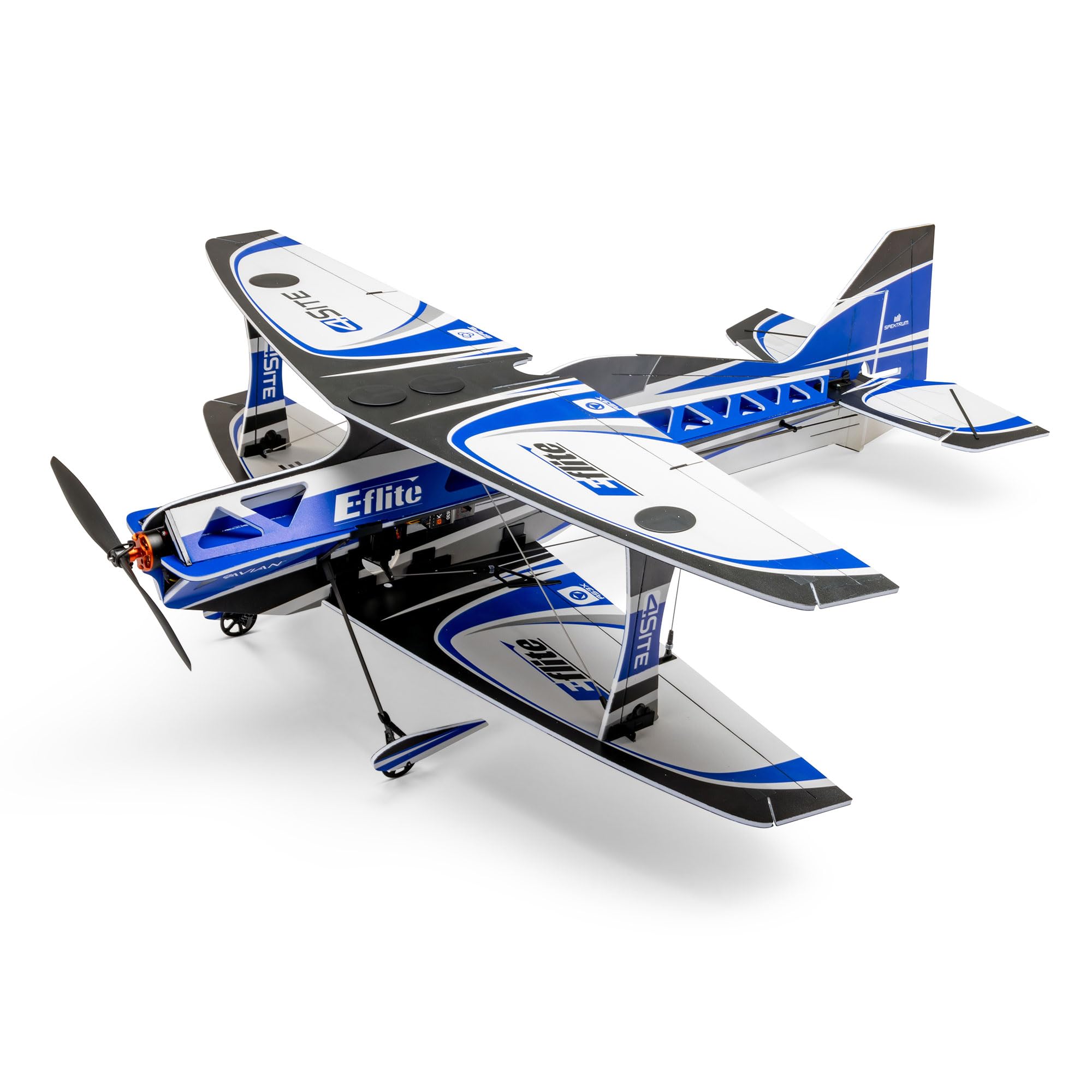
The 4-Site 3D FF (Flat Foamy) represents the purest 3D form factor — a slab-sided airframe designed to fly slow, hover indefinitely, and tumble like a ragdoll without losing structural integrity. Its 800mm wingspan and 3S 850-1000mAh battery compatibility keep the weight low while the specially tuned brushless motor delivers the instantaneous torque needed for waterfall tumbles and inverted harriers.
Click-together assembly is a standout feature for a flat foamy — most require tape and CA glue, but this one uses a modular structure that goes together in minutes. The AR630+ receiver includes AS3X+ for gust-dampening and SAFE Select for beginners who want to practice hovering before committing to full manual control.
Digital metal-geared servos and a 30-amp Smart ESC ensure crisp control surface response at any deflection angle, which matters when you’re hanging on the prop at zero airspeed and need instant aileron authority. This is the ideal 3D trainer for anyone who has outgrown basic sport flying but doesn’t want to invest in a larger 1.3m balsa or composite model.
Why it’s great
- True flat foamy slow-flight performance for harrier 3D training
- Tool-free click-together assembly — no glue required
- AR630+ receiver with AS3X+ and SAFE Select
Good to know
- Requires Spektrum transmitter and 3S battery (not included)
- Wing braces are fiddly to install despite click-together design
- Not suitable for high-wind days due to low wing loading
3. Fms F3A Olympus 1400mm PNP

The Fms F3A Olympus is built for precision aerobatics first and 3D second — its 1400mm wingspan and 6S power system make it a completely different beast from the micro and mid-range options. The 4250-KV550 motor swings a wood propeller that produces massive thrust while keeping vibrations low, which is critical for smooth knife-edge passes and seamless transition maneuvers.
EPO foam with a carefully engineered cockpit and pilot figure gives it a scale look that rivals much more expensive balsa kits, and the 17g digital metal gear servos provide the torque needed for large control surfaces at high deflection angles. Landing gear is robust enough for grass field operation, which is rare in the 3D foam space.
Out-of-the-box PNP (Plug-N-Play) means you need your own receiver, transmitter, and 6S battery, but the upside is complete flexibility to bind to any radio system. Experienced pilots report the airframe tracks like a pattern ship at speed and slows down nicely for hovers — though 6S power means you need to be ready for the extra speed and momentum.
Why it’s great
- 6S power system delivers unlimited vertical and long flight times
- Wood propeller reduces vibration for smoother aerobatics
- Scale cockpit and pilot add visual realism on the flight line
Good to know
- Large 1400mm wingspan needs a bigger car to transport
- Several user reports of motor failure within 5 flights
- Gyro software can be frustrating to configure for some receivers
4. Radiolink A560 RTF

The Radiolink A560 packs a surprising amount of 3D capability into a sub-600mm wingspan package, and it does it with a full RTF (Ready-to-Fly) kit that includes the T8S transmitter, batteries, charger, and a carry bag. The Byme-A gyro flight controller offers six flight modes — including full Manual and Acrobat modes — so you can go from stabilized beginner flying to wild 3D hucking with a single switch flick.
Reinforced PP (Polypropylene) foam is more flexible than standard EPO, which helps the A560 survive the inevitable nose-ins that come with learning 3D. The 2.5-mile range from the FHSS radio system is overkill for a 580mm park flyer, but real-time RSSI and battery voltage telemetry are genuinely useful when you’re focusing on the plane instead of the transmitter screen.
Out-of-box setup can require some trimming and servo reversing depending on your radio, but once dialed in, the A560 is stable enough for beginners in Stabilize mode and aggressive enough for experienced pilots in Acrobat mode. The included 600mAh 2S batteries deliver around 5-7 minutes of mixed 3D flight, and upgrading to 3S unlocks noticeably stronger vertical performance.
Why it’s great
- Six flight modes including full manual 3D in a single RTF package
- Real-time battery voltage telemetry on the T8S transmitter
- Reinforced PP foam survives crashes better than standard EPO
Good to know
- Out-of-box trim and control direction may need significant adjustment
- Beginner stabilization mode is overly aggressive for true newbies
- Small 580mm wingspan can get blown around in moderate wind
5. volantexrc TrainStar 500mm Brushless RTF
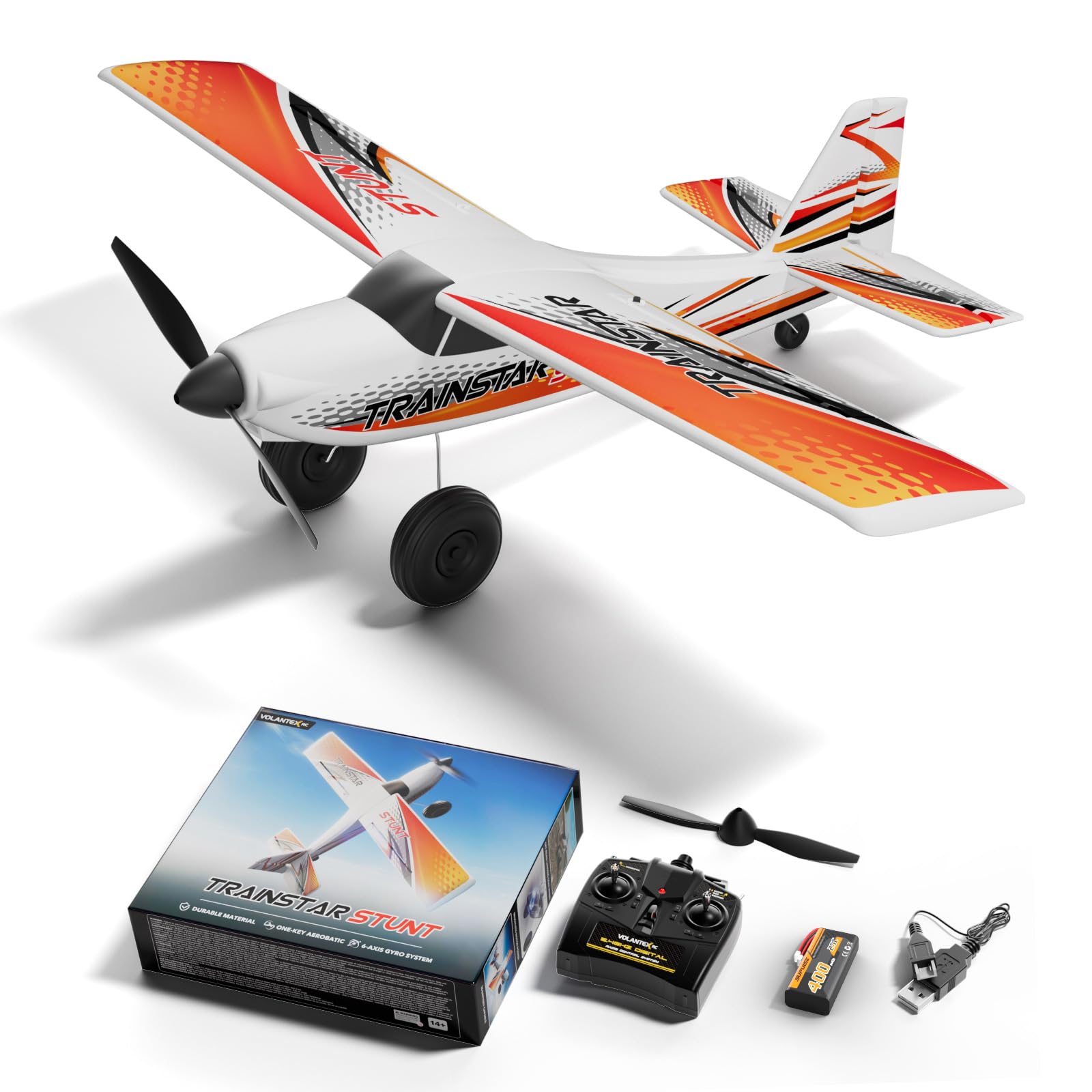
The TrainStar is explicitly designed as a bridge plane — something that flies like a trainer in Beginner mode but can perform aileron rolls and flips in Expert mode. The Xpilot 6-axis gyro stabilizer is the core component: it keeps the wings level in low-speed turns and recovers the plane from a spin with just a quick stick release, which builds 3D confidence without the crash penalty.
Construction is dense foam with spring-loaded landing gear that absorb hard touchdowns, and the prop uses a crash-release design that pops off on impact rather than snapping. The brushless motor is a significant step up from the coreless motors found in cheaper RTF kits — it delivers consistent thrust and doesn’t burn out after a dozen flights.
Two batteries are included, giving a combined flight time of around 20-30 minutes depending on throttle management. The one-button auto-takeoff and return-to-home functions are genuinely useful for beginners, though experienced pilots will want to spend most of their time in Expert mode practicing knife-edge passes and inverted circuits.
Why it’s great
- Three flight modes (Beginner/Intermediate/Expert) for skill progression
- Two batteries included for extended flight sessions
- Crash-release prop design reduces breakage on hard landings
Good to know
- Replacement propellers are difficult to source via Amazon
- Wheels and tail wheel are fragile and bend on rough ground
- Heavier than similar-sized planes, reducing floaty 3D feel
6. E-flite UMX Ultrix BNF Basic

The UMX Ultrix is a delta-wing micro that uses differential thrust from its twin brushless motors to replace the rudder for yaw control — a design that produces incredibly flat spins that full-rudder planes can only dream of. Running on a single 1S 500mAh LiPo, it’s insanely light at around 50 grams, which means it can hover in calm air with minimal power and fly in surprisingly tight indoor spaces.
AS3X technology with optional SAFE Select provides stability in wind up to 15-20 mph, which is remarkable for a sub-100 gram airframe. Flight times of 8-10 minutes on the included 500mAh pack are impressive, and many users report upgrading to 800mAh batteries for extended sessions — though you need to ensure the battery has a high enough C-rate to support the twin motors.
Assembly is as simple as pushing in the winglets and mounting the propeller — it takes under 10 minutes from box to air. The Ultrix is durable enough to survive full-throttle crashes into the ground, with a glued nose repair being the most common fix. The only genuine drawback is the lack of factory-installed LED lights, which require cutting into the foam to install the optional lighting kit.
Why it’s great
- Differential thrust creates flat spins impossible on conventional rudder planes
- Ultra-light 50g airframe allows flying in small parks and gymnasiums
- AS3X handles wind up to 20 mph despite the tiny size
Good to know
- Optional lighting kit requires cutting the foam for installation
- Bushings (not bearings) on motors may wear out over time
- Winglets fit loosely and can detach during aggressive maneuvers
7. FLYCOLOR QIDI-560 M7 RTF

The QIDI-560 M7 is a budget RTF that tries to bridge the gap between a camera drone and a 3D plane by including a one-key hover function and vertical flight mode — basically a transition between quadcopter-style lift and fixed-wing forward flight. The EPP construction is crash-resistant, and the breakaway prop helps prevent motor damage on belly landings.
The flight control system supports DSM and S-BUS receiver conversion, which allows binding to higher-end transmitters like the Radiomaster TX16S — a nice flexibility feature at this price point. The LED wing lights enable night flying, and the claimed level-5 wind resistance is optimistic but the plane does handle moderate breeze better than most micros in this class.
Where this plane struggles is control authority: multiple users report sluggish rudder and aileron response because the gyro constantly overrides pilot input. The trim function is unreliable, and the included battery has been reported as a fire hazard during charging by one user. For experienced pilots, the PNP version might be a better buy than the RTF, so you can supply your own reliable battery and radio.
Why it’s great
- One-key hover and vertical flight mode for easy orientation training
- LED lights enable night flying sessions
- EPP foam is genuinely durable for rough landings
Good to know
- Gyro overrides pilot control input, preventing true 3D maneuvers
- Sold battery has been reported as a fire hazard during charging
- Control response is sluggish and trim function is non-functional
8. Viloga Upgrade 3D EPP Sakura 420mm Kit

The Viloga Sakura is a mini F3P 3D plane kit with a 420mm wingspan designed for indoor or dead-calm outdoor 3D flying. The EPP foam is embedded with carbon rods for rigidity, and the plane weighs only 62 grams, which means it can hang on the prop with minimal power and accelerate vertically in a straight line if you keep the build light.
This is a KIT+Motor+ESC+Servo configuration — you provide your own micro receiver (specktrum or compatible), transmitter, and a 1S battery. The biggest gotcha is connector compatibility: the included servos and ESC use 100mm JST micro plugs, while most micro receivers use 150mm JST plugs, requiring micro soldering or adapter fabrication. Several users also note that the stock hinges create too much drag for the small servos, recommending cutting out the foam hinges and replacing with tape for acceptable performance.
For experienced 3D pilots who can solder and have a micro radio setup already, this is the cheapest way to get a dedicated F3P indoor 3D plane. The sparse instructions mean this is absolutely not a beginner’s kit — but for the right builder, the Sakura delivers incredible 3D performance in a package that fits in your backpack.
Why it’s great
- Ultra-light 62g airframe for indoor 3D hovering and tight maneuvers
- EPP with carbon rods is durable for micro 3D crashes
- Lowest cost entry point for a dedicated 3D-capable airframe
Good to know
- Servo/ESC plugs are incompatible with most micro receivers without soldering
- Foam hinges are too stiff for the weak included servos — requires tape hinge mod
- Kit form requires transmitter, receiver, battery, and soldering skills
FAQ
What does BNF Basic mean for a 3D RC plane?
Can I do 3D aerobatics with a plane that has SAFE Select?
Why do EPP planes survive crashes better than EPO for 3D?
Final Thoughts: The Verdict
For most users, the best 3d rc planes winner is the E-flite Extra 330 SC 1.3M BNF because it combines competition-grade aerobatic capability with SAFE Select for skill progression and real-time telemetry for battery management. If you want a dedicated flat foamy trainer for learning hovering and harriers, grab the E-flite 4-Site 3D FF 800mm BNF. And for tight-space micro 3D that fits in a backpack, nothing beats the E-flite UMX Ultrix BNF Basic.