
For home theater enthusiasts, a receiver is the brains and brawn of the entire system—the one component that can make or break the cinematic illusion. Finding an AV receiver that delivers the full bandwidth of Dolby Atmos, the speed of HDMI 2.1 for gaming, and the headroom to drive a proper 5.1.2 speaker array without exceeding a mid-range budget requires navigating a minefield of spec-sheet gimmicks and underpowered amplifiers.
I’m Min — the co-founder and writer behind Gadgets Feed. My analysis here is grounded in hundreds of hours spent dissecting power ratings, room correction algorithms, and real-world HDMI handshake reliability to separate the true performers from the hype.
After deep analysis of the market, I have curated this definitive guide to the best av receiver under $1000 for building a thrilling and immersive home cinema experience.
How To Choose The Best AV Receiver Under $1000
The AV receiver market under a thousand dollars is fiercely competitive, with brands fighting to pack in the most HDMI 2.1 inputs, the highest wattage claims, and the deepest slate of streaming features. Cutting through the marketing requires focusing on a few critical metrics that define real-world performance.
Channel Count and Amplifier Power
A 7.2-channel receiver allows for a 5.1.2 Dolby Atmos setup—a configuration widely considered the sweet spot for object-based audio at this budget. Pay close attention to the FTC-rated power per channel (typically measured at 8 ohms with two channels driven), as this gives a realistic idea of how much clean headroom you have for dynamic soundtrack peaks. 75 to 100 watts per channel is the target range for driving most bookshelf and tower speakers to satisfying theater levels.
HDMI 2.1 Connectivity and Gaming Features
With the PS5 and Xbox Series X supporting 4K at 120Hz, an HDMI 2.1 receiver with 40Gbps or 48Gbps bandwidth is essential for uncompromised gaming. Look for specific support for Variable Refresh Rate (VRR) and Auto Low Latency Mode (ALLM) to eliminate screen tearing and minimize input lag. Not all receivers labeled “8K” support these features fully, so check the fine print.
Room Calibration and Streaming
Room correction software like Audyssey, YPAO, or AccuEQ is not a luxury—it measures your speaker distances, adjusts levels, and applies EQ filters to tame room-related frequency issues. A good calibration suite (like Audyssey MultEQ or YPAO R.S.C.) dramatically improves soundstaging and dialogue clarity. For streaming, support for HEOS, MusicCast, Chromecast, and AirPlay 2 ensures your receiver acts as a smart hub, not just a dumb amplifier.
Quick Comparison
On smaller screens, swipe sideways to see the full table.
| Model | Category | Best For | Key Spec | Amazon |
|---|---|---|---|---|
| Yamaha RX-A2A AVENTAGE | Premium | Audiophile 5.1.2 setups | 90W/ch, Surround:AI, YPAO R.S.C. | Amazon |
| Denon AVR-S970H | Premium | Gaming & 5.1.2 flexibility | 90W/ch, 8 HDMI, 8K/60Hz | Amazon |
| Denon AVR-S770H | Mid-Range | First-time 5.1.2 buyers | 75W/ch, Audyssey, HEOS | Amazon |
| Onkyo TX-NR6100 | Mid-Range | THX certified performance | 210W/ch THX Select, 8K 40Gbps | Amazon |
| Yamaha RX-V6A | Mid-Range | MusicCast multi-room audio | 100W/ch, 7 HDMI (3x 8K) | Amazon |
| Marantz NR1510 | Mid-Range | Compact 5.2 setups | 50W/ch, Slim 4″ chassis | Amazon |
| JBL MA710 | Mid-Range | 8K readiness & streaming | 110W/ch, 6 HDMI, Phono input | Amazon |
| Sony STR-AN1000 | Mid-Range | Immersive audio with 8K | 7.2-ch, Dolby Atmos & DTS:X | Amazon |
| Pioneer VSX-935 | Mid-Range | Value 7.2 with 8K gaming | 80W/ch, 6 HDMI, Dolby Atmos Height | Amazon |
| JBL MA510 | Budget | Affordable 5.2 entry | 75W/ch, 5.2-ch, 8K passthrough | Amazon |
| Onkyo TX-SR494 | Budget | Cheapest 5.2.2 Atmos | 80W/ch, 5.2.2-ch, AccuEQ | Amazon |
In‑Depth Reviews
1. Yamaha RX-A2A AVENTAGE 7.2-Channel AV Receiver

The Yamaha RX-A2A is the clear class leader in this bracket, offering the premium build and acoustic philosophy of the AVENTAGE line. Its Surround:AI technology analyzes soundtracks in real-time and adjusts the DSP to emphasize dialogue, effects, or ambience based on the scene, which delivers a genuinely more engaging experience than standard upmixing. The YPAO R.S.C. with multipoint measurement is among the most effective room correction suites at this price, taming bass nodes and optimizing the soundstage for your specific space.
Gamers benefit from three HDMI 2.1 inputs supporting 8K60B and 4K120AB, along with ALLM and VRR for smooth, tear-free gameplay. The unit features a robust 25.35-pound chassis with an A.R.T. (Anti-Resonance Technology) foot for mechanical vibration damping, a detail typically reserved for far more expensive gear. The MusicCast multi-room platform integrates natively with streaming services like TIDAL and Qobuz, and the inclusion of a dedicated phono input makes it equally at home with vinyl collections.
While the on-screen menus show their age compared to Denon’s slick GUI, the sheer audio refinement and build quality of the A2A justify its position at the top of the list. It also passes the long-term reliability smell test, with several owners reporting seamless integration with projectors and complex speaker arrays. For the core 5.1.2 configuration, this receiver is a true endgame piece.
Why it’s great
- Surround:AI creates a more dynamic and engaging movie experience.
- YPAO R.S.C. room correction is detailed and highly effective.
- Premium AVENTAGE build with anti-resonance chassis.
Good to know
- On-screen setup menus feel dated and basic.
- MSRP often exceeds $1000; requires careful pricing to stay in budget.
2. Denon AVR-S970H 7.2 Channel AV Receiver

The Denon AVR-S970H is the most gamer-focused receiver on this list, packing six full HDMI 2.1 inputs with support for 8K/60Hz and 4K/120Hz passthrough, plus VRR, QFT, and ALLM. This makes it a perfect command center for a PS5, Xbox Series X, and a 4K/120Hz display without any bandwidth bottlenecks. The 90 watts per channel provide ample headroom to drive a 5.1.2 setup with authority, and the Audyssey MultEQ room correction cleans up muddy room modes effectively.
Beyond gaming, the S970H is a versatile media hub. It includes a built-in phono stage for turntables, two independent subwoofer outputs, and HEOS multi-room streaming for whole-home audio. Setup is guided via a clean on-screen wizard that makes initial configuration painless, even for first-time AVR owners. The Denon remote, while button-dense, offers direct access to all major functions without digging into nested menus.
One nuance to note: fully using the Zone 2 powered output reduces the main room to 5.1 channels, meaning you cannot run a 7.1 + Zone 2 setup simultaneously. This is a common compromise across receivers at this tier, but worth flagging for users wanting multi-room audio. For pure home theater and high-refresh-rate gaming, this Denon is a powerhouse.
Why it’s great
- Six HDMI 2.1 inputs with full gaming features (VRR, ALLM).
- Excellent 90W/ch power delivery for dynamic soundtracks.
- User-friendly on-screen setup and HEOS streaming.
Good to know
- Zone 2 operation reduces main room to 5.1 channels.
- FM tuner presets are cumbersome to manage.
3. Denon AVR-S770H 7.2 Ch Home Theater Receiver

The Denon AVR-S770H strikes the hardest value proposition in this category, delivering a future-proof feature set at a price that leaves room in the budget for better speakers. It offers 75 watts per channel across 7 channels, allowing for a 5.2.2 Atmos layout, and supports HDMI 2.1 with 8K/60Hz and 4K/120Hz passthrough, making it a legitimate gaming receiver despite its lower price point. The inclusion of Audyssey MultEQ room correction and a dedicated setup assistant removes the intimidation factor from calibration.
On the streaming side, the built-in HEOS platform grants access to Spotify, TIDAL, and thousands of internet radio stations, and works seamlessly with other Denon HEOS speakers for multi-room audio. The unit also boasts Dolby Height Virtualization and DTS Virtual:X, which can simulate overhead effects even in a standard 5.1 setup—useful for apartments or rooms where height speakers are impractical. The remote is straightforward, and the front-panel display is clean and informative.
The primary trade-off for the low price is the 75W per channel power rating, which is adequate for most bookshelf speakers but may leave you wanting more headroom with power-hungry tower speakers in a large room. Some users have also reported firmware quirks causing random volume drops, though a factory reset or firmware update typically resolves this. For the vast majority of buyers seeking a capable entry into 4K/120 gaming and Atmos, this is the smartest purchase.
Why it’s great
- Aggressive pricing for HDMI 2.1 and HEOS streaming.
- Audyssey MultEQ room correction simplifies setup.
- DTS Virtual:X creates immersive sound without height speakers.
Good to know
- 75W per channel may lack headroom for large rooms.
- Some users report occasional software glitches.
4. Onkyo TX-NR6100 7.2 Channel Network AV Receiver
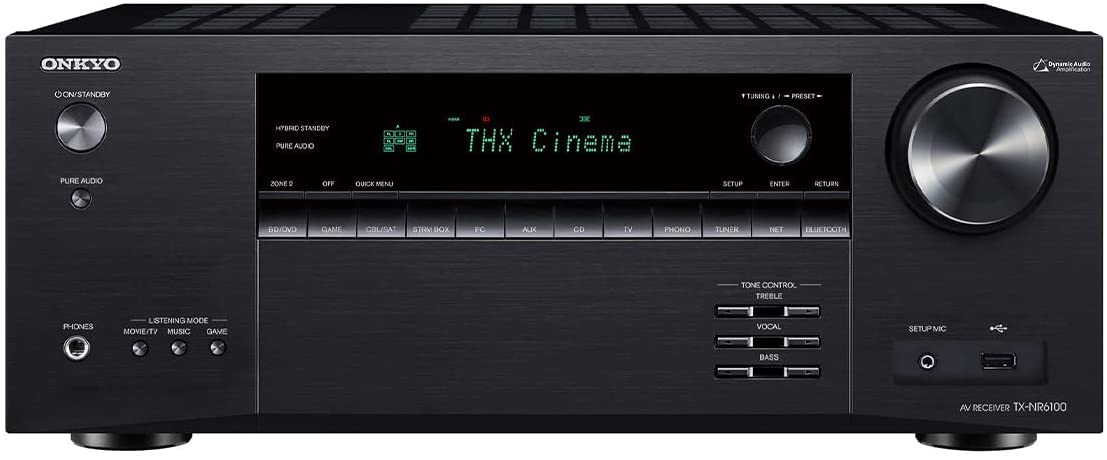
The Onkyo TX-NR6100 brings THX Select certification and a high-current amplifier design that delivers a headroom advantage over most competitors. It pumps 210 watts per channel (dynamic) into a 5.2.2 arrangement, and the THX certification guarantees Reference Level playback in a medium-sized room, meaning you can hit cinematic reference volumes with minimal distortion. The HDMI 2.1 board supports 40Gbps bandwidth with three 8K inputs, full VRR, and ALLM, making it a beast for console gaming.
The AccuEQ room calibration with AccuReflex is effective at aligning the timing between direct and reflected sound waves from height speakers, though it is less sophisticated than Audyssey or YPAO R.S.C. The unit includes discrete Zone 2 audio and video output, plus a front USB input for high-res audio playback up to 192kHz/24-bit. Onkyo’s upgraded Anthem Room Correction (ARC) is not present here, but the overall sound signature is powerful, with a clear, forward presentation that pairs well with bright speakers.
Be wary of the remote, which lacks backlighting—a common complaint across the Onkyo lineup. The unit also runs notably warm during extended use, so adequate ventilation is non-negotiable. Reliability concerns linger from older Onkyo generations, but the TX-NR6100’s warranty coverage and generally positive user reports suggest these issues are largely behind the brand. If you want the rawest, most cinematic power under $1000, this is the one.
Why it’s great
- THX Select certification ensures reference-level performance.
- Powerful amplifier with high dynamic headroom for demanding speakers.
- Eight HDMI inputs (3x 8K) for a fully loaded setup.
Good to know
- Remote is not backlit, difficult to use in dark theaters.
- Runs hot; requires careful ventilation placement.
5. Yamaha RX-V6A 7.2-Channel AV Receiver

The Yamaha RX-V6A serves as a more accessible entry point into Yamaha’s ecosystem while retaining the critical features that make the brand a home theater staple. It offers 100 watts per channel (measured honestly by Yamaha) and supports 7.2-channel configurations with Dolby Atmos Height Virtualization. The MusicCast platform is a significant draw—it allows you to group the receiver with any MusicCast speaker for whole-home audio, and supports every major streaming service from Amazon Music HD to Qobuz.
The unit features three 8K HDMI 2.1 inputs alongside four 4K inputs, providing plenty of flexibility for current and future sources. The YPAO calibration, while not the R.S.C. variant found in the A2A, does an adequate job of basic distance and level settings. The RX-V6A’s DSP modes are extensive, offering a wide range of sound fields that can add spaciousness to compressed TV broadcasts. Voice control via Alexa and Google Assistant is supported, and the receiver responds to commands without requiring a separate hub.
The main drawback is the lower-quality DAC compared to the AVENTAGE line, which manifests as slightly less refinement in the treble region during complex orchestral passages. The YPAO also lacks multipoint measurement, so room mode taming is less precise. For a living room setup where multi-room music is as critical as movie night, the RX-V6A is a top contender. Its clear, reliable sound and streaming ecosystem make it a joy to use daily.
Why it’s great
- MusicCast ecosystem for seamless whole-home audio streaming.
- Three 8K HDMI 2.1 inputs for future-proof connectivity.
- 100W/ch provide solid power for medium-sized rooms.
Good to know
- YPAO calibration lacks the advanced R.S.C. multipoint measurement.
- DAC treble performance is less refined than higher-end models.
6. Marantz NR1510 Slim 5.2 Channel AV Receiver

The Marantz NR1510 is a purpose-built solution for buyers who prioritize form factor and fidelity over raw channel count. At just 4 inches tall, it disappears into any media console while delivering the warm, musical sound signature Marantz is famous for. The 5.2-channel configuration means you get a solid 5.1 or 5.2 base system, but you cannot add height channels for Atmos—this is a trade-off for its tiny footprint. The discreet 50-watt amplifier section is refined and drives high-sensitivity speakers to satisfying levels without harshness.
Connectivity is surprisingly comprehensive for the size: six HDMI inputs (all HDCP 2.2), a built-in phono preamp for turntables, and dual subwoofer outputs. The HEOS multi-room platform gives you Spotify, TIDAL, and AirPlay 2 for wireless streaming. The front USB input plays high-res audio files up to 192kHz, and the unit supports Dolby TrueHD and DTS-HD Master Audio decoding. Setup via the graphical on-screen assistant is one of the easiest in this class, and the included remote is well-laid-out and backlit.
The major limitation is the lack of HDMI 2.1—you are capped at 4K/60Hz (HDMI 2.0). This makes the NR1510 inappropriate for anyone with a 4K/120Hz gaming console. It also runs quite hot given its compact size, so leave at least 4 inches of clearance above the vents. For a dedicated 5.2-channel music and movie system in a bedroom or apartment, the Marantz provides a level of sonic elegance that bulkier receivers cannot match at this price.
Why it’s great
- Ultra-slim 4-inch chassis fits easily into tight media cabinets.
- Warm, musical Marantz sound signature with refined treble.
- Includes phono input and HEOS multi-room streaming.
Good to know
- No HDMI 2.1—limited to 4K/60Hz for gaming.
- Runs hot and requires ample ventilation clearance.
7. JBL MA710 7.2 Channel 8K AV Receiver

JBL has re-entered the AV receiver market with the MA710, a 7.2-channel receiver that brings a surprising amount of modern features to the table. It delivers 110 watts per channel across 7 channels, supports up to a 5.1.2 Dolby Atmos configuration, and includes 8K/60Hz passthrough on its HDMI inputs. The unit also features a discrete moving magnet phono input, making it one of the few receivers in this range that natively supports a turntable without an outboard preamp.
Streaming is handled via Wi-Fi with AirPlay 2 and Chromecast built-in, plus Bluetooth for quick connections from any device. The MA710’s setup is screen-guided and surprisingly intuitive; the on-screen wizard walks you through speaker configuration, input assignment, and network setup. The chassis is noticeably shallow (13.7 inches deep), which is a major advantage for cramped media consoles. The auto room calibration, while basic, sets crossover and levels accurately for a clean baseline.
The main drawback reported by users is the lack of DTS-HD Master Audio downmixing for 2.1 setups—something that matters only if you primarily use a stereo speaker configuration with a subwoofer. The remote control also lacks backlighting, a recurring issue in this price tier. For a modern living room with mixed music, movie, and turntable use, the JBL MA710 is a very capable and well-rounded option. Its shallow depth alone might be the deciding factor for some installs.
Why it’s great
- Shallow 13.7-inch depth fits easily into tight AV cabinets.
- Built-in phono preamp for seamless turntable integration.
- 110W per channel provides strong dynamic headroom.
Good to know
- Cannot properly downmix DTS-HD for 2.1 speaker setups.
- Remote is not backlit, making dark-room operation difficult.
8. Sony STR-AN1000 7.2 CH AV Receiver (Renewed)
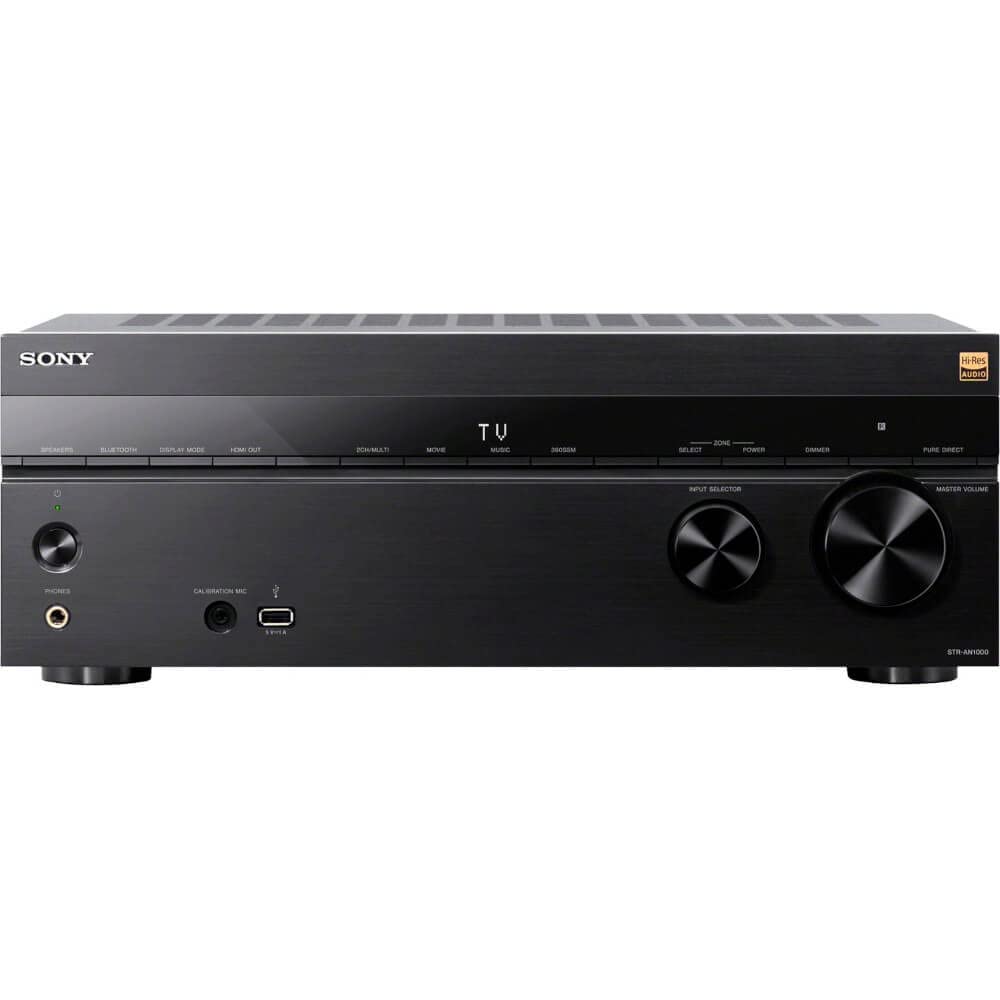
The Sony STR-AN1000 is a capable 7.2-channel receiver that focuses heavily on spatial audio immersion. It supports Dolby Atmos and DTS:X natively, and leverages Sony’s 360 Spatial Sound Mapping technology to create a wider, more enveloping soundstage from fewer physical speakers. The receiver supports 8K/60Hz and 4K/120Hz HDMI 2.1 connectivity, along with VRR and ALLM for latency-free gaming. It also supports the full range of HDR formats, including Dolby Vision and HDR10+.
On the audio processing side, the STR-AN1000 includes Sony’s Digital Cinema Auto Calibration (DCAC) which measures speaker distances and EQ in multiple positions. It also features an advanced DSEE Extreme upscaling engine that improves the quality of compressed audio streams from services like Spotify. Voice control is built-in with Google Assistant and Alexa, and the unit can be integrated into a broader smart home ecosystem. The front-panel design is clean and understated, with a large volume knob and a bright, clear display.
Reliability is a significant concern here: the STR-AN1000 has the highest number of reported early-life failures among the premium receivers in this guide. As a renewed unit, its out-of-box condition varies significantly, and several users reported logic board malfunctions within the first six months. If you are comfortable purchasing from Amazon Renewed with the associated warranty, the sound is solid for the price. But for long-term peace of mind, a new unit from Yamaha or Denon is a safer bet.
Why it’s great
- 360 Spatial Sound Mapping creates a wide, immersive soundstage.
- HDMI 2.1 with 4K/120Hz and ALLM supports gaming perfectly.
- DSEE Extreme upscaling improves compressed audio quality.
Good to know
- Higher-than-average reported failure rates for the renewed model.
- No built-in phono input for turntable users.
9. Pioneer VSX-935 7.2 Channel Network Receiver
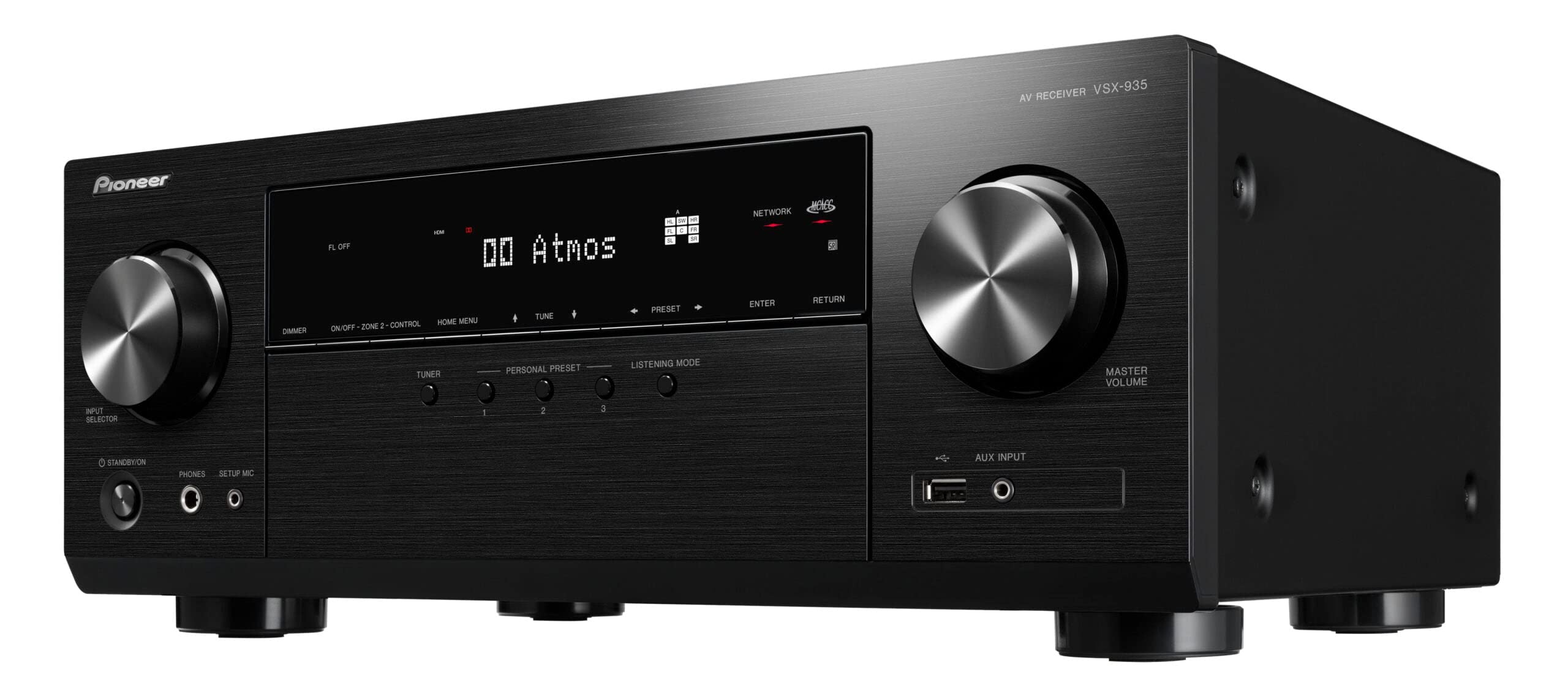
The Pioneer VSX-935 brings proper HDMI 2.1 gaming support to a lower price point, making it a strong candidate for gamers building a dedicated theater on a tighter budget. It features 6 HDMI inputs (with 8K/60Hz support on selected ports) and supports Dolby Atmos, DTS:X, and Dolby Atmos Height Virtualization for immersive audio without ceiling speakers. The 80 watts per channel provide sufficient power for most bookshelf and entry-level tower speakers.
The unit includes a full suite of streaming options via Wi-Fi and Bluetooth, with support for Chromecast, AirPlay 2, and DTS Play-Fi for multi-room audio. The on-screen setup interface is straightforward, and the included remote provides dedicated buttons for the most common sound modes. The front-panel display is bright and easy to read, with a dimmer option for dark rooms. Pioneer’s wall-to-wall warranty is an added peace-of-mind benefit.
Bluetooth implementation is notably flawed: the two-way Bluetooth is unreliable and lacks a dedicated button, making pairing a chore. The MCACC room calibration is serviceable but not as refined as Audyssey or YPAO; you may need to manually tweak speaker trims to achieve optimal sound balance. If you can live with these quirks, the VSX-935 offers a compelling mix of modern gaming connectivity and surround sound capability at a price that leaves room for speaker upgrades.
Why it’s great
- 4K/120Hz and VRR support for smooth console gaming.
- Dolby Atmos Height Virtualization works without ceiling speakers.
- Clean, bright front-panel display with dimmer control.
Good to know
- Bluetooth pairing is unreliable and confusing to use.
- MCACC room calibration requires manual fine-tuning.
10. JBL MA510 5.2 Channel 8K AV Receiver

The JBL MA510 is a focused entry point into the JBL receiver ecosystem, offering 5.2-channel configuration with a clean 75 watts per channel. It is a 5.2-only receiver, meaning you cannot add height channels for Atmos—it is designed for straightforward 5.1 or 5.2 surround setups. The headline feature is 8K/60Hz passthrough on its HDMI inputs, which future-proofs the video path even in this entry-level unit.
Setup is a breeze: the MA510 includes JBL’s simplified on-screen guidance, and the eARC port handles audio return from smart TV apps without extra cables. Network streaming is handled via AirPlay 2 and Chromecast, and the Bluetooth implementation is more reliable than the Pioneer VSX-935. The unit has a sleek, shallow profile (13.7 inches deep) that fits easily into most AV cabinets, and the black brushed finish looks more expensive than it is.
The biggest limitation is the 5.2-channel ceiling—you cannot expand to a 7.1 or 5.1.2 setup in the future without replacing the entire unit. The remote is also not backlit, which is frustrating in a dark theater environment. If you are SURE you will never want Atmos height effects and you prioritize 8K video passthrough and simplicity, the MA510 is a clean, affordable choice. For anyone even slightly curious about Atmos, invest in a 7-channel receiver instead.
Why it’s great
- 8K/60Hz HDMI passthrough for ultra-future-proof video.
- Shallow depth and sleek aesthetics fit tight cabinets.
- Simplified setup guided by on-screen instructions.
Good to know
- 5.2-channel limit—no support for Dolby Atmos height effects.
- Remote is not backlit, making dark-room operation hard.
11. Onkyo TX-SR494 4K Ultra HD Dolby Atmos AV Receiver
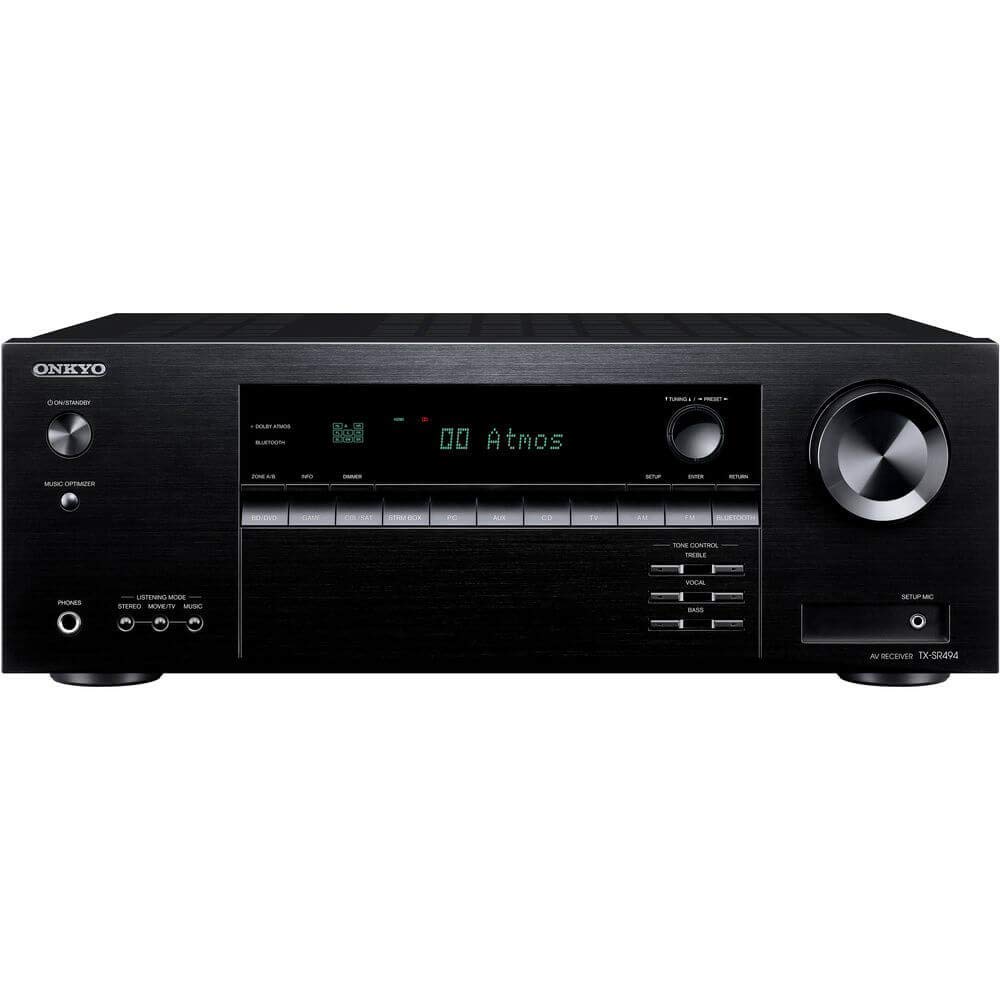
The Onkyo TX-SR494 is the absolute cheapest way to get a full Dolby Atmos 5.2.2 setup with a genuine discrete amplifier per channel. It pushes 80 watts per channel, which is surprisingly competent for the price, and includes both Dolby Atmos Height Virtualization and DTS Virtual:X for immersive sound in rooms without height speakers. The AccuEQ room calibration with AccuReflex helps align the timing between the floor and height layers, minimizing audio smear.
The unit features four HDMI 2.0 inputs (no 8K or 4K/120Hz), so it is strictly a 4K/60Hz receiver. For movie and TV streaming, that is perfectly fine—most content maxes out at 4K/60 anyway. The front-panel direct controls for bass, treble, and mid-range are a real highlight, allowing quick tone adjustments without diving into menus. The setup microphone is included, and the guided calibration process takes about five minutes.
This receiver’s age and HDMI 2.0 limitation mean it is not suited for next-gen gaming at high refresh rates. The Bluetooth module is also notoriously weak, with frequent dropouts reported by multiple users. The remote is poorly laid out, and the CEC implementation can be buggy with some TV brands. For a dedicated 4K movie room or a secondary theater setup where Atmos is the priority and gaming is not a concern, the TX-SR494 is an incredible bargain that punches well above its price class.
Why it’s great
- Full 5.2.2 Dolby Atmos capability at a rock-bottom price.
- Dedicated front-panel tone controls for quick EQ tweaks.
- AccuReflex timel alignment improves height speaker cohesion.
Good to know
- HDMI 2.0 only—no 4K/120Hz or 8K for modern gaming.
- Bluetooth is weak and prone to connection drops.
FAQ
Can I add height speakers for Atmos later to a 5.2 receiver?
Does every HDMI 2.1 receiver support 4K at 120Hz?
Is room correction software really necessary?
Do I need a separate phono preamp for a turntable?
Final Thoughts: The Verdict
For most users, the best av receiver under $1000 winner is the Yamaha RX-A2A AVENTAGE because it combines Surround:AI, excellent YPAO R.S.C. room correction, and premium build quality that rivals receivers costing far more. If you want rock-solid HDMI 2.1 gaming support with easy setup, grab the Denon AVR-S970H. And for the purest value-to-performance ratio for a first-time Atmos buyer, nothing beats the Denon AVR-S770H—it delivers a genuine 5.1.2 experience with HEOS streaming and keeps hundreds in your pocket for speaker upgrades.