
Ray tracing on a budget used to feel like a contradiction in terms, but the Turing generation changed that. The RTX 2060 and its Super variant deliver hardware-accelerated ray tracing and DLSS at a price point that makes 1080p high-refresh and smooth 1440p gaming genuinely accessible. Choosing the right partner card, however, means navigating different cooler designs, factory overclocks, and memory configurations to match your specific build and performance needs.
I’m Min — the co-founder and writer behind Gadgets Feed. I’ve spent countless hours analyzing GPU benchmarks, thermal performance data, and real-world user feedback to separate the noise from the specs that actually matter for this particular NVIDIA generation.
After comparing clock speeds, cooling solutions, and memory interfaces across the available models, here is a clear-eyed look at the best 2060 rtx graphics card options for every type of builder.
How To Choose The Best 2060 RTX Graphics Card
Choosing an RTX 2060 model means balancing factory clock speed, cooling efficiency, and memory size. The Super variants provide a substantial uplift with 8GB of VRAM and more CUDA cores, making them notably more future-proof for 1440p gaming.
8GB VRAM versus 6GB VRAM
The standard RTX 2060 comes with 6GB of GDDR6 memory, while the RTX 2060 Super doubles the count of memory modules to reach 8GB on a wider 256-bit bus. For 1080p gaming, 6GB still holds up well, but titles like Cyberpunk 2077 and Hogwarts Legacy push VRAM usage past 6GB at higher texture settings. The 8GB buffer on Super models gives you headroom for those demanding scenarios and smoother 1440p performance.
Cooler Design and Noise Profile
Dual-fan designs like the ASUS EVO and EVGA SC Ultra are compact and fit most mid-tower cases, but they often run louder under sustained load. Triple-fan or larger dual-slot coolers, such as the MSI Gaming X, use bigger heatsinks and Zero Frozr technology to keep fans off entirely during light use. Look for IP5X dust resistance on fan bearings if your case lacks fine dust filters.
Factory Overclock and Boost Behavior
Factory overclocks vary from 1650 MHz on the Founders Edition to 1755 MHz on the GIGABYTE OC model. These numbers rarely translate to a massive real-world difference — often 3–5% — but a higher boost bin ensures the card holds its clock longer before throttling. Pairing an OC model with decent case airflow gives you the most consistent frame timing.
Quick Comparison
On smaller screens, swipe sideways to see the full table.
| Model | Category | Best For | Key Spec | Amazon |
|---|---|---|---|---|
| MSI Gaming X RTX 2060 Super | Premium Super | Silent 1440p gaming | 8GB GDDR6 / 1695 MHz Boost | Amazon |
| ASUS RTX 2060 Super EVO | Mid-Range Super | Dust-resistant dual-fan | 8GB GDDR6 / 1725 MHz OC | Amazon |
| GIGABYTE RTX 2060 OC | Budget OC | Highest stock clock | 6GB GDDR6 / 1755 MHz Boost | Amazon |
| EVGA RTX 2060 SC Ultra | Value Dual-Fan | Compact desktop builds | 6GB GDDR6 / Dual HDB Fans | Amazon |
| NVIDIA RTX 2060 Super Founders | Reference Design | OEM aesthetics | 8GB GDDR6 / 1650 MHz Boost | Amazon |
In‑Depth Reviews
1. MSI Gaming GeForce RTX 2060 Super 8GB GDRR6 256-bit HDMI/DP G-SYNC Turing Architecture Overclocked Graphics Card (RTX 2060 Super Gaming X)

The MSI Gaming X stands as the most thermally refined RTX 2060 Super on the market. Its TWIN FROZR 7 cooler keeps GPU temperatures well under 70°C even during extended sessions, and the Zero Frozr technology stops the fans entirely below a certain load threshold, making it effectively silent during desktop use and lighter titles. The factory boost of 1695 MHz is a solid middle ground that stays consistent thanks to the ample heatsink mass.
At 1440p with moderate settings tweaks, this card sustains over 60 fps in demanding AAA titles, and at 1080p it easily clears 120 fps on high-to-ultra presets. The 8GB VRAM buffer on a 256-bit memory interface gives it a measurable advantage over the standard 2060 when loading high-resolution texture packs. Builders should note the 2.5-slot thickness, which can block an adjacent PCIe slot on smaller motherboards.
The included Dragon Center software handles RGB lighting and fan profiles, though some users report needing multiple installation attempts for it to function reliably. The card’s sturdy metal backplate prevents PCB sag, a common issue with heavy dual-fan designs. For anyone wanting quiet operation and Super-tier performance, this MSI card is the benchmark.
Why it’s great
- Excellent thermal performance with very quiet fans
- 8GB VRAM on a 256-bit bus for texture-heavy titles
- Zero Frozr keeps fans off during low load
Good to know
- 2.5-slot design blocks adjacent PCIe slot
- Dragon Center RGB software can be buggy
- Heavy card may require a support bracket for some cases
2. ASUS GeForce RTX 2060 SUPER Overclocked 8G EVO GDDR6 Dual-Fan Edition VR Ready HDMI DisplayPort DVI Graphics Card (DUAL-RTX2060S-O8G-EVO) (Renewed)
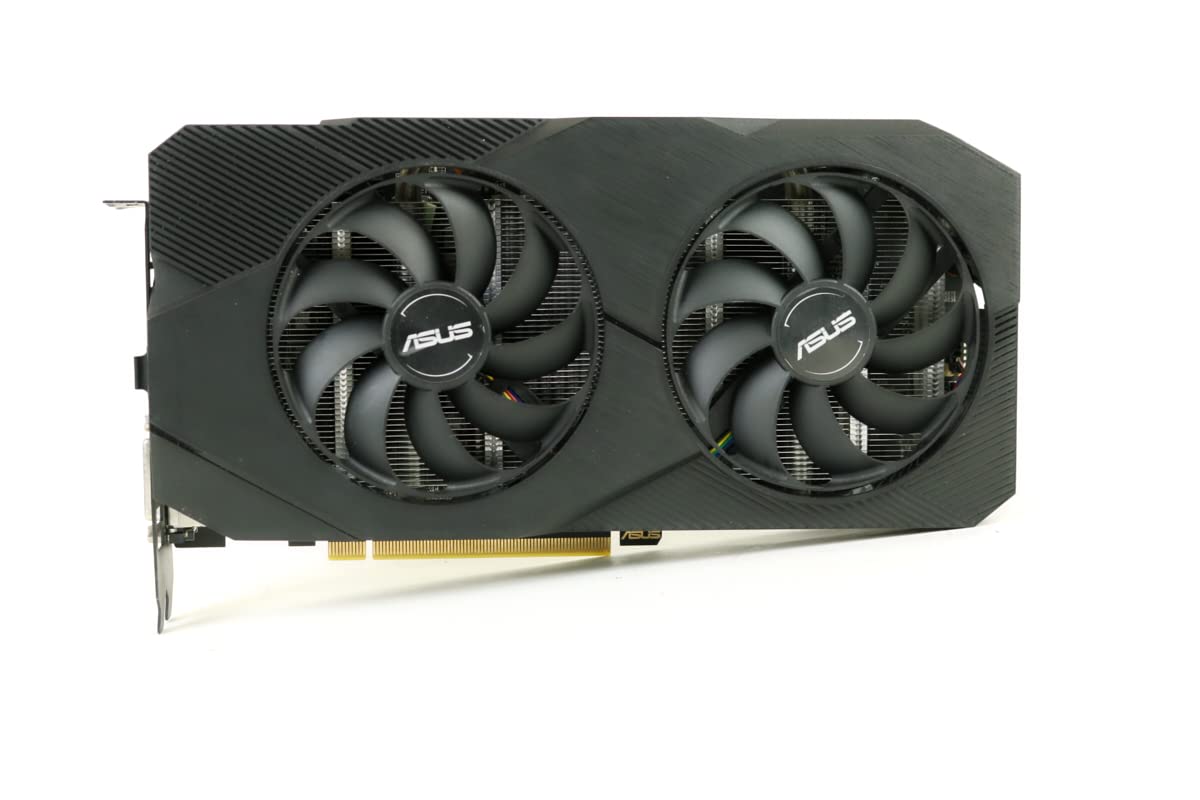
The ASUS DUAL-RTX2060S-O8G-EVO is a refurbished Super card that brings the critical 8GB VRAM upgrade to a friendlier price tier. It features Wing-Blade fans with an IP5X dust resistance rating, a detail that matters in less filtered cases. The card’s 1725 MHz boost clock in OC mode is competitive, and the aluminum backplate prevents PCB flex during installation or handling.
Connectivity is generous with two DisplayPort 1.4, two HDMI 2.0, and a legacy DVI-D port, supporting up to four monitors at 7680×4320 resolution. The 0 dB fan mode keeps the system silent when the GPU temperature stays below 55°C. Buyers should be aware that as a renewed unit, consistency can vary — some users report needing to clean contact pins or update Windows fully for driver stability.
GPU Tweak II provides real-time monitoring and one-click overclocking, and the bundled software suite includes Game Booster and XSplit Gamecaster. The dual-fan design is compact enough for most mid-tower cases without interfering with front radiators. If the premium price of a new Super card is a stretch, this renewed ASUS option is a compelling way to unlock 8GB performance.
Why it’s great
- 8GB GDDR6 at a lower entry cost
- IP5X dust-resistant fans for longevity
- Excellent multi-monitor support with DVI-D legacy port
Good to know
- Renewed unit quality and consistency vary
- Some units may arrive dead or require driver troubleshooting
- Dual-fan cooler runs louder than triple-fan alternatives
3. GIGABYTE GeForce RTX 2060 OC 6G Graphics Card, 2X Windforce Fans, 6GB 192-bit GDDR6, Gv-N2060OC-6GD REV2.0 Video Card

The GIGABYTE RTX 2060 OC rev 2.0 squeezes the highest factory boost clock of any card on this list at 1755 MHz, giving it a slight edge in raw compute for 1080p gaming. The Windforce 2x cooling system uses alternate-spinning fans to reduce turbulence, and the AORUS engine software gives you intuitive fan curve and voltage control. This card is built for budget builders who want to push high frame rates at 1080p without spending for a Super.
In practice, overclockers report stable results pushing +100 MHz on the core and +240 MHz on memory, with the card handling 1440p ultrawide at high settings in many titles. Ray tracing is functional but cuts frame rates roughly in half — treat it as a bonus feature rather than the main reason to buy. The 6GB VRAM is adequate for 1080p high textures but will hit a ceiling in VRAM-hungry titles at 1440p.
The card is lightweight at around 150 grams and fits easily into smaller cases. One trade-off is the lack of RGB lighting, and some users note a whining sound from the fan motor near 75% speed. For the 6GB 2060 segment, this GIGABYTE OC model gives you the highest clocks and reliable cooling at a very accessible price.
Why it’s great
- Highest factory boost clock at 1755 MHz
- Alternate-spinning fans reduce acoustic turbulence
- Lightweight and compact for small case builds
Good to know
- 6GB VRAM can be limiting at 1440p ultra textures
- Fan motor whine noticeable above 75% speed
- No RGB lighting on this model
4. EVGA GeForce RTX 2060 SC Ultra Gaming, 06G-P4-2067-KR, 6GB GDDR6, Dual HDB Fans

The EVGA SC Ultra is a straightforward, no-frills entry into the RTX 2060 ecosystem. Its dual HDB (hydro dynamic bearing) fans are designed for quieter long-term operation compared to sleeve-bearing alternatives. The card is compact enough to fit into smaller desktop cases and draws power efficiently, often reviving older systems — users report pairing it with i7-3770K builds for a substantial gaming uplift.
At 1080p, this EVGA card delivers 60–120 fps in modern titles and can reach 200 fps in lighter esports games like CS2 or Valorant. The 6GB GDDR6 buffer is fine for 1080p high settings, though you will need to dial back textures in the heaviest modern ports. The bundled EVGA Precision X1 software gives you granular fan control and on-screen monitoring without bloat.
One limitation is the PCI-Express x8 interface compatibility, which is technically fine for this card but worth noting if you plan to drop it into a system with a budget chipset that only provides x8 lanes. Builders who value brand reliability and a straightforward install experience without RGB or complex software will find this EVGA model a solid choice.
Why it’s great
- Compact size fits smaller cases easily
- HDB fans for quieter long-term performance
- EVGA brand reputation for reliability
Good to know
- 6GB VRAM limits ultra texture settings
- PCIe x8 interface may bottleneck in some configs
- No RGB or premium aesthetic touches
5. Nvidia Geforce RTX 2060 Super Founders Edition Graphics Card

The NVIDIA Founders Edition represents the reference design that all partner cards are measured against. At 1650 MHz boost clock, it runs slightly cooler and quieter than early 1080 Ti reference models, but the single-fan blower design can produce noticeable coil whine under load. The 8GB GDDR6 on a 256-bit bus delivers the full Super experience, matching the MSI and ASUS cards in VRAM capacity.
Initial setup can be finicky — some users report a 5- to 8-minute black screen period on first boot before the GPU is properly detected. Once drivers are installed, the card runs cool under gaming loads and produces a clean 60 fps at 1440p in most titles with settings turned down slightly. The green NVIDIA logo is the only lighting element, making it ideal for builders after a stealth, no-RGB aesthetic.
Pricing on the Founders Edition fluctuates significantly, often selling well above its original MSRP due to limited availability. The blower cooler is effective in small form factor cases with restricted airflow but runs louder than dual-fan alternatives. If you can find it at a reasonable price and prefer the clean OEM look, this card delivers Super performance without any software bloat.
Why it’s great
- 8GB VRAM on a 256-bit interface
- Clean, understated OEM design without RGB
- Works well in small form factor cases
Good to know
- Coil whine can be irritating under load
- First boot may require patience for detection
- Blower fan runs louder than dual-fan designs
FAQ
Is the RTX 2060 Super worth the extra cost over the standard RTX 2060?
Can an RTX 2060 handle ray tracing well in modern games?
What power supply wattage do I need for an RTX 2060 graphics card?
Final Thoughts: The Verdict
For most users, the best 2060 rtx graphics card winner is the MSI Gaming X RTX 2060 Super because its TWIN FROZR cooler delivers the quietest operation and lowest temps in the class while providing the essential 8GB VRAM. If you want the highest factory boost clock without the Super premium, grab the GIGABYTE RTX 2060 OC. And for a silent desktop and VR-ready setup, nothing beats the MSI Gaming X.