
Whether you are topping off an RV battery for a weekend boondocking trip or keeping a backup power station ready for an outage, a portable solar panel kit offers the simplest path to energy independence. The trick lies in finding a kit that actually delivers its rated wattage in real-world conditions — not just on a clear noon-day spec sheet.
I’m Min — the co-founder and writer behind Gadgets Feed. For this guide, I dug into the real-world output data, controller efficiency tiers, and build durability of today’s leading models to separate the daily power producers from the overpriced novelties.
After analyzing conversion rates, cable lengths, controller types, and hundreds of verified owner reports, I have identified the best candidates for the 100 watt solar panel kit category that truly earn their keep in the field.
How To Choose The Best 100 Watt Solar Panel Kit
The market is flooded with kits that all claim “100 watts,” but the real-world output varies wildly based on cell quality, controller type, and build materials. Focusing on a few key parameters will save you from buying a kit that struggles to push 60 watts on a partly cloudy afternoon.
Cell Technology & Conversion Efficiency
The cell type directly determines how much power you extract from the available sunlight. Monocrystalline cells are the standard for portable kits due to their higher efficiency (22% to 25%) compared to polycrystalline cells. Advanced features like 9BB (9 busbar) grids and half-cut cell technology reduce internal resistance and minimize power loss when part of the panel is shaded, which is critical for real-world camping and RV use where perfect direct sun is rare.
Charge Controller: PWM vs. MPPT
The charge controller is the brain of your kit. PWM (Pulse Width Modulation) controllers are simpler and cheaper, but they waste voltage headroom — a 100W panel operating in 12V mode will only deliver about 70-80% of its rated wattage. MPPT (Maximum Power Point Tracking) controllers squeeze out significantly more usable power, especially in cooler ambient temperatures or low-light conditions, often adding 20-30% more daily watt-hours to your battery.
Portability vs. Durability: Foldable vs. Rigid
Foldable kits with ETFE or tempered glass surfaces are ideal for campers who need quick setup and compact storage in an RV or trunk. Rigid aluminum-framed panels are heavier and require permanent mounting, but they offer better thermal management and long-term durability for fixed installations on roofs or ground mounts. Evaluate your primary use case: mobile vs. stationary.
Quick Comparison
On smaller screens, swipe sideways to see the full table.
| Model | Category | Best For | Key Spec | Amazon |
|---|---|---|---|---|
| Renogy 100W Portable | Premium | All-around off-grid reliability | 25% N-type cell efficiency | Amazon |
| SOLPERK 100W + MPPT | Premium | Maximum charge efficiency | 10A waterproof MPPT controller | Amazon |
| ZOUPW 100W Foldable | Mid-Range | Rugged portable glass panel | IP68 waterproof, 23.5% efficiency | Amazon |
| Topsolar 100W Kit | Mid-Range | Fixed roof or ground mount | 46.5 x 21.8 inch rigid panel | Amazon |
| JJN 100W 9BB Half-Cut | Mid-Range | Budget rigid system with brackets | 22% 9BB half-cut technology | Amazon |
| EcoGreen 100W Foldable | Mid-Range | Lightweight backpacking solar | 7.26 lbs, 24.8% efficiency | Amazon |
| GRECELL 100W Foldable | Budget | Budget-friendly portable power | 23.5% ETFE laminates, 6.17 kg | Amazon |
| DOKIO 100W Suitcase | Budget | Entry-level suitcase simplicity | 10A PWM controller, USB port | Amazon |
In‑Depth Reviews
1. Renogy 100W Portable Solar Panel

The Renogy 100W suitcases has been a benchmark in portable solar for years, and this updated version leverages N-type monocrystalline cells to push conversion efficiency to 25%. In practice, owners report consistent real-world output of 80–90W through the pre-installed 20A Voyager PWM controller, with peak readings near the full 100W under optimal conditions. The foldable design splits into two 50W panels, making it manageable for a single person to carry and position.
The kit includes a 20A PWM controller that supports Gel, AGM, Flooded, and Lithium batteries, with a four-stage charging algorithm that extends battery lifespan. The adjustable aluminum kickstand locks firmly at multiple angles, allowing you to track the sun throughout the day. At 17.42 lbs, it is heavier than most pure ETFE foldable models, but the trade-off is a stout build with low-iron tempered glass that resists hail and physical impacts.
Some owners have noted that the included 10-foot alligator clip cable is too short for certain layouts and that the latches and support arms feel light relative to the panels’ weight. However, the overall reliability is proven by three-year field reports from motorhome users who kept their battery banks full without any mechanical failure. If you want a proven, durable solution that balances portability with serious power, this kit commands the top spot.
Why it’s great
- Industry-leading 25% N-type cell efficiency delivers excellent real-world output
- Pre-installed 20A PWM controller with multi-battery profile support simplifies setup
- Tempered glass surface is far more durable than ETFE for long-term outdoor use
Good to know
- At 17.42 lbs, it is heavier than many foldable competitors
- Included battery clamp cables are undersized for sustained high current
2. SOLPERK 100W Solar Battery Charger + MPPT Controller

What sets the SOLPERK kit apart is the fully waterproof 10A MPPT charge controller — a rare find on sub- 100W kits. MPPT technology recovers the voltage overhead that PWM controllers waste, delivering roughly 30% more daily amp-hours to your battery, particularly in cool or overcast conditions. The panel itself uses A+ monocrystalline cells rated at 20V open-circuit, giving the MPPT controller enough headroom to work effectively even when the battery bank is deeply discharged.
The rigid aluminum-framed panel measures a standard 12V form factor and includes pre-drilled holes and Z-brackets for permanent mounting on RVs, sheds, or boat decks. The controller’s IP68 rating means it can be mounted directly in outdoor battery compartments without worrying about moisture damage. Owners report consistent 100W panel output under full sun, noting that the MPPT controller kept a deep-cycle marine battery charged even through consecutive rainy days with marginal sunlight.
The main drawback is the controller’s lack of a wattage display — users who want to monitor live production data will need to swap it for a unit with a screen or Bluetooth module. Additionally, the alligator clip cable is relatively short at 19.7 inches, limiting placement flexibility. For buyers who prioritize charging efficiency over frills and want to weatherproof their entire system, the SOLPERK is a top-tier value.
Why it’s great
- Fully waterproof 10A MPPT controller delivers up to 30% more power than PWM alternatives
- 54-cell monocrystalline panel offers excellent low-light performance
- Rigid build with Z-brackets ideal for permanent RV or cabin mounting
Good to know
- Charge controller lacks live wattage or voltage display screen
- Alligator clip cable is very short, requiring an extension for most layouts
3. ZOUPW 100W Foldable Panel Kit
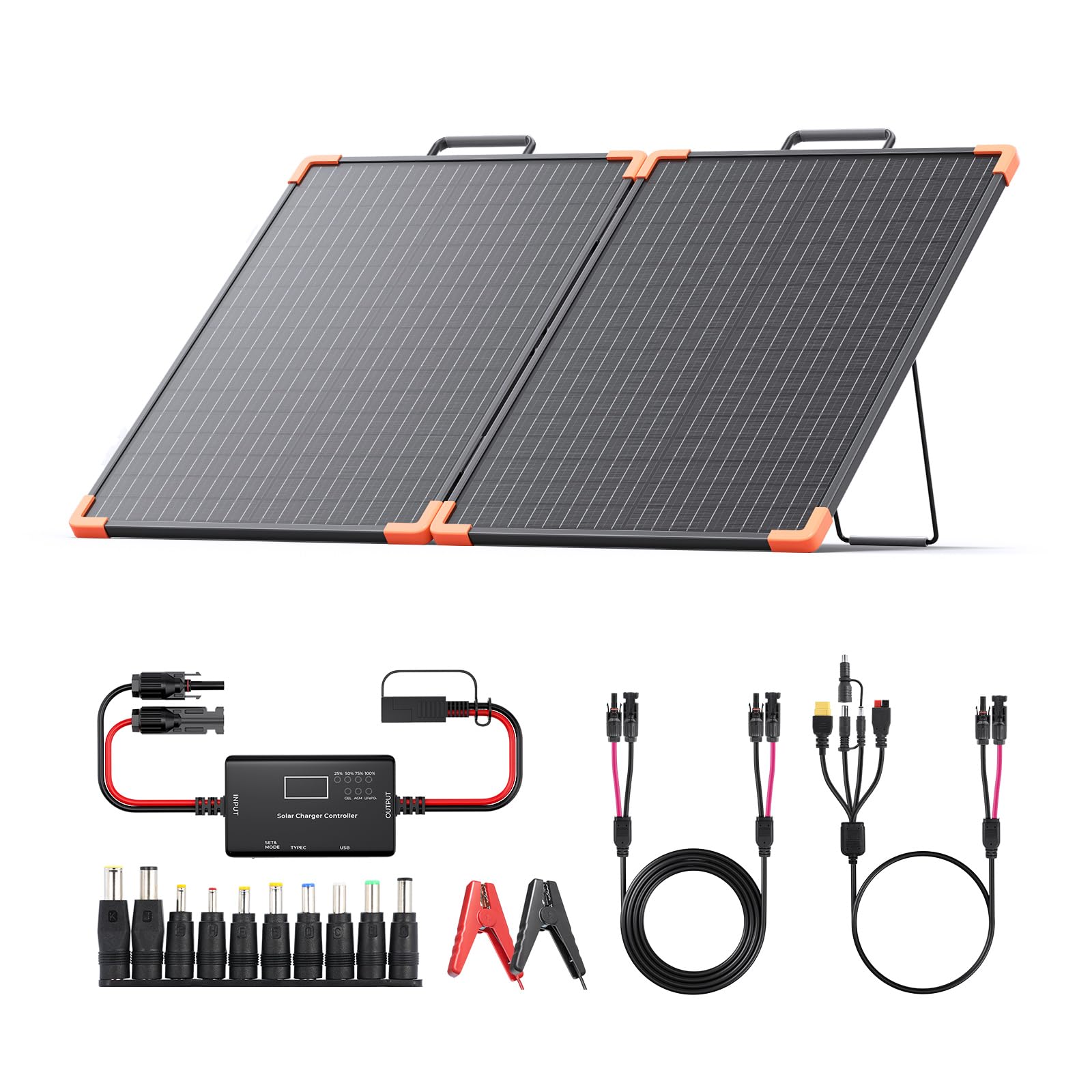
The ZOUPW kit takes a different approach to foldable solar: instead of the standard ETFE polymer surface, it uses a 1.6mm tempered glass panel that is far more scratch-resistant and durable over time. Together with the IP68 waterproof rating, this panel can handle sustained rain and splashes that would compromise IP65-rated alternatives. The 23.5% monocrystalline efficiency is competitive, and the 20A PWM controller provides comprehensive protections against overcharge, reverse polarity, and short circuits.
Setup is remarkably fast — owners report taking roughly 40 seconds to unfold the panel, deploy the two kickstands, and connect the alligator clips to a 12V battery. The zero-volt activation feature is particularly valuable for reviving a deeply discharged battery that cannot otherwise accept a charge. One owner revived a completely dead 100Ah battery to 75% within a few hours of partial sun, which is impressive for a 100W panel.
The wiring is stored within the folded panel itself, which keeps everything tidy but also requires careful extraction. Some users found the handles and bag construction could be more robust, and the kickstand legs may feel slightly flimsy. For the price, however, the tempered glass surface and IP68 rating make this the most weather-hardy portable option in the list.
Why it’s great
- 1.6mm tempered glass surface is far more durable than standard ETFE covers
- IP68 waterproof rating allows sustained exposure to rain and splashes
- Zero-volt activation can revive completely dead batteries
Good to know
- PWM controller is not waterproof and must be kept dry
- Kickstand legs and bag handles feel light-duty for long-term use
4. Topsolar 100W 12V Solar Panel Kit

If your plan involves permanently mounting a panel on an RV roof, shed, boat cabin, or ground frame, the Topsolar kit provides all the hardware needed in a single box. The 100W panel measures 46.5 x 21.8 inches with a corrosion-proof aluminum frame and tempered glass coating, and it includes MC4 leads with 16-foot cables that give you plenty of slack for routing to a battery compartment. The V-shape tilt rack bracket allows angle adjustment for better seasonal sun tracking.
The included 12V/24V intelligent charge controller is rated for 30A, which gives you headroom to add a second panel in parallel in the future without upgrading the controller. The controller offers full protection against overcharge, over-discharge, reverse polarity, and short circuits, and its LCD display shows battery voltage and charging status. Owners have reported that the panel consistently delivers its rated output and has lasted for years, with one owner running two units in parallel for a fleet of tractors with no issues.
Some users have noted that the pre-drilled mounting holes on the panel frame do not always align perfectly with the included bracket’s slots, requiring a quick drill adjustment. The controller also lacks the ability to switch between 12V and 24V battery profiles after the initial setup without a full system restart. For a complete, ready-to-mount system with long cables and future expansion in mind, this kit delivers practical, no-nonsense performance.
Why it’s great
- 30A controller allows easy expansion to 200W parallel system
- Long 16ft MC4 cables simplify routing through tight RV or boat compartments
- V-shape tilt bracket enables seasonal angle adjustment for higher annual yield
Good to know
- Pre-drilled mounting holes may not align with bracket slots without modification
- Controller battery profile switching can be cumbersome after installation
5. JJN 12 Volt 100W Solar Panel Kit

The JJN kit brings advanced cell technology to an aggressive price point. It uses 9BB (9-busbar) half-cut monocrystalline cells, a design that reduces internal electrical losses and lowers the panel’s temperature coefficient, resulting in more stable output as the panel heats up during midday. The half-cut architecture also minimizes the impact of partial shading — if one side of the panel is shaded by a tree branch or antenna, the other half continues producing near its full capacity.
The kit includes a 20A PWM charge controller with preset profiles for Wet, Gel, MF, EFB, and AGM batteries, making it compatible with almost any lead-acid chemistry. The Z mounting brackets and two pairs of cables (MC4 to controller, controller to battery) are included, so you can go from box to charging in under an hour. Owners have verified real-world output close to 100W in direct late-afternoon Texas sun, with one unit delivering 92W even when not optimally angled.
Build quality notes include a relatively thin aluminum frame that may not be ideal for mounting on a highway-speed vehicle roof, and the PWM controller has a small text display with no backlight, making nighttime reading difficult. The wires included are 12-gauge aluminum, which works but lacks the conductivity of pure copper. For a budget rigid kit that incorporates genuinely modern cell technology, the JJN is a compelling option.
Why it’s great
- 9BB half-cut cell design improves shade tolerance and temperature coefficient
- Pre-set battery profiles support Wet, Gel, AGM, and EFB lead-acid types
- 25-year power output warranty provides long-term peace of mind
Good to know
- Thin frame is not ideal for mounting on highway-speed vehicles
- Cables use aluminum conductors instead of higher-conductivity copper
6. EcoGreen 100W Foldable Solar Panel
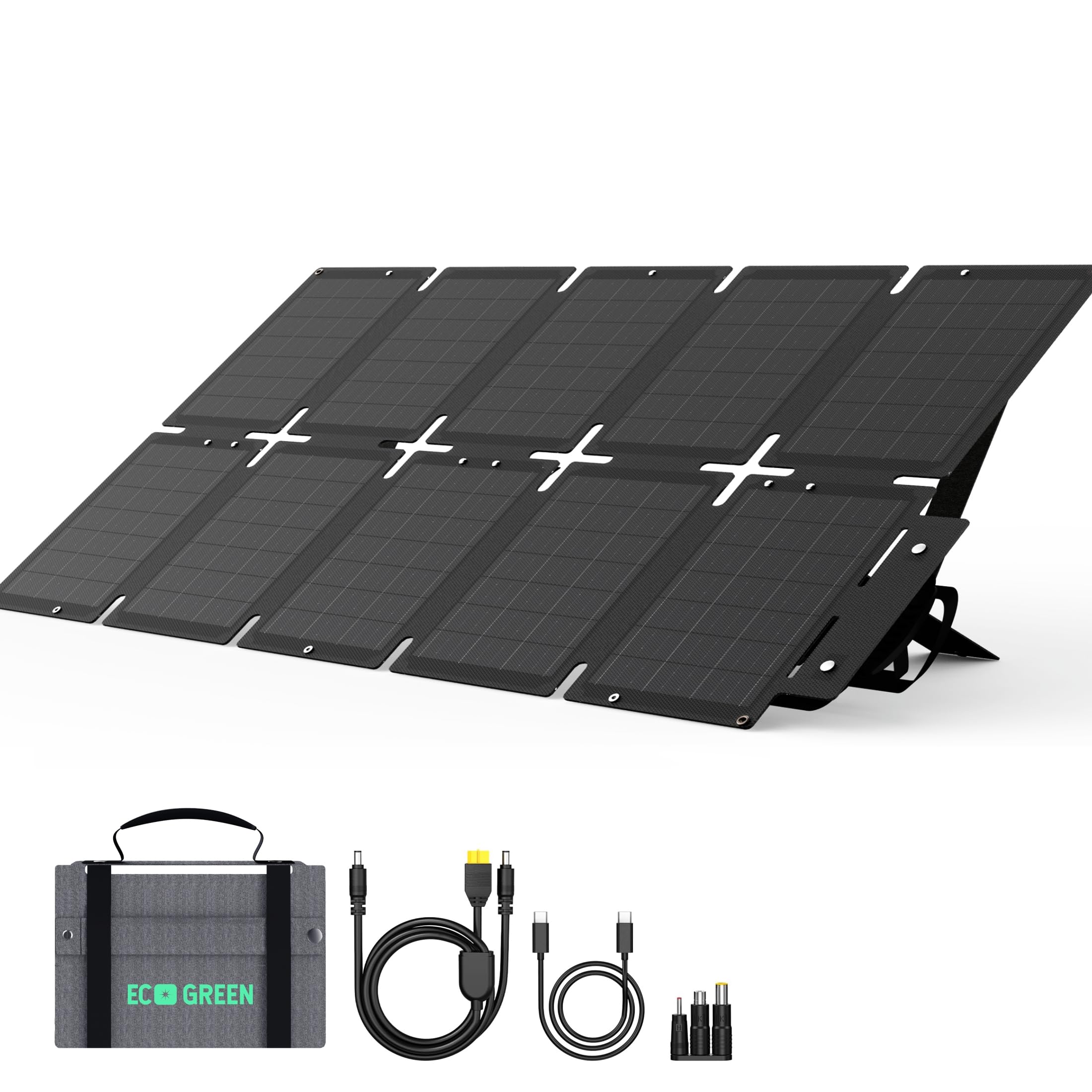
Weighing just 7.26 lbs, the EcoGreen foldable panel is the lightest 100W kit in this roundup, making it the obvious choice for backpackers, hikers, and campers who carry their power source on foot. The 24.8% conversion efficiency is among the highest in its weight class, and the ETFE-coated surface offers IP65 water resistance for unexpected rain showers. The panel folds down to a compact 41.3 x 27.4 x 3.98-inch package with a built-in handle.
The kit includes adjustable kickstands that tilt between 30 and 50 degrees, plus multiple output ports: a USB-A port, a USB-C port, and a DC5521 barrel connector. This wide compatibility means you can direct-charge phones, tablets, and small power banks without needing a separate controller for low-power devices. Owners report quick charging of EcoFlow Delta 2 power stations and reliable performance even in partial shade, noting that the panel is genuinely easy to reposition as the sun shifts.
Several buyers flagged a short 3-foot DC extension cable that makes connecting to certain power stations awkward — the MC4-to-DC cord is simply too short for many setups, forcing users to buy a separate extension. The IP65 rating also means you cannot leave it exposed to heavy rain. For ultralight adventurers who prioritize pack weight above all else, this panel offers an unmatched power-to-weight ratio.
Why it’s great
- At only 7.26 lbs, it is the lightest 100W panel in its class
- Built-in USB-A and USB-C ports allow direct device charging
- High 24.8% efficiency maximizes yield from limited portable surface area
Good to know
- DC extension cable is only 3 feet, too short for many power station connections
- IP65 rating is splash-resistant, not suitable for sustained rain exposure
7. GRECELL 100W Portable Solar Panel
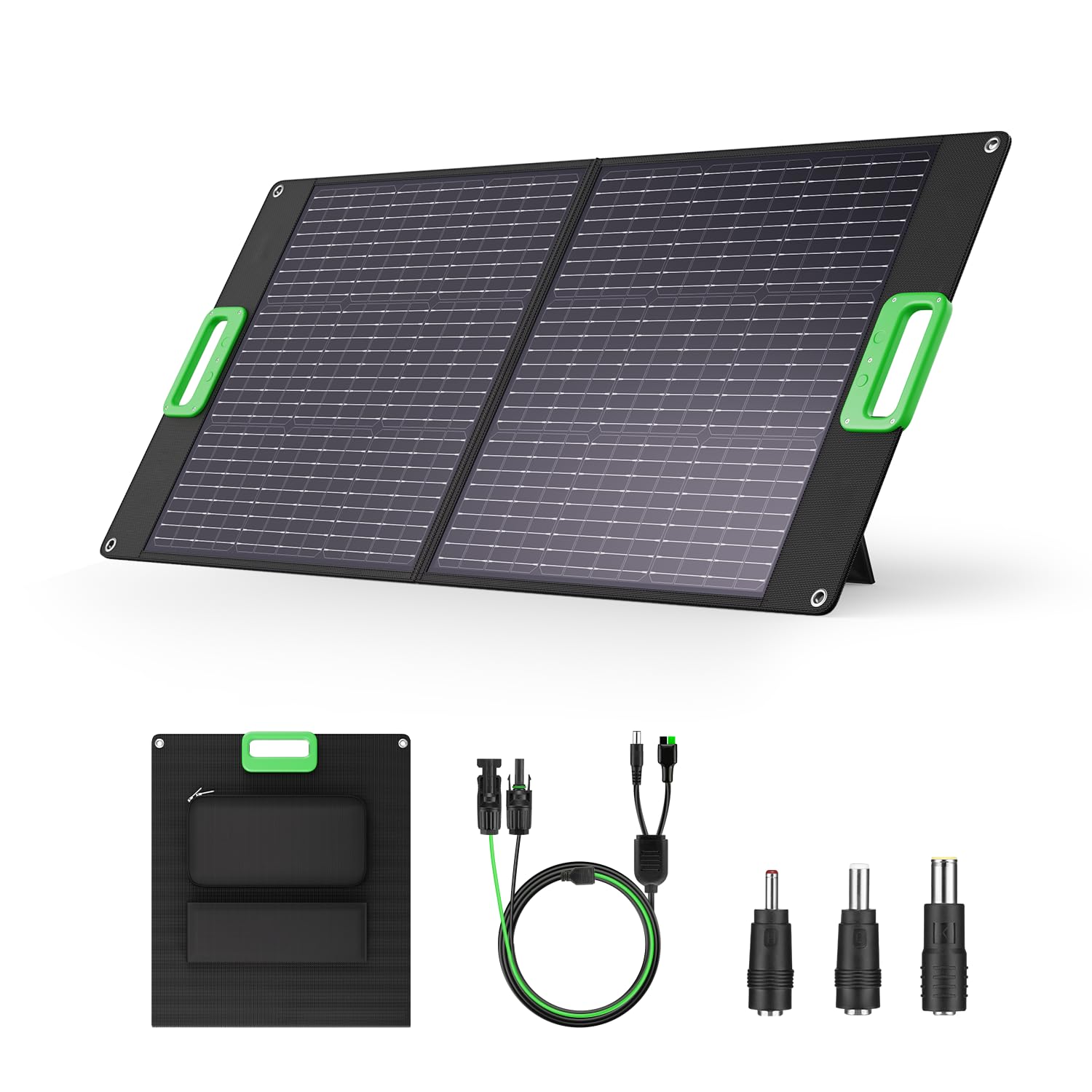
The GRECELL foldable panel delivers 23.5% efficient monocrystalline cells with ETFE lamination at a price point that undercuts most competitors by a noticeable margin. Despite the budget positioning, the build quality is respectable — the 600D/840D Oxford cloth backing and IP65 rating provide decent weather protection for camping trips. The foldable design includes a zippered internal pouch for cable management, and integrated grommets allow you to hang the panel from a tent or RV wall.
Compatibility is a strong suit: the kit ships with MC4-to-Anderson and MC4-to-DC5521 cables, plus three additional DC barrel adapters, covering the input ports of most portable power stations from Jackery, Goal Zero, Bluetti, and Anker. The panel supports both series and parallel connections, so you can link two units together for 200W output. Owners consistently confirm the panel charges their power stations quickly, even under partly cloudy conditions.
Where the budget price shows is in the cable quality — some users found the MC4 connectors to be less robust than premium-brand accessories, and the kickstands require a few extra seconds to stabilize on uneven ground. The panel also lacks an integrated charge controller, so you will need to use an external one or rely on your power station’s built-in MPPT input. For cost-conscious buyers who already own a controller or a station with direct solar input, this is a very capable panel.
Why it’s great
- Excellent value with 23.5% efficient ETFE cells at the lowest tier price
- Wide connector compatibility across Anderson, DC5521, and multiple adapter tips
- Scalable design — supports series or parallel connection for 200W output
Good to know
- No charge controller included — requires external controller or power station input
- Cable and connector quality is adequate but not premium-grade
8. DOKIO 100W Portable Solar Panel Suitcase
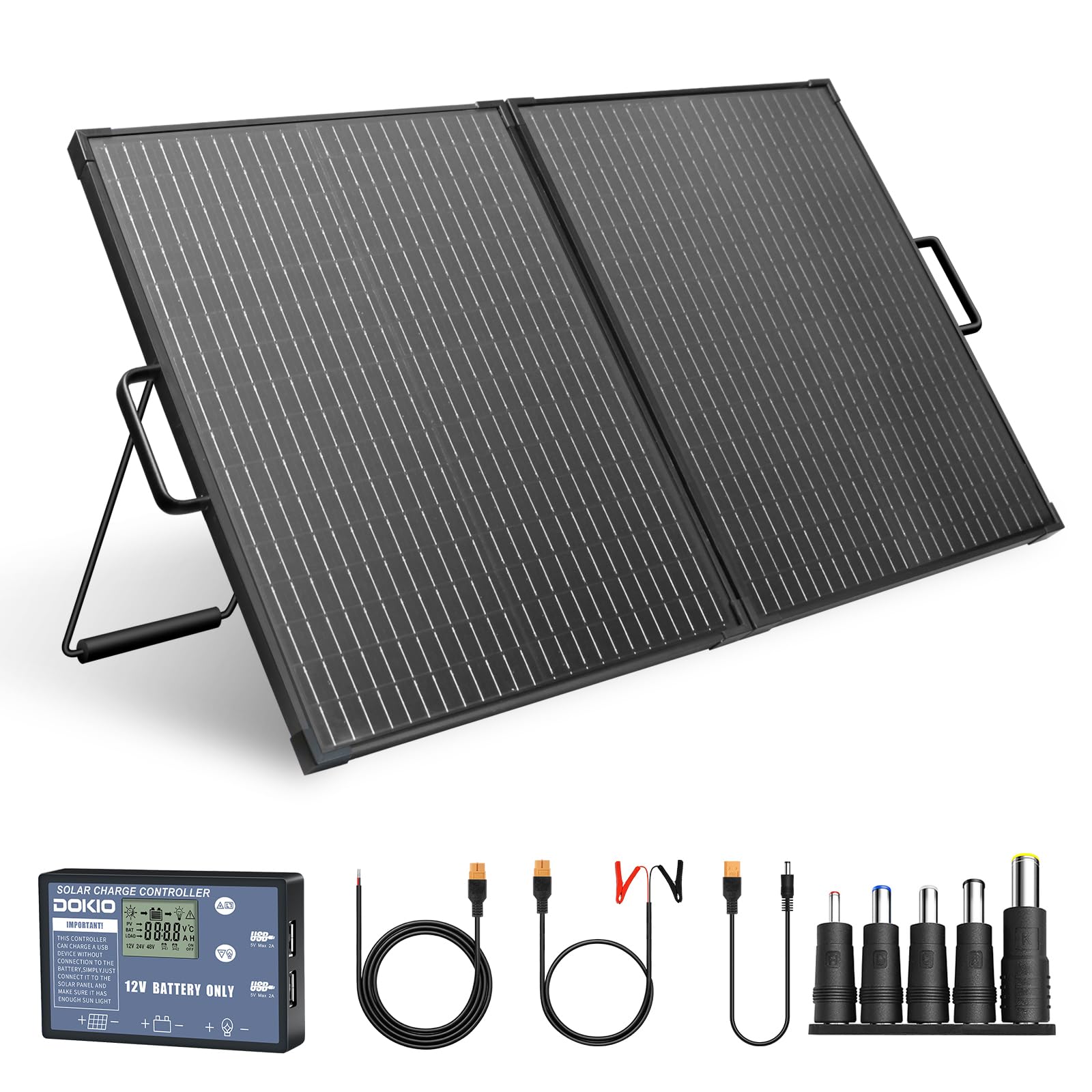
The DOKIO suitcase is the quintessential beginner kit — it bundles the panel, a detachable 10A PWM charge controller with LCD, and alligator clips into a single foldable unit that requires virtually no technical knowledge to operate. The N-type battery cells and corrosion-resistant aluminum frame are rated for extreme temperatures from -40°F to 185°F, and the integrated 5V 2A USB port lets you charge phones or a small fan directly from the controller without a separate power bank.
The 9.8-foot extension cable gives you freedom to place the panel in full sun while the controller and battery remain in the shade, reducing overheating risk for the electronics. The 30-degree adjustable bracket and free-sun-tracking cable make it easy to angle the panel toward the sun for maximum absorption. Owners have successfully powered a compressor cooler and maintained a 12V battery bank at 13.4V, confirming the panel delivers usable power even under less-than-ideal angles.
Build quality and quality control are the main weak points. Several owners reported chipped solar cells out of the box, a handle on the carrying bag that started failing after limited use, and sharp edges on the legs that can damage the panel surface if not handled carefully. The manual also lacks detailed setup guidance for non-standard battery chemistries. For a strictly beginner-friendly, all-in-one suitcase that costs very little, the DOKIO works — just inspect it carefully upon arrival.
Why it’s great
- Complete all-in-one suitcase with PWM controller and USB output for phones
- Extended 9.8ft cable allows controller to stay shaded while panel bakes in sun
- Wide operating temperature range (-40°F to 185°F) for extreme climates
Good to know
- Quality control is inconsistent — some units arrive with chipped cells or failing handles
- Carrying case has minimal padding and no internal protection for the glass panels
FAQ
Can I use a 100W solar panel kit without a charge controller?
How many amp-hours can I realistically get from a 100W panel per day?
Is a 100W kit enough for RV or van living?
Should I buy a rigid or foldable 100W panel for my campervan?
Final Thoughts: The Verdict
For most users, the 100 watt solar panel kit winner is the Renogy 100W Portable Panel because it combines proven real-world reliability, robust tempered glass construction, and a pre-installed 20A PWM controller that works with multiple battery chemistries out of the box. If you want maximum charging efficiency, especially under low light, grab the SOLPERK 100W kit with the waterproof MPPT controller. And for a hyper-portable, ultralight option that disappears into a backpack, nothing beats the EcoGreen 100W Foldable Panel.