
Choosing a prime lens for your APS-C camera is about committing to a specific vision. The fixed focal length forces you to compose with intent, and the wider apertures pull in more light and deliver that subject-isolation bokeh that zoom lenses simply cannot replicate. Whether you are chasing environmental portraits, street scenes, or ultra-wide landscapes, the right prime becomes the defining tool of your kit.
I’m Min — the co-founder and writer behind Gadgets Feed. I’ve spent hundreds of hours dissecting the optical formulas, autofocus systems, and real-world performance data of the latest APS-C primes to separate marketing claims from genuine image quality.
This guide evaluates the most compelling options across the spectrum, from budget-friendly character lenses to professional-grade G-series glass, to help you find the best aps-c prime lens for your specific shooting style and camera system.
How To Choose The Best APS-C Prime Lens
Selecting a prime lens for an APS-C sensor requires balancing focal length, maximum aperture, and autofocus capabilities against your budget and camera mount. The crop factor inherently changes the field of view, so a 50mm lens behaves like a short telephoto, while a 16mm offers a true wide-angle perspective.
Focal Length: Matching Your Subject
The lens’s fixed focal length dictates your angle of view and the compression of your image. Shorter focal lengths (11mm–23mm) are ideal for landscapes, architecture, and vlogging, as they capture expansive scenes. Standard lengths (30mm–35mm) offer a natural perspective street and documentary work. Longer primes (50mm–56mm) are the go-to for portraits because they flatter facial features and help isolate the subject from the background.
Maximum Aperture: The Light Master
A wider aperture (indicated by a smaller f-number like f/1.2 or f/1.4) allows more light to reach the sensor, enabling faster shutter speeds in dim conditions and creating shallower depth of field. On APS-C sensors, where achieving background blur is inherently more difficult than on full-frame, an f/1.4 lens provides a significant advantage over an f/2.8 zoom. The trade-off is often size, weight, and cost.
Autofocus System: Speed and Reliability
Modern prime lenses use either STM (Stepping Motor) or linear motor systems. STM motors are typically quiet and smooth, making them excellent for video. Linear motors, like Sony’s XD (Extreme Dynamic) or the dual linear motors found in newer lenses, provide faster and more precise focusing for tracking erratic subjects, which is critical for action or wildlife photography.
Quick Comparison
On smaller screens, swipe sideways to see the full table.
| Model | Category | Best For | Key Spec | Amazon |
|---|---|---|---|---|
| Sony E 15mm F1.4 G | Premium Wide | Vlogging & Astrophotography | f/1.4, Dual Linear Mot. | Amazon |
| Sony E 11mm F1.8 | Premium Ultra-Wide | Interior & Real Estate Video | 11mm, Compact Size | Amazon |
| VILTROX 13mm f/1.4 | Mid-Range Ultra-Wide | Landscape & Environmental Portraits | f/1.4, Metal Construction | Amazon |
| SIRUI Sniper 16mm F1.2 | Mid-Range Wide | Fujifilm X-Mount Shooters | f/1.2, Carbon Fiber Body | Amazon |
| VILTROX 15mm F1.7 | Value Wide-Angle | Content Creation & Vlogging | 180g, STM Motor | Amazon |
| Brightin Star 35mm F0.95 | Character Prime | Creative & Vintage-Look Shots | f/0.95, Manual Focus | Amazon |
| Meike 55mm F1.4 | Budget Portrait | Portraits on a Budget | 55mm, AF STM Motor | Amazon |
In‑Depth Reviews
1. Sony E 15mm F1.4 G (SEL15F14G)

The Sony 15mm F1.4 G represents the pinnacle of optical engineering for the APS-C E-mount system. Its dual linear motor system delivers near-instantaneous autofocus acquisition, making it effortless to track a vlogger moving through a scene or to lock onto a star for astrophotography. The optical design includes three aspherical elements and one Super ED element, which effectively suppresses chromatic aberration and distortion at the edges even when shooting wide open.
The inclusion of a physical aperture ring with a click-stop switch is a game-changer for hybrid shooters. You get tactile feedback for stills and silent, de-clicked control for smooth iris pulls during video. The internal focus mechanism keeps the lens length constant, so a gimbal balance is not disturbed during focusing. At 0.83 pounds, it feels substantial without being burdensome on compact bodies like the A6700.
Image quality is everything you expect from Sony’s G series—tack sharp from center to corner at f/1.4, with a beautiful rendering of out-of-focus highlights. The 22.5mm full-frame equivalent field of view is ideal for both immersive landscapes and environmental portraits. This lens justifies its premium tier status with zero compromises in optical performance or build quality.
Why it’s great
- Industry-leading dual linear motor autofocus for fast, silent tracking
- Sharp edge-to-edge at f/1.4 with excellent flare resistance
- Physical aperture ring with click-stop switch for hybrid shooting
Good to know
- Premium price point places it above many APS-C shooters’ budgets
- Some users may desire a wider angle than 15mm
2. Sony E 11mm F1.8 APS-C Ultra-Wide-Angle Prime

When you need to capture the entirety of a tight interior or achieve a dramatically wide field of view for a vlog, the Sony 11mm F1.8 is the definitive choice. Its 11mm focal length translates to a 16.5mm full-frame equivalent, delivering a 100-degree-plus angle of view that dwarfs even typical wide-angle zooms. The internal focus mechanism and compact body (just 10.56 ounces) make it a stealthy companion for run-and-gun video work.
The autofocus system uses two linear motors to provide the same snappy, near-silent performance found in Sony’s higher-end primes. This allows reliable eye-tracking on a ZV-E10 even when moving the camera rapidly away from your face. The minimum focusing distance of 0.12 meters (0.39 feet) lets you create dramatic, distorted close-ups that emphasize perspective in postage-stamp-sized rooms.
Optically, it is sharp enough for 4K video and high-resolution stills, though some barrel distortion and purple fringing are present wide open, requiring in-camera or post-processing corrections. The f/1.8 maximum aperture provides solid low-light performance for a lens of this breadth. For content creators and real estate shooters, this is the most versatile ultra-wide prime on the market.
Why it’s great
- Extremely wide 11mm (16.5mm eq.) view for tight spaces and vlogging
- Fast and reliable dual linear motor autofocus system
- Very light and compact for its focal length
Good to know
- Noticeable barrel distortion and fringing at f/1.8
- Requires software correction for optimal sharpness
3. VILTROX 13mm f/1.4 Fuji X-Mount

VILTROX has carved a reputation for delivering high-spec optics at disruptive prices, and the 13mm f/1.4 for Fujifilm X-mount is a perfect example. The lens is built around a complex optical formula featuring three ED (Extra-low Dispersion) elements and four high-refractive-index elements to combat chromatic aberration and distortion. At f/1.4, it produces a creamy bokeh that is rare for an ultra-wide, enabling environmental portraits with real subject separation.
The STM stepping motor autofocus is quick and quiet enough for most scenarios, though it can exhibit slight hunting in very dim light. The all-metal construction with a smooth manual aperture ring gives it a premium feel that belies its mid-range price. It also supports EXIF data transfer and firmware updates via USB, a touch of polish that is often missing from third-party lenses.
Sharpness is impressive, especially from f/2 onward, with good contrast and color rendering. A mild purple fringing can appear in high-contrast transitions, but it corrects easily. For a Fujifilm shooter needing a fast ultra-wide for landscapes or night skies, the VILTROX 13mm f/1.4 offers about 90% of the performance of the Fuji 14mm f/2.8 at half the price.
Why it’s great
- Bright f/1.4 aperture on an ultra-wide focal length
- Robust all-metal build with a smooth aperture ring
- Excellent value compared to native Fuji options
Good to know
- Autofocus can struggle in very low-light environments
- Some purple fringing in high-contrast edges
4. SIRUI Sniper 16mm F1.2 APS-C (X Mount)

SIRUI’s Sniper series brings a unique proposition to the Fujifilm X-mount ecosystem: a wide-angle lens with an incredibly fast f/1.2 maximum aperture. The 16mm focal length (24mm full-frame equivalent) is a versatile wide-angle, and the extra stop of light over an f/1.4 lens makes a meaningful difference for indoor ambient light and astrophotography. The lens uses a carbon fiber body, which keeps the total weight at 386 grams without sacrificing structural integrity.
The STM autofocus motor is adequate for portraits and street photography, but it is not as snappy as native Fuji lenses in continuous tracking scenarios. The optical performance is strong, with ED and high-refractive-index glass delivering good center sharpness at f/1.2 that improves significantly by f/2. The bokeh is exceptionally smooth for a lens in this focal range, thanks to the 11-blade aperture diaphragm.
One practical note: the locking lens hood is stiff to engage, which is a minor annoyance in the field. Chromatic aberration is well-controlled, though some softness at the edges is noticeable when pixel-peeping. For photographers who prioritize a wide aperture for creative effect over ultimate corner sharpness, the SIRUI Sniper 16mm f/1.2 offers a unique and compelling character.
Why it’s great
- Ultra-fast f/1.2 aperture provides excellent low-light ability and bokeh
- Lightweight carbon fiber construction
- Unique character with smooth out-of-focus rendering
Good to know
- Autofocus is slower than native Fuji lenses
- Edge sharpness is soft when shooting wide open at f/1.2
5. VILTROX 15mm F1.7 E-Mount (Sony)
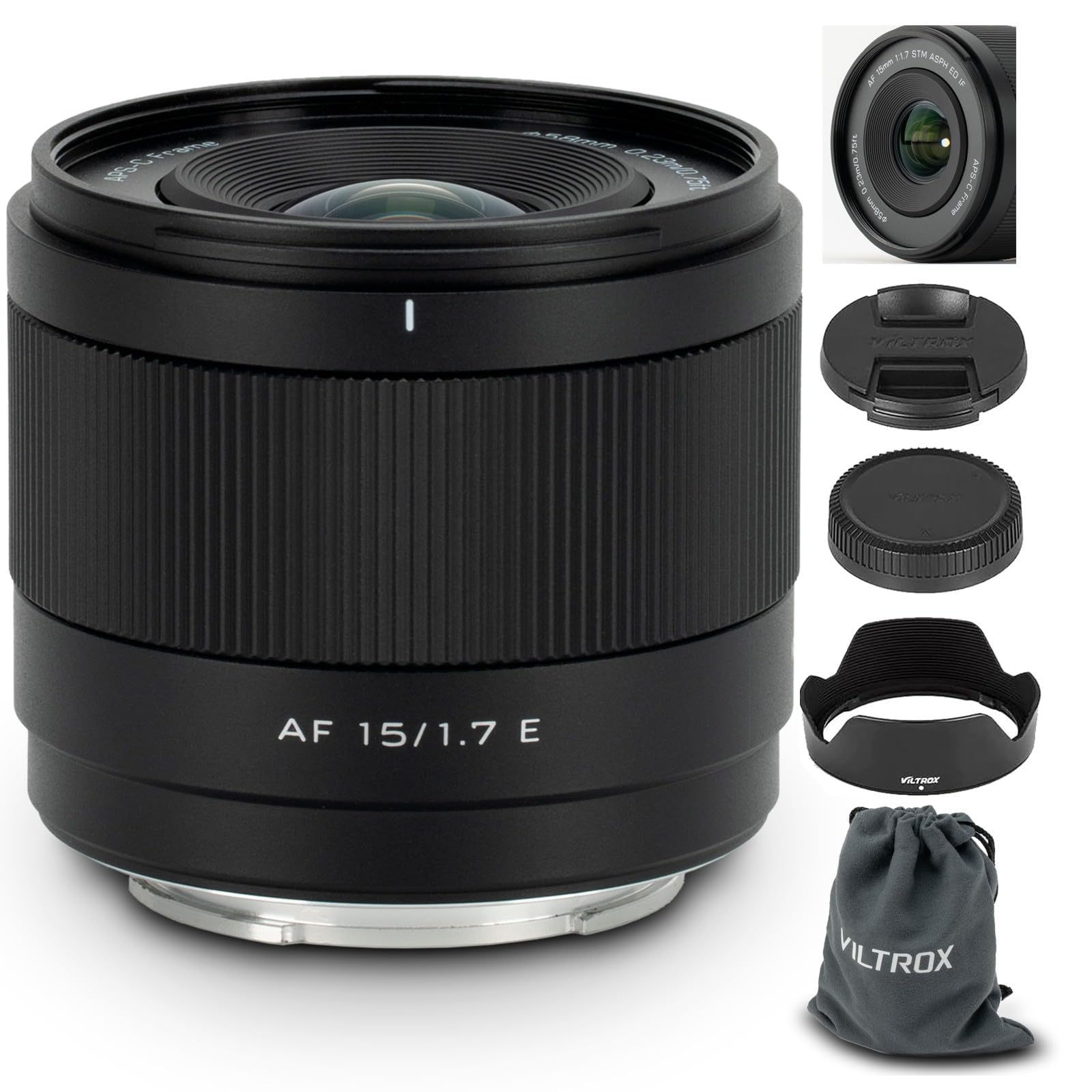
The VILTROX 15mm F1.7 is a lens designed with the modern content creator in mind, and its most impressive spec is its weight: just 180 grams. This makes it the lightest autofocus wide-angle prime on Sony E-mount, pairing perfectly with the ZV-E10 for handheld vlogging without arm fatigue. The 84.9° angle of view is wide enough for a pleasant FOV when the camera is at arm’s length, and the f/1.7 aperture provides decent background separation.
The STM stepping motor delivers reliable autofocus for stills and video, though the motor is audibly louder than the linear motors in the Sony G lenses. The minimum focusing distance of 0.23 meters allows for some creative close-up wide-angle shots. The 9-blade aperture creates a pleasing, round bokeh, and the lens is reasonably sharp when stopped down to f/2.8 for landscape work.
Some trade-offs exist for the low weight and price: the build is primarily plastic (though the mount is metal), and the autofocus motor can struggle in very dim indoor lighting. There is also no dedicated manual focus ring, which limits fine control for video pulls. For its targeted audience of vloggers and daylight content creators, this lens delivers exceptional value and portability.
Why it’s great
- Incredibly lightweight at 180g, perfect for gimbal and vlogging use
- Fast and reliable STM autofocus for most scenarios
- Excellent value proposition for Sony APS-C shooters
Good to know
- Autofocus motor is audible during video recording
- No dedicated manual focus ring for precise control
6. Brightin Star 35mm F0.95 APS-C (Sony E)

For photographers who feel that modern lenses are too clinically sharp, the Brightin Star 35mm F0.95 offers a refreshing antidote. Its f/0.95 aperture is the fastest in this roundup, letting in a staggering amount of light for shooting in near darkness. The lens is fully manual, so focusing requires patience, but the reward is a distinct vintage character with swirly bokeh, heavy vignetting, and ethereal softness wide open.
The build quality is solid, using aviation-grade aluminum with a CNC-anodized finish and engraved markings. The focus ring has a smooth, well-damped rotation, though it is a little stiff out of the box. The optical formula uses 11 elements in 8 groups, including 2 ED lenses, to manage dispersion. At f/0.95, the center is usable but not sharp; stopping down to f/2.0 dramatically improves clarity and makes it a capable standard lens.
This is not a lens for pixel-peepers or anyone who needs reliable autofocus. The heavy vignetting and chromatic aberration are baked into its personality. However, for street photography, creative portraits, or low-light documentary work where you want an unmistakable film-like aesthetic, the Brightin Star delivers a look that no other lens in this price range can touch.
Why it’s great
- Extremely bright f/0.95 aperture for near-dark shooting
- Unique vintage optical character with swirly bokeh
- Solid metal construction at a very low price
Good to know
- Fully manual focus; no autofocus capability
- Soft at f/0.95 with heavy vignetting and chromatic aberration
7. Meike 55mm F1.4 APS-C (Sony E)
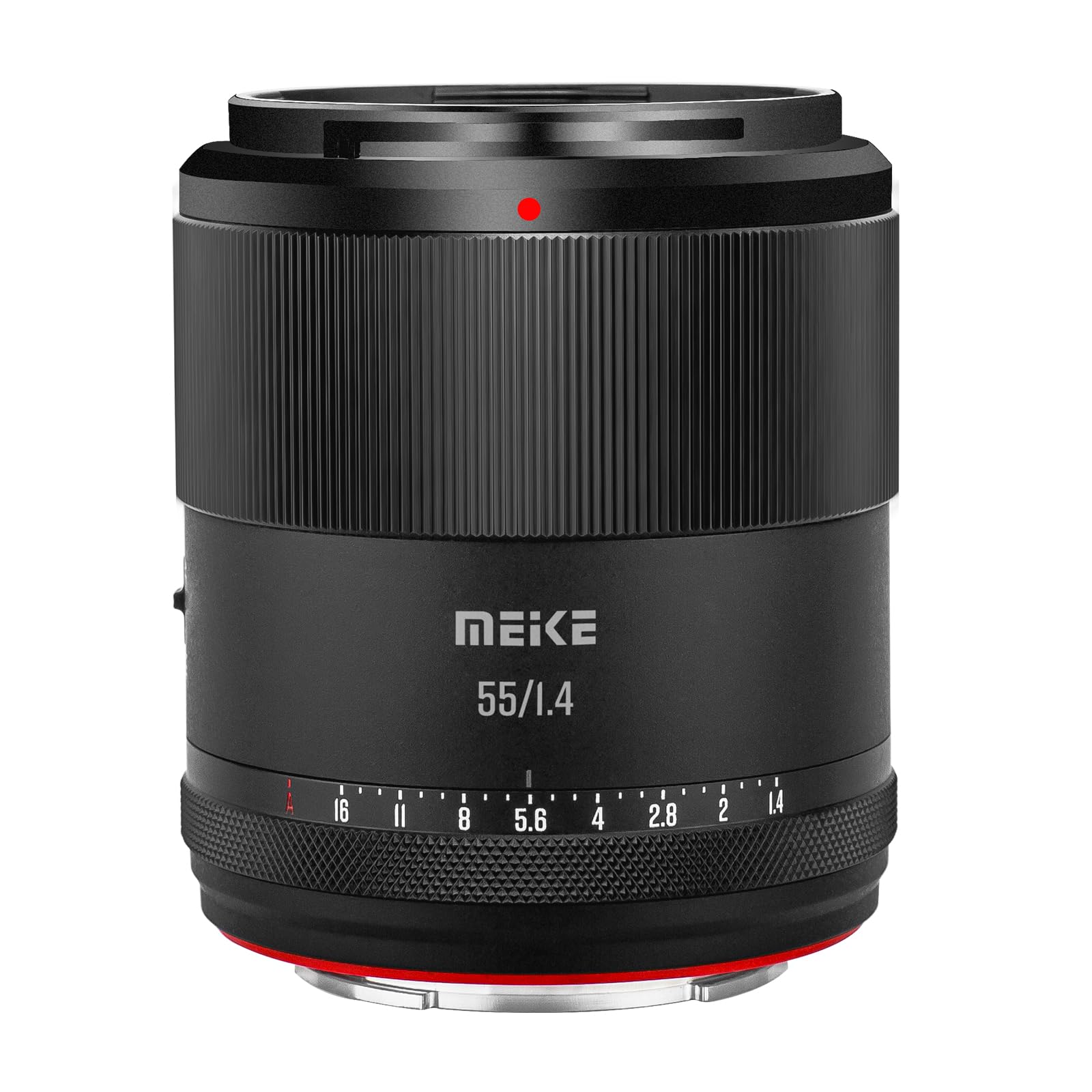
The Meike 55mm F1.4 is a textbook example of how to deliver high-impact features at an entry-level price point. Designed for Sony E-mount APS-C bodies, the 55mm focal length operates as an 82.5mm equivalent full-frame lens, placing it squarely in traditional portrait territory. The f/1.4 aperture allows for genuine subject isolation, producing a soft, creamy bokeh that makes backgrounds melt away, which is the primary reason to buy this lens.
The autofocus system uses an STM stepping motor, which is responsive enough for static portrait sessions and casual street photography. A small number of users have reported intermittent autofocus failures, but Meike offers firmware updates via a Type-C port (Android only). The optical design incorporates 8 elements in 11 groups, including 1 ED and 2 high-refractive-index elements, which keep chromatic aberration and flaring surprisingly well-controlled for the price.
Build quality is respectable for its budget-friendly tier, with a lightweight all-plastic barrel that keeps the lens at just 0.41 kilograms. The included lens hood and caps are a welcome touch. It is not going to compete with a Sigma 56mm f/1.4 for raw sharpness or AF consistency, but for someone stepping into portrait photography, the Meike 55mm F1.4 provides an unrivaled value proposition for the bokeh alone.
Why it’s great
- Genuine f/1.4 portrait bokeh at a very low cost
- Autofocus is fast enough for portraits and casual shooting
- Solid control of chromatic aberration for its price class
Good to know
- Autofocus reliability is inconsistent on some camera bodies
- Firmware updates require an Android device
FAQ
Is an f/1.4 prime lens worth it on APS-C compared to a kit zoom?
Why is a 35mm lens on my APS-C camera not the same as a 35mm on full frame?
Can I use a full-frame prime lens on my APS-C camera?
What does STM mean in lens autofocus?
Final Thoughts: The Verdict
For most users, the best aps-c prime lens winner is the Sony E 15mm F1.4 G because it combines flawless optical performance, professional-grade dual linear autofocus, and a hybrid-friendly aperture ring in a single compact package. If you want the widest possible view for vlogging or real estate, grab the Sony E 11mm F1.8. And for budget portrait shooters seeking creamy bokeh without the premium price, nothing beats the Meike 55mm F1.4.