
The single most freeing decision you can make for your home or office network is to cut the fiber optic cord entirely. A dedicated cellular gateway plugged directly into the 5G network bypasses slow DSL, expensive cable monopolies, and unavailable rural broadband. The only string attached is a plastic SIM card, and the performance now rivals—and often surpasses—traditional wired connections.
I’m Min — the co-founder and writer behind Gadgets Feed. I’ve spent hundreds of hours analyzing the technical specs, real-world performance data, and carrier certification lists to identify which dedicated 5G cellular routers actually deliver on the promise of reliable, high-speed wireless internet.
Whether you live in a broadband dead zone, run a business that demands always-on connectivity, or need a rock-solid backup for your wired line, the right device changes everything. This guide breaks down the best 5G SIM router options available right now so you can pick the one that fits your exact situation.
How To Choose The Best 5G SIM Router
Not every router that accepts a SIM card is built for heavy lifting. The wrong choice leaves you with unstable connections, throttled speeds, or a device that your carrier refuses to activate. Focus on these factors before you buy.
Carrier Certification and Compatibility
A router may technically support 5G frequencies but lack the IMEI whitelist clearance from your specific carrier. T-Mobile, AT&T, and Verizon each maintain certified device lists. Purchasing a router with explicit PTCRB certification and carrier endorsements ensures your SIM card will actually register on the network at full speed. Devices lacking this certification risk being blocked entirely or restricted to slower 4G failback.
Wi-Fi 6 Throughput and Antenna Configuration
The cellular modem inside the router grabs data from the tower, but the Wi-Fi radio determines how fast that speed reaches your devices. AX3000-class routers (574 Mbps on 2.4 GHz plus 2402 Mbps on 5 GHz) are the baseline for gigabit-class cellular service. External, detachable antennas matter tremendously in rural or obstructed locations—more gain and better placement flexibility can transform a marginal signal into a fully usable connection.
Dual-SIM Capabilities and Failover Logic
For business continuity or living in fringe coverage areas, a router with two SIM slots provides automatic failover if the primary carrier drops out. Some models support true load-balancing across both connections simultaneously, while others simply switch when a connection is lost. Know which implementation you need: failover is fine for backup, but multi-WAN load balancing is required for uninterrupted bonded performance.
VPN Support and Advanced Network Controls
If you need secure remote access to your home or office network, a router with built-in WireGuard or OpenVPN support saves you from buying separate hardware. Band locking, TTL adjustment, and carrier aggregation controls let power users fine-tune which cell towers and frequency bands the router uses—critical for squeezing every megabit out of a congested or weak signal.
Form Factor and Power Requirements
Stationary home routers run on AC power and sit on a desk or wall mount. Portable hotspots include a battery for on-the-go use. Industrial-grade units often require external power adapters and feature metal enclosures for heat dissipation. Choose based on your physical environment—an RV dweller needs something entirely different from a home office with wired fallback.
Quick Comparison
On smaller screens, swipe sideways to see the full table.
| Model | Category | Best For | Key Spec | Amazon |
|---|---|---|---|---|
| GL.iNet GL-X3000 (Spitz AX) | Premium | RV & power users | 6 detachable antennas, OpenWrt | Amazon |
| Cudy P5 | Premium | Advanced dual-SIM failover | Qualcomm SDX62, band lock | Amazon |
| MOFINETWORK MOFI6500 | Premium | Rugged business-class use | Metal case, amplified Wi-Fi 6 | Amazon |
| D-Link G530 | Mid-Range | Smart home & parental controls | AX3000, 4 high-gain antennas | Amazon |
| SquareWiz RM520N | Mid-Range | High-density deployments | 9 detachable antennas, 128 users | Amazon |
| GlocalMe Red Numen Air | Mid-Range | International travel | CloudSIM, 2.4″ touchscreen | Amazon |
| Hitron D60 | Mid-Range | Residential failover | AX3000, eSIM + Nano SIM | Amazon |
| UOTEK 5G CPE | Budget | Basic 5G home internet | 8 antennas, 1800 Mbps | Amazon |
| Teltonika RUTX50 | Premium | Industrial & EU deployment | 3.3 Gbps, 150 clients | Amazon |
In‑Depth Reviews
1. GL.iNet GL-X3000 (Spitz AX)

The GL.iNet GL-X3000, branded as Spitz AX, is the most well-rounded 5G SIM router on the market thanks to its unlocked OpenWrt-based firmware and physical hardware design. It integrates a 5G NR modem supporting both NSA and SA modes with a Qualcomm IPQ8071A WiFi 6 chipset, delivering real-world speeds up to 3000 Mbps across dual bands. The six detachable antennas (four cellular, two Wi-Fi) give you the flexibility to position for optimal signal, and the dual-SIM slot with automatic failover ensures your connection survives a carrier outage.
What sets the Spitz AX apart is the depth of its software. OpenWrt 21.02 provides access to over 5,000 plugins, including pre-installed OpenVPN and WireGuard with VPN routing speeds reaching 300 Mbps. Users who deployed this router in RVs and remote offices reported stable multi-WAN configurations, load balancing across Ethernet, cellular, and tethered connections simultaneously. The USB-C power requirement (20W) is a welcome departure from bulky barrel adapters, making it easy to power from a portable battery bank during extended trips.
Customer feedback highlights the responsive support team—two hardware failures over three years were resolved with immediate replacements. The primary tradeoff is the price point, which lands in the premium tier, and some users noted that the router handles a modest number of simultaneous devices better than a dedicated high-end consumer router. For anyone needing a flexible, travel-ready, or permanent 5G gateway with advanced network controls, the GL-X3000 earns the top spot.
Why it’s great
- Full OpenWrt fork with no-code admin panel for advanced customization
- Six detachable antennas with SMA connectors for outdoor upgrades
- Dual-SIM failover plus multi-WAN load balancing across Ethernet, cellular, and tethering
- USB-C powered at 20W for mobile deployment
- Carrier certified with AT&T and T-Mobile for hassle-free activation
Good to know
- Premium pricing places it above budget alternatives
- Runs warm under sustained load; good ventilation required
- Some carriers restrict to NSA 5G mode only without tweaking band locks
2. Cudy P5

The Cudy P5 packs a Qualcomm Snapdragon SDX62 modem capable of 3.4 Gbps downlink on 5G NSA and a dual-core ARM Cortex-A53 processor running a full-featured firmware. The AX3000 Wi-Fi 6 radio delivers 2402 Mbps on 5 GHz plus 574 Mbps on 2.4 GHz, sufficient for streaming 4K video, video conferencing, and gaming across a medium-sized home or office. The unit comes with four detachable 5 dBi cellular antennas and two 5 dBi Wi-Fi antennas, giving you plenty of mounting flexibility.
Advanced users will appreciate the built-in VPN client support for PPTP, L2TP, OpenVPN, WireGuard, IPsec, and Zerotier, as well as compatibility with over 20 DDNS providers. The dual-SIM slots support automatic failover, and the TTL adjustment and band-locking features let you steer the router toward specific frequency bands to avoid congestion or lock onto a stronger tower. Note that T-Mobile SIM cards are explicitly not compatible with this model, making it a better fit for AT&T or Verizon customers.
Real-world users report stable performance over months of daily use, with one reviewer noting that the Wi-Fi coverage is solid across a two-story home. The router runs warm due to the active modem, so allow airflow around it. For network administrators or tech enthusiasts who need granular control over carrier aggregation and band selection, the Cudy P5 is a capable tool that justifies its premium cost through feature depth alone.
Why it’s great
- Qualcomm SDX62 modem provides top-tier 5G throughput
- Advanced band-locking and TTL adjustment for fine-tuning
- Multiple VPN protocols including WireGuard and Zerotier
- Detachable antennas for precise placement or external antenna upgrades
Good to know
- T-Mobile SIM cards are not supported
- Runs hot under load; needs ventilation
- Tech support responsiveness criticized in some user reports
3. MOFINETWORK MOFI6500
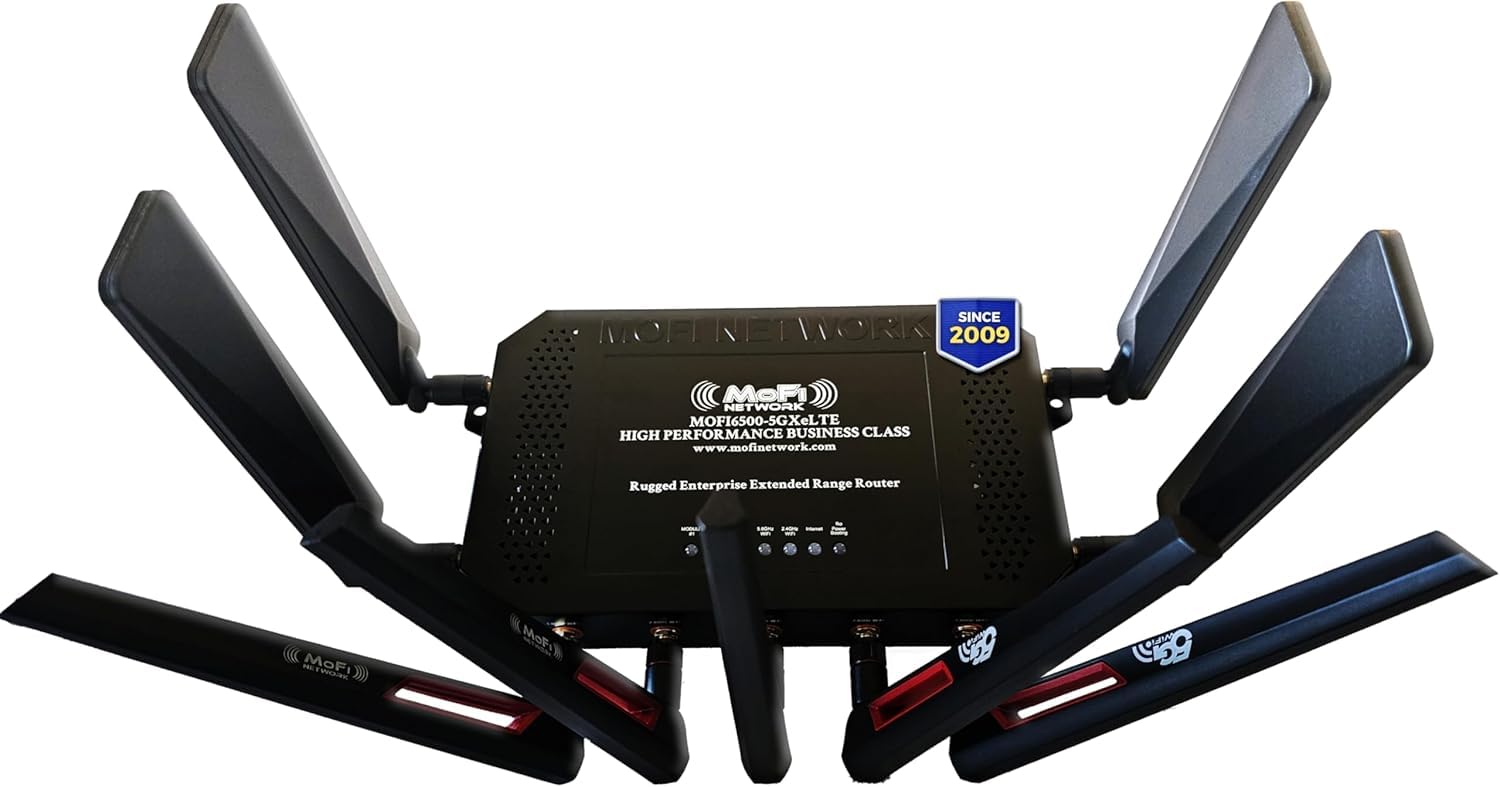
The MOFINETWORK MOFI6500 takes a different approach from consumer-grade routers by encasing its 5G modem and Wi-Fi 6 radio in a rugged full-metal chassis designed for heat dissipation and long-term reliability. It comes with four 5G cellular high-gain antennas and five Wi-Fi antennas, along with a 10-foot CAT6E Ethernet cable and a 3.5A power adapter. The built-in amplification extends Wi-Fi range significantly, making it suitable for covering two buildings or large floor plans from a single unit.
Business-class features include IP pass-through mode, automatic failover, band lock, VPN compatibility, and Zerotier certification. The dual-SIM slots operate in failover mode—only one SIM is active at a time, not simultaneous load balancing—so clarify your needs before purchasing. Users report that a single call to the toll-free support line (1-888-499-0123) resolves common setup issues quickly, and the router includes a programmable periodic reboot feature that stabilizes finicky connections in rural areas.
Reviews from full-time RVers and rural property owners praise the MOFI6500 for upgrading their signal from 1 bar to 4 bars when paired with an external Yagi antenna. The router handles Verizon, AT&T, and T-Mobile SIMs with equal reliability. For anyone who needs a heavy-duty, always-on 5G gateway that won’t overheat and includes professional-grade support, the MOFI6500 is a strong investment.
Why it’s great
- Rugged metal body for superior heat management
- Nine total antennas for maximum signal pickup and Wi-Fi coverage
- Programmable periodic reboot for connection stability
- Toll-free tech support with responsive team
Good to know
- Dual-SIM is failover-only, not simultaneous bonding
- Higher price point than mid-range alternatives
- Setup took multiple steps for some users; not truly plug-and-play
4. D-Link G530

D-Link brings its consumer router experience to the 5G SIM space with the G530, an AX3000-rated cellular gateway certified by PTCRB, AT&T, T-Mobile, and Verizon. The router includes four high-gain pre-positioned internal antennas that deliver reliable Wi-Fi coverage across a typical three-bedroom home. Dual-WAN auto-failover lets you plug in wired broadband as the primary and fall back to 5G if the cable goes out—or vice versa.
What distinguishes the G530 for families is the FALCON companion app. It provides guided setup, real-time usage monitoring, and granular parental controls including profile creation, schedule setting, domain blocking, and internet pauses. The router also meets IEC 62443-4-1 and ETSI EN 303 645 cybersecurity standards, which is rare in the cellular gateway space. Businesses will appreciate the gigabit LAN and WAN ports that enable full-speed wired connections to a switch or gaming PC.
Real-world performance shines in suburban and rural fringe areas where 5G signals are moderate. Users saw immediate speed improvements from 10/1 Mbps DSL to over 200 Mbps on a T-Mobile SIM. Some customers noted that the G530 does not support T-Mobile’s home internet SIM unless using a business plan, so confirm IMEI compatibility with your carrier. For families seeking a user-friendly, secure, and certified 5G home router, the G530 is the most polished option.
Why it’s great
- Carrier certified with all three major US carriers
- Robust parental controls and cybersecurity certifications
- Dual-WAN auto-failover for mixed wired/cellular setups
- Gigabit LAN/WAN ports for full-speed wired connections
Good to know
- App firmware lacks granular notification and advanced failover settings
- Some T-Mobile home internet SIMs require a business plan
- Support website had dead links and non-functional contact forms at launch
5. SquareWiz RM520N
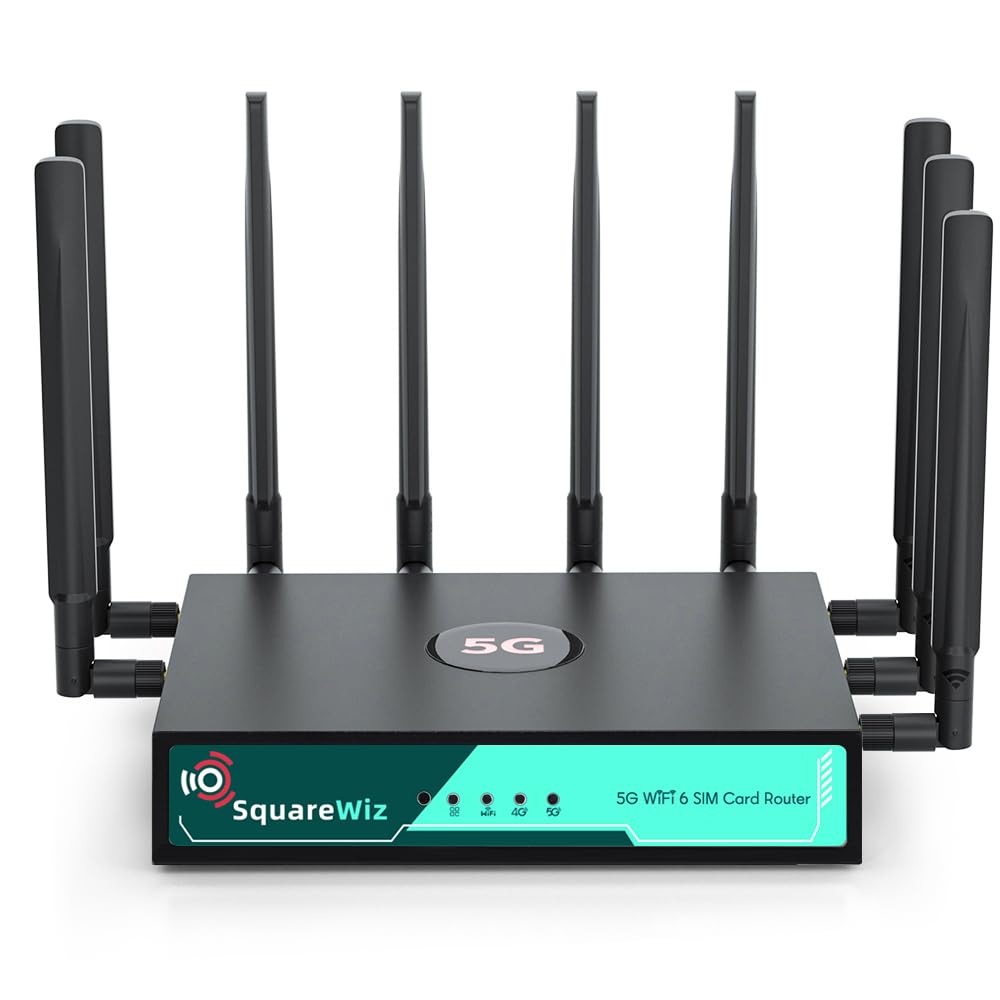
The SquareWiz RM520N is built for environments where many devices need simultaneous high-speed access. It uses a Qualcomm SDX62 5G modem capable of 3.4 Gbps downlink and supports up to 128 concurrent Wi-Fi users via AX3000 radios. The standout feature is the 9 detachable high-gain antennas—four 5 dBi cellular antennas and five 5 dBi Wi-Fi antennas—giving you exceptional flexibility to reposition for optimal signal or connect external outdoor antennas via SMA connectors.
Multi-WAN technology supports Ethernet, repeater, cellular, and tethering simultaneously, with load-balancing and configurable failover priorities. Built-in VPN protocols include PPTP, L2TP, GRE, WireGuard, and Zerotier, alongside compatibility with 20 DDNS providers for remote camera management. The router’s coverage is rated at 300 square meters line-of-sight, making it suitable for warehouses, retail spaces, or large homes.
Users transitioning from slow rural connections reported dramatic speed improvements—jumping from 10/1 Mbps to 150/50 Mbps after setup. However, some reviewers noted the router requires a weekly restart to maintain stability, and technical support is essentially non-existent via email. The unit also displayed some pop-up text in Chinese during initial configuration. For high-density deployments where you have some technical comfort level, the RM520N delivers raw throughput at a mid-range price.
Why it’s great
- Supports up to 128 simultaneous Wi-Fi clients
- Nine detachable antennas with SMA connectors for external antenna use
- Multi-WAN with load balancing across Ethernet, cellular, and tethering
- Multiple VPN protocols including WireGuard and Zerotier
Good to know
- Requires periodic restart for sustained stability
- No official tech support available
- Some Chinese language artifacts in the setup interface
6. GlocalMe Red Numen Air
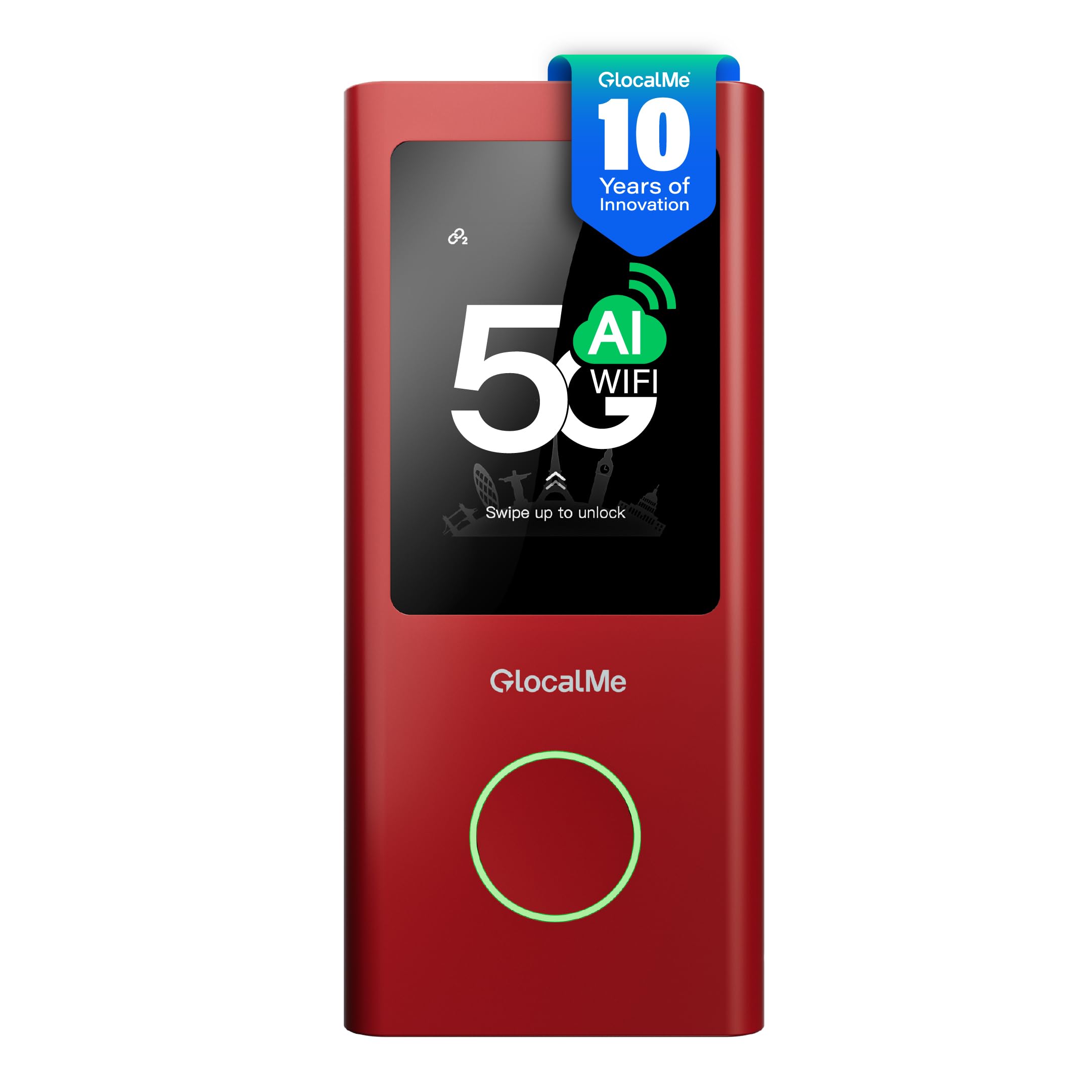
The GlocalMe Red Numen Air breaks the traditional SIM router mold by integrating CloudSIM technology, which lets you connect without inserting a physical SIM card at all. The router intelligently selects the best local network from over 390 operators across 90 countries, and you pay as you go via the GlocalMe app on a daily, monthly, or GB basis. For those who want to use a local SIM, the router also has a standard SIM slot and is fully unlocked.
The hardware is compact and travel-friendly, featuring a 2.4-inch LCD touchscreen for monitoring data usage, signal strength, and connected devices. It supports up to 16 simultaneous connections and doubles as a power bank to charge other devices via USB-C. Data transfer rates reach up to 2.5 Gbps, and the dual-band Wi-Fi (2.4 GHz and 5 GHz) minimizes interference in crowded environments like hotels or conference centers.
Users praised the Numen Air for its quick setup and strong signal in countries like Japan and the USA. Battery life is around 6 hours of continuous use, which is adequate for a day of travel but not enough for heavy tethering. The GlocalMe data packages are priced at a premium compared to local SIMs, so frequent travelers might pair it with a physical SIM for the best value. For globetrotters who want one device that works everywhere without SIM-hunting, this is the most convenient option.
Why it’s great
- CloudSIM technology works in 200+ countries without a physical SIM
- 2.4-inch LCD touchscreen for easy data and connection monitoring
- Compact design with power bank functionality
- Supports both CloudSIM and physical SIM slots
Good to know
- Data packages via GlocalMe app are expensive compared to local SIMs
- 6-hour battery life limits all-day untethered use
- Not ideal for heavy family streaming due to 16-device cap
7. Hitron D60
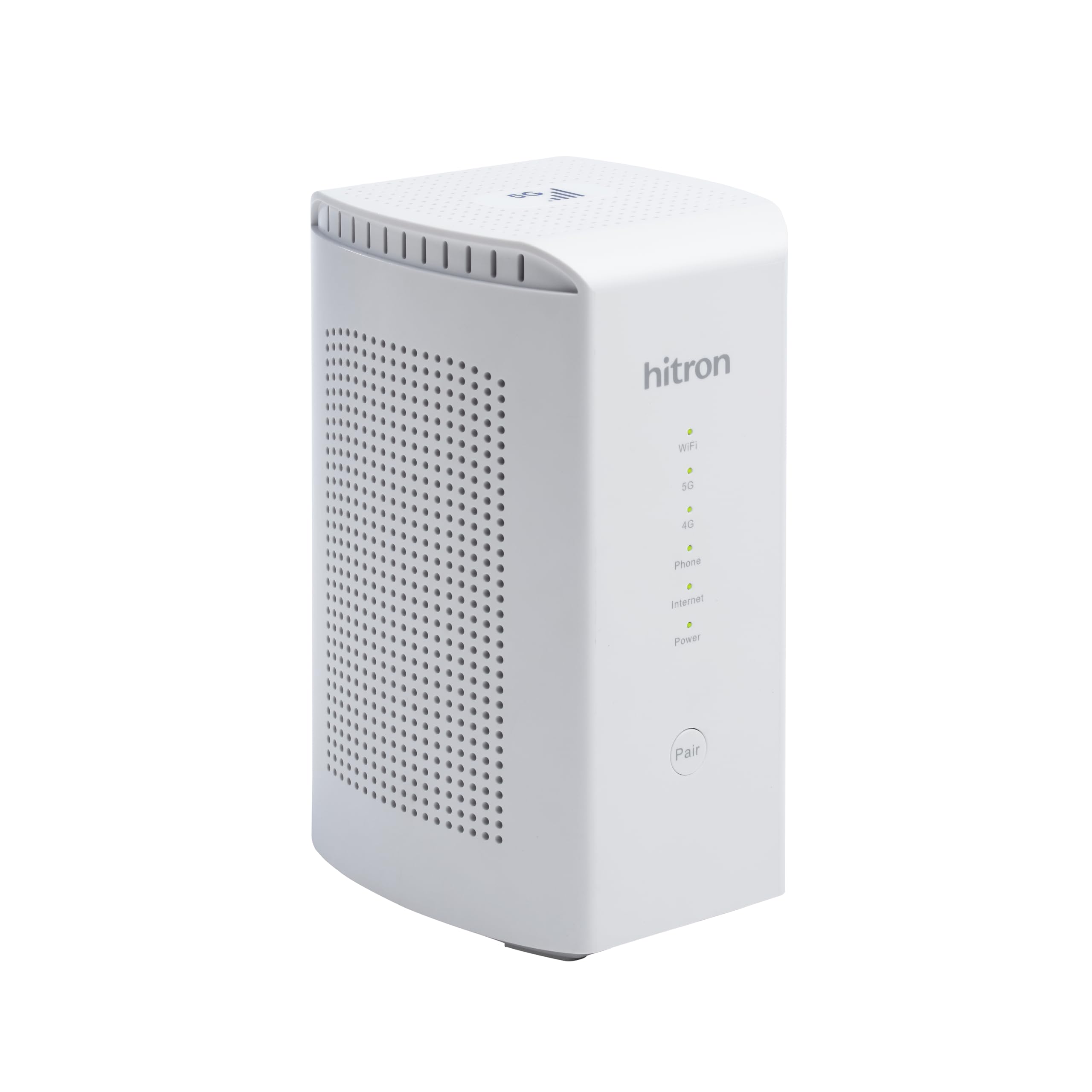
The Hitron D60 is a well-rounded AX3000 5G cellular router that supports both Nano SIM and eSIM for dual failover capability. It is certified to work with T-Mobile, AT&T, and US Cellular, making it one of the most carrier-compatible options in the mid-range tier. The built-in 4×4 MIMO 5 GHz radio delivers up to 5.4 Gbps of Wi-Fi bandwidth, and the cellular modem supports both SA and NSA 5G architectures for broad network compatibility.
A unique differentiator is the integrated RJ11 phone port, which allows you to connect a traditional landline phone. This is valuable in rural areas where VoIP or cellular voice may be unreliable. The D60 also supports cellular failover as a safeguard for residential and small office users who need to maintain internet access during wired outages. Setup is straightforward for most users, though some reported needing carrier assistance to configure multi-use SIM plans correctly.
Customer reviews highlight excellent performance in rural areas—one user saw speeds over 200 Mbps throughout their house after inserting an AT&T SIM. The device runs warm during operation, which is typical for 5G modems. The main caveat is the limited 3-month warranty, which is shorter than many competitors. For anyone needing a reliable primary or backup 5G connection with the bonus of a phone line, the Hitron D60 offers strong value.
Why it’s great
- Dual SIM failover using both Nano SIM and eSIM
- Includes RJ11 port for traditional phone line connectivity
- 4×4 MIMO on 5 GHz for faster Wi-Fi throughput
- Certified with T-Mobile, AT&T, and US Cellular
Good to know
- Only a 3-month limited warranty
- Some carriers require business-grade SIM plans
- User manual had poor copy quality, making setup harder for some
8. UOTEK 5G CPE

The UOTEK 5G CPE is an entry-level AX1800 router that brings 5G cellular internet to homes on a tighter budget. It features eight external antennas (four for cellular, four for Wi-Fi) and supports both 5G SA and NSA standards. The dual-band Wi-Fi 6 radio provides up to 1800 Mbps total throughput, which is sufficient for streaming, video calls, and general browsing but lags behind the AX3000 class for heavy simultaneous usage.
Setup is straightforward if you know the default login IP (192.168.100.1) and password (admin), though the included instructions omit these details. The router works immediately with T-Mobile SIMs out of the box, and users report that speeds consistently hit around 200 Mbps even in weak signal areas. Changing to SA mode improved ping times to 15-25 ms and boosted speeds by 20-30 Mbps over the carrier-provided Sagecomm gateway. The interface is basic but functional, without the advanced VPN or band-locking features of pricier units.
Some units had quality control issues—a reviewer had their first router fail after 2 days and the replacement was DOA. The router does not include mesh settings despite claiming mesh capability in the product description. For users who are comfortable flashing custom firmware like Rooter Goldenorb, the hardware platform responds well and becomes significantly more stable. At its price point, the UOTEK 5G CPE offers the most accessible path to 5G home internet for basic needs.
Why it’s great
- Lowest entry price for 5G SIM router functionality
- Eight external antennas for better signal reception
- Compatible with custom Rooter Goldenorb firmware for advanced users
- Works out of box with T-Mobile SIM
Good to know
- Quality control can be inconsistent; some units arrive DOA
- Basic interface lacks VPN, band locking, and mesh features
- Instruction manual missing critical login credentials
9. Teltonika RUTX50

The Teltonika RUTX50 is an industrial-grade 5G router designed for mission-critical deployments where reliability and configurability are non-negotiable. It supports dual-SIM with auto-failover, up to 150 simultaneous connections, and 5G speeds reaching 3.3 Gbps. The package includes four mobile antennas, two Wi-Fi antennas, one GNSS antenna, a 1.5-meter Ethernet cable, and a SIM adapter kit—everything needed for a professional installation.
Unlike consumer routers, the RUTX50 is built for integration into larger networks: it supports single-digit latency for real-time applications, advanced VPN tunneling, and full backward compatibility with 4G LTE CAT 20 and 3G. The router is designed for Europe, the Middle East, Africa, Oceania, and Brazil—it is explicitly not for use in the USA due to different frequency allocations. The robust metal housing and industrial-grade components ensure years of operation in harsh environments like factories, warehouses, and mobile installations like boats or caravans.
Users praise the RUTX50 for its infinite settings and generally well-built hardware, but note that it is not a plug-and-play home device. One reviewer achieved only 100 Mbps at 200 yards from a 5G antenna, likely due to local network configuration rather than the hardware itself. The price is the highest in this roundup, reflecting its industrial orientation and full accessory set. For businesses or advanced users deploying in supported regions who need carrier-grade reliability and remote management, the Teltonika RUTX50 is unmatched.
Why it’s great
- Industrial build quality with metal housing for harsh environments
- Supports 150 simultaneous clients for large-scale deployments
- Dual-SIM with auto-failover and GNSS antenna included
- Single-digit 5G latency for real-time industrial applications
Good to know
- Not certified for use in the USA
- Highest price in this comparison
- Complex configuration not suited for non-technical home users
FAQ
What is the difference between a 5G SIM router and a mobile hotspot?
Does a 5G SIM router need a specific data plan?
Can I use a 5G SIM router with T-Mobile home internet?
How many devices can a 5G SIM router support simultaneously?
Do I need external antennas for a 5G SIM router to work well?
Final Thoughts: The Verdict
For most users, the best 5g sim router winner is the GL.iNet GL-X3000 (Spitz AX) because it combines carrier certification, dual-SIM failover, six detachable antennas, and the unmatched flexibility of OpenWrt firmware in a package that works equally well for home, office, and RV deployment. If you prioritize carrier compatibility, family safety controls, and an easy-to-use app, grab the D-Link G530. And for globetrotters who want a single device that connects in 200+ countries without SIM hunting, nothing beats the GlocalMe Red Numen Air.