
An APS-C sensor crammed into a body that slips into a jacket pocket represents the ultimate balance between image quality and portability. You get the depth of field control and low-light capability of a serious camera without needing to haul a massive bag of gear. The challenge is finding the right body that pairs the sensor with a lens sharp enough to resolve every megapixel, and a feature set that matches how you actually shoot.
I’m Min — the co-founder and writer behind Gadgets Feed. I’ve spent countless hours dissecting the technical specifications of the latest APS-C compact cameras, analyzing sensor readout speeds, mount system compatibility, and real-world autofocus performance to deliver a buying guide that cuts through the marketing noise.
Whether you prioritize pocketability, video prowess, or a vintage shooting experience, this guide breaks down the best options to help you find the perfect aps-c compact camera for your specific needs and budget.
How To Choose The Best APS-C Compact Camera
The APS-C compact camera space is split between two distinct philosophies: the fixed-lens pocket rocket and the interchangeable-lens system. Your first decision should be about commitment. A fixed-lens camera like the Ricoh GR IIIx or Fujifilm X100 series forces you to master one focal length, but delivers a lens perfectly matched to the sensor, often with a faster aperture and a much smaller overall package. An interchangeable-lens camera like the Sony a6400 or Canon EOS R50 offers more versatility, but you’ll need to carry additional glass to cover different perspectives.
Sensor Resolution and Processor Generation
Not all APS-C sensors are created equal. The older 24.2MP sensor found in the Sony a6400 and Canon EOS R100 is still very capable, but newer sensors like the 26MP back-illuminated Exmor R in the Sony a6700 and ZV-E10 II offer better dynamic range and lower noise. The Fujifilm X100VI pushes the boundary with a 40MP sensor, which is a significant jump, but demands excellent technique and lighting to avoid motion blur. The processor is equally important — a DIGIC 8 in an entry-level Canon versus a BIONZ XR in a high-end Sony represents a real difference in autofocus speed, menu responsiveness, and video codec support.
Autofocus Capabilities for Real-World Use
For an APS-C compact, autofocus performance is often the deciding factor between a keeper and a blurry mess. Sony’s Real-time Eye AF for humans, animals, and birds is widely considered the gold standard, especially in the a6700 with its dedicated AI processor. Canon’s Dual Pixel CMOS AF is also excellent and covers a wide area on the R50 and R7. The Ricoh GR IIIx uses contrast-detection AF, which is reliable in good light but can hunt in dim conditions. If you shoot moving subjects or fast-paced street photography, prioritize phase-detection coverage across the sensor and a high autofocus point count.
Video Features and Codecs
If video is a core use case, pay close attention to recording limits, crop factors, and bit depth. The Sony a6700 and ZV-E10 II can record 4K 60p oversampled from 6K with 10-bit color, giving you significant flexibility in post-production. The Canon R7 offers 4K 30p with no crop, but its sensor readout is sharp. On the other hand, the Ricoh GR IIIx only does 1080p video, which is a dealbreaker for hybrid shooters. Also check for rolling shutter — the Sony a6400 and ZV-E10 have severe rolling shutter at 4K 30p, making them less ideal for hand-held vlogging.
Ergonomics and Portability
The entire point of an APS-C compact is to take it with you. The Ricoh GR IIIx is genuinely pocketable at roughly the size of a deck of cards, while the Fujifilm X100VI is more of a coat-pocket camera. Interchangeable-lens options like the Sony a6700 or Canon EOS R50 require a bag for the body and an extra lens. Consider the grip texture, button layout, and viewfinder type. The Fujifilm X100VI features a hybrid optical/electronic viewfinder, which is a joy for street photographers, while the Ricoh GR IIIx has no viewfinder at all, requiring you to compose from the rear screen.
Quick Comparison
On smaller screens, swipe sideways to see the full table.
| Model | Category | Best For | Key Spec | Amazon |
|---|---|---|---|---|
| Sony a6700 | Mirrorless | Serious Hybrid Shooters | 26MP BSI sensor / AI AF / 4K 120p | Amazon |
| Canon EOS R7 | Mirrorless | Sports & Wildlife | 32.5MP sensor / 30fps e-shutter / IBIS | Amazon |
| Ricoh GR IIIx | Fixed-Lens | Walkaround Street Photography | 24.2MP / 40mm f/2.8 GR Lens / IBIS | Amazon |
| Fujifilm X100VI | Fixed-Lens | Style & Film Simulations | 40MP X-Trans 5 HR / 23mm f/2 / 6.2K Video | Amazon |
| Sony a6400 | Mirrorless | Budget Photo-First Shooting | 24.2MP / 0.02s AF / 425 PD Points | Amazon |
| Sony ZV-E10 II | Mirrorless | Content Creation & Vlogging | 26MP BSI sensor / 4K 60p 10-bit | Amazon |
| Canon EOS R50 | Mirrorless | Beginner Hybrid Kit | 24.2MP / Dual Pixel CMOS AF / 4K | Amazon |
| Fujifilm X100 | Fixed-Lens | Retro Fan & Low-Light Street | 12.3MP / 23mm f/2 / Hybrid VF | Amazon |
| Sony ZV-E10 | Mirrorless | Entry-Level Vlogging | 24.2MP / 4K 30p from 6k / Side Flip Screen | Amazon |
| Canon EOS R100 | Mirrorless | Budget RF-S Introduction | 24.1MP / Dual Pixel AF / 6.5fps | Amazon |
In‑Depth Reviews
1. Sony a6700

The Sony a6700 is the most well-rounded APS-C mirrorless camera on the market, combining a sharp 26MP back-illuminated sensor with the flagship BIONZ XR processor and a dedicated AI processing unit. This combination delivers the best autofocus in the class — Real-time Recognition locks onto human eyes, animal faces, birds, and even vehicles with a level of reliability that feels more like a full-frame body. The 759 phase-detection points cover nearly the entire frame, and the subject tracking is tenacious, making it a joy to shoot fast-moving subjects like kids or running dogs.
For video creators, the a6700 is a serious tool. It records 4K 60p oversampled from 6K with 4:2:2 10-bit color, offering incredible flexibility in post-production for color grading. The inclusion of 4K 120p for slow-motion is a standout feature rarely seen at this price point in an APS-C body. The body is compact with a deep grip for comfortable handling, and the battery life is significantly better than the older a6000 series, allowing for a full day of casual shooting on a single charge. The menu system is still Sony-dense, but the customizable buttons and My Menu tab help a lot once you set it up.
Its main limitation is that in-body stabilization is decent but not class-leading — you will still want a gimbal for smooth handheld walking shots at 4K. Low-light high-ISO performance is good, but not as clean as the 32.5MP Canon R7 or the 40MP Fujifilm X100VI. However, for an all-around hybrid camera that excels at both stills and video, the a6700 is the benchmark against which all other APS-C compacts are measured. It’s a premium tool that justifies its cost with every shot.
Why it’s great
- AI-based autofocus is incredibly sticky and accurate for both people and animals.
- 4K 60p 10-bit video and 4K 120p slow-motion provide serious video capability.
- Compact body with excellent battery life for all-day carry.
Good to know
- In-body stabilization is adequate but not gimbal-replacing for smooth walking video.
- Menu system is complex and takes time to learn thoroughly.
- Low-light performance above ISO 6400 shows noticeable noise.
2. Canon EOS R7

The Canon EOS R7 is a beast for action-oriented photographers who need the fastest frame rates in an APS-C body. Its 32.5MP sensor captures incredible detail, and the electronic shutter can fire at a staggering 30 frames per second with full autofocus tracking. The 651-point Dual Pixel CMOS AF II system covers 100% of the frame, making it exceptionally easy to lock onto fast-moving subjects like birds in flight or a car at a racetrack. The build quality is excellent, with deep weather sealing and a comfortable grip that feels balanced even with larger RF-mount telephoto lenses.
The 5-axis In-Body Image Stabilization is a highlight — it works brilliantly in tandem with IS-equipped RF lenses, providing up to 8 stops of correction for handheld shooting in low light. This makes the R7 a powerful tool for hand-held wildlife shooting where a tripod is impractical. Video features are strong too, with 4K 30p from the full sensor width and 4K 60p with a slight crop, both in 10-bit color. The battery life is outstanding for a mirrorless camera, easily lasting a full day of heavy shooting thanks to the LP-E6NH battery.
The R7’s primary drawback is that it is not truly compact — it’s larger than the Sony a6700 or the Fujifilm X-T5, and you will need a proper camera bag. The lens selection for the Canon RF-S mount is still limited compared to Sony’s mature E-mount ecosystem, although EF lenses work well via the adapter. For photographers who prioritize reach, speed, and stabilization, the R7 is a purposeful tool, but it’s less suited for casual everyday carry or street photography.
Why it’s great
- Class-leading 30fps electronic shutter with full AF tracking.
- Excellent IBIS provides 8 stops of shake correction with IS lenses.
- Long battery life runs an entire day of high-volume shooting.
Good to know
- Body is larger and heavier, not a pocketable compact for daily carry.
- Limited native RF-S lens selection currently available.
- 4K 60p video uses a 1.8x crop factor.
3. Ricoh GR IIIx

The Ricoh GR IIIx is the purest expression of the pocketable APS-C concept. Its 40mm equivalent f/2.8 lens is a masterpiece of optical design — incredibly sharp across the frame with a natural perspective that mimics the human eye’s field of view. This is not a jack-of-all-trades zoom; it is a fixed focal length that forces you to think and compose carefully, rewarding you with images that have a truthful, journalistic feel. The 24.2MP sensor is paired with a GR Engine 6 that delivers excellent color and tonal gradation straight out of camera.
Portability is the defining trait. The GR IIIx is smaller than most smartphones in thickness, fitting into a pants pocket or a small jacket pocket with zero bulk. The startup time is about 0.8 seconds, meaning you can pull it out, power on, and capture a moment almost instantly. The in-body image stabilization helps keep hand-held shots sharp at slow shutter speeds, which is critical for a camera this small without a viewfinder to brace against your face. The build quality is solid, with a magnesium alloy frame that feels dense and durable.
Its weaknesses are clear and deliberate. The battery life is poor — you will want at least two spare batteries for a full day of shooting. The autofocus uses contrast-detection, which is fine in good light but hunts noticeably in dim conditions. There is no viewfinder, no 4K video, and the LCD is fixed. This is a still-photography-first tool for shooters who know they want a 40mm field of view. If that describes you, the GR IIIx is unmatched in its class.
Why it’s great
- Truly pocketable size fits in jeans or jacket pocket without a bag.
- Incredibly sharp 40mm f/2.8 GR lens delivers professional-grade image quality.
- Quick 0.8-second startup and reliable snap-focus for street photography.
Good to know
- Battery life is very poor; carry multiple spare batteries.
- Autofocus hunts in low light, and there is no viewfinder.
- No 4K video recording; only offers 1080p.
4. Fujifilm X100VI

The Fujifilm X100VI is the most hyped camera of the decade for good reason. It takes the iconic formula of the X100 series — a 23mm f/2 lens (35mm equivalent) with a hybrid optical/electronic viewfinder — and supercharges it with a modern 40MP X-Trans 5 HR BSI-CMOS sensor and the X-Processor 5. The result is a camera that produces stunningly detailed images with Fujifilm’s legendary film simulations (like Nostalgic Neg and Acros) that look fantastic with zero editing. The addition of 6-stop IBIS is a huge upgrade, making hand-held shooting in low light much more viable.
The shooting experience is tactile and deliberate. The aperture ring, shutter speed dial, and exposure compensation dial provide a mechanical feel absent from most modern cameras. The hybrid viewfinder is a joy — you can switch between a bright optical viewfinder with electronic frame overlays or a high-resolution EVF. The 6.2K 30p 10-bit 4:2:2 video capability is surprisingly robust, making it a capable tool for professional-looking B-roll. The build quality is premium, with a magnesium alloy body that feels cold and precise in the hand.
Its biggest problem is availability and price. The MSRP is already premium, but demand often drives street prices much higher. The autofocus is improved over the X100V but still not as fast or sticky as Sony’s a6700 — it can struggle with fast-moving subjects. The fixed 35mm-equivalent field of view is a creative choice that not everyone will like. For shooters who value style, a tactile experience, and gorgeous SOOC jpegs, the X100VI is an aspirational purchase. For those who just need the best specs per dollar, there are more practical options.
Why it’s great
- 40MP sensor with exceptional film simulations gives stunning SOOC images.
- Beautiful hybrid OVF/EVF and tactile analog controls enhance the shooting experience.
- 6-stop IBIS and 6.2K 30p video add real versatility.
Good to know
- Autofocus is improved but still behind Sony’s AI-assisted AF in speed and reliability.
- High demand and limited stock often lead to prices well above MSRP.
- Fixed 35mm equivalent lens is not for everyone and lacks zoom flexibility.
5. Sony a6400

The Sony a6400 remains a compelling option years after its release because its core strengths — blazing-fast autofocus and a sharp 24.2MP sensor — still hold up remarkably well. Its 0.02-second autofocus acquisition with 425 phase-detection points covering 84% of the sensor is not just a marketing number; in real-world use, it snaps onto subjects with a speed that makes other cameras in its price range feel sluggish. The Real-time Eye AF works flawlessly for both stills and video, making it a fantastic choice for portrait photographers and family documentarians.
The body is compact and lightweight, with a 180-degree flip-up touchscreen that is ideal for self-framing and vlogging. It shoots 11fps continuous with full AF tracking, which is more than enough for most action scenarios. The video features are capable, including 4K 30p oversampled from 6K, though the severe rolling shutter is a notable limitation — avoid fast panning. The compact size makes it easy to carry in a small sling bag with a couple of E-mount lenses, and the ecosystem is vast.
The a6400’s age shows in its contrast-only screen and poor touchscreen implementation. There is no IBIS, so you need OSS lenses for stabilized video. The rolling shutter in 4K is the biggest downside, making it less suitable for run-and-gun or hand-held vlogging where motion is constant. However, for a mid-range price, the a6400 delivers professional-grade autofocus and image quality that few competitors can match. It is a smart buy for photographers who prioritize speed and reliability above all else.
Why it’s great
- Incredibly fast and reliable Real-time Eye AF that rivals flagship cameras.
- Compact and lightweight body with a flip-up 180-degree touchscreen.
- Wide ecosystem of affordable and high-quality Sony E-mount lenses.
Good to know
- Severe rolling shutter in 4K video mode makes it unsuitable for action video.
- No in-body image stabilization and no headphone jack for audio monitoring.
- Menu system is dense and the touchscreen is poorly integrated.
6. Sony ZV-E10 II

The Sony ZV-E10 II is a significant generational leap over the original ZV-E10, and it directly targets content creators who need reliable autofocus and high-quality video without a full-frame price tag. The new 26MP back-illuminated Exmor R sensor and BIONZ XR processor bring the autofocus performance close to the a6700, with AI-assisted subject recognition that reliably tracks eyes and faces. The addition of 4K 60p recorded from a 6K oversample in 4:2:2 10-bit is a genuinely pro-level feature that makes color grading possible.
The vlogging-centric design is refined, with a side-flipping touchscreen that keeps the hotshoe clear for an external microphone. The Product Showcase mode, which quickly transitions focus from your face to an object held up to the lens, works beautifully for product reviews and tutorials. The built-in directional 3-capsule microphone with a windshield is surprisingly usable for run-and-gun recording. The body is lighter than the a6700, and the larger NP-FZ100 battery provides enough power for a full day of shooting without constant anxiety.
Its compromises are largely around ergonomic cost-cutting. The ZV-E10 II has no viewfinder, no built-in flash, and the plastic build doesn’t feel as premium as the a6700. It also lacks mechanical shutter, relying entirely on an electronic shutter, which can cause rolling shutter artifacts in fast-motion scenarios. For dedicated vloggers and solo content creators who prioritize video quality and ease of use over still-photography features, the ZV-E10 II is an excellent and well-priced tool. Photo-first shooters will be better served by the a6400 or a6700.
Why it’s great
- Excellent 4K 60p 10-bit video from a 6K oversample with reliable AF.
- Side-flipping screen and product showcase mode are perfect for creators.
- Improved battery life with the larger NP-FZ100 battery pack.
Good to know
- No viewfinder or flash; build quality uses more plastic than the a6700.
- Electronic shutter only, which can produce rolling shutter artifacts.
- Prioritizes video features; still-photography experience is secondary.
7. Canon EOS R50
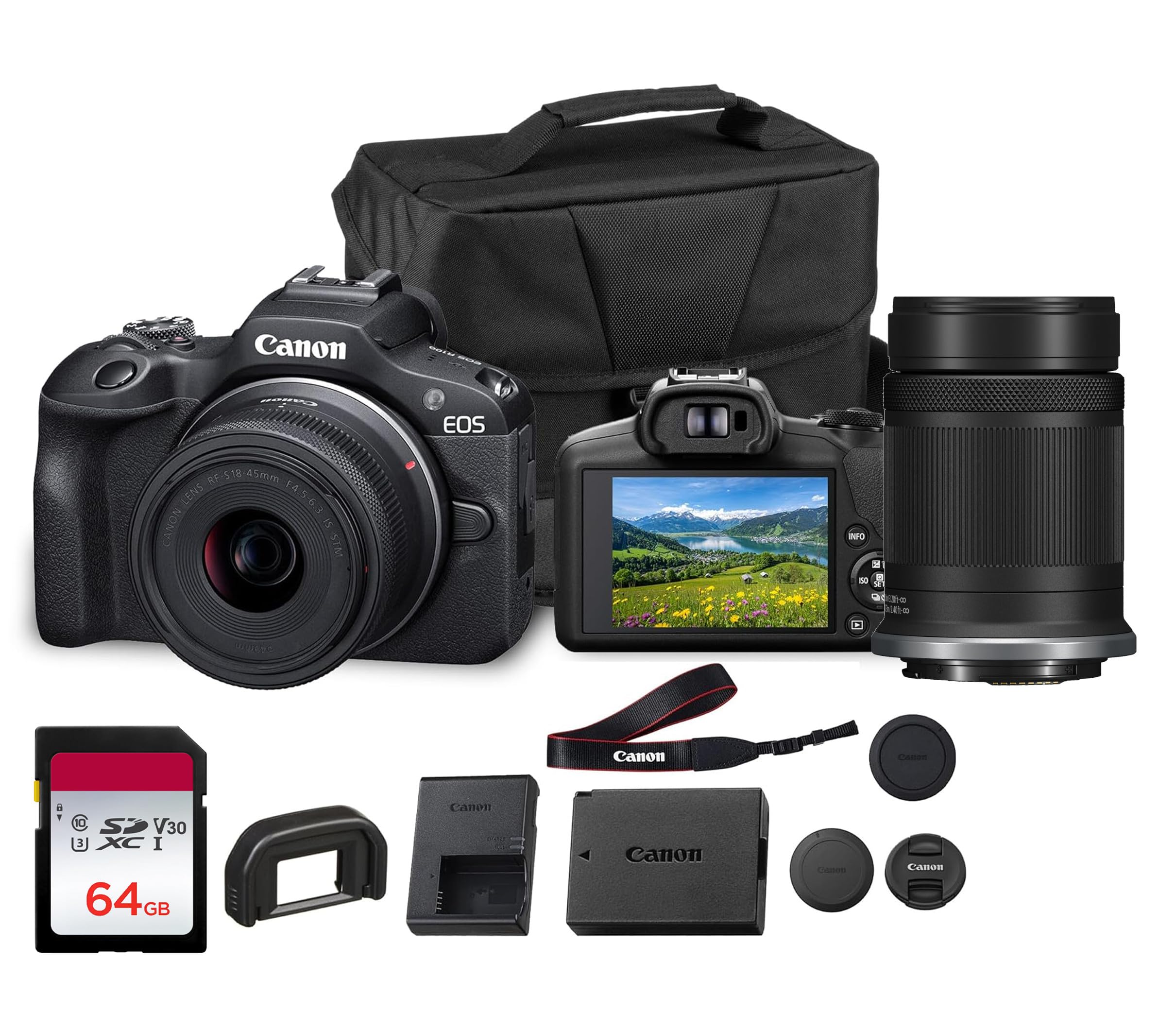
The Canon EOS R50 is the ideal starting point for someone who wants a capable APS-C camera with zero learning curve. Its 24.2MP sensor and DIGIC X processor deliver excellent image quality with natural Canon color science, and the Dual Pixel CMOS AF covers a wide area with reliable face and eye detection. The kit includes two zoom lenses — the RF-S 18-45mm f/4.5-6.3 for everyday wide to standard shots, and the RF-S 55-210mm f/5-7.1 for telephoto reach — giving beginners immediate coverage across a broad range of scenes.
The camera is remarkably small and light, making it one of the most comfortable APS-C options to carry around all day. The guided menu system explains shooting modes and settings, which is a massive help for a new photographer trying to understand aperture priority or shutter speed priority. The bundle also includes a shoulder bag and a 64GB memory card, meaning you have a complete kit out of the box. The video features are decent, with 4K 30p and 120fps in HD for slow-motion fun.
The R50’s limitations stem from its entry-level position. The kit lenses are slow (f/4.5-6.3), making indoor or low-light shooting difficult without pushing ISO. There is no in-body stabilization, and the body lacks weather sealing. The electronic viewfinder is basic and small compared to higher-end Canons. For a serious enthusiast, the R50 will feel limiting after a few months. But for a beginner or a family photographer who wants a user-friendly and capable system with room to grow into better RF-S lenses, the R50 is a fantastic value bundle.
Why it’s great
- Excellent guided interface that teaches beginners how to use different modes.
- Two-lens kit provides wide-angle to telephoto coverage for any scene.
- Lightweight, compact body with fast Dual Pixel CMOS AF.
Good to know
- Kit lenses are slow (f/4.5-6.3), struggling in indoor or low-light conditions.
- No in-body stabilization and no weather sealing for outdoor use.
- Entry-level build quality and small electronic viewfinder.
8. Fujifilm X100

The original Fujifilm X100 is a piece of camera history that still has a dedicated following for its unique character. Its 12.3MP APS-C EXR sensor is low-resolution by modern standards, but the image quality has a distinct film-like quality, and the Fujinon 23mm f/2 lens is sharp with lovely rendering. The hybrid viewfinder is the star of the show — you can look through a bright optical frame or switch to an electronic viewfinder, a feature that even the newest X100VI still uses. The built-in ND filter and silent leaf shutter make it perfect for discreet street photography.
This is a camera for shooters who prioritize the process over the result. The aperture ring, shutter speed dial, and manual focus ring provide a tactile engagement that modern cameras often lack. The film simulations — Velvia, Astia, Provia — produce beautiful colors straight out of camera. In good light, the X100 produces stunning images that look unlike any modern smartphone or clinical mirrorless camera. The build quality is solid, with a magnesium alloy body that feels like a precise instrument.
The X100’s age shows in its poor autofocus performance, especially in low light where it hunts badly. The manual focus is electronic and extremely slow, making it frustrating to use. The proprietary USB port and flimsy battery charger adapter are annoying. There is no 4K video, and the LCD screen is low resolution. The most critical issue is the known sticky aperture blade defect, which Fujifilm has not officially recalled — buying used carries real risk. For anyone who wants a reliable modern tool, the X100VI is a much better choice, but the original X100 has a soulful image quality that is hard to replicate.
Why it’s great
- Unique hybrid optical/electronic viewfinder for an immersive shooting experience.
- Beautiful film-like JPEG colors with Velvia and Astia simulations.
- Silent leaf shutter and built-in ND filter for unobtrusive street photography.
Good to know
- Autofocus is slow and hunts in low light; manual focus is unusably slow.
- Known sticky aperture blade defect is a common failure point.
- Low 12.3MP resolution and no 4K video capabilities.
9. Sony ZV-E10

The original Sony ZV-E10 democratized vlogging by offering a 4K-capable APS-C sensor in a body designed specifically for content creators. Its 24.2MP sensor delivers sharp video oversampled from a 6K readout, producing footage that looks far better than a smartphone. The side-flipping screen and built-in 3-capsule microphone with a windshield make it a competent all-in-one solution for talking-head content, product reviews, and run-and-gun vlogging. The Background Defocus button instantly switches between a shallow depth of field and a sharp background, a simple toggle that works well for beginners.
The camera’s best feature is its value proposition. For a budget-friendly price, you get an APS-C sensor, interchangeable lens system, and reliable autofocus that tracks faces well. The Product Showcase mode is genuinely useful for creators who need to show items on camera. The compact form factor makes it easy to mount on a tripod or gimbal, and the USB streaming feature allows it to function as a high-quality webcam for live streaming without extra hardware. The autofocus is fast with native Sony glass.
The ZV-E10’s list of caveats is long. It has severe rolling shutter in 4K 30p, which ruins hand-held panning shots. The battery life is poor — about 25 minutes of continuous 4K recording — so you need spare batteries. There is no in-body stabilization, no headphone jack, and the tiny LCD screen is hard to see in bright sunlight. The camera is also prone to overheating in warm environments. It is a very capable budget vlogging camera, but it requires significant workarounds to get the best out of it. The ZV-E10 II addresses nearly all these issues, making that a far better long-term investment.
Why it’s great
- Excellent 4K video quality from a 6K oversample for its price point.
- Designed for vloggers with a side-flip screen and built-in microphone windshield.
- Product Showcase and Background Defocus modes are genuinely useful.
Good to know
- Severe rolling shutter makes hand-held video unusable during movement.
- Poor battery life and no IBIS or headphone jack.
- Overheating risks in warm weather during extended 4K recording.
10. Canon EOS R100

The Canon EOS R100 is the most affordable way to enter the Canon RF-mount system with an APS-C sensor. Its 24.1MP sensor and DIGIC 8 processor produce very good image quality with Canon’s well-known color science — colors are pleasing, and the Dual Pixel CMOS AF provides reliable face detection for portraits. The kit lens, an 18-45mm f/4.5-6.3 IS STM, is optically stabilized and provides a useful standard zoom range for everyday photography. The body is the smallest and lightest in the EOS R series, making it genuinely easy to throw in a small bag.
For a beginner moving up from a smartphone, the R100’s auto mode works well, and the guided interface helps with basic creative controls. It shoots 4K 24p video without a crop, plus 120fps HD for slow-motion. The single-shot autofocus is fast at 6.5fps, though continuous AF drops to about 3.5fps. The compact body has a comfortable grip for its size. The wireless connectivity with the Canon app works well for quick sharing to social media, a priority for many casual photographers.
The R100 is heavily compromised to hit its low price point. It lacks a touchscreen, relying on physical buttons and a basic menu system. The electronic viewfinder is small and low resolution. The 4K 24p is a hard limit — no 4K 30p or 60p. The continuous shooting speed is slow for any action photography. The plastic build does not inspire confidence. This is a camera for a complete newcomer who wants to learn on a real camera system, but the lack of a touchscreen and basic 4K video means most users will outgrow it quickly. For a similar price, a used a6400 or a slightly more expensive R50 offers a significantly better experience.
Why it’s great
- Most affordable entry point into the Canon RF system with an APS-C sensor.
- Very small and lightweight body, easy to take on trips or everyday carry.
- Good image quality with Canon’s reliable Dual Pixel CMOS AF.
Good to know
- No touchscreen and a slow, small electronic viewfinder.
- 4K video is limited to 24 fps with slow continuous autofocus.
- Plastic build quality and limited controls for serious enthusiast use.
FAQ
Is a fixed-lens APS-C camera better than an interchangeable lens model?
How much does 10-bit video matter for an APS-C compact?
What is the real-world benefit of IBIS for a compact camera?
Which Sony APS-C compact is better for video the a6700 or ZV-E10 II?
Final Thoughts: The Verdict
For most users, the aps-c compact camera winner is the Sony a6700 because it offers the best all-around performance in every category — top-tier AI autofocus, sharp 26MP sensor, excellent 4K 60p 10-bit video, and a compact but ergonomic body. If you prioritize pocketability and still-photography purity, grab the Ricoh GR IIIx for its incredible lens and true pocket size. And for the ultimate style and film simulation experience, nothing beats the Fujifilm X100VI despite its premium price and availability headaches.