
Our readers keep the lights on and my morning glass full of iced black tea. As an Amazon Associate, I earn from qualifying purchases.
When you take your blood pressure at home, you need numbers you can trust — a false high reading causes unnecessary worry, and a missed high reading puts your health at risk. The monitors here are all automatic upper-arm models, which doctors recommend for the most reliable results. Each one is chosen for a different real-world need, so you can find the right fit without guesswork.
I’m Min — the co-founder and writer behind Gadgets Feed. This guide is built by comparing the manufacturers’ published specifications and the patterns across verified customer reviews, so you get each pick’s real strengths and trade-offs instead of marketing spin.
Your ideal home health companion depends on how many people will use it, whether you want smartphone tracking, and your arm size. This guide to the best bp machine covers it all.
How To Choose The Best BP Machine
The right monitor for you fits your arm, stores enough history for your household, and gives you readings you can trust without making daily use a chore.
Cuff Size Is Everything
A cuff that is too small will read too high, and one that is too large will read too low. Look for a monitor that includes or supports multiple cuff sizes. Some models here come with three different cuffs to fit arms from 7 inches to 21 inches, which covers nearly everyone in your household.
Memory for Multiple Users
If you are tracking blood pressure for yourself and a partner, choose a monitor that stores separate readings for each person. Consumer models typically store between 60 and 500 readings per user, so you can spot trends over weeks or months without a notebook.
Smart Features vs. Simplicity
Bluetooth (wireless short-range) syncing and companion apps let you share charts with your doctor easily. But if you prefer a device that just works out of the box with no phone required, a simple memory-only monitor is the better choice.
Quick Comparison
On smaller screens, swipe sideways to see the full table.
| Model | Category | Best For | Key Spec | Amazon |
|---|---|---|---|---|
| Greater Goods Bluetooth Smart Monitor | Smart / App | App tracking & sharable reports | 60 readings per user (120 total) | $64.99Amazon |
| OMRON Gold BP5360 | Premium Clinical | AFib detection & doctor trust | AFib detection + app sync | $84.24Amazon |
| AQESO U80AH (3 Cuffs) | Multi-Cuff | Households with diverse arm sizes | 3 cuffs (7″-21″) / 1.72 lbs | $59.99Amazon |
| Urion U80A U83X (FSA) | Value Premium | Large display & FSA/HSA eligibility | 4.5″ LED screen / 199 readings | $69.99Amazon |
| A&D Medical UA-1040TBLE | Accessible | Visually impaired users | Voice guidance (3 languages) | from $61.99Amazon |
| Acenis AOJ-30F | Entry-Level | Simple, fuss-free home testing | 3 users / 2 readings each / 1.1 lbs | $49.97Amazon |
| Medline MDS4001 | Budget | No-frills reliability on a budget | 90 readings per user (2 users) | $29.99$33.99Amazon |
In‑Depth Reviews
1. Greater Goods Bluetooth Smart Blood Pressure Monitor
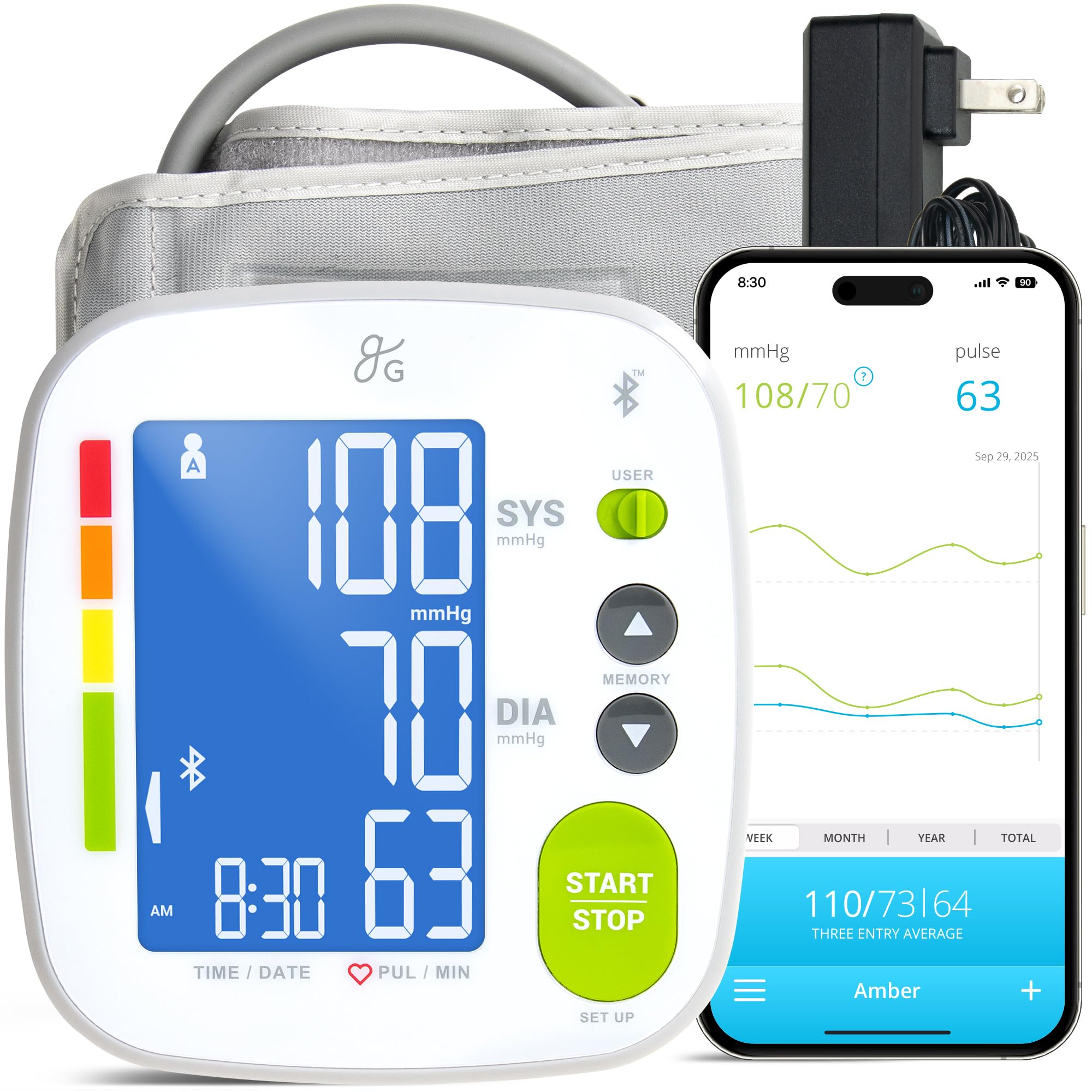
With Wirecutter-recognized accuracy and effortless app syncing, this is the top pick for anyone who wants to share unlimited readings with their doctor via the Balance Health app. One reviewer noted that “readings consistent with Omron 10 (120/68 vs 115/69),” so you can trust the numbers for daily tracking.
The large backlit display makes results visible even in a dark room. The adjustable cuff (8.7–16.5 inches) has an artery alignment guide to help you position it correctly every time. It stores 60 readings per user for up to 2 users (120 total), which covers a couple tracking their health for about a month without needing the app.
The only honest limit: the included travel case is a bit small, and some buyers report the cuff can be hard to tighten one-handed. But with both an AC adapter and four AAA batteries included, plus St. Louis-based customer support, this is the balanced pick for most households. If you want app sharing but need more memory than the 120 total, the AQESO with its 1,500 total capacity is a better fit. For most households, this is the balanced pick.
Why it’s great
- Bluetooth syncing to iOS and Android via Balance Health app
- Large backlit display for clear daytime and nighttime reading
- Includes AC adapter and batteries — ready to use out of the box
- Wirecutter recognized for accuracy and ease of use five times
Good to know
- Carrying case is snug; AC adapter can press the start button inside
- Cuff can be tricky to tighten one-handed for some users
- Bluetooth requires the app to be open during the reading to sync
2. OMRON Gold Blood Pressure Monitor BP5360
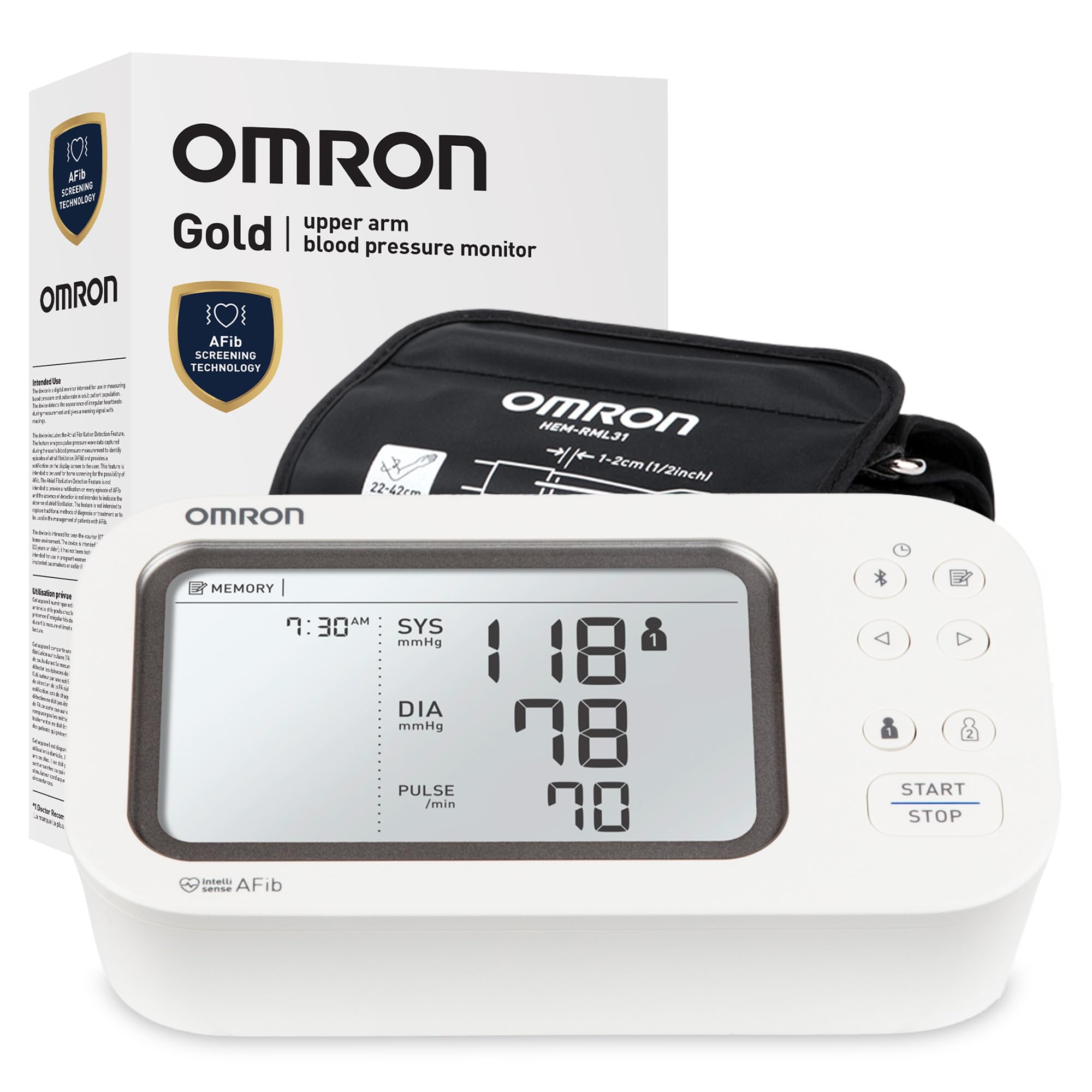
Unlike the top pick, which focuses on straightforward accuracy, the OMRON Gold BP5360 is the only monitor in this guide with Atrial Fibrillation (AFib) Detection — it screens for an irregular heartbeat during every reading. It also includes a High Morning Average Indicator that flags morning blood pressure spikes linked to higher cardiovascular risk, so you get more than just a number.
Bluetooth syncs to the free OMRON connect app, which works with Apple Health and Google Fit. The monitor supports two separate user profiles for partners sharing the device. One buyer mentioned it is “very quiet pumping,” so it won’t wake up the whole house in the morning.
The catch: if you have atrial fibrillation, this monitor will NOT display your blood pressure reading. The AFib detection algorithm blocks the result because it cannot guarantee accuracy, and users report this cannot be turned off. Another reviewer cautioned it is “inaccurate compared to doctor’s monitor” for one user. Choose this over the top pick if you want advanced screening and do not already know you have AFib.
Where it shines
- Exclusive Atrial Fibrillation detection screens for irregular heartbeat
- High Morning Average Indicator alerts you to risky morning spikes
- Bluetooth sync to OMRON connect app with trend tracking
- Wide-range D-ring cuff fits arms 9″–17″ out of the box
Worth noting
- Cannot display blood pressure reading if it detects A-fib
- Some users report readings inconsistent with doctor’s monitor
- No screen backlight, though display is still very clear
3. AQESO Blood Pressure Machine Upper Arm U80AH

If your household includes adults with very different arm sizes, this is the practical choice because it comes with three separate cuffs — small (7–9 inches), medium/large (9–17 inches), and extra large (13–21 inches). One owner reported they “love that it has three different size cuffs since one standard cuff didn’t work for our family.”
The large backlit LCD display is very easy to read in dim light, which some owners mention is “especially useful for elderly users.” It supports up to 3 users with 500 readings each, giving you roughly 16 months of twice-daily tracking before the memory fills — far more than the Greater Goods’ 120 total. A buyer confirmed it “keeps the history values even unplugged,” so you do not lose data when swapping batteries.
The downside: it has no Bluetooth or app connectivity for trend charts, and at 1.72 pounds it is the heaviest pick here. For a household with a wide range of arm sizes, though, the included cuffs make it a clear winner over the limited 8.6–11.8-inch cuff on the Medline.
What stands out
- Three adjustable cuffs included to fit arms from 7 to 21 inches
- Stores 500 readings per user for up to 3 users (1,500 total)
- Large backlit display ideal for reading in low light
- Dual power: USB-C cable or 4 AAA batteries
The trade-offs
- Device is not rechargeable; USB requires continuous power connection
- With 3 cuffs and case, it is the heaviest pick at 1.72 pounds
- No Bluetooth or app connectivity for trend charts
4. Urion U80A U83X FSA-Eligible BP Monitor
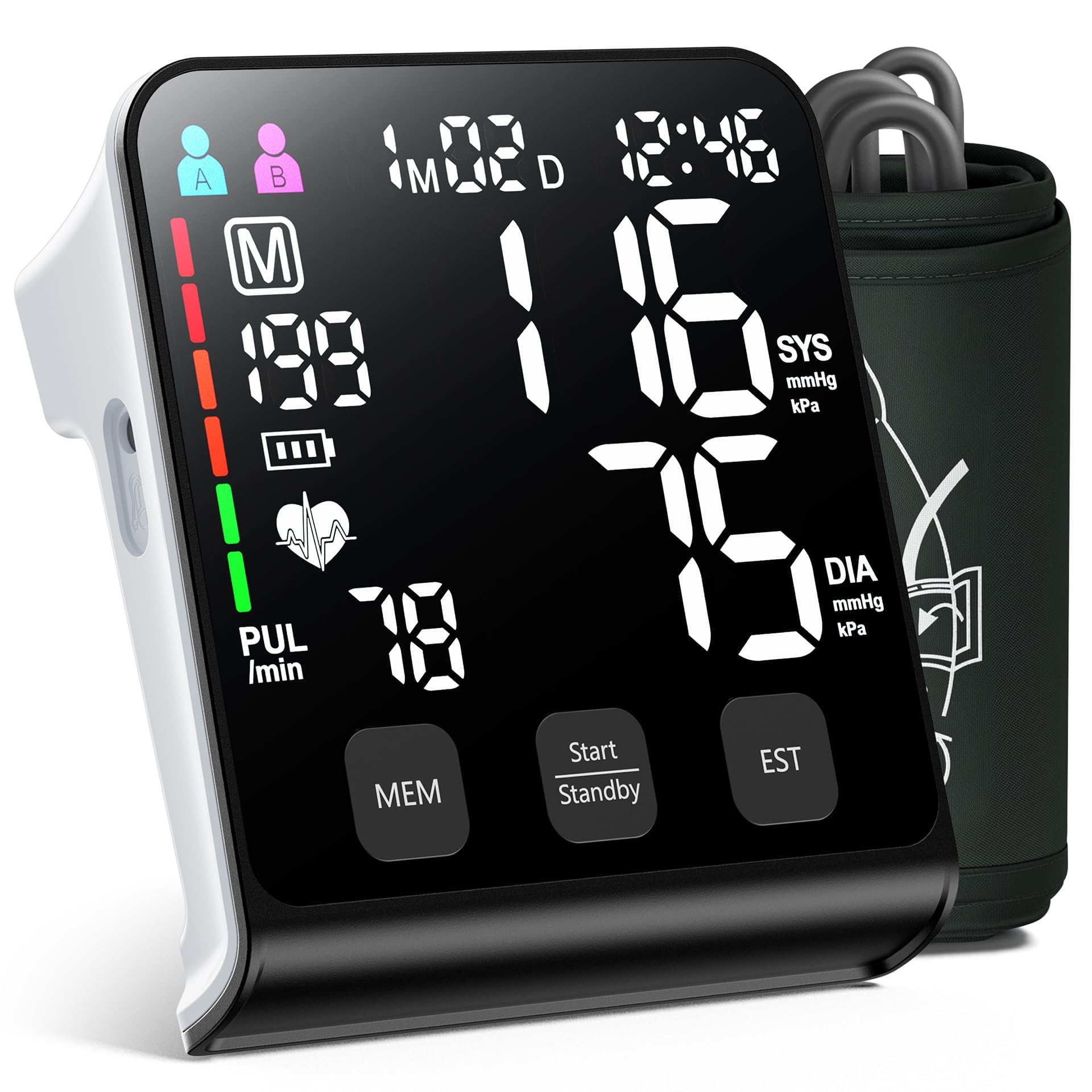
For many seniors, a screen they can read without glasses is the most important feature. The Urion delivers a 4.5-inch LED display with oversized digits that make your systolic and diastolic numbers impossible to miss. It also includes a blood pressure classification bar on the screen that color-codes your result (green for normal, yellow for elevated, red for high), so you know at a glance where you stand.
The trade-off is that this monitor does not have Bluetooth or an app. Everything is stored locally, with 199 readings per user for up to 2 users. That is enough for about three months of daily tracking per person. One-touch operation makes it as simple as pressing a single button to start a reading.
You get an intelligent pressure algorithm with ≤±3 mmHg (millimeters of mercury — the standard unit for blood pressure) error margin, heart rate irregularity alerts, a scratch-resistant acrylic panel, and both battery and USB power options. It is also FSA and HSA eligible, so you can use pre-tax health savings dollars to buy it. If you need a display this large but also want app sharing, pick the Greater Goods instead.
The upsides
- Very large 4.5-inch LED display with bold, easy-to-read digits
- Blood pressure classification bar for quick visual interpretation
- Stores 199 readings per user for 2 users
- FSA and HSA eligible for pre-tax purchase
Keep in mind
- No Bluetooth, app, or smartphone syncing
- Data must be manually recorded to share trends with your doctor
- Scratch-resistant panel is glossy and may show fingerprints
5. A&D Medical Voice-Guided BP Monitor UA-1040TBLE
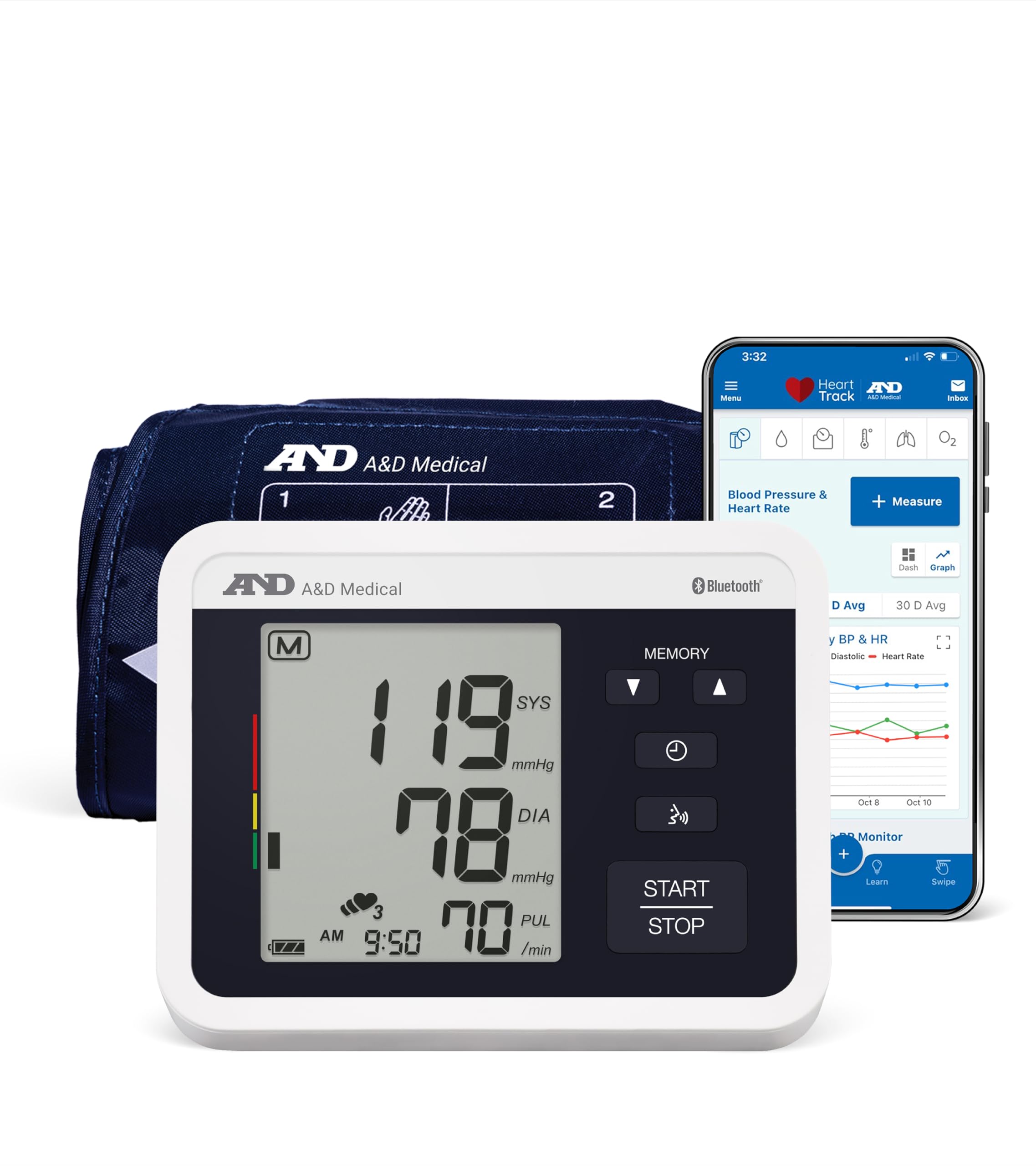
At this lower price, you get a monitor that speaks your readings out loud in English, Spanish, or French, with audible step-by-step instructions so you never have to squint at a screen. One reviewer shared it is “easy for legally blind husband: voice readings loud/clear,” making it a practical tool for independent health tracking at home.
The voice guidance pairs with Bluetooth to sync unlimited readings to the A&D Heart Track app on iOS or Android. The TriCheck function automatically takes three consecutive readings and averages them for a more reliable result. The pre-formed wide-range cuff (8.6–16.5 inches) is easier to position one-handed, and customers note it “speaks out of the box, no setup needed.”
The honest limit: it uses 4 AA batteries with no AC adapter included, so you will need to keep spares handy. But at just 11.2 ounces, it is the second-lightest monitor here, which makes it easy to pack in the included carrying case for travel. If you need voice guidance but prefer the bigger 1,500-reading memory, the AQESO offers more storage. It is perfect for the budget buyer who prioritizes spoken instructions over memory capacity.
Why we’d pick it
- Voice reads blood pressure and pulse in 3 languages — ideal for visually impaired users
- TriCheck mode takes 3 readings and shows the average for accuracy
- Bluetooth syncs to A&D Heart Track app for unlimited trend data
- Pre-formed cuff is easy to position one-handed
A few caveats
- AC adapter sold separately; runs on 4 AA batteries included
- No carrying handle on the case, just a simple zip pouch
- App requires iOS 12.0 or Android 5.0 or higher
6. Medline Digital Blood Pressure Monitor MDS4001

This Medline is perfect for the budget-conscious buyer who wants clinical-grade accuracy from a hospital-trusted brand without any smart features or apps. Reviewers confirm it is “easy to use and gives consistent readings” — no Bluetooth, just a reliable reading every time with a colored scale beside the display to help you interpret the result.
You give up smartphone connectivity and a backlit screen, but the large digital LCD is still easy to read. It stores up to 90 measurements for each of 2 users (180 total), and the cuff inflates at the push of a button with advanced error detection to flag movement or improper placement that could ruin the reading.
This is the right pick if you want a straightforward, durable monitor from a trusted healthcare manufacturer without paying for smart features. One customer observed Medline “makes great medical grade products… I had bought another off-brand one and it consistently read lower pressure,” so you are getting proven reliability. One limitation: its cuff fits only 8.6–11.8 inches, so if your arm is larger, the AQESO with its three included cuffs is a better fit.
Strong points
- Medical-grade brand trusted in hospitals and clinics
- Stores 90 readings per user for up to 2 users
- Colored scale on display for easy result interpretation
- Advanced error detection helps ensure reliable readings
Before you buy
- No backlight on the display — best used in a well-lit room
- No Bluetooth or app for data export to your doctor
- Cuff fits only 8.6″–11.8″ arms; no larger size included
7. Acenis Automatic Blood Pressure Monitor AOJ-30F
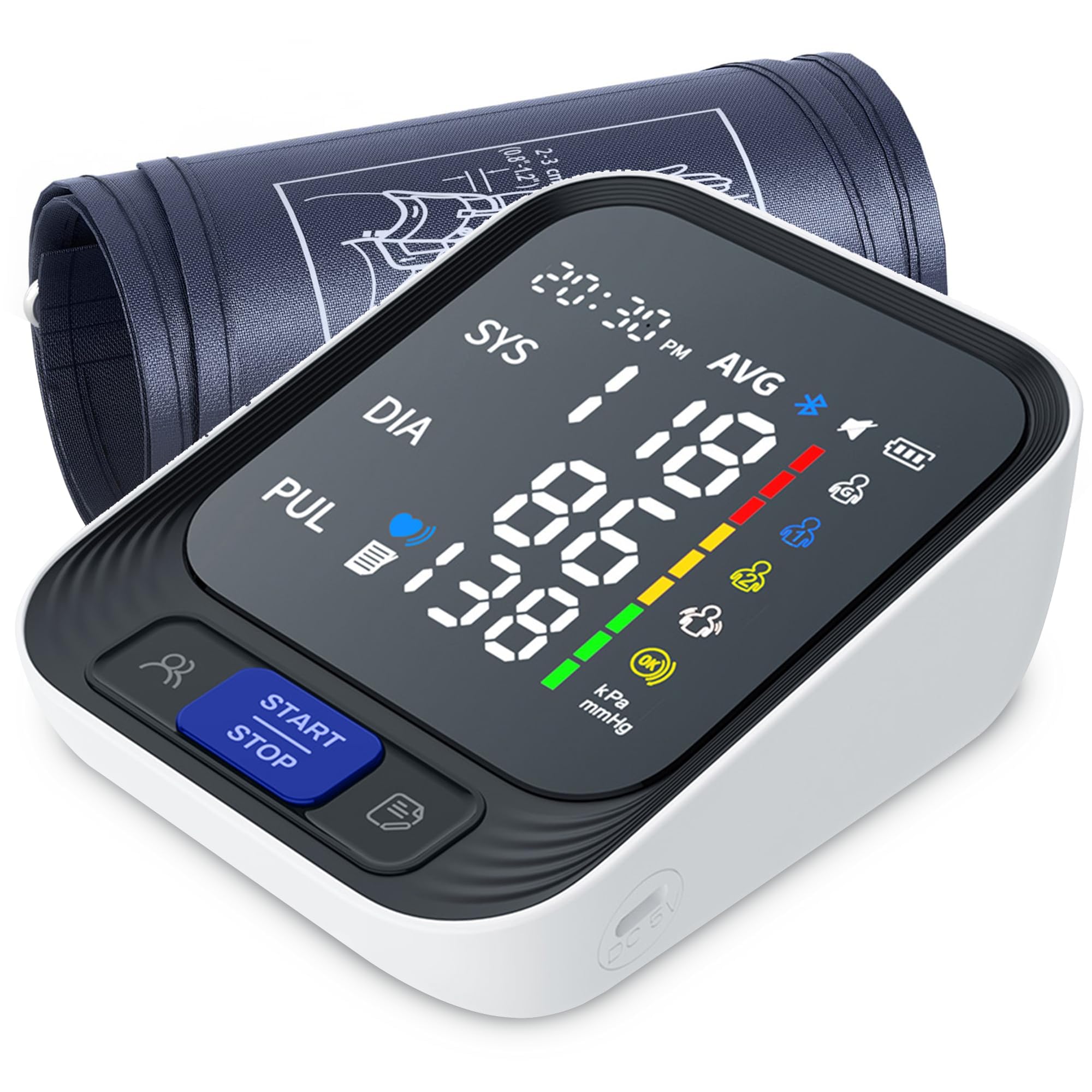
At a price that undercuts most of the field, this entry-level monitor does not feel entry-level — it has a large color screen that is clearly visible for seniors with poor eyesight and a wide adjustable cuff designed for comfort. At just 1.1 pounds, it is the lightest monitor here, 56% lighter than the multi-cuff AQESO, so it travels easily or stores in a small drawer.
You get one-touch operation that delivers results in about 40 seconds, support for up to 3 user profiles, and advanced technology that a reviewer found “more repeatable than other models when used correctly.” A buyer noted it “seems accurate” and that it “tracks 3 users, stores 2 readings” per session, which is enough for basic daily logging.
The compromise: it stores only 2 readings per user in memory, so you will need to manually record your numbers in a notebook or phone if you want to share trends with your doctor. For someone who just wants a simple, affordable monitor to keep an eye on their pressure without extra complexity, this is a clean and capable choice. If you need more memory, the Medline stores 90 readings per user.
What we like
- Large color display is easy to read without glasses
- Supports 3 separate user profiles for a family
- Lightweight at 1.1 pounds — lightweight for travel
- Includes 4 AAA batteries and has a power cord option
The downsides
- Only stores 2 readings per user in memory
- No Bluetooth or app for data sharing
- Setting the date and time is reportedly a bit fiddly
Understanding the Specs
Cuff Size and Fit
The cuff wraps around your upper arm. Its size is the single biggest factor in getting an accurate reading. A cuff that is too small squeezes too tightly and reads artificially high; one that is too large reads too low. Most home monitors include a single “standard” cuff that fits an arm circumference of about 9 to 17 inches. If your arm is smaller or larger, look for a model that includes multiple cuffs, like the AQESO with three sizes, or supports ordering alternate cuffs separately.
Memory and Multi-User Storage
Home monitors store your past readings so you can track trends without a notebook. If you are monitoring for yourself and a partner, make sure the monitor separates readings by user — most label them User A and User B. Entry-level models may store as few as 2 readings per person, while premium options can hold 500 per user. If you check your blood pressure twice daily, a 60-reading capacity gives you about one month of history; a 500-reading capacity covers about eight months.
Bluetooth and Smartphone Apps
Bluetooth-enabled monitors sync your readings to a free app on your phone, where you can view charts, calculate weekly averages, and export PDF reports to share with your doctor. The drawback: some monitors require you to have the app open during the reading for the sync to work. If you prefer a simpler, no-phone experience, a standard memory-only monitor is perfectly fine.
Clinical Accuracy and Validation
Accuracy is measured by how close the monitor’s reading is to a mercury sphygmomanometer (the gold-standard device in a doctor’s office). A good consumer monitor should have an error margin of ≤±3 mmHg for systolic and diastolic pressure. Some models add extra features like irregular heartbeat detection or AFib screening, which can alert you to potential issues between doctor visits — but these should never replace professional medical advice.
FAQ
Should I buy an upper arm monitor or a wrist monitor?
How do I know which cuff size I need?
What is AFib detection and do I need it?
How many readings does my monitor need to store?
Final Thoughts: The Verdict
When it comes down to it, the best bp machine winner is the Greater Goods Bluetooth Smart Monitor because it combines Wirecutter-recognized accuracy, easy app syncing for doctor reports, and a clear backlit display — all at a price that makes smart tracking affordable for any household. If you need a monitor that fits multiple arm sizes without buying extra cuffs, grab the AQESO U80AH with its three included cuffs and massive 1,500-reading storage. And for clinical-grade screening with AFib detection, the doctor-recommended OMRON Gold BP5360 is the pick for those who want advanced heart rhythm monitoring.
Product prices and availability are accurate as of the date/time indicated and are subject to change. Any price and availability information displayed on Amazon at the time of purchase will apply to the purchase of this product. As an Amazon Associate I earn from qualifying purchases.
CERTAIN CONTENT THAT APPEARS ON THIS SITE COMES FROM AMAZON. THIS CONTENT IS PROVIDED "AS IS" AND IS SUBJECT TO CHANGE OR REMOVAL AT ANY TIME.
Amazon and the Amazon logo are trademarks of Amazon.com, Inc. or its affiliates.