
Our readers keep the lights on and my morning glass full of iced black tea. As an Amazon Associate, I earn from qualifying purchases.
If you are reading this, you have probably already imagined your kayak flying off the roof on the highway. That fear keeps a lot of paddlers from enjoying the water as often as they should. The simple truth is that a good set of auto kayak racks turns a white-knuckle drive into a calm, confident trip — as long as you pick the right style, weight rating, and mounting system for your car.
I’m Min — the co-founder and writer behind Gadgets Feed. This guide is built by comparing the manufacturers’ published specifications and the patterns across verified customer reviews, so you get each pick’s real strengths and trade-offs instead of marketing spin.
Whether you are hauling a single recreational kayak or a full quiver of boards, the best auto kayak racks balance secure hold, easy loading, and lasting durability without making you break the bank or modify your car.
How To Choose The Best Auto Kayak Racks
Picking the right rack comes down to three things: what kind of crossbars your car has, how many kayaks you want to carry, and whether you prefer to load your boat on its side (j-style) or flat in a cradle (saddle-style). Each design has a real impact on wind noise, roof clearance, and how easily you can get the boat up there alone.
Saddle vs J-Style: Which shape fits your boat?
Saddle racks (like the BougeRV Crab or Malone SeaWing) support the kayak hull-side down, which is great for long, sit-on-top kayaks because the weight is spread evenly. J-style racks (like the TMS or FORWODE) carry the kayak on its side, reducing the width taken up on the roof — perfect for wide fishing kayaks or when you need to carry two boats side by side. J-bars generally create more wind noise; saddles are quieter on the highway.
Load capacity and crossbar compatibility
Every rack has a maximum load rating — look for at least 70 to 75 pounds per kayak for standard recreational boats. You will also need to confirm your car’s crossbar shape: round, square, oval, or aero (the flat, wide kind on modern SUVs). Some racks ship with two bolt lengths to handle different crossbar heights; others offer jaw-style clamps that grip without tools. If you have factory oval bars, the Malone Jawz and Thule universal mounts are the most reliable matches.
Tie-downs, locks, and extras that matter
Do not assume the straps included with a budget rack are highway-safe. Buyers consistently report that cheaper nylon cam straps stretch under load; upgrading to ratchet-style tie-downs (often sold separately for around) is the single cheapest way to prevent a catastrophe. Integrated bow-and-stern lines (to anchor the front and back of the kayak to your car’s bumpers) are a legal requirement in many states and a smart safety practice regardless. Fold-flat designs are a huge plus if you store your car in a garage with limited height.
Quick Comparison
On smaller screens, swipe sideways to see the full table.
| Model | Category | Best For | Key Spec | Amazon |
|---|---|---|---|---|
| FORWODE Premium | J-Style | Two heavy kayaks on a budget | 160-lb capacity | 12.95 kg | Amazon |
| ARTIPOLY Multifunction | J-Style | Versatile carry plus paddle holder | 165-lb capacity | 5 kg | Amazon |
| BougeRV Saddle Kit | Saddle | Sit-on-top kayaks on most crossbars | 150-lb capacity | 3.5 kg | Amazon |
| TMS Dual J-Bars | J-Style | Budget-friendly two-kayak carry | 160-lb capacity | 16 lb | Amazon |
| XGeek 4-in-1 | Foldable J | One kayak plus boards/skis | 158-lb capacity | 6.73 kg | Amazon |
| Malone SeaWing | Saddle | Quiet, low-profile single kayak haul | 70-lb capacity | 11.6 lb | Amazon |
| Malone Downloader | Folding J | Easy loading with built-in ramp | 75-lb capacity | 10 lb | Amazon |
| Thule HullaPort Pro | Foldable J | Premium two-kayak security and fit | 75-lb capacity | 6.03 kg | Amazon |
| Yakima SupDawg | Saddle/Flat | Large SUPs and wide boards | 66-lb capacity | 14 lb | Amazon |
In‑Depth Reviews
1. FORWODE Premium Kayak Roof Rack

160-pound total capacity (the highest among j-bar options in this guide) makes this the top pick for anyone who regularly hauls two full-size sit-on-top fishing kayaks and wants the most complete accessory bundle out of the box.
Buyers report a 10-minute install out of the box, and the folding arms drop to 180 degrees so you can still park in a low garage without removing the rack. The package throws in four ratchet belts, four 10-foot S-hook pulleys, four anchor belts, and a padded paddle holder — the most complete accessory bundle in this roundup. One reviewer drove 1,000 miles and noted the kayak “barely moves at highway speeds,” which is exactly the peace of mind you are paying for.
At 12.95 kilograms (28.5 pounds), the steel construction means you feel the weight when carrying it to the roof, but that heft is what makes it stable. The arms rely on carbon steel adjustment knobs (not plastic like some cheaper racks), and owners mention that the included foam is a full 1 cm thick to avoid scratching your hull. For two full-size kayaks, this rack earns its place as the top all-rounder.
Why it’s great
- 160-lb load capacity (highest among j-bar options here)
- Fold-flat design for garage storage
- Includes paddle holder, 4 ratchet straps, and 4 anchor belts
Good to know
- Heavy at 12.95 kg; not the easiest to lift on and off
- Oar holders can wobble at highway speeds per some reviews
- Lacks foam spacers for certain crossbar shapes
2. ARTIPOLY Kayak Roof Rack for 2 Kayaks

The ARTIPOLY edges out the FORWODE on raw capacity by 5 pounds (165 lb vs 160 lb) and beats it on weight — at 5 kilograms it is less than half the FORWODE’s mass — but it achieves that lightness with aviation-grade aluminum instead of carbon steel, which means you trade some brute strength for easier daily handling. For a single driver who loads and unloads alone, the lighter build makes a real difference when you are lifting the rack onto a high SUV roof.
Buyers confirm it fits a 9-foot-9 kayak securely on a RAV4 in under 10 minutes, and the 180-degree adjustable arms let you position the j-bar at any angle for different hull shapes. The horizontal stabilizer bar is a clever addition: it spans between the two cradles to stop the kayak from rocking side to side, which is a common weak point in cheaper two-piece j-bar sets. Reviewers also praise the paddle holder slots, which keep your gear organized without cluttering the cabin.
The rubber pedal protectors and ultra-high-density foam are noticeably thicker than the TMS rack’s padding, so your kayak’s gel coat stays free of dings even on long, bumpy drives. One thing to know: the included tie-down straps have drawn some complaints about ease of latching. Many owners swap them for separate ratchet straps, but the rack itself is sturdy enough that the swap is a minor upgrade, not a fix for a flaw. If you value a lightweight, two-boat j-bar system that also works for a canoe or surfboard, this is the one to grab.
Where it shines
- 165-lb capacity in a light 5-kg aluminum frame
- Horizontal stabilizer bar reduces side-to-side movement
- Built-in paddle holder saves interior space
Worth noting
- Included straps can be fussy to latch
- Instructions are lacking detail on tie-down methods
- Paddle holder straps are tight and hard to operate
3. BougeRV Kayak Roof Rack Saddles

If you own a fishing or sit-on-top kayak with a curved, flat bottom that tends to deform when strapped down on basic crossbars, the BougeRV saddle-style rack uses a unique “Crab” shaped clamp and four independent rubber pads to cradle the hull evenly — it spans a massive 47.24 inches across your roof bars, which is 2.7 times the length of the TMS j-bar package (17.5 inches) and provides far more contact area.
The rubber pads are thick enough to prevent scratches, and the strap routing clips underneath the crossbars to minimize strap flutter at speed. Customers note that after spending about 40 minutes fine-tuning the swivel points for level seating, the rack holds even slick plastic hulls securely — one reviewer noted it “prevents deformation of curved bottoms from flat crossbar pads,” which is a real pain point for owners of rotomolded kayaks. The kit comes with two ratchet straps, two tie-down straps, and an Allen key for the clamp bolts.
The one catch: the BougeRV will not mount to rounded crossbars at all. You need square, oval, or aero bars. Also, buyers emphasize that you must use a bow-and-stern rope in addition to the included straps; one driver who skipped the rope found themselves lucky the kayak did not fly off on the freeway. At 3.5 kilograms (7.7 pounds), it is also the lightest full saddle kit in this comparison, which matters when you are wrestling it into position on a tall SUV.
What stands out
- 47.24-inch saddle span distributes weight over your whole roof
- Lightweight at 3.5 kg for easy handling
- Rubber pads protect hulls from scratches and pressure points
The trade-offs
- Not compatible with rounded crossbars
- Requires 40+ minutes of adjustment and separate bow/stern ropes
- Kit includes only basic straps; upgrade recommended
4. TMS Kayak Roof Racks for 2 Kayaks

160 pounds total capacity — that is the single number that matters most in this category, and the TMS Kayak Roof Racks for 2 Kayaks scores a solid “adequate” for two standard sit-on-tops at roughly half the cost of the FORWODE, with buyers consistently saying it feels “sturdy with zero play” once assembled. The steel frame has a powder-coated, rust-resistant finish that holds up to coastal salt air, and the j-bar design leaves roof space open so you can still access a roof box if you have one.
The catch you accept at this price point is in the included straps. Nearly every verified review mentions that the cam straps stretch too easily — one driver swapped them out for ratchet straps before their first highway trip, and another noted that the hand knobs came loose on a trailer and needed a drop of Loctite to stay tight. Assembly takes about an hour the first time, and a reviewer who mounted them on a 2003 Blazer confirmed the instructions are picture-based and clear. At just over 16 pounds total, the steel is solid but not overly heavy to manage.
This is a no-frills, get-it-done option. You save money upfront, but you should budget extra for replacement ratchet straps and a tube of Loctite if you plan to mount them on a trailer. For someone who only drives to the local lake a few times a season and wants the lowest entry price for two kayaks, the TMS set works — just do not skip the strap upgrade, making the price-to-value read: low upfront cost but requiring a small additional investment to reach full reliability.
The upsides
- Rock-bottom price for a two-kayak j-bar system
- Powder-coated steel resists rust and corrosion
- Easy picture-based assembly instructions
Keep in mind
- Included cam straps stretch and are unreliable
- Hardware packaged in a frustrating, fiddly way
- Padding may need replacement after a season of use
5. XGeek Kayak Roof Rack 4-in-1
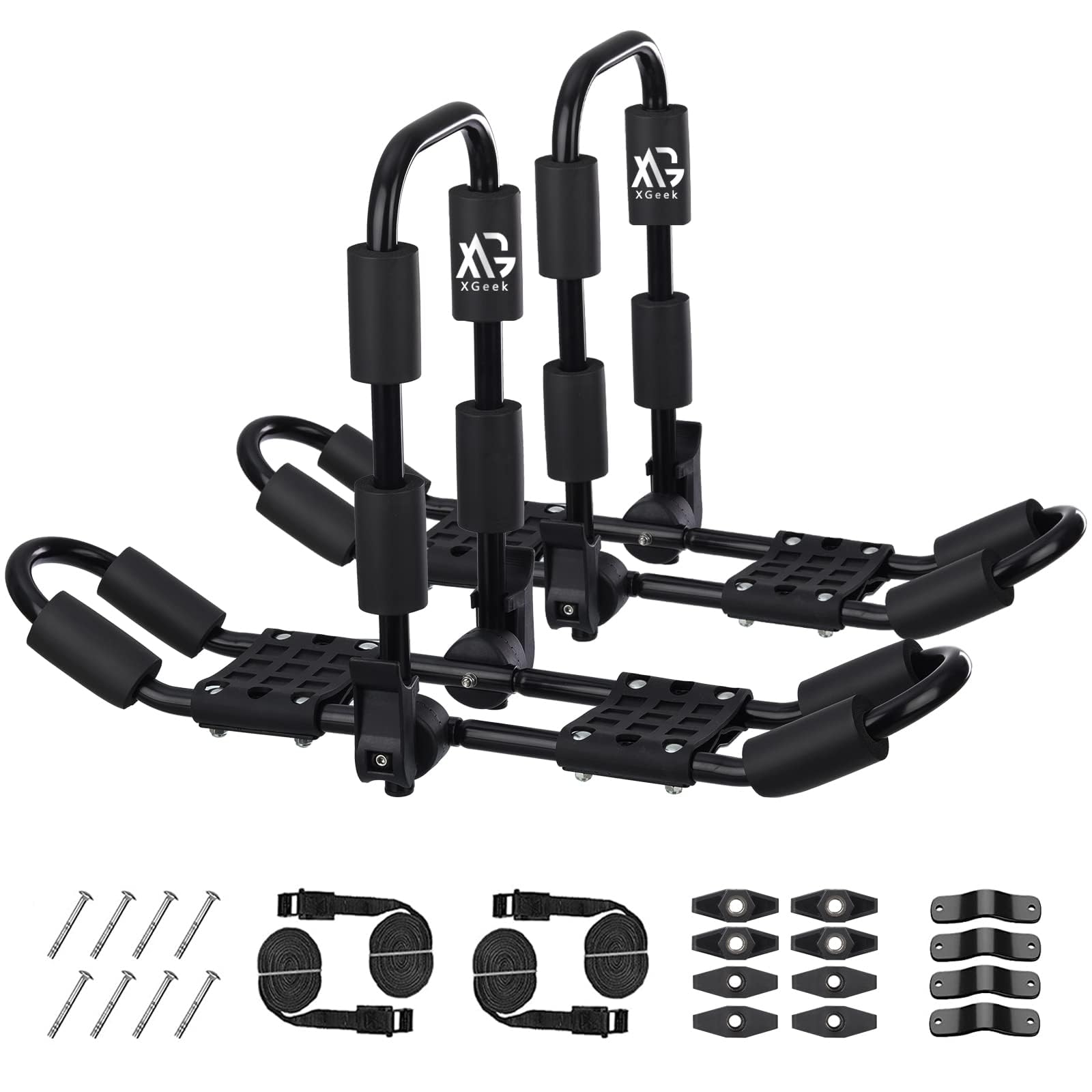
At this price, you get a 4-in-1 folding j-bar rack that handles not just a kayak but also a surfboard, canoe, or skis — all in one kit that weighs 6.73 kilograms and folds flat for storage.
The aluminum alloy frame has a 2.2mm wall thickness that is lightweight but still tough enough for a 158-pound load — enough for a single large kayak plus some extra gear on top. Reviewers point out the rack holds a 15-foot kayak steadily, and one noted it “held kayaks safely for 10 highway miles after straps slipped,” which underscores that the rack structure itself is solid but the strap system needs your attention. The tool-free quick-fold mechanism lets you change the angle to fit different boat shapes, and the kit includes longer 75mm screws and shorter 65mm screws to prevent scratching your roof depending on your crossbar thickness.
The standout spec here is the fold-down feature: one reviewer praised being able to lower the arms when not in use, reducing wind noise on days you are just commuting. Minor assembly gripes exist — some units require a bit of manual bending to get the tubes to slide together, and the plastic strap guides can arrive cracked. Overall, if you want a single rack that covers kayaks, surfboards, and skis while staying affordable, the XGeek is the most versatile pick in this price bracket — making it perfect for the multi-sport budget buyer who owns different types of gear and does not want to buy separate racks for each season.
Why we’d pick it
- 4-in-1 design works for kayaks, surfboards, skis, and canoes
- Folding arms reduce wind noise when not in use
- 2.2mm aluminum alloy is lightweight yet durable
A few caveats
- Plastic strap guides are fragile; can break in shipping
- Some units need manual bending to align the tubes
- Only 2 bolts per bracket may feel undersized for heavy loads
6. Malone SeaWing Saddle Style Kayak Carrier
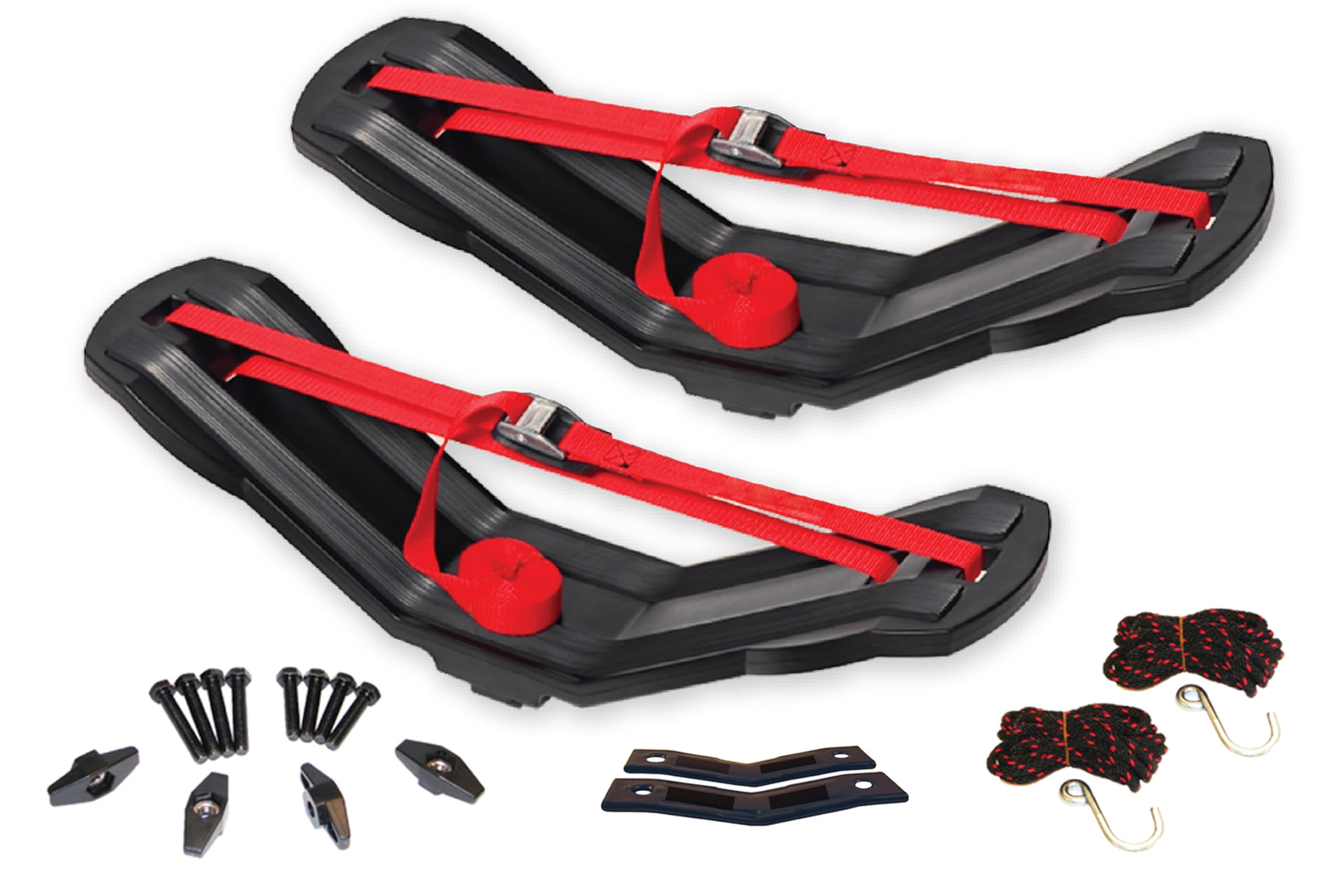
The Malone SeaWing is perfect for the highway-focused paddler who wants a single recreational kayak (sit-on-top or sit-inside) carried in a saddle-style rack that stays silent on long trips — buyers consistently report zero noise or movement even on 600-mile journeys. With a 70-pound capacity and a no-tool Jawz mounting system that fits round, square, and most factory oval crossbars out of the box, it requires no adapters.
The design is deliberately low-profile: the saddle sits just 6 inches high on your roof to avoid the aerodynamic penalty of a j-bar. The kit includes two bolt lengths (60mm and 70mm) to match different crossbar heights, and the rubber padding protects both hull and roof bars. Reviewers praise how easily a kayak slides onto the cradles — one called it “effortless” compared to j-bars — and the rack has held up through several touchless car washes without loosening.
The honest limit is that the included bow-and-stern tie-downs are not highway-ready; nearly every owner recommends upgrading to ratchet straps for real security. Also, at 11.6 pounds and with no folding mechanism, it stays permanently on your roof unless you unbolt it. If your priority is a simple, whisper-quiet, single-boat saddle that takes 5 minutes to install, the SeaWing is your best bet in the saddle category — just be aware that its stock tie-downs are the one weakness that needs addressing for highway use.
Strong points
- No-tool universal Jawz mount fits nearly any crossbar
- V-cradle design is silent and stable at highway speeds
- Low profile (6 inches) reduces wind drag
Before you buy
- Included tie-downs are weak; replace with ratchet straps
- 70-lb capacity limits it to one standard recreational kayak
- No quick-release or folding feature for storage
7. Malone Downloader Folding J-Style Carrier

The Malone Downloader is the only rack here with a built-in loading ramp — a curved extension at the bottom of the j-bar that lets you slide the kayak up rather than lift it straight, which is a lifesaver if you are loading a heavy 75-pound boat alone. At a mid-premium price, it lands between the budget TMS set and the premium Thule, offering genuine engineering value for solo paddlers who struggle to muscle a kayak onto their roof.
The steel frame is noticeably heavier and more solid than the TMS — one reviewer with 10 years of kayak rack experience called it “much better than competition” from Thule and Yakima, citing the thick padding, nylon sleeve over the padding, and heavy steel strap attachment. The folding mechanism lets the j-cradle drop flat when not in use (so you can park in a garage), and the Jawz mounting hardware comes with both 60mm and 70mm bolts to fit round, square, and most factory oval bars. Assembly takes about 10 minutes, and shoppers say the rack holds a kayak securely at 40-45 mph without shifting.
The downside? The folding pivot is plastic, and while it feels secure when properly tightened, it is the one component that could fail if over-tightened or exposed to extreme road salt. Also, owners of aero or oval crossbars note that the bracket has a square slot that may not curve perfectly with certain factory rails — one 3D-printed a small adapter to fix the fit on a Subaru WRX. If you load solo or have a heavy boat, the built-in ramp makes the Downloader worth the upgrade over a basic j-bar.
What we like
- Integrated loading ramp makes solo lifting much easier
- Heavy-duty steel construction with thick padding
- Folds flat for garage clearance when not in use
The downsides
- Plastic pivot point is the weakest link in an otherwise steel rack
- Square bracket may not contour perfectly to aero/oval bars
- Loading height requires a step stool for shorter users
8. Thule HullaPort Pro Rooftop Kayak Carrier

Dual-position j-cradle to two-boat stacker: the Thule HullaPort Pro is for owners of smaller cars with limited roof real estate who need to carry two kayaks on one side without a second mounting base.
Fully assembled out of the box, the HullaPort Pro mounts to any load bar style (round, square, oval, aero) using Thule’s universal strap system, and it folds flat with a spring-loaded release that locks in both the up and down positions. Buyers on a Jeep Renegade said their kayaks felt “secure” at highway speeds, and one noted the fold-down mechanism is reachable even at 5-foot-8. The kit includes two load straps with buckle bumpers to protect your kayak’s finish, plus bow-and-stern tie-downs for one boat. The folding racks also lock to your roof bars with Thule’s One Key System locks (cylinders sold separately), which is a nice theft deterrent if you park on the street.
The honest read from the community: this is excellent gear, but you are paying a premium for the brand and the fold-flat convenience. One reviewer who replaced a Thule Stacker said the HullaPort Pro is “worth the extra cost for peace of mind,” but another pointed out the fold-down feature is the only real difference from a cheaper SportRack version. If you plan to carry two kayaks on a compact car and want guaranteed compatibility and a lifetime warranty, the Thule is the safe bet — but you could get similar functionality from the FORWODE for less money if you do not need the dual-stacker feature. Verdict: the Thule HullaPort Pro is the smart space-saving pick for compact-car owners who need two kayaks on one side.
Why it’s great
- Dual-position design carries two kayaks on one base
- Folds flat with spring-loaded lock; fits in garage
- Thule’s limited lifetime warranty and universal fit
Good to know
- Premium price does not include lock cylinders (sold separately)
- Some buyers report it is overpriced vs. comparable models
- Wind noise can increase at highway speeds
9. Yakima SupDawg Roof Mount SUP/Kayak Rack
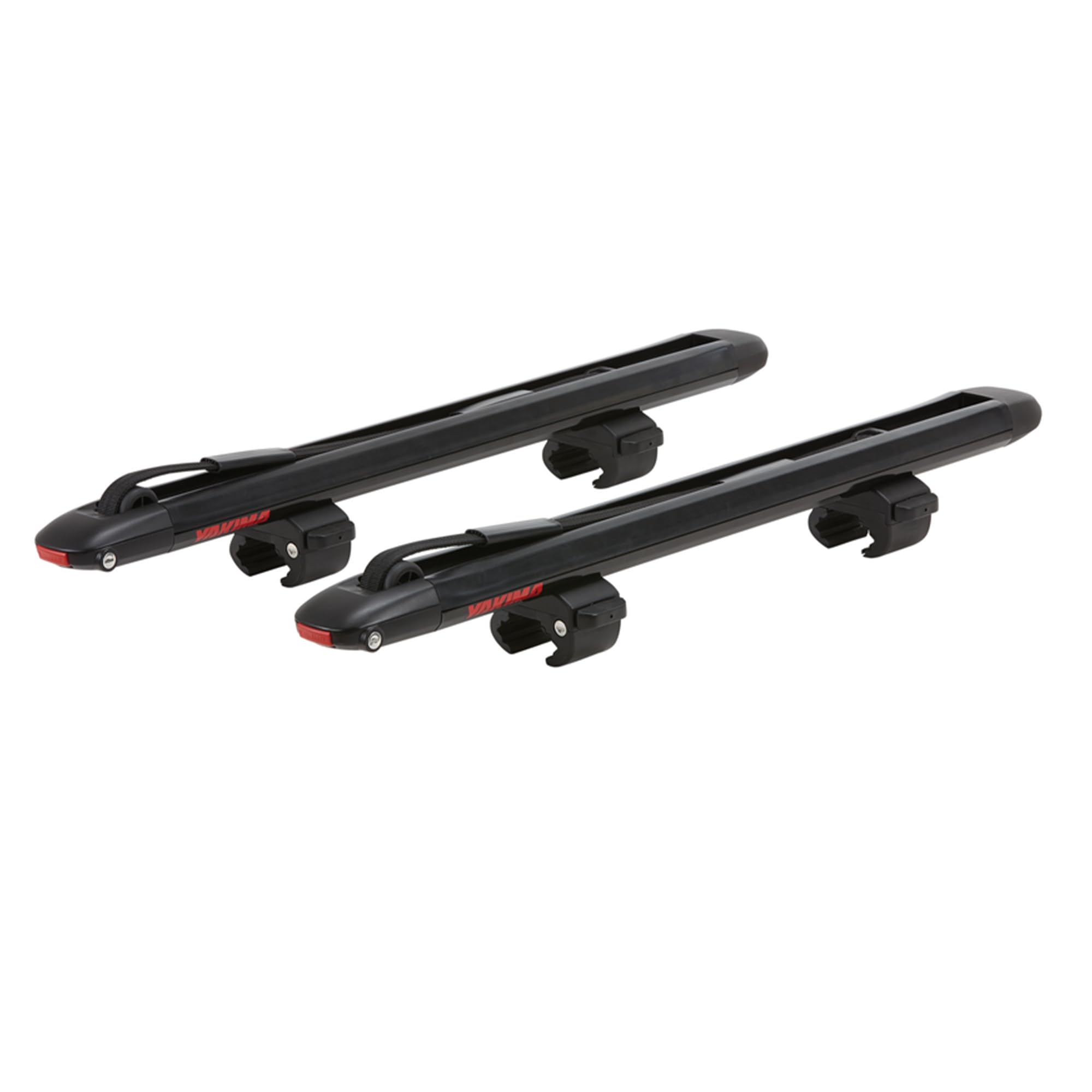
The Yakima SupDawg sits at the top of the price mountain, and its defining spec is the integrated roller bar — a set of small wheels embedded in the cradle that let you roll a 30-pound SUP board up onto the roof rather than lifting it straight. That is a standout for solo owners of large stand-up paddleboards or wide fishing kayaks, and no other rack on this list offers a roller system. It is fully assembled out of the box, installs tool-free on round, factory, aero, and square bars, and holds two boards up to 36 inches wide.
Owners mention that the roller system makes loading “relatively easy” even for 11-foot-plus boards, and the SKS locks secure both the rack and your gear against theft. The included bow-and-stern tie-downs are the most robust in this roundup, and the integrated strap management keeps loose ends tidy at highway speeds. One reviewer drove 16 hours at 80-85 mph and reported the board “remained secure” the entire trip — the kind of confidence you expect at this price. The glossy black aluminum finish also looks premium on modern crossbars.
The trade-off is the 66-pound capacity per set (it states “30 kg” in the specs), which is lower than every other rack here — unsuitable for heavy tandem kayaks or rotomolded fishing boats. Also, wind noise at highway speeds is higher than the Malone SeaWing saddle, and the price is roughly double that of the FORWODE. If you own a lightweight SUP or a slender recreational kayak and you load alone, the rollers are a genuine convenience upgrade. For heavier boats, the FORWODE or ARTIPOLY is a more practical value.
Where it shines
- Integrated roller bar eliminates heavy lifting for SUP boards
- Tool-free installation on all common crossbar shapes
- SKS locks secure both the rack and your gear to your roof
Worth noting
- 66-lb capacity is the lowest here; not for heavy kayaks
- High wind noise reported at highway speeds
- Price is significantly higher than comparable j-bar racks
Understanding the Specs
Load Capacity
The maximum weight a single rack can safely carry, measured in pounds (lb). Most quality auto kayak racks range from 70 to 165 lb per set. A 70-lb rack is fine for a standard recreational kayak (10-12 feet, under 50 lb). A 160-lb rack can comfortably handle two fishing kayaks or a heavy tandem boat. Do not exceed the rating — your kayak could shift or the rack could fail at speed. Always factor in the kayak’s weight plus any gear strapped to it.
Mounting System
This describes how the rack attaches to your crossbars. Jawz-style clamps (from Malone) wrap around the bar and tighten with a single knob — no tools needed — and fit round, square, oval, and most factory aero bars. C-clamp systems (like on the BougeRV) bolt onto the crossbar and require an Allen key. Always check your crossbar shape before buying: some racks explicitly reject rounded bars, and some square brackets do not contour well to aero profiles.
J-Style vs Saddle
The two main cradle shapes. J-style racks carry the kayak on its side, which uses less roof width and makes it possible to stack two boats on the same bar. Saddle racks support the kayak hull-side down with a padded V- or U-shaped cradle, which spreads the weight evenly and creates less wind noise. Saddles are better for long, flat-bottomed kayaks (fishing, sit-on-top) where you do not want the hull to deform. J-bars are better for storage efficiency and two-boat setups.
Bow & Stern Tie-Downs
Separate straps that anchor the front and back of the kayak to your car’s bumpers or tow hooks. They prevent the kayak from pitching forward or backward during hard braking or strong crosswinds. Many states legally require them when transporting a kayak on a roof rack. Almost every rack includes basic tie-downs, but buyers consistently say the included ones are too weak — plan to upgrade to ratchet-style straps (about for a set of two) for real highway confidence.
FAQ
Can I use saddle racks for sit-on-top kayaks?
What is the difference between a 75-lb and a 160-lb kayak rack?
How do I know if a roof rack fits my car’s crossbars?
Are ratchet straps really necessary if the rack comes with straps?
Final Thoughts: The Verdict
For most people, the auto kayak racks winner is the FORWODE Premium because it combines the highest load capacity (160 lb) with a steel frame, fold-flat storage, and the most complete accessory kit of any rack here — all at a mid-range price that undercuts premium brands with better specs. If you carry a single lighter kayak and want a whisper-quiet saddle that installs in 5 minutes, grab the Malone SeaWing. And for the solo paddler who wrestles a heavy board onto the roof alone, the Malone Downloader with its built-in loading ramp is the smartest upgrade you can make.