
Our readers keep the lights on and my morning glass full of iced black tea. As an Amazon Associate, I earn from qualifying purchases.
Buying your first 35mm film camera is exciting — until you are staring at a wall of vintage SLRs, point-and-shoots, and complex jargon, with no clear idea which one will actually take great photos without frustration. The wrong pick can mean blurry shots, a broken light meter (the sensor that tells you if your photo will be too dark or too bright), or a camera that sits on a shelf because it is too fiddly to use every day. You need a camera that lets you focus on making images, not fighting the hardware.
I’m Min — the co-founder and writer behind Gadgets Feed. This guide is built by comparing the manufacturers’ published specifications and the patterns across verified customer reviews, so you get each pick’s real strengths and trade-offs instead of marketing spin.
The entry-level film world splits into two camps: fully automatic point-and-shoot models that do the thinking for you, and classic SLRs (Single-Lens Reflex cameras that let you swap lenses and see exactly what the lens sees through the viewfinder) that give you total creative control. Both paths are valid, and the right one depends on how much you want to learn versus how little you want to fuss. I have matched every camera to the beginner who will love it most, and that is why this guide to the 35mm film camera for beginners is built around real-world usability, not vintage status.
How To Choose The Best 35mm Film Camera For Beginners
The biggest mistake new film shooters make is buying a “vintage classic” that looks great on a shelf but has a dead light meter or requires you to guess exposure with no help. For a beginner, the most important feature is a working, accurate light meter (the sensor that tells you if your photo will be too dark or too bright) — without it, almost every roll will come back underexposed or overexposed until you have learned Sunny 16 by heart. Once you confirm the meter works, the real choice is between automation and control.
Point-and-Shoot vs. SLR: Which learning curve is right for you?
A point-and-shoot like the Kodak Snapic A1 handles focusing, flash, and film winding for you, so you can focus purely on composition. It is the closest thing to a disposable camera that you can reload, and it is ideal if you want zero learning curve. An SLR (Single-Lens Reflex) like the Canon Rebel 2000 or the Pentax K1000 lets you swap lenses, control shutter speed and aperture (the opening that lets in light), and see exactly what the lens sees through the viewfinder. The catch: SLRs require learning exposure basics, but they also give you room to grow for years without needing a new camera.
ISO range and why it matters for film
ISO measures how sensitive the film is to light. A camera that can handle a wide ISO range — say 100 to 3200 — can work with slow, fine-grain films for bright days and fast, grainy films for indoor or evening shooting. The Canon New EOS Kiss (Rebel G) covers 100-3200, meaning you can load ISO 800 film for a birthday party and then switch to ISO 100 for a sunny walk without the camera fighting you. Cameras with a narrow range (like the Canon Rebel 2000 at 100-400) force you to stick to bright conditions or use flash more often.
Condition is everything: Why “renewed” matters for film cameras
Film cameras from the 1980s and 1990s are mechanical devices with foam seals that degrade, lubricants that harden, and electronics that fail. A properly renewed camera has been cleaned, tested, and had its light seals replaced. The Canon AE-1 Program and the Canon AE-1 are both sold as “Renewed” by Amazon, and buyers report they arrive “in like-new condition” or as a “beautiful collectors piece.” A non-renewed vintage camera from a garage sale might cost less but has a high chance of a dead meter or a scratched mirror.
Quick Comparison
On smaller screens, swipe sideways to see the full table.
| Model | Category | Best For | Key Spec | Amazon |
|---|---|---|---|---|
| Canon New EOS Kiss | SLR | Best overall beginner SLR with autofocus | ISO range 100-3200 | Amazon |
| Canon Rebel 2000 | SLR | Budget-friendly SLR with modern autofocus | 7-point autofocus system | Amazon |
| Canon AE-1 Program | SLR | Vintage feel with a full auto mode | Weight 735 grams | Amazon |
| Vintage Canon AE-1 | SLR | Iconic classic with shutter-priority auto | ISO range 12-3200 | Amazon |
| KODAK Snapic A1 | Point-and-Shoot | Zero-learning-curve point-and-shoot | Weight 117 grams | Amazon |
| Pentax K1000 | SLR | Fully mechanical, battery-free learning tool | 50mm f/2 prime lens | Amazon |
In‑Depth Reviews
1. Canon New EOS Kiss (Rebel G)

The Canon New EOS Kiss (Rebel G) wins the top spot with an ISO range of 100-3200 — 8 times wider than the Canon Rebel 2000’s 100-400 — and is for a beginner who wants to learn aperture and shutter priority modes without struggling with manual focus or limited film compatibility.
Out of the box, it comes with a 35-80mm EF zoom lens, so you can shoot wide landscapes and closer portraits without swapping glass. The built-in flash pops up when you need fill light, and the camera loads, advances, and rewinds film automatically. One reviewer noted the camera arrived “in excellent condition for 30+ years old” with just a minor bruise, and their first roll produced beautiful photos — consistent praise across the reviews for reliability.
Its ISO range handles low-light film much better than the Canon Rebel 2000 (100-3200 versus 100-400), meaning you use flash far less often in dim rooms. The only honest limit is that it is a plastic body, so it does not have the tank-like metal feel of a Pentax K1000 — but that also keeps it lighter to carry. This is the one camera that grows with you from full auto to fully manual without ever feeling like a compromise.
Why it’s great
- Wide ISO range (100-3200) handles any film type
- Autofocus is fast and accurate for beginners
- Comes with a versatile 35-80mm zoom lens
Good to know
- Plastic body lacks the heft of all-metal vintage cameras
- Some units may have minor cosmetic wear from age
2. Canon Rebel 2000
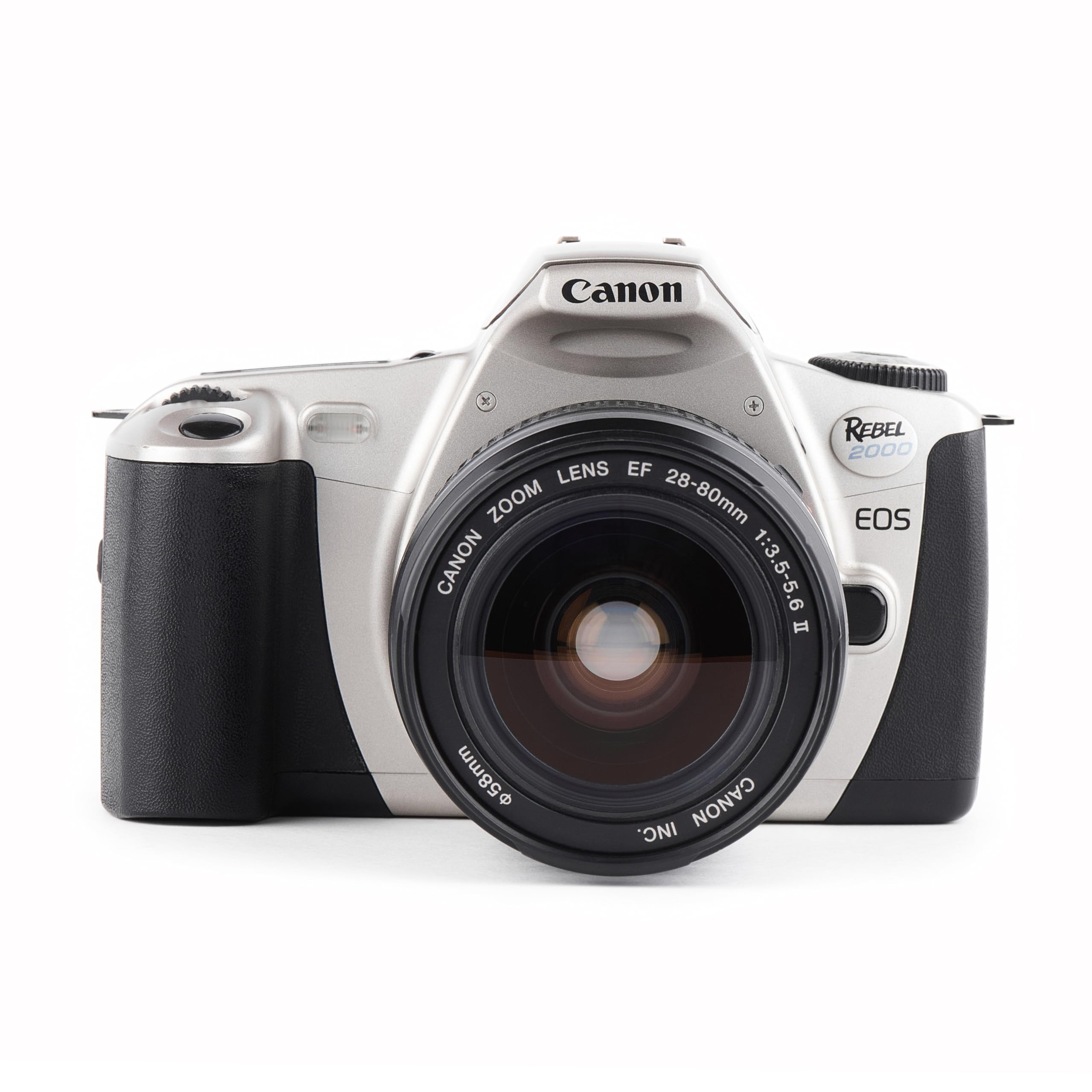
The Canon Rebel 2000 is the budget-friendly SLR in this list, but it beats the top pick on one front: its 7-point autofocus system is genuinely quick, even in dimmer light, so you spend less time hunting for focus and more time shooting. Where it falls short of the New EOS Kiss is its narrower ISO range of 100-400, which means you will rely on its built-in flash more often indoors or at dusk if you are shooting standard film.
This camera is a lightweight, modern-feeling SLR that automatically loads, advances, and rewinds film — no manual winding lever to mess with. It ships with a 28-80mm EF zoom lens, giving you a slightly wider angle than the Kiss’s 35-80mm. Owners mention it is a “really nice light weight film camera” and one buyer mentioned they buy three-packs of film from Walmart, which gives you a real-world sense of the ongoing cost of film shooting.
One review described it as the buyer’s “favorite Amazon purchase ever,” and the camera has strong reviews from college photography students who needed a reliable film body. Pick this over the top pick if your budget is tighter and you plan to shoot mostly in well-lit conditions where the narrower ISO range is not a limitation.
Where it shines
- Fast 7-point autofocus system
- Comes with a 28-80mm zoom lens
- Fully automatic film loading and rewinding
Worth noting
- Narrow ISO range (100-400) limits low-light performance
- Some units may arrive with missing accessories
3. Canon AE-1 Program

If you want the vintage SLR experience — the solid metal feel, the satisfying click of a mechanical shutter, the look of a classic black camera around your neck — the Canon AE-1 Program is the one that also gives you a modern safety net. Its “Program” mode is a fully automatic exposure mode where the camera picks both the shutter speed and aperture for you, so you can shoot like a point-and-shoot while still having full manual control when you want to learn.
This renewed kit includes the camera body, a 50mm f/1.8 lens (a fast prime lens that lets in plenty of light for low-light shots), and a power winder (a battery-powered grip that advances film automatically so you do not have to manually wind after every shot). At 735 grams, it is 6.3 times heavier than the Kodak Snapic A1 — you will feel it on a long walk, but customers note it is a “beautiful collectors piece” and many call the condition “flawless.”
Two real caveats: the AE-1 Program uses manual focus, so you need to turn the lens ring yourself, and it relies on two LR44 batteries to power the light meter and Program mode. If those batteries die, the camera defaults to a single manual shutter speed of 1/60th of a second. This is the camera for the beginner who wants to learn photography with a legendary tool that still offers a helping hand in auto mode.
What stands out
- Program mode offers full auto or full manual control
- Includes a fast 50mm f/1.8 lens and power winder
- Metal body feels durable and high-quality
The trade-offs
- Manual focus only — no autofocus
- Requires batteries for metering and auto modes
4. Vintage Canon AE-1

The single number that matters most in a vintage SLR is its ISO range — and the Canon AE-1 covers an extraordinary ISO range of 12-3200, a massive 8.3 times wider than the Canon New EOS Kiss at 100-3200, which means you can load extremely slow film like ISO 12 for long exposures in bright daylight or push to ISO 3200 for indoor handheld shots without flash. This flexibility makes it the most adaptable vintage camera on the list.
The downside you accept for that flexibility is that this is a manual-focus camera with shutter-priority auto mode (you set the shutter speed, the camera picks the aperture). If you want fully automatic “set it and forget it” shooting, the AE-1 Program or the Kodak Snapic A1 serve you better. But the original AE-1 has a Through-The-Lens (TTL) light meter (a meter that reads light exactly through the lens so your exposure is accurate no matter what filter or lens you attach), and one owner reported the camera “arrived in perfect, like-new condition” with no scratches on the metal frame.
For the price per feature, this is a premium-tier investment for someone who values the design and build of the original AE-1 — a camera that defined 1970s photography — and wants the widest possible film compatibility. It also leads on ISO range compared to the Canon Rebel 2000 by a factor of 32 (3200 versus 100). You pay more for a camera that can shoot literally any 35mm film ever made.
The upsides
- Extremely wide ISO range (12-3200)
- Classic, durable metal body construction
- Accurate TTL light meter
Keep in mind
- Manual focus only — no autofocus
- Requires batteries to operate the light meter
5. KODAK Snapic A1
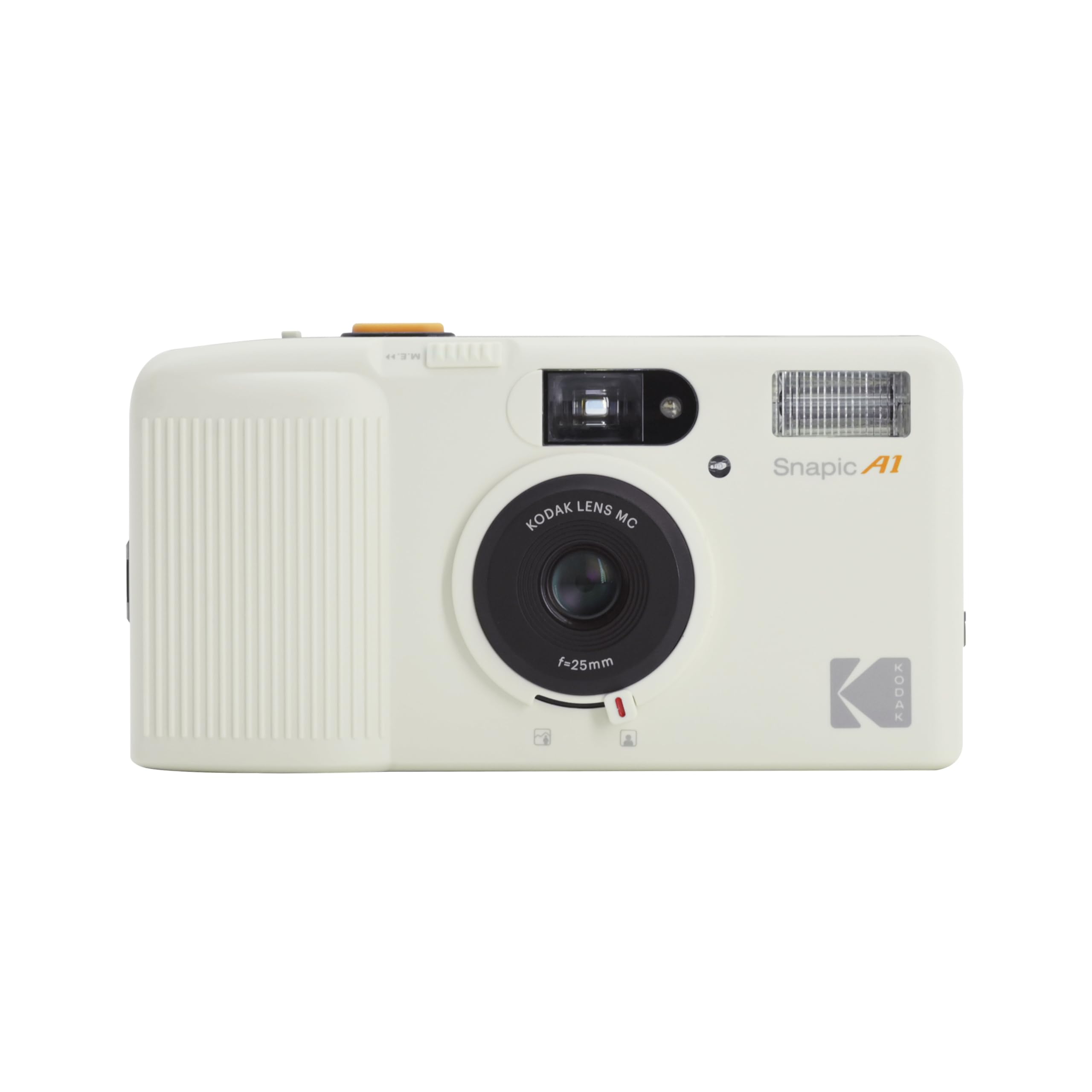
At this lower price point, the Kodak Snapic A1 gives you a genuinely useful point-and-shoot experience: auto-wind, auto-rewind, auto-flash with red-eye reduction, and a 3-element glass lens that reviewers point out produces “good image quality” with sharpness and detail. It is essentially a reusable disposable camera with the ability to load your own film, and it weighs just 117 grams — 6.3 times lighter than the Canon AE-1 Program — so you can drop it in any pocket without noticing it.
What you give up is control — there is no manual mode, no aperture or shutter speed adjustment, and no autofocus. Instead it uses a 2-zone focus setting you switch between (one for close-up subjects, one for distant scenes). The flash can be accidentally pressed on, and one customer observed that rechargeable NiMH batteries do not work; you must use standard alkaline AAA batteries. The maximum shutter speed is 1/100 seconds, which limits low-light and action shots.
This is the camera for the absolute beginner who has never shot film before and wants the simplest possible introduction without the high cost of disposable cameras. Shoppers say it is a “fun, simple point-and-shoot for first-time film users” and that the double exposure feature adds a creative twist. skip it if you want to learn aperture or shutter speed — that requires an SLR. This is the exact budget buyer it is perfect for.
Why we’d pick it
- Ultra-light 117g body — easy to carry anywhere
- Auto-everything: wind, rewind, flash
- Glass lens delivers good image quality
A few caveats
- No manual controls or autofocus
- Maximum shutter speed of 1/100 seconds limits action
6. Pentax K1000

The Pentax K1000 is perfect for the beginner who wants to learn photography the way it was taught in college darkrooms for decades, with a completely mechanical, battery-free camera that forces you to learn exposure from scratch. There is no autofocus, no program mode, no automatic film advance — you set every aperture and shutter speed by hand, and a built-in light meter (powered by a single LR44 battery that buyers report lasts “2+ years with constant use”) shows you if your exposure is correct. If the battery dies, the meter goes dark but the shutter still fires at every speed.
The included 50mm f/2 prime lens gives a natural field of view very close to what the human eye sees, and because it is an f/2 lens, it lets in enough light for indoor shooting without flash. Owners mention it is a “durable, accurate exposure meter” and call it “one of my favorite cameras of all time.” The one reason to choose it over the Canons above: if you want a camera that will never have electronics fail in 20 years, that can shoot without any battery, and that forces you to understand the exposure triangle (aperture, shutter speed, ISO) roll by roll, the Pentax K1000 is that tool.
The field offers autofocus and automation; this one offers mastery through simplicity. However, some renewed units have arrived with a broken light meter or a damaged mirror, so inspecting the condition on arrival is critical.
Strong points
- Fully mechanical — works without any battery
- Fast 50mm f/2 prime lens included
- Teaches exposure fundamentals with no shortcuts
Before you buy
- No autofocus or auto-exposure modes
- Renewed units may have light meter or mirror issues
Understanding the Specs
ISO Range
ISO tells you how sensitive the camera’s light meter is to the film you have loaded. A camera that covers ISO 100 to 3200 can handle fine-grain films for bright days and fast, grainy films for low light. The Canon New EOS Kiss leads here with 100-3200, while the Canon Rebel 2000 caps at ISO 400 — meaning you will need flash or a tripod in dim rooms. Always check the ISO range before buying a camera if you want to experiment with different film stocks.
Autofocus vs. Manual Focus
Autofocus (AF) cameras like the Canon New EOS Kiss and Rebel 2000 use sensors to automatically sharpen the image on your subject — great for moving subjects or if you wear glasses. Manual focus cameras like the Canon AE-1 and Pentax K1000 require you to turn the lens ring until the image looks sharp in the viewfinder. Beginners who want to shoot quickly should pick AF; those who want to learn precise focus should pick manual.
Film Transport System
“Auto-wind and auto-rewind” means the camera loads, advances after each shot, and rewinds the film back into the canister when the roll is done — no cranking. The Kodak Snapic A1 and all Canon SLRs on this list have it. The Pentax K1000 uses a manual film advance lever, which saves battery but requires one thumb motion per frame. For a beginner, auto-transport removes one more point of friction in the shooting process.
Camera Weight and Portability
Film cameras range from the Kodak Snapic A1 at 117 grams (barely heavier than a smartphone) to the Canon AE-1 Program at 735 grams (over a pound). A lighter camera means you are more likely to carry it daily, but heavier all-metal bodies like the Pentax K1000 dampen vibration for sharper handheld shots at slow shutter speeds. Decide whether you will carry it in a pocket or on a neck strap when choosing.
FAQ
Which 35mm film camera is best for a complete beginner who has never used film?
Should I buy a point and shoot or an SLR as my first film camera?
What does renewed mean for a vintage film camera?
Do all film cameras need batteries to work?
Final Thoughts: The Verdict
For most beginners, the 35mm film camera for beginners winner is the Canon New EOS Kiss (Rebel G) because it pairs autofocus convenience with a wide ISO range of 100-3200 and fully automatic film handling, making it the easiest SLR to learn on without outgrowing it in a month. If you want the lowest possible barrier to entry, grab the KODAK Snapic A1 — it is a lightweight point-and-shoot that does every technical decision for you so you can focus purely on composition. And for the beginner who wants to learn photography the classic way with a fully mechanical camera that will last a lifetime, the Pentax K1000 is the tool that teaches mastery through simplicity.