
Our readers keep the lights on and my morning glass full of iced black tea. As an Amazon Associate, I earn from qualifying purchases.
Most “pressure cookers” either take forever to pressurize, burn food on the bottom, or have a lid that feels like it needs a pilot’s license to close. The real trick is knowing whether you want the set-it-and-forget-it convenience of an electric model or the raw speed and durability of a stovetop design. This guide cuts through the confusion to help you pick the right one for your kitchen and your cooking style.
I’m Min — the co-founder and writer behind Gadgets Feed. This guide is built by comparing the manufacturers’ published specifications and the patterns across verified customer reviews, so you get each pick’s real strengths and trade-offs instead of marketing spin.
Whether you’re canning for a crowd, meal-prepping for the week, or just trying to get dinner on the table faster, this breakdown of the best air pressure cooker options will show you exactly what each model is actually good for.
How To Choose The Best Air Pressure Cooker
Choosing the right pressure cooker starts with two big forks in the road: stovetop versus electric, and size. Stovetop models (like a traditional pot with a locking lid) are faster, get hotter (reaching 15 PSI or more), and have no electronics to fail, but they need your attention. Electric models (plug-in countertop units with digital controls) are more convenient, with presets and timers, but they top out at a lower pressure (usually around 10–12 PSI) and take longer to heat up. A third path is whether you plan to can: home canning requires a stovetop model that can hold a steady 10–15 PSI, which most electric cookers cannot do. Your choice boils down to how much hands-on time you want and whether canning is on your menu.
Capacity: How Big Is Right for You?
Capacity is measured in quarts, and it directly determines how much food you can cook in one batch. A 4‑quart cooker is great for a couple or small sides (about 2–3 servings). A 6‑quart unit is the sweet spot for a family of four, handling a whole chicken or a big pot of chili. If you are canning or feeding a crowd, jump to 12 or even 24 quarts — one 12‑quart batch can process about 7–8 pint jars of meat or vegetables in one go. Be careful not to buy too big: a large cooker filled with just a small amount of food may struggle to build pressure, so match the pot size to your typical batch.
PSI (Pressure): The Speed and Safety Number
PSI (pounds per square inch) is what makes a pressure cooker fast. The higher the PSI, the hotter the steam gets inside, and the faster food cooks. Most stovetop models operate at 15 PSI, which cooks food about 70% faster than standard boiling. Many electric models run at 10–12 PSI, which is still fast but not quite as aggressive. For canning, you need a model that maintains at least 10 PSI for low-acid foods (meat, vegetables) — check the specs, since some aluminum models top out lower. A cooker with a visible pressure gauge or a weighted regulator lets you see and control the PSI, which gives you more predictable results.
Material: Aluminum vs. Stainless Steel
The material of the pot affects heat distribution, weight, and longevity. Aluminum pots are lightweight, heat up fast, and cost less, but they can warp over high heat and may react with acidic foods (like tomato sauce), giving a metallic taste. Stainless steel pots are heavier, more durable, and non-reactive, meaning they won’t discolor or flavor your food whether you’re cooking chili or canning pickles. They usually have an aluminum or copper disc bonded to the bottom for even heating. Stainless steel is the better long-term investment; aluminum is lighter on your wallet and your arms.
Safety Features: What to Look For
A good pressure cooker should have at least a few built-in safeguards. Look for a locking lid that prevents opening while the pot is pressurized — usually a visible pin or indicator that drops only when pressure has fully released. An overpressure plug (a small rubber stopper that pops out to release steam if the main valve clogs) and a backup pressure regulator valve add extra layers of protection. On electric models, sensors that detect boil-dry or overheat conditions automatically shut off the heating element. Avoid any model with only a single safety valve — it’s better to have a backup in case something blocks the primary release.
Quick Comparison
On smaller screens, swipe sideways to see the full table.
| Model | Category | Best For | Key Spec | Amazon |
|---|---|---|---|---|
| Presto 01362 6‑Quart | Stovetop | Versatile daily cooking & home canning | 15 PSI, stainless steel | Amazon |
| Carori Electric 6 Qt | Electric | Set‑and‑forget meal prep for families | 1000W, 12 presets | Amazon |
| Universal 13.7 Quart | Stovetop | Cooking for large families & gatherings | 13.7 quarts, audible whistle | Amazon |
| Fulgutonit 12 Quart | Stovetop | Entry‑level canning & large batches | 12 quarts, 10 PSI | Amazon |
| MegaChef 24 Quart | Stovetop | High‑volume canning & catering | 24 quarts, induction compatible | Amazon |
| Presto 01341 4‑Quart | Stovetop | Small kitchens & quick sides | 4 quarts, 15 PSI | Amazon |
| BreeRainz 5.3 Qt | Stovetop | Budget‑friendly canning for beginners | 5.3 quarts, 10 PSI | Amazon |
In‑Depth Reviews
1. Presto 01362 6‑Quart Stainless Steel Pressure Cooker
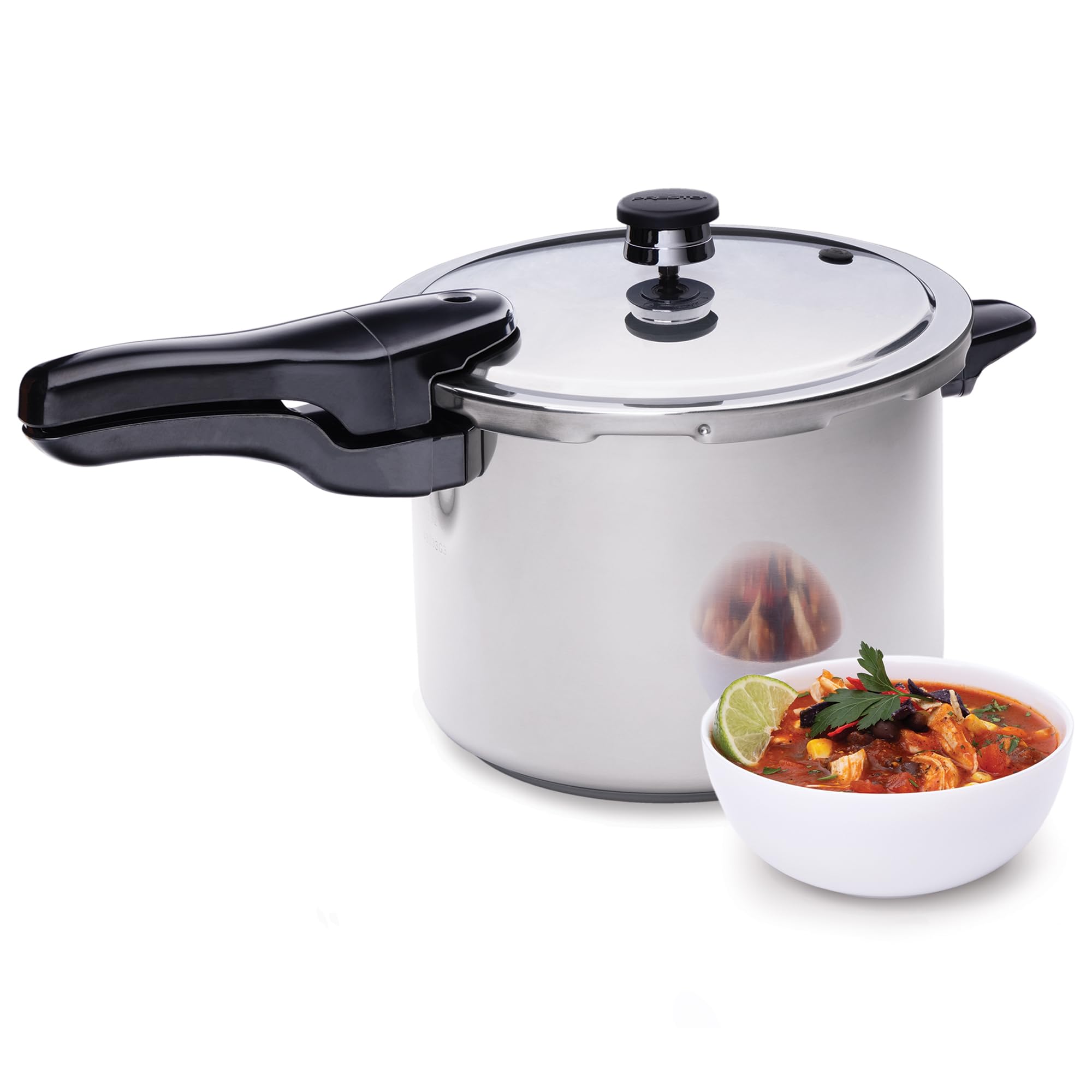
The Presto 01362 earns the top spot because it hits a full 15 PSI (pounds per square inch — the maximum home-cooker pressure, which cooks food about 70% faster than boiling) and uses a stainless steel body that won’t react with acidic foods like tomato sauce. This single pot handles fast weekday dinners and home canning alike. Buyers report potatoes cook perfectly in 5 minutes under pressure, compared to the usual 20–30 minutes of boiling. The cover lock indicator (a pop-up pin that stays up while the pot is pressurized) prevents opening until it’s safe — owners mention this makes first-time use feel secure. The thick aluminum-clad stainless steel bottom spreads heat evenly and stops scorching.
Think of it as more versatile than the Carori Electric because it can can, but less convenient than that model since you must watch the stovetop. One trade-off: unlike the larger Presto 8-quart, this 6-quart has no quick-release valve, so you use cold water to depressurize in a hurry. For the price, the 15 PSI plus stainless steel plus a 12-year limited warranty is tough to beat. This is the one pot for anyone who wants both daily speed and canning ability.
Why it’s great
- Full 15 PSI for fastest cooking and safe canning
- Stainless steel body with aluminum-clad base heats evenly, won’t react with food
- Clear pop-up indicator shows when it’s safe to open
Good to know
- No quick-release valve — requires cold water or natural release to depressurize quickly
- Handles attach with Phillips screws; careful not to overtighten
2. Carori Electric Pressure Cooker 6 Qt
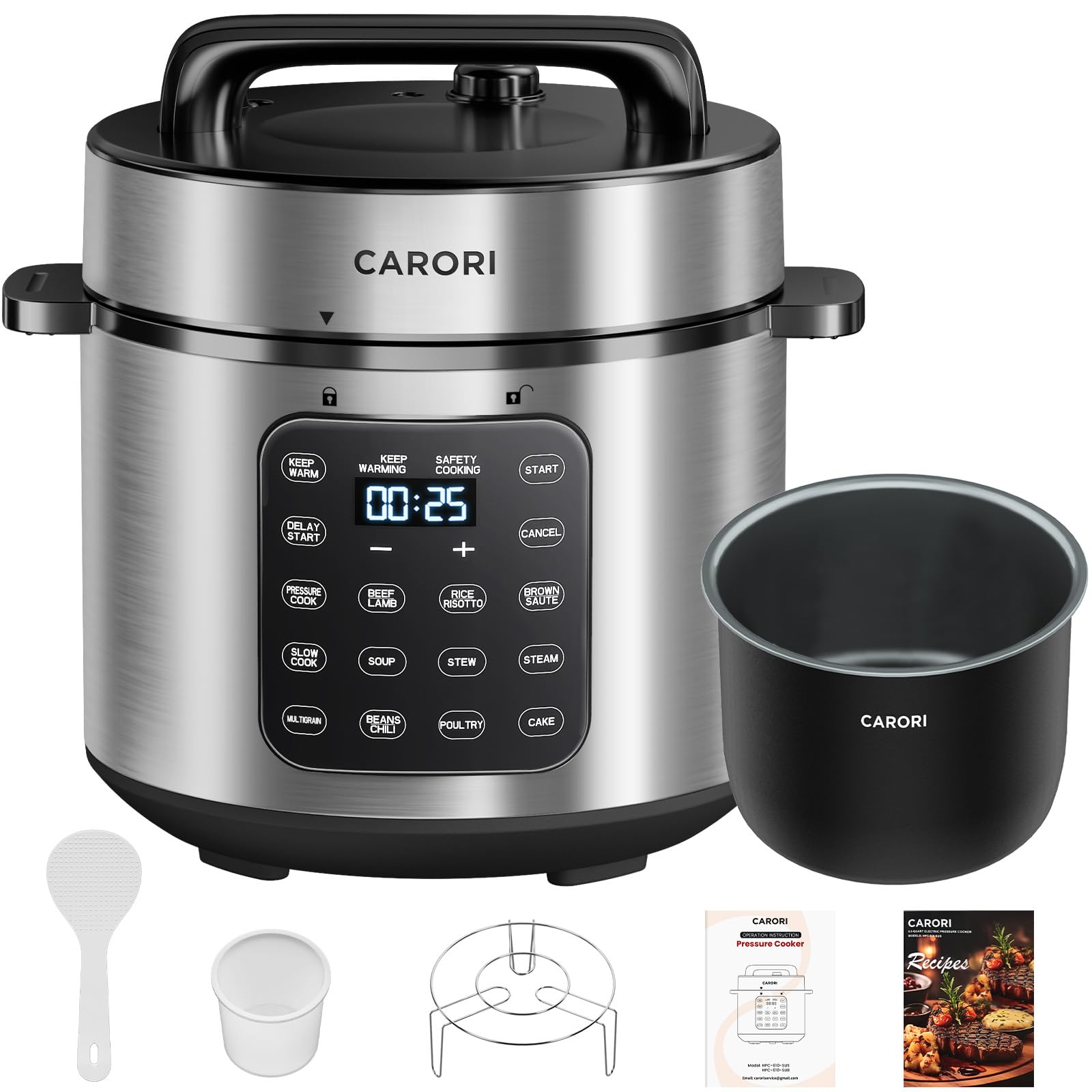
Compared to the top-pick Presto, the Carori’s 1000W heating element is less powerful than the Presto’s stovetop burner, but the Carori compensates with 12 preset programs and a digital touchscreen that automate pressure, temperature, and timing. Where the Presto wins on sheer speed and canning, the Carori wins on pure convenience: toss in rice, select “Rice Cook,” and walk away. Customers note that the “thick stainless steel inner pot” heats evenly and produces perfectly tender rice and beef. The unit weighs 13 pounds (countertop-friendly but not cabinet-stashable). With 16+ built-in safety protections, including a lid lock and a boil-dry sensor, it suits a first-time pressure cooker user. The 24-hour delay start lets you load ingredients in the morning and have dinner ready when you walk in.
You cannot can with it — electric models can’t sustain the steady high pressure for safe home canning. But for daily meals and meal prep, the Carori is the hands-off champion.
Choose this over the Presto if convenience matters more than raw speed.
Where it shines
- 12 preset programs with intuitive IMD touchscreen make cooking foolproof
- 24-hour delay start lets you prep meals in advance
- Non-stick ceramic inner pot reduces oil use and cleans easily
Worth noting
- 10–12 PSI maximum means slower cooking than a 15 PSI stovetop model
- Not suitable for home canning — does not reach or hold sufficient PSI
3. Universal 13.7 Quart Pressure Cooker

You are hosting a large family gathering or prepping a week’s worth of beans for fifteen people, and you need a single pot that can handle the volume. This 13.7-quart model is 65% larger than the Fulgutonit 12-quart in overall dimensions (18.2 x 10.6 x 12.4 inches versus 11.02 x 11.02 x 8.66 inches), giving you room for big cuts of meat or multiple pint jars in a single batch. Reviewers point out it “cooks quickly” and one called it “just like in Colombia” — a nod to the “La Pitadora” design with its iconic whistle that sounds at full pressure, so you know without checking a gauge.
The heavy-gauge aluminum body heats fast and evenly. The 5-layer safety system (pressure regulator, auxiliary valves, and a locking lid) covers the essentials. The inner lid design takes a moment to learn (line up the arrow, tilt, and slide), but shoppers say it becomes natural after a few uses. skip it if you cook for one or two; the Presto 6-quart or Presto 4-quart will serve you better.
The 25-year warranty suggests Universal expects this pot to outlast most kitchen appliances.
What stands out
- 13.7-quart capacity handles up to 14 servings or multiple canning jars per batch
- Audible whistle tells you when pressure is reached
- 25-year warranty signals long-term durability
The trade-offs
- Lid has a learning curve — alignment and tilting take practice
- Aluminum can react with acidic foods; use a liner for tomato-based dishes
4. Fulgutonit 12 Quart Pressure Cooker

The key number for a canning cooker is how many pint jars you can process per batch, and the Fulgutonit’s 12-quart capacity handles 7–8 pints per cycle. One reviewer noted it “produced 60 pints of canned meat for camping” — a sign of how much this pot can get done in a single afternoon. At a target pressure of 63–77 kPa (roughly 9–11 PSI), it meets the minimum for canning low-acid foods like meat and vegetables.
What you accept is aluminum construction — it may react with acidic foods like tomatoes over long cooks. The pot is heavy: 3.27 kilograms (about 7.2 pounds) for the pot alone. The secure self-locking lid and multiple safety valves (pressure sensors, a working valve, and a safety window) give beginners extra confidence during their first canning runs.
For the price, it delivers real canning capability in a size that fits standard kitchens. If you are getting into pressure canning or need a dedicated canner that won’t break the bank, this does the job.
The upsides
- 12-quart capacity fits 7–8 pints per batch for efficient canning
- Multiple safety devices include pressure sensors and backup valves
- Aluminum heats fast and evenly for consistent pressure
Keep in mind
- Aluminum may react with highly acidic foods over time
- Some unlucky buyers report peeling interior after a few uses — inspect upon arrival
5. MegaChef 24 Quart Large Capacity Aluminum Pressure Cooker

What you actually get at this lower price is a 24-quart aluminum pressure cooker that handles marathon kitchen sessions in a single batch—canning thirty pounds of pumpkin or sterilizing mycology substrates without a second run. Owners mention it “maintained 10 lb pressure easily for 90 minutes” on an induction cooktop, and one reviewer on an induction range said it “hits and holds 14 psi steadily.” At 13.7 pounds and 13.7 x 19.5 x 16 inches, the lightweight aluminum makes it manageable to lift empty, but full of jars it needs two hands. The safety pressurized locking lid and included pressure gauge give real-time PSI visibility so you can adjust the heat to hold a steady 10–15 pounds.
Every other stovetop model here is smaller and lighter, but none touches the 24-quart capacity for serious batch work. If your kitchen revolves around preserving the harvest, making stock for catering, or cooking for large events, the MegaChef is the one that won’t leave you running a second batch. pass on it if you cook for one or two; it will struggle to pressurize with small amounts of food.
This is the exact budget buyer it is perfect for: the home canner, the mushroom grower, or the caterer who needs high-volume pressure performance without paying for a commercial-grade price tag.
Why we’d pick it
- Massive 24-quart capacity for high-volume canning and catering
- Compatible with induction and gas stovetops
- Includes pressure gauge for precise PSI monitoring
A few caveats
- Large and heavy — not suitable for small kitchens or everyday single-pot meals
- Aluminum construction; some users report mineral deposits with hard water
6. Presto 01341 4‑Quart Stainless Steel Pressure Cooker

The 4-quart Presto is perfect for singles, couples, or anyone who needs a compact pot that won’t dominate a small stovetop. It shares the same full 15 PSI and stainless steel construction as the 6-quart Presto above, but in a size that’s easy to handle and store. One reviewer called it “perfect size for small kitchens” while noting it still “cooks for 8” if loaded with dense items like beans. At just 5.8 pounds and 5.1 x 15.75 x 6.5 inches, you can lift it with one hand even when full. The helper handle on the opposite side makes pouring steady. Like its bigger sibling, it includes a pressure regulator that automatically maintains 15 PSI, a cover lock indicator, and a cooking rack for steaming multiple items. Buyers confirm it speeds up potato cooking to 5 minutes at pressure versus 20-30 minutes of boiling, and it works on regular, smooth-top, and induction ranges.
At 4 quarts, you cannot can in it (the USDA recommends at least 6 quarts for safe processing). If you cook for more than two people regularly, you will outgrow it fast. But for singles, couples, or anyone who wants a fast stainless steel pot for rice, vegetables, and small cuts of meat without taking over the kitchen, this is the one. It is a sharper value for a compact kitchen than the Universal 13.7-quart because it takes up a fraction of the space.
Just keep in mind that its 4-quart capacity means it cannot be used for pressure canning, and if your household grows beyond one or two people, you will likely find yourself wanting a larger pot.
Strong points
- Stainless steel with aluminum-clad base for even heat without food reactions
- Full 15 PSI in a lightweight, easy-to-store 4-quart body
- Dishwasher-safe with removable sealing ring and overpressure plug
Before you buy
- Too small for canning — minimum recommended canner size is 6 quarts
- Handle attached with a single screw; may loosen over time if overtightened
7. BreeRainz 5.3 Qt Stovetop Pressure Cooker & Canner

For the lowest investment on this list, the BreeRainz gives you a functional stovetop pressure cooker and canner with a 5.3-quart capacity and a 10 PSI operating pressure. It is a bare-bones aluminum pot with a triple safety valve system: a pressure regulator, a safety valve, and a self-locking lid — all the essentials. One buyer summed it up: “This was so easy to put together install and use for canning.” What you give up includes aluminum construction (potential for food reactions over time) and the 5.3-quart capacity being at the small end for canning — you process a few jars at once but not the 7–8 pints the Fulgutonit or Universal can manage. The compact size (17 x 10 x 8 inches) is a genuine plus for limited counter space.
Cost is the headline here. This is for the budget-conscious beginner who wants to try pressure cooking or small-batch canning without a big financial commitment. It is not built for heavy daily use over years — aluminum will show wear faster than stainless steel. it’s not for you if you plan to can dozens of jars every season; invest in the Fulgutonit or a Presto instead.
The one clear reason to choose it is the lowest price on this list for a functional stovetop pressure cooker and canner that still includes a triple safety valve system.
What we like
- Triple safety valve system (regulator, safety valve, self-locking lid) for safe beginner use
- Compact 5.3-quart size fits small kitchens and small-batch canning
- Induction-compatible base at a budget-friendly entry point
The downsides
- Aluminum body may react with acidic foods over extended cook times
- No digital components, so no presets or automatic timing — requires manual heat management
Understanding the Specs
PSI (Pounds per Square Inch)
PSI is the pressure inside the cooker. Higher pressure means hotter steam and faster cooking. Most stovetop models run at 15 PSI, which cooks food about 70% faster than boiling. Electric models typically run at 10–12 PSI. For canning low-acid foods, you need a minimum of 10 PSI. A cooker with a visible pressure gauge or regulator lets you confirm the pressure is in the safe zone.
Capacity in Quarts
Quarts tell you how much food fits inside. A 4–6 quart cooker handles 2–4 servings comfortably. An 8–12 quart model is good for a family of 4–6 or small-batch canning (7–8 pint jars). A 24-quart unit is for high-volume canning or feeding a crowd. The golden rule: buy a size that matches your typical batch — too small means multiple rounds; too large means it struggles to pressurize with a small amount of food.
Stovetop vs. Electric
Stovetop cookers sit directly on your burner. They reach higher PSI faster, last longer (no electronics to fail), and can be used for canning. Electric cookers plug into the wall, have digital presets and timers, and are safer for unattended cooking. They tend to be larger and heavier but more convenient. Electric models cannot be used for pressure canning because they cannot maintain the steady high pressure required.
Aluminum vs. Stainless Steel
Aluminum heats quickly and is lightweight and inexpensive, but it can react with acidic foods, warping or pitting over time. Stainless steel is heavier, more durable, and non-reactive — it will not discolor or flavor your food. Good stainless steel cookers have a bonded aluminum or copper disc in the base for even heat distribution. If you cook tomato sauce, chili, or pickled foods regularly, stainless steel is the safer long-term choice.
FAQ
Can I use an electric pressure cooker for canning?
What is the difference between a pressure cooker and a pressure canner?
How do I clean a pressure cooker after use?
Why does my pressure cooker whistle or hiss loudly?
Final Thoughts: The Verdict
If you want one dependable pick, the best air pressure cooker winner is the Presto 01362 6-Quart because it combines the speed of 15 PSI, the food-safe durability of stainless steel, and a manageable size that works for both daily cooking and home canning. If you want the hands-off convenience of digital preset cooking, grab the Carori Electric 6 Qt. And for high-volume canning or feeding a crowd, the standout is the MegaChef 24 Quart‘s sheer batch capacity.